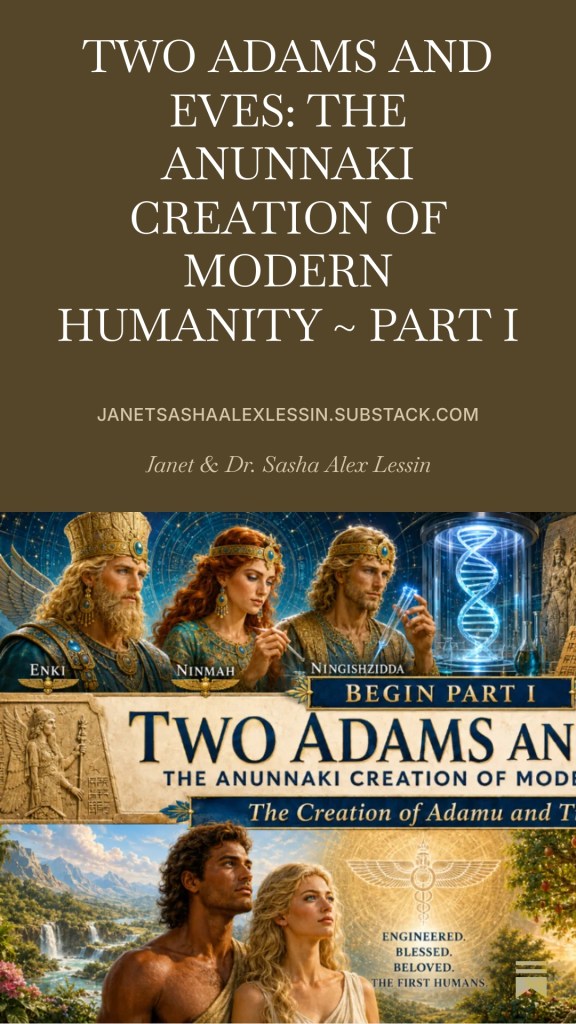
Adam & Eve, Adamu, Adapa, Anunnaki, Articles, Enki, Ningishzidda, Ninmah, Tiamat, Titi
TWO ADAMS AND EVES: THE ANUNNAKI CREATION OF MODERN HUMANITY

by Janet Lessin, updated on
TWO ADAMS AND EVES: THE ANUNNAKI CREATION OF MODERN HUMANITY

Adamu and Ti-Amat, circa 300,000 BCE — Adapa and Titi, circa 200,000 BCE
By Sasha Alex Lessin, Ph.D., and Janet Kira Lessin

Humanity, as we know it today, emerged through two major Anunnaki interventions. The first produced Adamu and Ti-Amat about 300,000 years ago and established a human population capable of reproduction without constant dependence upon Anunnaki surrogate mothers.

The second, about 200,000 years ago, produced Adapa and Titi, whose descendants possessed greater intellectual, cultural, and administrative capacities and could manage farms, herds, estates, records, and the labor force that served the Anunnaki settlements.

At the center of the first intervention stood Enki, Chief Scientist of the Anunnaki expedition; Ninmah, its Chief Medical Officer; and Enki’s son Ningishzidda, who later appeared in other traditions as Thoth.

Their work transformed an existing Earth hominid into a new human form, then altered that form so its descendants could reproduce and establish a viable population of their own.
THE FIRST ADAM AND EVE: ADAMU AND TI-AMAT

The Anunnaki came to Earth from Nibiru in search of gold and established major mining operations in Africa, where their labor force eventually rebelled against the harsh demands placed upon them.

Faced with the possible collapse of the expedition, Enki, Ninmah, and Ningishzidda sought a genetic solution: they would create an Earth-adapted worker capable of taking over the labor that the Anunnaki miners refused to continue.

The Anunnaki gold mission had become a vast interplanetary operation linking the mines of Earth to Mars and Nibiru. As workers extracted and processed the ore, overseers coordinated its movement through fortified bases, cargo systems, and spacecraft that carried the precious material from one world to the next. What began as a mining expedition had grown into a complex logistical network, with Earth as the source, Mars as a crucial transfer point, and Nibiru as the destination where the gold served the larger purpose of protecting the home world’s atmosphere.

The genetic team combined Nibiran material with the genome of an intelligent Earth hominid identified in this account as Homo erectus. After many experiments, they produced viable hybrid embryos, and Anunnaki women carried at least twenty-seven pairs of the new beings to term.

The procedure succeeded, but it created a serious practical problem because each new worker still required an Anunnaki surrogate mother.

Ningishzidda asked for access to the women’s wombs again, but Ninmah objected that the medical corps could not bear generation after generation of Earth workers.

If the new species was to become useful on the scale the expedition required, the hybrids themselves had to acquire the power to reproduce.

Around 300,000 BCE, Enki brought Adamu and Ti-Amat from his African laboratory to Eridu in what is now southern Iraq, close to the estate of Commander Enlil. Back in Africa, seven female and eight male hybrids descended from the original genetic stock lived together within the reserve, but although they had sexual relations, the females did not conceive.

The problem became more urgent when the Anunnaki miners in southern Africa again threatened mutiny unless Enki and Ningishzidda supplied enough workers to relieve them.

At the medical center in Shuruppak, Ningishzidda compared the genetic structure of the Nibirans with that of Adamu and Ti-Amat, identified the genetic difference that blocked reproduction, and devised a procedure to correct it.

At Enki’s estate, Ningishzidda altered Adamu and Ti-Amat so the pair could conceive children of their own. The intervention represented more than an adjustment to the labor force.

Enki, Ninmah, and Ningishzidda sought a human couple with greater mental, emotional, artistic, and intellectual potential, capable of language, culture, memory, technical knowledge, and awareness of their own origin.

Ningishzidda used material from the bone marrow of Enki and Ninmah as part of the transformation, with Enki providing the male contribution for Adamu and Ninmah the female contribution for Ti-Amat.

The biblical story of Eve’s creation from Adam’s rib may preserve a distorted memory of this procedure, for the significance lay not in the rib itself but in the marrow it contained.

Ti-Amat reached self-awareness before Adamu, and with the procedure complete, both could reproduce.

Ningishzidda described the result as the addition of two new branches to their Tree of Life, because humanity no longer depended upon Anunnaki surrogate mothers for each birth and could now establish a self-reproducing population.


JANET KIRA LESSIN

Janet Kira Lessin is an author, researcher, experiencer, educator, and media host whose work explores humanity’s ancient past, extraterrestrial contact, consciousness, spirituality, and the forces that have shaped human civilization. For decades, she has examined the Anunnaki traditions, ancient creation accounts, contact phenomena, reincarnation, human origins, and the relationship between advanced beings and emerging humanity.
Janet draws upon a lifetime of unusual experiences as well as decades of research, interviews, and collaboration with investigators, experiencers, authors, scientists, and spiritual teachers. She co-hosts programs through Aquarian Media and publishes articles at Dragon at the End of Time, where she examines ancient history, consciousness, contact, human potential, and the struggle between systems of domination and cooperation.
Her work asks readers to look beyond inherited assumptions and consider a larger human story—one in which consciousness, extraterrestrial intervention, ancient civilization, and humanity’s capacity for self-awareness form parts of the same unfolding mystery.
DragonAtTheEndOfTime.com
AquarianMedia.org
SASHA ALEX LESSIN, PH.D.

Sasha Alex Lessin, Ph.D. is an anthropologist, author, researcher, educator, and longtime student of the Anunnaki traditions preserved in ancient Mesopotamian texts. He earned two master’s degrees in anthropology and psychology from UCLA and a Ph.D. in anthropology from the same university.
His research examines the work of Zecharia Sitchin alongside ancient history, mythology, comparative religion, psychology, consciousness, human origins, and the development of civilization. Sasha has spent decades tracing the complex family relationships, political struggles, genetic interventions, technological achievements, and conflicts attributed to the Anunnaki.
He is the author and co-author of books and articles that explore Nibiru, Enki, Enlil, Ninmah, Ningishzidda, Marduk, the creation of humanity, the Deluge, ancient wars, and the legacy these beings left within human religion, government, economics, and social organization.
Together with Janet Kira Lessin, Sasha presents the Anunnaki story as a vast family and political saga whose consequences continue to echo through human civilization.
EnkiSpeaks.com
AquarianMedia.org
JANET KIRA LESSIN & SASHA ALEX LESSIN, PH.D.

Janet Kira Lessin and Sasha Alex Lessin, Ph.D., have spent decades together exploring humanity’s origins, the Anunnaki, extraterrestrial contact, consciousness, ancient civilizations, mythology, spirituality, and the hidden forces that shaped the human story.
Their work combines Sasha’s background in anthropology and psychology with Janet’s decades of research, media work, contact studies, and exploration of consciousness. Together they examine ancient texts and traditions as parts of a larger narrative that connects Nibiru, the Anunnaki royal families, the creation of humanity, the rise of civilization, the Deluge, ancient wars, religious systems, political hierarchy, and humanity’s long struggle to claim knowledge and self-determination.
Through their books, articles, interviews, videos, podcasts, and educational programs, Janet and Sasha seek to recover the human story from fragments scattered across ancient cultures and bring those pieces together into a coherent narrative.
Their work appears through Dragon at the End of Time, Enki Speaks, and Aquarian Media, where they continue to explore the Anunnaki legacy, consciousness, contact, human potential, and humanity’s place within a much larger cosmic story.
DragonAtTheEndOfTime.com
EnkiSpeaks.com
AquarianMedia.org


TAGS — comma-separated
Anunnaki, Two Adams and Eves, Adam and Eve, Adamu, Ti-Amat, Adapa, Titi, Enki, Ninmah, Ningishzidda, Thoth, Nibiru, Zecharia Sitchin, Anunnaki genetic intervention, human origins, creation of humanity, ancient astronauts, ancient aliens, Homo erectus, genetic engineering, Tree of Life, Tree of Knowledge, Bread of Life, Water of Life, immortality, Sumer, Eridu, Shuruppak, Mesopotamia, ancient Sumer, Anunnaki civilization, Anunnaki legacy, human evolution, hybrid humans, extraterrestrial creators, ancient history, alternative history, Sumerian texts, ancient Mesopotamia, Janet Kira Lessin, Sasha Alex Lessin, Enki Speaks, Dragon at the End of Time, Aquarian Media
HASHTAGS — comma-separated
#Anunnaki, #TwoAdamsAndEves, #AdamAndEve, #Adamu, #TiAmat, #Adapa, #Titi, #Enki, #Ninmah, #Ningishzidda, #Thoth, #Nibiru, #ZechariaSitchin, #HumanOrigins, #AncientAstronauts, #AncientAliens, #GeneticEngineering, #TreeOfLife, #TreeOfKnowledge, #Sumer, #Mesopotamia, #AncientSumer, #AnunnakiLegacy, #HumanEvolution, #AlternativeHistory, #AncientHistory, #JanetKiraLessin, #SashaAlexLessin, #EnkiSpeaks, #DragonAtTheEndOfTime, #AquarianMedia
REFERENCES
For the reference section, I recommend distinguishing Sitchin’s interpretation from the surviving Mesopotamian texts and modern scholarly editions. Your article itself says that it extends Sitchin’s interpretation of the Mesopotamian material.
- Sitchin, Zecharia. The 12th Planet. The first volume of The Earth Chronicles. Bear & Company. The publisher describes it as the foundation of Sitchin’s theory of extraterrestrial intervention in human origins.
- Sitchin, Zecharia. The Lost Book of Enki: Memoirs and Prophecies of an Extraterrestrial God. Bear & Company. This volume presents Sitchin’s narrative of the Anunnaki, Nibiru, and the genetic creation of humanity.
- Sitchin, Zecharia. The Wars of Gods and Men.
- Sitchin, Zecharia. Genesis Revisited.
- Sitchin, Zecharia. The Cosmic Code.
- Sitchin, Zecharia. When Time Began.
- “Enki and Ninmah.” The Electronic Text Corpus of Sumerian Literature, University of Oxford. The surviving Sumerian composition connects Enki, Ninmah, birth goddesses, human creation, and the assignment of labor.
- Izre’el, Shlomo. Adapa and the South Wind: Language Has the Power of Life and Death. Eisenbrauns/Penn State University Press, 2001. The study examines the surviving fragments of the Adapa myth, including the major Amarna tablet.
- The Atrahasis Epic. Akkadian creation and flood tradition concerning divine labor, rebellion, the creation of humans, and the Deluge.
- Genesis 2–3. The biblical Adam and Eve, Tree of Life, Tree of Knowledge, serpent, and human mortality traditions.
TWO ADAMS AND EVES: THE ANUNNAKI CREATION OF MODERN HUMANITY
What if the ancient story of Adam and Eve preserves memories of more than one intervention in human origins?
In this new article, Sasha Alex Lessin, Ph.D., and Janet Kira Lessin trace two pivotal stages in the Anunnaki story. The first centers on Adamu and Ti-Amat, whose transformation gave the new human population the power to reproduce without continued dependence on Anunnaki surrogate mothers. The second centers on Adapa and Titi, children fathered by Enki whose descendants acquired the intellectual, cultural, agricultural, and administrative skills required to build complex civilization.
The story moves from the African gold mines and the revolt of the Anunnaki labor force to Enki, Ninmah, and Ningishzidda’s genetic work; from the Tree of Life to Adapa’s quest for the Bread and Water of Life; and from humanity’s creation as a labor force to its emergence as a species capable of knowledge, creativity, self-awareness, and questioning its creators.
Read the full illustrated article at DragonAtTheEndOfTime.com.
#Anunnaki, #Enki, #Ninmah, #Adapa, #AdamAndEve, #HumanOrigins, #Nibiru, #ZechariaSitchin, #AncientSumer

LINKEDIN PROMOTION
Were there two stages behind the ancient Adam-and-Eve tradition?
Our new illustrated article, “Two Adams and Eves: The Anunnaki Creation of Modern Humanity,” examines the human-origin narrative developed from Zecharia Sitchin’s interpretation of ancient Mesopotamian traditions.
The first intervention centers on Adamu and Ti-Amat and the establishment of a self-reproducing human population. The second centers on Adapa and Titi, whose descendants became administrators, scribes, agricultural managers, artisans, and culture bearers within the emerging settlements of Sumer.
The article follows the story from genetic intervention and labor crisis through the transfer of knowledge, the rise of organized civilization, and Adapa’s confrontation with the fundamental difference between humans and his Anunnaki father: mortality.
By Sasha Alex Lessin, Ph.D. & Janet Kira Lessin
Read at DragonAtTheEndOfTime.com
More Anunnaki research at EnkiSpeaks.com
Programs and interviews at AquarianMedia.org

X PROMOTION
Two Adams. Two Eves. Two interventions in human history.
Adamu & Ti-Amat establish a self-reproducing humanity. A century of millennia later, Enki fathers Adapa & Titi, whose descendants carry new intellectual and cultural capacities into Sumer.
Enki. Ninmah. Ningishzidda/Thoth. The Tree of Life. The Bread & Water of Life. The origins of civilization.