Who Killed Jesus, JFK, RFK, MLK, Lennon — and Charlie Kirk?
From Gandhi to Sadat, Rabin to Charlie Kirk, blood is the coin of political power.
By Janet Kira Lessin & Dr. Sasha Alex Lessin, Ph.D.

Jesus stands calm before Pontius Pilate as the Roman governor weighs political pressure and public unrest.
The death of a prophet is never just a death. It is a battle for meaning.
Two thousand years ago in Judea, the crucifixion of Jesus of Nazareth — preceded by the beheading of John the Baptist — was not merely a spiritual rupture. It was a political calculation. Rome’s governors ruled through fear, local client kings through compromise, and Temple elites through sacred authority. Into that volatile landscape walked prophetic voices who baptized crowds, overturned temple tables, and threatened established order. The imperial response was brutal and public: crucifixion as spectacle and deterrent. The intended lesson — silence the dissenter — became a different kind of power: the story of the cross became the seed of a movement Rome could not kill.

Jesus stands calm before Pontius Pilate as the Roman governor weighs political pressure and public unrest.

The Politics Before the Cross

Jesus of Nazareth stands with arms outstretched before a gathering of followers and skeptics. Roman soldiers and city officials, including Pontius Pilate, look on as tension fills the air. This moment captures Judea’s unrest — the clash of spiritual hope, political authority, and imperial power.
Judea was boiling. Rome taxed heavily, garrisoned cities, and tolerated client rulers whose compromise alienated the people. Multiple sects — including the Pharisees, Sadducees, Essenes, and Zealots — vied for moral and political authority, while a widespread hope for a deliverer, a “messiah,” made crowds prone to projection.
John the Baptist publicly confronted Herod; he was beheaded. Jesus’s claims and actions — especially in the Temple — were read as political threats.

Pilate’s calculus favored order over mercy. Crucifixion followed. The political “solution” became, over time, a religious revolution.


Lincoln’s Bullet: Reconstruction Reforged

Abraham Lincoln’s assassination in April 1865 did not merely remove a leader; it redirected history. At the time, the Civil War’s end might have allowed Lincoln to shepherd a gentle, reconciliatory Reconstruction; his death, however, handed power to forces that pushed for a harsher settlement and, later, to politics that permitted the rise of Jim Crow. The assassination hardened Northern resolve and altered the balance among competing political visions for the reunited nation — a sober reminder that a single bullet can change policy for generations.

President Abraham Lincoln was struck by John Wilkes Booth during the final days of the Civil War, altering the course of Reconstruction.


The Modern Martyr’s Roll Call
JFK (1963): A charismatic presidency cut down in Dallas; the country reeled, and conspiracy debates began that have never fully stopped.

John F. Kennedy rides in an open-top car with Jacqueline Kennedy, moments before the shots that shook America.

RFK (1968): A second Kennedy slain amid a hopeful campaign — America’s optimism fractured.

Senator Robert F. Kennedy lies mortally wounded on the floor of the Ambassador Hotel in Los Angeles after being shot during his presidential campaign. Surrounded by aides and supporters in anguish, the moment shattered America’s fragile hope after his brother’s death and deepened the nation’s sense of loss.


MLK (1968): The nonviolent prophet was assassinated in Memphis; his death mobilized sorrow into both rage and legislation.

Dr. King stands outside the Lorraine Motel, a moment later felled by an assassin’s bullet in Memphis.

John Lennon (1980): An artist of global conscience gunned down in New York; grief turned into myth and memory.

Outside the Dakota in New York, a global icon of peace is struck down, sparking worldwide vigils.

Mahatma Gandhi (1948): Killed by a domestic extremist; his assassination enshrined him as India’s conscience.

Mahatma Gandhi walks to prayer, meeting his assassin; his death sanctifies him as India’s eternal conscience.

Anwar Sadat (1981): Assassinated for signing a peace treaty with Israel; his death reshaped regional politics and sent shockwaves across the Middle East.

President Anwar Sadat is struck down during a military parade in Cairo as soldiers suddenly turn their weapons on him. The scene captures the chaos, shock, and betrayal that ended the life of Egypt’s leader, who had dared to sign a peace treaty with Israel, reshaping Middle Eastern politics forever.

Yitzhak Rabin (1995): Shot by a domestic opponent of the Oslo Accords; Rabin’s death was a turning point that weakened Israel’s peace camp and reshaped Israeli politics.

Prime Minister Rabin waves to the crowd at a Tel Aviv rally, moments before an assassin ends his life.

Across cultures, martyrdom serves as a form of political currency. The narrative formed in the immediate aftermath — who is blamed, who sanctifies the death, who profits — often does more harm or more good to a political project than the life that ended did.

From Lincoln to Gandhi, Kennedy to King, Sadat to Rabin, and Kirk — this gallery of leaders shows how bullets reshaped nations. Each face looks directly at the viewer, a reminder that political martyrdom alters the course of history.
The Battle of Stories
Every violent death births competing narratives. In antiquity, Rome’s line was “He was a rebel; crucifixion maintains order,” the Temple elites insisted he had threatened their authority, and followers insisted he was the Messiah.

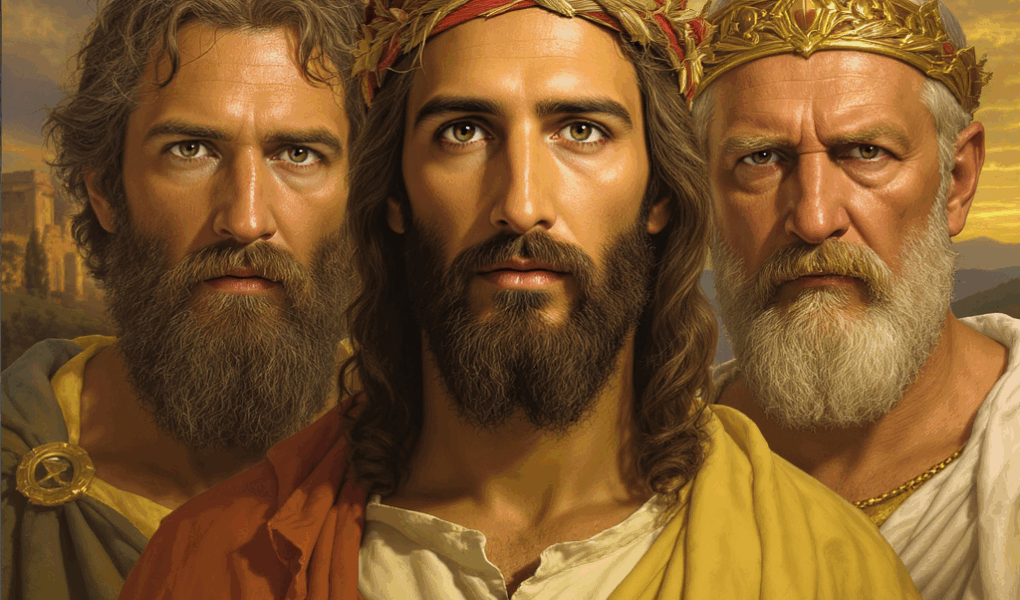
Roman officials declaring Jesus a rebel, Temple priests accusing him, and his followers insisting he is the Messiah. Three “storylines” are visually overlapping.
Today, narratives explode across social platforms in minutes. One camp blames ideological enemies; another blames radicalization of the perpetrator’s home movement. Conspiracy culture offers dozens of alternative truths. Meanwhile, the evidence that courts weigh — communications, payments, authenticated metadata, sworn testimony — takes time to surface, and often never entirely does.

A candlelight vigil gathers in America, as followers sanctify his death and transform grief into movement.

When Charlie Kirk was shot while speaking on a college tour, political actors raced to claim the story and to morph grief into mobilization. At significant memorials, high-profile speakers sanctified him as a martyr and invoked earlier American icons — an act of rhetorical consecration that immediately reshapes fundraising, recruitment, and political legitimacy. The forensic investigation proceeds; the political reframing has already moved faster than the court calendar.
The Question We Must Ask: Who Benefits?

Description: Modern digital battleground — hashtags trending, multiple narratives clashing online after a political assassination.
History shows that the most revealing answer to “who killed X?” is often “who benefits from the death?” That question can point to motives, to beneficiaries, to the institutions that advance after the body is gone. In psychology, we say intentions are made manifest by results. John the Baptist’s execution eliminated a critic but fed the mythic soil that nourished Jesus’s following. Lincoln’s death handed Reconstruction to other hands and remade policy. Rabin’s killing crushed a peace momentum.

A tense digital battlefield unfolds as people clash online over a political assassination. Faces lit by glowing screens show anger, grief, and disbelief while hashtags trend across platforms. The image illustrates how, in minutes, competing narratives can fracture public perception and transform tragedy into a polarized debate.
So when a movement instantly sanctifies a fallen leader — when memorials become rallies and grief becomes fundraising — it is vital to ask not only who pulled the trigger (a legal question) but who is writing the story of the cross (a political and moral question).
Lone Wolves, Hired Hands, and the Assassin’s Afterlife

Description: A symbolic courtroom with a lone defendant in the dock, but shadowy figures in the background — representing uncertainty about whether assassins act alone or in concert.
Official investigations often name “lone gunmen” — neat, contained explanations that reassure the public. However, history warns that lone wolves are politically convenient narratives. Some assassins have been proven to be part of broader plots; others were indeed solitary actors. The decisive evidence is documentary: communications, financial trails, corroborated witness testimony, and authenticated metadata. Without those, gesture and timing make for powerful suspicion but not proof.

Consider Michael Jackson’s death: his physician, Dr. Conrad Murray, was tried and convicted for involuntary manslaughter — a court verdict, not a conspiracy theory — demonstrating the difference between a documented legal outcome and speculative narrative. But still, to this day, some people believe Michael was targeted and killed because he dared to challenge the power elite and major corporations like Sony.

In a Los Angeles courtroom, Dr. Conrad Murray sits solemnly at the defense table during his trial for involuntary manslaughter in the death of Michael Jackson. The scene reflects the gravity of a legal process that delivered a documented verdict, contrasting courtroom fact with the haze of conspiracy theories.

Bio: (1958–2009) Global pop icon known as the “King of Pop.” Revolutionized music, dance, and celebrity culture. His sudden death from acute propofol intoxication led to the conviction of his physician, Dr. Conrad Murray, for involuntary manslaughter — a rare case where speculation met a clear legal outcome.

The Modern Cross

Description: A symbolic “digital crucifixion” — a giant glowing cross replaced by a smartphone screen, crowds lit by their phones, livestreaming a memorial.
Rome nailed a man to a beam to stop a movement. In our age, the cross is digital: memorials are livestreamed, hashtags sanctify, and donors pour in before facts are aired in court. When death is made sacred in the service of political mobilization, the integrity of the democratic process and the search for truth are both at risk.
That is why we demand proof — not as cynics, but as citizens protecting the rule of law.
Final Question
Who killed Jesus? The Romans, the Temple elite, the mob — all complicit.
Who killed JFK, RFK, MLK, Lennon, Gandhi, Sadat, and Rabin? The names are recorded, but their stories remain contested, reframed, and reappropriated.
Who killed Charlie Kirk? A suspect has been charged, and the courts will do their work. But the deeper, political question will not be answered by the charging documents alone: who benefits, who consolidates power, who writes the martyrdom into the future?
That question should shape our reporting, our protests, and our politics — because once blood becomes myth, evidence often fades into the background.

Abraham Lincoln, Mahatma Gandhi, John F. Kennedy, and Robert F. Kennedy appear in lifelike portraits. Their assassinations marked turning points in American and world history, transforming politics through loss.
🔹 References / Sources
- Brown, Raymond E. The Death of the Messiah. Yale University Press, 1994.
- Goodblatt, David. The Political and Social History of the Jews in Antiquity. Routledge, 2006.
- Donald, David H. Lincoln. Simon & Schuster, 1995.
- Branch, Taylor. At Canaan’s Edge: America in the King Years, 1965–68. Simon & Schuster, 2006.
- Bugliosi, Vincent. Reclaiming History: The Assassination of President John F. Kennedy. W.W. Norton, 2007.
- Rabinovich, Abraham. The Yom Kippur War: The Epic Encounter That Transformed the Middle East. Schocken, 2007.
- Morris, Benny. Righteous Victims: A History of the Zionist-Arab Conflict, 1881–1999. Vintage, 2001.
- Court record: People v. Murray (Los Angeles County Superior Court, 2011).

John Lennon and Michael Jackson, two of the most influential cultural voices of the modern era, are presented side by side. Their artistry, activism, and untimely deaths transformed grief into myth and left legacies far beyond music.
🔹 Tags
Jesus, Messiah, Martyrdom, JFK, RFK, MLK, John Lennon, Charlie Kirk, Abraham Lincoln, Gandhi, Anwar Sadat, Yitzhak Rabin, Political Assassinations, Historical Parallels, Religion and Politics, Power and Narrative, The Cross, Movement Building, Conspiracy Theories, Political Power, Rome, Crucifixion

From Lincoln to Gandhi, Kennedy to King, Sadat to Rabin, and Kirk — this gallery of leaders shows how bullets reshaped nations. Each face looks directly at the viewer, a reminder that political martyrdom alters the course of history.
🔹 Social Media Blurbs
X (Twitter)
“Who killed Jesus, JFK, RFK, MLK, Lennon — and now Charlie Kirk? From Gandhi to Sadat, Rabin to Kirk, blood has always been the coin of political power. The real question is never only who fired the shot, but who profits from the martyrdom?”
👉 [Insert article link]

The story of martyrdom is as old as the cross. From Jesus and John the Baptist to JFK, RFK, MLK, Gandhi, Sadat, Rabin — and now Charlie Kirk — violent deaths don’t just silence leaders; they sanctify movements, redirect history, and rewrite politics.
Who benefits when blood is spilled? Who writes the story of the martyr?
Read the full article here: [Insert article link]

🔹 Image Suggestions + Prompts
- Jesus before Pilate (ancient cross begins the pattern)
Prompt: “Realistic artistic scene of Pontius Pilate before the crowd, Jesus standing calm but resolute, Roman soldiers in the background, dramatic ancient atmosphere, landscape composition.” - Lincoln’s Assassination (Ford’s Theatre, 1865)
Prompt: “Realistic historical illustration of Abraham Lincoln at Ford’s Theatre, John Wilkes Booth behind him with a pistol, shocked crowd in the background, dramatic but dignified tone, landscape.” - Kennedy Motorcade (Dallas, 1963)
Prompt: “Realistic artistic scene of JFK and Jacqueline Kennedy in the Dallas motorcade, convertible car, waving at crowd, moment before the fatal shot, landscape style.” - MLK at the Lorraine Motel (Memphis, 1968)
Prompt: “Realistic depiction of Martin Luther King Jr. on the balcony of the Lorraine Motel, aides pointing, tense and fateful moment, dramatic lighting, landscape.” - John Lennon Tribute (New York, 1980)
Prompt: “Realistic artistic image of John Lennon outside the Dakota in New York City, candlelight vigil scene with grieving fans, peace and sorrow mood, landscape.” - Sadat Assassination (Cairo, 1981)
Prompt: “Realistic artistic depiction of Anwar Sadat at a military parade, soldiers turning their guns, chaos and shock, landscape composition.” - Rabin’s Rally (Tel Aviv, 1995)
Prompt: “Realistic artistic image of Yitzhak Rabin on stage at peace rally, bright spotlights, crowd with signs for peace, moment before assassination, landscape.” - Charlie Kirk Memorial (Contemporary)
Prompt: “Realistic artistic illustration of a candlelight vigil for Charlie Kirk, American flags, solemn crowd holding candles, stage backdrop with his image, landscape style.”


A candlelight vigil gathers in America, as followers sanctify his death and transform grief into movement.
🔹 Other Articles in This Series
The Anunnaki Legacy: Gods, Gold, and the Making of Humanity
- Yohanan ben Zakkai and the Jerusalem Peace Faction
- Augustus, Herod, and the Politics of Empire
- Enki Stepping Up: Ancient Archetypes in Modern Politics
- WWIII Groundhog Day: Authoritarianism and the New Rome

Bio: (1940–1980) Musician, activist, and cultural icon. As a Beatle and solo artist, he preached peace and challenged authority. Murdered outside the Dakota in New York, his death became a global moment of mourning.


