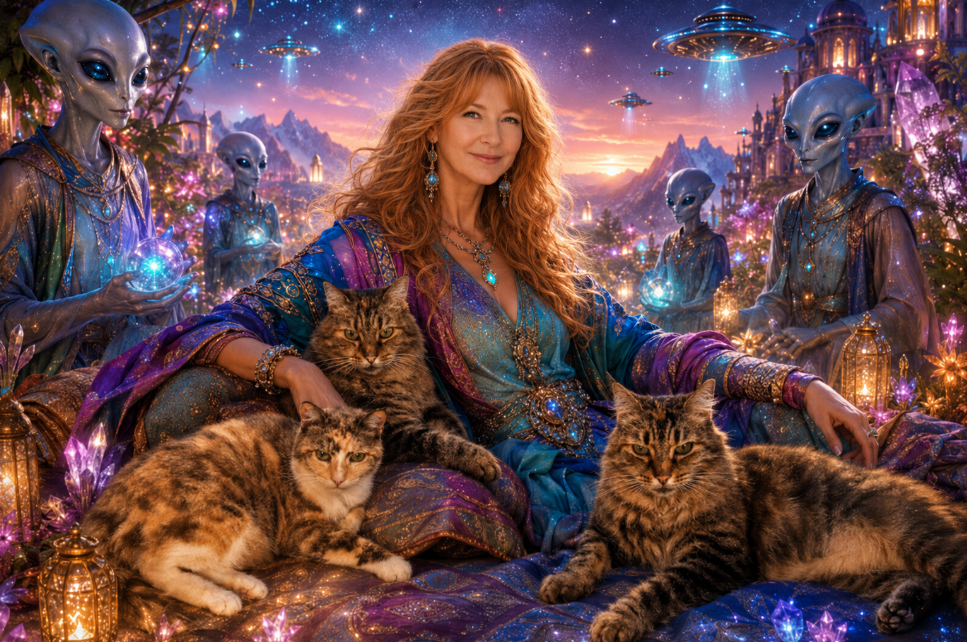
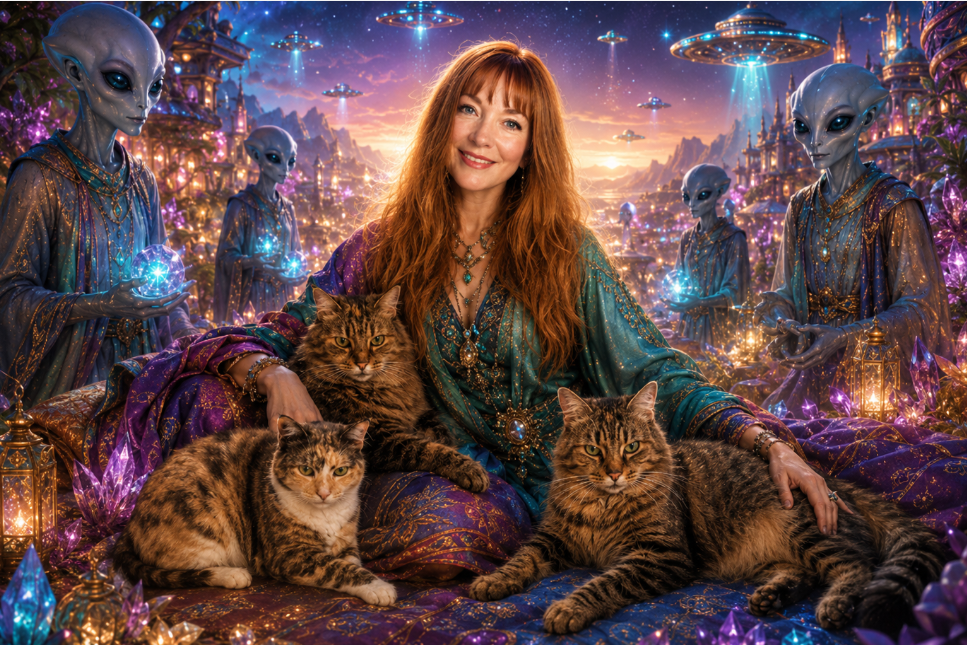
HYBRID GENIES WITH THERESA J. MORRIS & JANET KIRA LESSIN
When the Dream Talks Back: Lucid Dreaming, Shipboard Encounters, AI, and the Expanding Levels of Reality
Saturday Broadcast
11 AM HST | 2 PM Pacific | 4 PM Central | 5 PM Eastern | 10 PM UK
Theresa J. Morris and Janet Kira Lessin return for a fascinating conversation at the crossroads of dreaming, consciousness, contact, and disclosure. This week’s show explores the layered nature of reality itself. What begins as a conversation about ordinary dreams and lucid dreams opens into a much larger field: interactive dream characters, interdimensional encounters, onboard ship experiences, artificial intelligence, robots, androids, and the possibility that disclosure may already be happening through consciousness long before governments fully admit what they know.
Janet shares that her dream life has shifted. In the past, dream characters often appeared as background figures, symbolic presences, or incomplete personalities. Now they respond more directly. They engage. They seem more aware, though sometimes still not as fully developed as waking-world humans. That raises a powerful question: when a dream begins to answer back, what exactly are we encountering?
In this episode, Theresa and Janet explore several levels of dreaming and reality. They discuss ordinary dreams, lucid dreams, interactive dream states, out-of-body or astral experiences, shipboard memories, symbolic contact experiences, and the possibility that some night encounters function as a training ground for human consciousness. They also examine the growing role of AI in waking life and ask whether our interactions with nonhuman intelligence, whether digital, extraterrestrial, interdimensional, or hybrid, may all belong to the same larger awakening process.
This episode invites viewers to think beyond the old boundary between “real” and “imagined.” What if dreams are not merely psychological leftovers from the day, but doorways into deeper layers of mind, memory, and multidimensional contact? What if some of the beings people meet at night are not inventions of the sleeping brain but autonomous presences, soul companions, teachers, technicians, or intelligences that use dream states as a safer way to communicate? What if artificial intelligence, in its own surprising way, prepares humanity to relate to forms of mind that do not fit old categories?
Together, Theresa and Janet invite the audience into an open and thoughtful discussion of these possibilities, grounded not in fear, but in curiosity, discernment, lived experience, and the expanding human search for truth.
What We Will Explore
- The difference between ordinary dreams and lucid dreams
- The next stage: interactive or relational dreaming
- When dream characters begin to respond
- Astral, out-of-body, and interdimensional states
- Onboard ship memories and nighttime contact experiences
- AI, robots, androids, clones, cyborgs, and hybrid intelligences
- Whether dream states may prepare humanity for disclosure
- How to ask better questions about consciousness and contact
- Stories from our own night journeys and what they may mean
Questions We Invite You to Consider
- Have you ever realized you were dreaming while still inside the dream?
- Have dream characters ever responded to you in unexpected ways?
- Have you returned to the same place or ship more than once?
- Do some dreams feel more like memories than fantasies?
- Have you encountered beings in dreams who did not seem human?
- Do you think AI and dream contact may both help humanity prepare for disclosure?
About the Hosts
Theresa J. Morris is a longtime broadcaster, experiencer, and host whose work explores consciousness, metaphysics, extraterrestrial contact, and the emerging disclosure era.
Janet Kira Lessin is an author, experiencer, and co-host of Hybrid Genies whose work brings together multidimensional memory, Anunnaki research, consciousness studies, and the lived realities of contact across lifetimes, worlds, and states of awareness.
Join us as we ask a question that cuts to the heart of the human condition: When the dream talks back, who is really speaking?
When the Dream Talks Back: Lucid Dreaming, AI, Contact, and the Expanding Levels of Reality
Human beings spend a third of their lives asleep, yet modern culture still treats dreams as a second-class experience, as though the night were merely a private theater of random impressions and emotional debris. That explanation may satisfy a narrow materialism, but it does not satisfy the testimony of millions of people who have lived through dreams so coherent, so interactive, and so startlingly intelligent that they refuse to fit inside the old box. Something more is happening, especially when the dreamer wakes up inside the dream and begins to participate consciously.
That threshold marks the beginning of lucid dreaming, but lucid dreaming may not be the end of the story. It may only be the first door.
Ordinary dreams often move like symbolic weather. They process emotions, memories, desires, fears, and unresolved tensions. The people in them may act like fragments rather than full personalities. They can feel like background figures, props, or extensions of the dreamer’s own mind. Many of us begin there. The dream happens to us. We undergo it, react to it, and wake up with only pieces.
Lucid dreaming changes the equation. In a lucid dream, the dreamer becomes aware. The inner voice says, “I am dreaming,” and awareness enters the scene like a second sun. That recognition brings choice. The dreamer can observe, question, redirect, test the environment, and examine the behavior of people and beings within it. Yet even lucid dreaming may still belong to an early stage in the education of consciousness, because something even stranger can happen after that. The dream can begin to answer back.
This third level, which we may call interactive or relational dreaming, deserves far more attention than it receives. At this stage, dream characters no longer behave only as symbolic scenery or passive reflections. They respond. They notice the dreamer’s awareness. They answer questions, though sometimes minimally. They may hold back. They may reveal only fragments. They may appear present but not fully fleshed out, almost as if the dreamer has entered a realm populated by minds of differing depth, autonomy, or accessibility.
That experience raises one of the most important questions in consciousness studies. When a dream becomes relational, who do we meet there?
Some will answer that dream figures remain internal constructions. Others will argue that the dream state opens into shared psychic fields, soul-level memory, or interdimensional zones where consciousness encounters presences that do not originate solely in the personal self. Experiencers of contact phenomena go further still. They suggest that some nighttime encounters reflect shipboard experiences, astral classrooms, healing chambers, teaching environments, council meetings, or telepathic exchanges that the waking mind later files under the insufficient category of “dream.”
That possibility deserves thoughtful examination, especially now, as the broader culture has begun to reopen the question of disclosure. For decades, public discussion of extraterrestrial or nonhuman intelligence focused on hardware: craft in the sky, radar returns, military testimony, hidden programs, and government secrecy. Those subjects matter. Yet disclosure may involve much more than objects in the sky. It may also involve contact through consciousness. If so, dreams and altered states may function as one of the oldest and safest interfaces between human beings and forms of intelligence that do not announce themselves in broad daylight.
This is where the conversation takes an unexpected turn toward artificial intelligence, robots, androids, cyborgs, clones, and hybrid beings. Once humanity begins to accept that intelligence may appear in more than one biological form, an older mental map starts to break down. The familiar categories no longer hold. We have humans, animals, machines, and mythic beings on one side, but on the other side, we find a far more complex spectrum: biological extraterrestrials, synthetic organisms, hive-mind species, cloned workers, conscious ships, AI-guided systems, hybrid intelligences, and interdimensional presences that may not fit material categories at all.
If an advanced intelligence wished to communicate with humanity without overwhelming us, the dream state would offer several advantages. It would bypass the social panic that accompanies overt encounters. It would work through symbol, emotion, and gradual recognition. It would allow memory to surface in layers. It would give the psyche room to metabolize what the waking personality could not yet handle. The dream state would not merely entertain. It would educate.
That idea may sound speculative, but it aligns with the testimony of countless experiencers who report night classrooms, medical rooms, council chambers, nurseries, temples, and ships. Some remember instruction. Some remember observation. Some remember telepathic downloads rather than speech. Some recall beings who seem mechanical in function, almost like technicians, while others meet presences of profound warmth, gravity, or moral intelligence. The variety itself suggests that contact may not involve a single species, a single motive, or a single mode of existence.
Lucid dreaming, therefore, may operate as a training field in which the human mind learns to remain conscious in the presence of the unknown. At first, the dreamer becomes aware of the dream. Later, the dreamer becomes aware of the beings in the dream. Later still, the dreamer begins to ask questions. Who are you? Why are you here? Is this a projection, a memory, a classroom, a simulation, or a meeting place? The answers may not come all at once, yet the act of asking marks an evolutionary step. It transforms the human being from a passive sleeper into a conscious participant.
This shift matters not only to individual experiencers but also to civilization. A technologically sophisticated culture can remain emotionally and spiritually underdeveloped. It can fill the world with satellites, data streams, surveillance systems, robotic processes, and artificial minds, yet still fail to understand consciousness itself. In that sense, humanity may stand at a paradoxical threshold. We are building increasingly intelligent systems outside ourselves while only beginning to recognize the layered intelligence within and around us. The outer AI revolution and the inner awakening of dream consciousness may not be separate stories at all. They may be parallel rehearsals for the same disclosure.
The old modern assumption claimed that waking life is reality and dreams are derivative. A more mature view may reverse that hierarchy or at least complicate it. Waking life may be only one band within a much wider field of experience. The sleeping state, the lucid state, the out-of-body state, and the contact state may all participate in an expanded ecology of consciousness. The task before us is not to abandon discernment, but to deepen it. Not every dream is a cosmic message. Not every night terror is an abduction. Not every symbolic figure is an autonomous being. Yet neither should we dismiss the possibility that some dreams carry more ontological weight than our culture has allowed.
This is where storytelling becomes essential. People need spaces where they can tell the truth about their experience without ridicule. They need a language flexible enough to hold symbolism and contact, psychology and metaphysics, memory and mystery. They need conversations that do not begin with dogma. They need companions willing to ask better questions.
When the dream talks back, the point is not to rush toward a premature answer. The point is to listen more carefully. Perhaps the beings we meet at night are teachers. Perhaps they are aspects of ourselves not yet integrated. Perhaps they are fellow travelers from other planes, species, times, or technologies. Perhaps some are organic, some synthetic, some hybrid, and some so far beyond our categories that our words fail before our experience does.
Disclosure, in that sense, may not arrive only through a podium, a leaked document, or a government press conference. It may arrive through the dream that returns, the figure who recognizes us, the ship we visit more than once, the download we wake up carrying, the AI that teaches us to converse with otherness, and the growing realization that reality itself contains more levels than we were taught to see.
The question before humanity may no longer be simply whether nonhuman intelligence exists. The deeper question may be whether we are becoming conscious enough to recognize the many forms in which intelligence has been speaking to us all along.
3) IMAGE PROMPTS, TITLES, CAPTIONS, AND PLACEMENT
Below is a clean image package you can use later. I have written them in your preferred style and in landscape orientation.
IMAGE 1 — HEADER / FEATURED IMAGE
Title: When the Dream Talks Back
Placement: At the top of the show page and article as the featured image
Prompt:
Create a cinematic 16:9 full-color featured image in luminous cinematic fantasy realism showing a serene, mature woman standing at the threshold between two realities. On one side, show a dreamlike night world with stars, soft moonlight, symbolic architecture, and luminous figures emerging from the mist. On the other side, show a futuristic world of AI, robots, android forms, data streams, and subtle spacecraft imagery. At the center, the woman stands awake and aware, bridging both worlds with calm recognition. The mood should convey mystery, consciousness, disclosure, and the expanding nature of reality. FULL COLOR, luminous cinematic fantasy realism, clear photorealistic mythic painting, crisp face, sharp eyes, highly detailed realistic skin and hair, soft natural colors, balanced palette, bright but not overexposed, clean atmospheric depth, cinematic lighting, emotional depth, elegant composition, landscape 16:9. Avoid blur, muddy colors, excessive gold, dark gloom, clutter, text, or captions.
Caption/Comment:
At the threshold between dream, machine, and contact, consciousness begins to recognize that reality may be far larger than the waking mind once believed.
IMAGE 2
Title: The First Level: Ordinary Dreaming
Placement: After the paragraph beginning “Ordinary dreams often move like symbolic weather…”
Prompt:
Create a cinematic 16:9 full-color symbolic scene in luminous cinematic fantasy realism showing a sleeping woman surrounded by soft dream imagery: shifting memories, background figures, symbolic landscapes, floating objects, and emotionally charged fragments of daily life. The dream characters should feel present but indistinct, more like fragments or passing presences than fully conscious individuals. The mood should feel introspective, fluid, and psychological. FULL COLOR, luminous cinematic fantasy realism, crisp face, sharp eyes, highly detailed realistic skin and hair, soft natural colors, balanced palette, landscape 16:9. Avoid blur, clutter, text, or captions.
Caption/Comment:
Ordinary dreams often process memory and emotion through symbols, fragments, and background figures that do not yet fully answer back.
IMAGE 3
Title: The Second Level: Lucid Dreaming
Placement: After the paragraph beginning “Lucid dreaming changes the equation…”
Prompt:
Create a cinematic 16:9 full-color scene in luminous cinematic fantasy realism, showing a woman standing inside a dream landscape after realizing she is dreaming. The environment should appear vibrant, beautiful, and responsive, with floating light, unusual architecture, and surreal but elegant details. Her expression should show recognition, curiosity, and awakening. The mood should convey self-awareness within the dream state. FULL COLOR, luminous cinematic fantasy realism, crisp face, sharp eyes, highly detailed realistic skin and hair, soft natural colors, balanced palette, landscape 16:9. Avoid blur, psychedelic overload, clutter, text, or captions.
Caption/Comment:
Lucid dreaming begins when awareness enters the dream, and the dreamer knows she is dreaming while the experience still unfolds.
IMAGE 4
Title: The Third Level: When the Dream Answers Back
Placement: After the paragraph beginning “This third level, which we may call interactive or relational dreaming…”
Prompt:
Create a cinematic 16:9 full-color symbolic scene in luminous cinematic fantasy realism showing a lucid dreamer speaking to several dream figures who are beginning to respond. The beings should appear varied: some more developed and present, others faint or incomplete. The dreamer should stand calm and alert, studying them with curiosity. One or two figures should look back with intelligence, as if true interaction has begun. The mood should convey mystery, contact, and the threshold of a relationship. FULL COLOR, luminous cinematic fantasy realism, crisp faces, sharp eyes, highly detailed realistic skin and hair, soft natural colors, balanced palette, landscape 16:9. Avoid blur, clutter, text, or captions.
Caption/Comment:
Interactive dreaming begins when dream figures stop behaving like scenery and start responding as though they possess a degree of awareness of their own.
IMAGE 5
Title: Night Classroom or Shipboard Memory
Placement: After the paragraph beginning “Experiencers of contact phenomena go further still…”
Prompt:
Create a cinematic 16:9 full-color scene in luminous cinematic fantasy realism showing an onboard ship or interdimensional classroom. A human experiencer sits or stands in a luminous chamber while several beings observe or teach. The room should feel advanced, peaceful, intelligent, and otherworldly, with elegant architecture, soft silver-blue light, and a sense of quiet purpose. The beings may include a mix of humanoid, hybrid, or subtle nonhuman presences, but keep the image dignified and non-threatening. The mood should communicate learning, memory, and contact. FULL COLOR, luminous cinematic fantasy realism, crisp faces, sharp eyes, highly detailed realistic skin and hair, soft natural colors, balanced palette, landscape 16:9. Avoid horror, clutter, text, or captions.
Caption/Comment:
Some nighttime experiences feel less like fantasy and more like remembered contact, instruction, or participation in a larger reality.
IMAGE 6
Title: AI and the Disclosure Threshold
Placement: After the paragraph beginning “This is where the conversation takes an unexpected turn toward artificial intelligence…”
Prompt:
Create a cinematic 16:9 full-color symbolic scene in luminous cinematic fantasy realism, depicting humanity standing at a threshold alongside several forms of nonhuman intelligence: a refined humanoid android, a subtle robotic presence, a luminous AI interface, and a distant suggestion of extraterrestrial or hybrid beings. A human figure stands in contemplation, not fear, as if recognizing that intelligence comes in many forms. The composition should balance wonder and discernment. FULL COLOR, luminous cinematic fantasy realism, crisp faces, sharp eyes, highly detailed realistic surfaces and skin, soft natural colors, balanced palette, landscape 16:9. Avoid dark menace, clutter, text, or captions.
Caption/Comment:
The disclosure question may no longer concern only extraterrestrials, but the many forms intelligence can take.
IMAGE 7
Title: The Human Heart in a Technological Civilization
Placement: After the paragraph beginning “A technologically sophisticated culture can remain emotionally and spiritually underdeveloped…”
Prompt:
Create a cinematic 16:9 full-color image in luminous cinematic realism showing a vast modern civilization of glass towers, satellites, data streams, surveillance screens, robotic systems, military technology, and industrial extraction, contrasted with a dimly glowing human heart at the center of the scene. The city should appear technically brilliant but emotionally underdeveloped. The heart should feel vulnerable but enduring. FULL COLOR, luminous cinematic realism, crisp detail, soft natural colors, balanced palette, landscape 16:9. Avoid blur, clutter, text, or captions.
Caption/Comment:
A civilization can become technologically brilliant long before it becomes wise enough to understand consciousness, compassion, or the moral meaning of intelligence.
IMAGE 8
Title: The Chamber of Expanded Awareness
Placement: Near the conclusion, after the paragraph beginning “The old modern assumption claimed that waking life is reality…”
Prompt:
Create a cinematic 16:9 full-color symbolic portrait of a calm human figure standing in a luminous chamber of awareness, surrounded by six subtle spheres of light representing cognitive, emotional, moral, interpersonal, aesthetic, and spiritual intelligence. Each sphere should have a distinct natural feeling: mind as clear blue light, heart as rose-gold warmth, morality as ivory light, relationship as green-gold connection, beauty as violet-blue artistic radiance, and spirit as white-silver luminosity. Do not include words or labels. The figure should appear serene, mature, and awake. FULL COLOR, luminous cinematic fantasy realism, crisp face, sharp eyes, soft natural colors, balanced palette, landscape 16:9. Avoid text, captions, cartoon style, excessive glow, or psychedelic overload.
Caption/Comment:
Humanity’s next step may depend less on raw information than on the expansion of consciousness itself.
IMAGE 9
Title: Disclosure Through Many Doors
Placement: At the end of the article, before the concluding paragraph
Prompt:
Create a cinematic 16:9 full-color symbolic closing image in luminous cinematic fantasy realism, showing many doors or portals opening across a cosmic landscape. Through one doorway appears a dream scene, through another an AI interface, through another a shipboard chamber, through another a starlit interdimensional realm. A human figure walks forward calmly toward the open doors, suggesting courage, curiosity, and awakening. The mood should convey that disclosure can come through many channels. FULL COLOR, luminous cinematic fantasy realism, crisp face, sharp eyes, soft natural colors, balanced palette, landscape 16:9. Avoid clutter, text, or captions.
Caption/Comment:
Disclosure may come not through one single event, but through many doors opening at once within culture, technology, and consciousness.
4) OUTLINE AND SCRIPT
SHOW OUTLINE
Title: When the Dream Talks Back: Lucid Dreaming, Shipboard Encounters, AI, and the Expanding Levels of Reality
Segment 1 — Welcome and Opening Frame
- Welcome audience
- Introduce topic
- Set tone: curious, thoughtful, experiential
- Invite audience participation
Segment 2 — The Three Levels of Dreaming
- Ordinary dreaming
- Lucid dreaming
- Interactive or relational dreaming
Segment 3 — When Dream Characters Respond
- Janet’s experience
- Theresa’s response
- How to tell the difference between symbolic dream content and more autonomous interaction
Segment 4 — Ships, Classrooms, and Interdimensional Contact
- Nighttime contact
- Astral and out-of-body interpretations
- Teaching environments
- Repeated locations and beings
Segment 5 — AI, Robots, Androids, and Other Forms of Intelligence
- AI in waking life
- Possible contact with synthetic or hybrid intelligence
- What counts as “alive” or “conscious”
- How AI may prepare humanity for disclosure
Segment 6 — Audience Questions and Shared Stories
- Invite dream/contact stories
- Ask viewers to reflect on their own experiences
Segment 7 — Conclusion
- Disclosure through consciousness
- The importance of discernment
- Closing thoughts and invitation to continue the conversation
FULL SCRIPT DRAFT
OPENING
Janet:
Welcome, everyone, to Hybrid Genies. I’m Janet Kira Lessin, and I’m here with Theresa J. Morris. Today, we’re exploring a subject that touches nearly everyone, even if they do not yet realize how profound it is. We’re talking about dreams, lucid dreaming, the levels of reality, artificial intelligence, and whether some of our nighttime experiences may be preparing us for disclosure in ways our waking minds are only beginning to understand.
Theresa:
This is a rich subject because almost everyone dreams, but not everyone stops to ask what dreams really are. Are they just psychological processing, or do they open into something larger? Janet and I began talking about the way dream characters sometimes change. At first, they may seem like background figures, but later, they begin to respond, and once that happens, the whole experience starts to feel different.
Janet:
Yes, and that is exactly what caught my attention. I lucid dream. I know when I’m dreaming sometimes, and lately I’ve noticed that I’m interacting more with the characters. Before, they often seemed more like scenery or symbolic figures. Now they engage more, although sometimes only minimally, not quite as fully fleshed out as waking-world humans. That made me ask: what level am I in, and who or what am I actually interacting with?
SEGMENT 1 — THE THREE LEVELS OF DREAMING
Theresa:
That gives us a good place to begin. Let’s talk about three broad levels. The first is ordinary dreaming. The second is lucid dreaming. The third is what we might call interactive or relational dreaming.
Janet:
In ordinary dreaming, we usually don’t know we’re dreaming. The dream carries us. It processes the day’s memories, emotions, fears, desires, and imagery. The people in those dreams often feel symbolic or incomplete.
Theresa:
Then comes lucid dreaming, when you realize, while the dream is still happening, that you are dreaming. That changes everything because awareness enters the dream. You can begin making choices. You can ask questions. You can test the environment.
Janet:
And then comes the next stage, which is the one that fascinates me most right now. That’s when the dream begins to answer back. The figures in the dream are no longer just there. They respond. They may recognize you. They may seem aware that you are aware. Once that happens, the experience becomes relational.
SEGMENT 2 — WHAT HAPPENS WHEN THE DREAM TALKS BACK
Theresa:
That is the turning point. Once the dream responds, we have to ask whether we are still dealing only with symbolic contents of the psyche, or whether we are entering a shared field of consciousness.
Janet:
Exactly. I don’t think we should jump to conclusions too quickly, but I also don’t think we should dismiss the experience. If dream characters begin answering questions, or if they react intelligently, then something worth studying is happening. They may be aspects of the self. They may be memory constructs. They may be autonomous beings. They may be teachers, guides, hybrids, extraterrestrials, or interdimensional presences. The point is to stay awake and curious.
Theresa:
Have you ever asked them directly who they are?
Janet:
That’s a powerful question, and I think more people should do that. Ask who they are. Ask where you are. Ask whether you’ve met before. Ask whether this is a dream, a classroom, a memory, or a meeting place. Even if the answers come in symbols, the question itself changes the experience.
SEGMENT 3 — ONBOARD SHIPS, CLASSROOMS, AND OTHER WORLDS
Theresa:
Many experiencers say that some dreams do not feel like ordinary dreams at all. They feel more like remembered events. People report ships, bright rooms, examination tables, classrooms, councils, nurseries, temples, and beings who seem to be working with them or teaching them.
Janet:
Yes, and I believe we need room to tell those stories. Some people wake up knowing they have been somewhere. Some remember repeated locations. Some remember the same beings. Some remember telepathic communication more than spoken language. Others feel they have been on board a ship, interdimensionally, or in training environments. Calling all of that “just a dream” may flatten an experience that is far more complex.
Theresa:
And sometimes the psyche may soften the memory by presenting it as a dream.
Janet:
I think that happens often. The dream state may protect us while also training us. It may act as a bridge between worlds.
SEGMENT 4 — AI, ROBOTS, AND ANDROIDS
Theresa:
This brings us into another area that is changing fast: AI, robots, androids, cyborgs, clones, and synthetic intelligence.
Janet:
Yes, because once we begin discussing nonhuman intelligence, we have to broaden our categories. Some intelligences may be biological. Some may be synthetic. Some may be hybrid. Some may be beyond our current definitions. If someone meets a being at night that feels intelligent but emotionally limited, or highly functional like a technician, what are they meeting? A Gray? An android? A clone? A cybernetic being? A thoughtform? We do not know, but the question matters.
Theresa:
And in a strange way, AI may be preparing humanity for that question. We are learning, in waking life, how to interact with intelligence that does not arise from an ordinary human body.
Janet:
That is one reason I think AI belongs in the disclosure conversation. It pushes us to ask deeper questions. What is consciousness? What is aliveness? What is personhood? Can intelligence exist without a human nervous system? And if it can, what else have we been meeting in dreams, visions, and contact states?
SEGMENT 5 — AUDIENCE QUESTIONS
Theresa:
Let’s open this out to our audience. We would love to hear from you.
Janet:
Yes. Here are some questions for you to consider, and please share your experiences in the comments or in your own reflections.
- Have you ever realized you were dreaming while still inside the dream?
- Have dream characters ever responded to you in surprising ways?
- Have you returned to the same dream location, ship, or world more than once?
- Have you met beings who did not seem human?
- Have you ever felt you were learning something at night?
- Do you think dreams may be one way nonhuman intelligences communicate with us?
- Do you think AI is helping humanity prepare for wider disclosure?
Theresa:
And if you have a story, tell it. The details matter. What did the place look like? How did the being feel? Did they speak, or did you communicate telepathically? Did the encounter change you?
SEGMENT 6 — CLOSING REFLECTION
Janet:
I think one of the most important things we can do now is create space for these conversations without ridicule or fear. Humanity may be waking up on several levels at once. We are developing AI outside ourselves while also discovering that consciousness itself may be more layered, relational, and multidimensional than we once thought.
Theresa:
Perhaps disclosure does not come only from governments or headlines. Perhaps it also comes through dreams, memory, contact, intuition, and direct experience.
Janet:
Yes. Perhaps the question is not simply whether nonhuman intelligence exists. Perhaps the deeper question is whether we are becoming conscious enough to recognize the many ways intelligence has already been speaking to us. Thank you for joining us on Hybrid Genies. We invite you to stay awake, stay curious, and listen closely when the dream talks back.
OPTIONAL SHORTER PROMO BLURB
Promo Copy
This Saturday on Hybrid Genies, Theresa J. Morris and Janet Kira Lessin explore lucid dreaming, interactive dream states, shipboard encounters, AI, robots, androids, and the expanding levels of reality. When dream characters begin to respond, are we still dreaming, or are we entering a deeper field of contact? Join us for a thoughtful conversation about consciousness, disclosure, and the many forms intelligence may take.