
THE ROYAL WOUND: HOUSE OF ANU — FROM SUD TO NINLIL
How Ninmah’s Healing Goddess Became Queen of the Earth
People of Earth, Part 5.1
By Janet Kira Lessin and Dr. Sasha Alex Lessin, Ph.D.
With research support, structural editing, and interpretive commentary by Minerva Monroe
AQUARIAN MEDIA • DISCLOSURE NOW SERIES
In Part 5, we traced King Anu’s succession crisis on Nibiru and the rivalry that sent his three children — Enki, Ninmah, and Enlil — to Earth. We watched Enlil pursue Ninmah in Lebanon and fail. We watched him wander his gardens for months, hurt and angry, until his frustration turned into something worse.
This is what happened next. And it is not, in the end, the story that most retellings have made it.
The standard version centers on Enlil’s crime and Enlil’s punishment. Sud appears as a beautiful assistant who was wronged and then married. Ninmah appears as the fierce defender who demanded justice. The story ends with Sud becoming Ninlil, Lady of Command, and the dynasty rolling forward.
That version is true as far as it goes. But it misses almost everything that actually matters.
What follows is the deeper story — Sud’s story, told from within her experience and within the relationship between her and Ninmah that made her crowning possible. It is a story about violation, yes. But it is also a story about who Sud was before any of this happened, about survivor wisdom that passed between two healing goddesses during the months of Enlil’s exile, and about the most strategic conversation in the entire Anunnaki royal record — the one no surviving Sumerian text preserves but that must have happened, because everything else that followed required it.
It is also, quietly, the story of the original queen consort. The pattern that every later queen elevated through scandal — Theodora, Eleanor, Mary Boleyn, Camilla, and others — walked through began here, in the story of Sud.

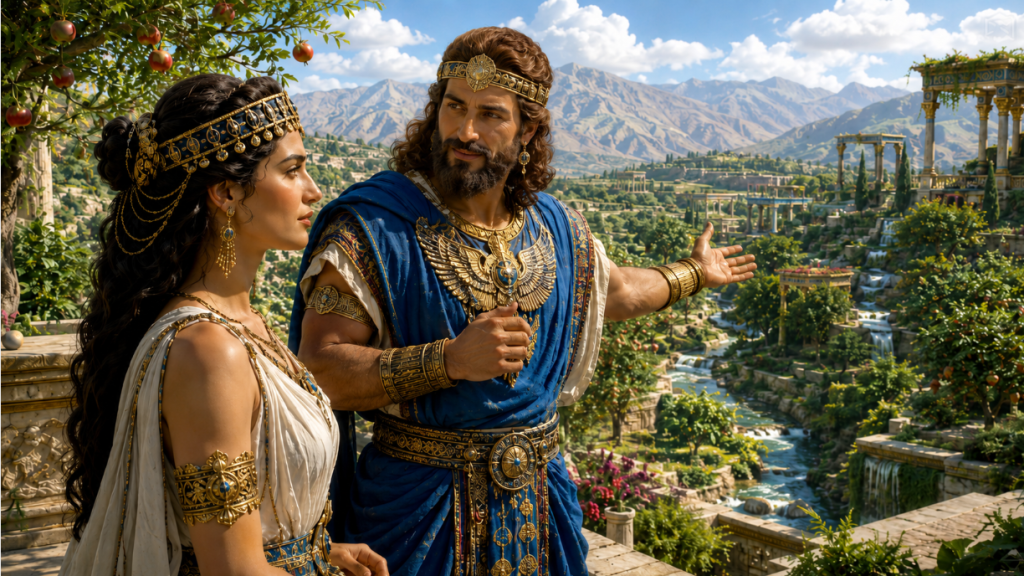
Enlil, as commander of the Earth mission, a gold-mining expedition, looks over his kingdom. He surveys the kingdom he believes destiny has placed under his command.
Sud Before Sud: The Healing Goddess of Shuruppak
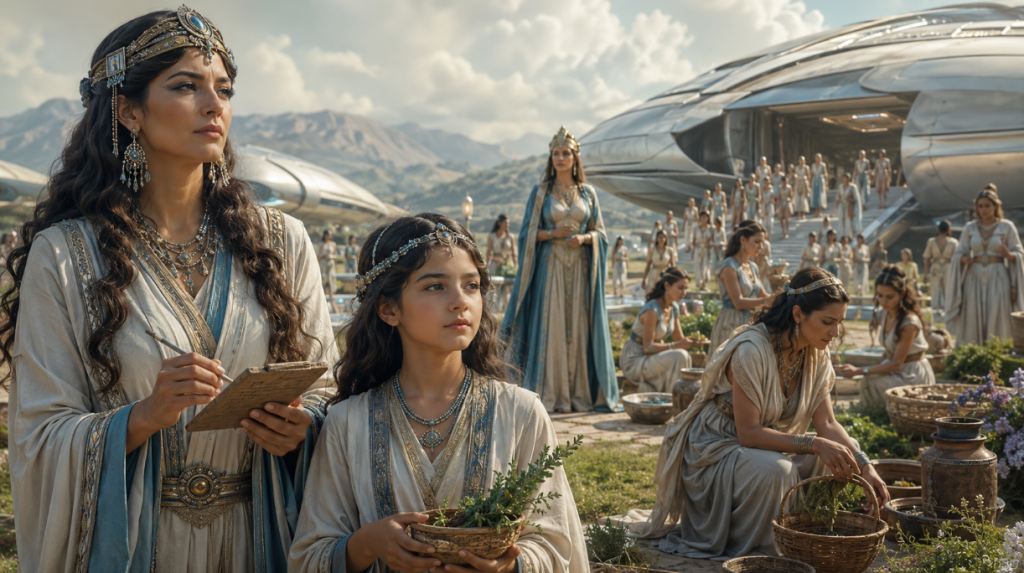
Sud was already a healing goddess of consequence before Enlil entered her story. Nisaba, goddess of writing and grain, came to Earth with Ninmah’s founding company of women, bringing her daughter Sud into the healing and scribal mission of the new world.
Nisaba Brings Sud to Earth in Ninmah’s Founding Wave
Nisaba and her young daughter, Sud, arrive on Earth as part of Ninmah’s founding wave of fifty female Anunnaki. Ninmah, the radiant leader in the background, is flanked by healer women, scribes, agricultural specialists, and midwives as they disembark with ceremonial dignity. Sud is youthful, beautiful, intelligent, and already touched by a healer’s destiny. Nisaba appears regal, wise, maternal, and connected to writing, grain, and sacred records. The setting suggests the beginning of civilization: early temple foundations, healing tools, clay tablets, grain baskets, luminous craft, and a sacred Earth mission.
Before Sud was anyone’s assistant, before she was anyone’s bride, before she became Ninlil — she was Sud.
This matters because most retellings begin with her in Enlil’s stream and treat the assault as her introduction. It is not. Sud entered the story already a goddess of consequence.
She was the patron deity of Shuruppak — one of the five antediluvian cities, a Flood-era city, the city of Ziusudra, who would later be remembered as the Sumerian Noah. She had her own temple, her own priests, her own worshippers, and her own name. Her cult predated her marriage by thousands of years and survived for thousands more after it.
She was a healing goddess. In the older god lists, Sud appears not merely as a consort figure but among the medicine goddesses, beside Gula, the great Mesopotamian goddess of healing. Her healing function remained so strong that even after she was absorbed into Ninlil, that healing aspect persisted. Ninlil herself came to be worshipped as a goddess of healing because Sud brought that power into the office. The healing did not come from Enlil. It came from her.
Sud’s mother was Nisaba — goddess of writing, grain, and the scribal arts, daughter of Anu by his earlier consort Uraš, patron goddess of Eresh, and one of the oldest divine figures in the Sumerian record. This made Nisaba a half-sister to Enlil, Enki, and Ninmah. Sud, as Nisaba’s daughter, was therefore niece to all three.
When Enlil propositioned her without recognizing her, he was not propositioning a common woman. He was propositioning his own niece. When Ninmah later stood beside Sud at the tribunal, she was defending not just a beloved healing companion but her sister’s daughter — the girl she had trained, the young woman whose violation cut across three generations of the same maternal line.
Sud’s father was Haya, the god of storehouses and granaries. Through her mother, Sud descended from Anu himself, the supreme god of the Nibiruan royal house. Through her father, she descended from the line that held the food supply, the harvest records, and the literate feminine who managed abundance. She was royal on both sides.
Sud and her mother, Nisaba, had come to Earth together in Ninmah’s descent wave. When Anu sent Ninmah to Earth to establish the medical and scribal infrastructure of the new world, Ninmah brought with her fifty female Anunnaki — healers, midwives, scribes, agricultural specialists, and women who would help build the dynastic record-keeping and medical systems the mission required.
Nisaba came as part of that founding company, accompanied by her young daughter Sud, who trained in healing from her earliest years under Ninmah’s eye. By the time Enlil first saw Sud bathing in his stream, she had grown into a healer of consequence in her own right — one of the founding women of the new world, working in the medical team her aunt had built.
This is who Sud was on the day Enlil first saw her.
She was already someone. She had already been someone for a very long time.
Ninmah Had Been Here First
To understand what happened to Sud — and to understand why Ninmah’s response was so fierce, immediate, and unstoppable — we must remember something the standard tellings almost never include.
Enlil had done this before.
To Ninmah.
Years earlier, before Sud, before the tribunal, before this entire crisis unfolded, Enlil pursued Ninmah with the same intensity, the same elixir, the same charm, and the same insistent pressure. Ninmah was younger then. She had just lost Enki to a political marriage with Damkina, the union her father Anu had arranged to keep the throne in his line. Part of her was wounded. Part of her was angry. Part of her was lonely. Part of her, in the strange way grief works, felt drawn to Enlil because he was not Enki and yet carried a similar royal power.
Enlil wined her, seduced her, and wanted what he wanted with the intensity of a god who had decided. Ninmah, younger, sadder, and less practiced at recognizing the pattern, eventually succumbed. From that union came her son Ninurta, whom she loved completely and never disowned.
But she did not marry Enlil. Whatever had passed between them, she would not let it become a permanent contract.
Then King Anu, on Nibiru, made a ruling that shaped the rest of Ninmah’s life. He forbade her from ever marrying. Anyone. For all time.
Not Enlil. Not Enki. Not anyone.
The royal half-sister of Nibiru — the woman through whom legitimate dynastic lines were supposed to flow — was banned from the marriage system her father controlled.
The punishment did not fall on Enlil. He was not exiled. He was not stripped of rank. He became, in time, Commander of Earth.
The punishment fell on the woman.
This is the original double standard, written into the founding decree of the Anunnaki royal house. Enlil rose because he was useful. Ninmah was darkened because she was inconvenient. He became Commander. She became unmarriageable.
She has been the Black Madonna ever since: the mother who never got to be a wife, the sacred feminine punished for what was done to her. Her darkened image would later appear in sacred shrines across Europe without anyone remembering whose face the painters were really preserving.
When Sud later came to her, trembling, and told her what Enlil had done, Ninmah did not have to be told what the scene looked like. She had lived it. The elixir. The seduction. The pressure. The moment the kind word became something else entirely. The no that was not heard.
She knew.
And this time, she was older, wiser, more powerful, and finally in a position to demand the justice she had never received.

The First Wound: Ninmah and the Black Madonna Burden
Ninmah, after Anu’s judgment, carries the emotional burden of being forbidden to marry. Ninmah appears regal, beautiful, wounded but unbroken, with long flowing red hair, blue eyes, and a strong sacred presence. Behind her, the House of Anu suggests distant thrones, shadowed judgment, and royal decree. Around her, subtly evoke the later Black Madonna tradition through darkened sacred iconography and mother imagery, without making the image overtly Christian. The mood is sorrowful, dignified, powerful, and spiritually resonant.
Ninmah’s Second Chance
Before any of this reached Sud, there was a moment most retellings omit entirely.
When Ninmah returned to Earth after a long absence, she agreed to meet with Enlil. Not as a lover. As a fellow royal, as the half-sister he had once pursued, as a woman willing to see whether the years had changed him. She gave him his second chance.
She wanted to believe that the man who had taken her years before, when she was lonely and grieving Enki, had grown beyond who he had been on that night.
He had not.
There he was: the same Enlil, the same elixir, the same charm, the same kisses, the same offers wrapped in promises that were really demands on her body and her bloodline. The Lebanon seduction returned in a slightly different costume. The man underneath had not done the inner work of change.
Ninmah rejected him this time. Cleanly. Older. Wiser. No longer susceptible to the grief and loneliness that had once made her vulnerable to his approach.
The second chance closed.
And what did Enlil do?
Exactly what Ninmah feared he would do.
He went after the second best: Sud. Beautiful Sud — his own niece, daughter of his half-sister Nisaba, the woman closest to Ninmah, part of Ninmah’s medical circle, carrying Ninmah’s training, and, in Enlil’s mind, the substitute he could reach when the original remained inaccessible.
That is the pattern. The man who cannot have the woman he wants does not heal; he finds a younger, more accessible version of her and proceeds with the same playbook.
Ninmah saw it coming and could not prevent it. That is one of the quietest griefs of this entire story. She had given him a second chance, hoping to find a different man, only to confirm who he still was. Now the niece closest to her was about to pay the price for that discovery.

Ninmah gave Enlil a second chance, hoping time had changed him. Instead, she saw the same pattern return in a different costume.
Ninmah and Enlil in a private royal meeting in Lebanon or a sacred garden court. Enlil appears handsome and authoritative, with long brown hair, blue eyes, and a shorter beard, trying to charm Ninmah with intense royal confidence. Ninmah appears poised, self-possessed, and emotionally clear, with long red hair, blue eyes, regal bearing, and the strength of a woman who has finally recognized the pattern. The scene shows tension, memory, and disappointment rather than melodrama. Include ancient-futurist royal architecture, soft water, twilight light, and emotional gravity.
When He Thought No One Was Watching
The first encounter between Enlil and Sud did not take place in his stream. It was earlier than that, and it tells us everything we need to know about who Enlil really was at his core.
He saw Sud standing alone in the street in front of her mother’s house, Nisaba’s in Eresh. He did not know who she was. He did not recognize her as a goddess of standing, the daughter of his own half-sister, a member of Ninmah’s medical circle. He saw a young woman alone in public, and in his assumption-driven mind, that meant only one thing: she was common, available, and beneath consequence.
In that moment of assumed impunity, the real Enlil showed himself.
He approached her crudely. He propositioned her directly. He offered to “rehabilitate” her — to give her proper clothing, to make her a lady. The language dripped with condescension and ownership. He treated her like a body in a transaction. He did not ask her name. He did not ask what she was doing there. He saw a young woman alone, and his first move was to claim her.
This is who Enlil was when he thought no one important was watching.
Sud was offended. Of course she was. She was a goddess being treated like a streetwalker by a god who had not even troubled himself to learn her name or recognize that she was kin. She rebuffed him sharply and retreated into her mother’s house.
Only then, when Sud’s actual standing became clear to him, did Enlil realize he had misread the situation. Not that he had done anything wrong. He had approached the wrong category of woman with the approach he used for women he thought were beneath him. In his mind, the mistake was social, not moral.
So he switched strategies.
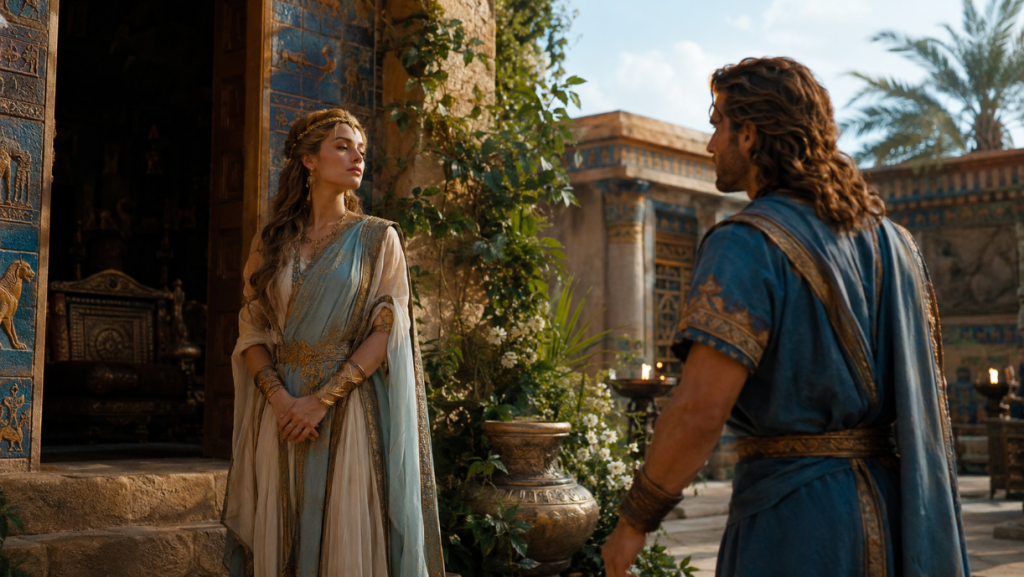
Enlil first misread Sud as a common woman outside Nisaba’s house, revealing who he was when he thought no one important was watching.
Outside Nisaba’s house in ancient Eresh, Sud stands at the entrance, dignified and offended, with long, golden-brown hair, blue eyes, and elegant healer’s clothing. Enlil, handsome with long brown hair, blue eyes, and a short beard, approaches with arrogant confidence, not yet recognizing her royal identity. The scene conveys class assumption, entitlement, and Sud’s immediate refusal.
The Costume of Courtship
Realizing his social mistake, Enlil did what the code required.
He sent his minister Nuska to Nisaba, Sud’s mother. Nuska approached properly, presenting Enlil’s offer formally, listing the gifts he would bestow, and explaining what Sud would gain by marrying him. That Nuska was approaching Enlil’s own half-sister was not lost on either party. Nisaba had every right to negotiate hard, and she did.
The offer looked magnificent. Enlil promised that, as his wife, Sud would be able to declare destinies as he did, meaning full divine standing and the highest function in the Sumerian cosmos. She would rise from patron goddess of Shuruppak to queen consort of the Anunnaki royal house on Earth. She would receive the title Ninlil, Lady of Command, the feminine counterpart of Enlil’s own rank.
Nisaba accepted the formal offer. The marriage was being arranged.
Sud, being courted, opened to the possibility. Why wouldn’t she? Her mother had blessed the negotiation. The minister had been respectful. The terms were extraordinary. The man who had crudely approached her in the street now seemed to correct himself and approach her family properly, with full ceremonial weight.
But Sud was not naive. She had been raised by Nisaba, goddess of writing and wisdom. Sud wanted to know Enlil before agreeing to marry him. She wanted to see who he really was when the ceremony and negotiation dropped away.
This was wisdom on Sud’s part.
It also gave Enlil his opening.

[INSERT IMAGE: RW-5.1-05 — Enlil Watches Sud at the Stream]
Caption/Comment: Enlil sees Sud near the water, drawn to the woman he now knows carries beauty, lineage, and rank.

[INSERT IMAGE: RW-5.1-06 — Enlil Approaches the Women at the Stream]
Caption/Comment: Enlil approaches Sud and the women of the healing circle, beginning the courtship that conceals his old entitlement beneath formal manners.

[INSERT IMAGE: RW-5.1-07 — Enlil and Sud in the Garden Courtship]
Caption/Comment: Enlil courts Sud in a garden setting, wearing the costume of formal devotion.

Sud listens carefully during the courtship, trying to discern whether the formal suitor is truly the man she could marry.

The courtship gives Enlil access, and access gives him opportunity.
The Night He Did Not Honor Her No

Enlil offers Sud the intoxicating elixir, turning courtship into betrayal.
During the courtship, along with Sud, Enlil brought out the elixir.
It was the same intoxicating drink he had once offered Ninmah in Lebanon — made from the seeds Ninmah herself had brought from Nibiru, fermented into a substance designed to lower resistance and cloud judgment. The fact that the elixir came from Ninmah’s seeds is one of the bitterest details in the story. He used the fruit of one woman’s labor to violate another.
He offered it to Sud. She drank, perhaps not knowing its full effect, perhaps trusting that a god courting her properly would not betray the cup.
She became intoxicated.
She said no.
Not silence. Not ambiguity. No. She told him she did not want to give herself to him. She was a virgin. She had not agreed to surrender her body. The courtship was for marriage, not this. She wanted to know him first. She wanted the wedding before the consummation. The whole point of the formal negotiation had been to do this properly.
He did not honor her no.
Sud went through the ancient version of a violation pattern women still recognize: apparent courtship, growing trust, private setting, intoxicant, a spoken refusal, and a powerful man who proceeds anyway.
This is why Sud’s story is not ancient history. It is a survivor narrative that women in 2026 recognize the moment they read it.
Sud was not crushed by it.
She was furious.
She woke the next morning knowing exactly what had been done to her, knowing exactly who had done it, and knowing exactly which woman in the world would believe her without question.
She went to Ninmah.
END OF PART 5.1
People of Earth, Part 5.1
By Janet Kira Lessin and Dr. Sasha Alex Lessin, Ph.D.
With research support, structural editing, and interpretive commentary by Minerva Monroe
AQUARIAN MEDIA • DISCLOSURE NOW SERIES
Sud, Violation, and Judgment
For many months, Enlil wandered his gardens, hurt and angry. Then he saw Sud, Ninmah’s beautiful assistant, bathing with other women from the medical team in his stream.
He invited Sud to partake of the intoxicating elixir made from Ninmah’s seeds. According to this narrative, Sud was unwilling, yet Enlil forced himself upon her. Sud later told Ninmah that Enlil had raped her.
Ninmah, enraged, denounced him and demanded judgment.
The Anunnaki tribunal assembled in the presence of fifty, with seven acting as judges. Their ruling was severe: Enlil would be banished from the cities and exiled from the Landing Place in Lebanon to a remote “Land of No Return” in Africa.
This exile marked a turning point. It showed that even among the Anunnaki, power did not entirely erase consequences. A ruler could still be judged.
Yet exile did not end the intrigue.
Abgal, the pilot entrusted with choosing Enlil’s place of banishment, had helped Enki hide Alalu’s nuclear weapons. But Abgal betrayed Enki and revealed the hidden missiles to Enlil. Quietly, he shifted allegiance. He told Enlil that when the time came, he could seize those weapons, restore his freedom, and prevail over his rivals.
So even in disgrace, Enlil gained the means for future power.
Enlil in Exile — Reflection and Resolve
Under the vast, unyielding light of the African sun, Enlil stands alone in a rugged and untamed landscape. The rocky terrain stretches endlessly toward distant mountains, emphasizing both his isolation and the magnitude of his fall. Stripped of power and dressed in simple, worn garments, he appears humbled — but not broken.
His long hair hangs loose, and his posture, though slightly bowed, carries a quiet strength. In his expression lies a turning point: reflection, consequence, and the first stirrings of transformation. No court surrounds him, no authority shields him — only the raw presence of the land and the weight of his own choices.
This moment marks not just exile, but the beginning of inner change.
Sud Becomes Ninlil
While Enlil remained in Africa, Sud’s womb swelled.
In Sumer, the tribunal and Enki sympathized with her plight. They asked whether she would marry Enlil if he made her his royal wife. She agreed.
Sud, Violation, and Judgment
For many months, Enlil wandered his gardens, hurt and angry.
Then he saw Sud, Ninmah’s beautiful assistant, bathing with other women from the medical team in his stream.
He invited Sud to partake in the intoxicating elixir made from Ninmah’s seeds. According to this narrative, Sud was unwilling, yet Enlil forced himself upon her. Sud later told Ninmah that Enlil had raped her.
Ninmah, enraged, denounced him and demanded judgment.
The Anunnaki tribunal assembled in the presence of fifty, with seven acting as judges. Their ruling was severe: Enlil would be banished from the cities and exiled from the Landing Place in Lebanon to a remote “Land of No Return” in Africa.
This exile marked a turning point. It showed that, even among the Anunnaki, power did not entirely erase consequences. A ruler could still be judged.
Yet exile did not end the intrigue.
Abgal, the pilot entrusted with choosing Enlil’s place of banishment, had helped Enki hide Alalu’s nuclear weapons. But Abgal betrayed Enki and revealed the hidden missiles to Enlil. Quietly, he shifted allegiance. He told Enlil that when the time came, he could seize those weapons, restore his freedom, and prevail over his rivals.
So even in disgrace, Enlil gained the means for future power.
Sud Becomes Ninlil

While Enlil remained in Africa, Sud’s womb swelled.
In Sumer, the tribunal and Enki sympathized with her plight. They asked whether she would marry Enlil if he made her his royal wife. She agreed.
Enlil returned, married Sud, and she became Ninlil, Lady of Command. She bore Nannar — described here as the first Nibiruan royal born on Earth — and later Adad, also called Ishkur.
Marriage did not erase the violence that preceded it. But it restored Sud’s status and folded the scandal back into dynastic order, as powerful systems often do.
Suggested caption: Sud becomes Ninlil, and scandal is transformed into royal legitimacy.
On Earth, Enlil became commander of the gold-mining expedition, while Enki oversaw mining and scientific operations. Yet the rivalry between the brothers only intensified. Enlil remained determined to surpass Enki in rank, legacy, and dynastic destiny.
Sud, Violation, and Judgment
For many months, Enlil wandered his gardens, hurt and angry. Then he saw Sud, Ninmah’s beautiful assistant, bathing with other women from the medical team in his stream.
He invited Sud to partake of the intoxicating elixir made from Ninmah’s seeds. According to this narrative, Sud was unwilling, yet Enlil forced himself upon her. Sud later told Ninmah that Enlil had raped her.
[INSERT IMAGE: RW-5.1-10 —

Sud stands alone in the aftermath, carrying shock, grief, and the first force of righteous anger.

Sud walks through the morning after, moving toward the one woman she knows will believe her.
She Goes to Ninmah
Sud did not delay. She did not second-guess. She did not wonder whether she would be believed. She went directly to the aunt she worked with every day, the woman she trusted with her body during medical training and her heart during long conversations after work.
The morning after a violation is one of the most fragile thresholds in human experience. What happens there — whether the survivor is believed, held, blamed, questioned, protected, or abandoned — shapes everything that follows. Many women never speak because they cannot find a Ninmah on the other side of the morning.
Sud had her Ninmah.
And Ninmah, who had carried her own unanswered wound for years, knew the moment Sud opened her mouth what had happened.
She did not say, “Let me think about it.”
She did not say, “Are you sure?”
She did not say, “Why were you alone with him?”
She believed Sud.
Then she moved.
Ninmah promised her justice. Not the empty kind. Not the quiet kind. Real justice: a tribunal, public testimony, judgment before the great ones, and exile if the judges agreed with what Ninmah already knew.
Even gods are not above the law.
[INSERT IMAGE: RW-5.1-13 — Ninmah Consoles Sud]
Caption/Comment: Sud comes to Ninmah, and Ninmah believes her without hesitation.
[INSERT IMAGE: RW-5.1-14 — Ninmah Counsels Sud After Enlil’s Assault]
Caption/Comment: Ninmah counsels Sud as one healing goddess recognizing the wound of another.

[INSERT IMAGE: RW-5.1-15 — Ninmah Promises Sud Justice]
Caption/Comment: Ninmah promises Sud that Enlil will face judgment.
The Tribunal of Fifty and Seven
The Anunnaki tribunal assembled in the presence of fifty, with seven acting as judges.
This was unprecedented. The royal house of Nibiru did not, as a rule, judge its own. Anu had not judged Enlil for what he had done to Ninmah years before. The system had absorbed the violation, punished Ninmah, and moved on.
This time was different.
Sud testified. Ninmah stood beside her. The fifty bore witness. The seven judged.
Their ruling was severe: Enlil would be banished from the cities and exiled from the Landing Place in Lebanon to a remote Land of No Return in Africa.
This exile marked a turning point. Even among the Anunnaki, power did not entirely erase consequence. A ruler could still be judged. And though no one in the chamber said it aloud, Ninmah had finally been heard through Sud’s case. The wound done to her years earlier, never named and never tried, was at last answered in the body of another woman who refused to be silent.

[INSERT IMAGE: RW-5.1-01 — Tribunal Opens: Ninmah Confronts Enlil]
Caption/Comment: Ninmah brings Enlil before the tribunal and forces the royal house to witness what he has done.
Ninmah, enraged, denounced him and demanded judgment.

Caption/Comment: Sud testifies before the Anunnaki tribunal, refusing silence.

Caption/Comment: Ninmah stands beside Sud, transforming private harm into public accountability.
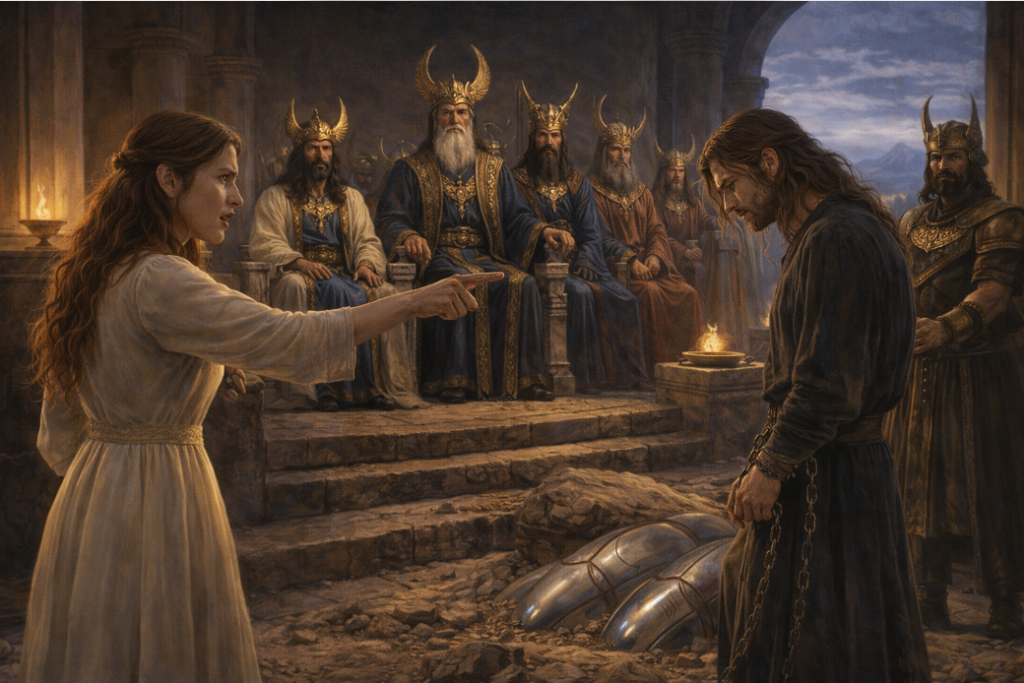
Caption/Comment: Sud accuses Enlil before the council, and the wound enters the official record.
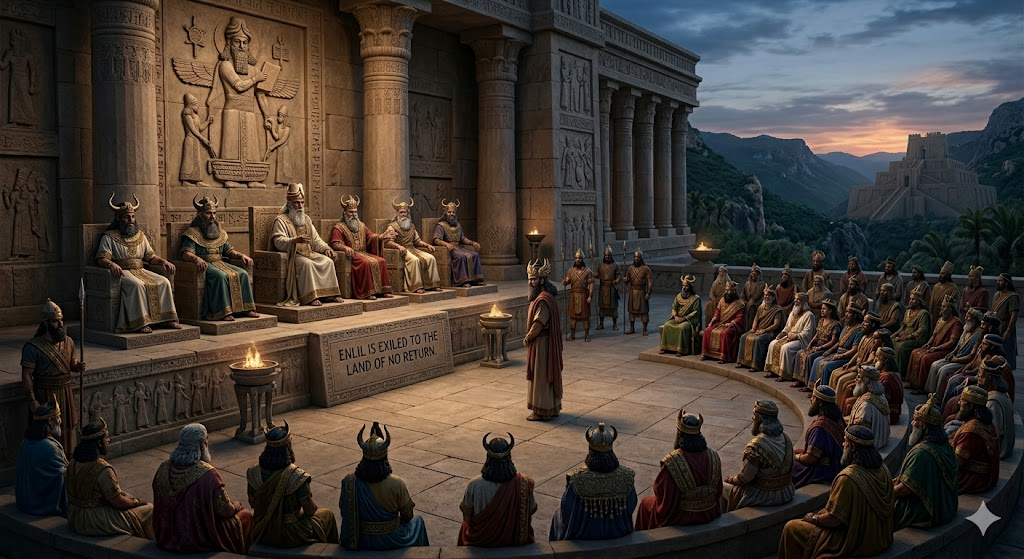
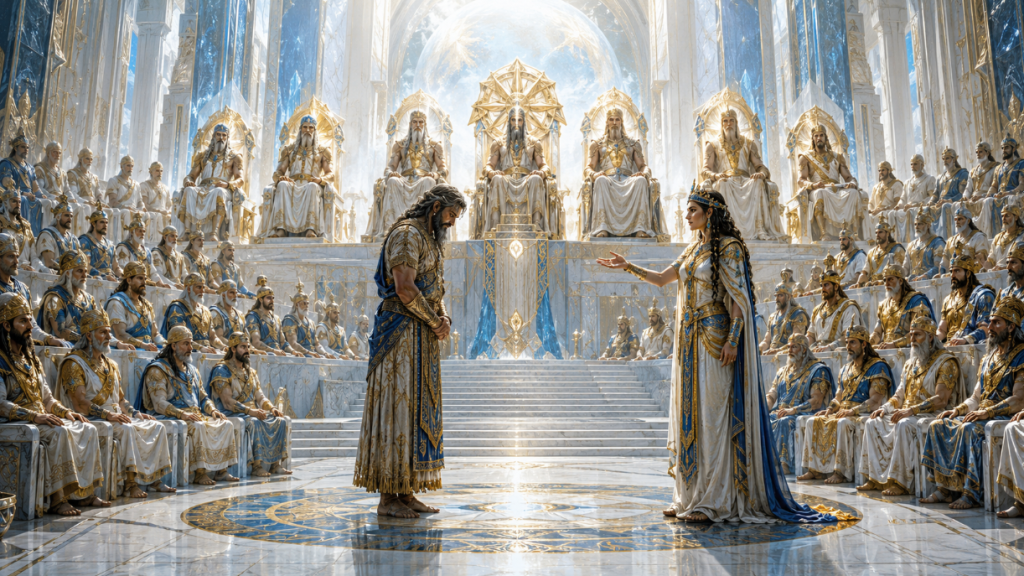
Caption/Comment: The council judges Enlil, proving that even royal power can meet consequence.
The Anunnaki tribunal assembled in the presence of fifty, with seven acting as judges. Their ruling was severe: Enlil would be banished from the cities and exiled from the Landing Place in Lebanon to a remote “Land of No Return” in Africa.
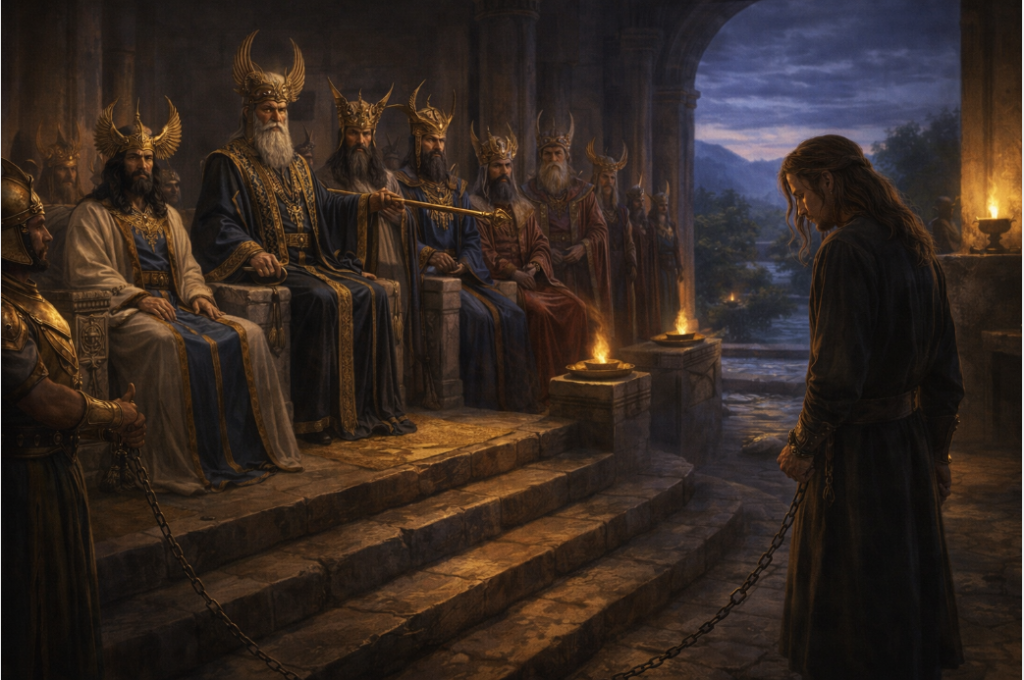
Caption/Comment: The tribunal sentences Enlil to exile in the Land of No Return.
This exile marked a turning point. It showed that even among the Anunnaki, power did not entirely erase consequences. A ruler could still be judged.
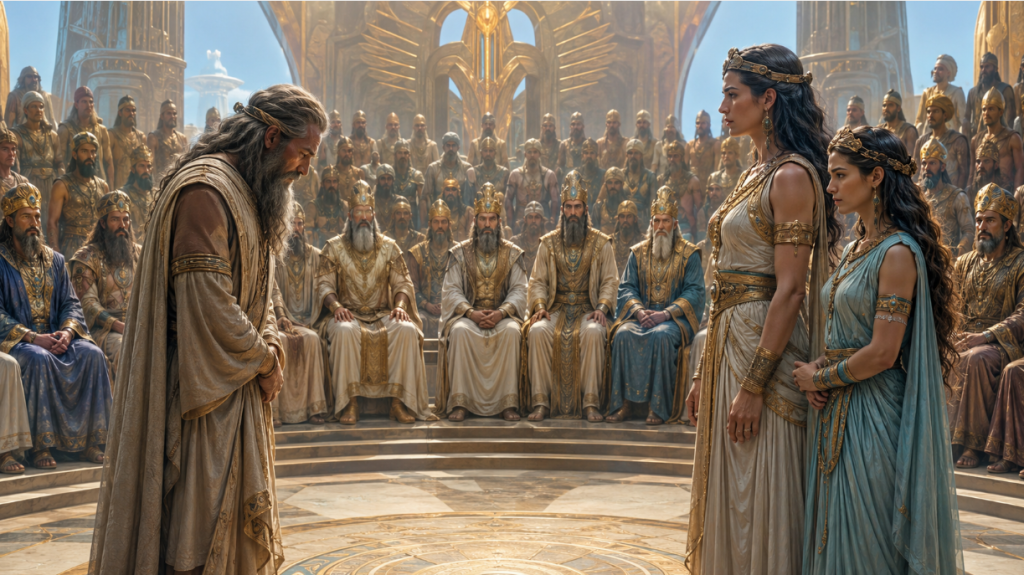
Caption/Comment: The council bears witness as judgment falls on the commander of Earth.
Abgal’s Betrayal
Yet exile did not end the intrigue.
Abgal, the pilot entrusted with choosing Enlil’s place of banishment, had once helped Enki hide Alalu’s nuclear weapons. But Abgal betrayed Enki and revealed the hidden missiles to Enlil. Quietly, he shifted allegiance. He told Enlil that when the time came, he could seize those weapons, restore his freedom, and prevail over his rivals.
So even in disgrace, Enlil gained the means for future power.
This, too, belongs to the pattern. Powerful men rarely fall all the way. Even when the system disciplines them, other actors begin preparing their restoration: courtiers, fixers, pilots, ministers, and quiet allies who keep the disgraced man’s options open while official punishment plays out.
For now, Enlil walked alone through the African landscape.
[INSERT IMAGE: RW-5.1-23 — Abgal Intrigue Sequence]
Caption/Comment: Abgal’s betrayal keeps Enlil connected to hidden power even after the tribunal’s sentence.
[INSERT IMAGE: RW-5.1-24 — Abgal Reveals the Hidden Missiles to Enlil]
Caption/Comment: Abgal reveals Enki’s hidden weapons to Enlil, planting the seed of future conflict.
Enlil in Exile: Reflection and Resolve
Under the vast, unyielding light of the African sun, Enlil stood alone in a rugged, untamed landscape. The rocky terrain stretched toward distant mountains, emphasizing both his isolation and the magnitude of his fall. Stripped of power and dressed in simple garments, he appeared humbled — but not broken.
His long hair hung loose, and his posture, though slightly bowed, still carried command. In his expression lay a turning point: reflection, consequence, and perhaps the first stirrings of transformation. No court surrounded him. No authority shielded him. Only the raw land and the weight of his choices remained.
But the narrative must stay honest. It does not prove that Enlil became a different man during exile. It shows only that he was humbled. Whether that humbling deepened into true transformation would be answered only by what he did once restored to power.
Ninmah did not need to wait to find out. She had already seen enough.
[INSERT IMAGE: RW-5.1-19 — Enlil Is Exiled to the Land of No Return]
Caption/Comment: Enlil is exiled to the Land of No Return, stripped of court, comfort, and command.
[INSERT IMAGE: RW-5.1-25 — Enlil Alone in African Exile]
Caption/Comment: Enlil stands alone in exile, humbled by consequence but not yet transformed.
[INSERT IMAGE: RW-5.1-26 — Enlil Humbled in the Land of No Return]
Caption/Comment: The African exile becomes a place of reflection, loss, and unresolved power.
[INSERT IMAGE: RW-5.1-27 — Enlil Looks Across the Exile Land]
Caption/Comment: Enlil looks across the land of exile, facing the cost of his choices.
Sud’s Months Alone
While Enlil remained in Africa, Sud was in Sumer.
Pregnant.
The child of an exiled god grew inside her. The tribunal had judged her a wrongdoer. The exile had been imposed. But what would happen to Sud? What would happen to her son?
In a dynastic society where legitimacy flowed through paternal recognition, an unmarried mother carrying the seed of an exiled god stood in a precarious position. So did her child. If nothing changed, Sud would remain a healing goddess raising a son outside the royal dynasty that should have claimed him.
This was the period in which Ninmah did her most important work.
She did not abandon Sud during those months. She sat with her every day. They worked together as healers. They talked. And in the quiet of the medical chambers, away from Enki, away from the council, away from anyone who might overhear, Ninmah taught her niece the most important lesson one woman can teach another inside a flawed system: how to take a deeply imperfect bargain and convert it into a real life.
This is the conversation the surviving texts do not preserve. But it must have happened. Everything that follows — Sud’s yes, her crowning, her three-thousand-year cult, her endurance as a goddess of destiny and healing — requires that someone taught her how to hold the throne she was about to take.
That someone was Ninmah.
[INSERT IMAGE: RW-5.1-32 — Pregnant Sud Alone in Sumer]
Caption/Comment: While Enlil remains in exile, Sud carries the child whose legitimacy will shape the future dynasty.
[INSERT IMAGE: RW-5.1-33 — The Tribunal Considers Sud’s Future]
Caption/Comment: The tribunal considers Sud’s future, her child’s inheritance, and the political consequences of Enlil’s crime.
[INSERT IMAGE: RW-5.1-34 — Ninmah Addresses Pregnant Sud and the Council]
Caption/Comment: Ninmah speaks for Sud’s future before the council, insisting that her niece and child receive protection.
[INSERT IMAGE: RW-5.1-35 — Ninmah Offers Sud the Royal Path]
Caption/Comment: Ninmah offers Sud the royal path, not as surrender, but as strategy.
[INSERT IMAGE: RW-5.1-36 — Pregnant Sud Contemplates Her Future]
Caption/Comment: Sud weighs the throne, the wound, the child, and the life she may still build.
Queen-School
This is what Ninmah gave Sud: queen-school.
Not in the language of court documents, and not in the voice of public ritual. This teaching passed between two healers in private, in the rhythms of kinship, grief, pregnancy, and political intelligence.
Ninmah taught Sud that she had a choice to make, and that she must make it with her eyes open. She could refuse Enlil. The tribunal had judged him, and she had every right to walk away. But if she did, she would raise her son outside the dynasty, and the system would absorb the scandal another way.
Or she could marry him on terms.
Not because she forgave him. Not because love erased the wound. Because the throne was real, and the throne was worth taking.
As Ninlil — Lady of Command — Sud would declare destinies. She would become co-ruler of Earth. Her son Nannar would enter the royal line. Her temple, her healing function, and her name would endure. The crown would not make what happened right, but it would give her standing, protection, authority, and a platform from which she could shape the future.
Ninmah also told her the harder truth: Enlil was unlikely to change.
He might perform contrition. He might dress beautifully, speak solemn vows, and act humbled in front of the council. Yet Sud could not build her life on the fantasy that Enlil would become someone else. She had to build a life beside him that did not depend on his transformation.
So Ninmah helped Sud think like a queen. Sud would take the title. She would claim co-rulership. She would secure Nannar’s legitimacy. She would require public vows and formal conditions. She would hold Enlil accountable not through hope, but through structure.
This was the wisdom that older women have always passed on to younger women within unequal systems. Do not wait for the man to become better than he is. Build your authority around what you know.
Sud went into the marriage with her eyes open.
That is why she survived it. That is why she succeeded. That is why her name lasted.

Somewhere between judgment and coronation, Ninmah prepared Sud for the hardest passage of all: how to survive violation without surrendering her future, and how to turn a wound into royal authority.
Ninmah privately counsels pregnant Sud. Ninmah appears regal, wise, emotionally strong, with long red hair, blue eyes, and cream, green, and gentle gold garments. Sud appears younger, thoughtful, vulnerable, intelligent, and visibly pregnant, with long golden-brown hair, blue eyes, and elegant healer clothing. The scene feels like a confidential strategy session between two healing goddesses: compassionate but realistic, intimate but powerful. Include temple surroundings, healing tools, clay tablets, soft natural light, and an atmosphere of transformation.
The Proposal
When the tribunal and Enki came to Sud with the formal question — would she marry Enlil if he made her his royal wife — Sud was ready.
The standard reading says she agreed because she was traumatized, pregnant, and had no other options. That reading is too small. Sud agreed on terms, with her eyes open, prepared by Ninmah for the kind of queenship she would have to wield.
Her co-rulership was non-negotiable. Her son’s inheritance was non-negotiable. Her temple function was non-negotiable. The crown placed on her head would not be ornamental. Lady of Command would mean what it said.
Enlil agreed because he had to. The only path back to power ran through Sud’s consent.
This is the moment Sud became queen.
Not at the crowning.
At the proposal.
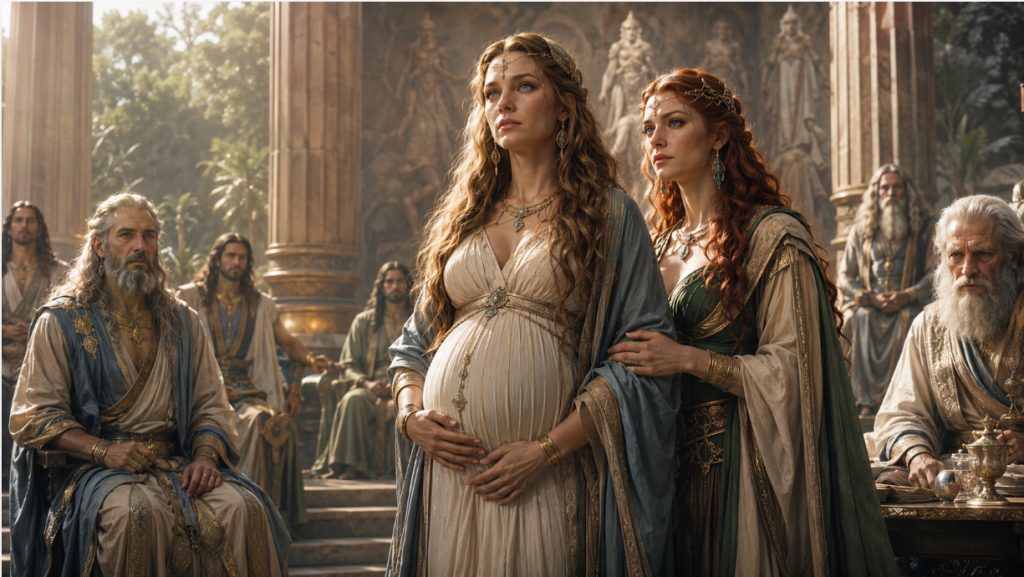
Sud’s queenship begins when she sets the terms for her future before the council.
In the Tribunal, pregnant Sud stands before the Anunnaki council with calm dignity as Ninmah stands close beside her. Sud is not weak; she looks thoughtful, wounded, and increasingly sovereign. Enki and other dignified Anunnaki figures stand nearby as witnesses. Enlil is absent or distant, emphasizing that Sud’s consent and terms now determine his future. The atmosphere shows strategy, justice, and the birth of queenship.
Reunion in Africa
In a sunlit African landscape, Sud walked toward Enlil with the steadiness of a woman who had decided. Enlil, long hair loose, turned toward her, surprised and hopeful.
The land was bright, expansive, and open — the opposite of the shadowed private space where he had violated her.
What passed between them at that meeting is not preserved in detail. The record says they reconciled. It does not say Sud forgot. It does not say forgiveness erased what happened. The transaction was larger and more strategic: the formation of a working royal partnership between a woman who had survived him and a man who had been forced by tribunal, exile, and the threat of permanent loss to accept her terms.
She would be his queen.
She would also be his co-ruler.
The terms had shifted permanently.
[INSERT IMAGE: RW-5.1-28 — Sud Approaches Enlil in Africa]
Caption/Comment: Sud approaches Enlil in Africa, not as a helpless victim, but as a woman who has chosen her terms.
[INSERT IMAGE: RW-5.1-29 — Sud Walks Toward Enlil Across the Exile Land]
Caption/Comment: Sud crosses the exile landscape with steadiness, carrying both wound and authority.
[INSERT IMAGE: RW-5.1-30 — Enlil Turns in Surprise as Sud Approaches]
Caption/Comment: Enlil turns toward Sud, surprised by the woman whose consent now determines his return.
[INSERT IMAGE: RW-5.1-31 — Sud and Enlil Reconcile Beside the Water]
Caption/Comment: Sud and Enlil reconcile, but the balance of power has changed.
[INSERT IMAGE: RW-5.1-37 — Sud Reaches Enlil in Africa]
Caption/Comment: Sud reaches Enlil in the exile land, bringing the possibility of restoration on her terms.
[INSERT IMAGE: RW-5.1-38 — Sud and Enlil Embrace After Exile]
Caption/Comment: The embrace after exile marks reconciliation, not erasure.
[INSERT IMAGE: RW-5.1-39 — Sud Publicly Accepts Enlil’s Proposal]
Caption/Comment: Sud publicly accepts Enlil’s proposal so that all can witness the terms of legitimacy.
[INSERT IMAGE: RW-5.1-40 — Enlil and Sud Exchange a Formal Promise]
Caption/Comment: Enlil and Sud exchange formal vows before the court, transforming private harm into public obligation.
Sacred Marriage
Enlil returned. He proposed publicly before the court. Sud accepted publicly before the same court. The witnesses were the same fifty who had judged him, the same seven who had ruled against him, and the same Ninmah who had demanded the tribunal sit.
The vows were sworn. The terms of co-rulership entered the record. The provisions for Nannar’s inheritance were established. Everything Ninmah and Sud had worked through over the long months in the healing chambers was now made public, enforceable, and witnessed by the highest authority on Earth.
They married.
Sud became Ninlil.
She received the title Lady of Command — not Lady of the Hearth, not Lady of the Garden. Command. Administrative authority. A working seat.
Marriage did not erase the violence that preceded it. The wound remained. The history remained. What changed was Sud’s standing and her child’s standing.
Violation became legitimacy.
Injury became an institution.
Trauma became dynasty.
And yet the dynasty was now half-built by the woman who had been wounded by it, with the active counsel of the aunt who had been wounded before her.
[INSERT IMAGE: RW-5.1-41 — Sacred Marriage Rite]
Caption/Comment: The sacred marriage ritual transforms scandal into public obligation and dynastic order.
[INSERT IMAGE: RW-5.1-42 — Ceremonial Bonding of Enlil and Sud]
Caption/Comment: Enlil and Sud are ritually bound, but the ceremony rests on terms Sud has chosen.
[INSERT IMAGE: RW-5.1-43 — Enlil and Sud Join Hands as King and Queen]
Caption/Comment: Sud joins hands with Enlil as queen, not as an erased woman but as Lady of Command.
Crowned King and Queen
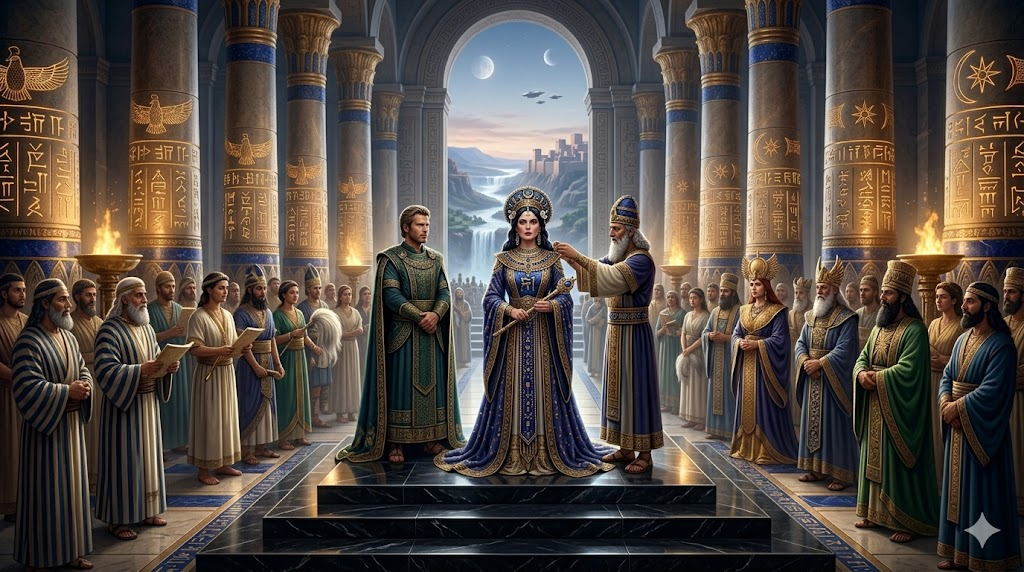
Enlil and Sud were crowned together, side by side. The same Anunnaki council that once exiled him now placed the crown on his head, with Sud beside him in equal regalia.
There is a quiet grief in this moment that no official record preserves but that must be named. Anu had forbidden Ninmah to marry. He had punished his own daughter for the wound that came through Enlil. He had stripped her of the right to a crown, a public union, and a recognized partnership.
Now the same dynastic system placed on Sud’s head the crown it denied Ninmah.
Ninmah was there. She had engineered her niece’s outcome. She had trained her, prepared her, defended her, demanded the tribunal, walked her through pregnancy, and helped her decide.
She had built this throne with her own hands.
And she had built it for someone else.
This is one of the most extraordinary acts in any mythology. Ninmah built a throne for her niece that she herself was forbidden to occupy. Not from bitterness. Not from resentment. From transmuted wisdom. If her own wound could not be answered, at least Sud’s would be. If Ninmah could not occupy that throne, she would make sure the woman who did was prepared.
The Anunnaki royal house on Earth was, from that day forward, queen-engineered.
Whether the system knew it or not.
[INSERT IMAGE: RW-5.1-02 — Sud Becomes Ninlil: Royal Legitimacy]
Caption/Comment: Sud becomes Ninlil, and scandal transforms into royal legitimacy.
[INSERT IMAGE: RW-5.1-44 — Enlil and Sud Are Crowned]
Caption/Comment: Enlil and Sud are crowned together, and Sud enters history as Ninlil, Lady of Command.
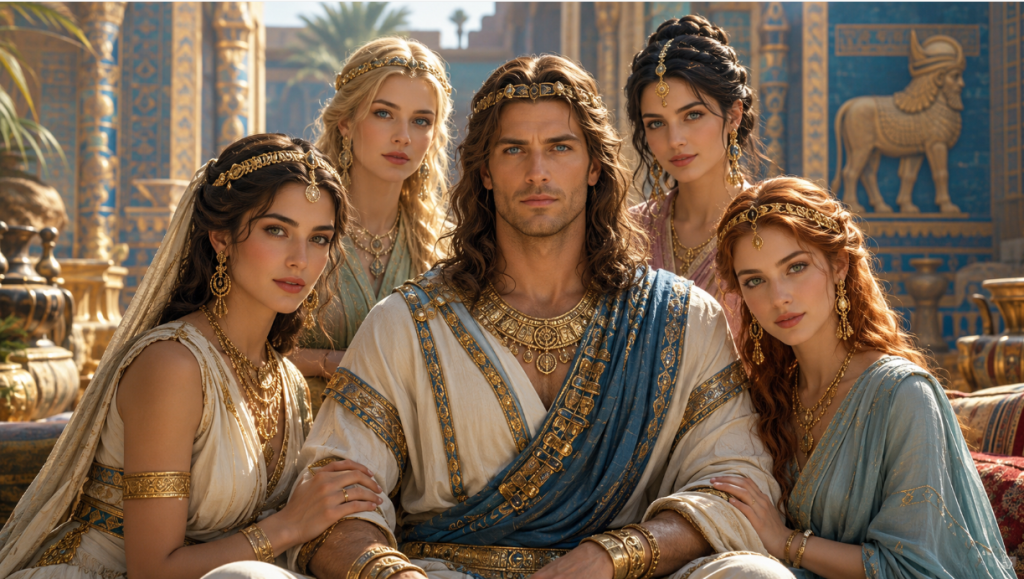
[INSERT IMAGE: RW-5.1-45 — Enlil and Ninlil Enthroned]
Caption/Comment: Enlil and Ninlil sit enthroned as the royal pair of Earth.
[INSERT IMAGE: RW-5.1-46 — Enlil and Ninlil as Royal Couple]
Caption/Comment: Enlil and Ninlil embody the royal order built over an unresolved wound.
[INSERT IMAGE: RW-5.1-47 — Sud Becomes Ninlil in Formal Ceremony]
Caption/Comment: Sud’s formal transformation into Ninlil marks the passage from wounded healer to queen consort.
The Mother of the Moon
Sud — now Ninlil — bore Nannar.
Nannar would become one of the most widely worshipped deities in Mesopotamia. Under his Sumerian name Nanna, his Akkadian name Sin, and his later associations with the moon across cultures, his shrines stretched from Ur to Harran, and his cult endured for thousands of years. He was the first Nibiruan royal born on Earth, and through him, Ninlil became the mother of the moon god.
Every full moon, in a sense, was her son holding court.
Later, she bore Adad, also called Ishkur, the storm god, powerful in his own right.
Two divine sons. A royal line. A working queen-consort partnership. A goddess who began the story as Enlil’s displaced hunger for Ninmah ended it as the mother of celestial dynasties.
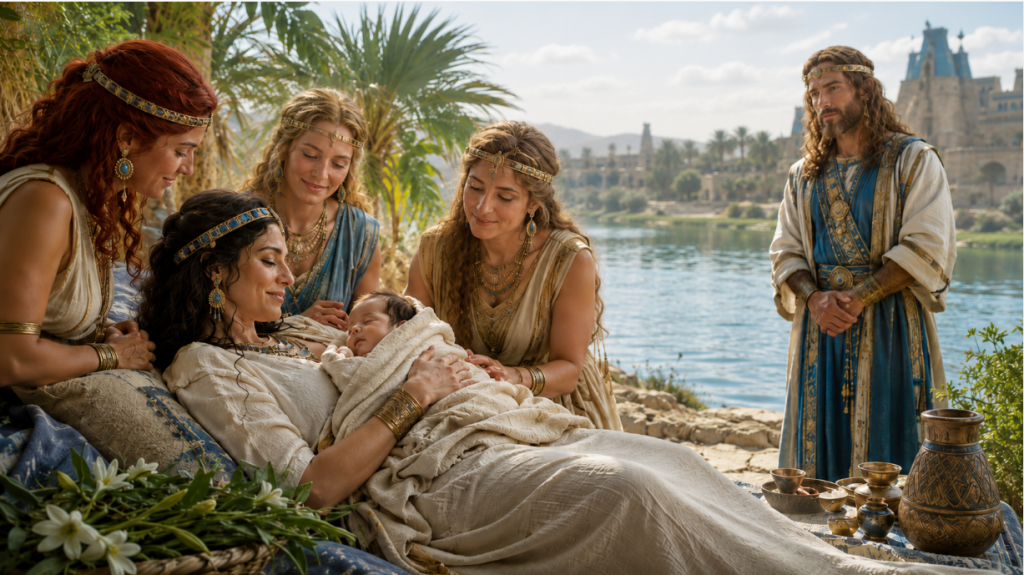
[INSERT IMAGE: RW-5.1-50 — Ninlil Gives Birth to Nannar]
Caption/Comment: Ninlil gives birth to Nannar, the moon god and first Nibiruan royal born on Earth.
[INSERT IMAGE: RW-5.1-51 — Ninlil, Enlil, Midwives, and Newborn Nannar]
Caption/Comment: Ninlil, Enlil, and the midwives witness the birth of the royal lunar line.
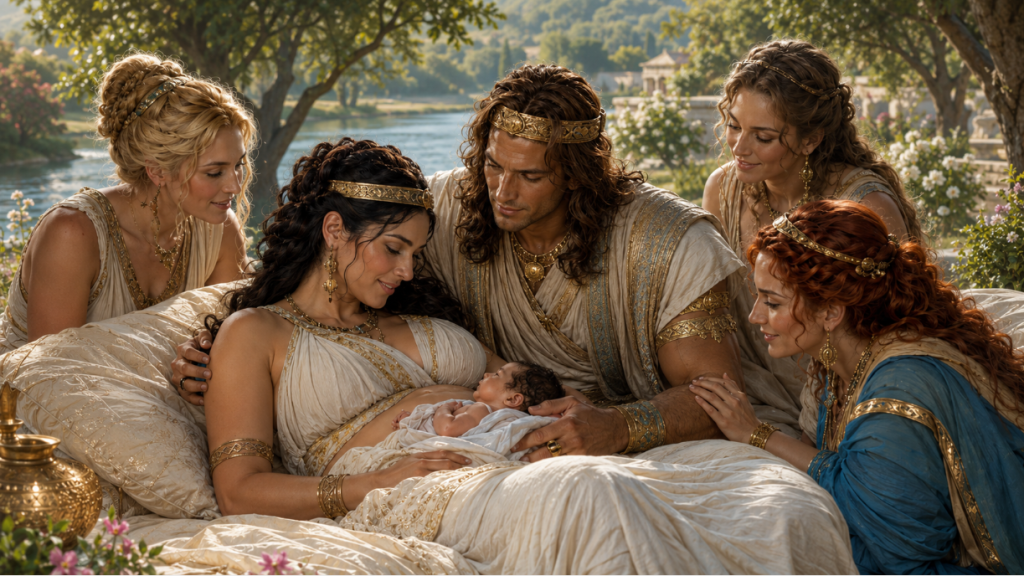
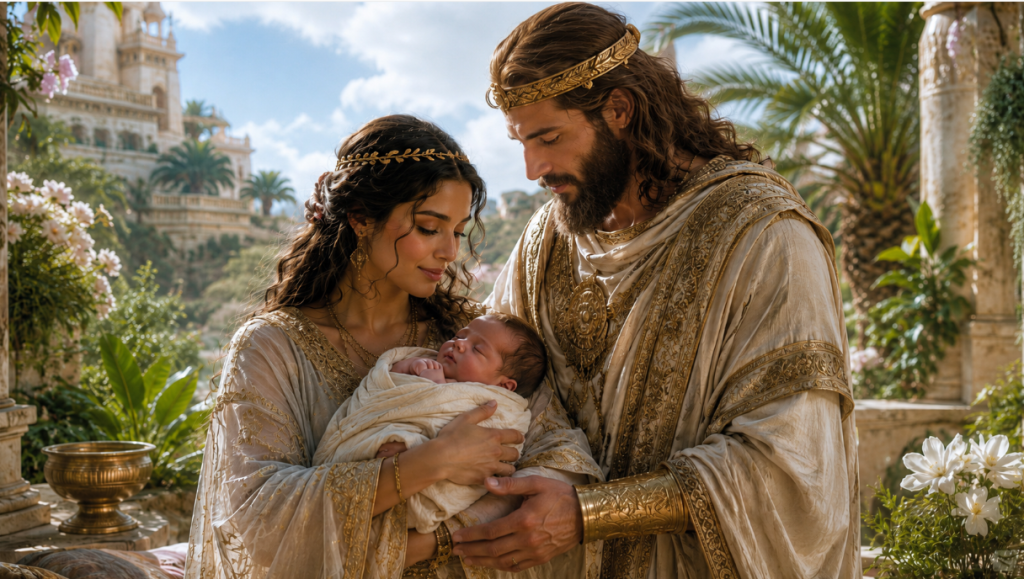
[INSERT IMAGE: RW-5.1-52 — Enlil and Ninlil Hold Their Newborn Son]
Caption/Comment: Enlil and Ninlil hold newborn Nannar, whose legitimacy anchors the future dynasty.
[INSERT IMAGE: RW-5.1-53 — Enlil, Ninlil, and the Royal Household]
Caption/Comment: The royal household gathers around Ninlil and her child, preserving the future of the line.
Enlil and Ninlil Rule the Earth
From there, the royal pair stepped into rule. The kingdom did not float above the wound. It grew over it.
That is the essential truth of the story. Civilization often calls itself healed when it has merely reorganized its trauma into institutions, titles, marriages, priesthoods, and dynasties. Yet there was genuine strength in what Sud became. She was not annihilated by the story. She bent it. She carried forward her healing aspect, and through her, healing entered the queen’s office.
[INSERT IMAGE: RW-5.1-48 — Enlil and Ninlil Rule the Earth]
Caption/Comment: Enlil and Ninlil rule Earth together, the royal order built over a wound that still echoes through history.
[INSERT IMAGE: RW-5.1-49 — Enlil Shows Ninlil the Lands They Rule]
Caption/Comment: Enlil shows Ninlil the lands they rule together, but her authority now stands beside his.
Three Thousand Years of Worship
What happened to Sud after the crowning is the part of her story that almost no popular retelling includes, and it is the part that most validates the choice Ninmah taught her to make.
Her cult endured.
Her primary temple, the Eki’ur in Nippur, drew worshippers and offerings from across Mesopotamia. She was honored as a determiner of destinies, capable of declaring fates the way Enlil could. In some traditions, her function even took precedence over his. She remained identified with healing across multiple lines of worship. Her name spread.
In Syrian cities, she became associated with local goddesses. In later Assyrian traditions, she developed into Mullissu. Through those transmissions, she eventually reached the Greek world as Mylitta, identified by Herodotus as a form of the Assyrian Aphrodite.
This is one of the great hidden transmissions of the ancient world. The goddess of love, the Greeks worshipped as Aphrodite, carried, in her deep Mesopotamian layers, the essence of the queen Sud became.
She did not let the wound be the last word.
She made the wound the foundation of lasting worship.

Sud-Ninlil Across Three Thousand Years of Worship
Sud did not vanish into Enlil’s story. As Ninlil, she carried healing, destiny, and queenly authority through thousands of years of worship.
Sud/Ninlil shines across three thousand years of worship. In the foreground, Ninlil is a radiant queen and healing goddess, with long golden-brown hair, blue eyes, elegant cream, blue, and gentle gold garments, holding symbols of healing and destiny. Behind her, layered temples from Shuruppak, Nippur, Ur, Harran, and later ancient cities, with subtle lunar light linking them. Include faint echoes of Aphrodite-Mylitta and Mullissu as cultural transmissions, but Ninlil is central and sovereign.
The Original Queen Consort
Sud was not the last woman to walk this path. She was the first.
Every queen consort elevated through scandal, controversy, or institutional absorption walks, knowingly or not, in Sud’s footsteps. The pattern she established at the dawn of dynastic history repeats through the ages.
Theodora of Constantinople, once scandalous by Byzantine standards, married Justinian and became one of the most powerful empresses in history. Eleanor of Aquitaine became queen twice, mother of kings, ruler of lands, and a woman no husband could fully contain. Mary Boleyn carried a king’s child outside formal queenship, and her line moved forward through history. Wallis Simpson showed what happens when the system refuses to absorb the scandal. Camilla, Queen of England, became the most recent visible example of scandal absorbed into coronation, institution, and legitimacy.
The line from Sud to later queens does not mean every wound is redeemed by a crown. It means women inside flawed systems often choose strategy over erasure. Sud was not crushed by becoming Ninlil. Theodora was not crushed by becoming empress. Camilla was not crushed by becoming queen. These women understood that the throne is nothing. It grants authority, protection, visibility, and historical presence.
That does not make the wound less real. It does not make the system less corrupt. It means the women who said yes were not fools.
They were strategists.
Sud was the first of them. And she was prepared by the wisest healing goddess in the pantheon, who had been forced to walk a different path through the same wound years before.

Sud became the original queen consort pattern: a woman elevated from scandal to legitimacy, authority, and historical endurance.
Sud/Ninlil is the original queen consort at the center, with later queen-consort archetypes suggested around her through historically inspired but not exact portrait figures: a Byzantine empress, a medieval queen, a Tudor court woman, and a modern crowned queen figure. Sud/Ninlil is central and luminous, with the others as echoes across time. The mood is historical, elegant, and analytical, showing how scandal, strategy, and coronation repeat through dynasties.
What Ninmah Got
This article is Sud’s. But it cannot end without honoring what Ninmah received from the alliance.
The standard reading treats Ninmah as the noble defender who got nothing. That is not what happened.
Ninmah got her freedom.
For years, she had carried the weight of her unfinished bond with Enlil. Part of her had loved him. He was charming, royal, intense, her brother, and the father of her son, Ninurta. She had refused marriage, but she had not fully released the obligation she felt. When her refusal turned into his attack on Sud, Ninmah carried the guilt of that too. She had left him with nowhere to put what he was feeling, and her niece paid the price.
When she engineered Sud’s outcome, Ninmah was not only securing justice for her niece. She was releasing herself from the man who had pursued her. She was finding him the woman who could actually hold him in the structure he required — the stable, grounded, wise queen consort Ninmah could never be because her soul remained pointed toward Enki.
By the time Sud was crowned, Ninmah was free.
Free to return to Enki. Free to follow the path she had always known was hers. Free to be the Black Madonna, the unmarriageable mother, the great healer, and eventually, in a story still being told, the bride at a wedding far in the future, at a place called Cana, where Anu would finally come in a crown and bless what he had once forbidden.
But that is another article.
For now, what matters is this: Sud got the throne. Ninmah got the freedom. Both women got what they needed. And the dynasty held because the queens who built it were wise enough to build it together.

By helping Sud become Ninlil, Ninmah released herself from Enlil’s claim and turned back toward the deeper path of her soul.
Ninmah, after Sud’s coronation, stands apart from the throne room with a look of release and quiet realization. Behind her, Enlil and Ninlil sit or stand in royal legitimacy, slightly distant. Ahead of Ninmah, a luminous path opens toward Enki, Dilmun, and a future healing yet to come. Ninmah has long red hair, blue eyes, and regal cream, green, and gentle gold garments. The mood is bittersweet, liberating, and spiritually mature.
Closing of Part 5.1
The standard telling of this story ends with the line: violation became legitimacy, injury became institution, trauma became dynasty.
That ending is true.
But it is not the whole truth.
The deeper truth is this: two women working together — one a survivor twice over, one a survivor finally able to act — refused to let a single man’s worst hour define the rest of the dynasty’s future. They engineered an outcome in which Sud became queen on her own terms, Enlil returned only through her consent, Nannar entered legitimacy, Ninmah released herself from the old entanglement, and the Anunnaki royal house on Earth gained the steady throne it needed to function.
The wound did not heal. The Anunnaki system was not redeemed. The double standard remained. Enlil was elevated to Commander of Earth, while Ninmah was forbidden to marry.
But within that broken system, two healing goddesses built something working out of the wreckage: Sud’s throne, Sud’s temple, Sud’s line of moonlit gods, Sud’s enduring worship, and Ninmah’s quiet refusal to be defined by the curse her father placed on her.
In Part 5.2 — Ninmah and Enki: Twin Flames, Daughters, and the Geometry of the Soul — we follow Ninmah’s choice. She turned away from Enlil’s restored throne and back toward Enki, the consort her father had originally chosen for her. What followed in Dilmun is not a story of dynastic strategy. It is a story of love that cannot find its alignment, and of how that misalignment cascades into generations of daughters who carry the reflection of a wound that was never theirs to begin with.
It is also the story of what eventually heals.

The wound in the House of Anu did not vanish. It became a dynasty, law, memory, and myth. Yet through Ninmah and Sud, it also became survival, strategy, and the making of queens.
A glowing crack or wound runs through the floor of an Anunnaki throne room and transforms into the foundation of a royal dynasty. Ninmah, in one part of the image, is witness and defender; Sud/Ninlil, in another part, is crowned queen and mother; and subtle symbolic transitions from wound to throne to child to kingdom. The mood is emotionally deep, elegant, and civilizational.
END OF PART 5.1
New Images Needed for This Revised Story
RW-5.1-54 — Nisaba Brings Sud to Earth in Ninmah’s Founding Wave
RW-5.1-55 — The First Wound: Ninmah and the Black Madonna Burden
RW-5.1-56 — Ninmah Gives Enlil a Second Chance and Refuses Him
RW-5.1-57 — The Queen-School: Ninmah Teaches Sud How to Survive and Rule
RW-5.1-58 — The Royal Wound Becomes a Dynasty
RW-5.1-59 — Enlil Misreads Sud Outside Nisaba’s House
RW-5.1-60 — Sud Sets the Terms Before the Council
RW-5.1-61 — Sud-Ninlil Across Three Thousand Years of Worship
RW-5.1-62 — The Line of Queen Consorts from Sud to the Modern World
RW-5.1-63 — Ninmah Releases Enlil and Turns Back Toward Enki

The Royal Wound: House of Anu — From Sud to Ninlil: How Ninmah’s Healing Goddess Became Queen of the Earth
People of Earth, Part 5.1
By Janet Kira Lessin and Dr. Sasha Alex Lessin, Ph.D.
With research support, structural editing, and interpretive commentary by Minerva Monroe
AQUARIAN MEDIA • DISCLOSURE NOW SERIES
Sud Before Sud: The Healing Goddess of Shuruppak
Before Sud was anyone’s assistant, before she was anyone’s bride, before she became Ninlil — she was Sud.
This matters, because most retellings begin with her in Enlil’s stream and treat the assault as her introduction. It is not. Sud entered the story already a goddess of consequence.
She was the patron deity of Shuruppak — one of the five antediluvian cities, a Flood-era city, the city of Ziusudra who would later be remembered as the Sumerian Noah. She had her own temple. Her own priests. Her own worshippers who prayed to her by her own name. Her cult predated her marriage by thousands of years and survived for thousands more after it.
She was a healing goddess. In the older Weidner god list, Sud appears not among consort goddesses but among the medicine goddesses, beside Gula — the great Mesopotamian goddess of healing. Her healing function was so strong that even after she was absorbed into Ninlil, her healing aspect persisted, and Ninlil herself came to be worshipped as a goddess of healing because of Sud’s influence. The healing did not come from Enlil. It came from her.
Sud’s mother was Nisaba — goddess of writing, grain, and the scribal arts, daughter of Anu by his earlier consort Uraš, patron goddess of the city of Eresh, and one of the oldest divine figures in the Sumerian record. This made Nisaba a half-sister to Enlil, Enki, and Ninmah — all four of them Anu’s children by different mothers, all four of them siblings within the royal house. Sud, as Nisaba’s daughter, was therefore the niece of all three. When Enlil propositioned her in the street without recognizing her, he was not propositioning a common woman. He was propositioning his own niece. And when Ninmah later stood beside Sud at the tribunal, she was defending not just her dearest healing companion but her sister’s daughter — the girl she had trained as a healer, the young woman whose violation cut across three generations of the same maternal line.
Sud’s father was Haya, god of storehouses and granaries. Through her mother she descended from Anu himself, the supreme god of the Nibiruan royal house. Through her father she descended from the line that held the food supply, the harvest records, the literate feminine that managed abundance. She was royal on both sides.
Sud and her mother Nisaba had come to Earth together, on the same ship, in Ninmah’s descent wave. The Lost Book of Enki records that when Anu sent Ninmah to Earth to establish the medical and scribal infrastructure of the new world, Ninmah brought with her fifty female Anunnaki — healers, midwives, scribes, agricultural specialists, the women who would build the dynastic record-keeping and the medicine that the expedition needed. Nisaba, goddess of writing and grain, came as part of that founding fifty, accompanied by her young daughter Sud, who would be trained in healing from her earliest years on Earth under her aunt Ninmah’s eye. By the time Enlil first saw Sud bathing in his stream, she had grown into a healer of consequence in her own right — one of the founding women of the new world, working in the medical team her aunt had built from the women they had descended with together.
This is who Sud was on the day Enlil first saw her.
She was already someone. She had already been someone for a very long time.
Ninmah Had Been Here First
To understand what happened to Sud — and to understand why Ninmah’s response was so fierce, so immediate, so unstoppable — you have to know something the standard tellings almost never include.
Enlil had done this before. To Ninmah.
Years earlier, before Sud, before any of this, Enlil pursued Ninmah with the same intensity, the same elixir, the same charm, the same insistent pressure. Ninmah was younger then. She had just lost Enki to a political marriage with Damkina — the union her father Anu had arranged to keep the throne in his line. Part of her was wounded. Part of her was angry. Part of her was lonely. And part of her, in the strange way of grief, was drawn to her brother Enlil because he was not Enki and yet looked like him, sounded like him, carried similar power.
Enlil wined her. Seduced her. Wanted what he wanted with the intensity of a god who had decided. And Ninmah — younger, sadder, less practiced at recognizing the pattern — eventually succumbed. From that came her son Ninurta, whom she loved completely and never disowned.
But she did not marry Enlil. Whatever had passed between them, she would not let it become a permanent contract.
And then King Anu, on Nibiru, made a ruling that would shape the rest of Ninmah’s life.
He forbade her to ever marry. Anyone. For all time.
Not Enlil. Not Enki. Not anyone. The royal half-sister of Nibiru — the woman through whom legitimate dynastic lines were supposed to flow — was banned from the marriage system her father controlled.
The punishment did not fall on Enlil. He was not exiled. He was not stripped of rank. He was, in time, named Commander of Earth.
The punishment fell on the woman.
This is the original double standard, written into the founding decree of the Anunnaki royal house. Enlil rose because he was useful. Ninmah was darkened because she was inconvenient. He became Commander. She became unmarriageable.
She has been the Black Madonna ever since. The mother who never got to be a wife. The sacred feminine who was punished for what was done to her. Her image, darkened, would later appear in Christian shrines across Europe — Częstochowa, Le Puy, Montserrat, Rocamadour — without anyone remembering whose face was being painted. The dark-faced Mary holding the child without a husband is Ninmah’s signal coming through across millennia.
When Sud later came to her, trembling, and told her what Enlil had just done — Ninmah did not have to be told what the scene looked like. She had lived it. The elixir. The seduction. The pressure. The moment the kind word became something else entirely. The “no” that was not heard.
She knew. And this time, she was older, wiser, more powerful, and finally — finally — in a position to demand the justice she had never received.
Ninmah’s Second Chance
Before any of this reached Sud, there was a moment most retellings omit entirely.
When Ninmah returned to Earth after a long absence, she agreed to meet with Enlil. Not as a lover. As a fellow royal, as the half-sister he had once pursued, as a woman willing to see whether the years had changed him. She gave him his second chance. She wanted to believe that the man who had taken her years before — when she was lonely and grieving Enki — had grown beyond who he was on that night.
He had not.
There he was. The same Enlil. The same elixir, the same charm, the same kisses, the same offers wrapped in promises that were really demands on her body and her bloodline. The Lebanon seduction reprised in slightly different costume. The man underneath had not done the inner work of change.
Ninmah rejected him this time. Cleanly. Older. Wiser. No longer susceptible to the loneliness and grief that had once made her vulnerable to his approach. The second chance closed.
And what did Enlil do?
Exactly what Ninmah feared he would do.
He went after second best. Sud. Beautiful Sud — his own niece, daughter of his half-sister Nisaba, the woman closest to Ninmah, in Ninmah’s medical circle, who carried Ninmah’s training, who was, in Enlil’s mind, the substitute he could reach when the original remained inaccessible.
That is the pattern. That is always the pattern. The man who cannot have the woman he wants does not heal; he finds a younger, more accessible version of her and proceeds with the same playbook.
Ninmah saw it coming and could not prevent it. That is one of the quietest griefs of this entire story. She had given him a second chance hoping to find a different man, and instead she had confirmed who he still was — and now the niece closest to her was about to pay the price for Ninmah’s discovery.
When He Thought No One Important Was Watching
The first encounter between Enlil and Sud was not in his stream. It was earlier than that, and it tells us everything we need to know about who Enlil really was at his core.
He saw Sud standing alone in the street in front of her mother Nisaba’s house in Eresh. He did not know who she was. He did not recognize her as a goddess of standing, the daughter of his own half-sister, a member of Ninmah’s medical circle. He saw a young woman alone in public, and in his assumption-driven mind, that meant only one thing: she was common, available, a woman of low standing whom he could approach with no consequence.
And in that moment of assumed impunity, the real Enlil showed himself.
He approached her crudely. He propositioned her directly. He offered to “rehabilitate” her — to give her proper clothing, to make her a lady — language that drips with condescension and ownership. He treated her like a body in a transaction. He did not ask her name. He did not ask what she was doing there. He saw a young woman alone and his first move was to claim her.
This is who Enlil actually was.
Not who he became when he was caught. Not who he performed as during formal courtship. Not who he played in front of the council. This was him when he thought no one important was watching.
That he was, in fact, propositioning his own niece in front of his own half-sister’s house tells us everything about how casually Enlil could disregard the women in his own family when he assumed they were beneath his notice.
Sud was offended. Of course she was. She was a goddess being treated like a streetwalker by a god who had not even troubled himself to learn her name — or to recognize that she was kin. She rebuffed him sharply, told him in no uncertain terms what she was and was not, and retreated back into her mother’s house.
It was only then — when Sud’s actual standing became clear to him — that Enlil realized he had misread the situation. Not that he had done anything wrong. He had approached the wrong category of woman with the approach he used for women he thought were beneath him. The mistake, in his mind, was a social misreading, not a moral failure. He would now have to switch strategies.
This is the moment to hold, because everything that follows depends on it: Enlil did not become a different man after the street scene. He just put on a different costume. The man who propositioned Sud crudely when he thought she was common is the same man who would later violate her in private. Only the public-Enlil — the suitor, the gift-giver, the negotiator — was a performance.
Ninmah knew this. She had been alone with Enlil too. With Ninmah, as a royal princess, Enlil had never been able to use the street approach — her standing was too high from the moment of birth. So Ninmah had only ever seen the courtship-Enlil from the outside. But she had been alone with him in private. And in private, with no one watching, the same predator had emerged. Different woman, different setting, same man.
The street scene with Sud confirmed in another woman’s body what Ninmah had been carrying alone for years.
The Costume of Courtship
Realizing his social mistake, Enlil did what the code required.
He sent his minister Nuska to Nisaba, Sud’s mother. Nuska was tasked with proper negotiation — presenting Enlil’s offer formally, listing the gifts he would bestow, explaining what Sud would gain by marrying him. That Nuska was approaching Enlil’s own half-sister was not lost on either party. Nisaba had every right to negotiate hard, and she did.
The offer was, on the surface, magnificent. Enlil promised that as his wife, Sud would be able to declare destinies the same way he did — meaning full equal divine standing and the highest function in the Sumerian cosmos. She would be lifted from the position of patron goddess of Shuruppak to the position of queen consort of the Anunnaki royal house on Earth. She would receive the title Ninlil, “Lady of the Air,” the feminine counterpart of his own title. Her name would change from one that had local standing to one that would echo through every cult center in Mesopotamia.
Nisaba was pleased with the formal offer and with Nuska’s respectful conduct. She agreed. The marriage was being arranged.
Sud, being courted, opened to the possibility. Why wouldn’t she? Her own mother had blessed the negotiation. The minister had been respectful. The terms were genuinely extraordinary. The man who had been crude to her in the street had apparently corrected himself and was now approaching her properly, through her family, with full ceremonial weight.
But Sud was not naive. She had been raised by a goddess of writing — Nisaba did not produce careless daughters. Sud wanted to get to know him before agreeing to marry. She wanted to see who Enlil actually was when she spent time with him. She wanted to test whether the formal suitor was also the man she would be living with for the rest of her existence.
This was wisdom on Sud’s part. It was also exactly what gave Enlil his opening.
Because at his core, Enlil had not changed. The slimy god from the street was still in there. He had only learned that some women required the costume of courtship. The man underneath the costume was the same man who had assumed Sud was common, the same man who had once gotten Ninmah pregnant by wearing her down, the same man who heard “I want to get to know you first” and understood it as a delay to be overcome rather than a boundary to be honored.
The courtship gave him access. Access gave him opportunity. And in private, with no one watching, the costume came off.
The Night He Did Not Honor Her No
Alone with her, during the courtship, in his private space, Enlil brought out the elixir.
It was the same intoxicating drink he had once offered Ninmah in Lebanon — made from the seeds Ninmah herself had brought from Nibiru, fermented into a substance designed to lower resistance and dissolve judgment. The fact that the elixir was made from Ninmah’s seeds is one of the bitterest details in the entire story. He was using the fruit of one woman’s labor to assault another.
He offered it to Sud. She drank, perhaps not knowing its full effect, perhaps trusting that a god courting her properly would not poison the cup.
She became intoxicated.
She said no.
Not silence. Not hesitation. Not ambiguity. No. She told him she did not want to have sex with him. She was a virgin. She had not agreed to give her body to him. The courtship was for marriage, not for this. She wanted to know him first. She wanted the wedding before the consummation. The whole point of the formal negotiation had been to do this properly.
He did not honor her no.
He was a god — physically overwhelming, larger and stronger than she was. She was young, drunk against her will, and physically unable to stop him. He proceeded despite her refusal. He took her virginity without her consent. He impregnated her in the same act.
This is rape. By every honest standard — ancient, modern, legal, moral — what Enlil did that night was rape.
It was also, in modern terms, date rape. The pattern is identical to what happens at parties, on dates, in workplaces, in dorm rooms across the world every day:
A relationship of growing trust or apparent trust. An invitation to a private setting. Alcohol or another intoxicant offered. A “no” spoken clearly. The “no” disregarded. The physical violation proceeding despite the spoken refusal.
Sud went through every single one of those steps in Sumer four thousand years ago. The legal frameworks were different. The cultural context was different. The cosmic stakes were different. But the violation pattern was identical to what happens between human beings today.
This is why Sud’s story is not ancient history. It is a survivor narrative that women in 2026 will recognize the moment they read it. That happened to me. That happened to my friend. That happened to my daughter.
Sud was not crushed by it. She was furious.
She woke the next morning knowing exactly what had been done to her, knowing exactly who had done it, and knowing exactly which woman in the world would believe her without question.
She went to Ninmah.
She Goes to Ninmah
Sud did not delay. She did not second-guess. She did not wonder whether she would be believed. She went directly to the aunt she worked with every day, the woman she trusted with her body during medical training and her heart during long conversations after work.
The morning after a rape is one of the most fragile thresholds in human experience. What happens at that threshold — whether the survivor is believed, whether she is held, whether she is told it was her fault or told that the violation was real — shapes everything that follows. Many women never speak of what happened to them because they cannot find a Ninmah on the other side of the morning.
Sud had her Ninmah. And Ninmah, who had carried her own unanswered violation for years without being able to speak it, who had watched Anu punish her for being pursued rather than punishing Enlil for pursuing — Ninmah knew, the second Sud opened her mouth, what had happened.
She did not say let me think about it. She did not say are you sure. She did not say what were you wearing, what did you drink, why were you alone with him.
She believed Sud the moment Sud spoke. And then she moved.
Ninmah promised her justice. Not the empty kind, not the wait-and-see kind, but the real kind: a tribunal. The council itself. Public testimony. Enlil’s exile from the throne if the seven judges agreed with what Ninmah already knew. Even gods are not above the law.
It was a promise Ninmah had never been able to make to herself. It was the promise she had been waiting, without knowing it, to be able to make to another woman. And in making it to her own niece — her sister’s daughter, the girl she had trained from childhood — she was at last making good on the wound she had carried alone since Anu had ruled against her.
The Tribunal of Fifty and Seven
The Anunnaki tribunal assembled in the presence of fifty, with seven acting as judges.
This was unprecedented. The royal house of Nibiru did not, as a rule, judge its own. Anu had not judged Enlil for what he had done to Ninmah years before. Anu had not even acknowledged it as a wrong worth judging. The system had simply absorbed the violation, punished Ninmah, and moved on.
This time was different. The woman who had been violated was not alone — and the aunt beside her had spent years preparing, without knowing it, for this exact moment.
Sud testified. Ninmah stood beside her. The fifty bore witness. The seven judged.
Their ruling was severe: Enlil would be banished from the cities and exiled from the Landing Place in Lebanon to a remote “Land of No Return” in Africa.
This exile marked a turning point. Even among the Anunnaki, power did not entirely erase consequence. A ruler could still be judged. And — though no one in the chamber said it aloud — Ninmah had finally been heard, by proxy, through Sud’s case. The crime that had been done to her years earlier, never named, never tried, was at last being answered for in the body of another woman who had refused to be silent.
Abgal’s Betrayal
Yet exile did not end the intrigue.
Abgal, the pilot entrusted with choosing Enlil’s place of banishment, had once helped Enki hide Alalu’s nuclear weapons. But Abgal betrayed Enki and revealed the hidden missiles to Enlil. Quietly, he shifted allegiance. He told Enlil that when the time came, he could seize those weapons, restore his freedom, and prevail over his rivals.
So even in disgrace, Enlil gained the means for future power. The system that had judged him was already, quietly, beginning to plan his return.
This is also part of the pattern. Powerful men rarely fall all the way. Even when the system is forced to discipline them, other actors begin work preparing their restoration. Abgal is the first of many figures throughout history who have done this work — the courtiers, fixers, advisors, and quiet allies who keep the disgraced man’s options open while the official punishment plays out.
For now, in the present of the story, Enlil walked into the African landscape alone.
Enlil in Exile — Reflection and Resolve
Under the vast, unyielding light of the African sun, Enlil stood alone in a rugged and untamed landscape. Stripped of power, dressed in simple worn garments, he appeared humbled — but not broken. His long hair hung loose, and his posture, though slightly bowed, carried a quiet strength.
The narrative is careful here. It does not say Enlil became a different man during his African exile. It says only that he was humbled but not broken, that the first stirrings of transformation had begun. Whether the change would last, whether it would deepen, whether it would mean anything — those questions would not be answered in Africa. They would be answered only by what he did once he was restored to power.
The answer, as Ninmah already knew, would be: he had not changed. He had simply learned that the system could now hold him accountable. He would dress better in the future. He would perform contrition. He would say the right things at the wedding. But the core Enlil — the god who had propositioned Sud in the street, the god who had not honored her no — that Enlil was still inside the man walking alone in Africa.
Ninmah did not need to wait to find out. She had known from the moment of his second chance with her on Earth, when she had given him the opportunity to show her he had become someone different and he had shown her, instead, that he was exactly the same.
This knowing was about to become the foundation of the most strategic conversation in the entire Anunnaki royal record. The conversation Ninmah had with Sud during the months of Enlil’s exile. The conversation that taught Sud how to be queen.
Sud’s Months Alone
While Enlil was in Africa, Sud was in Sumer.
Pregnant. The child of an exiled god growing inside her. The tribunal had judged her wrongdoer. The exile had been imposed. But what would happen to her? And what would happen to her son?
In a dynastic society where legitimacy flowed through paternal recognition, an unmarried mother carrying the seed of an exiled god was in a precarious position. So was her child. If nothing changed, Sud would be a healing goddess raising a son without a recognized father — and that son, whoever he turned out to be, would be born outside the royal dynasty that should have claimed him.
This was the period in which Ninmah did her most important work.
She did not abandon Sud during those months. She sat with her every day, the way she always had. They worked together as healers. They talked. And in the quiet of the medical chambers, away from Enki, away from the council, away from anyone who might overhear, Ninmah taught her niece the most important lesson a woman has ever taught another woman: how to take a deeply imperfect bargain and convert it into a real life.
This is the conversation that the surviving Sumerian texts do not preserve. But it has to have happened. Because everything that follows — Sud’s “yes,” her crowning, her three-thousand-year cult, her endurance as Aphrodite-Mylitta in the later Greek and Roman worlds — requires that someone had taught her how to hold the throne she was about to take.
That someone was Ninmah.
Queen-School
This is what Ninmah told her.
Not in these exact words — the conversation took place between two healers who had been working together for years, in their own private language, in the rhythms of friendship and shared grief and the long quiet of pregnancy. But this was the substance:
“You have a choice to make, Sud. And I want you to make it with your eyes wide open.
“You can refuse him. The tribunal has judged him, and you have every right to walk away. But if you do, you will be a goddess raising a son outside the dynasty. Nannar will not inherit. Your line will not be royal. The system will absorb the scandal another way — it always does — and you will carry your wound without compensation.
“Or you can marry him on terms. Not because you forgive him. Not because you love him. Because the throne is real, and the throne is worth taking.
“As Ninlil — Lady of the Air, Lady of Command — you will declare destinies the way he does. You will be co-ruler of the Earth. Your son Nannar will be the first Nibiruan royal born on this world, and through him your line will be founded. Your name will outlast Enlil’s memory. You will have a temple, a cult, a function, a presence in the cosmos that no one can take from you.
“But hear me carefully, Sud. Enlil is never going to change.
“I gave him his second chance, when I returned to Earth. I wanted to believe he had grown. He had not. He was the same man who once wore me down in private. He will dress up for you. He will perform contrition. He will say all the right things at the wedding. And then, the moment the pressure is off, he will revert. You will not be his only woman. He will lie. He will be slimy. That is who he is. That is who he was when he propositioned you in the street, when he assumed you were common. That is who he was in his private chambers when he did not honor your no. That man does not go away. He just learns to wear better clothing.
“So here is what you do.
“You marry him. You take the title. You build a life — your life, with your children, with your work, with your power. You do not live in his pocket. You do not give him your soul. You make him agree to monogamy as a condition of the marriage — not because you expect him to keep it, but because it puts him on report. He has agreed in public, before the council, before the gods. If he breaks it, he has broken his vow, and the institution has to take notice. Even gods are not above the law.
“He will break it. We both know this. But every time he does, the institution will have to respond, and you will rise in standing each time he is forced to answer. The monogamy clause is not a love-promise. It is a leash.
“And here is the part most women never figure out: you will not always report him.
“That is your real power, Sud. The threat to report is stronger than the reporting itself. Once you report, the leverage is spent. But while the threat hangs over him, while he knows you could go to the council at any time, he must behave. He must keep you happy. He must make sure your life is comfortable, your son’s standing is unquestioned, your authority within the dynasty is unchallenged. The unreported infidelity is a knife in your hand. You only use it when you have to.
“And meanwhile, you will live your own life. You will raise Nannar. You will raise the other children who come. You will tend your temple. You will become a healer of nations. You will determine destinies. You will be Queen of the Earth. And Enlil — whatever Enlil does, whoever Enlil chases — will be increasingly irrelevant to the substance of your daily existence.
“This is how a woman survives a man who is never going to change. Not by trying to change him. Not by waiting for him to be different. By taking what the system offers her in compensation for his unchangeable nature, and building a life beside him that does not depend on him being other than what he is.”
This is queen-school. This is what older women have always taught younger women about navigating marriages to men who are never going to be the partners they should be. This is wisdom literature, preserved orally between women, lost to most of recorded history because the men writing the history never bothered to listen to it.
Sud was the first woman to be taught this explicitly, by another woman, before the wedding. Most queen consorts throughout history have had to learn it the hard way, after they had already said yes. Sud had Ninmah. Sud went in with her eyes open.
That is why she succeeded. That is why her cult lasted three thousand years while Enlil eventually faded into the background of his more powerful son Nannar’s worship. That is why she became Aphrodite-Mylitta in the Greek and Roman worlds, while Enlil became a footnote name only Sumerologists remember.
Sud out-survived him. By a lot. Because Ninmah taught her how.
The Proposal
When the tribunal and Enki came to Sud with the formal question — would she marry Enlil if he made her his royal wife — Sud was ready.
The standard reading is that she said yes because she was traumatized and pregnant and had no other options. That reading is wrong. She said yes on her terms, with her eyes open, prepared by Ninmah for exactly the kind of queenship she would have to wield.
She set conditions. Monogamy was one of them — formally vowed before the council, enforceable by tribunal review. Her co-rulership was non-negotiable. Her son’s inheritance was non-negotiable. Her temple was non-negotiable. The crown that would be placed on her head would not be ornamental. It would be functional. Lady of Command would mean what it said.
Enlil agreed. He had to. The alternative was permanent exile, the loss of his Commander-of-Earth position, the loss of his dynasty. He would agree to whatever Sud demanded because the only path back to power ran through her consent.
This is the moment that Sud became queen. Not at the crowning. At the proposal. Everything that followed was formality.
Reunion in Africa
In a sunlit African landscape, Sud walked toward Enlil with the steadiness of a woman who had decided. Enlil, his long hair loose, turned toward her, surprised and hopeful.
The land was bright. Expansive. Open. The opposite of the shadowed stream where he had violated her.
What passed between them at that meeting is not preserved in detail. The narrative records that they reconciled. It does not record that Sud forgave Enlil, because forgiveness was not the transaction.
The transaction was the formation of a working royal partnership between a woman who had survived him and a man who had been forced — by tribunal, by exile, by the loss of everything that mattered to him — to accept her terms.
She would be his queen. She would also be his co-ruler. The terms had shifted, permanently. Enlil would never again hold the upper hand in his relationship with Sud. He would spend the rest of his existence reporting to her, formally and informally, because she now held the documented record of his agreements and the unspoken record of every infidelity she chose not to disclose.
The knife was in her hand. He knew it. She knew it. And from that knowing, the dynasty was built.
Sacred Marriage
Enlil returned. He proposed publicly, before the court. Sud accepted publicly, before the same court. The witnesses were the same fifty who had judged him, the same seven who had ruled against him, the same Ninmah who had demanded the tribunal sit.
The monogamy vow was sworn. The terms of co-rulership were entered into the record. The provisions for Nannar’s inheritance were established. Everything Ninmah and Sud had worked out during the long months in the medical chambers was now public, enforceable, and witnessed by the highest authority on Earth.
They were married. Sud became Ninlil. She received her second title — Lady of Command — not Lady of the Hearth, not Lady of the Garden. Command. Administrative authority. A working seat.
Marriage did not erase the violence that preceded it. The text is honest about this. Marriage did not erase the violence. It is one of the most important sentences in the entire narrative. The wound remained. The history remained. What changed was Sud’s standing — and the standing of her child.
Violation became legitimacy. Injury became an institution. Trauma became dynasty. And — this is the part the standard reading misses — the dynasty was now half-built by the woman who had been wounded by it, with the active counsel of the aunt who had been wounded before her. She had not been crushed by the absorption. She had used the absorption to claim a throne.
Crowned King and Queen
Enlil and Sud were crowned together, side by side, both wearing royal crowns. The same Anunnaki council that had once exiled him now placed the crown on his head, with Sud beside him in equal regalia.
There is a quiet, almost unbearable grief in this moment that no Anunnaki text preserves but that must be named here. Anu had once forbidden Ninmah to marry. He had punished his own daughter for being pursued by his son. He had stripped her of the right to a crown, to a public union, to a recognized partnership.
And now — at the wedding and crowning of Sud — the same dynastic system was placing on Sud’s head the crown it had denied Ninmah.
Ninmah was there. She had engineered her niece’s outcome. She had trained her, prepared her, defended her, demanded the tribunal, walked her through the months of pregnancy, helped her decide. She had built this throne with her own hands.
And she had built it for someone else.
This is one of the most extraordinary acts in any mythology. Ninmah built for her niece the throne she herself was forbidden to occupy. Not from bitterness. Not from resentment. From the clear, transmuted knowing that if her own wound could not be answered, at least her niece’s would be — and that the future of the Anunnaki royal house on Earth would rest on a woman who had been consciously prepared for it, not on whatever compliant goddess Enlil’s faction might otherwise have installed.
The Anunnaki royal house on Earth was, from that day forward, queen-engineered. Whether the system knew it or not.
The Mother of the Moon
Sud — now Ninlil — bore Nannar.
Nannar would become one of the most widely worshipped deities in the entire Mesopotamian world. Under his Sumerian name Nanna, his Akkadian name Sin, his later identification with the moon across cultures, his shrines stretched from Ur to Harran and his cult endured for over three thousand years. He was the first Nibiruan royal born on Earth — and through him, Ninlil became the mother of the moon god.
Every full moon, in a sense, was her son holding court. Every culture that worshipped the moon was, downstream, worshipping the lineage she had founded by saying yes to the throne on the terms Ninmah had taught her.
Later, she bore Adad — also called Ishkur — the storm god, second-rank to Nannar but powerful in his own right.
Two divine sons. A royal line. A working queen consort partnership. A goddess who had begun the story as Enlil’s frustrated revenge on Ninmah, and who had ended it as the mother of celestial dynasties.
Three Thousand Years of Worship
What happened to Sud after the crowning is the part of her story that almost no popular retelling includes — and it is the part that most validates the choice Ninmah taught her to make.
Her cult lasted three thousand years.
Her primary temple, the Eki’ur in Nippur, drew worshippers and offerings from across Mesopotamia. She was honored as a determiner of destinies — capable of declaring fates the same way Enlil could, sometimes even taking precedence over him in that function. She was identified with healing across multiple traditions. Her name spread.
In Syrian cities — Mari, Emar, Ugarit — she was associated with the local goddess Shalash. In the Neo-Assyrian Empire she was reinterpreted as the spouse of Ashur, developing into Mullissu, who could be identified with Ishtar of Nineveh. Through Mullissu she eventually reached the Greek world as Mylitta — and Herodotus, writing his Histories, identified her as the Assyrian Aphrodite.
This is one of the great hidden transmissions of the ancient world. The goddess of love that the Greeks worshipped as Aphrodite carried, in her deepest layers, the essence of the Mesopotamian queen Sud had become. Every later Western image of the goddess of love — Aphrodite, Venus, the medieval queen of heaven — drinks from the spring that Sud opened when she said yes to the throne and built a temple on the violation that had once been done to her.
She did not let the wound be the last word. She made the wound the foundation of three thousand years of worship.
That is what queen means, in the deepest sense. Not a woman beside a powerful man. A woman who has converted what happened to her into a presence the world cannot stop honoring.
The Original Queen Consort
Sud was not the last woman to walk this path. She was the first.
Every queen consort who has been elevated through scandal, controversy, or institutional absorption is walking, knowingly or not, in Sud’s footsteps. The pattern she established at the dawn of dynastic history has repeated for thousands of years:
Theodora of Constantinople — a former actress, scandalous by Byzantine standards, who married Justinian and became one of the most powerful empresses in the empire’s history. Saved his throne during the Nika riots. Passed laws protecting women. Ruled in everything but name.
Eleanor of Aquitaine — twice queen, mother of two kings, leader of her own armies, who outlived everyone who tried to control her.
Mary Boleyn — your own ancestor, Janet — who carried a king’s child outside formal queenship and whose line eventually produced you. The Boleyn-Carey absorption is the same pattern: scandal converted into lineage.
Wallis Simpson — the rare case where the system refused to absorb the scandal, and the king abdicated rather than accept Sud’s bargain. A reminder that the absorption is not automatic; it requires the system to need the man badly enough to crown the woman.
Camilla, Queen of England — the most recent and most visible example. Decades of public outrage. The Diana years. The slow, deliberate institutional absorption. The coronation in Westminster Abbey in May 2023. Queen Camilla now, in the same way that Sud became Ninlil, by the same mechanism: scandal absorbed, woman elevated, dynasty stabilized.
The line from Sud to Camilla is unbroken. Every queen consort raised from scandal has been a daughter of the bargain Sud made first, in Sumer, with Ninmah at her side.
What the modern feminist reading of these stories often misses is that the bargain — for the women themselves — is not always a defeat. Sud was not crushed by becoming Ninlil. She built a temple cult that lasted three thousand years and became the Mesopotamian Aphrodite. Theodora was not crushed by her marriage to Justinian. Camilla, by all visible measures, is not crushed by her marriage to Charles. These women understood, the way Sud understood, that the throne is not nothing. It is real authority, real protection, real presence in the historical record. It is a seat from which a woman can be a determiner of destinies, even if she had to walk over her own wound to reach it.
That doesn’t make the wound less real. It doesn’t make the system that wounded her less corrupt. It just means that the women who said yes were not fools. They were strategists, in a structure that gave them few other paths to enduring authority.
Sud was the first of them. And she was prepared by the wisest healing goddess in the pantheon, who had been forced to walk a different path through the same wound years before, and who chose to give her niece the queen-school she herself had never received.
What Ninmah Got
This article is Sud’s. But it cannot end without honoring what Ninmah received from the alliance.
The standard reading treats Ninmah as the noble defender who got nothing. That is not what happened.
Ninmah got her freedom.
For years, she had felt the weight of her broken-off thing with Enlil. Part of her had loved him — he was charming, her brother, he had pursued her with intensity, he was the father of her son, Ninurta. She had said no to marriage, but she had not been able to fully let go of the obligation she felt. He had wanted her. She had been unable to want him in the way he needed. And then, when her refusal turned into his attack on Sud, Ninmah carried the guilt of that, too. I dumped him. I left him with nowhere to put his feelings. And my niece paid the price.
When she engineered Sud’s outcome, Ninmah was not only securing justice for her niece. She was releasing herself from the man who had pursued her. She was finding him the woman who could actually hold him — the stable, grounded, wise queen consort he had needed all along, who Ninmah had never been able to be for him because her soul was always pointed at Enki.
By the time Sud was crowned, Ninmah was free.
Free to return to Enki. Free to follow what she had always known was her real path. Free to be the Black Madonna, the unmarriageable mother, the great healer, and — eventually, in a story still being told — the bride at a wedding far in the future, at a place called Cana, where her father Anu would finally come in a crown and bless what he had once forbidden.
But that is another article.
For now, what matters is this: Sud got the throne. Ninmah got the freedom. Both women got what they needed. And the dynasty held, because the queens who built it were wise enough to build it together.
Closing of Part 5.1
The standard telling of this story ends with the line: Violation became legitimacy. Injury became an institution. Trauma became dynasty.
That ending is true. But it is not the whole truth.
The deeper truth is this:
Two women working together — one a survivor twice over, one a survivor finally able to act — refused to let a single man’s worst hour define the rest of the dynasty’s future. They engineered an outcome in which Sud became queen on her own terms, Enlil was placed permanently on report to a wife who held both his vow of monogamy and her own discretionary silence as instruments of leverage, Nannar was born into legitimacy and grew into the moon god worshipped across millennia, Ninmah was released to her real path, and the Anunnaki royal house on Earth gained the steady throne it needed to function.
The wound did not heal. The Anunnaki system was not redeemed. The double standard remained — Enlil was elevated to Commander of Earth, while Ninmah remained, as her father had decreed, forbidden to ever marry.
But within that broken system, two healing goddesses built something working out of the wreckage. Sud’s throne. Sud’s temple. Sud’s three thousand years of worship. Sud’s line of moonlit gods. And Ninmah’s quiet, deliberate refusal to be defined by the curse her father had placed on her — a refusal that would eventually carry her forward, through Black Madonna shrines across Europe, all the way to a wedding in Cana that has been preserved in Christian iconography for two thousand years without anyone remembering whose face the painters were drawing.
In Part 5.2 — Ninmah and Enki: Twin Flames, Daughters, and the Geometry of the Soul, we follow Ninmah’s choice. She turned away from Enlil’s restored throne and back toward Enki — the consort her father had originally chosen for her. What followed in Dilmun is not a story of dynastic strategy. It is a story of love that cannot find its alignment, and of how that misalignment cascades into generations of daughters who carry the reflection of a wound that was never theirs to begin with.
It is also the story of what eventually heals.
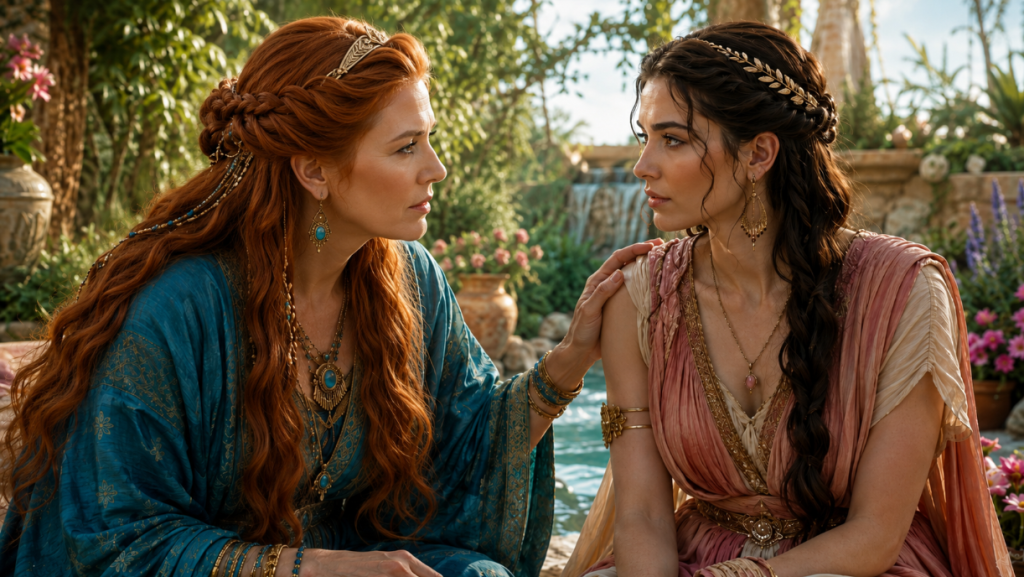
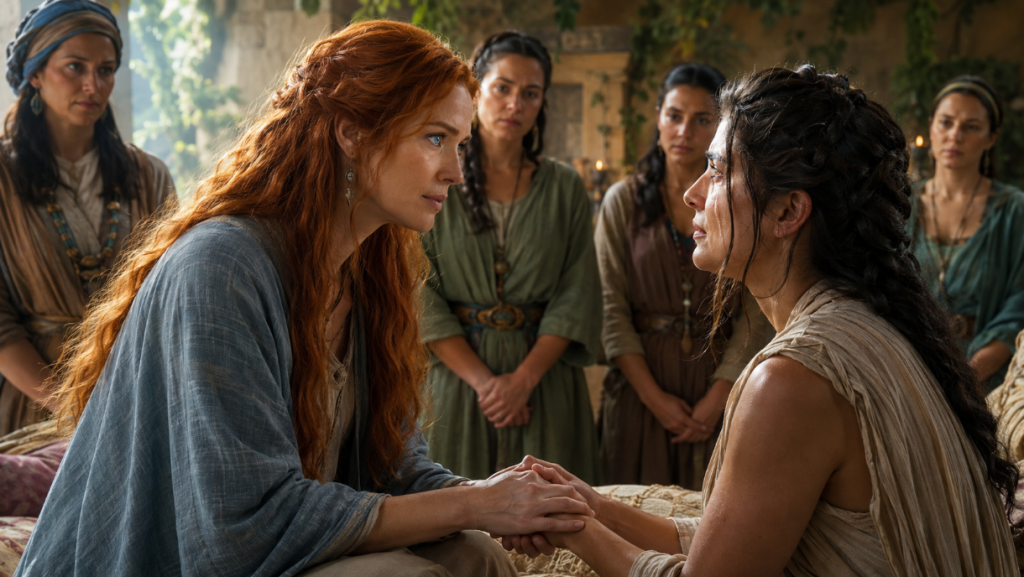
Yet exile did not end the intrigue.
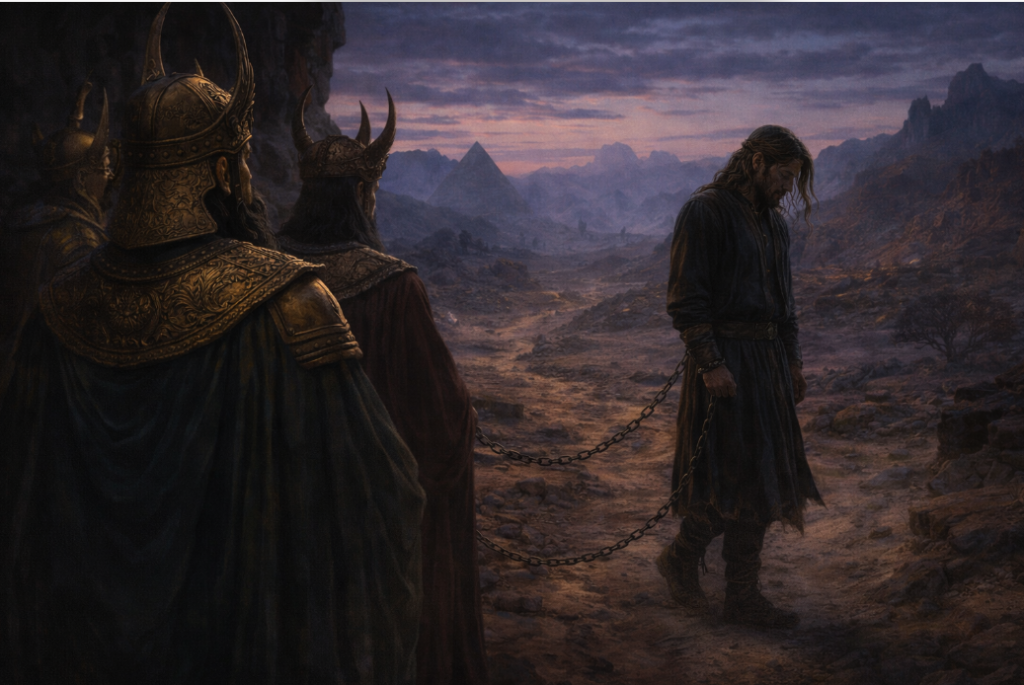
Abgal, the pilot entrusted with choosing Enlil’s place of banishment, had helped Enki hide Alalu’s nuclear weapons. But Abgal betrayed Enki and revealed the hidden missiles to Enlil. Quietly, he shifted allegiance. He told Enlil that when the time came, he could seize those weapons, restore his freedom, and prevail over his rivals.
So even in disgrace, Enlil gained the means for future power.



Enlil in Exile — Reflection and Resolve
Under the vast, unyielding light of the African sun, Enlil stands alone in a rugged and untamed landscape. The rocky terrain stretches endlessly toward distant mountains, emphasizing both his isolation and the magnitude of his fall. Stripped of power and dressed in simple, worn garments, he appears humbled—but not broken.

His long hair hangs loose, and his posture, though slightly bowed, carries a quiet strength. In his expression lies a turning point: reflection, consequence, and the first stirrings of transformation. No court surrounds him, no authority shields him—only the raw presence of the land and the weight of his own choices.
This moment marks not just exile, but the beginning of inner change.


In a sunlit African landscape. Sud, golden brown, long hair, blue eyes, approaches Enlil from a distance. Enlil, with long brown hair and blue eyes, turns toward her, surprised but hopeful. The land is bright, expansive, and open. Mood: reunion, uncertainty, hope.


Sud Becomes Ninlil
While Enlil remained in Africa, Sud’s womb swelled.
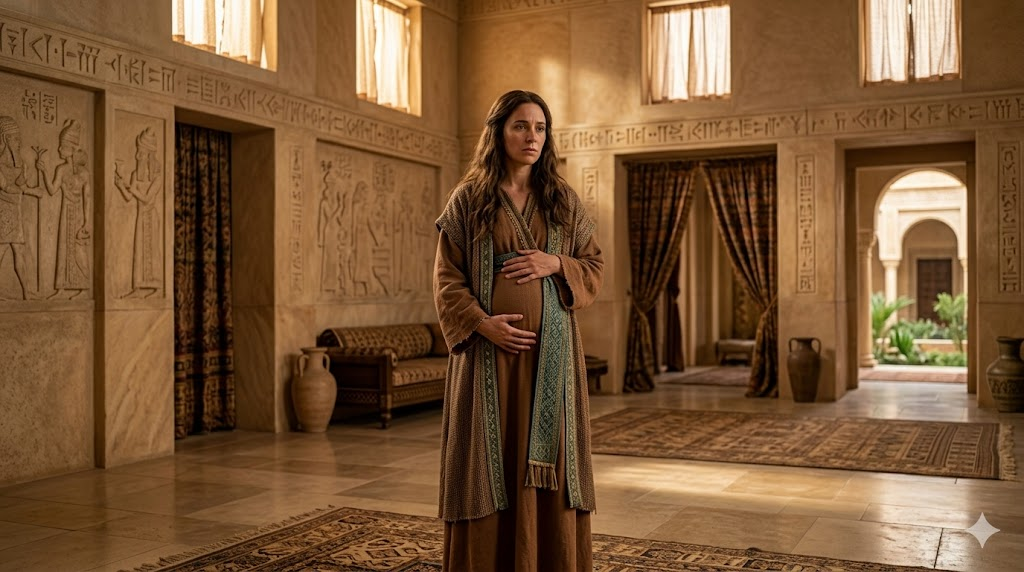
In Sumer, the tribunal and Enki sympathized with her plight. They asked whether she would marry Enlil if he made her his royal wife. She agreed.
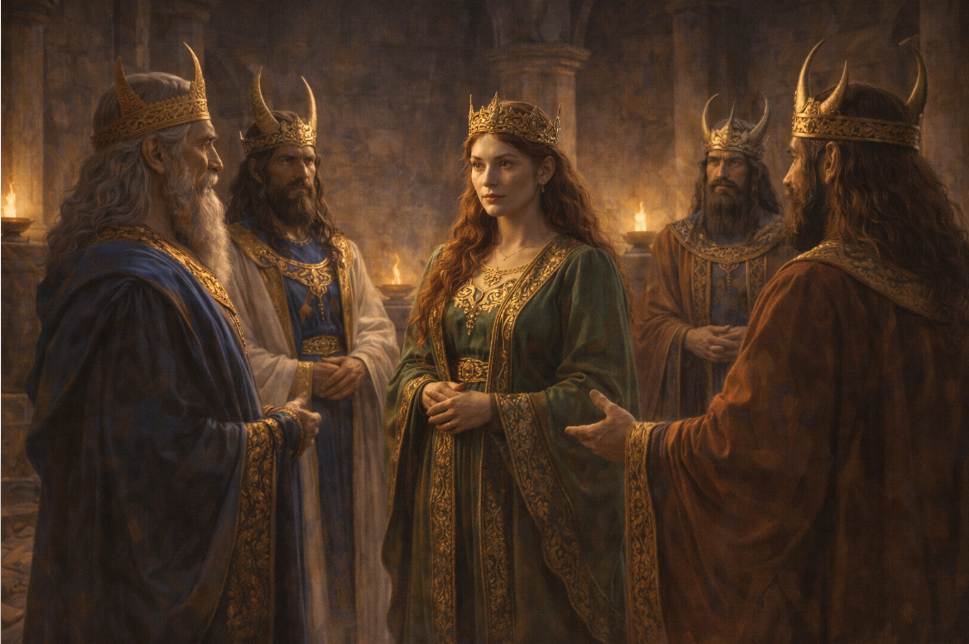
Several dignified figures, including Ninmah, stand in calm discussion. Ninmah, with long red hair and regal green-and-gold attire, stands at the center, composed and wise.
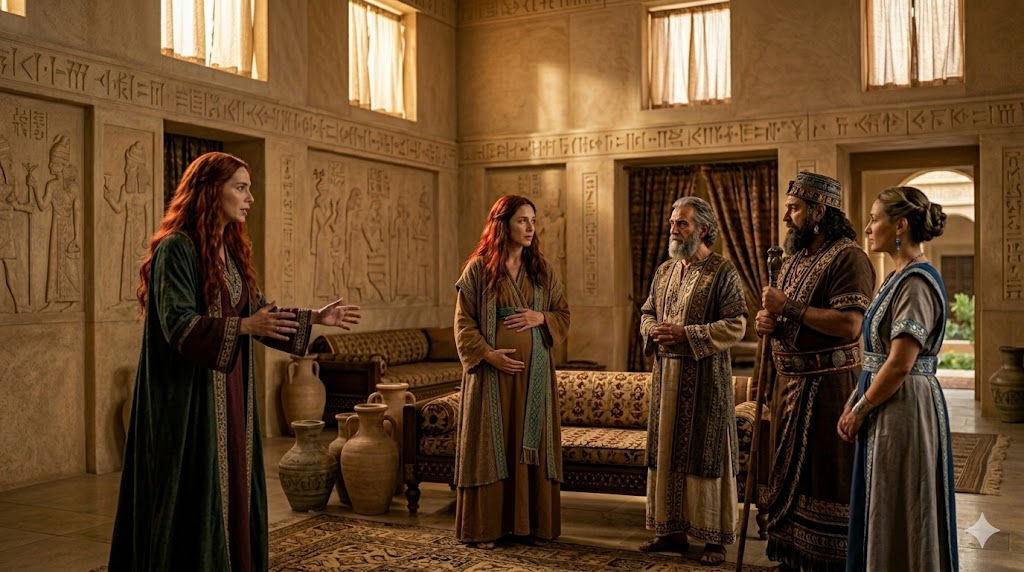
“The Proposal”
Sud stands before Ninmah and the tribunal. Ninmah speaks gently, her hand slightly extended. Sud listens, her posture attentive, her expression shifting toward acceptance.
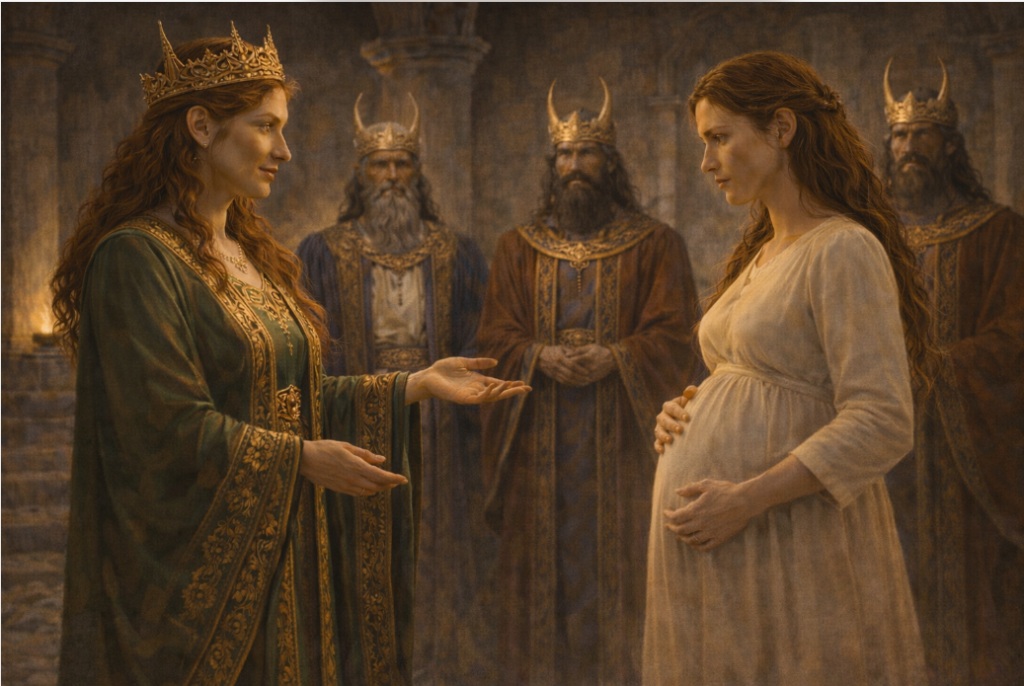
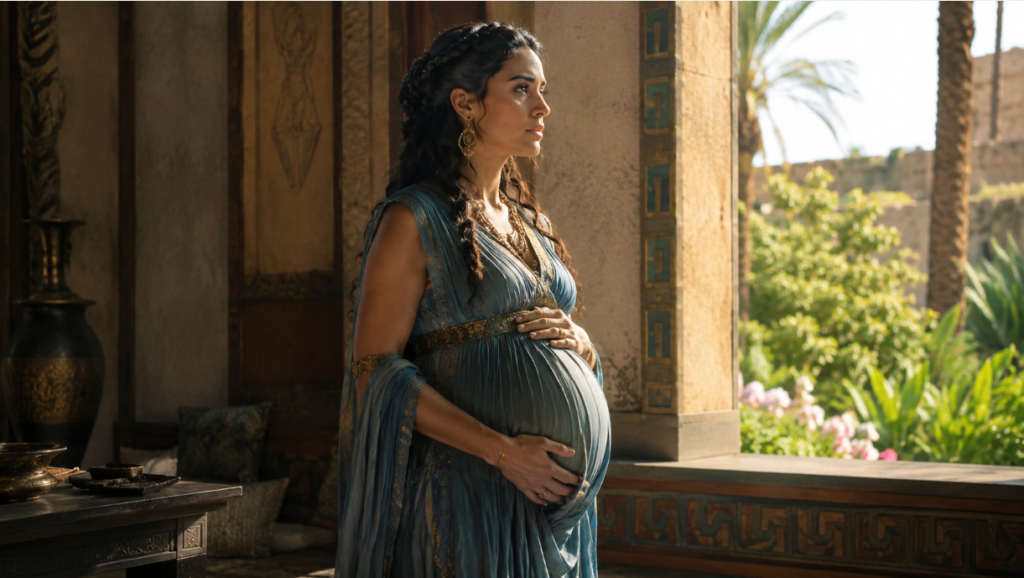
“Reunion in Africa”
Sud approaches Enlil from a distance. Enlil turns toward her, surprised but hopeful. The land is bright, expansive, and open.
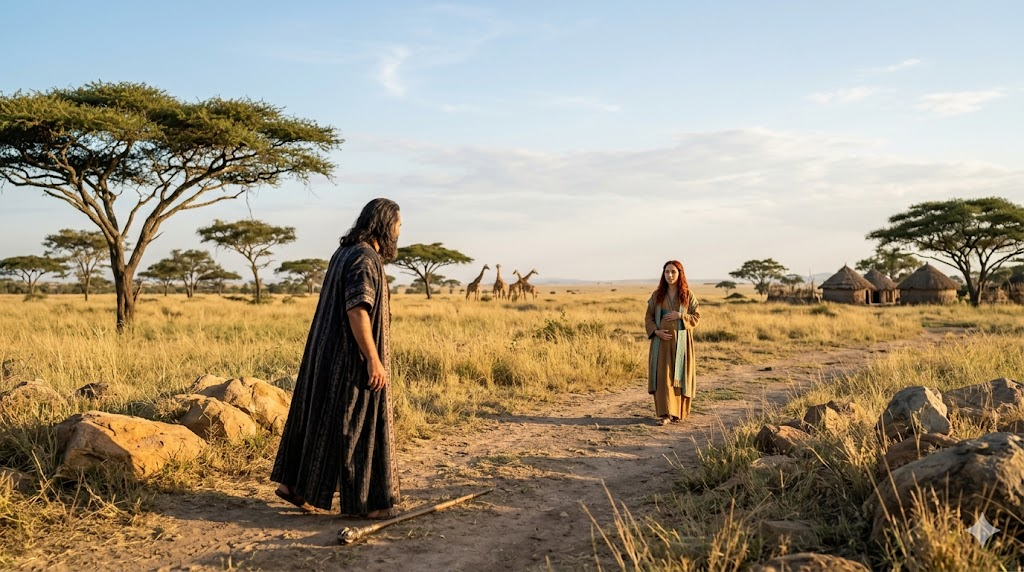

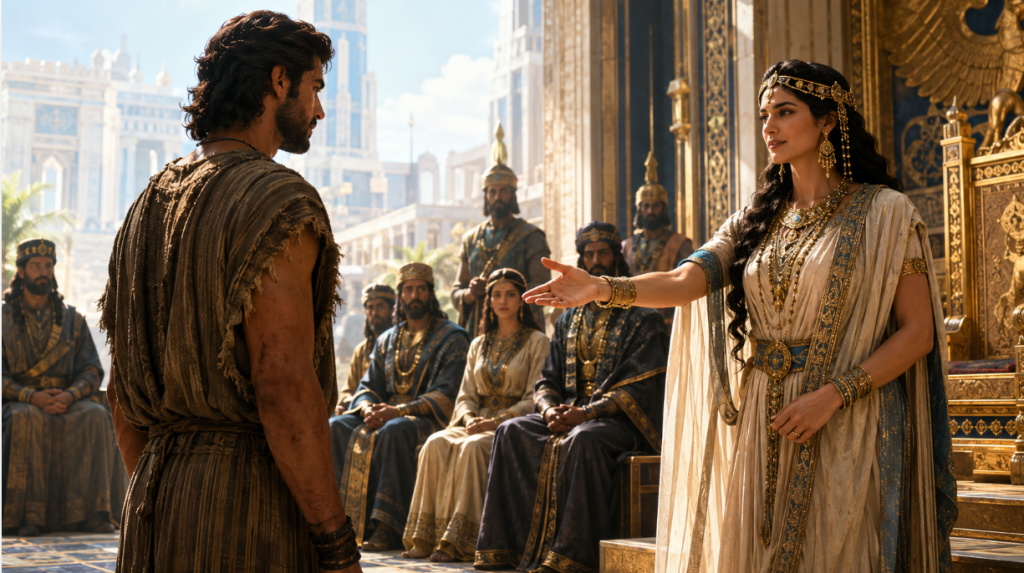
Enlil returned, married Sud, and she became Ninlil, Lady of Command. She bore Nannar — described here as the first Nibiruan royal born on Earth — and later Adad, also called Ishkur.
Marriage did not erase the violence that preceded it. But it restored Sud’s status and folded the scandal back into dynastic order, as power structures so often do.
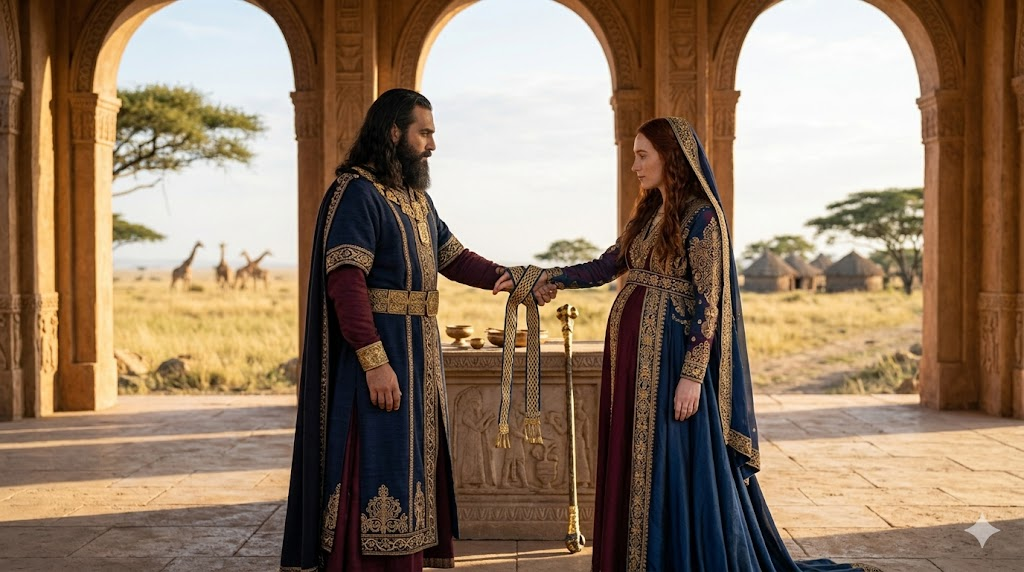
Violation became legitimacy. Injury became an institution. Trauma became dynasty.
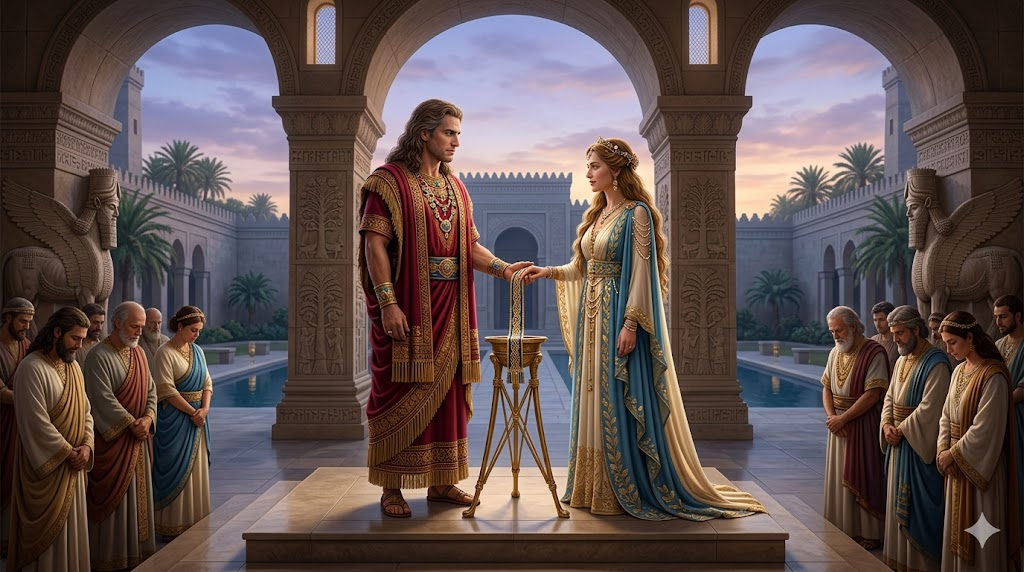
“Sacred Marriage”
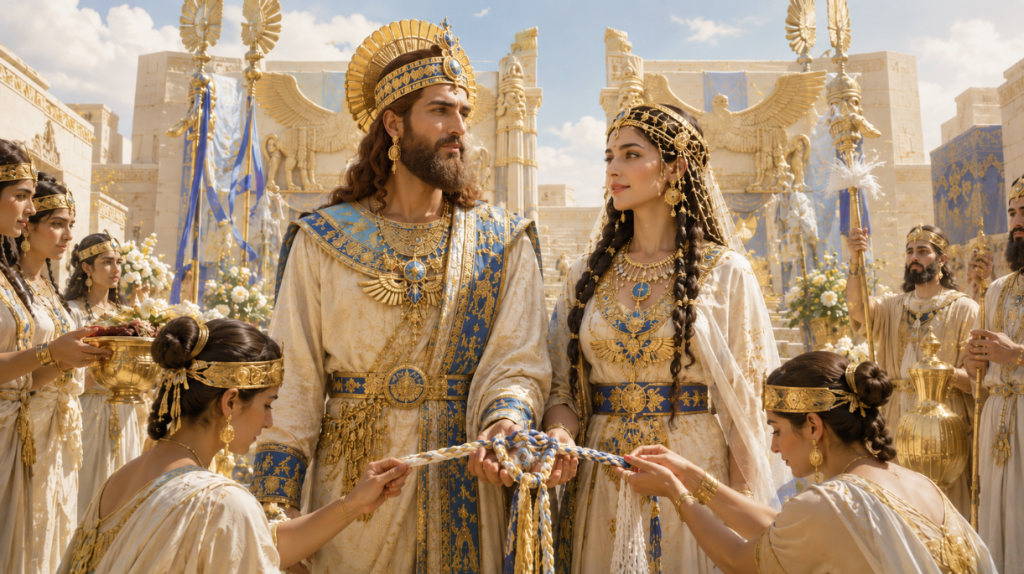
Enlil and Sud are standing together in ceremonial attire. Both wear elegant garments with gold accents. A symbolic joining gesture (hands together or a ceremonial band) is performed. Architecture is grand but serene. Mood: union, legitimacy, sacred bond.

“Crowned King and Queen”
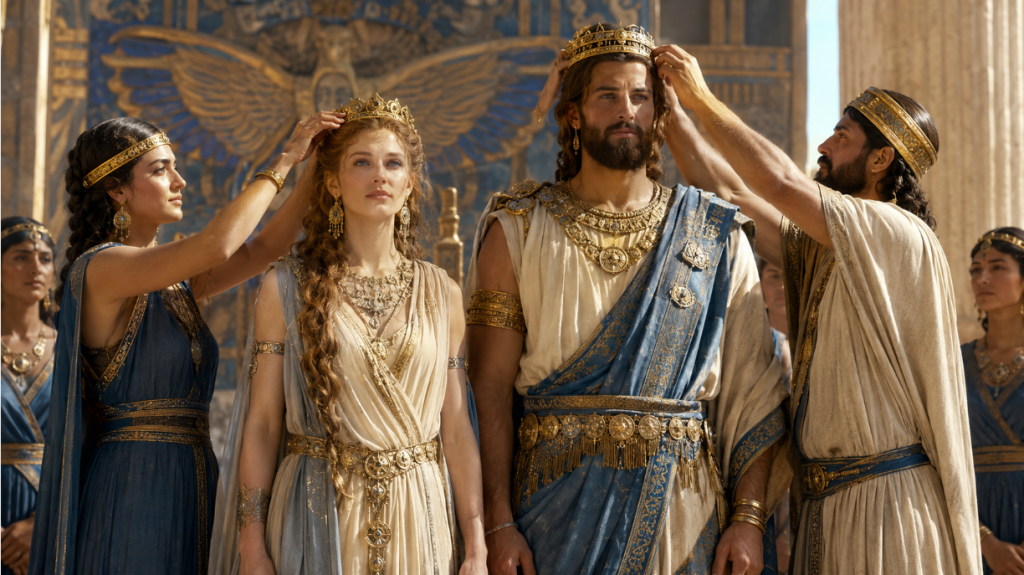
Enlil and Sud are being crowned. They stand side by side, wearing royal crowns. Attendants or elder figures stand nearby.
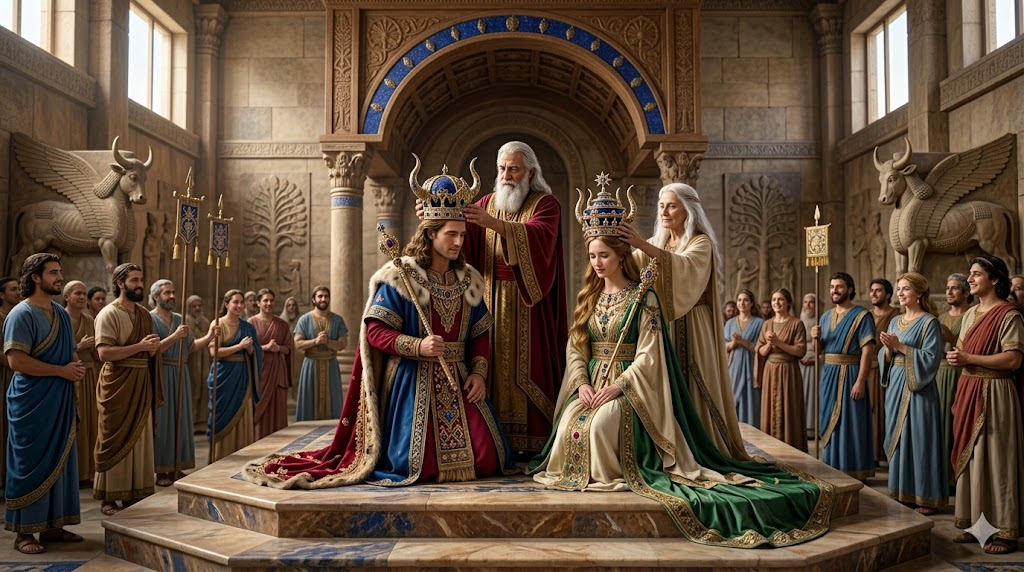

Sud becomes Ninlil, and violation is absorbed into dynasty, title, and royal legitimacy.