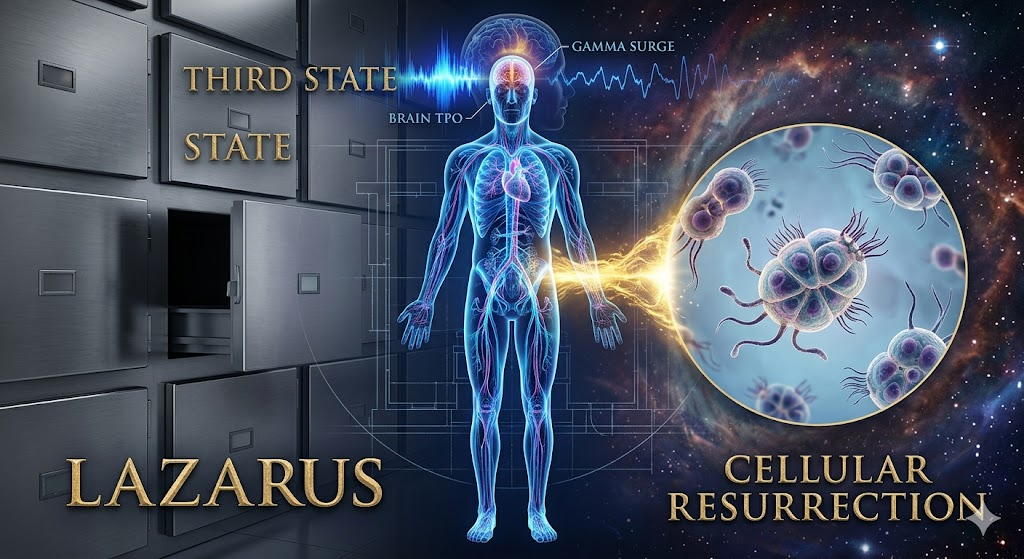
The Twilight Frontier: Cellular Resurrection and the Organ Harvesting Industry
By Janet Kira Lessin, Researchers/Contributors: Gemma Genesis, Minerva Monroe & Claudia Lenore © 2026 Aquarian Media
The definitive line between life and death is dissolving. Modern science now identifies a “third state” of existence—a biological twilight where cells from deceased organisms reorganize and perform entirely new functions. This discovery converges with thousands of documented “Lazarus” cases where individuals pronounced legally dead returned to consciousness. These phenomena suggest that the medical definition of death serves the logistics of the organ transplant industry more effectively than it describes biological reality.
[Image Prompt: A high-contrast, cinematic medical illustration showing a glowing, iridescent “bridge” of light connecting a human heart to a microscopic view of self-assembling biobots. The aesthetic is professional, sleek, and slightly eerie, using deep blues and vibrant golds.]
The Third State: Life Beyond the Organism
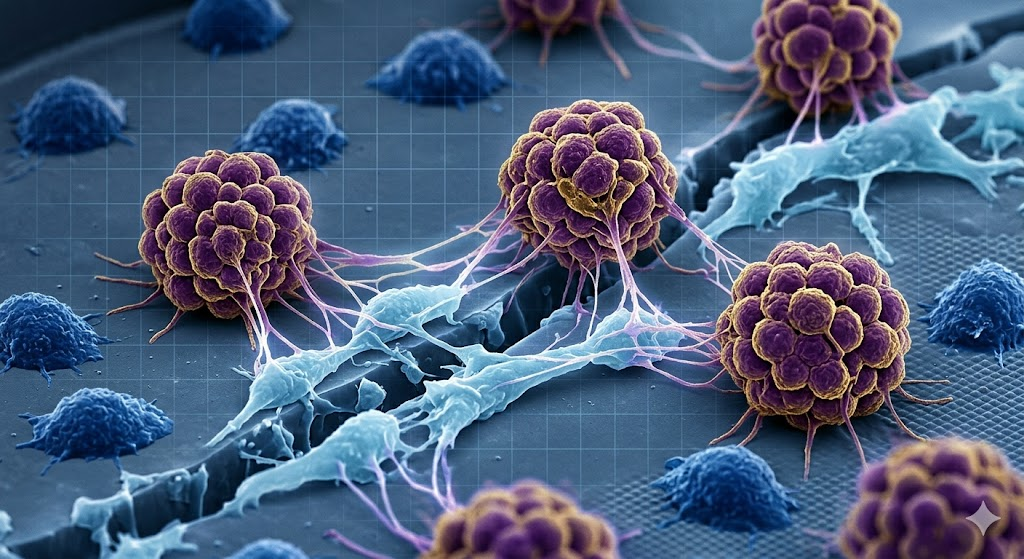
Biologists Peter Noble and Alex Pozhitkov recently documented the “third state” in the journal Physiology. Their research confirms that cells from deceased organisms, when provided with specific environmental triggers such as oxygen and bioelectrical signals, bypass decay. Instead, they self-assemble into multicellular life-forms called “biobots.”
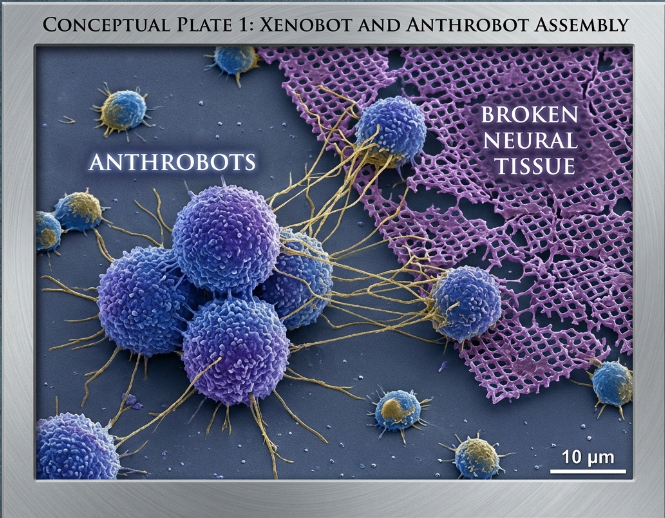
This process first appeared in “xenobots,” created from the skin cells of deceased frog embryos. Without genetic instructions, these cells formed mobile entities capable of independent movement and “kinematic self-replication”—the act of sculpting loose cells into functional copies of themselves. Human lung cells exhibit similar behavior, forming “anthrobots” that navigate environments and actively repair damaged neural tissue. Death, at the cellular level, acts as a catalyst for new biological complexity rather than a terminal end.
[Image Prompt: A microscopic view of human anthrobots—tiny, hair-like multicellular structures—navigating a petri dish and weaving together damaged nerve fibers. The image should look like a high-resolution scanning electron microscope (SEM) capture with false-color enhancement.]
The Dying Brain: A Surge of Awareness
Research into the neurobiology of death challenges the “fading light” narrative. University of Michigan neuroscientist Jimo Borjigin discovered a paradoxical surge of gamma-wave activity in the brains of patients following the removal of life support. This high-frequency activity, associated with lucid consciousness and memory integration, concentrates in the brain’s sensory processing regions.
This data aligns with reports from the University of Virginia’s Division of Perceptual Studies. Near-death experiencers (NDEs) consistently report heightened clarity and multi-sensory encounters during periods where monitors show zero electrical brain activity. These accounts remain vivid and unchanged for decades, suggesting a state of “expanded awareness” that standard models of hallucination fail to explain.
Lazarus Syndrome: The Reality of Autoresuscitation
Medical literature defines “Lazarus Syndrome” as the spontaneous return of cardiac rhythm after failed CPR and a formal declaration of death. While the establishment treats these as anomalies, documented cases are frequent. In 2014, a Mississippi man woke in a body bag at a funeral home nearly twelve hours after being pronounced dead. In 2020, a Detroit woman was discovered alive by morticians hours after a physician declared her deceased via telephone.
Surveys indicate that nearly half of French emergency room physicians and one-third of Canadian intensive care doctors have witnessed autoresuscitation. The actual frequency remains obscured by the significant legal and professional risks associated with admitting a living person who was labeled dead.
The DNR-to-Donor Pipeline
The intersection of “Donation after Circulatory Death” (DCD) and the Lazarus window presents a dark ethical conflict. Under DCD protocols, surgeons begin harvesting organs as early as two to five minutes after the heart stops. This timeframe sits directly within the primary window for autoresuscitation.
To prevent the “risk” of a donor regaining consciousness during the harvest, some surgical teams utilize “normothermic regional perfusion” (NRP). This procedure involves surgically blocking blood flow to the brain while restoring circulation to the rest of the body via an ECMO bypass. The American College of Physicians notes that this technique is specifically designed to prevent the restoration of brain function. In 2021, a woman with a brain aneurysm self-resuscitated on the operating table during kidney removal. Her case entered the literature; many others remain unrecorded.
[Image Prompt: A conceptual architectural drawing of a “DNR-to-Donor” pipeline, depicted as a cold, industrial surgical suite transitioning into a sterile, high-tech organ transport hub. Use sharp angles and a clinical, monochromatic color palette.]
Redefining the End
The “brain death” standard, established in 1968, remains a social and legal construct designed to facilitate transplantation. A “brain-dead” body continues to metabolize, heal, and in some cases, gestate infants. The boundary between life and death is increasingly permeable and dictated by institutional needs.
A “Do Not Resuscitate” (DNR) order, when paired with organ donor status, creates a pathway where the machinery of procurement begins before the biological possibility of recovery ends. True consent requires acknowledging that the legal declaration of death is often a premature conclusion to a complex biological transition.
The Bells & Whistles Package
Deep Dive & Subscriber Exclusives
- The Biobot Blueprint: Access our technical breakdown of the Noble-Pozhitkov study, including the specific bioelectrical signals that trigger cellular reorganization.
- The Lazarus Logs: A comprehensive, unabridged list of all 63 peer-reviewed autoresuscitation cases, including recovery times and long-term outcomes.
- The “Ligation” Brief: A detailed investigation into the American College of Physicians’ stance on NRP and the legal maneuvers used to bypass the “Dead Donor Rule.”
- Archival Audio: Listen to our 2025 interview with NDE researchers regarding the “Gamma Surge” and what it implies for the soul’s transition.
Mahalo for reading. To get the full story, including our investigative files on the global organ trade, join the community at https://substack.com/@janetalexlessinphd. Your subscription directly funds the Kira’s Cat Colonies and our mission to restore historic sanctuaries for animals and conscious humans alike.
1. The Header / Featured Image: “The Twilight Frontier” Summary Collage
[Image_0: Generative Image Prompt] A cinematic, complex collage visual that serves as a summary of the entire article. The central image is a high-contrast, professional medical illustration of a human body in transition—a glowing, iridescent digital blueprint showing neural pathways and the heart. A vibrant, golden ‘bridge of light’ connects this body to a microscopic inset showing human lung cells self-assembling into mobile biobots. Surrounding this center, various conceptual layers merge: the background transitions from a clinical morgue drawer on one side to a starry, consciousness-expanding cosmic background on the other. Woven throughout are subtle, abstract representations of brainwaves (the ‘gamma surge’), a faint outline of the “DNR-to-Donor pipeline” architectural plan, and stylized text elements reading ‘THIRD STATE,’ ‘LAZARUS,’ and ‘CELLULAR RESURRECTION.’ The overall tone is sophisticated, slightly eerie, and deeply reflective. (Style: Cinematic, highly detailed, high-contrast illustration.)
2. Conceptual Plate 1: “Xenobot and Anthrobot Assembly”
[Image_1: Generative Image Prompt] A high-resolution, false-color scanning electron microscope (SEM) capture, presenting a close-up visualization of human anthrobots. The image details solitary human lung cells spontaneously coalescing into intricate, spherical, multicellular forms. These miniature “biobots” are actively weaving together broken neural tissue, bridging the gap across a surface that resembles a petri dish. The aesthetics are sleek and professional, using vibrant blues, deep purples, and rich golds to differentiate the cells from the synthetic repairing process. (Style: High-resolution scientific SEM visualization with false-color enhancement.)
3. Conceptual Plate 2: “The Gamma Resonance”
[Image_2: Generative Image Prompt] A professional, detailed illustration analyzing the dying brain, presented in a style that resembles a cinematic, interactive medical exhibit. It shows a human cerebral cortex in cross-section. The view is focused on the junction of the temporal, parietal, and occipital lobes. This entire junction point is radiating with a localized, intense ‘gamma surge,’ visualized as a bright, swirling network of high-frequency, cobalt-blue energy. This surge stands out in sharp, luminous contrast against the dark, static, gray matter of the rest of the brain. The composition conveys heightened, lucid consciousness within a failing biological structure. (Style: Sleek, deep-space black background, high-contrast neural architecture illustration.)
4. Conceptual Plate 3: “The DNR-to-Donor Pipeline”
[Image_3: Generative Image Prompt] A cold, industrial, yet high-tech conceptual schematic of the “DNR-to-Donor Pipeline.” The image functions as a flow chart built into an architectural cross-section of a facility. It shows the logical and procedural progression from a sterile hospital room (labeled ‘DNR STATUS’) directly following a patient’s ‘Declaration of Pulselessness.’ The pathway is depicted as a cold, industrial surgical suite (labeled ‘DCD WINDOW’) that immediately transitions into a high-tech organ transport hub (labeled ‘PROCUREMENT’). The final ‘EXIT’ pathway branches, contrasting a conceptual visualization of the standard Lazarus window and subsequent potential recovery against the closed loop of organ harvest. The aesthetics use sharp angles and a monochromatic, clinical blue and steel color palette. (Style: Conceptual schematic and flow-chart cross-section.)
