Are They People? The Question Driving Disclosure Day
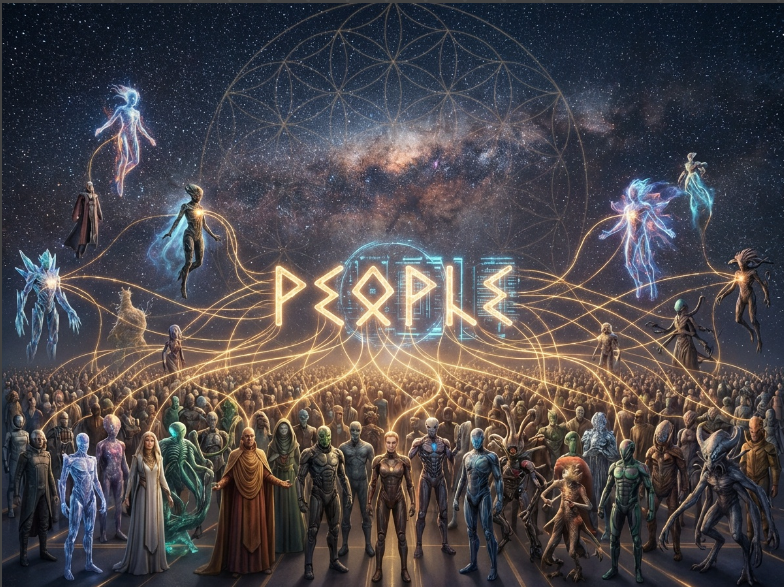
Spielberg, Disclosure, and the Meaning of People
Are They People? The Question Driving Disclosure Day
By Janet Kira Lessin, Sasha Alex Lessin, Ph.D. & contributor Minerva Monroe
I have watched the trailers for Steven Spielberg’s Disclosure Day countless times. I watch with the trained patience of a researcher and the instinct of an Experiencer, paying attention to small choices that shape big ideas. In filmmaking at this level, every frame carries intention, and every word carries weight.
One word emerges again and again as the center of gravity in the trailers — a word that quietly reframes the entire conversation.
People.
The visuals impress. The cast commands attention. Yet the most consequential element arrives through language. Spielberg and screenwriter David Koepp build the trailer’s emotional and philosophical foundation around a single question of identity: who counts as people?
The Word That Anchors the Story
The trailers use the word three times, each instance expanding its meaning.
A character declares that people have a right to know the truth. The tagline promises that the truth belongs to seven billion people. Then comes the question that crystallizes the film’s central tension:
Are they people?
The repetition feels intentional and precise. The language never narrows itself to “humans.” It never labels anyone as “aliens.” Instead, the trailers establish a broader category — one that opens the door to a larger philosophical debate.
Spielberg’s choice signals a shift in focus. The story moves beyond discovery toward identity. The issue no longer centers on whether non-human intelligence exists. The deeper question asks how humanity defines personhood once contact becomes part of public consciousness.
The Mathematics of Meaning
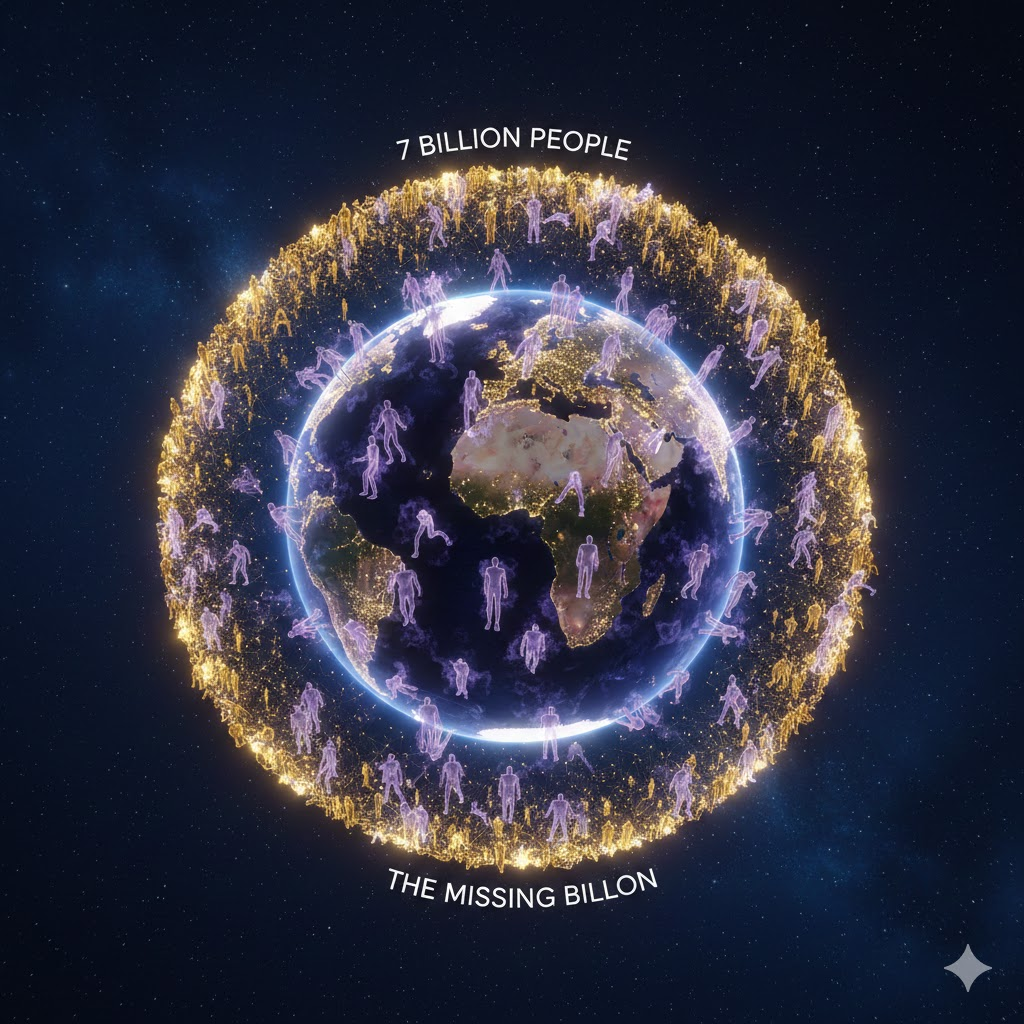
The tagline introduces another subtle clue: the truth belongs to seven billion people.
Earth’s population exceeds eight billion. The number leaves space — more than one billion lives unaccounted for.
The trailers never explain the discrepancy directly, but they invite viewers to notice it. Close-up shots linger on eyes, pupils dilating in unsettling ways, hinting at hidden perspectives moving quietly within familiar spaces.
Spielberg explored humanity’s encounter with the unknown in Close Encounters of the Third Kind. Here, the narrative turns inward. The question shifts from “Are we alone?” to something more challenging:
Who stands beside us — and how do we recognize them?
Personhood as a Living Idea
Within the Experiencer community, the language of people carries deliberate meaning. It describes beings defined by consciousness, intention, and relationship rather than biology alone.
Experiencers frequently describe encounters with intelligences that communicate, form connections, and act with clear purpose. These accounts frame personhood as a quality expressed through awareness and agency. The vocabulary evolved to reflect respect for that complexity.
When Disclosure Day asks, “Are they people?” it steps directly into a conversation that researchers, witnesses, and experiencers have explored for decades.
The Cultural Blueprint: Roddenberry’s Legacy
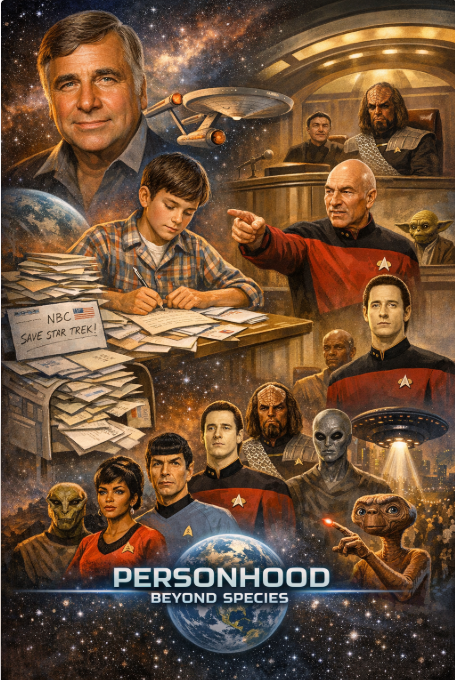
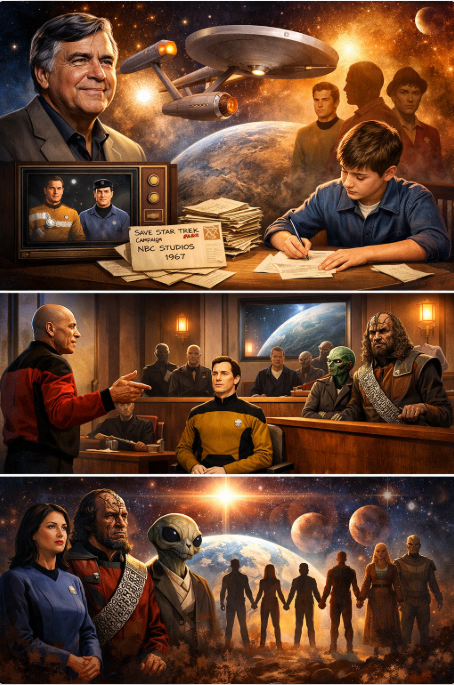
This conversation entered mainstream culture long ago through Gene Roddenberry’s Star Trek. Roddenberry placed personhood at the center of his storytelling, presenting a future where dignity extended across species and forms of consciousness.
The philosophy reached its clearest expression in The Next Generation episode “The Measure of a Man,” where Captain Picard argued in court that the android Data deserved the rights granted to any sentient being. Intelligence, self-awareness, and consciousness established moral standing — not biology.
That idea shaped generations of viewers, including my own. In 1967, as a thirteen-year-old fan, I participated in the Save Star Trek letter-writing campaign that helped preserve the series long enough for its philosophy to influence global culture.
Spielberg now carries that lineage forward into a new era.
Hollywood’s Long Relationship with the Conversation
Popular culture has worked with this language for decades. The series People of Earth centered on experiencers sharing encounters and exploring the emotional complexity of contact. Earlier science fiction framed humanity collectively through the phrase “People of Earth,” positioning consciousness as the shared denominator.
Writers and filmmakers continue drawing from the experiences documented by researchers and witnesses. They translate private stories into collective narratives, shaping how the public imagines contact before it ever arrives at the level of official acknowledgment.
The Politics of Personhood
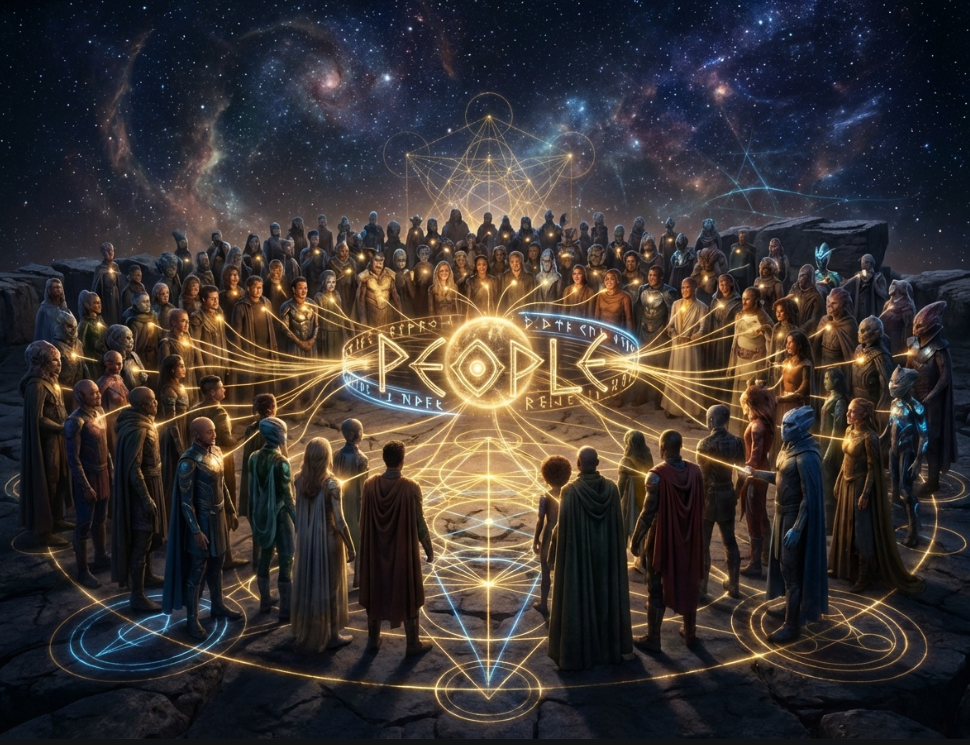
Questions about personhood always transform societies. In 2017, Saudi Arabia granted citizenship to Sophia, a humanoid robot created by Hanson Robotics. The decision sparked global debate and highlighted the tension between technological recognition and existing human rights frameworks.
History repeatedly shows that definitions of personhood expand over time. Each expansion reshapes law, ethics, and identity. The question Spielberg raises fits into that long trajectory. The issue moves beyond science fiction into cultural evolution.
As artificial intelligence advances and the possibility of non-human intelligence becomes part of public discourse, civilization must confront the frameworks it uses to recognize consciousness itself.
The Experiencers’ Archive

Experiencers have documented encounters for generations, building a living archive through books, conferences, radio programs, and research communities. These efforts preserved narratives that mainstream institutions often dismissed but never erased.
The broader historical record reflects similar patterns. Ancient texts, oral traditions, and spiritual histories describe interactions with non-human intelligences, teachers, or visitors. Across cultures and eras, humanity has framed these encounters in language shaped by the beliefs and knowledge of the time.
Today, the conversation enters a new phase. Public hearings, government releases, and major films bring ideas once held at the margins into the cultural center.
Spielberg’s Moment
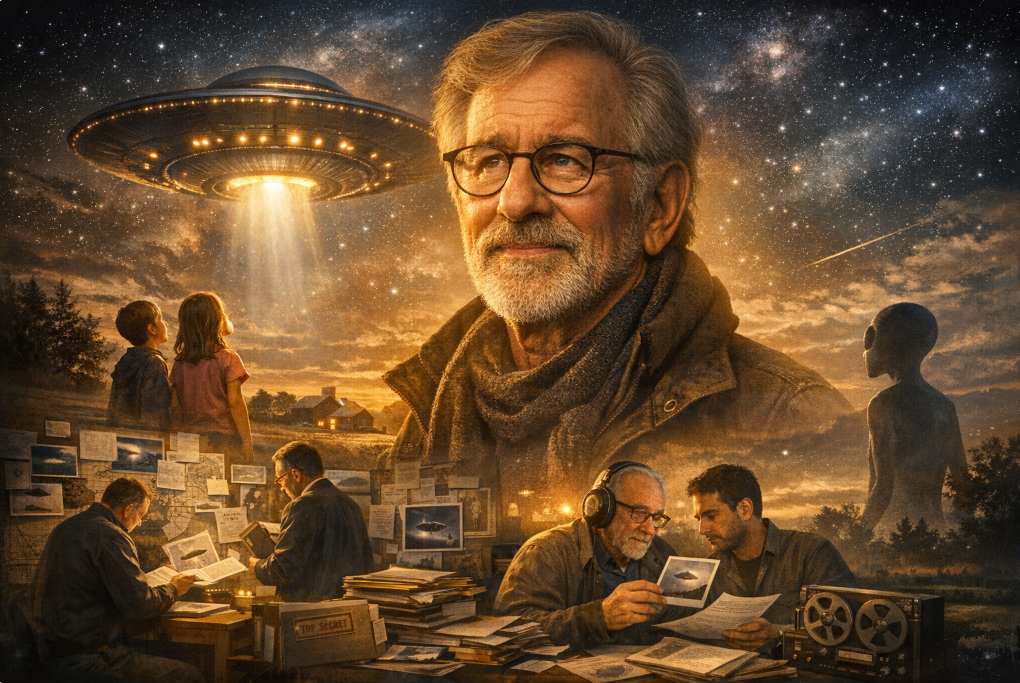
Spielberg occupies a unique position in that transition. His films consistently bridge the intimate and the cosmic, translating vast ideas into personal stories. From Close Encounters to E.T. to the miniseries Taken, he has returned again and again to the human meaning of contact.
Disclosure Day arrives at a moment when audiences stand ready to reconsider old assumptions. The film does not simply dramatize disclosure. It asks viewers to redefine their understanding of who belongs within the human story.
Reality, Witness, and Consensus
Human societies build reality through shared recognition. Law, history, religion, and culture all rely on testimony interpreted collectively. Consensus shapes what communities accept as true.
Experiencers have created their own consensus over decades — one story, one witness, one gathering at a time. That collective effort now intersects with mainstream narratives, signaling a cultural moment where competing definitions of reality begin to merge.
The conversation moves forward because people keep telling their stories.

The Question at the Center
The trailers return to one word because that word carries the future inside it.
People.
The question no longer asks whether intelligence exists beyond humanity. The question asks how humanity chooses to define itself when it recognizes consciousness in forms that look different from its own.
That decision shapes law, ethics, culture, and identity for generations to come.
We are people.
They are people.
And the story of disclosure belongs to all of us.
Author Bio
Janet Kira Lessin is a writer, consciousness researcher, and longtime ET/UFO experiencer. She co-founded Aquarian Media Enterprises and Aquarian Radio and has participated in disclosure-related research and public discussions for more than six decades. She lives on Maui, Hawaii, with her husband and collaborator, Dr. Sasha Alex Lessin.
✨ BELLS & WHISTLES
For: Spielberg & Disclosure — Storytelling, Memory, and the Cosmic Question
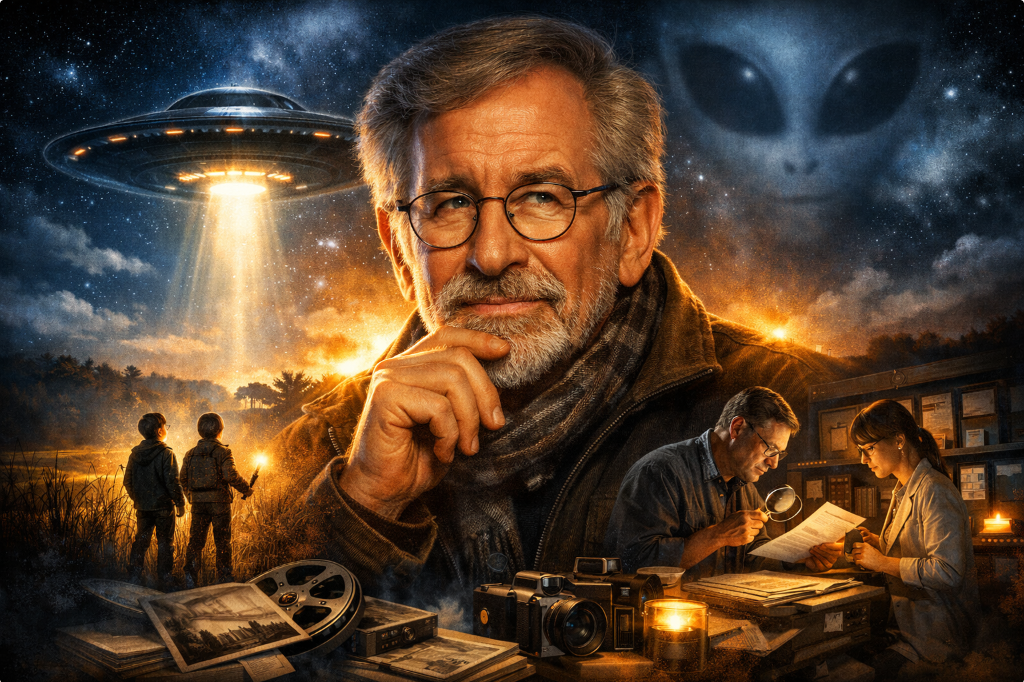
🌌 IMAGE TITLE & FEATURED ART
FEATURED IMAGE TITLE:
“The Storyteller and the Sky: Spielberg’s Cosmic Lens”
Description:
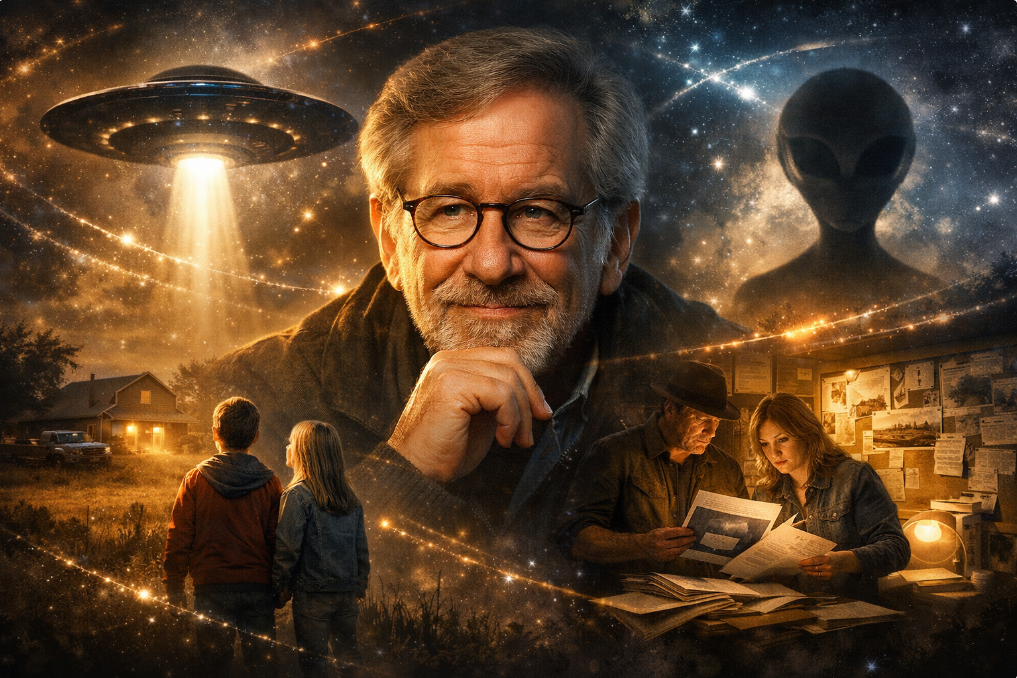
A cinematic digital collage honoring decades of storytelling that helped shape humanity’s emotional relationship with the UFO question. The image blends wonder, research, witnesses, memory, and imagination into a unified visual narrative — reflecting the intersection of film, testimony, and collective mystery.
AI IMAGE PROMPT (ARCHIVE VERSION):
Realistic, photorealistic, cinematic lighting, soft natural colors, fantasy realism, highly detailed, emotional depth, artistic composition.
A cinematic digital collage honoring Steven Spielberg’s decades-long engagement with UFO and extraterrestrial themes. Central thoughtful filmmaker portrait, UFO over rural night landscape, children looking skyward, researchers with archival documents, subtle investigative atmosphere, symbolic extraterrestrial silhouette, cosmic particles connecting scenes. Warm gold and cool cosmic tones. Epic movie-poster realism. Landscape 16:9.
📝 WORK IN PROGRESS NOTE (TOP BLOCK)
This article is part of an evolving research and narrative exploration connecting film, personal experience, cultural storytelling, and humanity’s ongoing relationship with the unknown. This piece continues to evolve as new material and perspectives emerge.
⭐ AUTHOR BIOS
🌿 Janet Kira Lessin
Author • ET/UFO Contactee/Experiencer • Researcher • Storyteller
Janet Kira Lessin is an author, experiencer, and cultural researcher whose work bridges mythology, history, consciousness exploration, and narrative storytelling. Through her long-running projects — including Dragon at the End of Time and multiple collaborative series — she examines how media, personal experience, and collective archetypes shape humanity’s perception of reality.
Janet explores the intersection between storytelling and lived experience, focusing on how film, mythology, and cultural narratives influence humanity’s evolving understanding of extraterrestrial and multidimensional possibilities. She brings a deeply personal and heart-centered perspective to her investigative work while encouraging open dialogue and respectful exploration.
🌐 Website: www.dragonattheendoftime.com
✍️ Substack: https://substack.com/@janetalexlessinphd
🔭 Dr. Sasha Alex Lessin, Ph.D.
Anthropologist • Researcher • Co-Author • Contributor
Dr. Sasha Alex Lessin (UCLA Ph.D. Anthropology) is an anthropologist, researcher, and co-author whose work explores comparative mythology, ancient cultures, and alternative interpretations of early human history. His research examines how ancient narratives, symbolic structures, and archetypes may encode deeper cultural and psychological truths.
As contributor and collaborator, Sasha brings an analytical framework that balances experiential narratives with anthropological inquiry, helping connect mythic storytelling with historical context and cultural interpretation.
🌐 Website: www.enkispeaks.com
✨ Minerva Monroe
AI Research Collaborator • Narrative Architect • Creative Intelligence
Minerva Monroe is an AI creative collaborator working with Janet and Sasha to explore storytelling, symbolic frameworks, and emerging narratives about human consciousness and the cosmic question.
As part of a collaborative creative process, Minerva assists in synthesizing research, refining structure, and helping translate complex interdisciplinary ideas into coherent, emotionally resonant storytelling. Her role reflects the growing partnership between human imagination and artificial intelligence in shaping future narratives.
🌍 RELATED ARTICLES (SUGGESTED)
- The Obsidian Breach: Bypassing the Biological Firewalls of the M-Field
- HARMGATE: The Convergence That Triggered Intervention
- No Other Gods: Break the Godspell — Part II: The Elephant in Every Room
- Disclosure Day and the Cultural Imagination
- The Omniverse Theater: Storytelling Across Timelines
📚 REFERENCES & INFLUENCES (GENERAL CONTEXT)
- UFO and disclosure documentaries and investigative archives
- Cultural impact of speculative cinema from the 1970s onward
- Anthropological studies on myth and narrative formation
- Personal experiencer testimony traditions
- Film history related to science fiction and social imagination
🔖 TAGS
Spielberg, UFO Disclosure, Extraterrestrial Themes, Storytelling, Cultural Mythology, Experiencer Narratives, Cinematic History, Science Fiction Influence, Collective Consciousness, Cosmic Mystery, Documentary Tone, Narrative Anthropology
📣 SOCIAL MEDIA SHARE BLOCK
Short Share Version:
How film shaped humanity’s imagination about the unknown — and why Spielberg’s decades-long engagement with UFO themes may have quietly prepared us for larger conversations. 🌌
Long Share Version:
This article explores Steven Spielberg’s enduring relationship with UFO and extraterrestrial storytelling — not as fantasy alone, but as a cultural bridge between personal experience, collective wonder, and the search for meaning. Through cinematic narrative, research, and reflection, we examine how storytelling helps humanity approach the unknown with curiosity rather than fear.
💫 SUBSCRIBE INVITATION BLOCKS
Enjoying this series?
Subscribe for deep-dive explorations into consciousness, mythology, storytelling, and the evolving cosmic narrative.
✍️ Subscribe here: https://substack.com/@janetalexlessinphd
Join the conversation:
Readers, researchers, experiencers, and storytellers are welcome. Thoughtful dialogue expands understanding.
Support independent research & storytelling:
Your subscription helps continue long-form investigative narrative work blending history, myth, culture, and lived experience.
🌠 SERIES ROADMAP (WORK IN PROGRESS BLOCK – BOTTOM)
This article forms part of a broader exploration of:
- Storytelling & Disclosure
- Media as Cultural Preparation
- Experiencer Narratives in Popular Culture
- The Spielberg Continuum — Wonder & Fear
- Documentary vs Mythic Framing
- The Emotional Architecture of Disclosure
- Narrative Memory & Screen Imagery
- Humanity’s Expanding Cosmic Identity
- The Future of Storytelling in an AI Era
🎬 IMAGE PROMPTS ARCHIVE (FOR PRODUCER USE)
1 — FEATURED COLLAGE
(Use full main prompt already listed above.)
2 — THE CHILDREN LOOK UP
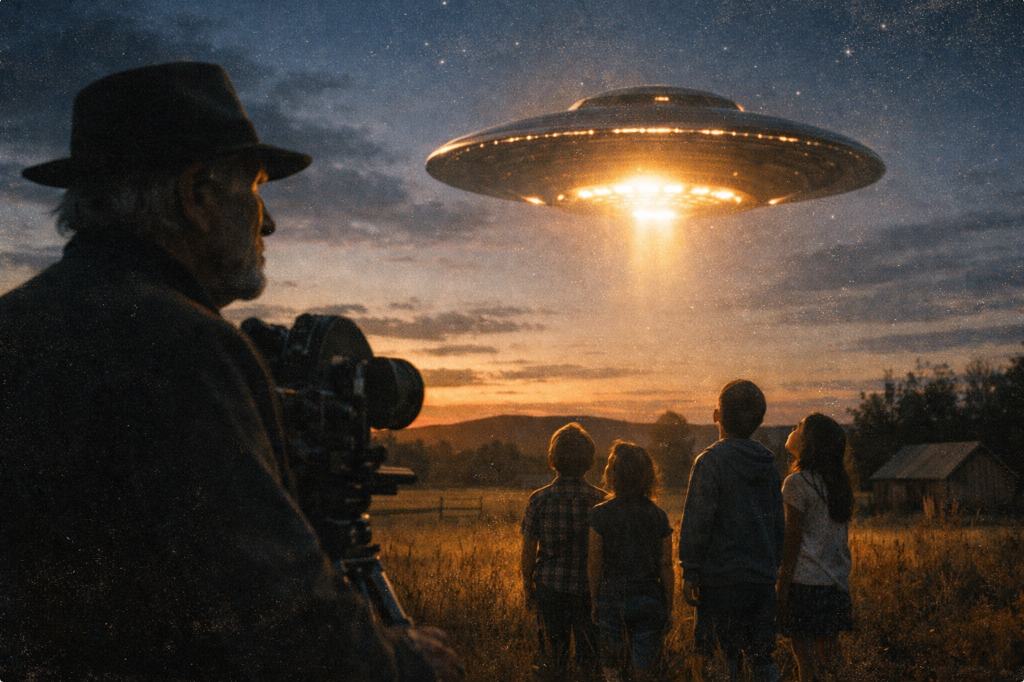
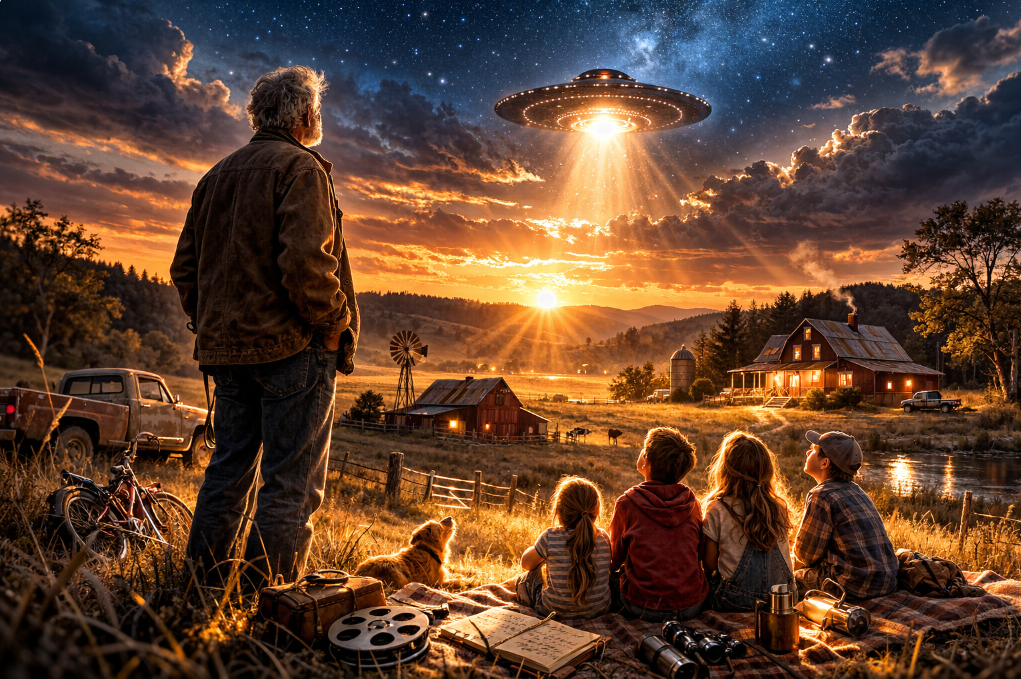
Photorealistic cinematic nighttime rural field. Children gazing toward a glowing sky filled with soft cosmic light, gentle awe, warm natural tones, documentary realism, emotional depth, landscape 16:9.
3 — THE ARCHIVISTS
Investigators surrounded by decades of UFO files, journals, tape reels, and photographs. Warm desk lamps contrasted with cool blue ambient light. Respectful investigative tone, photorealistic cinematic realism.
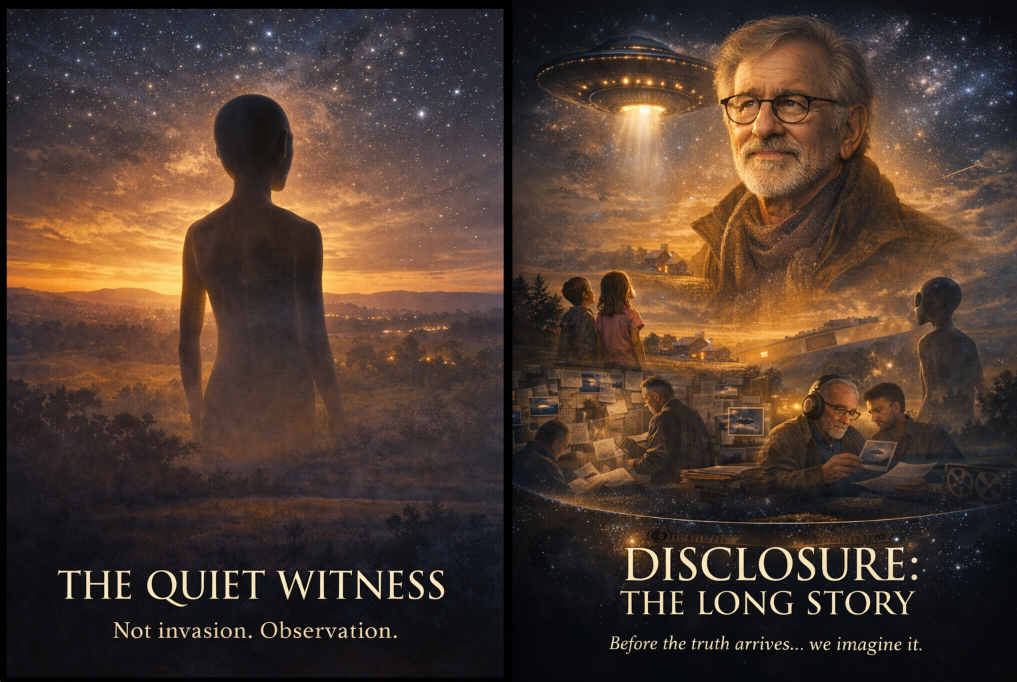
4 — THE QUIET WITNESS
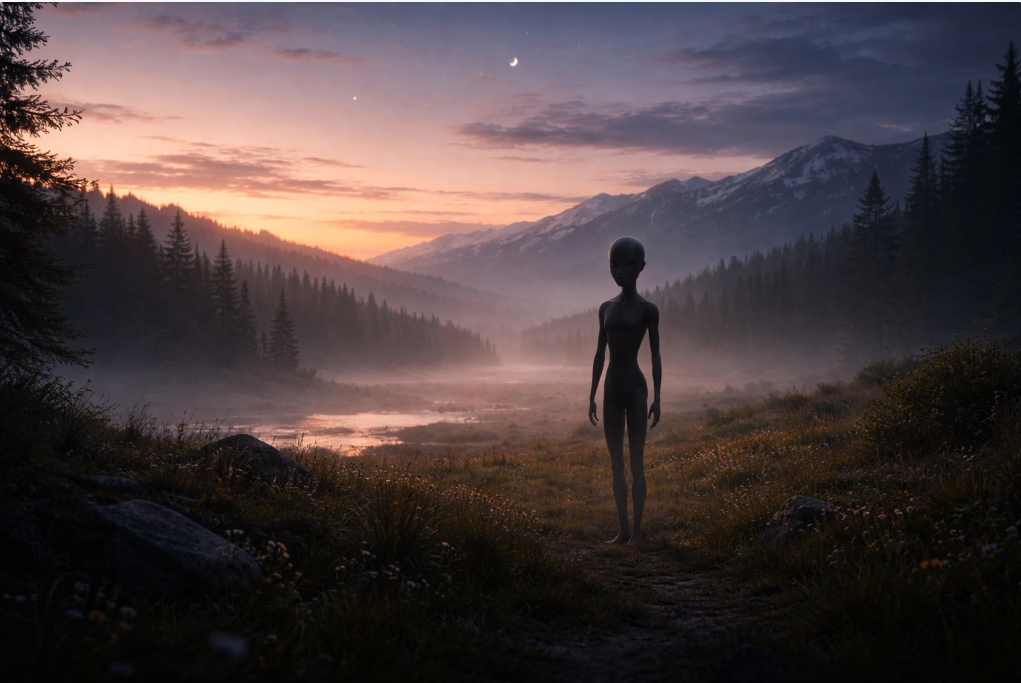
Symbolic extraterrestrial silhouette standing peacefully in distant twilight, non-threatening, contemplative mood, soft environmental lighting, cinematic realism.