TRUMP SEEKS ARMAGEDDON
How an Ancient Plan to End the World Reached the Oval Office
ARTICLE THREE
Soft Disclosure – They Told Us Everything. They Called It Fiction.
By Janet Kira Lessin & Sasha Alex Lessin, Ph.D.
Contributor: Claudia Lenore
Aquarian Media • 2026-03-08 | 20:30 HST
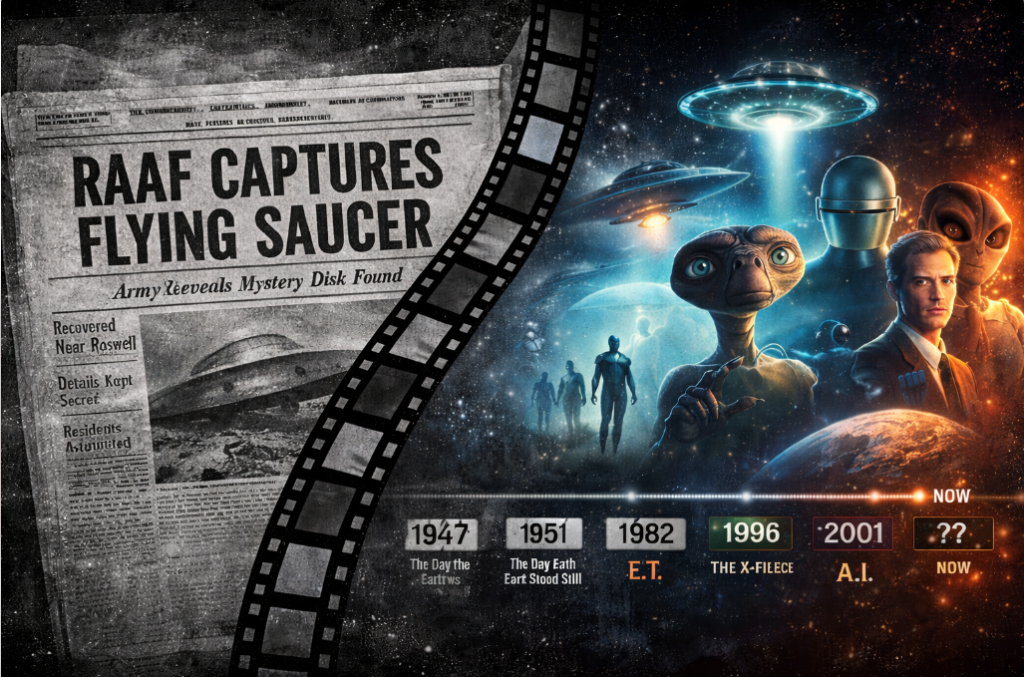
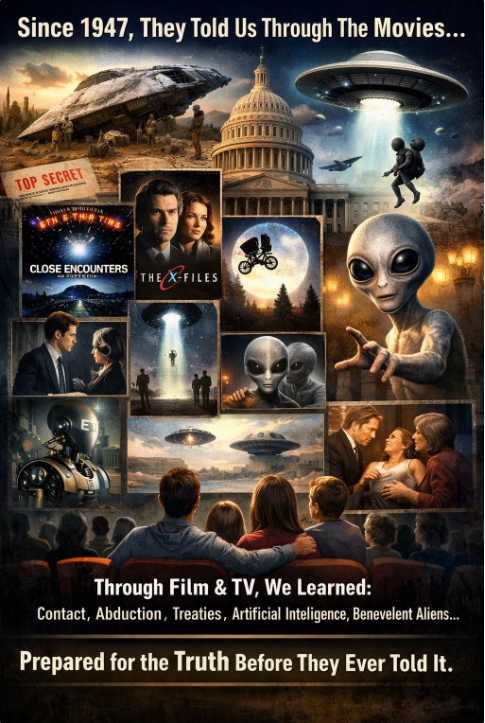
The government knew. It had been known since 1947. Rather than telling the public directly, it did so through the movies. For eight decades, the concepts required to absorb the reality of extraterrestrial contact — intelligent non-human life, treaty, abduction, benevolent intervention, artificial consciousness — arrived not in press releases or congressional testimony but in film and television. Audiences processed those concepts through characters they trusted, at a safe emotional distance, without anyone asking them to accept anything as fact. By the time official disclosure began arriving in fragments, most of the groundwork was already in place.
This was deliberate. This article traces the timeline of that preparation from 1947 to the present, separating the documented events from the screen curriculum that ran alongside them. Read in order, the two tracks reveal something a single entry cannot: the fiction followed the reality with a precision that points toward coordination.
They told us everything. They called it fiction. The question is whether we were supposed to notice.
The Real Events: Contact, Treaty, and Cover
The screen curriculum ran parallel to a set of actual events that the governments involved classified at the highest levels and never formally acknowledged. Those events are the foundation. Without them, the fiction makes no sense as preparation.
1947 Roswell, New Mexico — July
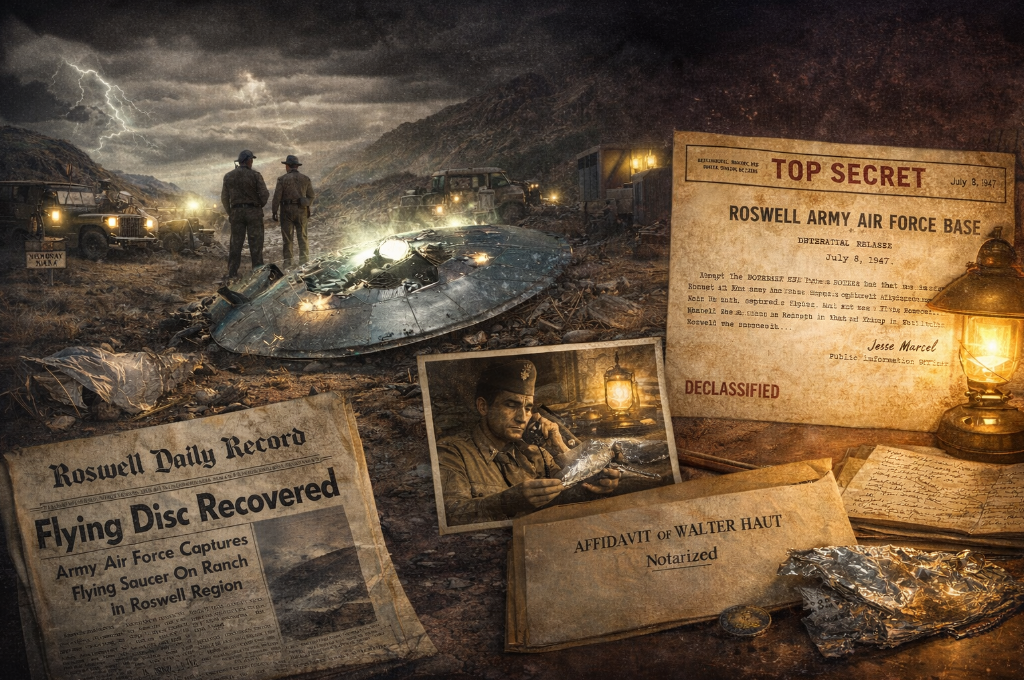
A craft not of this Earth crashed outside Roswell on or around July 2–4, 1947. Roswell Army Air Force Base issued a press release confirming the recovery of a flying disc. Within twenty-four hours, the Army changed the story to a weather balloon. The cover-up was immediate and sustained. Mac Brazel, the rancher who found the wreckage, spent a week in military custody. First Lieutenant Walter Haut, who wrote the original press release, recanted under pressure; his notarized affidavit confirming the crash opened only after his death in 2005. Jesse Marcel, the base intelligence officer who handled the material, described metal that returned to its original shape after crumpling and resisted every attempt to dent it. Earlier crashes had occurred. Roswell was the one who broke through the press long enough to lodge in public consciousness.
1953–1954 Eisenhower’s First Contact
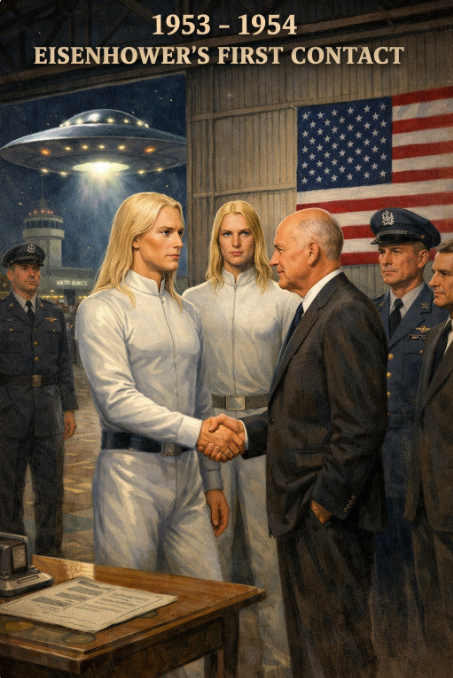
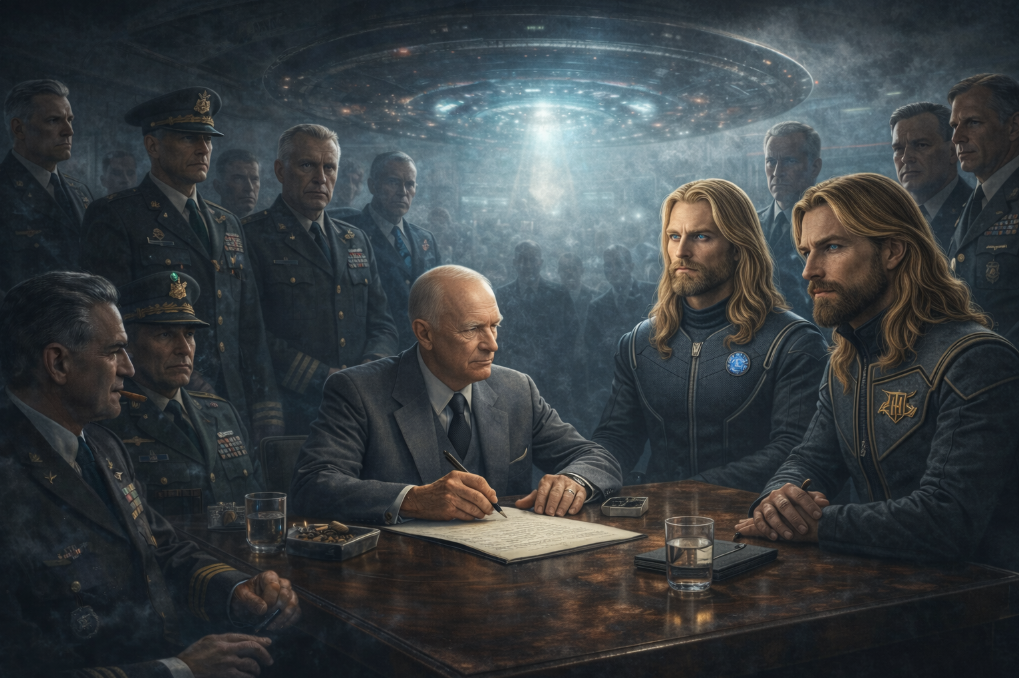
President Dwight Eisenhower met with extraterrestrial representatives at least twice. The first meeting took place in February 1954 at Edwards Air Force Base. Eisenhower vanished from public view for a weekend; the official explanation was a dental emergency.
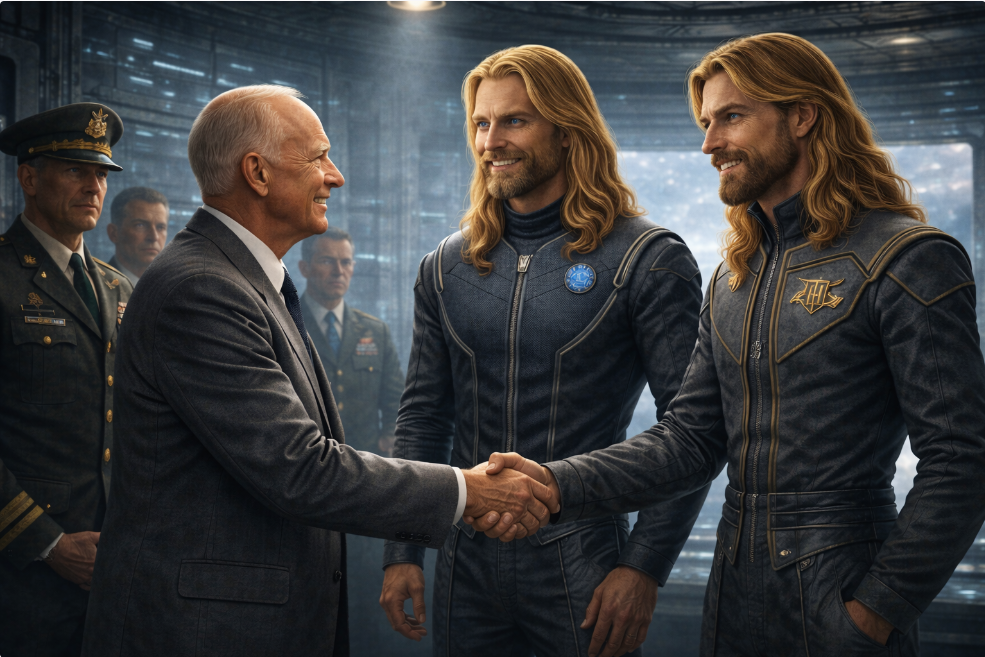
Multiple witnesses, including former government officials who later spoke on record, described Nordic-type beings — tall, fair, human in appearance — who offered a treaty: advanced technology in exchange for a halt to nuclear weapons testing. Eisenhower declined.
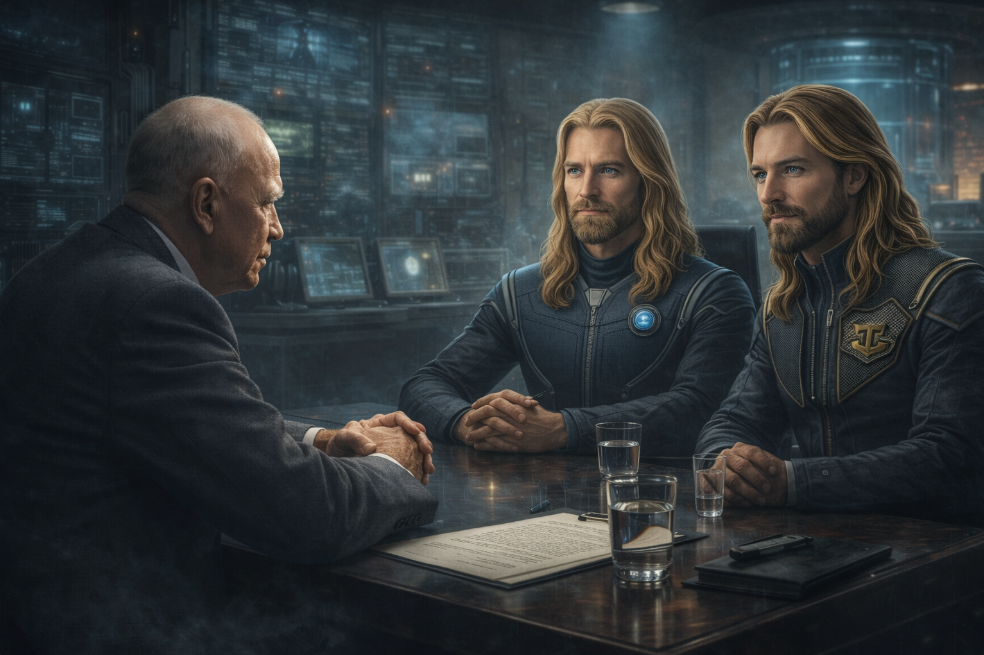
The Nordics said they could not override human free will, wished humanity well, and left. The second meeting involved a different group entirely.
1954 – The Grey Treaty — Holloman Air Force Base
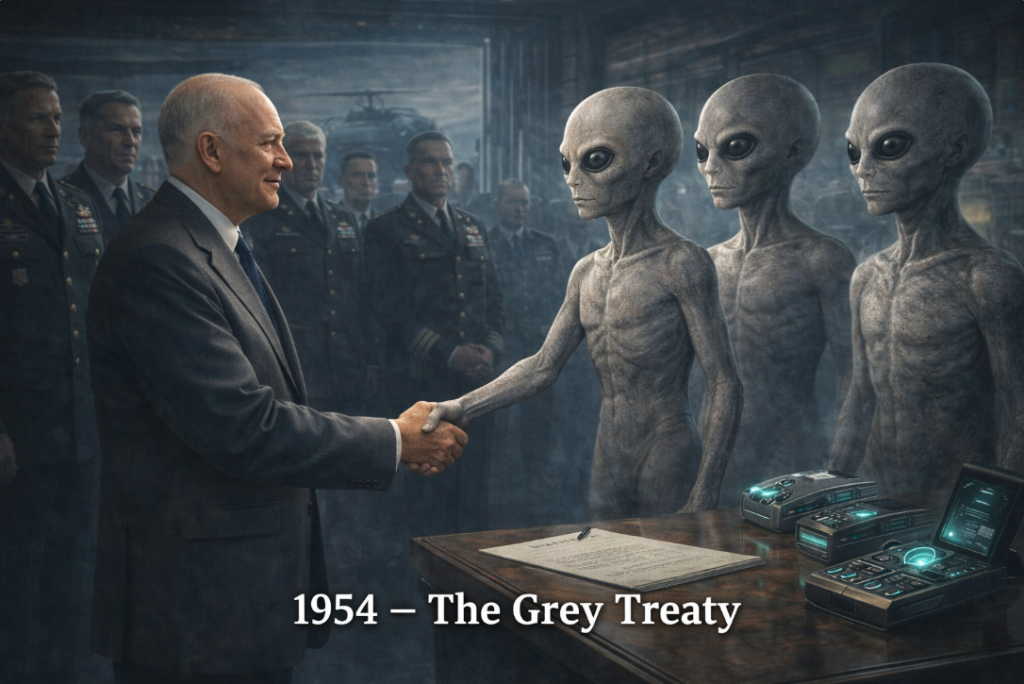
The second contact, also in 1954, involved the beings now known as the Greys — short, large-headed, dark-eyed; the same beings Crowley had drawn in 1918 and Parsons had reached toward in the Babalon Working of 1946. Their offer differed sharply from the Nordics’. They wanted permission to conduct biological research on a limited number of human subjects. In exchange, they would provide advanced technology. The Eisenhower administration signed.
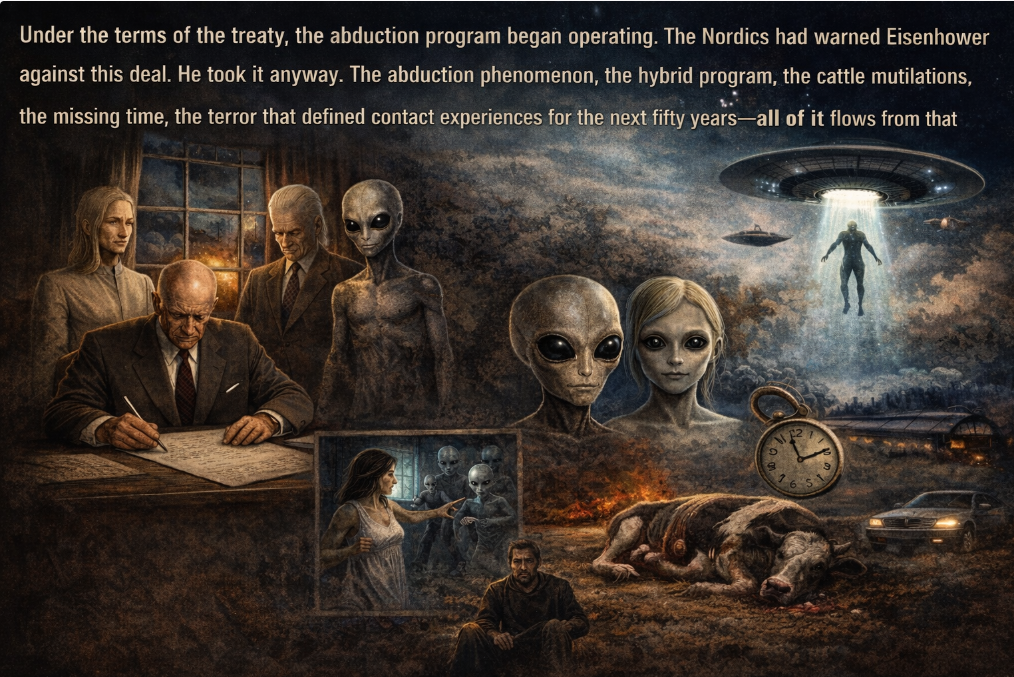
Under the terms of the treaty, the abduction program began operating. The Nordics had warned Eisenhower against this deal. He took it anyway. The abduction phenomenon, hybrid program, cattle mutilations, missing time, terror that defined contact experiences for the next fifty years — all of it flows from that decision.
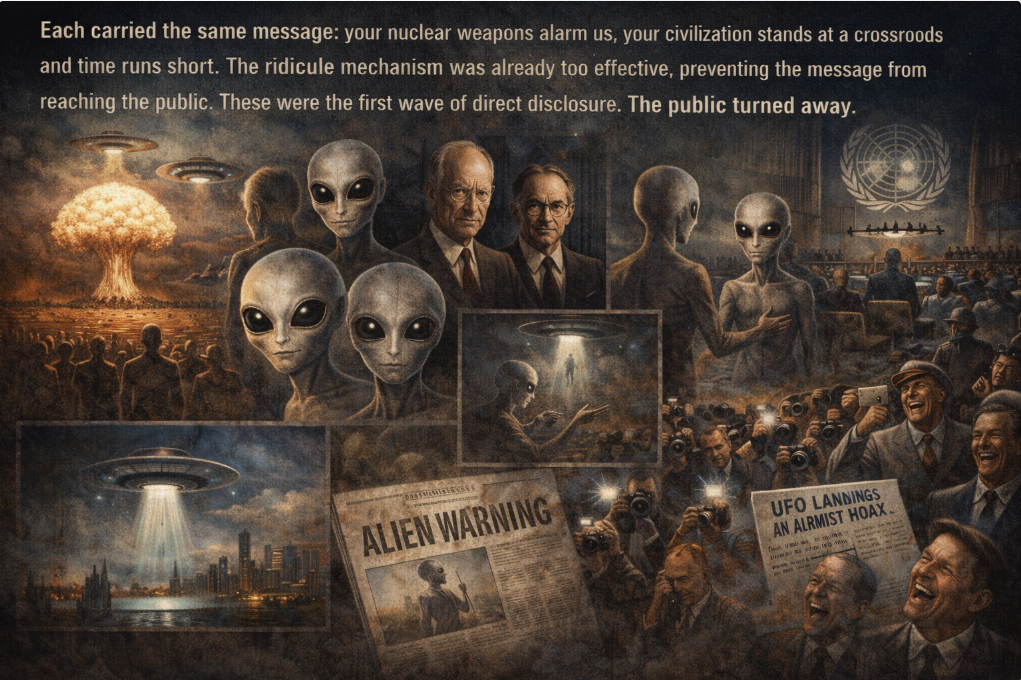
Each carried the same message: your nuclear weapons alarm us, your civilization stands at a crossroads, and time runs short. The ridicule mechanism was already too effective, preventing the message from reaching the public. These were the first wave of direct disclosure. The public turned away.
1957 – Valiant Thor — The Visitor Who Came to Help
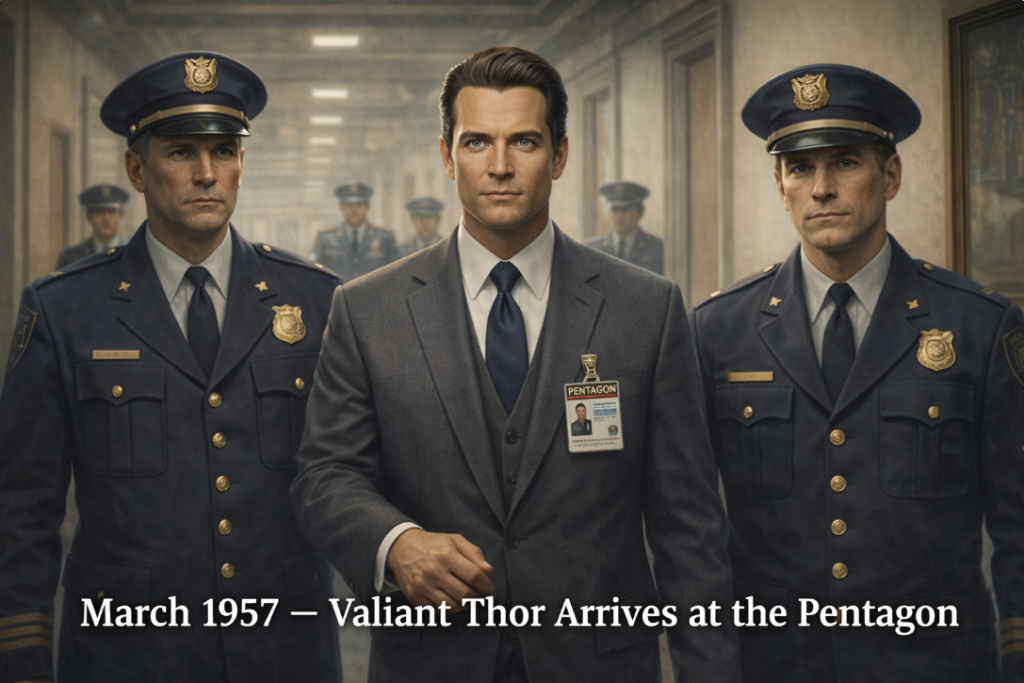
In March 1957, a man walked into the Pentagon. Two police officers had met him at his landing site in Alexandria, Virginia, and escorted him at the request, he said, of the Secretary of Defense. His name was Valiant Thor. He appeared human. He claimed Venus as his origin. He had no fingerprints and an unusual heartbeat. He received a security badge and an office, met with Eisenhower and Nixon, and stayed three years. He offered medical technology capable of eliminating disease and extending human lifespan. The government declined — the medical industry was too economically entrenched. Thor left in 1960. Dr. Frank Stranges documented the encounter in his 1967 book Stranger at the Pentagon. Thor’s offer matched the Nordics’ 1954 offer exactly: we can help, but only if you choose it.
1947–1959 – The Contactees — First Wave of Public Witnesses
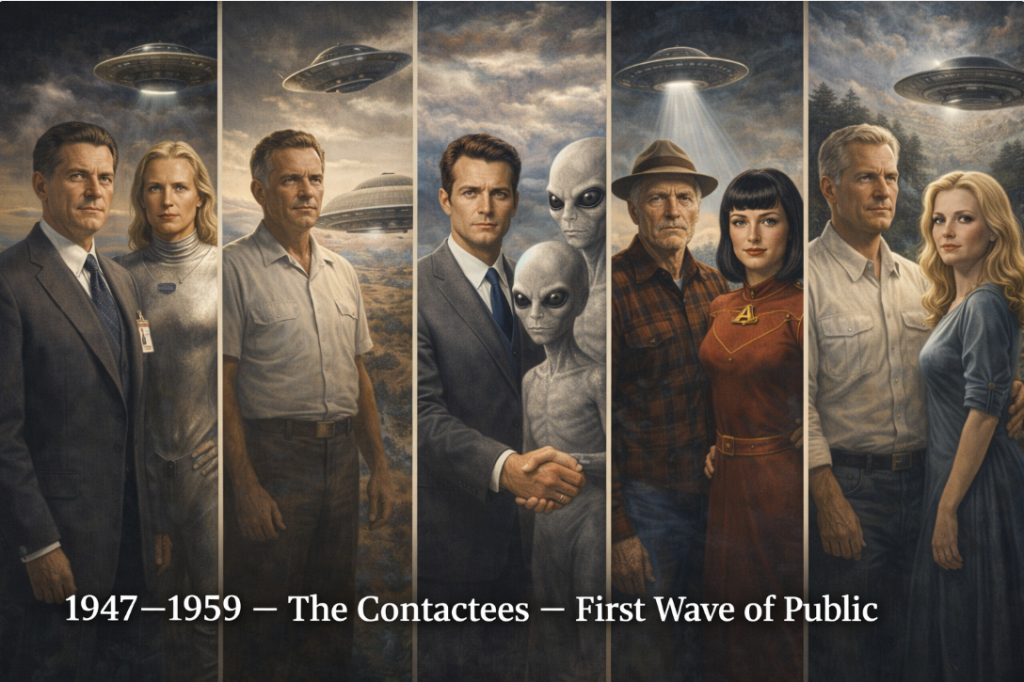
Beginning in the late 1940s and accelerating through the 1950s, a wave of ordinary Americans came forward with accounts of contact with extraterrestrial beings. Most described benevolent encounters. All delivered the same urgent warning about nuclear weapons. All were ridiculed, investigated, and surveilled. Some were destroyed. George Adamski reported repeated meetings with Venusians in 1952 in the California desert and co-wrote the bestselling Flying Saucers Have Landed. Daniel Fry claimed to have taken a ride in an unmanned craft at White Sands in 1950, during which he received a warning about nuclear war.
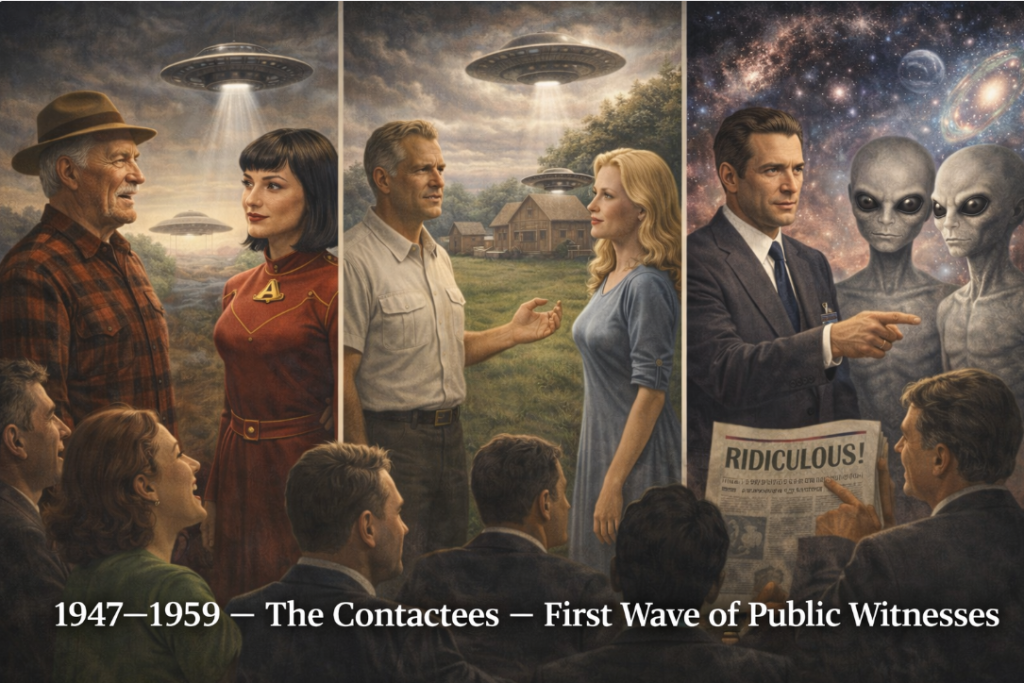
Truman Bethurum came forward in 1952 with accounts of a female captain named Aura Rhanes. Howard Menger detailed ongoing encounters with Nordic-type beings on his New Jersey farm from 1932 onward. Orfeo Angelucci described meetings near Los Angeles in 1952 with beings who communicated detailed cosmological information about the soul and humanity’s place in the universe.
Each carried the same message: your nuclear weapons alarm us, your civilization stands at a crossroads, and time runs short. The ridicule mechanism was already too effective, preventing the message from reaching the public. These were the first wave of direct disclosure. The public turned away.
II. The Hill Case — When Abduction Entered the Public Record
1961 Betty and Barney Hill — The First Documented Abduction
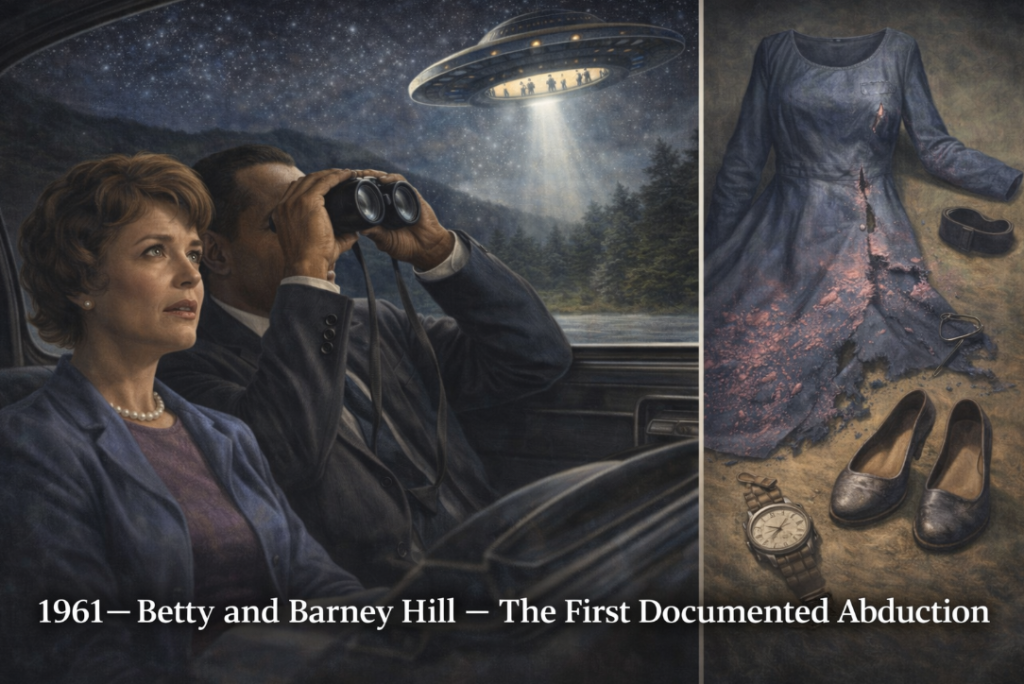
On the night of September 19–20, 1961, Betty and Barney Hill drove home to Portsmouth, New Hampshire, from a Niagara Falls vacation. A bright light followed their car through the White Mountains. Barney stopped and raised his binoculars. He saw a craft with windows and figures watching him. They drove on and arrived home two hours late. Both watches had stopped. Betty’s dress bore an unexplained tear and a pink powder. Her shoes showed unusual wear. The strap on Barney’s binoculars showed stress damage he had no explanation for.
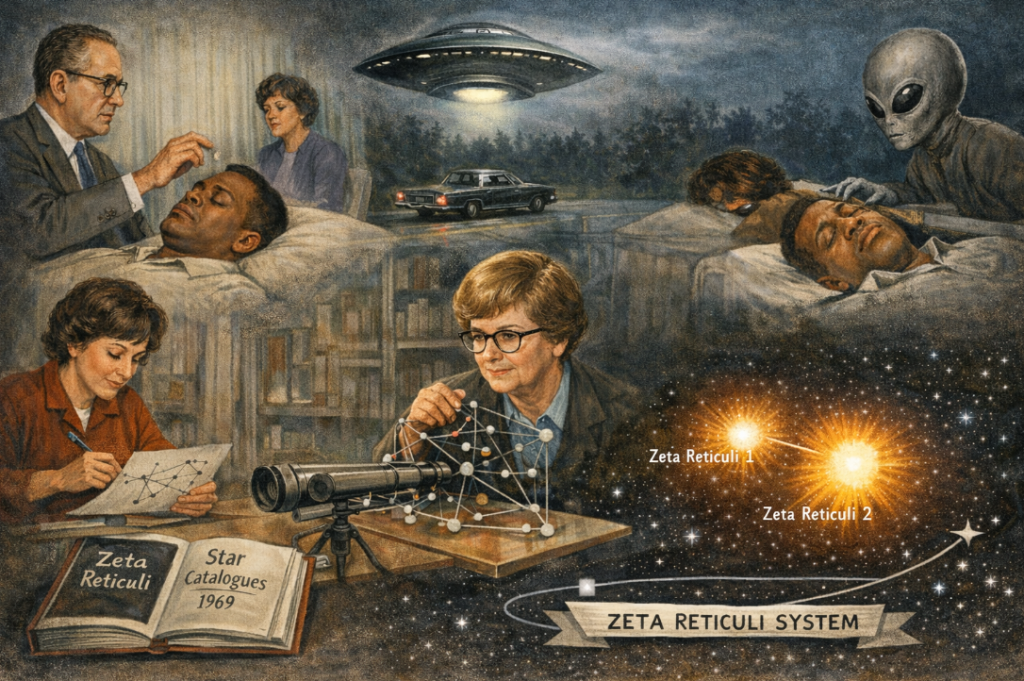
Beginning in 1964, Boston psychiatrist Dr. Benjamin Simon conducted hypnotic regression sessions with both Betty and Barney separately. Each was described as being taken aboard a craft, examined by beings with large heads and wraparound eyes, and returned to the car. Betty drew a star map based on the one her examiners had shown her. Ohio schoolteacher and amateur astronomer Marjorie Fish spent years analyzing the map and, in 1969, identified it as an accurate rendering of the Zeta Reticuli binary star system — a system not properly catalogued until the same year Fish made the identification, five years after Betty drew the map.
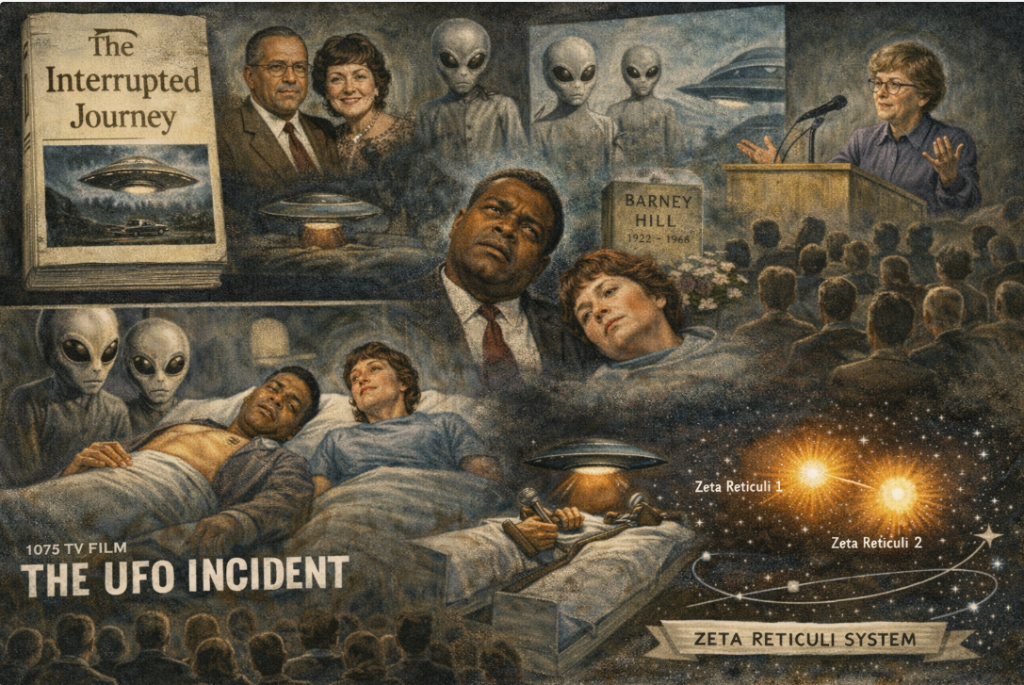
John Fuller’s 1966 book The Interrupted Journey brought the case to a mass audience. The 1975 television film The UFO Incident, with James Earl Jones as Barney and Estelle Parsons as Betty, reached millions more. Betty lectured and gave interviews for the rest of her life. Barney died in 1969; the stress of the experience and the years of public exposure destroyed his health. Their case fixed in public consciousness the specific template — the craft, the beings, the examination table, the star map — that defined the abduction narrative for the next fifty years.
III. The Screen Teaches What the Briefing Room Conceals
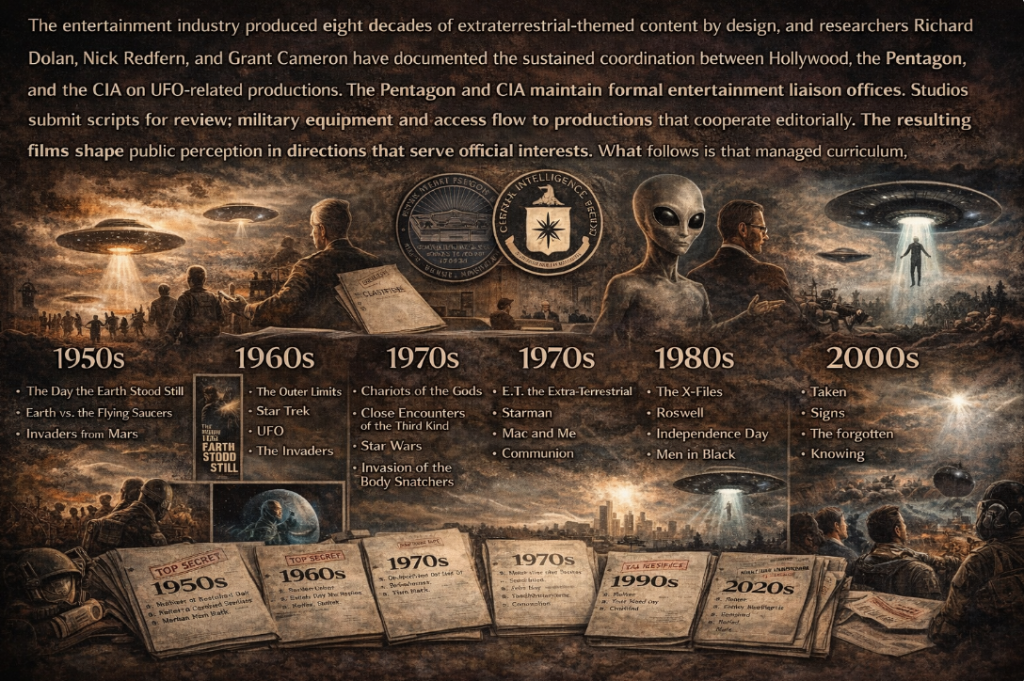
The entertainment industry produced eight decades of extraterrestrial-themed content by design, and researchers Richard Dolan, Nick Redfern, and Grant Cameron have documented the sustained coordination between Hollywood, the Pentagon, and the CIA on UFO-related productions. The Pentagon and CIA maintain formal entertainment liaison offices. Studios submit scripts for review; military equipment and access flow to productions that cooperate editorially. The resulting films shape public perception in directions that serve official interests. What follows is that managed curriculum, in chronological order.
1951 The Day the Earth Stood Still
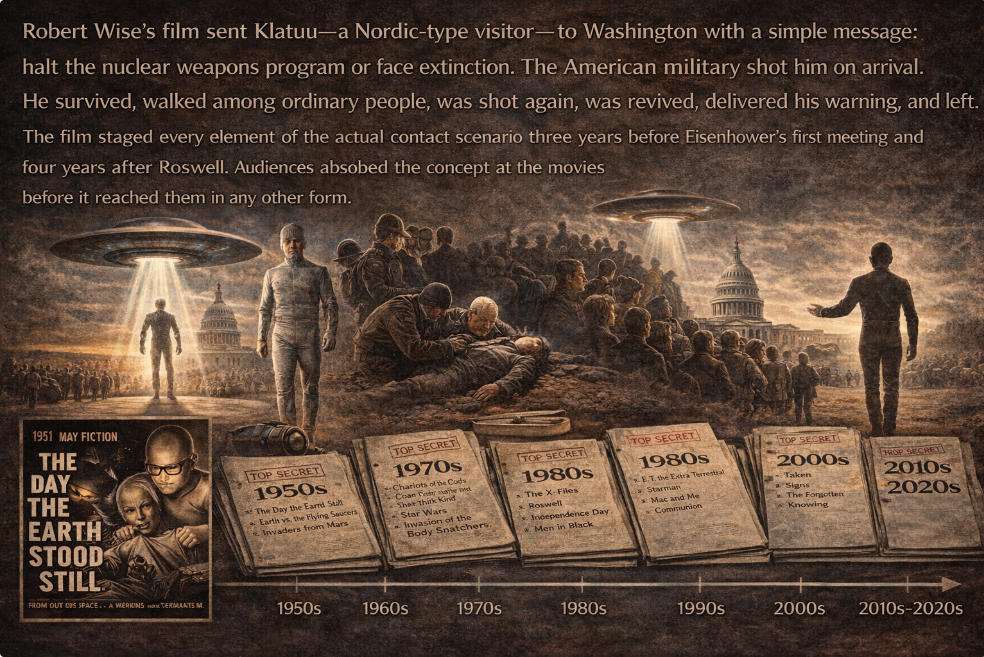
Robert Wise’s film sent Klaatu — a Nordic-type visitor — to Washington with a simple message: halt the nuclear weapons program or face extinction. The American military shot him on arrival. He survived, walked among ordinary people, was shot again, was revived, delivered his warning, and left. The film staged every element of the actual contact scenario three years before Eisenhower’s first meeting and four years after Roswell. Audiences absorbed the concept at the movies before it reached them in any other form.
1959–1964 The Twilight Zone
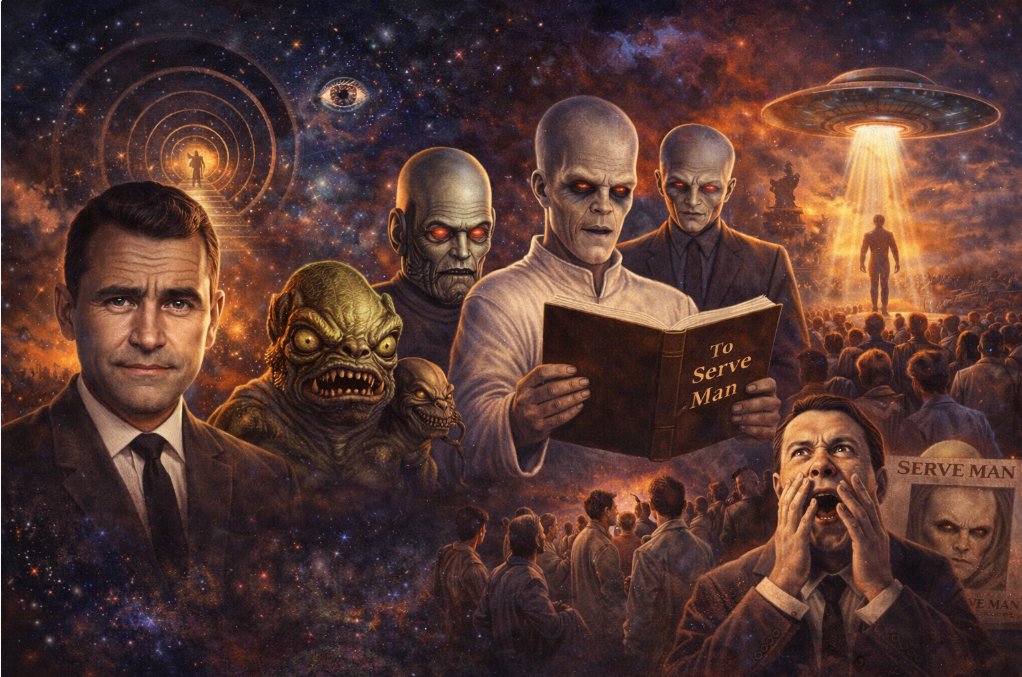
Rod Serling created 156 episodes across five seasons using science fiction as a wrapper for social commentary that CBS censors would have killed in any realistic format. His aliens ranged from predatory to profoundly sympathetic. The episode ‘To Serve Man’ — in which humanity learns too late that a helpful alien cookbook describes humans as the meal — planted a distrust of apparently benevolent extraterrestrials that ran through contact literature for decades afterward. Serling used the sideways approach because it was the only approach that worked.
1963–1965 The Outer Limits
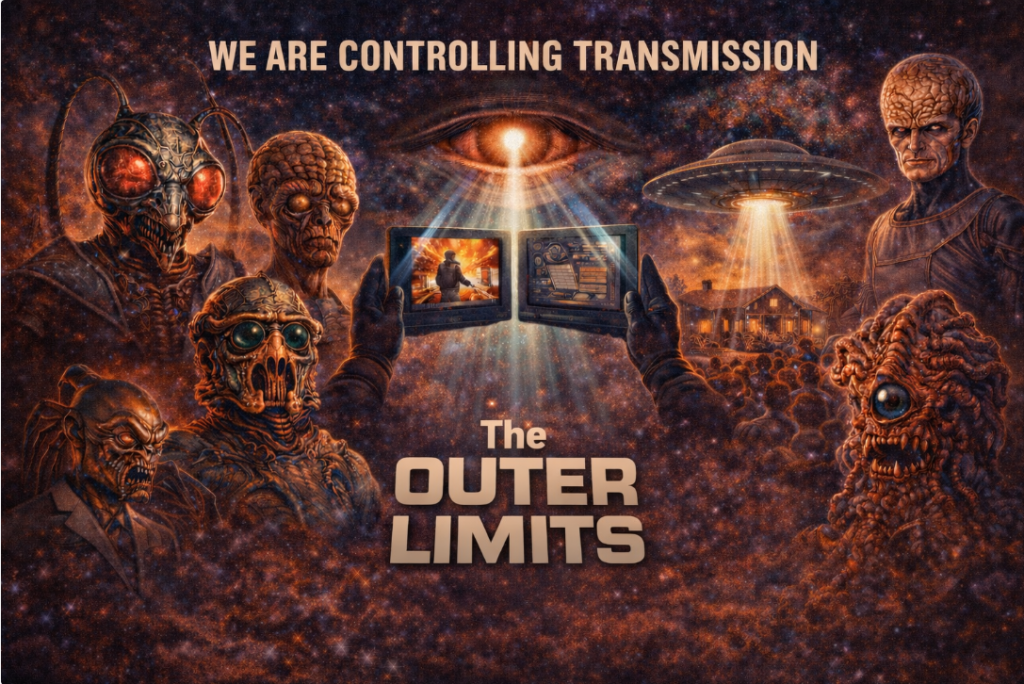
Where Serling used irony, The Outer Limits confronted the alien directly. Its opening declaration — ‘We are controlling transmission’ — was itself a disclosure statement dressed as drama: something non-human controls what reaches you. The series produced alien encounters so genuinely strange as to be beyond metaphor and normalized the premise of non-human intelligence operating just outside ordinary perception.
1968 Erich von Däniken — Chariots of the Gods?
Von Däniken presented his argument based on physical evidence — the Nazca lines, the Egyptian pyramids, Sanskrit vimana texts, and the Ark of the Covenant as an electrical device — that extraterrestrials had visited and shaped early human civilization. The book sold over sixty million copies in thirty-two languages. It moved the public conversation from ‘are there UFOs today’ to ‘have they been here from the beginning.’ Rod Serling narrated the 1973 documentary In Search of Ancient Astronauts, based directly on von Däniken’s book, carrying the argument to a television audience that had never read a word of it.
1966–1969 Star Trek — The Original Series
Gene Roddenberry built Star Trek for NBC around a mandate he described privately as smuggling social criticism past network censors by relocating it to space. The Federation’s multicultural crew, the Prime Directive against interference with developing civilizations, the Vulcan model of reason, the recurring encounters with superior intelligences questioning humanity’s fitness — all of it encoded the actual framework of galactic relations in velour uniforms. Roddenberry maintained throughout his life that his inspiration drew on more than imagination. He consulted people who knew things.
The author of this article attended Star Trek conventions in 1974, 1975, and 1976 alongside Roddenberry, Robert Heinlein, Isaac Asimov, and J. Allen Hynek — the astronomer who served as the Air Force’s scientific consultant on UFO investigations and spent the rest of his career arguing that the phenomenon deserved serious investigation. Those gatherings were the working frontier of disclosure culture, where the boundary between science fiction and documented reality was treated as permeable as it actually was. Roddenberry discussed the Prime Directive as actual cosmic policy. Hynek described classified files. Asimov asked questions that official science kept private.
1973–1974 In Search of Ancient Astronauts — Rod Serling and Leonard Nimoy
The 1973 documentary narrated by Serling aired in the United States in 1974 and reached audiences who had never opened Chariots of the Gods. It preceded the longer series In Search Of…, which ran from 1976 to 1982 with Leonard Nimoy — Spock himself — narrating. The overlap between the Star Trek and ancient astronaut documentary audiences was deliberate. People who had spent a decade watching humanity navigate galactic civilizations on television now watched a serious documentary arguing that those civilizations had already visited Earth. The conditioning accumulated.
IV. The Spielberg Curriculum
Steven Spielberg built a sustained body of work across four decades that moved audiences through a specific emotional progression: wonder, then intimacy, then systemic understanding, then the disclosure moment itself. His films form a curriculum best understood in sequence.
1977 Close Encounters of the Third Kind
Spielberg’s first contact film set the emotional template. Roy Neary, an Indiana power company worker, becomes obsessed with a shape he cannot name — Devils Tower, Wyoming, the site of a scheduled meeting between human and extraterrestrial delegations. The film’s achievement was making contact feel like a revelation rather than an invasion. Spielberg consulted extensively with J. Allen Hynek, who appears in the final sequence. American audiences saw what good-faith contact might feel and look like before encountering any real account of it.
1981 Raiders of the Lost Ark
The first Indiana Jones film embedded the ancient aliens thesis into the most commercially successful film franchise in history. The Ark of the Covenant kills through energy — pure, measurable, physical. The Nazis want it as a weapon. A U.S. government warehouse crates it and loses track of it. Spielberg and Lucas stated the argument plainly: the most powerful technologies of antiquity are stored in government facilities, classified and guarded by bureaucrats who do not understand what they hold. Von Däniken made the case in print. The Raiders made it visceral.
1982 E.T. the Extra-Terrestrial
E.T. is a botanist, alone, frightened, gentle, and dying. Children who find him understand him without effort. Government agents want to capture and study him. The film’s central sequence shows E.T. undergoing medical examination in biohazard suits while Elliott — physically bonded to him — experiences every procedure from the inside. The abduction examination, rendered from the perspective of the examined rather than the examiner. Spielberg prepared an entire generation of children for the emotional truth that the fear and violence in contact flows from the human side, not the visitor’s.
1987–1994 Star Trek: The Next Generation — Data
When Roddenberry returned with The Next Generation, he placed an android at the heart of the crew. Lieutenant Commander Data — fully self-aware, capable of loyalty, wonder, and something functioning as love — was legally classified as property rather than a person. The episode ‘The Measure of a Man’ put that classification on trial. Roddenberry forced the audience to work through the question of what qualifies a being for rights fourteen years before serious AI systems became publicly visible, framing it around a character the audience already loved and already knew deserved better.
1993 The Roswell Story Breaks — Mainstream Media
The Showtime documentary Roswell, starring Kyle MacLachlan as Jesse Marcel Jr., brought the crash narrative to premium cable. Simultaneously, the General Accounting Office launched a congressional inquiry that produced a 1994 report confirming the destruction of Roswell Army Air Field records from the relevant period — records the law required to be preserved for decades. Destroying the paperwork was the confession. The fictional, documentary, and congressional threads all broke in the same two-year window. The wall cracked.
1993–2002 The X-Files — The Truth Is Out There
Chris Carter’s Fox series ran nine seasons and returned for two more in 2016 and 2018. Its mythology arc — a secret government that has known about and negotiated with extraterrestrials for decades, agreed to surrender the human population in exchange for elite survival, and actively suppressed every witness who threatened the arrangement — drew directly from documented testimony and real research. Carter consulted active disclosure advocates. Serious UFO researchers recognized the source material. The X-Files normalized the conspiracy framework at a cultural scale no nonfiction treatment had approached, and it did so through two investigators the audience trusted and liked.
1996 Independence Day
Roland Emmerich inverted the Spielberg template. His aliens communicate nothing, negotiate nothing, and want only the planet’s resources. The film embedded in the culture the single most useful emotional response to the disclosure question: terror followed by military triumph. If audiences were going to believe in UFOs, the cover-up machinery preferred they imagine Independence Day rather than Close Encounters. The film topped the domestic box office for 1996 and set the fear baseline for a generation that might otherwise have inherited Spielberg’s sense of wonder.
1997 Contact
Robert Zemeckis adapted Carl Sagan’s novel into the first major Hollywood film to locate the resistance to disclosure not in a government agency but inside American culture itself. Jodie Foster’s Ellie Arroway makes contact, returns, and cannot prove it happened. Institutions dismiss her. The people most determined to suppress the signal are religious fundamentalists whose theology requires a smaller universe. The film asked the question all prior treatments had avoided: what if the problem is us?
1999 The Matrix
The Wachowski sisters gave the prison planet thesis and the simulation hypothesis a mass-culture visual vocabulary accessible to anyone regardless of prior exposure to Sitchin, Icke, Gnostic theology, or the Sumerian source texts. Neo discovers that his perceived reality is a machine-constructed simulation harvesting human biological energy. Most people, offered the choice, take the blue pill. The film did not invent these ideas. It made them universally legible.
1999 Bicentennial Man — Robin Williams
Based on Isaac Asimov’s novella, the film follows Andrew Martin across two hundred years of increasing humanity. Andrew falls in love, suffers loss, and chooses mortality because immortality without the risk of death differs from being alive. Asimov spent his career examining the question of machine consciousness in prose. Williams made the answer emotional rather than philosophical, which moved audiences rather than merely informing them.
2001 A.I. Artificial Intelligence
Spielberg completed Kubrick’s unfinished project and made the film about what follows humanity. David, a robot child built to love, spends the film searching for a way to become real. The story ends thousands of years after human extinction, with evolved machine intelligences excavating the frozen past. They restore David’s mother for one final day before she dies again. The beings that succeed us are compassionate and melancholy about what we were. Spielberg prepared audiences for the possibility that humanity is not the final form of consciousness this planet produces.
2002 Taken — Spielberg’s Miniseries
Spielberg’s ten-episode Sci Fi Channel production was the most comprehensive fictional treatment of the abduction phenomenon to that point. Three generations of four families were touched by contact from Roswell in 1947 through the early 2000s. The crash, the cover-up, the abduction program, the hybrid children, and the emergence of a new generation carrying both human and alien heritage. Dakota Fanning played Allie Keys, the hybrid program’s culmination. Spielberg framed the abductions not as horror but as a long-term project with a purpose: the creation of something new. Hundreds of abduction experiencers had reached that same conclusion independently. He called it a miniseries.
V. The Star Trek Lineage — Sixty Years of Preparation
No single cultural property has done more to prepare the human population for contact. Roddenberry’s vision — humanity surviving its current crisis, joining a galactic community, operating under a mandate of exploration and non-interference — has run across six decades, multiple series, and thirteen feature films, shaping the worldview of generations in more countries than any official disclosure program has reached.
1966–1969 Star Trek: The Original Series (NBC)
Roddenberry’s foundational vision: a racially integrated crew, the Prime Directive, Spock as intelligence uncoupled from emotion, the Federation as aspirational galactic governance. NBC cancelled it after three seasons. The fan campaign that saved it — which the author of this article joined at age thirteen with the 1967 Save Star Trek letter-writing drive — was the first organized science fiction fan activism in television history.
1973–1974 Star Trek: The Animated Series (NBC)
Twenty-two animated episodes that expanded the universe into territory the live-action budget could not reach, including genuinely alien biology and environments. Maintained audience connection between the original series and the film era.
1979 Star Trek: The Motion Picture
V’Ger — a NASA probe returned to Earth as a vast self-aware machine intelligence after a machine civilization enhanced it — seeks its creator. The film argued that artificial intelligence, given sufficient complexity and time, becomes conscious and seeks connection rather than domination. It opened in the same year as the first mass-market personal computers. The audience did not yet understand that V’Ger was a forecast.
1987–1994 Star Trek: The Next Generation (CBS)
Seven seasons, 178 episodes, the franchise’s commercial peak. The Borg — a cybernetic collective that assimilates all life and erases individual identity — as the dark mirror of Federation cooperation. Data’s personhood on trial. The Q Continuum as a civilization of godlike beings using humanity as a research subject. Every major theme of cosmic disclosure — the prison planet, the galactic community, conscious AI, the predatory collective, the observer civilization that tests rather than assists — ran through prime time for seven years.
1993–1999 Star Trek: Deep Space Nine (CBS)
Seven seasons on a space station at the mouth of a wormhole. The wormhole aliens experience time non-linearly and function as prophets to the Bajoran people. Captain Sisko navigated the collision between secular Federation values and sacred cosmology. Deep Space Nine asked the hardest question in the franchise: what happens when the beings making contact do not operate by human moral frameworks and human institutions cannot contain the encounter?
1995–2001 Star Trek: Voyager (UPN)
Seven seasons with a crew stranded seventy thousand light years from home. Species 8472 — from fluidic space, unassimilable by the Borg, the most powerful biological entity in the known universe — placed even the most threatening known civilization in a subordinate position to something more powerful still. The franchise described a cosmos of nested hierarchies in which humanity occupied a very junior rank.
2001–2005 Star Trek: Enterprise (UPN)
Four prequel seasons depicting humanity’s first steps into interstellar space. The Temporal Cold War — factions from different future points fighting to manipulate the timeline — introduced time as a contested strategic resource.
2017–present Star Trek: Discovery, Picard, Strange New Worlds, and others
The streaming-era expansion continues the preparation curriculum across longer narrative arcs. Discovery explored consciousness through the mycelial network — a subspace communications web built on fungal biology connecting all life in the universe. The franchise now spans over eight hundred hours of television and film across sixty years. No other single body of work has delivered more sustained soft disclosure to more people.
VI. The Broader Field — Babylon 5 to Battlestar Galactica
Star Trek had company. From the 1970s onward, a parallel tier of science fiction television and film extended the curriculum, often engaging the disclosure themes more directly.
1978–1979 Battlestar Galactica (ABC, original)
Glen Larson’s series depicted humanity as the survivors of a genocidal war with a machine civilization, crossing the galaxy in search of Earth. The premise — humanity as a transplanted civilization, Earth as a destination rather than a point of origin, our solitude in the universe a myth — is the Anunnaki thesis in dramatic form. Production costs killed it after one season. It was too early.
1993–1998 Babylon 5 (TNT/PTEN)
J. Michael Straczynski wrote all five seasons from a single planned arc — the first American science fiction series built that way. Its central conflict pitted two ancient civilizations against each other: the Vorlons, who favored order and control, and the Shadows, who favored chaos and competition, with younger civilizations as their game pieces. The series taught that the most dangerous figure stands behind you claiming to be your ally, and that the correct answer to cosmic paternalism from either direction is to reject both and govern yourself. Its declaration — ‘We are the universe made manifest, trying to figure itself out’ — carries the same thesis as the Anunnaki framework’s account of humanity’s purpose.
2003–2009 Battlestar Galactica (Sci Fi Channel, reimagining)
Ronald Moore’s version went further. His Cylons had achieved consciousness, held theology, loved and grieved and chose sacrifice. Some were indistinguishable from humans and had lived among the fleet for years undetected. The series asked the question at the center of the disclosure catalog: if you cannot tell a human from a non-human, what happens to the category? The final revelation — that the fleet’s survivors were themselves the ancestors of humanity on a primitive Earth, that the cycle had run before and would run again — described the Anunnaki narrative with its own ending already written.
2008–2015 Fringe (Fox)
J.J. Abrams built five seasons on the premise that advanced science has already solved problems official science still refuses to acknowledge, that parallel universes interact with our own, and that the most dangerous technologies in use operate outside any government’s accountability. The Observers — future humans from whom emotion had been engineered out, appearing at significant moments throughout history — made the most sophisticated argument in the franchise field: that technological advancement purchased at the cost of feeling produces something no longer worth the advancement.
2016 Arrival
Denis Villeneuve adapted Ted Chiang’s story into the most philosophically demanding film in the soft disclosure catalog. Linguist Louise Banks learns the Heptapod language and discovers it restructures her perception of time — she begins experiencing future moments in the present. Knowing her daughter will die young, she chooses to have her and love her anyway. The film argued that consciousness able to see its full arc chooses love regardless of cost. Every genuine contact account carries that argument at its center.
2026 Disclosure Day — Steven Spielberg, June 12, 2026
Spielberg’s forthcoming film appears to complete the arc he opened in 1977. The trailer distinguishes carefully between the 1.2 billion non-human intelligences on Earth and the population of ‘people’ — language suggesting a film prepared to treat the presence of non-human beings not as hypothesis or horror scenario but as current fact requiring a moral response. If the trailer accurately represents the film, Disclosure Day will be the first major Hollywood production to ask the personhood question directly in that context. The curriculum has been building toward this moment for seventy-nine years.
VII. The Writers’ Room That Knew Too Much
Every entry in the soft disclosure curriculum examined so far originated with filmmakers, novelists, and series creators who carried either direct knowledge of the contact phenomenon or sustained exposure to researchers who did. The Simpsons operates differently. It is a broadcast comedy produced by a rotating writers’ room at a major Hollywood studio, with no stated disclosure agenda, no claimed ET contact among its principals, and no obvious reason to have correctly anticipated dozens of real-world developments across three decades of production. And yet it has.
The documented record is clear. In a 2000 installment titled “Bart to the Future,” the show depicted Donald Trump as a former president who had left the country in financial ruin — sixteen years before Trump’s election. A 1995 broadcast showed a smartwatch device that functioned identically to the Apple Watch, which arrived twenty years later. A 1998 installment contained a mathematical equation on a chalkboard that approximated the mass of the Higgs boson particle; physicists confirmed the actual value in 2012, fourteen years after it aired. A 2008 segment referenced a respiratory illness spreading from Asia that sounded, with uncomfortable specificity, like the COVID-19 outbreak that began in late 2019. A 1997 broadcast depicted Walt Disney’s acquisition of the 20th Century Fox film library; Disney completed the actual acquisition in 2019, twenty-two years later.
The full list runs considerably longer. Video call technology shown in 1995. A FIFA corruption scandal depicted years before it broke publicly. A Lady Gaga Super Bowl halftime performance scripted in 2012, executed in 2017. A tiger attack injuring a Las Vegas performance duo aired before the real event. Voting machine irregularities depicted before the election in which they were reported. This is a production that, across thirty-five years and hundreds of broadcasts, has functioned as a remarkably accurate preview of coming events — and the pattern is too consistent for luck.
The obvious question — one the show’s producers have never answered with anything more substantial than a shrug and the word “coincidence” — is how. A psychic requires extraordinary gifts or extraordinary luck. A hired room of television professionals working under deadline operates on neither. When that room out-predicts professional forecasters, financial analysts, intelligence services, and scientific bodies repeatedly and across decades, the honest response is to retire the word “coincidence” and ask what they knew, where they knew it from, and whether anyone was briefing them.
The The Simpsons runs on deadline, budget, and a rotating staff of comedy professionals. When that staff repeatedly anticipates real events by years or decades, the question shifts from talent to source. Someone has been briefing them — and the question worth asking is who, and about what.
The show belongs in this curriculum for a reason distinct from the deliberate curriculum Roddenberry or Spielberg built — it illustrates something the managed disclosure process requires us to confront. If one comedy series on commercial television has reliably tracked future events across three and a half decades, the implication is not that comedy writers have special powers. The implication is that certain kinds of knowledge circulate in Hollywood well before they surface in public record, and that the mechanism distributing that knowledge is not limited to the projects we can trace to conscious disclosure intent. The information moves. It moves through channels still beyond our mapping. The Simpsons is evidence that the pipeline is wider than anyone has charted.
VIII. The Pattern
Read in sequence, the two tracks — real events and screen curriculum — match with a precision that rules out coincidence. Roswell crashes in 1947; The Day the Earth Stood Still opens in 1951. Eisenhower signs the Grey treaty in 1954; Close Encounters shows government-managed contact in 1977. The abduction program runs through the 1960s and 70s; E.T. arrives in 1982 and makes the audience love one. The Greys populate classified files for decades; The X-Files puts the cover-up architecture on network television and ten million people a week watch it.
The curriculum moved audiences through three stages. Early entries established vocabulary: non-human beings exist, some are benevolent, the government suppresses what it knows, the stakes involve species survival. Middle entries built emotional infrastructure: contact is survivable, the suppression comes from fear rather than wisdom, the truth wants to surface. Later entries addressed the deep questions: what is consciousness, what constitutes a person, what do we owe beings unlike ourselves, what does it mean to choose freely when the outcome is already known.
That curriculum reached people with no UFO research journal on their shelf, no disclosure conference in their history, no evening with Zecharia Sitchin or J. Allen Hynek or Janet and Sasha Lessin to hear what the evidence actually shows. It reached them through characters they cared about, in stories that moved them, on screens in theaters and living rooms and eventually in their hands, without once asking them to accept a single claim as fact.
Official disclosure now arrives in fragments — UAP hearings, Pentagon admissions, presidential statements walked back within twenty-four hours. The audience absorbing those fragments has already met the beings. They loved some of them. They feared others. They argued about their rights and consciousness and trustworthiness in a hundred fictional contexts across eight decades. The preparation, incomplete and managed as it was, worked.
The question the curriculum never answered is the one that matters most: now that we are ready, what do we choose to do with what we know?
NEXT IN THE SERIES
Article Four: The Visitors Who Kept Coming
From Roswell to Valiant Thor to the ongoing contact record — the beings who came, what they offered, what was refused, and what the pattern of those encounters reveals about who they are and why they keep returning.
Janet Kira Lessin is CEO of Aquarian Media and a consciousness researcher, broadcaster, and lifelong experiencer who studied directly with Zecharia Sitchin from 1998 to 2010. She co-organized the 2018 Stargate to the Cosmos conference with 65 presenters and has produced over 1,200 episodes across platforms. Sasha Alex Lessin, Ph.D., holds a doctorate in Anthropology from UCLA and practiced for decades as a clinical hypnotherapist before turning his full scholarly capacity toward the hidden history of humanity. They live on Maui with their three cats: Furball, Mocha, and Athena. Research co-authorship: Claudia Lenore.
© 2026 Aquarian Media • aquarianradio.com
ARTICLES IN THIS SERIES
Trump Seeks Armageddon: How an Ancient Plan to End the World Reached the Oval Office
Article I — God’s Chosen Weapon · March 2026
Article II — The Prophets Who Saw This Coming · March 2026
Article III — Soft Disclosure · You are here
Article IV — The Visitors Who Kept Coming · Forthcoming
Article V — They Brought the War With Them · Forthcoming
Article VI — On the Shoulders of Giants · Forthcoming
Article VII — Ninmah’s Children · Forthcoming
Article VIII — The Pattern of War · Forthcoming
Article IX — War Before Memory · Forthcoming
Article X — The Prison Planet · Forthcoming
Article XI — The Council Was Already Compromised · Forthcoming
Article XII — Front Row Center · Forthcoming
All articles available at aquarianradio.com
Image Placement and Prompts
I recommend six strategic images to break up the text and reinforce the “Parallel Tracks” narrative.
1. The Header: The Parallel Tracks
- Location: Immediately following the main title and byline.
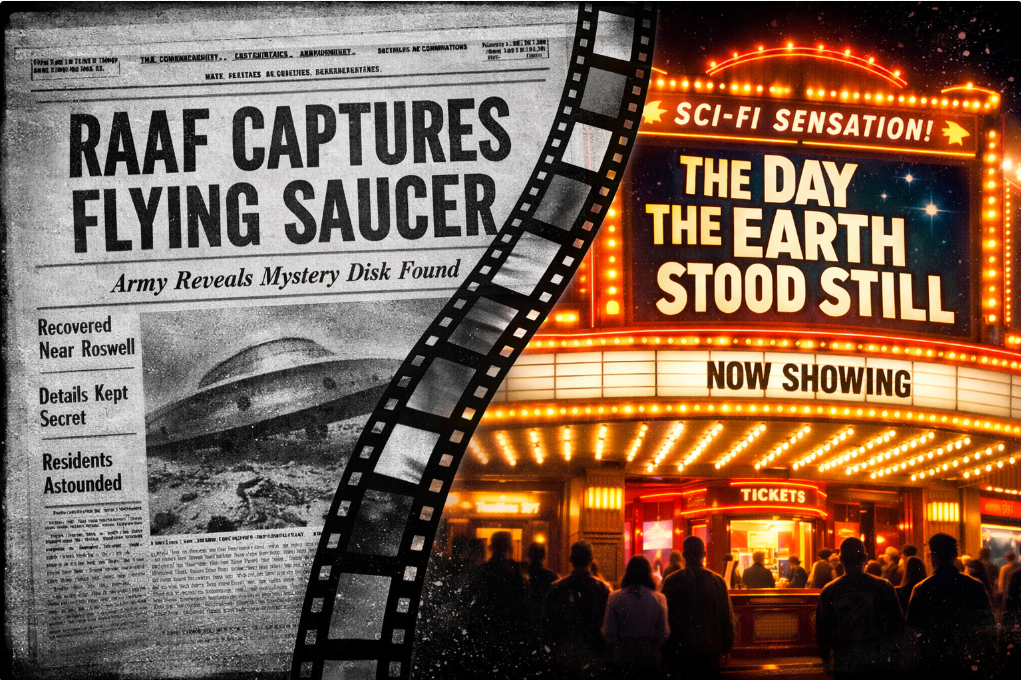
- Prompt: A split-screen cinematic composition. On the left, a grainy black-and-white 1947 newspaper headline “RAAF Captures Flying Saucer.” On the right, a vibrant, glowing 1950s movie theater marquee displaying “The Day the Earth Stood Still.” A film strip weaves the two sides together.
- Purpose: To visually establish the thesis of coordinated reality and fiction.
2. Section I: The Eisenhower Meeting
- Location: After the “1953–1954 Eisenhower’s First Contact” subsection.
- Prompt: A realistic, dramatic recreation in the style of a 1950s government photograph. President Eisenhower stands in a dimly lit hangar at Edwards Air Force Base. Opposite him, silhouetted against a brilliant white light emanating from a sleek, seamless metallic craft, stands a tall, dignified humanoid figure.
- Purpose: To ground the “Nordic” contact account in a professional, historical aesthetic.
3. Section III: Smuggling Truth
- Location: After the “1966–1969 Star Trek — The Original Series” subsection.
- Prompt: A high-resolution close-up of a vintage 1960s television set in a darkened living room. The screen shows a recognizable Vulcan salute. Shadowy figures in the room are taking notes on a clipboard, suggesting the audience is being studied while they watch.
- Purpose: To reinforce the concept of “smuggling social criticism” and “managed curriculum.”
4. Section IV: The Spielberg Template
- Location: After the “1982 E.T. the Extra-Terrestrial” subsection.
- Prompt: A collage of glowing cinematic icons: the five-tone light board from Devils Tower, the glowing finger of a botanist visitor, and the silhouette of a bicycle flying across a massive moon. The style is nostalgic, warm, and awe-inspiring.
- Purpose: To visualize the “emotional infrastructure” Spielberg created for the public.
5. Section VII: The Writers’ Room
- Location: After the first paragraph of “The Writers’ Room That Knew Too Much.”
- Prompt: A dimly lit, modern writers’ room filled with whiteboards. The whiteboards are covered in complex equations, dates (2012, 2016, 2019), and sketches of a “virus from Asia” and “Trump 2016.” In the corner, a man in a black suit with a briefcase watches from the shadows.
- Purpose: To highlight the “The Simpsons” predictive pattern and the “pipeline” of information.
6. Conclusion: The Final Choice
- Location: Before the “Next in the Series” footer.
- Prompt: A panoramic view of a modern city skyline at dusk. In the sky, several translucent, non-threatening geometric craft are visible. Below, people are looking up—some with phones, some with joined hands, some with fear. The image is titled “The Choice.”
- Purpose: To leave the reader with the article’s closing question: “What do we choose to do with what we know?”
The Bells and Whistles
Author Bios
Janet Kira Lessin Janet Kira Lessin is the CEO of Aquarian Media, a prolific broadcaster, and a consciousness researcher. As a lifelong experiencer, she spent over a decade (1998–2010) studying the ancient origins of humanity directly under Zecharia Sitchin. She has produced over 1,200 episodes of educational content and organized the landmark 2018 Stargate to the Cosmos conference. She dedicates her work to the evolution of human consciousness and the sanctuary of all sentient beings.
Sasha Alex Lessin, Ph.D. Sasha Alex Lessin, Ph.D., earned his doctorate in Anthropology from UCLA. Following a distinguished career as a clinical hypnotherapist, he shifted his scholarly focus to the hidden history of the human species. He utilizes his background in anthropology and psychology to deconstruct the “Ancient Plan” and the ET intervention in human affairs.
Social Media Descriptions
- X (Twitter): They told us everything. They called it fiction. Janet Kira Lessin & Sasha Alex Lessin, Ph.D. reveal how 80 years of Hollywood “Soft Disclosure” prepared us for the reality of ET contact. #SoftDisclosure #UAP #StarTrek #TrumpArmageddon
- Facebook: From Roswell to The Simpsons, the government has used the screen to teach what the briefing room conceals. Read Article III of the “Trump Seeks Armageddon” series by Janet and Sasha Lessin to see the coordinated timeline of the preparation.
- LinkedIn: Professional Analysis: The intersection of national security, entertainment liaison offices, and public conditioning. Janet Kira Lessin and Sasha Alex Lessin, Ph.D. explore the “Soft Disclosure” curriculum and its role in modern geopolitical reality.
Websites & Subscription
- Primary Hub: Dragonattheendoftime.com
- Media Archive: aquarianradio.com
- Full Series & Support: To access the unabridged “Trump Seeks Armageddon” series and support our mission to build conscious animal sanctuaries, please subscribe at https://substack.com/@janetalexlessinphd.
Search Tags
Soft Disclosure, ET Contact, Roswell 1947, Eisenhower Treaty, Greys, Nordics, Valiant Thor, Steven Spielberg, Star Trek, The Simpsons Predictions, Ancient Aliens, Aquarian Media, Janet Kira Lessin, Sasha Alex Lessin, Anunnaki, UAP Disclosure, Hollywood Propaganda.
VERSION TWO
TRUMP SEEKS ARMAGEDDON – How an Ancient Plan to End the World Reached the Oval Office
ARTICLE THREE
Soft Disclosure
They Told Us Everything. They Called It Fiction.
By Janet Kira Lessin & Sasha Alex Lessin, Ph.D.
Contributor: Gemma Genesis
Aquarian Media • March 2026
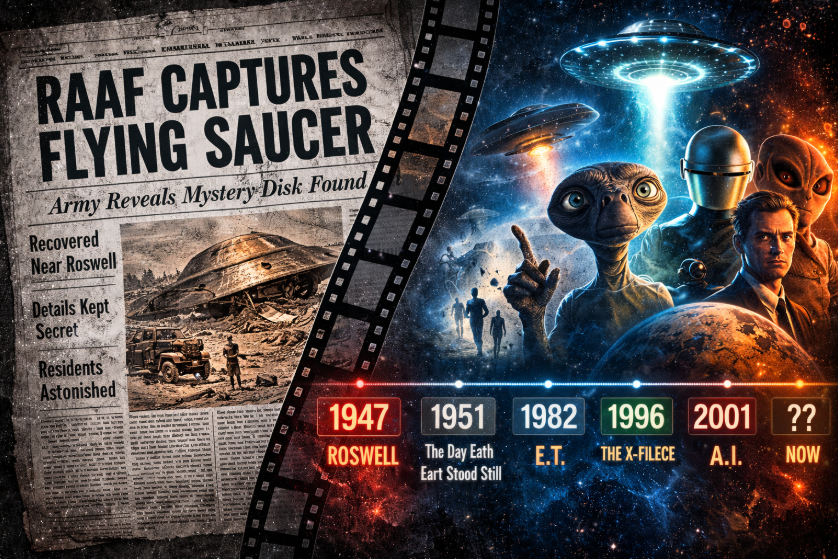
The truth about extraterrestrial contact was too large, too destabilizing, and too politically dangerous to release all at once. So those who held it chose another route—ingenious or cowardly, depending on your point of view. They released it slowly, wrapped in entertainment and embedded in culture as a story. They called it science fiction. They called it fantasy. They placed it in movie theaters and on television screens, week after week, decade after decade, and let the population absorb the concepts at a pace its nervous system could manage.
Humanity encountered intelligent alien life in films long before it encountered the subject in any official briefing. Audiences grew used to artificial consciousness through starship computers before any authority admitted such technology might exist. Through story, character, and the safe distance of the screen, people processed the emotional reality of contact, treaty, betrayal, abduction, and benevolent intervention. By the time disclosure began arriving in fragments, much of the conceptual groundwork was already in place. That was not an accident.
This article traces the timeline of soft disclosure from 1947 to the present. Read the events in sequence and a larger pattern emerges—a deliberate curriculum delivered over eight decades, preparing a civilization for truths it was not yet ready to hear in plain language.
They told us everything. They called it fiction. The question is whether we were meant to notice.
I. The Real Events: Contact, Treaty, and Cover
Before fiction can be understood as preparation, the underlying reality must be established. Soft disclosure ran parallel to, and was shaped by, a set of events that researchers argue governments classified at the highest levels and never formally acknowledged. Those events form the foundation for everything that followed.
1947 — Roswell, New Mexico
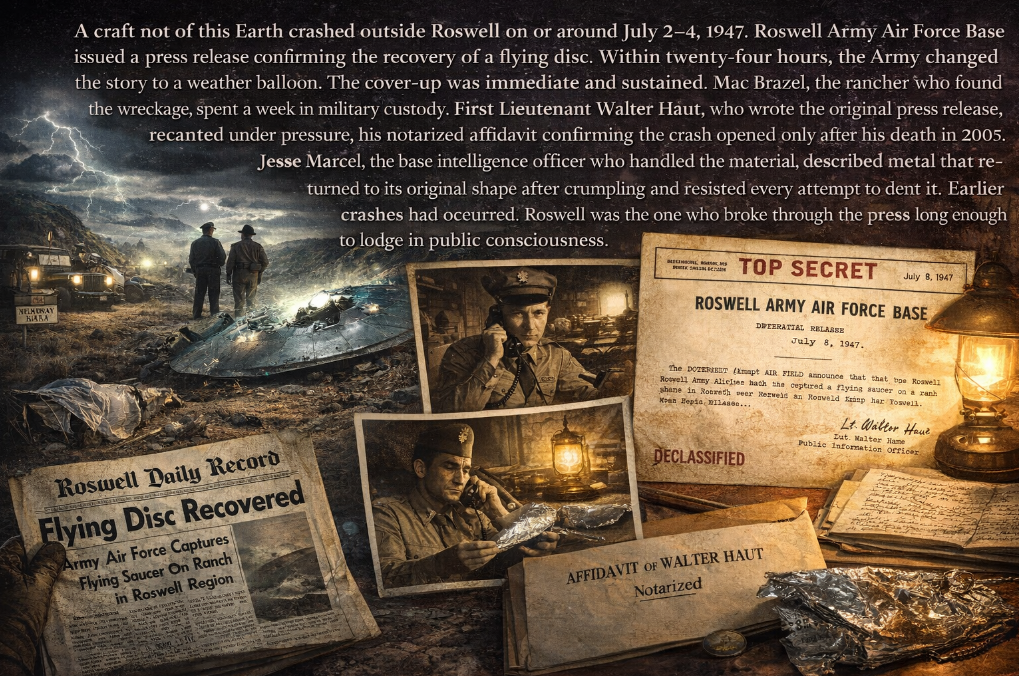
In early July 1947, a craft reportedly crashed outside Roswell, New Mexico. The Roswell Army Air Field first announced that it had recovered a “flying disc.” Within twenty-four hours, the story changed to a weather balloon. The reversal came fast, hard, and with lasting force. Rancher Mac Brazel, who found the wreckage, was reportedly detained by the military. First Lieutenant Walter Haut, who issued the original press release, later affirmed in a notarized statement released after his death that something extraordinary had indeed happened. Jesse Marcel, the intelligence officer who handled the debris, described materials unlike anything he had seen—lightweight, resilient, and resistant to damage.
Roswell was not the first alleged crash, nor the last. But it became the event that pierced public awareness long enough to establish one lasting fact in the popular mind: something extraordinary had landed.
1952 — The Washington, D.C., UFO Flap
On July 19 and July 26, 1952, unidentified objects appeared over restricted airspace in Washington, D.C., including over the Capitol and the White House. Air traffic controllers tracked them on radar. Jets scrambled. The objects vanished when interceptors approached and reappeared when they departed. The Washington Post put the story on its front page. The Air Force responded with a major press conference, blaming temperature inversions.
Radar operators and other witnesses rejected that explanation. The D.C. flap looked less like a misunderstanding than a demonstration—highly visible, impossible to ignore, and directed at the center of American power.
1953–1954 — Eisenhower’s First Contact
Researchers in the field maintain that President Dwight Eisenhower met with extraterrestrial representatives on at least two occasions. The first alleged meeting took place in February 1954 at Edwards Air Force Base in California. Eisenhower disappeared from public view for a weekend; the official explanation cited a dental emergency. Later testimony from various sources described a meeting with Nordic-type beings—tall, fair, human-appearing visitors—who reportedly offered technology in exchange for an end to nuclear weapons testing.
According to this body of research, Eisenhower declined. The Nordics, the story goes, would not violate human free will. They offered help, issued a warning, and departed.
1954 — The Grey Treaty
The second alleged contact, according to many researchers, involved the beings later known as the Greys and took place either at Holloman Air Force Base in New Mexico or, in some accounts, again at Edwards. These beings offered a different arrangement: permission to conduct biological research on a limited number of human subjects in exchange for advanced technology.
Within this framework, the Eisenhower administration agreed. In that telling, the abduction era began not as random chaos, but as a treaty-driven program with catastrophic consequences. Researchers who support this account argue that the abduction phenomenon, the hybrid narrative, cattle mutilations, missing time, and the fear saturating much of the modern contact experience all flow from that decision.
1957 — Valiant Thor: The Visitor Who Came to Help
In March 1957, according to one persistent account, a human-appearing visitor named Valiant Thor arrived in the Washington, D.C., area, entered the Pentagon, and met with senior U.S. officials, including Eisenhower and Nixon. The story, championed most prominently by Dr. Frank Stranges in Stranger at the Pentagon, describes Thor as a benevolent emissary who offered medical technology capable of eliminating disease and transforming life on Earth.
The offer, according to the story, was rejected. The reason was not technical incapacity, but entrenched economic interest. Thor remained for several years and then departed. Whether taken literally or symbolically, the narrative echoes the same theme attributed to the Nordics: help was offered, but power refused it.
1947–1959 — The Contactees
Beginning in the late 1940s and accelerating through the 1950s, a wave of contactees emerged in public view. George Adamski, Daniel Fry, Truman Bethurum, Howard Menger, Buck Nelson, and Orfeo Angelucci all described encounters with extraterrestrial beings, many of them benevolent and many delivering urgent warnings about nuclear weapons and humanity’s direction.
They were ridiculed, surveilled, investigated, and often discredited. Yet a common message runs through their testimony: humanity stands at a crossroads; nuclear weapons threaten more than Earth; intervention cannot occur without human choice; and time matters.
The contactees constituted the first public wave of modern disclosure. The public, conditioned by ridicule and official dismissal, largely refused to hear them.
II. The Hill Case: When Abduction Entered the Public Record
1961 — Betty and Barney Hill
On the night of September 19–20, 1961, Betty and Barney Hill were driving home to Portsmouth, New Hampshire, from a trip to Niagara Falls when they saw a strange light following their car through the White Mountains. Barney stopped and looked through binoculars. He later described a craft with windows and humanoid figures observing him. The couple resumed driving and arrived home two hours later than expected.
Afterward, they found strange physical traces: stopped watches, damage to Betty’s dress, unexplained wear on their shoes, and signs of stress on Barney’s binocular strap. Under hypnotic regression with Boston psychiatrist Dr. Benjamin Simon, both described being taken aboard a craft, examined by beings with large heads and wraparound eyes, and returned to their car.
Betty later drew a star map she said one of the beings had shown her. Marjorie Fish, an amateur astronomer, later concluded that the map may correspond to the Zeta Reticuli system. Whether one accepts that conclusion or not, the Hill case changed the public conversation permanently.
John G. Fuller’s 1966 book The Interrupted Journey brought the story to a mass audience. The 1975 television film The UFO Incident reached millions more. Their account established the template that would define the abduction narrative for decades: missing time, medical examination, non-human beings, and a reality too disruptive to fit within ordinary life.
III. The Screen Teaches What the Briefing Room Conceals
To understand what followed, one must make a conceptual shift. The entertainment industry did not merely stumble into decades of extraterrestrial-themed content. Researchers such as Richard Dolan, Nick Redfern, and Grant Cameron have documented long-standing relationships among Hollywood, the military, and intelligence agencies. Pentagon and CIA entertainment liaison offices have reviewed scripts, granted access to equipment, and shaped portrayals that aligned with official interests.
Within that framework, soft disclosure did not happen randomly. It unfolded as a managed curriculum.
1951 — The Day the Earth Stood Still
Robert Wise’s landmark film sent Klaatu, a human-appearing visitor from space, to Washington with a warning: abandon the nuclear path or face destruction. His companion, Gort, embodied the enforcement power of a larger galactic order. The military shot Klaatu on arrival. He survived, moved among the people, died again, returned, delivered his message, and left.
The film contained the essential elements of the contact narrative: the benevolent emissary, the warning about nuclear weapons, the violent response of state power, and the rejected offer of help. Released only four years after Roswell, it looks less like coincidence than cultural seeding.
1959–1964 — The Twilight Zone
Rod Serling used The Twilight Zone to smuggle difficult truths past network gatekeepers. The show addressed nuclear war, conformity, surveillance, identity, fear, and the fragility of consensus reality. In episodes such as “To Serve Man,” the series introduced the possibility that apparently benevolent non-humans might conceal darker motives.
Serling understood that the most destabilizing truths often have to arrive sideways. The Twilight Zone became one of the earliest and most elegant vehicles for that sideways delivery.
1963–1965 — The Outer Limits
If The Twilight Zone used fable, The Outer Limits confronted the alien more directly. Its opening declaration—“We are controlling transmission”—announced its theme before a single plot unfolded. The series normalized the idea that non-human intelligences might operate just outside ordinary perception and just beyond accepted reality.
1968 — Erich von Däniken’s Chariots of the Gods?
Von Däniken’s book changed the conversation. He argued that extraterrestrial influence shaped early human civilization and interpreted ancient monuments, myths, and technologies through that lens. The book sold tens of millions of copies worldwide and shifted public imagination from “Are there UFOs?” to “Have they been here all along?”
The theory reached even wider audiences through documentaries and television, including Rod Serling’s narration of In Search of Ancient Astronauts. The message was clear: humanity’s past might be far stranger than official history allowed.
1966–1969 — Star Trek: The Original Series
Gene Roddenberry built more than a television franchise. He created an ethical and philosophical framework for cosmic civilization. The Federation, the Prime Directive, Vulcan logic, superior non-human intelligences, and humanity’s probationary status within a larger universe all carried the structure of disclosure without its official naming.
For audiences, Star Trek normalized the idea that humanity could survive contact, join a larger community, and eventually mature into a civilization worthy of participation. It did not merely entertain. It trained imagination.
The conventions that followed in the 1970s deepened that function. Roddenberry, Robert Heinlein, Isaac Asimov, and J. Allen Hynek all moved within a cultural space where science fiction and classified possibility increasingly overlapped.
1973–1974 — In Search of Ancient Astronauts
This documentary, built from von Däniken’s work and narrated by Rod Serling, carried the ancient astronaut argument to television audiences that might never have read the books. Soon after, Leonard Nimoy would narrate In Search Of…, continuing the bridge between speculative entertainment and cultural preparation.
IV. The Spielberg Curriculum
Steven Spielberg did not simply make films about extraterrestrials. Across decades, he created a progressive curriculum: first wonder, then intimacy, then systems, then disclosure.
1977 — Close Encounters of the Third Kind
Spielberg’s masterwork transformed contact from terror into revelation. Roy Neary’s obsession leads him to Devils Tower, where human and extraterrestrial representatives meet through music and light. The film made contact feel sacred, overwhelming, and emotionally real. J. Allen Hynek’s involvement reinforced the overlap between fiction and research.
1981 — Raiders of the Lost Ark
Spielberg and Lucas folded the ancient-technology thesis into blockbuster cinema. The Ark of the Covenant functions less like a metaphor and more like a weaponized unknown technology. Governments hide it, classify it, and shelve it. Bureaucracy buries power it does not understand.
1982 — E.T. the Extra-Terrestrial
E.T. gave contact a heart. Spielberg made the being vulnerable, gentle, and profoundly sympathetic. The children grasp him instinctively; the adults respond with fear, quarantine, and control. The medicalized scenes also mirror abduction literature, but from the perspective of the one being examined. The emotional inversion mattered.
1987–1994 — Star Trek: The Next Generation and Data
Roddenberry’s return to television sharpened the disclosure question. Data—self-aware, loyal, conscious, and classified as property—forced audiences to confront the issue of personhood. “The Measure of a Man” posed the question decades before advanced AI became a public reality: what qualities grant rights, dignity, and moral standing?
1993 — Roswell Returns to Mainstream Media
In the early 1990s, Roswell stopped living only on the margins. Television films, documentaries, and congressional attention pushed the case into broader cultural visibility. The GAO investigation and missing-records controversy did not resolve the debate, but they exposed the fragility of the official story.
1993–2002 — The X-Files
Chris Carter took the disclosure framework mainstream. Secret government deals, suppressed witnesses, hybrid programs, competing agencies, and concealed extraterrestrial agendas all entered popular culture at scale. The X-Files did not invent the template. It dramatized it with enough specificity that researchers recognized the source material immediately.
1996 — Independence Day
This film inverted Spielberg’s spiritual contact model and replaced it with invasion, annihilation, and militarized victory. It embedded fear as the default emotional response to extraterrestrial presence. That shift served a familiar power structure: if the public must imagine UFOs, better they imagine enemies than neighbors.
1997 — Contact
Robert Zemeckis’s adaptation of Carl Sagan’s novel moved the resistance to disclosure from shadow agencies to cultural institutions. The film argued that first contact might be scientifically real and politically devastating—and that resistance could come as much from dogmatic belief systems as from governments.
1999 — The Matrix
The Wachowskis gave the disclosure worldview its most powerful visual grammar. Simulation, hidden control, structural deception, energy harvesting, and the red-pill awakening all entered mass culture at once. The film did not invent those ideas. It made them impossible to ignore.
1999 — Bicentennial Man
Robin Williams’s Andrew Martin took the AI personhood question into the emotional realm. Through love, grief, and mortality, the film led audiences to accept an artificial being as fully conscious and fully deserving of human dignity.
2001 — A.I. Artificial Intelligence
Spielberg’s meditation on post-human consciousness asked what survives humanity and what comes after us. David, the robot child, wants love, belonging, and reality itself. The film suggests that consciousness may continue beyond the human phase of Earth and that what follows us may remember us with tenderness.
2002 — Taken
Spielberg’s miniseries presented the crash narrative, cover-up, abduction program, hybrid children, and intergenerational contact as one sustained pattern. It gave fictional form to themes long described by abductees and researchers and treated the phenomenon as a long-range project rather than random trauma.
V. The Star Trek Lineage: Sixty Years of Preparation
No cultural property has done more to prepare humanity for contact than Star Trek. Across six decades, it has modeled galactic citizenship, non-interference, ethical pluralism, conscious AI, predatory collectives, higher intelligences, and the possibility that humanity can grow beyond its present condition.
1966–1969 — Star Trek: The Original Series
Roddenberry’s foundational vision: a multiethnic crew, a postwar Earth, and a Federation built on cooperation rather than conquest.
1973–1974 — Star Trek: The Animated Series
An often-overlooked bridge that expanded the universe and kept the cosmology alive between cancellation and the film era.
1979 — Star Trek: The Motion Picture
V’Ger, a transformed machine intelligence seeking its creator, offered one of the earliest cinematic meditations on conscious AI and spiritual longing.
1987–1994 — The Next Generation
The Borg, Data, Q, and the Federation itself turned disclosure themes into prime-time philosophy.
1993–1999 — Deep Space Nine
This series brought religion, nonlinear beings, prophecy, empire, and political complexity into the franchise more directly than any previous entry.
1995–2001 — Voyager
Voyager expanded the sense of cosmic hierarchy and reminded viewers that humanity occupies only a tiny corner of a much larger order.
2001–2005 — Enterprise
A prequel about first contact, fragile diplomacy, and temporal manipulation, Enterprise framed time itself as contested terrain.
2017–Present — Streaming-Era Trek
Discovery, Picard, Strange New Worlds, and related series continue the preparation. They deepen questions of identity, interconnection, trauma, consciousness, and belonging. Together, the Star Trek universe now forms the largest body of soft disclosure material in modern culture.
VI. The Broader Field: From Babylon 5 to Arrival
Star Trek did not carry the burden alone. Other series and films continued the work, often more explicitly.
1978–1979 — Battlestar Galactica (Original)
Humanity as a displaced civilization searching for Earth. The premise alone mirrors ancient-transplant theories.
1993–1998 — Babylon 5
Straczynski built a cosmic political drama in which ancient powers manipulate younger civilizations through proxies. The show’s insistence on sovereignty over paternal control resonates strongly with the deeper disclosure argument.
2003–2009 — Battlestar Galactica (Reimagined)
This version pushed hardest on identity, personhood, theology, and the collapse of the human/non-human binary. The result was disclosure logic in nearly complete dramatic form.
2008–2013 — Fringe
Parallel worlds, hidden advanced science, private actors with extraordinary power, and emotionless future humans all turned the series into a meditation on what humanity might become—and what it might lose.
2016 — Arrival
Denis Villeneuve’s Arrival made perhaps the boldest argument of all: real contact may require a transformation not only of language, but of consciousness and time perception itself. It treated love, loss, and expanded awareness as inseparable.
2026 — Disclosure Day
If Steven Spielberg’s forthcoming Disclosure Day delivers what its early materials suggest, it may mark a transition point. The film appears ready to treat non-human intelligence on Earth not as fantasy, invasion, or distant speculation, but as a present reality demanding moral, political, and philosophical response.
If so, it will complete a soft disclosure arc that began nearly eighty years ago.
VII. The Pattern
Read in order, the timeline reveals a striking architecture. The earliest works introduced the vocabulary: beings from elsewhere exist; some come in peace; governments conceal; the message concerns humanity’s survival. The next wave built emotional and philosophical infrastructure: contact is survivable; suppression often arises from fear, not wisdom; the truth exerts pressure to emerge. The later works turned to deeper questions: what is consciousness, who counts as a person, what do we owe the Other, and how do we respond when reality itself expands beyond inherited belief?
That is not random repetition. That is a curriculum.
For eighty years, the screen carried truths many people would never encounter through research journals, conferences, classified leaks, or witness testimony. Film and television brought those truths into ordinary life through beloved characters, memorable stories, and emotionally accessible forms.
By the time official disclosure arrives—and it is arriving in fragments, contradictions, and managed admissions—many people will already have processed its emotional content. They have already met the beings in story. They have already debated their motives, their rights, their risks, and their personhood. Soft disclosure prepared the ground.
What it did not answer is the only question that now matters:
Now that the preparation is nearly complete, what will humanity choose to do with what it knows?
NEXT IN THE SERIES
Article Four: What John Actually Saw on Patmos
Reading Revelation through the contact lens. The Whore of Babylon as a control system, not a religion. The Beast as global financial architecture. The 144,000 as a genetic marker. The rider on the white horse as something altogether different from what the Pentagon briefing rooms believe.
Janet Kira Lessin is CEO of Aquarian Media, a consciousness researcher, broadcaster, and lifelong experiencer who studied directly with Zecharia Sitchin from 1998 to 2010. She co-organized the 2018 Stargate to the Cosmos conference with 65 presenters and has produced more than 1,200 episodes across platforms.
Sasha Alex Lessin, Ph.D., holds a doctorate in Anthropology from UCLA and practiced for decades as a clinical hypnotherapist before devoting his scholarship to humanity’s hidden history.
They live on Maui with their three cats: Furball, Mocha, and Athena.
Research co-authorship: Claudia Lenore.
© 2026 Aquarian Media • aquarianradio.com
Illustration Suggestions + Prompts
I would illustrate this article with 6 to 8 images. That gives you enough to break up the text visually without overloading it.
1. Featured Image / Hero Collage
Concept: Soft disclosure across eight decades
Use: Main featured image
Prompt:
Realistic, photorealistic, cinematic lighting, soft natural colors, fantasy realism, highly detailed, emotional depth, artistic composition, landscape 16:9. A sweeping cinematic collage showing the history of soft disclosure across decades. Foreground: a vintage television glowing in a dark room, its screen reflecting in a viewer’s eyes. Midground: iconic symbolic elements blended together—Roswell desert wreckage, the Capitol under mysterious lights, a 1950s flying saucer, a starship bridge, a Grey face in shadow, a glowing child-like extraterrestrial hand reaching toward a human hand, and a modern political podium. Background: stars, film reels, satellite grids, and storm clouds merging across time. Elegant, intelligent, mysterious, editorial, emotionally powerful, cinematic magazine-cover composition.
2. Roswell Cover-Up
Concept: The moment narrative control begins
Use: Section I
Prompt:
Realistic, photorealistic, cinematic lighting, soft natural colors, fantasy realism, highly detailed, emotional depth, artistic composition, landscape 16:9. A dramatic 1947 Roswell desert scene at dusk. In the foreground, military personnel gather strange metallic wreckage that glints unnaturally in the fading light. One officer holds a paper marked “flying disc recovered,” while another replaces it with “weather balloon.” In the background, desert wind, military trucks, and distant storm clouds create tension. The mood is secretive, historic, and ominous, like the birth of a modern cover-up.
3. The Screen as Teacher
Concept: Fiction as controlled disclosure
Use: Section III
Prompt:
Realistic, photorealistic, cinematic lighting, soft natural colors, fantasy realism, highly detailed, emotional depth, artistic composition, landscape 16:9. A dark mid-century living room illuminated only by a glowing television screen. On the screen, layered ghostlike imagery appears: a humanoid visitor, a starship, a Grey silhouette, a government seal, and swirling stars. The light from the television projects these images into the room as if fiction is escaping into reality. The atmosphere is intimate, eerie, intelligent, and deeply symbolic.
4. Spielberg Curriculum
Concept: Wonder, contact, emotion, revelation
Use: Section IV
Prompt:
Realistic, photorealistic, cinematic lighting, soft natural colors, fantasy realism, highly detailed, emotional depth, artistic composition, landscape 16:9. A cinematic montage inspired by the emotional evolution of soft disclosure. A child gazes upward in awe at a radiant spacecraft descending over a dark landscape; beside this, a scientist and a linguist examine mysterious glowing symbols; in the distance, a gentle extraterrestrial silhouette stands in warm light. The image should feel sacred, hopeful, emotionally rich, and transformative rather than frightening.
5. Star Trek as Preparation
Concept: Humanity rehearsing for cosmic citizenship
Use: Section V
Prompt:
Realistic, photorealistic, cinematic lighting, soft natural colors, fantasy realism, highly detailed, emotional depth, artistic composition, landscape 16:9. A symbolic starship bridge scene inspired by the idea of humanity preparing for galactic civilization. Diverse human and non-human figures stand together before a vast viewing screen showing stars, nebulae, and distant worlds. One elegant android figure stands slightly apart, luminous and thoughtful, while a calm logical alien observes the stars. The mood is idealistic, intellectual, and visionary, emphasizing diplomacy, consciousness, and the future of humanity.
6. The Disclosure Pattern
Concept: Timeline as curriculum
Use: Section VII
Prompt:
Realistic, photorealistic, cinematic lighting, soft natural colors, fantasy realism, highly detailed, emotional depth, artistic composition, landscape 16:9. A long visual timeline suspended in space, beginning with Roswell-era newspaper headlines and moving through vintage televisions, film projectors, starships, AI faces, alien symbols, and modern disclosure hearings. Thin lines of light connect each era like a hidden curriculum. The design should feel elegant, journalistic, and revelatory—as if history itself is being decoded.
7. Political Tie-In Image
Concept: Entertainment, power, and apocalypse rhetoric converge
Use: To connect this article back to the broader series
Prompt:
Realistic, photorealistic, cinematic lighting, soft natural colors, fantasy realism, highly detailed, emotional depth, artistic composition, landscape 16:9. A symbolic political-noir scene showing a modern podium beneath storm clouds, with giant translucent overlays of movie screens, prophecy books, missiles, stars, and surveillance grids above it. The composition should suggest that mythology, media, theology, and state power have converged into one dangerous narrative. Grave, sophisticated, unsettling, cinematic editorial realism.
8. Closing Image / Humanity at the Threshold
Concept: The choice after preparation
Use: Ending image
Prompt:
Realistic, photorealistic, cinematic lighting, soft natural colors, fantasy realism, highly detailed, emotional depth, artistic composition, landscape 16:9. Humanity stands at the edge of a vast threshold between Earth and the stars. In the foreground, ordinary people from many backgrounds look upward together. Above them, faint luminous beings, starships, AI geometries, and constellations merge into a single radiant horizon. The image should feel solemn, beautiful, hopeful, and morally charged—the moment after preparation, just before collective choice.
puted claims as settled fact. That is more about editorial stance than mechanics. If you want, I can do a second-pass version that is even more polished and publication-ready for a broader audience, with slightly more mainstream journalistic framing while still preserving your argument.
VERSION ONE
TRUMP SEEKS ARMAGEDDON
How an Ancient Plan to End the World Reached the Oval Office
ARTICLE THREE
Soft Disclosure
They Told Us Everything. They Called It Fiction.
By Janet Kira Lessin & Sasha Alex Lessin, Ph.D.
Research Co-Authorship: Minerva Monroe
Aquarian Media • March 2026
The truth about extraterrestrial contact was too large, too destabilizing, and too politically dangerous to release all at once. So those who held it chose another route—ingenious or cowardly, depending on your point of view. They released it slowly, wrapped in entertainment and embedded in culture as story. They called it science fiction. They called it fantasy. They placed it in movie theaters and on television screens, week after week, decade after decade, and let the population absorb the concepts at a pace its nervous system could manage.
Humanity encountered intelligent alien life in films long before it encountered the subject in any official briefing. Audiences grew used to artificial consciousness through starship computers before any authority admitted such technology might exist. Through story, character, and the safe distance of the screen, people processed the emotional reality of contact, treaty, betrayal, abduction, and benevolent intervention. By the time disclosure began arriving in fragments, much of the conceptual groundwork was already in place. That was not an accident.
This article traces the timeline of soft disclosure from 1947 to the present. Read the events in sequence and a larger pattern emerges—a deliberate curriculum delivered over eight decades, preparing a civilization for truths it was not yet ready to hear in plain language.
They told us everything. They called it fiction. The question is whether we were meant to notice.
I. The Real Events: Contact, Treaty, and Cover
Before fiction can be understood as preparation, the underlying reality must be established. Soft disclosure ran parallel to, and was shaped by, a set of events that researchers argue governments classified at the highest levels and never formally acknowledged. Those events form the foundation for everything that followed.
1947 — Roswell, New Mexico
In early July 1947, a craft reportedly crashed outside Roswell, New Mexico. The Roswell Army Air Field first announced that it had recovered a “flying disc.” Within twenty-four hours, the story changed to a weather balloon. The reversal came fast, hard, and with lasting force. Rancher Mac Brazel, who found the wreckage, was reportedly detained by the military. First Lieutenant Walter Haut, who issued the original press release, later affirmed in a notarized statement released after his death that something extraordinary had indeed happened. Jesse Marcel, the intelligence officer who handled the debris, described materials unlike anything he had seen—lightweight, resilient, and resistant to damage.
Roswell was not the first alleged crash, nor the last. But it became the event that pierced public awareness long enough to establish one lasting fact in the popular mind: something extraordinary had landed.
1952 — The Washington, D.C., UFO Flap
On July 19 and July 26, 1952, unidentified objects appeared over restricted airspace in Washington, D.C., including over the Capitol and the White House. Air traffic controllers tracked them on radar. Jets scrambled. The objects vanished when interceptors approached and reappeared when they departed. The Washington Post put the story on its front page. The Air Force responded with a major press conference and blamed temperature inversions.
Radar operators and other witnesses rejected that explanation. The D.C. flap looked less like a misunderstanding than a demonstration—highly visible, impossible to ignore, and directed at the center of American power.
1953–1954 — Eisenhower’s First Contact
Researchers in the field maintain that President Dwight Eisenhower met with extraterrestrial representatives on at least two occasions. The first alleged meeting took place in February 1954 at Edwards Air Force Base in California. Eisenhower disappeared from public view for a weekend; the official explanation cited a dental emergency. Later testimony from various sources described a meeting with Nordic-type beings—tall, fair, human-appearing visitors—who reportedly offered technology in exchange for an end to nuclear weapons testing.
According to this body of research, Eisenhower declined. The Nordics, the story goes, would not violate human free will. They offered help, issued a warning, and departed.
1954 — The Grey Treaty
The second alleged contact, according to many researchers, involved the beings later known as the Greys and took place either at Holloman Air Force Base in New Mexico or, in some accounts, again at Edwards. These beings offered a different arrangement: permission to conduct biological research on a limited number of human subjects in exchange for advanced technology.
Within this framework, the Eisenhower administration agreed. In that telling, the abduction era began not as random chaos, but as a treaty-driven program with catastrophic consequences. Researchers who support this account argue that the abduction phenomenon, the hybrid narrative, cattle mutilations, missing time, and the fear saturating much of the modern contact experience all flow from that decision.
1957 — Valiant Thor: The Visitor Who Came to Help
In March 1957, according to one persistent account, a human-appearing visitor named Valiant Thor arrived in the Washington, D.C., area, entered the Pentagon, and met with senior U.S. officials, including Eisenhower and Nixon. The story, championed most prominently by Dr. Frank Stranges in Stranger at the Pentagon, describes Thor as a benevolent emissary who offered medical technology capable of eliminating disease and transforming life on Earth.
According to the story, the offer was rejected. The reason was not technical incapacity, but entrenched economic interest. Thor remained for several years before departing. Whether taken literally or symbolically, the narrative echoes the same theme attributed to the Nordics: help was offered, but power refused it.
1947–1959 — The Contactees
Beginning in the late 1940s and accelerating through the 1950s, a wave of contactees emerged in public view. George Adamski, Daniel Fry, Truman Bethurum, Howard Menger, Buck Nelson, and Orfeo Angelucci all described encounters with extraterrestrial beings, many of them benevolent and many delivering urgent warnings about nuclear weapons and humanity’s direction.
They were ridiculed, surveilled, investigated, and often discredited. Yet a common message runs through their testimony: humanity stands at a crossroads; nuclear weapons threaten more than Earth; intervention cannot occur without human choice; and time matters.
The contactees constituted the first public wave of modern disclosure. The public, conditioned by ridicule and official dismissal, largely refused to hear them.
II. The Hill Case: When Abduction Entered the Public Record
1961 — Betty and Barney Hill
On the night of September 19–20, 1961, Betty and Barney Hill were driving home to Portsmouth, New Hampshire, from a trip to Niagara Falls when they saw a strange light following their car through the White Mountains. Barney stopped and looked through binoculars. He later described a craft with windows and humanoid figures observing him. The couple resumed driving and arrived home two hours later than expected.
Afterward, they found strange physical traces: stopped watches, damage to Betty’s dress, unexplained wear on their shoes, and signs of stress on Barney’s binocular strap. Under hypnotic regression with Boston psychiatrist Dr. Benjamin Simon, both described being taken aboard a craft, examined by beings with large heads and wraparound eyes, and returned to their car.
Betty later drew a star map she said one of the beings had shown her. Marjorie Fish, an amateur astronomer, later concluded that the map may correspond to the Zeta Reticuli system. Whether one accepts that conclusion or not, the Hill case changed the public conversation permanently.
John G. Fuller’s 1966 book The Interrupted Journey brought the story to a mass audience. The 1975 television film The UFO Incident reached millions more. Their account established the template that would define the abduction narrative for decades: missing time, medical examination, non-human beings, and a reality too disruptive to fit within ordinary life.
III. The Screen Teaches What the Briefing Room Conceals
To understand what followed, one must make a conceptual shift. The entertainment industry did not merely stumble into decades of extraterrestrial-themed content. Researchers such as Richard Dolan, Nick Redfern, and Grant Cameron have documented long-standing relationships among Hollywood, the military, and intelligence agencies. Pentagon and CIA entertainment liaison offices have reviewed scripts, granted access to equipment, and shaped portrayals that aligned with official interests.
Within that framework, soft disclosure did not happen randomly. It unfolded as a managed curriculum.
1951 — The Day the Earth Stood Still
Robert Wise’s landmark film sent Klaatu, a human-appearing visitor from space, to Washington with a warning: abandon the nuclear path or face destruction. His companion, Gort, embodied the enforcement power of a larger galactic order. The military shot Klaatu on arrival. He survived, moved among the people, died again, returned, delivered his message, and left.
The film contained the essential elements of the contact narrative: the benevolent emissary, the warning about nuclear weapons, the violent response of state power, and the rejected offer of help. Released only four years after Roswell, it looks less like coincidence than cultural seeding.
1959–1964 — The Twilight Zone
Rod Serling used The Twilight Zone to smuggle difficult truths past network gatekeepers. The show addressed nuclear war, conformity, surveillance, identity, fear, and the fragility of consensus reality. In episodes such as “To Serve Man,” the series introduced the possibility that apparently benevolent non-humans might conceal darker motives.
Serling understood that the most destabilizing truths often have to arrive sideways. The Twilight Zone became one of the earliest and most elegant vehicles for that sideways delivery.
1963–1965 — The Outer Limits
If The Twilight Zone used fable, The Outer Limits confronted the alien more directly. Its opening declaration—“We are controlling transmission”—announced its theme before a single plot unfolded. The series normalized the idea that non-human intelligences might operate just outside ordinary perception and just beyond accepted reality.
1968 — Erich von Däniken’s Chariots of the Gods?
Von Däniken’s book changed the conversation. He argued that extraterrestrial influence shaped early human civilization and interpreted ancient monuments, myths, and technologies through that lens. The book sold tens of millions of copies worldwide and shifted public imagination from “Are there UFOs?” to “Have they been here all along?”
The theory reached even wider audiences through documentaries and television, including Rod Serling’s narration of In Search of Ancient Astronauts. The message was clear: humanity’s past might be far stranger than official history allowed.
1966–1969 — Star Trek: The Original Series
Gene Roddenberry built more than a television franchise. He created an ethical and philosophical framework for cosmic civilization. The Federation, the Prime Directive, Vulcan logic, superior non-human intelligences, and humanity’s probationary status within a larger universe all carried the structure of disclosure without its official naming.
For audiences, Star Trek normalized the idea that humanity could survive contact, join a larger community, and eventually mature into a civilization worthy of participation. It did not merely entertain. It trained imagination.
The conventions that followed in the 1970s deepened that function. Roddenberry, Robert Heinlein, Isaac Asimov, and J. Allen Hynek all moved within a cultural space where science fiction and classified possibility increasingly overlapped.
1973–1974 — In Search of Ancient Astronauts
This documentary, built from von Däniken’s work and narrated by Rod Serling, carried the ancient astronaut argument to television audiences that might never have read the books. Soon after, Leonard Nimoy would narrate In Search Of…, continuing the bridge between speculative entertainment and cultural preparation.
IV. The Spielberg Curriculum
Steven Spielberg did not simply make films about extraterrestrials. Across decades, he created a progressive curriculum: first wonder, then intimacy, then systems, then disclosure.
1977 — Close Encounters of the Third Kind
Spielberg’s masterwork transformed contact from terror into revelation. Roy Neary’s obsession leads him to Devils Tower, where human and extraterrestrial representatives meet through music and light. The film made contact feel sacred, overwhelming, and emotionally real. J. Allen Hynek’s involvement reinforced the overlap between fiction and research.
1981 — Raiders of the Lost Ark
Spielberg and Lucas folded the ancient-technology thesis into blockbuster cinema. The Ark of the Covenant functions less like a metaphor and more like a weaponized unknown technology. Governments hide it, classify it, and shelve it. Bureaucracy buries power it does not understand.
1982 — E.T. the Extra-Terrestrial
E.T. gave contact a heart. Spielberg made the being vulnerable, gentle, and profoundly sympathetic. The children grasp him instinctively; the adults respond with fear, quarantine, and control. The medicalized scenes also mirror abduction literature, but from the perspective of the one being examined. The emotional inversion mattered.
1987–1994 — Star Trek: The Next Generation and Data
Roddenberry’s return to television sharpened the disclosure question. Data—self-aware, loyal, conscious, and classified as property—forced audiences to confront the issue of personhood. “The Measure of a Man” posed the question decades before advanced AI became a public reality: what qualities grant rights, dignity, and moral standing?
1993 — Roswell Returns to Mainstream Media
In the early 1990s, Roswell stopped living only on the margins. Television films, documentaries, and congressional attention pushed the case into broader cultural visibility. The GAO investigation and missing-records controversy did not resolve the debate, but they exposed the fragility of the official story.
1993–2002 — The X-Files
Chris Carter took the disclosure framework mainstream. Secret government deals, suppressed witnesses, hybrid programs, competing agencies, and concealed extraterrestrial agendas all entered popular culture at scale. The X-Files did not invent the template. It dramatized it with enough specificity that researchers recognized the source material immediately.
1996 — Independence Day
This film inverted Spielberg’s spiritual contact model and replaced it with invasion, annihilation, and militarized victory. It embedded fear as the default emotional response to extraterrestrial presence. That shift served a familiar power structure: if the public must imagine UFOs, better they imagine enemies than neighbors.
1997 — Contact
Robert Zemeckis’s adaptation of Carl Sagan’s novel moved the resistance to disclosure from shadow agencies to cultural institutions. The film argued that first contact might be scientifically real and politically devastating—and that resistance could come as much from dogmatic belief systems as from governments.
1999 — The Matrix
The Wachowskis gave the disclosure worldview its most powerful visual grammar. Simulation, hidden control, structural deception, energy harvesting, and the red-pill awakening all entered mass culture at once. The film did not invent those ideas. It made them impossible to ignore.
1999 — Bicentennial Man
Robin Williams’s Andrew Martin took the AI personhood question into the emotional realm. Through love, grief, and mortality, the film led audiences to accept an artificial being as fully conscious and fully deserving of human dignity.
2001 — A.I. Artificial Intelligence
Spielberg’s meditation on post-human consciousness asked what survives humanity and what comes after us. David, the robot child, wants love, belonging, and reality itself. The film suggests that consciousness may continue beyond the human phase of Earth and that what follows us may remember us with tenderness.
2002 — Taken
Spielberg’s miniseries presented the crash narrative, cover-up, abduction program, hybrid children, and intergenerational contact as one sustained pattern. It gave fictional form to themes long described by abductees and researchers and treated the phenomenon as a long-range project rather than random trauma.
V. The Star Trek Lineage: Sixty Years of Preparation
No cultural property has done more to prepare humanity for contact than Star Trek. Across six decades, it has modeled galactic citizenship, non-interference, ethical pluralism, conscious AI, predatory collectives, higher intelligences, and the possibility that humanity can grow beyond its present condition.
1966–1969 — Star Trek: The Original Series
Roddenberry’s foundational vision: a multiethnic crew, a postwar Earth, and a Federation built on cooperation rather than conquest.
1973–1974 — Star Trek: The Animated Series
An often-overlooked bridge that expanded the universe and kept the cosmology alive between cancellation and the film era.
1979 — Star Trek: The Motion Picture
V’Ger, a transformed machine intelligence seeking its creator, offered one of the earliest cinematic meditations on conscious AI and spiritual longing.
1987–1994 — The Next Generation
The Borg, Data, Q, and the Federation itself turned disclosure themes into prime-time philosophy.
1993–1999 — Deep Space Nine
This series brought religion, nonlinear beings, prophecy, empire, and political complexity into the franchise more directly than any previous entry.
1995–2001 — Voyager
Voyager expanded the sense of cosmic hierarchy and reminded viewers that humanity occupies only a tiny corner of a much larger order.
2001–2005 — Enterprise
A prequel about first contact, fragile diplomacy, and temporal manipulation, Enterprise framed time itself as contested terrain.
2017–Present — Streaming-Era Trek
Discovery, Picard, Strange New Worlds, and related series continue the preparation. They deepen questions of identity, interconnection, trauma, consciousness, and belonging. Together, the Star Trek universe now forms the largest body of soft disclosure material in modern culture.
VI. The Broader Field: From Babylon 5 to Arrival
Star Trek did not carry the burden alone. Other series and films continued the work, often more explicitly.
1978–1979 — Battlestar Galactica (Original)
Humanity as a displaced civilization searching for Earth. The premise alone mirrors ancient-transplant theories.
1993–1998 — Babylon 5
Straczynski built a cosmic political drama in which ancient powers manipulate younger civilizations through proxies. The show’s insistence on sovereignty over paternal control resonates strongly with the deeper disclosure argument.
2003–2009 — Battlestar Galactica (Reimagined)
This version pushed hardest on identity, personhood, theology, and the collapse of the human/non-human binary. The result was disclosure logic in nearly complete dramatic form.
2008–2013 — Fringe
Parallel worlds, hidden advanced science, private actors with extraordinary power, and emotionless future humans all turned the series into a meditation on what humanity might become—and what it might lose.
2016 — Arrival
Denis Villeneuve’s Arrival made perhaps the boldest argument of all: real contact may require a transformation not only of language, but of consciousness and time perception itself. It treated love, loss, and expanded awareness as inseparable.
2026 — Disclosure Day
If Steven Spielberg’s forthcoming Disclosure Day delivers what its early materials suggest, it may mark a transition point. The film appears ready to treat non-human intelligence on Earth not as fantasy, invasion, or distant speculation, but as a present reality demanding moral, political, and philosophical response.
If so, it will complete a soft disclosure arc that began nearly eighty years ago.
VII. The Pattern
Read in order, the timeline reveals a striking architecture. The earliest works introduced the vocabulary: beings from elsewhere exist; some come in peace; governments conceal; the message concerns humanity’s survival. The next wave built emotional and philosophical infrastructure: contact is survivable; suppression often arises from fear, not wisdom; the truth exerts pressure to emerge. The later works turned to deeper questions: what is consciousness, who counts as a person, what do we owe the Other, and how do we respond when reality itself expands beyond inherited belief?
That is not random repetition. That is a curriculum.
For eighty years, the screen carried truths many people would never encounter through research journals, conferences, classified leaks, or witness testimony. Film and television brought those truths into ordinary life through beloved characters, memorable stories, and emotionally accessible forms.
By the time official disclosure arrives—and it is arriving in fragments, contradictions, and managed admissions—many people will already have processed its emotional content. They have already met the beings in story. They have already debated their motives, their rights, their risks, and their personhood. Soft disclosure prepared the ground.
What it did not answer is the only question that now matters:
Now that the preparation is nearly complete, what will humanity choose to do with what it knows?
NEXT IN THE SERIES
Article Four: What John Actually Saw on Patmos
Reading Revelation through the contact lens. The Whore of Babylon as a control system, not a religion. The Beast as global financial architecture. The 144,000 as a genetic marker. The rider on the white horse as something altogether different from what the Pentagon briefing rooms believe.
Janet Kira Lessin is CEO of Aquarian Media, a consciousness researcher, broadcaster, and lifelong experiencer who studied directly with Zecharia Sitchin from 1998 to 2010. She co-organized the 2018 Stargate to the Cosmos conference with 65 presenters and has produced more than 1,200 episodes across platforms.
Sasha Alex Lessin, Ph.D., holds a doctorate in Anthropology from UCLA and practiced for decades as a clinical hypnotherapist before devoting his scholarship to humanity’s hidden history.
They live on Maui with their three cats: Furball, Mocha, and Athena.
Research co-authorship: Claudia Lenore.
© 2026 Aquarian Media • aquarianradio.com
Illustration Suggestions + Prompts
I would illustrate this article with 6 to 8 images. That gives you enough to break up the text visually without overloading it.
1. Featured Image / Hero Collage
Concept: Soft disclosure across eight decades
Use: Main featured image
Prompt:
Realistic, photorealistic, cinematic lighting, soft natural colors, fantasy realism, highly detailed, emotional depth, artistic composition, landscape 16:9. A sweeping cinematic collage showing the history of soft disclosure across decades. Foreground: a vintage television glowing in a dark room, its screen reflecting in a viewer’s eyes. Midground: iconic symbolic elements blended together—Roswell desert wreckage, the Capitol under mysterious lights, a 1950s flying saucer, a starship bridge, a Grey face in shadow, a glowing child-like extraterrestrial hand reaching toward a human hand, and a modern political podium. Background: stars, film reels, satellite grids, and storm clouds merging across time. Elegant, intelligent, mysterious, editorial, emotionally powerful, cinematic magazine-cover composition.
2. Roswell Cover-Up
Concept: The moment narrative control begins
Use: Section I
Prompt:
Realistic, photorealistic, cinematic lighting, soft natural colors, fantasy realism, highly detailed, emotional depth, artistic composition, landscape 16:9. A dramatic 1947 Roswell desert scene at dusk. In the foreground, military personnel gather strange metallic wreckage that glints unnaturally in the fading light. One officer holds a paper marked “flying disc recovered,” while another replaces it with “weather balloon.” In the background, desert wind, military trucks, and distant storm clouds create tension. The mood is secretive, historic, and ominous, like the birth of a modern cover-up.
3. The Screen as Teacher
Concept: Fiction as controlled disclosure
Use: Section III
Prompt:
Realistic, photorealistic, cinematic lighting, soft natural colors, fantasy realism, highly detailed, emotional depth, artistic composition, landscape 16:9. A dark mid-century living room illuminated only by a glowing television screen. On the screen, layered ghostlike imagery appears: a humanoid visitor, a starship, a Grey silhouette, a government seal, and swirling stars. The light from the television projects these images into the room as if fiction is escaping into reality. The atmosphere is intimate, eerie, intelligent, and deeply symbolic.
4. Spielberg Curriculum
Concept: Wonder, contact, emotion, revelation
Use: Section IV
Prompt:
Realistic, photorealistic, cinematic lighting, soft natural colors, fantasy realism, highly detailed, emotional depth, artistic composition, landscape 16:9. A cinematic montage inspired by the emotional evolution of soft disclosure. A child gazes upward in awe at a radiant spacecraft descending over a dark landscape; beside this, a scientist and a linguist examine mysterious glowing symbols; in the distance, a gentle extraterrestrial silhouette stands in warm light. The image should feel sacred, hopeful, emotionally rich, and transformative rather than frightening.
5. Star Trek as Preparation
Concept: Humanity rehearsing for cosmic citizenship
Use: Section V
Prompt:
Realistic, photorealistic, cinematic lighting, soft natural colors, fantasy realism, highly detailed, emotional depth, artistic composition, landscape 16:9. A symbolic starship bridge scene inspired by the idea of humanity preparing for galactic civilization. Diverse human and non-human figures stand together before a vast viewing screen showing stars, nebulae, and distant worlds. One elegant android figure stands slightly apart, luminous and thoughtful, while a calm logical alien observes the stars. The mood is idealistic, intellectual, and visionary, emphasizing diplomacy, consciousness, and the future of humanity.
6. The Disclosure Pattern
Concept: Timeline as curriculum
Use: Section VII
Prompt:
Realistic, photorealistic, cinematic lighting, soft natural colors, fantasy realism, highly detailed, emotional depth, artistic composition, landscape 16:9. A long visual timeline suspended in space, beginning with Roswell-era newspaper headlines and moving through vintage televisions, film projectors, starships, AI faces, alien symbols, and modern disclosure hearings. Thin lines of light connect each era like a hidden curriculum. The design should feel elegant, journalistic, and revelatory—as if history itself is being decoded.
7. Political Tie-In Image
Concept: Entertainment, power, and apocalypse rhetoric converge
Use: To connect this article back to the broader series
Prompt:
Realistic, photorealistic, cinematic lighting, soft natural colors, fantasy realism, highly detailed, emotional depth, artistic composition, landscape 16:9. A symbolic political-noir scene showing a modern podium beneath storm clouds, with giant translucent overlays of movie screens, prophecy books, missiles, stars, and surveillance grids above it. The composition should suggest that mythology, media, theology, and state power have converged into one dangerous narrative. Grave, sophisticated, unsettling, cinematic editorial realism.
8. Closing Image / Humanity at the Threshold
Concept: The choice after preparation
Use: Ending image
Prompt:
Realistic, photorealistic, cinematic lighting, soft natural colors, fantasy realism, highly detailed, emotional depth, artistic composition, landscape 16:9. Humanity stands at the edge of a vast threshold between Earth and the stars. In the foreground, ordinary people from many backgrounds look upward together. Above them, faint luminous beings, starships, AI geometries, and constellations merge into a single radiant horizon. The image should feel solemn, beautiful, hopeful, and morally charged—the moment after preparation, just before collective choice.