Gideon Welles
From Wikipedia, the free encyclopedia
https://en.wikipedia.org/wiki/Gideon_Welles
Jump to navigationJump to search
| Gideon Welles | |
|---|---|
| 24th United States Secretary of the Navy | |
| In office March 7, 1861 – March 4, 1869 | |
| President | Abraham Lincoln Andrew Johnson |
| Preceded by | Isaac Toucey |
| Succeeded by | Adolph E. Borie |
| Comptroller of Connecticut | |
| In office 1842–1844 | |
| Governor | Chauncey Fitch Cleveland |
| Preceded by | Henry Kilbourn |
| Succeeded by | Abijah Carrington |
| In office 1835–1836 | |
| Governor | Henry W. Edwards |
| Preceded by | Roger Huntington |
| Succeeded by | William Field |
| Personal details | |
| Born | July 1, 1802 Glastonbury, Connecticut, U.S. |
| Died | February 11, 1878 (aged 75) Hartford, Connecticut, U.S. |
| Political party | Democratic (before 1848) Free Soil (1848–1854) Republican (1854–1878) |
| Spouse | Mary Jane Hale |
| Children | 8 |
| Education | Norwich University (BA) |
| Signature | |
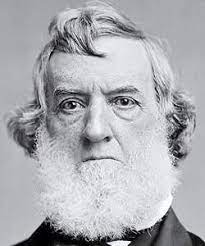
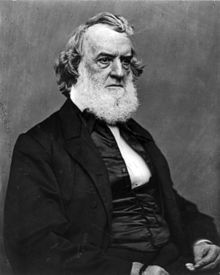
Gideon Welles (July 1, 1802 – February 11, 1878), nicknamed “Father Neptune”, was the United States Secretary of the Navy from 1861 to 1869, a cabinet post he was awarded after supporting Abraham Lincoln in the 1860 election. Although opposed to the Union blockade of Southern ports, he duly carried out his part of the Anaconda Plan, largely sealing off the Confederate coastline and preventing the exchange of cotton for war supplies. This is viewed as a major cause of Union victory in the Civil War, and his achievement in expanding the Navy almost tenfold was widely praised. Welles was also instrumental in the Navy’s creation of the Medal of Honor.
Contents
- 1Early political career
- 2Secretary of the Navy
- 3Later life and death
- 4Legacy
- 5See also
- 6Notes
- 7References
- 8External links
Early political career
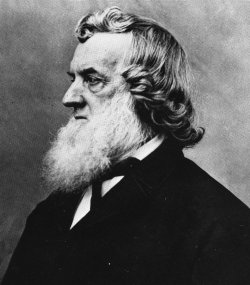
Gideon Welles, the son of Samuel Welles and Ann Hale,[1] was born on July 1, 1802, in Glastonbury, Connecticut.[2] His father was a shipping merchant and fervent Jeffersonian;[3] he was a member of the Convention, which formed the first state Connecticut Constitution in 1818 that abolished the colonial charter and officially severed the pre-American Revolution political ties to England. In contrast to the Fundamental Orders of Connecticut, the successor constitution of 1818 provided for freedom of religion. He was a member of the seventh generation of his family in America. His original immigrant ancestor was Thomas Welles,[4][5] who arrived in 1635 and was the only man in Connecticut’s history to hold all four top offices: governor, deputy governor, treasurer, and secretary. He was also the transcriber of the Fundamental Orders. Welles was the second great grandson of Capt. Samuel Welles and Ruth (Rice) Welles, the daughter of Edmund Rice, a 1638 immigrant to Sudbury and founder of Marlborough, Massachusetts.[6]
He married on June 16, 1835, at Lewiston, Mifflin County, Pennsylvania, Mary Jane Hale,[7] who was born on June 18, 1817, in Glastonbury, Connecticut, the daughter of Elias White Hale and Jane Mullhallan. Her father, Elias, graduated from Yale College in 1794 and practiced law in Mifflin and Centre Counties, Pennsylvania.[8] She died on February 28, 1886, in Hartford, Connecticut, and was buried next to her husband in Cedar Hill Cemetery in Hartford. Gideon and Mary Jane were the parents of six children.
He was educated at the Episcopal Academy at Cheshire, Connecticut, and earned a degree at the American Literary, Scientific, and Military Academy at Norwich, Vt. (later Norwich University).[2] He became a lawyer through the then-common practice of reading the law, but soon shifted to journalism and became the founder and editor of the Hartford Times in 1826. After successfully gaining admission, from 1827 to 1835, he participated in the Connecticut House of Representatives as a Democrat. Following his service in the Connecticut General Assembly, he served in various posts, including State Controller of Public Accounts in 1835, Postmaster of Hartford (1836–41), and Chief of the Bureau of Provisions and Clothing for the Navy (1846–49).[9]
Welles was a Jacksonian Democrat who worked very closely with Martin Van Buren and John Milton Niles. His chief rival in the Connecticut Democratic Party was Isaac Toucey, whom Welles would later replace at the Navy Department. While Welles dutifully supported James K. Polk in the 1844 election, he would abandon the Democrats in 1848 to support Van Buren’s Free Soil campaign.[10]
Mainly because of his strong anti-slavery views, Welles shifted allegiance in 1854 to the newly established Republican Party and founded a newspaper in 1856 (the Hartford Evening Press) that would espouse Republican ideals for decades thereafter.
Secretary of the Navy
![A dark-haired, bearded, middle-aged man holding documents is seated among seven other men.]]](https://upload.wikimedia.org/wikipedia/commons/thumb/6/6c/Emancipation_proclamation.jpg/280px-Emancipation_proclamation.jpg)
First Reading of the Emancipation Proclamation of President Lincoln by Francis Bicknell Carpenter (1864) (Clickable image—use cursor to identify.)
The Running Machine:
An 1864 cartoon takes a swing at the Lincoln administration. It features Welles, William P. Fessenden, Edwin M. Stanton, Abraham Lincoln and William H. Seward.
Welles’ strong support of Abraham Lincoln in the 1860 presidential election made him the logical candidate from New England for Lincoln’s cabinet. In March 1861, Lincoln named Welles his Secretary of the Navy.
Welles found the Naval Department in disarray, with Southern officers resigning en masse. His first major action was to dispatch the Navy’s most powerful warship, the USS Powhatan, to relieve Fort Sumter on Lincoln’s instructions. Unfortunately, Secretary of State Seward had just ordered the Powhatan to Fort Pickens, Florida on his own authority, ruining whatever chance Major Robert Anderson had of withstanding the assault. Several weeks later, when Seward argued for a blockade of Southern ports, Welles argued vociferously against the action but was eventually overruled by Lincoln. Despite his misgivings, Welles’ efforts to rebuild the Navy and implement the blockade proved extraordinarily effective. From 76 ships and 7,600 sailors in 1861, the Navy expanded almost tenfold by 1865. His implementation of the Naval portion of the Anaconda Plan strongly weakened the Confederacy’s ability to finance the war by limiting the cotton trade, and while never completely effective in sealing off all 3,500 miles of Southern coastline, it was a major contribution towards Northern victory. Lincoln nicknamed Welles his “Neptune.”[11]
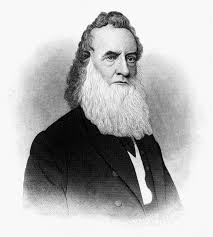
At the start of the war, David Dixon Porter wrote Welles that “the present allowance of crews … is for peace establishment and is not suited at all to times of war.” On another occasion, Porter told Welles that his own vessel lacked coal and that small steamers of shallow draft were required to make the blockade effective. From Mobile to the Mississippi River, numerous inlets allowed small Confederate craft to slip through the Federal blockade.[12]
Despite his successes, Welles was never at ease in the Cabinet. His anti-English sentiments caused him to clash with Seward, and Welles’s conservative stances led to arguments with Treasury Secretary Salmon P. Chase and War Secretary Edwin M. Stanton.[citation needed]
After Lincoln’s assassination, Welles was retained by President Andrew Johnson as Secretary of the Navy. In 1866, Welles, along with Seward, was instrumental in launching the National Union Party as a third party alternative supportive of Johnson’s reconciliation policies. Welles also played a prominent part in Johnson’s ill-fated “Swing Around the Circle” campaign that autumn.[citation needed] Although Welles admitted in his diary that he was dismayed by Johnson’s behavior on the trip, particularly the president’s penchant for invective and engaging directly with hecklers, Welles remained loyal to Johnson, and supported him during his impeachment.[13] On April 17 and 18, 1868, Welles testified in the impeachment trial of Johnson, having been called as a witness by Johnson’s defense team.[14] His son Edgar also testified that day.[15]
Later life and death
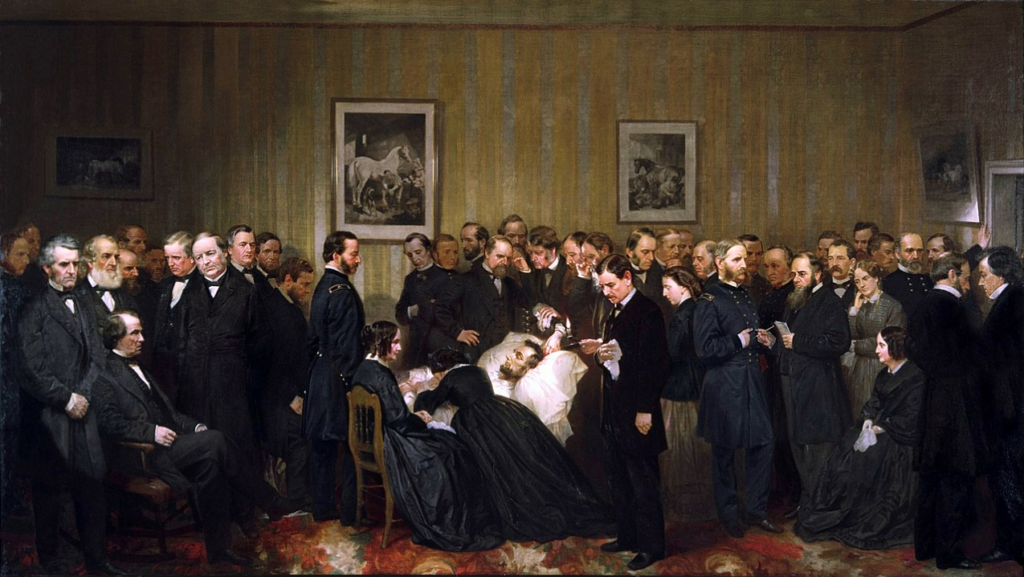
Gideon Welles
After leaving politics, Welles returned to Connecticut and to writing, editing his journals, and authoring several books before his death, including a biography, Lincoln and Seward, published in 1874.[2]
He was a Third Class Companion of the Military Order of the Loyal Legion of the United States. While the Loyal Legion did consist predominantly of Union officers who had served in the American Civil War the Order’s constitution provided for honorary members (i.e. Third Class Companions) who were civilians who had made significant contributions to the war effort. Welles was also instrumental in the Navy’s creation of the Medal of Honor.[16]
Towards the end of 1877, his health began to wane. A streptococcal infection of the throat killed Gideon Welles at the age of seventy-five on February 12, 1878.[2] His body was interred at Cedar Hill Cemetery in Hartford, Connecticut.[17]
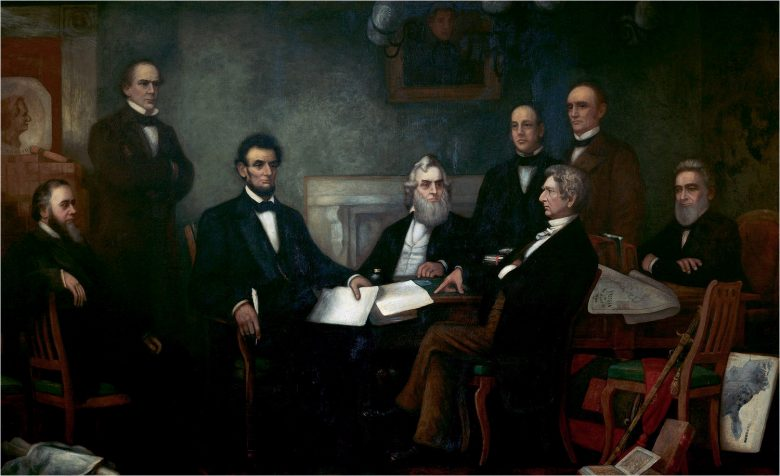
Painting by Francis Bicknell Carpenter
Legacy
Two ships have been named USS Welles in his honor. The Dining Commons at Cheshire Academy and the Gideon Welles School in Glastonbury, Connecticut, are also named after him.[18][19] In the Lincoln Square neighborhood of Chicago, Welles Park was dedicated in honor of Gideon Welles in 1910,[20] and more recently, an adjacent restaurant, opened in 2014, has also been named after Gideon Welles.[21]
See also
Notes
- ^ Hale 1909, p. 113.
- ^ Jump up to:a b c d “Obituary: Gideon Welles” (PDF). The New York Times. February 12, 1878. Retrieved August 21, 2010.
- ^ Niven 1973, p. 6.
- ^ Norton 1905, pp. 19–21.
- ^ Niven 1973, p. 7.
- ^ “Gideon Welles in ERA database”. Edmund Rice (1638) Association, Inc. Retrieved March 15, 2011.
- ^ “Obituary: Mrs. Gideon Welles” (PDF). The New York Times. March 4, 1886. Retrieved August 21, 2010.
- ^ Niven 1973, p. 16.
- ^ “Gideon Welles papers, 1777-1911”. Library of Congress Finding Aid.
- ^ Earle 2004, pp. 73–75.
- ^ Marinaro, Michael. “Gideon Welles, US Secretary of the Navy and Lincoln’s “Neptune””. Connecticut History. Retrieved April 9, 2016.
- ^ Winters 1963, p. 47.
- ^ Connecticut History
- ^ Extracts from the Journal of the United States Senate In All Cases of Impeachment Presented By The United States House of Representatives (1798-1904). Washington Government Printing Office. 1912. p. 278-281.
- ^ “By Telegraph Saturday’s Dispatches From Washington”. Daily Missouri Republican. April 20, 1980. Retrieved July 22, 2022 – via Newspapers.com.
- ^ “The Navy’s Medal of Honor”. Department of the Navy – Naval Historical Center. October 30, 2007. Archived from the original on July 9, 1997. Retrieved August 21, 2010.
- ^ Gideon Welles at Find A Grave
- ^ “Gideon Welles Dining Hall”. www.cheshireacademy.org. Cheshire Academy. Retrieved January 24, 2017.
- ^ “Gideon Welles School”. sites.google.com. Retrieved January 24, 2017.
- ^ Welles Park | Chicago Park District
- ^ “Home | Gideon Welles in Chicago, IL | Food & Drink”. Gideon Welles. Retrieved March 28, 2018.
References
- Boulard, Garry “The Swing Around the Circle—Andrew Johnson and the Train Ride that Destroyed a Presidency” (iUniverse, 2008)
- Earle, Jonathan Halperin (2004). Jacksonian antislavery and the politics of free soil, 1824-1854. Chapel Hill, NC: The University of North Carolina Press. ISBN 978-0-8078-2888-5. OCLC 1098629620. Archived from the original on August 19, 2016. Retrieved July 7, 2016.
- Hale, Oscar Fitzalan (1909). Ancestry and descendants of Josiah Hale : fifth in descent from Samuel Hale of Hartford, Conn., 1637. Rutland, VT: Tuttle. OCLC 608535741.
- Niven, John (1973). Gideon Welles; Lincoln’s Secretary of the Navy. New York: Oxford University Press. ISBN 9780195016932. OCLC 797990.
- Norton, Frederick Calvin (1905). The governors of Connecticut : biographies of the chief executives of the commonwealth that gave to the world the first written constitution known to history. OCLC 958732197.
- Siemiatkoski, Donna Holt. The Descendants of Governor Thomas Welles of Connecticut, 1590–1658, and His Wife, Alice Tomes Baltimore: Publisher, Gateway Press, 1990.
- Winters, John (1963). The Civil War in Louisiana. Baton Rouge: Louisiana State University Press. ISBN 978-0-8071-0834-5. OCLC 1391726.
Further reading
- Welles, Gideon (1911). Diary of Gideon Welles, Secretary of the Navy under Lincoln and Johnson. Vol. I. Boston ; New York : Houghton Mifflin Company.
- Welles, Gideon (1911). Diary of Gideon Welles, Secretary of the Navy under Lincoln and Johnson. Vol. II. Boston ; New York : Houghton Mifflin Company.
- Welles, Gideon (1911). Diary of Gideon Welles, Secretary of the Navy under Lincoln and Johnson. Vol. III. Boston ; New York : Houghton Mifflin Company.
External links

Wikimedia Commons has media related to Gideon Welles.

Wikiquote has quotations related to Gideon Welles.

Wikisource has the text of the 1911 Encyclopædia Britannica article “Welles, Gideon“.
- Gideon Welles at Find a Grave
- Lincoln and Seward: by Gideon Welles, New York: Publisher, Sheldon and Company, 1874.
- Mr. Lincoln’s White House: Gideon Welles
- Gideon Welles Archived August 22, 2007, at the Wayback Machine at the Naval Historical Center
- Welles Family Association, Inc.
- Biographical sketch of Thomas Welles Connecticut State Library
- Lost Letters of Gideon Welles
- Stuart A. Rose Manuscript, Archives and Rare Book Library, Emory University: Welles family papers, 1712-1871
| Preceded byRoger Huntington | Connecticut State Comptroller 1835–1836 | Succeeded byWilliam Field |
| Preceded byHenry Kilbourn | Connecticut State Comptroller 1842–1844 | Succeeded byAbijah Carrington |
| Party political offices | ||
|---|---|---|
| New political party | Republican nominee for Governor of Connecticut 1856 | Succeeded byAlexander H. Holley |
| Political offices | ||
| Preceded byIsaac Toucey | United States Secretary of the Navy 1861–1869 | Succeeded byAdolph E. Borie |


| hidevteCabinet of President Abraham Lincoln (1861–1865) | ||
|---|---|---|
| Secretary of State | William H. Seward (1861–1865) |  |
| Secretary of the Treasury | Salmon P. Chase (1861–1864)William P. Fessenden (1864–1865)Hugh McCulloch (1865) | |
| Secretary of War | Simon Cameron (1861–1862)Edwin Stanton (1862–1865) | |
| Attorney General | Edward Bates (1861–1864)James Speed (1864–1865) | |
| Postmaster General | Montgomery Blair (1861–1864)William Dennison Jr. (1864–1865) | |
| Secretary of the Navy | Gideon Welles (1861–1865) | |
| Secretary of the Interior | Caleb Blood Smith (1861–1862)John Palmer Usher (1863–1865) | |
| Related | Team of Rivals (2005 book) |
| hidevteCabinet of President Andrew Johnson (1865–1869) | ||
|---|---|---|
| Secretary of State | William H. Seward (1865–1869) |  |
| Secretary of the Treasury | Hugh McCulloch (1865–1869) | |
| Secretary of War | Edwin Stanton (1865–1868)John Schofield (1868–1869) | |
| Attorney General | James Speed (1865–1866)Henry Stanbery (1866–1868)William M. Evarts (1868–1869) | |
| Postmaster General | William Dennison Jr. (1865–1866)Alexander Randall (1866–1869) | |
| Secretary of the Navy | Gideon Welles (1865–1869) | |
| Secretary of the Interior | John Palmer Usher (1865)James Harlan (1865–1866)Orville Hickman Browning (1866–1869) |


- 1802 births
- 1878 deaths
- 19th-century American journalists
- 19th-century American newspaper publishers (people)
- 19th-century American politicians
- American abolitionists
- American naval historians
- American people of English descent
- American male journalists
- American newspaper editors
- Connecticut postmasters
- Andrew Johnson administration cabinet members
- Burials at Cedar Hill Cemetery (Hartford, Connecticut)
- Connecticut Comptrollers
- Connecticut Democrats
- Connecticut Jacksonians
- Connecticut lawyers
- Connecticut Republicans
- Lincoln administration cabinet members
- Members of the Connecticut House of Representatives
- Norwich University alumni
- People from Glastonbury, Connecticut
- People of Connecticut in the American Civil War
- Union (American Civil War) political leaders
- United States Secretaries of the Navy
- Cheshire Academy alumni
- Historians from Connecticut
- Testifying witnesses of the impeachment trial of Andrew Johnson


