Gene Roddenberry
“Eugene Roddenberry” redirects here. For Gene Roddenberry’s son, born Eugene Wesley Roddenberry Jr., see Rod Roddenberry.
| Gene Roddenberry | |
|---|---|
| Roddenberry with Space Shuttle Enterprise in Palmdale, California (1976) | |
| Born | Eugene Wesley Roddenberry August 19, 1921 El Paso, Texas, U.S. |
| Died | October 24, 1991 (aged 70) Santa Monica, California, U.S. |
| Other names | Robert Wesley |
| Alma mater | Los Angeles City College |
| Occupation | Television writer, producer |
| Spouse(s) | Eileen-Anita Rexroat(m. 1942; div. 1969)Majel Barrett (m. 1969) |
| Partner(s) | Susan Sackett (1975–1991) |
| Children | 3, including Rod |
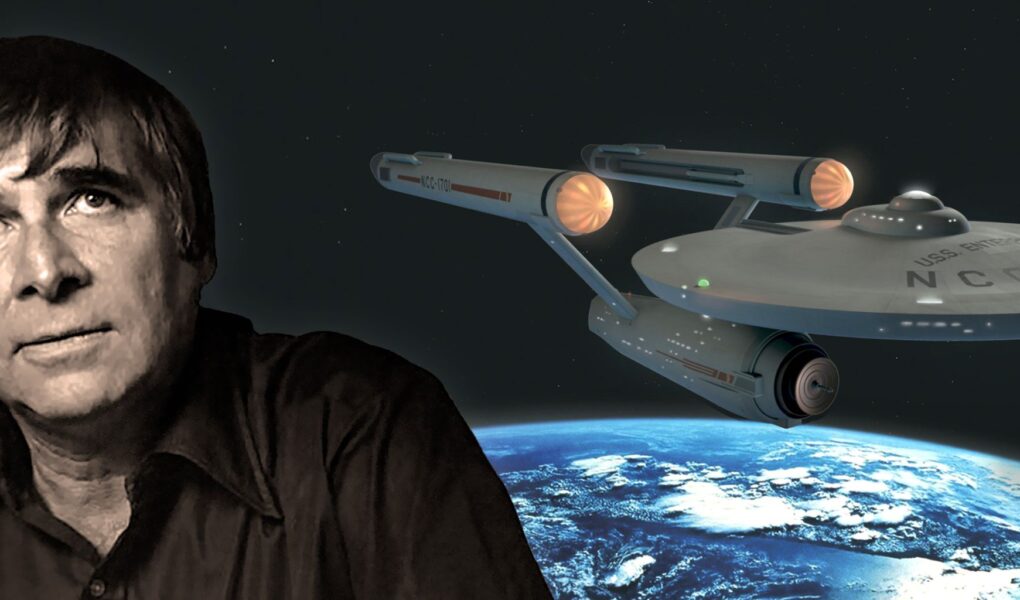
Eugene Wesley Roddenberry Sr. (August 19, 1921 – October 24, 1991) was an American television screenwriter, producer, and creator of Star Trek: The Original Series, its sequel spin-off series Star Trek: The Animated Series, and Star Trek: The Next Generation. Born in El Paso, Texas, Roddenberry grew up in Los Angeles, where his father was a police officer. Roddenberry flew 89 combat missions in the Army Air Forces during World War II and worked as a commercial pilot after the war. Later, he followed in his father’s footsteps and joined the Los Angeles Police Department, where he also began to write scripts for television.
As a freelance writer, Roddenberry wrote scripts for Highway Patrol, Have Gun – Will Travel, and other series, before creating and producing his own television series, The Lieutenant. In 1964, Roddenberry created Star Trek, which premiered in 1966 and ran for three seasons before being canceled. He then worked on other projects, including a string of failed television pilots. The syndication of Star Trek led to its growing popularity; this, in turn, resulted in the Star Trek feature films, on which Roddenberry continued to produce and consult. In 1987, the sequel series Star Trek: The Next Generation began airing on television in first-run syndication; Roddenberry was heavily involved in the initial development of the series but took a less active role after the first season due to ill health. He continued to consult on the series until his death in 1991.
In 1985, he became the first TV writer with a star on the Hollywood Walk of Fame, and he was later inducted into both the Science Fiction Hall of Fame and the Academy of Television Arts & Sciences Hall of Fame. Years after his death, Roddenberry was one of the first humans to have their ashes carried into earth orbit. The popularity of the Star Trek universe and films has inspired films, books, comic books, video games, and fan films set in the Star Trek universe.
Contents
- 1Early life and career
- 2Career as full-time writer and producer
- 3Personal life
- 4Health decline and death
- 5Legacy
- 6See also
- 7Notes
- 8References
- 9External links
Early life and career[edit]
Main article: Early life and career of Gene RoddenberryRoddenberry during his senior year of high school (1939)
Gene Roddenberry was born on August 19, 1921, in his parents’ rented home in El Paso, Texas, the first child of Eugene Edward Roddenberry and Caroline “Glen” (née Golemon) Roddenberry. The family moved to Los Angeles in 1923 after Gene’s father passed the civil service test and was given a police commission there.[1] During his childhood, Roddenberry was interested in reading, especially pulp magazines,[2] and was a fan of stories such as John Carter of Mars, Tarzan, and the Skylark series by E. E. Smith.[3]
Roddenberry majored in police science at Los Angeles City College,[4][n 1] where he began dating Eileen-Anita Rexroat and became interested in aeronautical engineering.[4] He obtained a pilot’s license through the United States Army Air Corps-sponsored Civilian Pilot Training Program.[6] He enlisted with the USAAC on December 18, 1941[7] and married Eileen on June 13, 1942.[8] He graduated from the USAAC on August 5, 1942, when he was commissioned as a second lieutenant.[9]
He was posted to Bellows Field, Oahu, to join the 394th Bomb Squadron, 5th Bombardment Group, of the Thirteenth Air Force, which flew the Boeing B-17 Flying Fortress.[10]
On August 2, 1943, while flying B-17E-BO, 41-2463, “Yankee Doodle”, out of Espiritu Santo, the plane Roddenberry was piloting overshot the runway by 500 feet (150 m) and crashed into trees, crushing the nose and starting a fire as well as killing two men: bombardier Sgt. John P. Kruger and navigator Lt. Talbert H. Woolam.[11] The official report absolved Roddenberry of any responsibility.[11] Roddenberry spent the remainder of his military career in the United States[12] and flew all over the country as a plane crash investigator. He was involved in a second plane crash, this time as a passenger.[12] He was awarded the Distinguished Flying Cross and the Air Medal.[13]
In 1945, Roddenberry began flying for Pan American World Airways,[14] including routes from New York to Johannesburg or Calcutta, the two longest Pan Am routes at the time.[14] Listed as a resident of River Edge, New Jersey, he experienced his third crash while on the Clipper Eclipse on June 18, 1947.[15] The plane came down in the Syrian Desert, and Roddenberry, who took control as the ranking flight officer, suffered two broken ribs but was able to drag injured passengers out of the burning plane and led the group to get help.[16] Fourteen (or fifteen)[17] people died in the crash; eleven passengers required hospital treatment (including Bishnu Charan Ghosh), and eight were unharmed.[18] Roddenberry resigned from Pan Am on May 15, 1948, and decided to pursue his dream of writing, particularly for the new medium of television.[19]
Roddenberry applied for a position with the Los Angeles Police Department on January 10, 1949,[20] and spent his first sixteen months in the traffic division before being transferred to the newspaper unit.[21] This became the Public Information Division, and Roddenberry became the Chief of Police’s speech writer.[22] He became technical advisor for a new television version of Mr. District Attorney, which led to him writing for the show under his pseudonym “Robert Wesley”.[23] He began to collaborate with Ziv Television Programs[24] and continued to sell scripts to Mr. District Attorney, in addition to Ziv’s Highway Patrol. In early 1956, he sold two story ideas for I Led Three Lives, and he found that it was becoming increasingly difficult to be a writer and a policeman.[25] On June 7, 1956, he resigned from the force to concentrate on his writing career.[26]
Career as full-time writer and producer[edit]
See also: Gene Roddenberry filmography
Early career[edit]
Roddenberry was promoted to head writer for The West Point Story and wrote ten scripts for the first season, about a third of the total episodes.[27] While working for Ziv, in 1956, he pitched a series to CBS set aboard a cruise ship, Hawaii Passage,[28] but they did not buy it, as he wanted to become a producer and have full creative control. He wrote another script for Ziv’s series Harbourmaster titled “Coastal Security” and signed a contract with the company to develop a show called Junior Executive with Quinn Martin. Nothing came of the series.[29]Leonard Nimoy first worked with Roddenberry on The Lieutenant.
He wrote scripts for a number of other series in his early years as a professional writer, including Bat Masterson and Jefferson Drum.[30] Roddenberry’s episode of the series Have Gun – Will Travel, “Helen of Abajinian”, won the Writers Guild of America award for Best Teleplay in 1958.[31] He also continued to create series of his own, including a series based on an agent for Lloyd’s of London called The Man from Lloyds. He pitched a police-based series called Footbeat to CBS, Hollis Productions, and Screen Gems. It nearly made it into ABC‘s Sunday-night lineup, but they opted to show only Western series that night.[30]
Roddenberry was asked to write a series called Riverboat, set in 1860s Mississippi. When he discovered that the producers wanted no black people on the show, he argued so much with them that he lost the job.[32] He also considered moving to England around this time, as Lew Grade wanted Roddenberry to develop series and set up his own production company.[33] Though he did not move, he leveraged the deal to land a contract with Screen Gems that included a guaranteed $100,000, and became a producer for the first time on a summer replacement for The Tennessee Ernie Ford Show titled Wrangler.[34]
Screen Gems backed Roddenberry’s first attempt at creating a pilot. His series, The Wild Blue, went to pilot, but was not picked up. The three main characters had names that later appeared in the Star Trek franchise: Philip Pike, Edward Jellicoe, and James T. Irvine.[35] While working at Screen Gems, an actress, new to Hollywood, wrote to him asking for a meeting. They quickly became friends and met every few months; the woman was Majel Leigh Hudec, later known as Majel Barrett.[36] He created a second pilot called 333 Montgomery about a lawyer, played by DeForest Kelley.[37] It was not picked up by the network but was later rewritten as a new series called Defiance County. His career with Screen Gems ended in late 1961,[38] and shortly afterward, he had issues with his old friend Erle Stanley Gardner. The Perry Mason creator claimed that Defiance County had infringed his character Doug Selby.[39] The two writers fell out via correspondence and stopped contacting one another, though Defiance County never proceeded past the pilot stage.[40]Roddenberry appearing in an advertisement for MONY in 1961
In 1961, he agreed to appear in an advertisement for MONY (Mutual of New York) as long as he had final approval.[41] With the money from Screen Gems and other works, Eileen and he moved to 539 South Beverly Glen, near Beverly Hills.[42] He discussed an idea about a multi-ethnic crew on an airship traveling the world, based on the film Master of the World (1961), with fellow writer Christopher Knopf at MGM. As the time was not right for science fiction, he began work on The Lieutenant for Arena Productions. This made it to the NBC Saturday night lineup at 7:30 pm[43] and premiered on September 14, 1963. The show set a new ratings record for the time slot.[44] Roddenberry worked with several cast and crew who would later join him on Star Trek, including Gene L. Coon, star Gary Lockwood, Joe D’Agosta, Leonard Nimoy, Nichelle Nichols, and Majel Barrett.[43]
The Lieutenant was produced with the co-operation of the Pentagon, which allowed them to film at an actual Marine base. During the production of the series, Roddenberry clashed regularly with the Department of Defense over potential plots.[45] The department withdrew its support after Roddenberry pressed ahead with a plot titled “To Set It Right” in which a white and a black man find a common cause in their roles as Marines.[46][47] “To Set It Right” was the first time he worked with Nichols, and it was her first television role. The episode has been preserved at the Museum of Television and Radio in New York City.[47] The show was not renewed after its first season. Roddenberry was already working on a new series idea. This included his ship location from Hawaii Passage and added a Horatio Hornblower character, plus the multiracial crew from his airship idea. He decided to write it as science fiction, and by March 11, 1964, he brought together a 16-page pitch. On April 24, he sent three copies and two dollars to the Writers Guild of America to register his series. He called it Star Trek.[48]
Star Trek[edit]
Main article: Star Trek: The Original Series
When Roddenberry pitched Star Trek to MGM, it was warmly received, but no offer was made.[49] He then went to Desilu Productions, but rather than being offered a one-script deal, he was hired as a producer and allowed to work on his own projects. His first was a half-hour pilot called Police Story (not to be confused with the anthology series created by Joseph Wambaugh), which was not picked up by the networks.[50] Having not sold a pilot in five years, Desilu was having financial difficulties; its only success was The Lucy Show.[51] Roddenberry took the Star Trek idea to Oscar Katz, head of programming, and the duo immediately started work on a plan to sell the series to the networks. They took it to CBS, which ultimately passed on it. The duo later learned that CBS had been eager to find out about Star Trek because it had a science fiction series in development—Lost in Space. Roddenberry and Katz next took the idea to Mort Werner at NBC,[51] this time downplaying the science fiction elements and highlighting the links to Gunsmoke and Wagon Train.[50] The network funded three story ideas and selected “The Menagerie”, which was later known as “The Cage“, to be made into a pilot. (The other two later became episodes of the series.) While most of the money for the pilot came from NBC, the remaining costs were covered by Desilu.[52][53] Roddenberry hired Dorothy Fontana, better known as D. C. Fontana, as his assistant. They had worked together previously on The Lieutenant, and she had eight script credits to her name.[51]William Shatner and Sally Kellerman, from “Where No Man Has Gone Before“, the second pilot of Star Trek
Roddenberry and Barrett had begun an affair by the early days of Star Trek,[52] and he specifically wrote the part of the character Number One in the pilot with her in mind; no other actresses were considered for the role. Barrett suggested Nimoy for the part of Spock. He had worked with both Roddenberry and Barrett on The Lieutenant, and once Roddenberry remembered the thin features of the actor, he did not consider anyone else for the part.[54] The remaining cast came together; filming began on November 27, 1964, and was completed on December 11.[55] After post-production, the episode was shown to NBC executives, and it was rumored that Star Trek would be broadcast at 8:00 pm on Friday nights. The episode failed to impress test audiences,[56] and after the executives became hesitant, Katz offered to make a second pilot. On March 26, 1965, NBC ordered a new episode.[57]
Roddenberry developed several possible scripts, including “Mudd’s Women“, “The Omega Glory“, and with the help of Samuel A. Peeples, “Where No Man Has Gone Before“. NBC selected the last one, leading to later rumors that Peeples created Star Trek, something he always denied.[58] Roddenberry was determined to make the crew racially diverse, which impressed actor George Takei when he came for his audition.[59] The episode went into production on July 15, 1965, and was completed at around half the cost of “The Cage”, since the sets were already built.[60] Roddenberry worked on several projects for the rest of the year. In December, he decided to write lyrics to the Star Trek theme; this angered the theme’s composer, Alexander Courage, as it meant that royalties would be split between them. In February 1966, NBC informed Desilu that they were buying Star Trek and that it would be included in the fall 1966 television schedule.[61]
On May 24, the first episode of the Star Trek series went into production;[62] Desilu was contracted to deliver 13 episodes.[63] Five days before the first broadcast, Roddenberry appeared at the 24th World Science Fiction Convention and previewed “Where No Man Has Gone Before”. After the episode was shown, he received a standing ovation. The first episode to air on NBC was “The Man Trap“, on September 8, 1966, at 8:00 pm.[64] Roddenberry was immediately concerned about the series’ low ratings and wrote to Harlan Ellison to ask if he could use his name in letters to the network to save the show. Not wanting to lose a potential source of income, Ellison agreed and also sought the help of other writers who also wanted to avoid losing potential income.[65] Roddenberry corresponded with science fiction writer Isaac Asimov about how to address the issue of Spock’s growing popularity and the possibility that his character would overshadow Kirk.[66] Asimov suggested having Kirk and Spock work together as a team “to get people to think of Kirk when they think of Spock.”[67] The series was renewed by NBC, first for a full season’s order, and then for a second season. An article in the Chicago Tribune quoted studio executives as stating that the letter-writing campaign had been wasted because they had already been planning to renew Star Trek.[68]Some of the main cast of Star Trek during the third season
Roddenberry often rewrote submitted scripts, although he did not always take credit for these.[69] Roddenberry and Ellison fell out over “The City on the Edge of Forever” after Roddenberry rewrote Ellison’s script to make it both financially feasible to film and usable for the series context.[70] Even his close friend Don Ingalls had his script for “A Private Little War” altered drastically,[69] and as a result, Ingalls declared that he would only be credited under the pseudonym “Jud Crucis” (a play on “Jesus Christ”), claiming he had been crucified by the process.[71] Roddenberry’s work rewriting “The Menagerie“, based on footage originally shot for “The Cage”, resulted in a Writers Guild arbitration board hearing. The Guild ruled in his favor over John D. F. Black, the complainant.[72] The script won a Hugo Award, but the awards board neglected to inform Roddenberry, who found out through correspondence with Asimov.[73]
As the second season was drawing to a close, Roddenberry once again faced the threat of cancellation. He enlisted the help of Asimov,[74] and even encouraged a student-led protest march on NBC. On January 8, 1968, a thousand students from 20 different schools across the country marched on the studio.[75] Roddenberry began to communicate with Star Trek fan Bjo Trimble, who led a fan writing campaign to save the series. Trimble later noted that this campaign of writing to fans who had written to Desilu about the show, urging them to write NBC, had created an organized Star Trek fandom.[76] The network received around 6,000 letters a week from fans petitioning it to renew the series.[77] On March 1, 1968, NBC announced on air, at the end of “The Omega Glory”, that Star Trek would return for a third season.[78]
The network had initially planned to place Star Trek in the 7:30 pm Monday-night time slot freed up by The Man from U.N.C.L.E. completing its run. Instead, the enraged George Schlatter forced the network to insert Rowan and Martin’s Laugh-In into the slot, and Roddenberry’s series was moved to 10:00 pm on Fridays. Realizing the show could not survive in that time slot and burned out from arguments with the network, Roddenberry resigned from the day-to-day running of Star Trek, although he continued to be credited as executive producer.[79] Roddenberry cooperated with Stephen Edward Poe, writing as Stephen Whitfield, on the 1968 nonfiction book The Making of Star Trek for Ballantine Books, splitting the royalties evenly. Roddenberry explained to Whitfield: “I had to get some money somewhere. I’m sure not going to get it from the profits of Star Trek.”[80] Herbert Solow and Robert H. Justman observed that Whitfield never regretted his 50-50 deal with Roddenberry, since it gave him “the opportunity to become the first chronicler of television’s successful unsuccessful series.”[80] Whitfield had previously been the national advertising and promotion director for model makers Aluminum Model Toys, better known as “AMT”, which then held the Star Trek license, and moved to run Lincoln Enterprises, Roddenberry’s company set up to sell the series’ merchandise.[81]
Having stepped aside from the majority of his Star Trek duties, Roddenberry sought instead to create a film based on Asimov’s “I, Robot” and also began work on a Tarzan script for National General Pictures.[82] After initially requesting a budget of $2 million and being refused, Roddenberry made cuts to reduce costs to $1.2 million. When he learned they were being offered only $700,000 to shoot the film, which by now was being called a TV movie, he canceled the deal.[83] Meanwhile, NBC announced Star Trek‘s cancellation in February 1969. A similar but much smaller letter-writing campaign followed news of the cancellation.[84] Because of the manner in which the series was sold to NBC, it left the production company $4.7 million in debt.[85] The last episode of Star Trek aired 47 days before Neil Armstrong stepped onto the moon as part of the Apollo 11 mission,[86] and Roddenberry declared that he would never write for television again.[87]
1970s projects[edit]
Following the cancellation of Star Trek, Roddenberry felt typecast as a producer of science fiction, despite his background in Westerns and police stories.[88] He later described the period, saying, “My dreams were going downhill because I could not get work after the original series was cancelled.”[89] He felt that he was “perceived as the guy who made the show that was an expensive flop.”[90] Roddenberry had sold his interest in Star Trek to Paramount Studios in return for a third of the ongoing profits. However, this did not result in any quick financial gain; the studio was still claiming that the series was $500,000 in the red in 1982.[91]
He wrote and produced Pretty Maids All in a Row (1971), a sexploitation film directed by Roger Vadim, for MGM. The cast included Rock Hudson, Angie Dickinson, Telly Savalas, and Roddy McDowall alongside Star Trek regular James Doohan, and William J. Campbell, who had appeared as a guest in two Star Trek episodes, “The Squire Of Gothos” and “The Trouble With Tribbles”. Variety was unimpressed: “Whatever substance was in the original [novel by Francis Pollini] or screen concept has been plowed under, leaving only superficial, one-joke results.”[92] Herbert Solow had given Roddenberry the work as a favor, paying him $100,000 for the script.[93]Roddenberry at a Star Trek convention in 1976
Faced with a mortgage and a $2,000-per-month alimony obligation as a result of his 1969 divorce, he retained a booking agent (with the assistance of longtime friend Arthur C. Clarke) and began to support himself largely by giving college lectures and appearances at science fiction conventions.[94][95] These presentations included screenings of “The Cage” and blooper reels from the production of Star Trek.[96] The conventions began to build the fan support to bring back Star Trek, leading TV Guide to describe it, in 1972, as “the show that won’t die.”[97]
In 1972 and 1973, Roddenberry made a comeback to science fiction, selling ideas for four new series to a variety of networks.[98] Roddenberry’s Genesis II was set in a postapocalyptic Earth. He had hoped to recreate the success of Star Trek without “doing another space-hopping show.” He created a 45-page writing guide, and proposed several story ideas based on the concept that pockets of civilisation had regressed to past eras or changed altogether.[99] The pilot aired as a TV movie in March 1973, setting new records for the Thursday Night Movie of the Week. Roddenberry was asked to produce four more scripts for episodes, but before production could begin again, CBS aired the film Planet of the Apes. It was watched by an even greater audience than Genesis II. CBS scrapped Genesis II and replaced it with a television series based on the film;[100] the results were disastrous from a ratings standpoint, and Planet of the Apes was canceled after 14 episodes.
The Questor Tapes project reunited him with his Star Trek collaborator, Gene L. Coon, who was in failing health at the time. NBC ordered 16 episodes, and tentatively scheduled the series to follow The Rockford Files on Friday nights;[101] the pilot launched on January 23, 1974,[102] to positive critical response, but Roddenberry balked at the substantial changes requested by the network and left the project, leading to its immediate cancellation. During 1974, Roddenberry reworked the Genesis II concept as a second pilot, Planet Earth, for rival network ABC, with similar less-than-successful results. The pilot was aired on April 23, 1974. While Roddenberry wanted to create something that could feasibly exist in the future, the network wanted stereotypical science-fiction women and were unhappy when that was not delivered.[101] Roddenberry was not involved in a third reworking of the material by ABC that produced Strange New World.[103] He began developing MAGNA I, an underwater science-fiction series, for 20th Century Fox Television. By the time the work on the script was complete, though, those who had approved the project had left Fox and their replacements were not interested in the project. A similar fate was faced by Tribunes, a science-fiction police series, which Roddenberry attempted to get off the ground between 1973 and 1977. He gave up after four years;[104] the series never even reached the pilot stage.[citation needed]
In 1974, Roddenberry was paid $25,000 by John Whitmore to write a script called The Nine.[105] Intended to be about Andrija Puharich‘s parapsychological research, it evolved into a frank exploration of his experiences attempting to earn a living attending science fiction conventions.[98] At the time, he was again close to losing his house because of a lack of income.[105]
The pilot Spectre, Roddenberry’s 1977 attempt to create an occult detective duo similar to Sherlock Holmes and Dr. Watson,[106] was released as a television movie within the United States and received a limited theatrical release in the United Kingdom.[107]
Star Trek revival[edit]
Roddenberry (third from the right) in 1976 with most of the cast of Star Trek at the rollout of the Space ShuttleEnterprise at the Rockwell International plant at Palmdale, California
Lacking funds in the early 1970s, Roddenberry was unable to buy the full rights to Star Trek for $150,000 from Paramount. Lou Scheimer approached Paramount in 1973 about creating an animated Star Trek series.[108] Credited as “executive consultant” and paid $2,500 per episode, Roddenberry was granted full creative control of Star Trek: The Animated Series. Although he read all the scripts and “sometimes [added] touches of his own”, he relinquished most of his authority to de facto showrunner/associate producer D. C. Fontana.[109]
Roddenberry had some difficulties with the cast. To save money, he sought not to hire George Takei and Nichelle Nichols. He neglected to inform Leonard Nimoy of this and instead, in an effort to get him to sign on, told him that he was the only member of the main cast not returning. After Nimoy discovered the deception, he demanded that Takei and Nichols play Sulu and Uhura when their characters appeared on screen; Roddenberry acquiesced. He had been promised five full seasons of the new show, but ultimately, only one and a half were produced.[110]
However, the groundswell of vociferous fan support (6,000 attended the second New York Star Trek convention in 1973 and 15,000 attended in 1974, eclipsing the 4,500 attendees at the 32nd World Science Fiction Convention in 1974) led Paramount to hire Roddenberry to create and produce a feature film based on the franchise in May 1975.[111][112] The studio was unimpressed with the ideas being put forward; John D. F. Black’s opinion was that their ideas were never “big enough” for the studio, even when one scenario involved the end of the universe.[113] At the time, several ideas were partly developed including Star Trek: The God Thing and Star Trek: Planet of the Titans.[114][115] Following the commercial reception of Star Wars, in June 1977, Paramount instead green-lit a new series set in the franchise titled Star Trek: Phase II,[116] with Roddenberry and most of the original cast, except Nimoy, set to reprise their respective roles.[117] It was to be the anchor show of a proposed Paramount-owned “fourth network”,[116] but plans for the network were scrapped and the project was reworked into a feature film.[118] The result, Star Trek: The Motion Picture, troubled the studio because of budgetary concerns,[119] but was a box-office hit. Adjusted for inflation, it was the third-highest grossing Star Trek movie, with the 2009 film coming in first and the 2013 film second.[120]
In 1980, Roddenberry submitted a treatment for a proposed sequel about the crew preventing the alien Klingons from thwarting the assassination of John F. Kennedy. Mindful of the tumult that suffused the production of Star Trek: The Motion Picture, Paramount rejected the proposal. After he was replaced on the project by television producer Harve Bennett, Roddenberry was named “executive consultant” for the project, a position he retained for all subsequent Star Trek franchise films produced during his lifetime. Under this arrangement, he was compensated with a producer’s fee and a percentage of the net profits of the film in exchange for proffering non-binding story notes and corresponding with the fan community; much to his ongoing chagrin, these memos were largely disregarded by Bennett and other producers.[121] An initial script for Star Trek II: The Wrath of Khan was circulated to eight people; Bennett attributed the subsequent plot leak of the death of Spock to Roddenberry. About 20% of the plot was based on Roddenberry’s ideas.[122]
Roddenberry was involved in creating the television series Star Trek: The Next Generation, which premiered with “Encounter at Farpoint” on September 28, 1987.[123] He was given a bonus of $1 million in addition to an ongoing salary to produce the series, and celebrated by purchasing a new Rolls-Royce for $100,000.[124] The arrangement did not entitle him to be executive producer of the series. However, Paramount was already concerned about the original cast not returning, and fearing fan reaction if Roddenberry was not involved, agreed to his demand for control of the show.[125] Roddenberry rewrote the series bible from an original version by David Gerrold, who had previously written The Original Series episode “The Trouble with Tribbles“, and The Animated Series follow-up, “More Tribbles, More Troubles“.[126]Majel Barrett at a Star Trek convention in 2007
According to producer Rick Berman, Roddenberry’s involvement in The Next Generation “diminished greatly” after the first season,[127] but the nature of his increasingly peripheral role was not disclosed because of the value of his name to fans.[127] While Berman said that Roddenberry had “all but stopped writing and rewriting” by the end of the third season, his final writing credit on the show (a co-teleplay credit) actually occurred considerably earlier, appearing on “Datalore“, the 13th episode of the first season.[citation needed]
Although commercially successful from its inception, the series was initially marred by Writers Guild of America grievances from Fontana and Gerrold, both of whom left the series under acrimonious circumstances;[128] frequent turnover among the writing staff (24 staff writers left the show during its first three seasons, triple the average attrition rate for such series);[129] and allegations that longtime Roddenberry attorney Leonard Maizlish had become the producer’s “point man and proxy”,[128] ghostwriting memos, sitting in on meetings, and contributing to scripts despite not being on staff.[130] Writer Tracy Tormé described the first few seasons of The Next Generation under Roddenberry as an “insane asylum”.[131]
In 1990, Nicholas Meyer was brought in to direct the sixth film in the series: Star Trek VI: The Undiscovered Country. Creatively, Meyer clashed with Roddenberry, who felt that having the Enterprise crew hold prejudices against the Klingons did not fit with his view of the universe. Meyer described a meeting with Roddenberry he later regretted, saying:
His guys were lined up on one side of the room, and my guys were lined up on the other side of the room, and this was not a meeting in which I felt I’d behaved very well, very diplomatically. I came out of it feeling not very good, and I’ve not felt good about it ever since. He was not well, and maybe there were more tactful ways of dealing with it, because at the end of the day, I was going to go out and make the movie. I didn’t have to take him on. Not my finest hour.[132]
In Joel Engel’s biography, Gene Roddenberry: The Myth and the Man Behind Star Trek, he states that Roddenberry watched The Undiscovered Country alongside the producers of the film at a private screening two days before his death, and told them they had done a “good job”.[133] In contrast, Nimoy and Shatner’s memoirs report that after the screening, Roddenberry called his lawyer and demanded a quarter of the scenes be cut; the producers refused.[134]
In addition to his film and television work, Roddenberry wrote the novelization of Star Trek: The Motion Picture. Although it has been incorrectly attributed to several other authors (most notably Alan Dean Foster), it was the first in a series of hundreds of Star Trek-based novels to be published by the Pocket Books imprint of Simon & Schuster, whose parent company also owned Paramount Pictures Corporation.[135] Previously, Roddenberry worked intermittently on The God Thing, a proposed novel based upon his rejected 1975 screenplay for a proposed low-budget ($3 to $5 million) Star Trek film preceding the development of Phase II throughout 1976. Attempts to complete the project by Walter Koenig,[136] Susan Sackett, Fred Bronson,[137] and Michael Jan Friedman have proven to be unfeasible for a variety of legal and structural reasons.[138][139]
Personal life[edit]
Main article: Personal life of Gene RoddenberryMajel Barrett-Roddenberry and Rod Roddenberry in 2008
While at Los Angeles City College, Roddenberry began dating Eileen-Anita Rexroat.[4] They became engaged before Roddenberry left Los Angeles during his military service,[140] and married in June 1942 at the chapel at Kelly Field.[9] They had two children together, Darleen Anita[19] and Dawn Allison.[141] During his time in the LAPD, Roddenberry was known to have had affairs with secretarial staff.[142] Before his work on Star Trek, he began relationships with both Nichelle Nichols and Majel Barrett.[143] Nichols wrote about their relationship in her autobiography Beyond Uhura only after Roddenberry’s death.[144] At the time, Roddenberry wanted to remain in an open relationship with both women,[145] but Nichols, recognizing Barrett’s devotion to him, ended the affair as she did not want to be “the other woman to the other woman”.[146]
Barrett and he had an apartment together by the opening weeks of Star Trek.[147] He had planned to divorce Eileen after the first season of the show, but when the show was renewed, he delayed doing so, fearing that he would not have enough time to deal with both the divorce and Star Trek. He moved out of the family home on August 9, 1968, two weeks after the marriage of his daughter Darleen.[148][149] In 1969, while scouting locations in Japan for MGM for Pretty Maids All in a Row,[93] he proposed to Barrett by telephone.[150] They were married in a Shinto ceremony, as Roddenberry had considered it “sacrilegious” to use an American minister in Japan.[150] Roddenberry and Barrett had a son together, Eugene Jr., commonly and professionally known as Rod Roddenberry, in February 1974.[150] From 1975 until his death, Roddenberry maintained an extramarital relationship with his executive assistant, Susan Sackett.[151]
Religious views[edit]
Roddenberry was raised a Southern Baptist;[152] however, as an adult, he rejected religion, and considered himself a humanist.[30] He began questioning religion around the age of 14, and came to the conclusion that it was “nonsense”.[152] As a child, he served in the choir at his local church, but often substituted lyrics as he sang hymns.[152] Early in his writing career, he received an award from the American Baptist Convention for “skillfully writing Christian truth and the application of Christian principles into commercial, dramatic TV scripts”.[30] For several years, he corresponded with John M. Gunn of the National Council of Churches regarding the application of Christian teachings in television series. However, Gunn stopped replying after Roddenberry wrote in a letter: “But you must understand that I am a complete pagan, and consume enormous amounts of bread, having found the Word more spice than nourishment, so I am interested in a statement couched in dollars and cents of what this means to the Roddenberry treasury.”[153]
Roddenberry said of Christianity, “How can I take seriously a God-image that requires that I prostrate myself every seven days and praise it? That sounds to me like a very insecure personality.”[152] At one point, he worked a similar opinion, which was to have been stated by a Vulcan, into the plot for Star Trek: The God Thing.[114] Before his death, Roddenberry became close friends with philosopher Charles Musès, who said that Roddenberry’s views were “a far cry from atheism“.[154] Roddenberry explained his position thus: “It’s not true that I don’t believe in God. I believe in a kind of God. It’s just not other people’s God. I reject religion. I accept the notion of God.”[155] He had an ongoing interest in other people’s experiences with religion,[156] and called Catholicism “a very beautiful religion. An art form.”[157] However, he said that he dismissed all organized religions, saying that for the most part, they acted like a “substitute brain… and a very malfunctioning one”.[158] Roddenberry was also critical of how the public looked at certain religions, noting that when the King David Hotel bombing took place in 1946, the American public accepted it as the action of freedom fighters, whereas a car bombing by a Muslim in Beirut is condemned as a terrorist act. While he agreed that both parties were wrong in their use of violence, he said that the actions of both were undertaken because of their strong religious beliefs.[159]
According to Ronald D. Moore, Roddenberry “felt very strongly that contemporary Earth religions would be gone by the 23rd century”.[160] Brannon Braga said that Roddenberry made it known to the writers of Star Trek and Star Trek: The Next Generation that religion, superstition, and mystical thinking were not to be included.[161] Even a mention of marriage in a script for an early episode of The Next Generation resulted in Roddenberry’s chastising the writers.[131] Nicholas Meyer said that Star Trek had evolved “into sort of a secular parallel to the Catholic Mass“.[162] Roddenberry compared the franchise to his own philosophy by saying: “Understand that Star Trek is more than just my political philosophy, my racial philosophy, my overview on life and the human condition.”[163] He was awarded the 1991 Humanist Arts Award from the American Humanist Association.[164]
Health decline and death[edit]
In the late 1980s, it was likely that Roddenberry was afflicted by the first manifestations of cerebral vascular disease and encephalopathy as a result of his longstanding recreational use of legal and illicit drugs, including alcohol, methaqualone,[165] methylphenidate, Dexamyl, and cocaine (which he had used regularly since the production of Star Trek: The Motion Picture).[128] Throughout much of his career, he had routinely used stimulants to work through the night on scripts, especially amphetamines.[166] The effects of these substances were compounded by deleterious interactions with diabetes,[167] high blood pressure, and antidepressant prescriptions.[128]
Following a stroke at a family reunion in Tallahassee, Florida, in September 1989,[168] Roddenberry’s health declined further, ultimately requiring him to use a wheelchair.[133] His right arm was paralyzed after another stroke in early October 1991, causing him ongoing pain as the muscles began to atrophy. It also caused problems with the sight in his right eye and he found communicating in full sentences difficult.[169] At 2:00 pm, on October 24, he attended an appointment with his doctor, Dr. Ronald Rich, in Santa Monica, California.[170] He arrived in the building with his staff, and began to travel up to the ninth floor in the elevator. As they reached the fifth floor, he began struggling for breath, and was wheeled into the doctor’s office, where he was reclined and a nurse administered oxygen. Barrett was sent for. Upon her arrival, she held Roddenberry while encouraging him to breathe. He had a cardiopulmonary arrest, and he died in the doctor’s office shortly afterwards.[171] Cardiopulmonary resuscitation was attempted with no effect, and paramedics arrived to take him across the road to the Santa Monica Medical Center, where he was pronounced dead.[172]
The funeral was arranged for November 1, with the public invited to the memorial service at the Hall of Liberty, within the Forest Lawn Memorial Park, in Hollywood Hills.[173] It was a secular service; Roddenberry had been cremated before the event. More than 300 Star Trek fans attended, and stood in the balcony section of the hall, while the invited guests were on the floor level. Nichelle Nichols sang twice during the ceremony, first “Yesterday” and then a song she wrote herself titled “Gene”.[174] Both songs had been requested by Barrett.[175] Several people spoke at the memorial, including Ray Bradbury, Whoopi Goldberg, Christopher Knopf, E. Jack Neuman,[174] and Patrick Stewart. The ceremony was closed by two kilted pipers playing “Amazing Grace” as a recorded message by Roddenberry was broadcast. A four-plane flypast, in the missing man formation, followed some 30 minutes later.[176] After his death, Star Trek: The Next Generation aired a two-part episode of season five, called “Unification“, which featured a dedication to Roddenberry.[177]
Roddenberry’s will left the majority of his $30 million estate to Barrett, in a trust. He also left money to his children and his first wife Eileen. However, his daughter Dawn contested the will on the grounds that Barrett had undue influence on her father.[178] In a hearing held in 1993, the Los Angeles Superior Court ruled that improprieties existed in the management of the trust and removed Barrett as executor. In another decision, the court found that Roddenberry had hidden assets from Star Trek in the Norway Corporation to keep funds away from his first wife, and ordered the payment of 50% of those assets to Eileen, as well as punitive damages.[179] In 1996, the California Court of Appeals ruled that the original will, which stated that anyone who contested it would be disinherited, would stand. As a result, Dawn lost $500,000 from the estate, as well as a share of the trust upon Barrett’s death.[178] The appellate court also overturned the earlier decision to award Roddenberry’s first wife, Eileen, 50% of his assets. The judge called that case one “that should never have been”.[180][181]
Spaceflight[edit]
In 1992, some of Roddenberry’s ashes were flown into space, and returned to Earth, on the Space Shuttle Columbia mission STS-52.[182][183] On April 21, 1997,[184] a Celestis spacecraft with 7 grams (a quarter of an ounce) of the cremated remains of Roddenberry,[185] along with those of Timothy Leary, Gerard K. O’Neill and 21 other people, was launched into Earth orbit as part of the Minisat 01 mission aboard a Pegasus XL rocket from a site near the Canary Islands.[184][186] On May 20, 2002, the spacecraft’s orbit deteriorated and it disintegrated in the atmosphere. Another flight to launch more of his ashes into deep space, along with those of Barrett, who died in 2008, was initially planned to take place in 2009. Unlike previous flights, the intention was that this flight would not return to burn up in the Earth’s atmosphere.[187] The payload was to include the ashes of James Doohan in addition to the Roddenberrys and several others and was scheduled to fly in 2016 on the Sunjammer solar sail experiment,[188] but the project was canceled in 2014.[189] At this time, it is not known if there is another mission being planned.[citation needed]
Legacy[edit]
Main article: Legacy of Gene RoddenberryRoddenberry’s star on the Hollywood Walk of Fame
In 1985, Gene Roddenberry was the first television writer to receive a star on the Hollywood Walk of Fame.[190] When the Sci-Fi Channel was launched, the first broadcast was a dedication to two “science fiction pioneers”:[191] Isaac Asimov and Roddenberry.[191] The Roddenberry crater on Mars is named after him,[192] as is the asteroid 4659 Roddenberry.[193] Roddenberry and Star Trek have been cited as inspiration for other science fiction franchises, with George Lucas crediting the series for enabling Star Wars to be produced.[194] J. Michael Straczynski, creator of the Babylon 5 franchise, appreciated Star Trek amongst other science fiction series and “what they had to say about who we are, and where we are going.”[195]
David Alexander collaborated with Roddenberry on a biography over two decades.[196] Titled Star Trek Creator, it was published in 1995.[197] Yvonne Fern’s book Gene Roddenberry: The Last Conversation detailed a series of conversations she had with Roddenberry over the last months of his life.[198] In October 2002, a plaque was placed at Roddenberry’s birthplace in El Paso, Texas.[199] The El Paso Independent School District named the 40-foot, 120-seat Roddenberry Planetarium in his honor. The planetarium was recently upgraded and relocated to northeast El Paso. The Science Fiction Hall of Fame inducted Roddenberry in 2007,[200] and the Television Academy Hall of Fame in January 2010.[201]
Commemorating Roddenberry’s 100th birthday in August 2021, NASA used its Deep Space Network to transmit a 1976 recording of Roddenberry towards the direction of the star system 40 Eridani (the host of the fictional planet Vulcan). The signal will reach the star in early 2038.[202][203][204]
Posthumous television series[edit]
Star Trek: Deep Space Nine was already in development when Roddenberry died. Berman said that while he never discussed the ideas for the series, he was given a blessing by Roddenberry to pursue it.[205] Berman later stated, “I don’t believe the 24th century is going to be like Gene Roddenberry believed it to be, that people will be free from poverty and greed. But if you’re going to write and produce for Star Trek, you’ve got to buy into that.”[206] In early 1996, Majel Barret-Roddenberry uncovered scripts for a series called Battleground Earth. The project was sent to distributors by the Creative Artists Agency, and it was picked up by Tribune Entertainment, which set the budget at over $1 million per episode.[207] The series was renamed Earth: Final Conflict before launch, and premiered in 1997, six years after Gene’s death; it ran for five seasons and 110 episodes until 2002.[208]
Two further series ideas were developed from Roddenberry’s notes, Genesis and Andromeda.[209] After an initial order for two seasons, 110 episodes of Andromeda were aired over five seasons from 2000 to 2005.[210][211] Tribune also worked on another Roddenberry series. Titled Starship; the production company aimed to launch it via the network route rather than into syndication.[212] Rod Roddenberry, president of Roddenberry Productions, announced in 2010, at his father’s posthumous induction into the Academy of Television Arts and Sciences Hall of Fame, that he was aiming to take The Questor Tapes to television.[213] Rod was developing the series alongside Imagine Television.[213] Rod would go on to create the two-hour television movie Trek Nation regarding the impact of his father’s work.[214]
Awards and nominations[edit]
Main article: List of awards and nominations received by Gene Roddenberry
The majority of the awards and nominations received by Roddenberry throughout his career were related to Star Trek. He was credited for Star Trek during the nominations for two Emmy Awards,[215][216] and won two Hugo Awards.[217][218] One Hugo was a special award for the series, while another was for “The Menagerie”, the episode that used footage from the original unaired pilot for Star Trek, “The Cage”.[219] In addition, he was awarded the Brotherhood Award by the National Association for the Advancement of Colored People for his work in the advancement of African American characters on television.[31] Following the end of Star Trek, he was nominated for Hugo Awards for Genesis II and The Questor Tapes.[220][221] Following his death in 1991,[171] he was posthumously awarded the Robert A. Heinlein Memorial Award by the National Space Society and The George Pal Memorial Award at the Saturn Awards, as well as the Exceptional Public Service Medal by NASA.[222][223][224]
See also[edit]
Notes[edit]
- ^ Studio biographies have erroneously credited Roddenberry as taking pre-law at Los Angeles City College, before switching to a major in engineering at the UCLA.[5]
References[edit]
- ^ Alexander (1995): pp. 15–17
- ^ Alexander (1995): p. 34
- ^ Alexander (1995): p. 37
- ^ Jump up to:a b c Alexander (1995): p. 48
- ^ Alexander (1995): p. 47
- ^ Alexander (1995): p. 49
- ^ “World War II Army Enlistment Records Transcription”. Findmypast. Retrieved April 28, 2015.
- ^ Alexander (1995): pp. 54–55
- ^ Jump up to:a b Alexander (1995): pp. 59–61
- ^ Alexander (1995): pp. 62–63
- ^ Jump up to:a b Alexander (1995): pp. 81–82
- ^ Jump up to:a b Alexander (1995): p. 83
- ^ Hamilton (2007): p. 14
- ^ Jump up to:a b Alexander (1995): p. 85
- ^ Freeze, Christopher. “Clipper Eclipse”. Check-Six.com. Retrieved September 6, 2016.
- ^ Alexander (1995): pp. 91–95
- ^ “Clipper Plane Crash Kills 14”, Pittsburgh Post-Gazette, June 20, 1947, p4
- ^ Alexander (1995): pp. 97–98
- ^ Jump up to:a b Alexander (1995): pp. 103–104
- ^ Alexander (1995): p. 110
- ^ Alexander (1995): p. 114
- ^ Alexander (1995): p. 115
- ^ Alexander (1995): pp. 135–137
- ^ Alexander (1995) p. 145
- ^ Alexander (1995): p. 148
- ^ Alexander (1995): p. 151
- ^ Alexander (1995): p. 160
- ^ Gross, Edward; Altman, Mark A., eds. (June 2016). “Gene had been a big fan of 1961’s Master of the World. But less known is that five years earlier, in 1956, Gene had pitched an idea for a new series called Hawaii Passage, which followed the adventures of a cruise ship, her captain, and senior officers. What was different here was that Gene referred to the ship as one of the characters, unheard of at the time.”. The Fifty-Year Mission: The Complete, Uncensored, Unauthorized Oral History of Star Trek: The First 25 Years (1st ed.). New York, NY: Thomas Dunne Books. p. 66. ISBN 978-1-250-06584-1. Retrieved May 12, 2019.
- ^ Alexander (1995): pp. 162–164
- ^ Jump up to:a b c d Alexander (1995): pp. 166–167
- ^ Jump up to:a b Reginald (1979): p. 1052
- ^ Van Hise (1992): p. 13
- ^ Alexander (1995): p. 170
- ^ Alexander (1995): p. 175
- ^ Alexander (1995): pp. 179–180
- ^ Alexander (1995): p. 181
- ^ Van Hise (1992): p. 15
- ^ Alexander (1995): p. 182
- ^ Alexander (1995): p. 186
- ^ Alexander (1995): p. 195
- ^ Alexander (1995): p. 198
- ^ Alexander (1995): p. 200
- ^ Jump up to:a b Alexander (1995): pp. 201–202
- ^ Engel (1994), p. 25
- ^ Engel (1994), p. 26
- ^ Engel (1994), p. 28
- ^ Jump up to:a b Nichols (1994): p. 122
- ^ Alexander (1995): p. 204
- ^ Alexander (1995): p. 206
- ^ Jump up to:a b Alexander (1995): pp. 211–212
- ^ Jump up to:a b c Van Hise (1992): p. 20
- ^ Jump up to:a b Alexander (1995): p. 213
- ^ Alexander (1995): p. 216
- ^ Alexander (1995): pp. 227–228
- ^ Alexander (1995): pp. 234–236
- ^ Alexander (1995): p. 238
- ^ Alexander (1995): pp. 243–244
- ^ Alexander (1995): pp. 246–248
- ^ Takei (1994), p. 149
- ^ Alexander (1995): p. 252
- ^ Alexander (1995): pp. 255–256
- ^ Alexander (1995): p. 272
- ^ Alexander (1995): p. 275
- ^ Alexander (1995): p. 278
- ^ Alexander (1995): p. 284
- ^ Alexander (1995): p. 304
- ^ Alexander (1995): p. 307
- ^ Alexander (1995): p. 287
- ^ Jump up to:a b Alexander (1995): p. 314
- ^ Alexander (1995): p. 313
- ^ Alexander (1995): p. 315
- ^ Engel (1994), p. 118
- ^ Engel (1994), pp. 120–121
- ^ Alexander (1995): p. 327
- ^ Alexander (1995): p. 329
- ^ Alexander (1995): pp. 336–337
- ^ Alexander (1995): p. 338
- ^ Alexander (1995): p. 341
- ^ Alexander (1995): pp. 342–343
- ^ Jump up to:a b Solow & Justman (1996): p. 402
- ^ Engel (1994), p. 123
- ^ Alexander (1995): pp. 390–391
- ^ Alexander (1995): pp. 393–394
- ^ Alexander (1995): p. 398
- ^ Alexander (1995): p. 399
- ^ Alexander (1995): p. 400
- ^ Engel (1994), p. 175
- ^ Asherman (1988): p. 13
- ^ Van Hise (1992): p. 45
- ^ Schonauer, David (April 22, 1988). “What’s important is what hasn’t changed”. Herald-Journal. Vol. 58, no. 113. p. B8. Retrieved April 15, 2015 – via Google News.
- ^ Van Hise (1992): p. 58
- ^ “Review: ‘Pretty Maids All in a Row'”. Variety. December 31, 1970. Archived from the original on January 12, 2015. Retrieved March 25, 2015.
- ^ Jump up to:a b Engel (1994): p. 139
- ^ Engel (1994): p. 140
- ^ Nemecek (2003): p. 2
- ^ “‘Star Trek’ creator brings banned pilot to the Arena Sunday”. San Antonio Express. January 7, 1977. p. 4C. Retrieved April 26, 2015 – via Newspapers.com.
- ^ Engel (1994), p. 149
- ^ Jump up to:a b Van Hise (1992): p. 59
- ^ Van Hise (1992): p. 60
- ^ Van Hise (1992): p. 61
- ^ Jump up to:a b Van Hise (1992): p. 65
- ^ Van Hise (1992): p. 63
- ^ Alexander, David, “Star Trek Creator.” ROC Books, an imprint of Dutton Signet, a division of Penguin Books USA, New York, June 1994, ISBN 0-451-45418-9, pp. 398–403.
- ^ Van Hise (1992): p. 67
- ^ Jump up to:a b Engel (1994), p. 165
- ^ Van Hise (1992): p. 68
- ^ “A new Trek? Roddenberry’s failed TV pilots (video)”. blastr. December 14, 2012. Archived from the original on March 15, 2016. Retrieved March 15, 2016.
- ^ Engel (1994), p. 150
- ^ Clark (2012): p. 323
- ^ Engel (1994), p. 158
- ^ Reeves-Stevens & Reeves-Stevens (1997): p. 16
- ^ “Star Trek Conventions”. Archived from the original on June 18, 2016. Retrieved July 3, 2016.
- ^ Engel (1994), p. 179
- ^ Jump up to:a b Burns, Jim (November 1976). “The Star Trek movie”. Starlog (2): 13. Retrieved January 1, 2015.
- ^ Reeves-Stevens & Reeves-Stevens (1997): p. 17
- ^ Jump up to:a b Engel (1994), p. 180
- ^ Engel (1994), p. 181
- ^ Engel (1994), p. 182
- ^ Engel (1994), p. 204
- ^ “Star Trek Movies at the Box Office”. Box Office Mojo. Archived from the original on January 1, 2015. Retrieved April 15, 2015.
- ^ Greenberger (2012), p. 115
- ^ Greenberger (2012), p. 118
- ^ “Encounter at Farpoint, Part I”. StarTrek.com. Retrieved April 26, 2015.
- ^ Engel (1994), p. 220
- ^ Engel (1994), p. 222
- ^ Vinciguerra, Thomas (December 16, 2007). “Nobody Knows the Tribbles He’s Seen”. The New York Times. Archived from the original on April 15, 2015. Retrieved April 15, 2015.
- ^ Jump up to:a b Tulock & Jenkins (1995): p. 186
- ^ Jump up to:a b c d Engel (1994), p. 238
- ^ Engel (1994), p. 243
- ^ Engel (1994), p. 239
- ^ Jump up to:a b Engel (1994), p. 247
- ^ Clark, Noelene (June 10, 2011). “‘Star Trek’: Nicholas Meyer explains his Roddenberry regret”. Los Angeles Times. Archived from the original on January 3, 2015. Retrieved March 28, 2015.
- ^ Jump up to:a b Engel (1994), p. 259
- ^ Sarantakes, Nicholas Evan (2005). “Cold War Pop Culture and the Image of US Foreign Policy: The Perspective of the Original Star Trek Series”. Journal of Cold War Studies. 7 (4): 101. doi:10.1162/1520397055012488. S2CID 57563417.
- ^ Ayers (2006): p. 314
- ^ Koenig (1997): p. 217
- ^ Sackett (2002): pp. 192–193
- ^ Sackett, Susan (March 1978). “A Conversation with Gene Roddenberry”. Starlog (12): 25–29. Retrieved January 1, 2015.
- ^ Greenberger (2012), p. 192
- ^ Alexander (1995): p. 58
- ^ Alexander (1995): p. 163
- ^ Alexander (1995): p. 123
- ^ Sterling, Ian (January 1995). “Uhura and Beyond”. Starlog (210): 47–49. Retrieved April 17, 2015.
- ^ Nichols (1994): p. 130
- ^ Nichols (1994): p. 132
- ^ Nichols (1994): p. 133
- ^ Engel (1994): p. 103
- ^ Alexander (1995): pp. 352–353
- ^ Alexander (1995): p. 356
- ^ Jump up to:a b c Van Hise (1992): p. 53
- ^ Sackett (2002): pp. 70
- ^ Jump up to:a b c d Van Hise (1992): p. 7
- ^ Alexander (1995): p. 169
- ^ Fern (1994): p. 28
- ^ Fern (1994): p. 66
- ^ Fern (1994): p. 42
- ^ Fern (1994): p. 110
- ^ Fern (1994): p. 111
- ^ Asherman (1988): p. 7
- ^ Ronald D. Moore. “AOL chats Ronald D. Moore”. Retrieved January 20, 2014.
- ^ Braga, Brannon (June 24, 2006). “Every religion has a mythology”. International Atheist Conference. Reykjavik, Iceland. Archived from the original on February 12, 2014. Retrieved May 11, 2009.
- ^ Fern (1994): p. 112
- ^ Nichols (1994): p. 14
- ^ “From the AHA Archives: Gene Roddenberry”. American Humanist Association. Archived from the original on August 21, 2012. Retrieved April 26, 2015.
- ^ Drew, Brian (September 12, 2014). “Exclusive: David Gerrold Talks Frankly About TNG Conflicts With Roddenberry & Berman + JJ-Trek & more”. TrekMovie.com. Retrieved November 24, 2017.
- ^ Alexander (1995): p. 323
- ^ Engel (1994), p. 11
- ^ Nichols (1994): p. 11
- ^ Alexander (1995): p. 1
- ^ Alexander (1995): p. 4
- ^ Jump up to:a b Alexander (1995): p. 7
- ^ Hastings, Deborah (October 25, 1991). “Man who boldly launched Capt. Kirk, Mr. Spock dies”. The San Bernardino County Sun. Retrieved March 27, 2015 – via Newspapers.com.
- ^ Engel (1994), p. 6
- ^ Jump up to:a b Engel (1994), pp. 7–9
- ^ Nichols (1994): p. 10
- ^ Engel (1994), p. 10
- ^ DeCandido, Keith (June 27, 2012). “Star Trek: The Next Generation Rewatch: ‘Unification, Part I'”. Tor.com. Archived from the original on April 9, 2015. Retrieved April 15, 2015.
- ^ Jump up to:a b “Roddenberry’s Heir Losing Enterprise”. Daily News. June 29, 1996. Archived from the original on April 2, 2015. Retrieved March 22, 2015 – via HighBeam Research.
- ^ Engel (1994), p. 262
- ^ “California’s appellate court has overturned a jury’s decision to order the estate of Star Trek creator Gene Roddenberry to pay his first wife, Eileen, more than $4 million in damages”. Broadcasting & Cable. April 22, 1996. Archived from the original on January 31, 2013. Retrieved March 22, 2015 – via HighBeam Research.
- ^ “Roddenberry v. Roddenberry (1996)”. Justia US Law. Retrieved March 6, 2018.
- ^ “Shuttle bore Roddenberry’s ashes”. Rome News-Tribune. April 29, 1994. Retrieved August 4, 2012.
- ^ Zwecker, Bill (April 29, 2014). “Gene Roddenberry Goes Boldly”. Chicago Sun-Times. Archived from the original on April 2, 2015. Retrieved March 22, 2015 – via HighBeam Research.
- ^ Jump up to:a b “The Founders Flight”. Celestis. Archived from the original on February 8, 2014. Retrieved April 25, 2015.
- ^ “Launching the Great Bird”. Star Trek Monthly. 1 (27): 5. May 1997.
- ^ Seligmann, Jean (May 5, 1997). “Ashes Away”. Newsweek. Archived from the original on April 2, 2015. Retrieved March 22, 2015 – via HighBeam Research.
- ^ “Gene Roddenberry, wife to spend eternity in space”. Associated Press. January 27, 2009. Archived from the original on April 2, 2015. Retrieved March 22, 2015 – via HighBeam Research.
- ^ “The Sunjammer Flight is projected to launch in 2016”. Celestis. Archived from the original on October 18, 2014. Retrieved April 26, 2015.
- ^ “NASA Nixes Sunjammer Mission, Cites Integration, Schedule Risk”. October 17, 2014. Retrieved April 25, 2017.
- ^ Pearson (2011): pp. 105–131
- ^ Jump up to:a b Engel (1994): p. xix
- ^ Ayers (2006): p. 291
- ^ Hamilton (2007): p. 17
- ^ McIntyre, Gina (July 9, 2013). “George Lucas: ‘Star Wars’ stood on the shoulders of ‘Star Trek'”. Los Angeles Times. Archived from the original on March 22, 2015. Retrieved March 22, 2015.
- ^ Webster, Dan (May 16, 2003). “Roddenberry’s ideas have prospered; ‘Star Trek’ was an inspiration to ‘Babylon 5’ creator”. The Spokesman-Review. Archived from the original on April 2, 2015. Retrieved March 22, 2015 – via HighBeam Research.
- ^ Salles, Andre (November 20, 2008). “10 Questions with David Alexander”. The Beacon News. Archived from the original on April 2, 2015. Retrieved March 22, 2015 – via HighBeam Research.
- ^ “Museum official, ‘Star Trek’ expert”. Chicago Sun-Times. December 17, 2010. Archived from the original on April 2, 2015. Retrieved March 22, 2015 – via HighBeam Research.
- ^ Hall (1997): p. 261
- ^ “El Paso to Mark Roddenberry’s Birth”. Associated Press. October 4, 2002. Archived from the original on September 24, 2015. Retrieved March 22, 2015 – via HighBeam Research.
- ^ “Science Fiction Hall of Fame to Induct Ed Emshwiller, Gene Roddenberry, Ridley Scott and Gene Wolfe”. empsfm.org. Archived from the original on October 14, 2007. Retrieved April 26, 2015.
- ^ “Seth MacFarlane on Gene Roddenberry: Hall of Fame 2010”. Television Academy. February 10, 2010. Archived from the original on July 15, 2014. Retrieved April 26, 2015.
- ^ @NASASCaN (August 19, 2021). “”Attention on the complex. The DSS-13 antenna will be moving to Vulcan in 3 minutes.” DSS-13 is ready to broadcast a 1976 recording of Gene Roddenberry. The audio file will be sent to the star system 40 Eridani, home to the planet Vulcan in @StarTrek lore. #Roddenberry100″ (Tweet) – via Twitter.
- ^ @NASASCaN (August 19, 2021). “Beam us up, DSN!Raised hand with part between middle and ring fingers Planet Vulcan is fictional but its star system – 40 Eridani – is real. In honor of #Roddenberry100, we’ll send a 1976 recording of @StarTrek creator Gene Roddenberry across space via @NASASCaN. See how these giant antennas connect us: go.nasa.gov/about-dsn” (Tweet) – via Twitter.
- ^ @NASASCaN (August 19, 2021). “Transmission successful! Traveling via the Deep Space Network at the Goldstone Deep Space Communications Complex, to star system 40 Eridani, Gene Roddenberry’s message will take around 16.5 years to arrive. #Roddenberry100” (Tweet) – via Twitter.
- ^ Cerone, Daniel (January 2, 1993). “‘Trek’ Rolls on Without Roddenberry”. Chicago Sun-Times. Archived from the original on April 2, 2015. Retrieved March 22, 2015 – via HighBeam Research.
- ^ Cerone, Daniel Howard (November 18, 1994). “Berman in Firm Control of Starfleet Command”. No. Chicago Sun-Times. Archived from the original on April 2, 2015. Retrieved March 22, 2015 – via HighBeam Research.
- ^ Littleton, Cynthia (September 2, 1996). “Tribune stakes out ‘Battleground Earth:’ Roddenberry project for first-run is budgeted at $1 million per episode”. Broadcasting & Cable. Archived from the original on January 31, 2013. Retrieved March 22, 2015 – via HighBeam Research.
- ^ “Roddenberry’s Wife Picks up the Banner”. Rocky Mountain News. January 18, 1998. Archived from the original on April 2, 2015. Retrieved March 22, 2015 – via HighBeam Research.
- ^ Schlosser, Joe (January 17, 2000). “Gene Roddenberry’s Andromeda”. Broadcasting & Cable. Archived from the original on January 31, 2013. Retrieved March 22, 2015 – via HighBeam Research.
- ^ Grego, Melissa (January 21, 2002). “‘Andromeda’ sets 2 more”. Variety. Archived from the original on January 31, 2013. Retrieved March 22, 2015 – via HighBeam Research.
- ^ Grego, Melissa (January 19, 2004). “Sci Fi Channel has picked up the final season of Tribune’s Andromeda as an original series”. Broadcasting & Cable. Archived from the original on September 24, 2015. Retrieved April 15, 2015 – via HighBeam Research.
- ^ Schlosser, Joe (May 17, 1999). “Hercules Heads for Stars”. Broadcasting & Cable. Archived from the original on April 2, 2015. Retrieved March 22, 2015 – via HighBeam Research.
- ^ Jump up to:a b “Roddenberry Productions in Development with Imagine Entertainment on Classic Gene Roddenberry Pilot ‘The Questor Tapes'”. Biotech Week. February 3, 2010. Archived from the original on April 2, 2015. Retrieved March 22, 2015 – via HighBeam Research.
- ^ “Science Explores the Legacy of the Star Trek Phenomenon with the Definitive Two-Hour Television Event: Trek Nation”. Defense & Aerospace Week. November 30, 2011. Archived from the original on April 2, 2015. Retrieved March 22, 2015 – via HighBeam Research.
- ^ “19th Primetime Emmys Nominees and Winners”. Television Academy. Archived from the original on September 1, 2015. Retrieved October 10, 2015.
- ^ “20th Primetime Emmys Nominees and Winners”. Television Academy. Archived from the original on January 18, 2015. Retrieved April 26, 2015.
- ^ “1967 Hugo Awards”. The Hugo Awards. July 26, 2007. Archived from the original on February 11, 2012. Retrieved April 26, 2015.
- ^ “The Hugo Awards By Category”. World Science Fiction Convention. Archived from the original on March 2, 1999. Retrieved October 17, 2015.
- ^ Cushman & Osborn (2013): p. 337
- ^ “1974 Hugo Awards”. The Hugo Awards. July 26, 2007. Archived from the original on March 3, 2012. Retrieved April 26, 2015.
- ^ “1975 Hugo Awards”. The Hugo Awards. July 26, 2007. Archived from the original on February 11, 2012. Retrieved April 26, 2015.
- ^ “NSS Robert A. Heinlein Memorial Award”. National Space Society. Archived from the original on May 14, 2012. Retrieved April 26, 2015.
- ^ Hall (1997): p. 215
- ^ “Star Trek a Gene Roddenberry Vision”. Product of Culture.
Sources[edit]
- Alexander, David (1995). Star Trek Creator: The Authorized Biography of Gene Roddenberry. New York: Roc. ISBN 0-451-45440-5.
- Asherman, Allan (1986). The Star Trek Compendium. New York: Pocket Books. ISBN 978-067162-7263.
- Asherman, Allan (1988). The Star Trek Interview Book. New York: Pocket Books. ISBN 9780671617943.
- Clark, Mark (2012). Star Trek FAQ. Milwaukee, Wisconsin: Applause Theatre & Cinema Books. ISBN 9781557837929.
- Engel, Joel (1994). Gene Roddenberry: The Myth and the Man Behind Star Trek. New York: Hyperion. ISBN 0-7868-6004-9.
- Fern, Yvonne (1994). Gene Roddenberry: The Last Conversation. Berkeley: University of California Press. ISBN 0-520-08842-5.
- Greenberger, Robert (2012). Star Trek: The Complete Unauthorized History. Minneapolis: Voyageur Press. ISBN 978-0-76034-359-3.
- Hall, Halbert W. (1997). Science Fiction and Fantasy Reference Index, 1992–1995. Englewood, Colorado: Libraries Unlimited. ISBN 9780585373973.
- Hamilton, John (2007). Science Fiction in the Media. Edina, Minnesota: ABDO Publishing Company. ISBN 978-1-59679-994-3.
- Koenig, Walter (1997). Warped Factors. Dallas, Texas: Taylor Publishing. ISBN 978-0-87833-991-4.
- Nichols, Nichelle (1994). Beyond Uhura. New York: G. P. Putnam’s. ISBN 0-3991-3993-1.
- Nemecek, Larry (2003). Star Trek: The Next Generation Companion (3rd ed.). New York: Pocket Books. ISBN 0-7434-5798-6.
- Pearson, Roberta (2011). “Cult Television as Digital Television’s Cutting Edge”. In Bennett, James; Strange, Niki (eds.). Television as Digital Media. Duke University Press. ISBN 978-0-8223-4910-5.
- Reeves-Stevens, Judith; Reeves-Stevens, Garfield (1998). Star Trek: The Next Generation: The Continuing Mission (2nd ed.). New York: Pocket Books. ISBN 978-0671025595.
- Reginald, Robert (1979). Science Fiction and Fantasy Literature Volume II. Detroit: Gale. ISBN 9780810310513.
- Sackett, Susan (2002). Inside Trek. Tulsa: Hawk Publishing. ISBN 978-1930709423.
- Solow, Herbert F.; Justman, Robert H. (1996). Inside Star Trek: The Real Story. New York: Pocket Books. ISBN 978-0671896287.
- Takei, George (1994). To The Stars. Pocket Books. ISBN 0-671-89008-5.
- Tulock, John; Jenkins, Henry (1995). Science Fiction Audiences. London; New York: Routledge. ISBN 9780203993392.
- Van Hise, James (1992). The Man Who Created Star Trek: Gene Roddenberry. Pioneer Books. ISBN 1-55698-318-2.
External links[edit]
- Roddenberry Entertainment website
- Image of Rock Hudson, Gene Roddenberry, and Roger Vadim posing with women cast members for motion picture “Pretty Maids All in a Row,” California, 1970. Los Angeles Times Photographic Archive (Collection 1429). UCLA Library Special Collections, Charles E. Young Research Library, University of California, Los Angeles.
- Gene Roddenberry at IMDb
- Gene Roddenberry at Memory Alpha (a Star Trek wiki)
- Talking About Gene Roddenberry at The Interviews: An Oral History of Television
Portals:CaliforniaLawSpeculative fiction/Science fictionSpeculative fictionTelevisionWorld War IIGene Roddenberry at Wikipedia’s sister projects: Media from Commons
 Quotations from Wikiquote
 Data from Wikidata
| showvteTelevision Hall of Fame Class of 2010 |
|---|
- Gene Roddenberry
- 1921 births
- 1991 deaths
- 20th-century American businesspeople
- 20th-century American novelists
- American science fiction writers
- Film producers from California
- Critics of religions
- American humanists
- American male novelists
- American male screenwriters
- Television producers from California
- American television writers
- Former Baptists
- Los Angeles City College alumni
- Los Angeles Police Department officers
- American male television writers
- Military personnel from Texas
- People from El Paso, Texas
- People from River Edge, New Jersey
- Recipients of the Air Medal
- Recipients of the Distinguished Flying Cross (United States)
- Science Fiction Hall of Fame inductees
- Showrunners
- Space burials
- United States Army Air Forces officers
- United States Army Air Forces bomber pilots of World War II
- Writers from Los Angeles
- Writers Guild of America Award winners
- Commercial aviators
- Screenwriters from New Jersey
- Screenwriters from California
- 20th-century American male writers
- Novelists from New Jersey
- Screenwriters from Texas
- Television producers from Texas
- Film producers from Texas
- Film producers from New Jersey
- 20th-century American screenwriters
- 20th-century pseudonymous writers
- Television producers from New Jersey
Star Trek Creator, Gene Roddenberry Gives Lecture at Wichita State University
Flat panel televisions, on-demand TV, and chatting with video. Star Trek creator, Gene Roddenberry was talking about these things in 1974 when he spoke the Wichita State “Forum Series.”SHOW LESS
39 Comments
SORT BY

LOMED Beats
3 years agoThe fact that we are watching this on YouTube is testament to his vision. What a guy! Thanks Gene13REPLY

Derek Kase
5 years agohe predicted USB ports, the internet, Netflix, YouTube, cellphones, smartphones etc etc etc… just outstanding amazing a visionary. our time is now. peace, tread ever on.14REPLY

Marina Simón Guastella
4 years agoI adore him! We still need good visionaries like him. The logical inspiration to the magical generations.6REPLYHide reply

WSUTV4 years agoAgreed! Truly an inspiration to us all! Thanks for watching!4REPLY

John G
6 years ago33:31 – 36:40 This is so interesting, he was spot on.15REPLYView 2 replies

Phobos Anomaly
5 years agoA beautiful and cogent speech. When I think of the philosophers that have informed my life, I name just a few: Spinoza, Hume, and Roddenberry…yes, Roddenberry. He was a great ethical and philosophical thinker, and the human race is better for his teachings.5REPLY

Carl Ralph Adler
1 month agoSo happy to find this….saw him at University of New Hampshire in the same year. I approached him after and gave him an envelope with several non-fiction pieces I had written about science fiction for my journalism degree. A few weeks later, I was stunned to get a personal letter from him thanking me, and asking if he could include some of my thoughts in future lectures. That letter is framed and cherished. He had no reason to take the time to write to me, with encouragement to pursue a career in writing based on the samples I gave him.Show lessREPLY

carl perkins
4 months agoGene Roddenberry ,besides being a visionary ,brought excellent directors and scrip writers for his business ,he create a tv series ” The Lieutenant ” with amazing actors like Robert Vaughn ,Gary Lockwood .REPLY

magnaviator
3 months agoHe broke a lot of ground. Really exceptional individual and philosopher to emerge out of the mediocrity of Hollywood.REPLY

Jonathan Hudgins
5 years agoWhat a visionary.4REPLY

Kevin Bost
3 years agoHoly shit gene. Predicted the communication revolution, personal computers, fucking DVR.4REPLY

Miles Regal
4 months agoThanks for posting this man!1REPLY

wade barnett
1 month agoIt was about that time that he spoke at Augustana College in Rock Island, IL. I remember some key points from his speech.REPLY

leland frame
6 years agoHe predicts books on Flash Drive at 34:00!4REPLY

romancandlefight
1 year agoMostly readily agree with a lot of what he says, but.. Fall of Rome led to the Renaissance? If you believe that then why did it take >1500 years… and why do you assume Rome could not have improved to reach that level (much sooner)?1REPLYView reply

Captain Spire
2 years agoDO YOU GET IT NOW CBS? DO you GET why we HATE Star Trek Discovery? Why we DONT want your Picard series? Why we are tired of your agenda replacing story, your social diversity replacing real characters, your woke politics stripping down the core of the stories the characters convey in the most human of ways? YOU KILLED GENE RODDENBERRY’S CREATION. Without Respect, We Reject!Read more5REPLYHide 2 replies

Enclave General
3 months ago (edited)If you lived in the 60s or 70s when this speech was given, you would have been the one complaining about women characters and the interracial kiss on star trek. You probably complained about Sisko being the commander/captain on DS9 and thought DS9 was too political, also Voyager having a woman captain. Your viewpoint is extreme and is the minority thankfully. People like you are shrinking in numbers due to education and knowledge. You probably don’t want gov. regulation of anything and are against sex education in schools, this is just a guess because your type is alike. Roddenberry’s viewpoint on everything is the opposite of your worldview.Read moreREPLY
Captain Spire
3 months ago @Enclave General You remind me of those sorry Democrats that try to argue that the Democrat party switched sides and it’s the Republicans who owned slaves, not the democrats. You also remind me of a person that amounts to very little while trying to claim those who came before you are your champions while simultaneously do all you can to destroy and teardown what others, cherish. You’re missing the point that Gene had a vison for a future without inner conflict, with out human struggling. He realized that could only be accomplished through struggle and effort. Again something you most likely lack as you so easily skipped to jumping to conclusions. See if you actually WATCHED star Trek you would have remembered there was a fantastic Female captain of the 1701-C, and a female captain of the USS. Saratoga. But how would you remember, with your lack of understanding of what Star Trek even was? As far as Sisko, Deep Space 9 was arguably the most flushed out and well developed of all the star Trek series. Sisko was a Father, a man, a leader, and had what we call a Hero’s arch. It is THAT hero’s arch that is completely missing from the last 7 years of Star Trek films and shows. Again, something you wouldn’t know since you never actually watched Star Trek. Your arguments sound right from an SJW hand book. Try again.Show less2REPLY

Chris Dawson
5 months agoAmazing!1REPLY

Christopher Miles
6 years agoAbout 10:15 Roddenberry referenced a “…half mechanical man…” which is a thinly veiled reference to Cyborg/The Six Million Dollar Man. After the Six Million Dollar Man moved from Pilot/TV Movie(s) to regular show- it was helmed by Harve Bennett- who later went on to produce Star Treks II-V. Irony abounds.2REPLY

evelyn raymond
3 years agoWow it’s almost like he had a crystal bowl.2REPLY

Lee Murray
1 year agoNot one dislike. I love it.2REPLY

HipJipC
3 years agoThe show “Lie to Me” was canceled because of such a small audience, it didn’t sell enough beer and toothpaste, lol. It was too “cerebral” they said. Yeah, and it cut too close to the truths of human behavior. No, it’s not too difficult to see how, over the last 3-4 generations, the majority has been dumbed-down and continue to play the apathetic and mostly unconsciously willing, zombie consumer-bots. I canceled my cable when Star Trek TNG was canceled. I mourned when they declared “Black Friday” a Day and Thanksgiving and Christmas depress the crap out of me. A great lecture and Mr. Roddenberry’s humor is priceless!Read more1REPLY

Bert Visscher
5 years ago41:40 I’ve heard about the Mayo Clinic thanks to Virtual Ability in Second Life.1REPLY

David Westman
2 months ago“ isn’t there someway you can add apes to genesis two?” LolREPLY

Gorn Hegemony
5 years agoWHAT A VISIONARY,SWEET MAN, BABY SITTER FOR MILLIONS OF SINGLE, LONELY CHILDREN,LIKE MYSELF.MODELS AND TOYS.MY PHOTOS AND WALL PAPERS ON MY PHONE ARE FILLED WITH YOUR LEGACY.AS ARE MY PROFILES AND NAME.LIVE LONG AND PROSPER GENE.EVEN THOUGH IN THIS DAY AND AGE THE WORLD IS FAR FROM IT, I HOPE ONE DAY THE WORLD AND MANKIND ACHIEVES YOUR VISION.I UNDERSTAND YOU WERE INFLUENCED BY JOHN KENNEDY,S VISION,THE NEW FRONTIER,YOU TURNED IT INTO THE FINAL FRONTIER. R.I.P. GENE. R.I.P. JOHN.F.KENNEDY. THANK YOU! BOTH.Read more2REPLY

Mad Action Media
1 year agoFact this isn’t a national speech is shocking3REPLY

Jon Simon
8 months agoIf you read Marc Cushman’s “These Are The Voyages” books, you’ll learn that Gene’s constant berating of the TV execs is one of the main reasons why Star Trek was not supported and was ultimately cancelled. It wasn’t the ratings. They did not like Roddenberry, his persona or his style and it eventually came back to bite him. Nobody in the creative arts likes to be told what to do, but he soured his own relationships with them. After it was cancelled, he doubled-down on his remarks as evident here in the first minute.Show less1REPLY
Mad Action Media
1 year ago2020 babyREPLY

PimpMaster
3 years ago (edited)I agree with the others here. From 34:00 onward he’s describing the modern world from 50 years ago. It could be that the existence of Star Trek in the first place caused people to create the future we now live in. At 42:00 in answering a question about space travel, he touted the idea that Elon musk is now planning for: he plans to send 100 people exactly to Mars for the first time partly in conjunction with the same idea- build a community instantly rather than wait for it to build slowly. Mark up another one for Roddenberry.Show less2REPLY

Christos Potamianos
6 years agoYouTube essentiallyREPLY
romancandlefight
1 year agoAlso, sorry to see economics wasn’t among his sources of education. Seems to view commerce and private trade the way all elites have – with contempt. Yet it has been the catalyst for all human progress via the accumulation of wealth, without which none of the luxuries of modern civilization (including fiction, entertainment) would exist1REPLYHide 2 replies
Enclave General
3 months agoAlso, my opinion is capitalism has entered its last stage in which it destroys itself. Socialism is the next step of capitalism. The distribution of wealth from the bottom up or more evenly will be the big factor, besides the means of production being owned by the workforce, which also includes the upper management. Democracy will enter the workforce and most things will be decided on by the workforce voting or other ways. The one area of our lives that this countries ideals of democracy and freedom do not enter is labor and this need to change.Show lessREPLY