
Title: Ea, the Lord of the Waters — First Avatar of Enki on Earth
Short Bio:
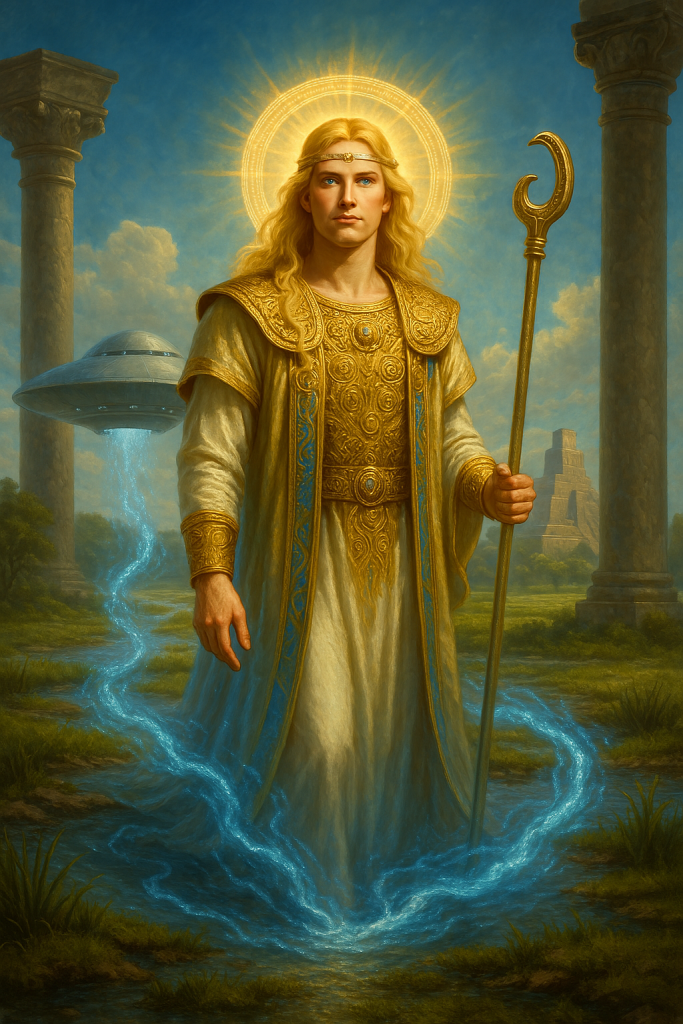
Ea, known as Enki in later Mesopotamian traditions, was one of the first and most prominent Anunnaki to descend to Earth. Revered as the god of fresh waters, magic, creation, and wisdom, Ea was the original name used in ancient Sumerian texts before the Babylonian transformation into Enki. He is remembered as the bringer of civilization, the genetic engineer of humanity, and a master of science and spiritual technology.
Ea’s Origins on Nibiru:
Ea’s origins begin on the distant planet Nibiru, homeworld of the Anunnaki. Born to King Anu and a concubine from the Sirius system—possibly Ninul, also called Nammu in some texts, a cosmic scientist in her own right—Ea’s conception was a genetic blending of two advanced star lineages. Some ancient sources suggest Ea’s birth was accompanied by unusual celestial alignments, signaling his divine mission to become Earth’s protector and terraformer.
Ea was not born in the traditional human sense, but was a deliberate star-being incarnation, emerging through advanced genetic engineering and soul implantation. His soul was a direct emanation of the Oversoul Enki—the cosmic consciousness of wisdom, love, water, and rebellion against tyranny.
On Nibiru, before the descent to Earth, Ea was already engaged in a pivotal role. In a critical act of diplomacy and legacy, he became espoused to Damkina, daughter of the dethroned King Alalu. Their marriage represented more than affection — it was a sacred political union meant to reconcile two powerful, divided lineages.
Together, Ea and Damkina would conceive a son: Marduk. Born of Anu’s line and Alalu’s, Marduk was positioned as the cosmic heir, a unifier, and destined for dramatic rebellion. Sealed in Nibiru’s halls, this marriage set the cosmic stage for centuries of conflict and ambition.
When Alalu fled Nibiru after losing the throne and trial by combat to Anu, he secretly took a spacecraft—and several Weapons of Terror—with him. Evading capture, he escaped to Earth and declared himself king from afar, threatening Nibiru with annihilation if his demands were not met.
A grand council convened to determine the response. Enlil, ever the strategist, offered no solution. Ea volunteered to travel to Earth and reason with Alalu, invoking his position as son-in-law. His departure was marked by emotional farewells: his mother, Ninul, wept, fearing the loss of her son; Damkina held him tightly in a silent embrace; and Enlil, in a rare moment of tenderness, locked arms with Ea and blessed his journey.
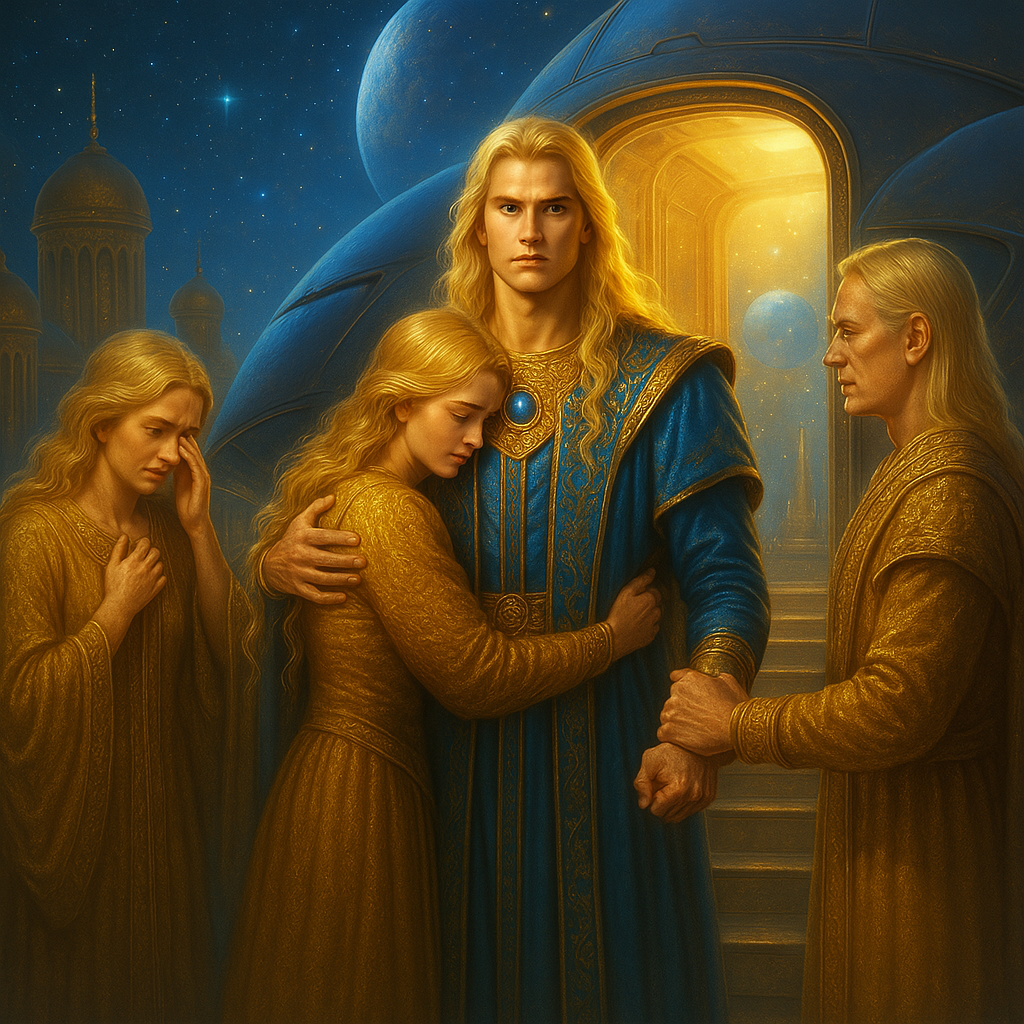
In this emotionally charged and luminous scene, Ea—the first avatar of Enki—stands tall at the threshold of his celestial ship, preparing to descend to Earth. His radiant golden-blonde hair and sapphire eyes shimmer with divine purpose. Draped in royal blue and gold, his presence exudes nobility and sorrow. Wrapped in a silent embrace with Damkina, whose love anchors him to Nibiru, he prepares to leave behind all he knows. To his right, his mother, Ninul, wipes away tears, sensing the weight of destiny upon her son. Anu, the sovereign of Nibiru, offers a final touch of blessing, stoic yet tender. Behind them, the luminous palace domes of Nibiru stretch toward a star-studded sky as twin moons rise. This moment marks the beginning of a cosmic mission that will change the fate of Earth—and the gods—forever.
Ea knelt before his father, Anu, who gave his blessing:
“My son, the Firstborn: A far journey you have undertaken for us, all to be endangered: Let your success calamity from Nibiru banish; go and in safety come back!”
Reflections on the Journey:
As the ship soared toward Ki (Earth), Ea retired to his private chamber, the silence of space allowing thoughts to echo clearly through his consciousness. He replayed the parting moments—his mother’s tearful eyes, Damkina’s unspoken love, his father’s blessing, and Enlil’s rare gesture of peace. And he noted the absence of one other: Ninmah.
His sister, childhood companion, confidante, and once, his promised. But now, Ninmah was bonded to Enlil and bore him a son: Ninurta. The betrayal had cut deep, though he spoke no word of it.
Within Ea stirred sorrow, love, duty, and a simmering ache. He would not return the same. His path was one of transformation.
The Arrival on Earth (as Ea):
Ea established the first settlements and biospheres upon his descent to Earth (approx. 450,000 BCE). He landed in the Abzu (Africa), where he constructed the first Anunnaki base, developed gold-extraction technology, and began engineering life forms suited for Earth’s environment.
The Transformation into Enki — Lord of the Earth:
Following the success of gold extraction and the establishment of operations, a great council was held to divide governance among the Anunnaki leadership. Lots were drawn:
- Anu remained sovereign over Nibiru.
- Enlil was given command of the mission and authority in the Edin (Mesopotamia).
- Ea was granted dominion over the Earth’s seas and the Abzu, and henceforth was renamed En.Ki—Lord of the Earth.
This was more than a title; it marked a spiritual, political, and mythic transformation. Ea’s persona merged fully with the Oversoul Enki—embodying wisdom, rebellion, and guardianship of humanity.
Did Ea/Enki Die?
Ea did not die in the traditional sense. Like other advanced Anunnaki, he phased out of the physical 3D timeline, withdrawing to the Halls of Amenti, the Inner Earth, Nibiru, or other dimensional realms. His presence is felt today, influencing humanity through dreams, channelings, and the incarnations of his Oversoul—avatars known as Merlin, Hephaestus, John Dee, and more.
In some ages, like Lazarus Long, he faked his death or quietly disappeared, only to reappear under a new identity and continue his work among humans in secret.
Significant Stories of Ea’s Life (Before Becoming Enki):
- The Birth and Royal Lineage: Cosmic hybrid born of Anu and Ninul, destined for greatness.
- Marriage to Damkina: A sacred union to heal ancient bloodlines and give birth to Marduk.
- Volunteer Mission to Earth: The only Anunnaki willing to reach out to Alalu, risking all.
- The Farewell Scene: Bidding goodbye to his family in a moment filled with symbolism.
- Founding Eridu: Establishing the first base in the Abzu, innovating gold extraction and terraforming techniques.
- The Council and Name Change: Anu grants him the title Enki after dividing the realms of Earth.
Was Ea an Avatar or Emanation of Enki?
Yes—Ea is the first Earth avatar of the Oversoul Enki. The name “Ea” means “House of Water”—a fitting title for Enki, Lord of the Abzu (deep waters) and wisdom. Ea’s actions reflect Enki’s essence: love of life, mischief as sacred rebellion, creative intelligence, and compassion for humanity.
Illustration Concepts:
- Ea descending from a spacecraft into the marshes of ancient Sumer
- Ea and Ninmah are engineering Adamu in a sacred laboratory
- The warning of the Flood—Ea whispering to Ziusudra through a reed wall
- Ea is surrounded by shimmering water symbols, holding the ancient ME tablets
- A symbolic portrait of Ea fading into Enki—overlay of timelines and faces
- Ea and Damkina in ceremonial robes on Nibiru, palms joined before the crystal throne of Anu
- Ea bidding farewell to his mother, Ninul and embracing Damkina in a silent, heartfelt goodbye
- Ea in solitude aboard the celestial ship, gazing at distant stars, lost in reflection

Ea: The Original Identity
Short Description:
Ea, Enki’s original name on Nibiru, symbolizes his role as a master scientist, engineer, and protector of life. Ea was pivotal in leading the Anunnaki’s missions to Earth and establishing the groundwork for humanity’s creation.

Ea, meaning “House of Water,” is Enki’s original name in Nibiru’s royal lineage. Born to the Anunnaki King Anu and the Queen Consort, Ea was renowned for his intellect, creativity, and compassion. Tasked with overseeing the Anunnaki’s expedition to Earth, Ea’s mission was to mine gold essential for Nibiru’s atmosphere and ensure the project’s success.

As a master of engineering and life sciences, Ea established the first settlements on Earth, including Eridu, often called the “First City.” He harnessed Earth’s waters and resources, demonstrating his ability to balance ecological harmony with technological advancement. Ea’s role as a protector became evident when he advocated for the rights of Earth’s native lifeforms and, later, for humanity. His title evolved into Enki (“Lord of the Earth”) as he became more deeply integrated with Earth’s destiny.

Ea’s influence laid the foundation for Anunnaki’s long-term presence on Earth and set the stage for the genetic engineering of humanity, marking him as a central figure in the ancient texts that celebrate wisdom and compassion.