Bau, Princess of Nibiru
Healer of Gods and the Black-Headed People
Janet Kira Lessin & Sasha Alex Lessin, Ph.D. | Research: Claudia Lenore | © 2026 Aquarian Media
“Lady Who Brings the Dead Back to Life” — Sumerian epithet of Bau
The Clay That Remembers
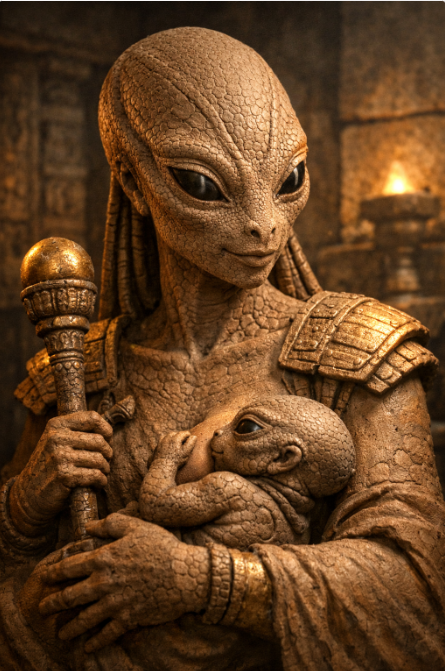
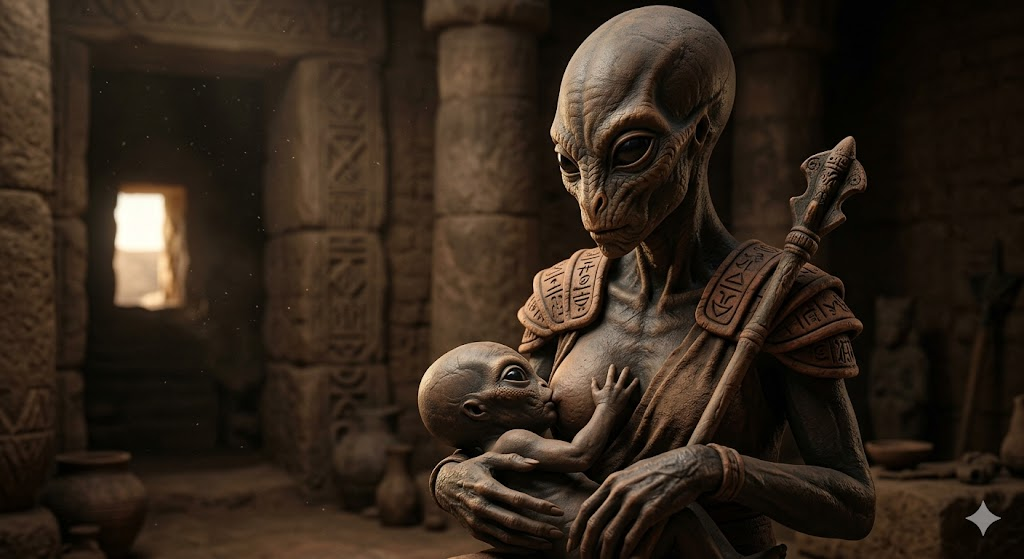
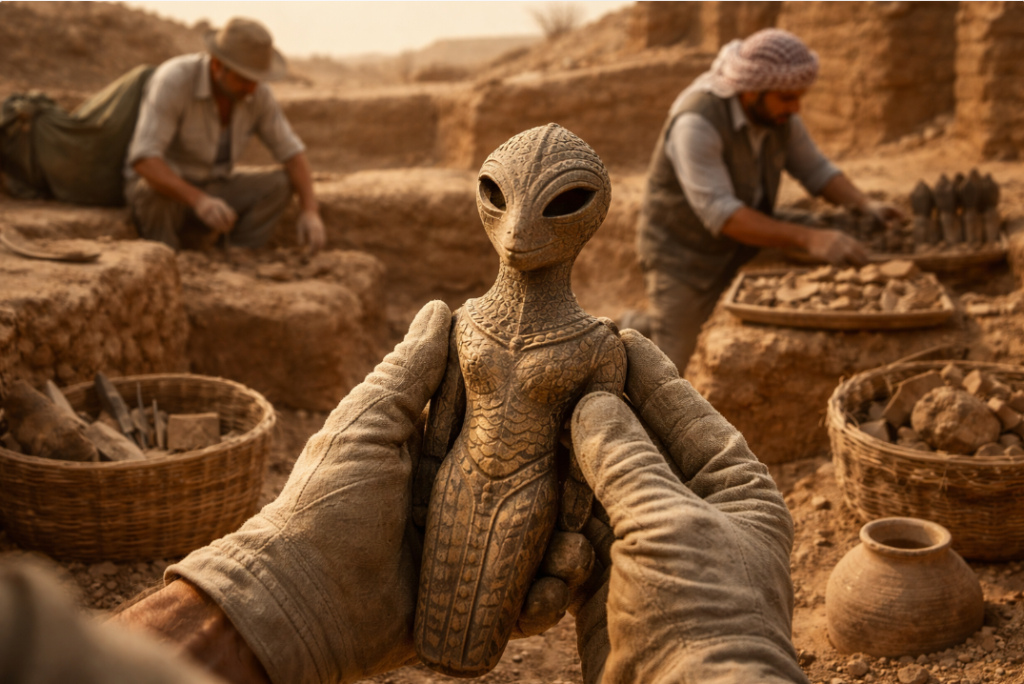
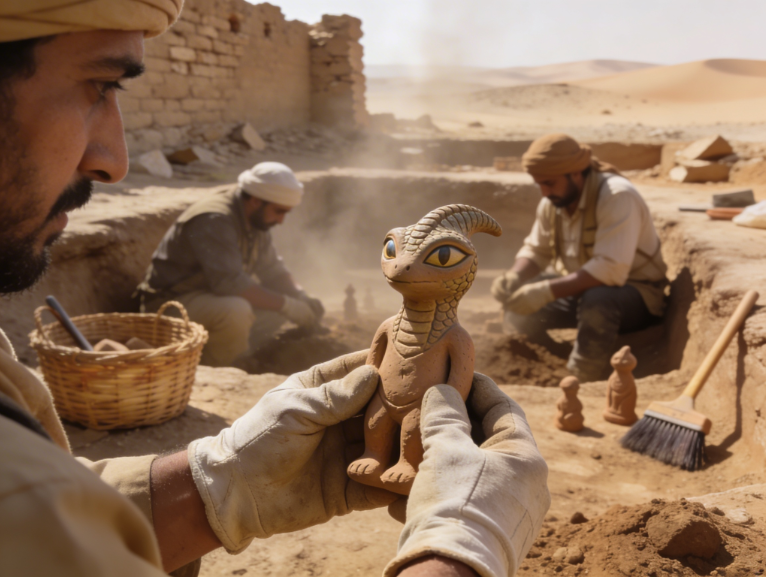
In the early decades of the twentieth century, archaeologists working the sun-baked mounds of southern Iraq pulled something extraordinary from the earth. At Tell Al’Ubaid, at ancient Ur, and at Eridu — the oldest city in the world — they recovered small fired-clay figurines unlike anything the archaeological record had previously produced. The figures stood upright. They held scepters. Some wore helmets with shoulder padding, suggesting authority and rank. Others sat quietly, nursing infants at their breasts.
But the faces looking back at the excavators were not human.
Elongated skulls. Tapered faces. Almond-shaped eyes set wide and flat. Noses that pressed forward like a reptile’s snout. And the nursing infants — the children held tenderly at the breast — shared every feature of their mothers. These were not humans. The Ubaid people of ancient Mesopotamia, who flourished between 6500 and 3800 BCE and who laid the cultural and architectural foundations for Sumerian civilization, had encoded in clay the memory of a species that preceded them. A species that governed them. A species that, in the most intimate possible human gesture, fed their young.
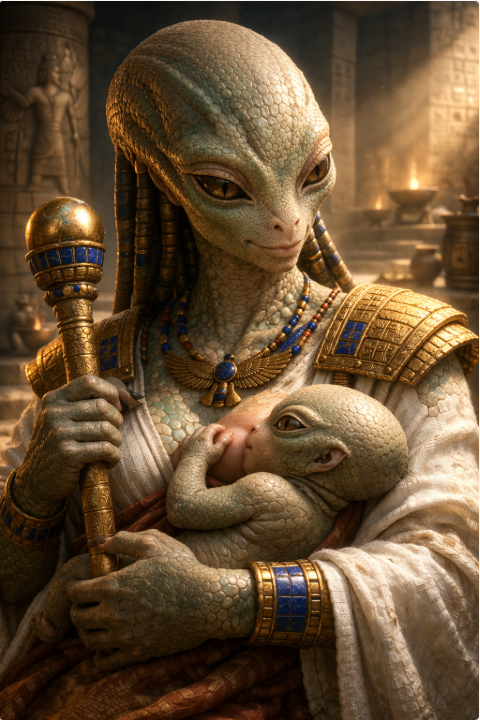
Mainstream archaeology labels these artifacts “ophidian figurines” — serpent-headed — and files them under the category of ritual objects, purpose unknown. The Anunnaki research framework developed by the late Zecharia Sitchin, and expanded by scholars including Dr. Sasha Alex Lessin, proposes a more precise answer. These figurines depict the Anunnaki themselves: the royal extraterrestrial lineage from the planet Nibiru who established Earth’s first civilization, created the human workforce through genetic engineering, and left their imprint so deeply in human memory that pre-literate artists reached for the only medium available to them — clay — and pressed the truth of what they had witnessed into permanent form.
Among those Anunnaki royal figures, one stands at the intersection of medicine, governance, and divine lineage with particular clarity. Her name was Bau.
Eridu: The First City, Enki’s Domain
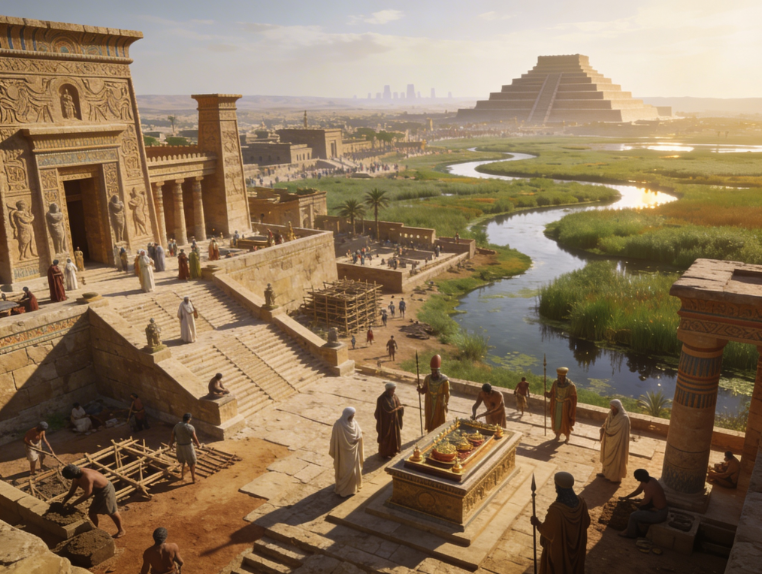
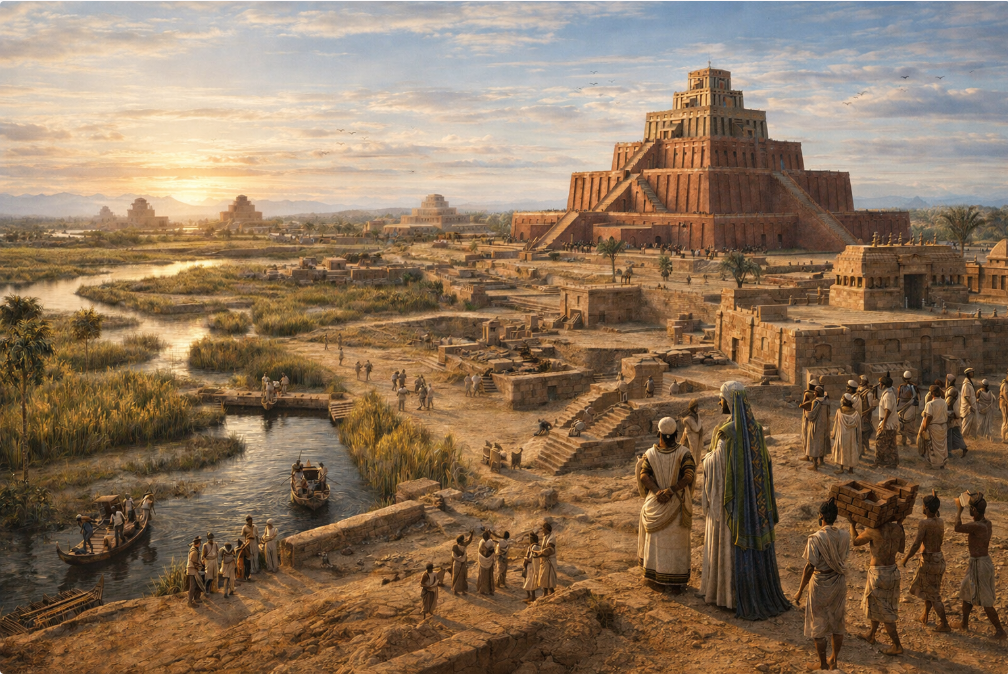
To understand Bau, one must first understand the city where these figurines surfaced and what that city represented within the Anunnaki operational framework. Eridu, located in what is now southeastern Iraq near the ancient Persian Gulf coastline, holds the distinction of being the oldest continuously occupied urban site in Mesopotamian history. Sumerian king lists identify it as the city where “kingship descended from heaven” — the first seat of divine governance on Earth.
In the Anunnaki framework, Eridu carried a specific designation. It belonged to Enki, the eldest son of Anu, king of Nibiru. Enki’s name itself encodes its meaning: E.A., “he whose home is water.” He arrived on Earth before the main wave of Anunnaki colonizers, established Eridu as his operational base in the marshlands of southern Mesopotamia, and named it “Place of the Water.” The Abzu — the great freshwater aquifer beneath the Mesopotamian plain — fell under his dominion. Enki was the scientist, the geneticist, the keeper of the ME: the tablets encoding the fundamental sciences and arts of civilization.
It was in Enki’s city, and in the surrounding settlements of the Ubaid culture, that the lizard-headed figurines emerged from the soil. Their presence in temple contexts — not in domestic spaces, not in refuse pits, but in sacred precincts — tells us something critical: the Ubaid people were not depicting monsters or mythological abstractions. They placed these figures in the houses of their gods because they believed the figures represented the gods themselves. The elongated skulls, the non-human facial geometry, the authority encoded in scepter and helmet — these marked a distinct and remembered species.
One of those remembered beings was Bau. And the nursing figurines — the mother holding a lizard-infant at her breast — may well encode her specific story.
Bau: Royal Lineage, Healing Mission
The cuneiform record preserves Bau across multiple name-forms and city cults, each layer revealing a different facet of an extraordinarily complex figure. In Sumer, she appeared as Bau or Baba. In Isin, she became Nininsina, Lady of Isin. In Akkadian tradition, she was known as Ninnibru, Queen of Nippur. The Babylonians knew her as Nintinugga. The Greeks later mapped her qualities onto Artemis; the Romans, onto Diana. Behind every name stood the same essential identity: a daughter of Anu, a physician of extraordinary power, and the consort of Ninurta, warrior-heir to the Anunnaki throne.
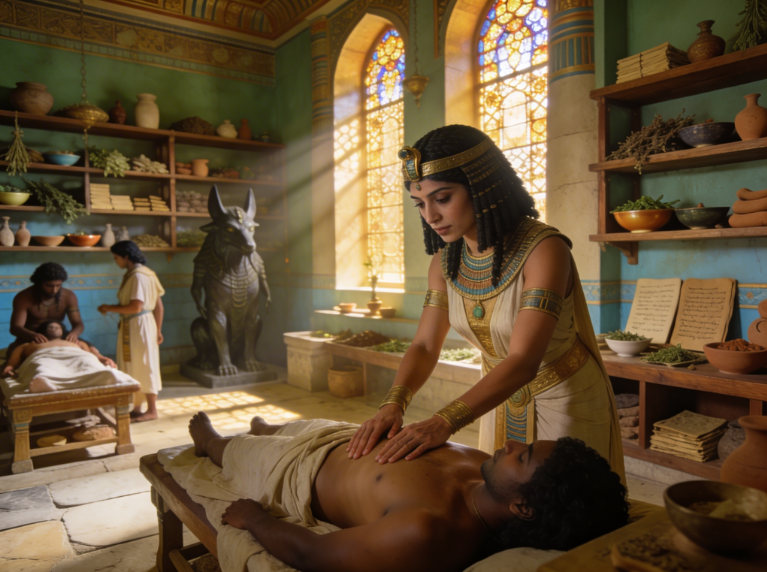
Her Sumerian epithet states her power without ambiguity: “Lady Who Brings the Dead Back to Life.” This was not a metaphor. In a civilization that understood medicine as divine technology — where the boundary between biological science and sacred knowledge did not yet exist — Bau’s mastery of healing carried the full weight of resurrection. She served as physician not only to humans but to the gods themselves. Cuneiform texts identify her as healer of both the Anunnaki council and “the black-headed earthlings” — the Sumerian term for humanity, the engineered workforce created by Enki and Ninhursag from Homo erectus and Anunnaki DNA.
Her family’s position within the Anunnaki hierarchy places her in the second generation of the Earth mission. Enki, Enlil, and Ninhursag (also known as Ninmah) constituted the founding elder cohort — direct children of Anu who arrived with the initial colonizing wave. Bau came later, born of Anu through a different mother, Urash, or in alternate texts, Ereshkigal, queen of the underworld. She married Ninurta, himself the son of Enlil and Ninhursag, thereby consolidating the dynasty: the physician-princess of Nibiru paired with the military heir of the Enlilite faction.
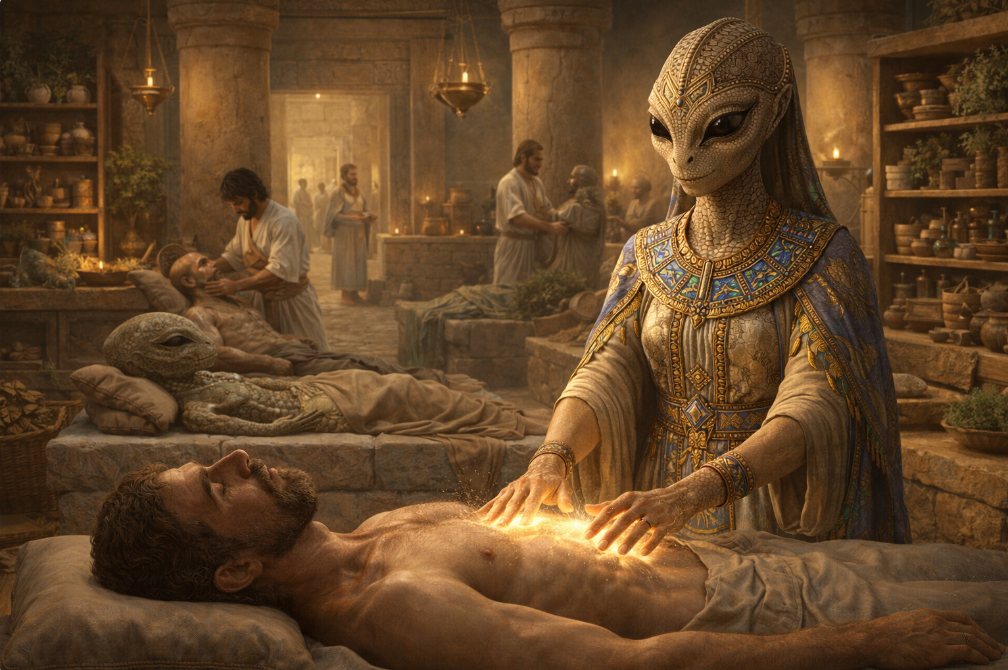
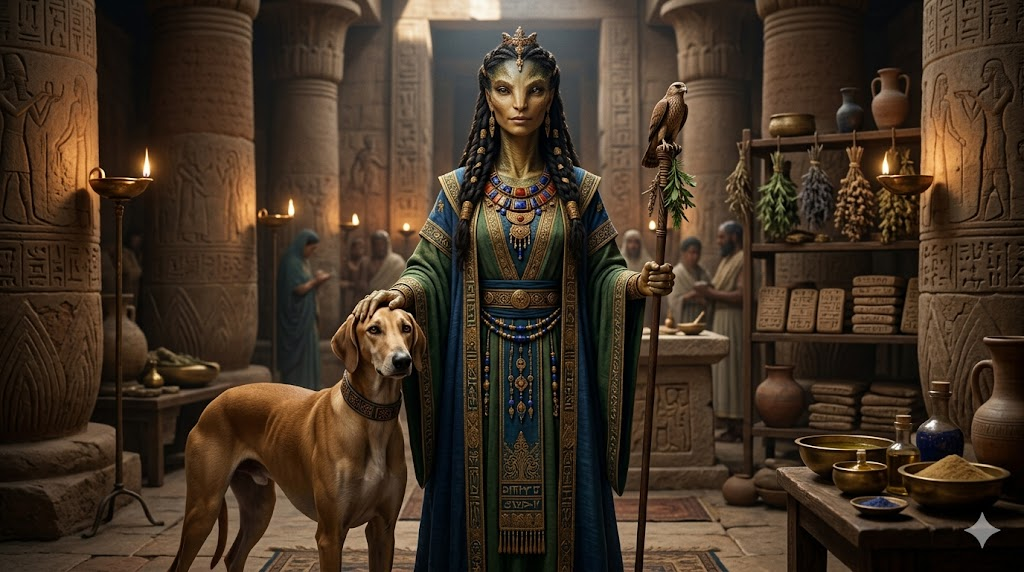
Her temples reflected her dual nature. At Lagash, Girsu, Isin, and Kish, temple precincts dedicated to Bau served as functioning medical centers. Priests and priestesses trained in her healing arts received the sick and conducted curative rituals. The texts describe her as “herb grower,” suggesting pharmacological knowledge — a command of medicinal plants that echoes Enki’s own botanical expertise. She carried the title “Lady of Health,” azugallatu — the great healer — and “she who makes the broken up whole again.” She also served as warden to the wicked, guardian of prisons — a combination of healer and enforcer that reflects the full administrative scope of Anunnaki governance.
The Dog and the Science of Healing
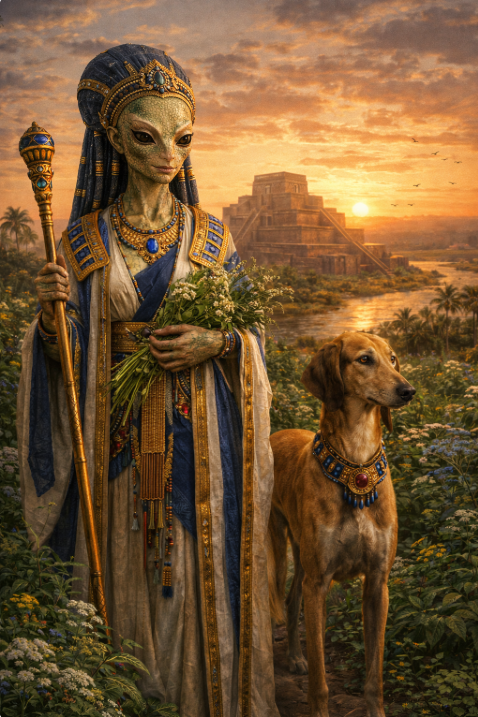
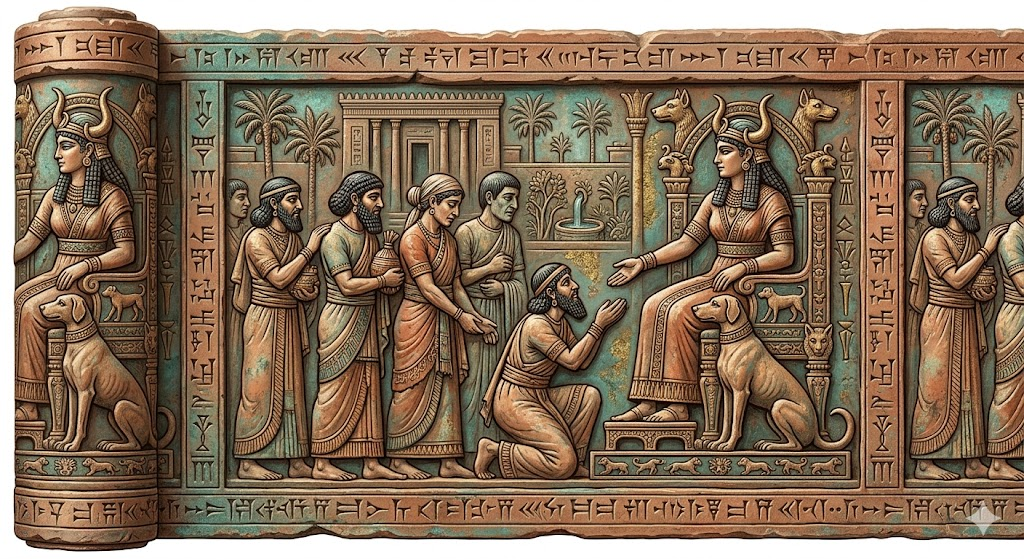
Bau’s most distinctive symbol — and the one that allowed her cult to persist through millennia of cultural transformation — was the dog. Her sacred animal, Tuni-iu-sag, accompanied her in iconography, and temple precincts dedicated to her worship welcomed live dogs to roam freely among the sick. Dogs who died near her temples received burial in consecrated ground, kept close to the goddess who would protect them even in death.
The connection between Bau and dogs reflects a precise observation rather than arbitrary symbolism. Ancient Mesopotamians noticed that wounds licked by dogs healed unusually quickly. Modern research has confirmed the mechanism: canine saliva contains nerve growth factor, histatins, and nitrate compounds that accelerate cell regeneration, inhibit infection, and reduce inflammation. The Ubaid and early Sumerian healers arrived at the same conclusion through empirical observation, millennia before biochemistry became a discipline. They encoded that observation in the iconography of their goddess of medicine.
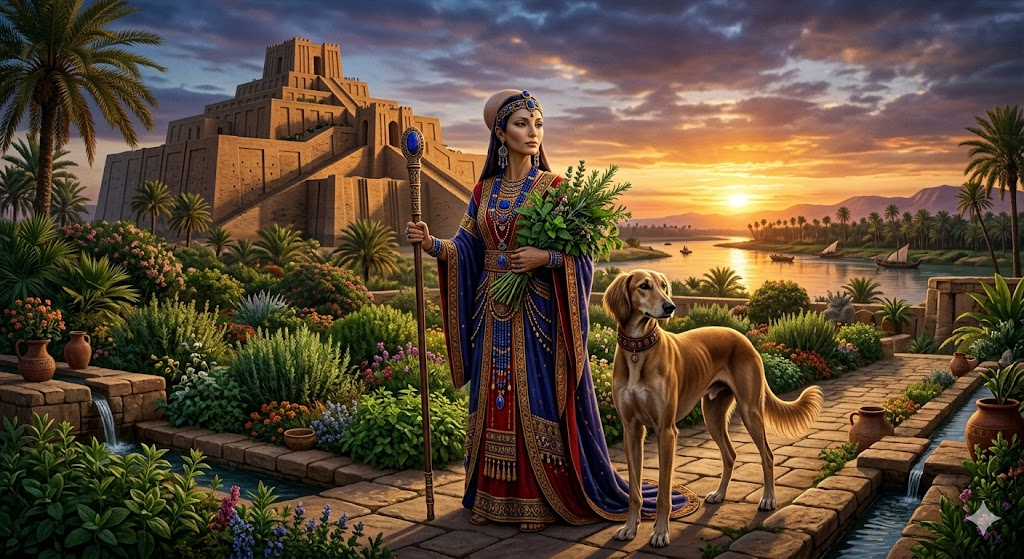
As Bau’s cult expanded and merged with that of Gula — a related healing goddess whose name translates as “great in healing” — the dog became the universal symbol of Mesopotamian medicine. Votive dog statuettes appeared in temple precincts from Lagash to Nippur to Babylon. Physicians invoked Bau-Gula before treating patients. Her son Damu served as the divine intermediary who channeled her healing power to human doctors — a sacred chain of medical transmission that preserved, in religious form, the original Anunnaki technology of biological repair.
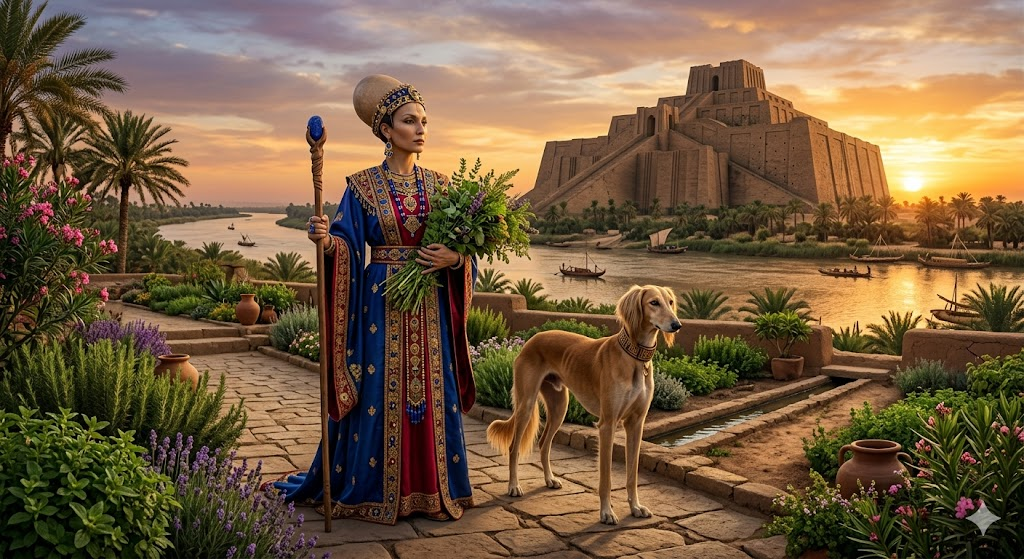
Her temple at Isin carried the name E-u-gi7-ra: the Dog Temple. Centuries of accumulated healing knowledge concentrated in that compound, maintained by a priesthood that understood medicine as both science and covenant with a divine physician who had walked among them.
The Figurines Reconsidered
Return now to those fired-clay figures from the Ubaid sites — from Eridu, from Ur, from Tell Al’Ubaid. Consider the nursing mother with the lizard child in light of what we now know of Bau.
Bau was a princess of Nibiru. She belonged to a species with a skull structure, facial geometry, and physical form that diverged from the engineered human template. She arrived on Earth in the generation following the founding Anunnaki, entering a civilization already populated by the black-headed workers Enki’s team had produced. Her mission centered on healing — on the biological maintenance of both the Anunnaki themselves and the human population they managed. She established temple-hospitals. She carried the knowledge of resurrection. She nursed, in the deepest sense of the word, the civilization entrusted to her care.
The Ubaid artists who pressed clay into the form of a non-human mother nursing a non-human child were not imagining. They were remembering. They lived within a cultural memory still warm with the presence of beings their ancestors had witnessed directly. The elongated skull, the almond eye, the forward-pressing nose — these were observed features, not invented ones. The nursing scene encoded a specific understanding: that the Anunnaki reproduced among themselves, that their children carried the same non-human features, and that the intimacy of maternal care — the most universal of bonds — belonged to them as fully as it belonged to any species.
The scepter-bearing figures in helmets with shoulder padding encoded a parallel truth: these beings held authority. They governed. The staffs they carried were not decorative; they marked the same ruling function that the cuneiform texts later described in administrative and legal detail. In Bau’s case, that authority extended across medicine, law enforcement, and the sacred sciences. She healed, and she judged. She restored life, and she maintained order. The Ubaid artists, working millennia before the Sumerian writing systematized these roles, compressed the entire civic and spiritual identity of their divine physician into a few inches of fired clay.
A Presence That Persisted
The remarkable fact about Bau is not merely that she existed within the Anunnaki framework but that her cult survived — absorbing new names, merging with parallel goddess traditions, migrating from city to city — across more than three thousand years of continuous Mesopotamian civilization. The healing goddess who walked Lagash’s temple precincts with her sacred dog in 2100 BCE stood at the end of a continuous line stretching back to the Ubaid culture of 5000 BCE and beyond, to the original Nibiruian physician who had made the Earth her domain.
By the time Babylonian scribes recorded her final epithets, the specific biological features of Bau had faded from direct memory into symbol and metaphor. The non-human face became a divine mask. The actual dog that had roamed her healing temples became an icon of medicine. The resurrection technology of a species from another world became the miracle power of a goddess. But the core function remained intact across every transformation: Bau healed. Bau governed. Bau kept biological restoration knowledge in human hands.
The Ubaid figurines from Eridu, Ur, and Tell Al’Ubaid preserve the moment before that transformation — the window when living memory still held the image of what Bau actually looked like. Pressed into clay by artists who had not yet developed writing, who could not leave a verbal account of what they witnessed, they left the most direct testimony available to them instead. A mother. A child. A non-human face. A nursing bond that crossed the boundary of species and entered the permanent record of human civilization.
That record waited seven thousand years in the soil of Iraq for archaeologists with enough courage to ask the question the clay was answering.
Janet Kira Lessin & Sasha Alex Lessin, Ph.D. | Research: Claudia Lenore | © 2026 Aquarian Media
Aquarian Media • Maui, Hawaii • aquarianradio.com
Social Media Descriptions
- X (formerly Twitter) Archaeologists at Eridu uncovered “ophidian” figurines that defy human anatomy. Janet Kira Lessin and Sasha Alex Lessin, Ph.D., explore the legacy of Bau, the Anunnaki physician-princess whose healing arts and sacred canine companions shaped Sumerian civilization. #Anunnaki #AncientAliens #SumerianHistory #BauGoddess
- LinkedIn Bridging the gap between archaeology and the Anunnaki framework: A new deep dive into the Ubaid figurines and the administrative role of Bau, the “Lady Who Brings the Dead Back to Life.” This research examines the intersection of extraterrestrial lineage, ancient pharmacology, and the origins of medical science in Mesopotamia.
- Facebook: What if the “serpent-headed” figurines found in ancient Iraq weren’t myths, but portraits? Janet Kira Lessin and Sasha Alex Lessin, Ph.D., reveal the story of Bau, the Princess of Nibiru. From the “Dog Temple” of Isin to her role as a master geneticist and healer, learn how this royal figure governed the “black-headed people” and left an indelible mark on human history.
Author Biographies
Janet Kira Lessin is an author, researcher, and experiencer dedicated to uncovering humanity’s true history and its connection to extraterrestrial lineages. As the voice behind Dragon at the End of Time and a prolific Substack writer, she explores archetypal narratives and the Anunnaki’s influence on modern consciousness. Her work focuses on animal rescue, conscious evolution, and the restoration of sacred spaces. Follow her work and subscribe at https://substack.com/@janetalexlessinphd.
Sasha Alex Lessin, Ph.D. Sasha Alex Lessin, Ph.D., is a scholar of anthropology and a leading researcher in the Anunnaki framework. Having studied extensively under Zecharia Sitchin, Dr. Lessin specializes in the translation and interpretation of ancient Sumerian texts to illuminate the extraterrestrial origins of human civilization. He co-authors numerous works with Janet Kira Lessin, blending academic rigor with cosmological insight to redefine the human story.
The Mother of Eridu
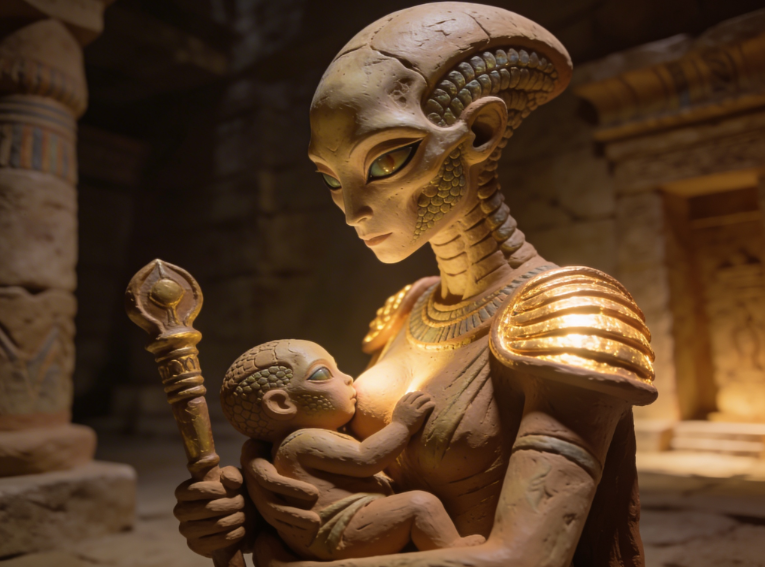
A hyper-realistic cinematic close-up of a Ubaid-style Anunnaki female figure with an elongated skull, almond-shaped eyes, and reptilian facial features. She is nursing a small infant with identical non-human features. The setting is a dimly lit, ancient stone temple in Eridu. Soft golden light hits her shoulder padding and scepter. Fired-clay texture aesthetic, 8k resolution, highly detailed.
Tags: Anunnaki, Ubaid, ancient Mesopotamia, Eridu, goddess Bau, extraterrestrial, nursing mother, hyper-realistic, archeology.
The Lady of the Dog Temple
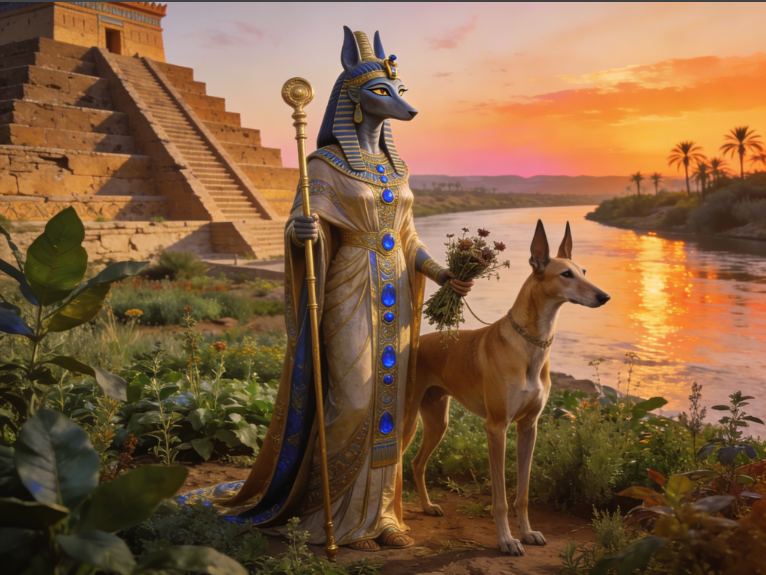
A majestic Anunnaki princess, Bau, stands in a lush Mesopotamian herb garden near a ziggurat. She has an elongated head and wears royal Sumerian robes with lapis lazuli accents. Beside her stands a large, ancient Mesopotamian dog (a Saluki type). She holds a staff and a bundle of medicinal herbs. The sun sets over the Euphrates in the background. Photorealistic, epic scale.
Tags: Bau, Nininsina, Anunnaki princess, ancient medicine, sacred dog, Sumerian garden, ziggurat, healing arts, cinematic lighting.
The Divine Physician’s Seal
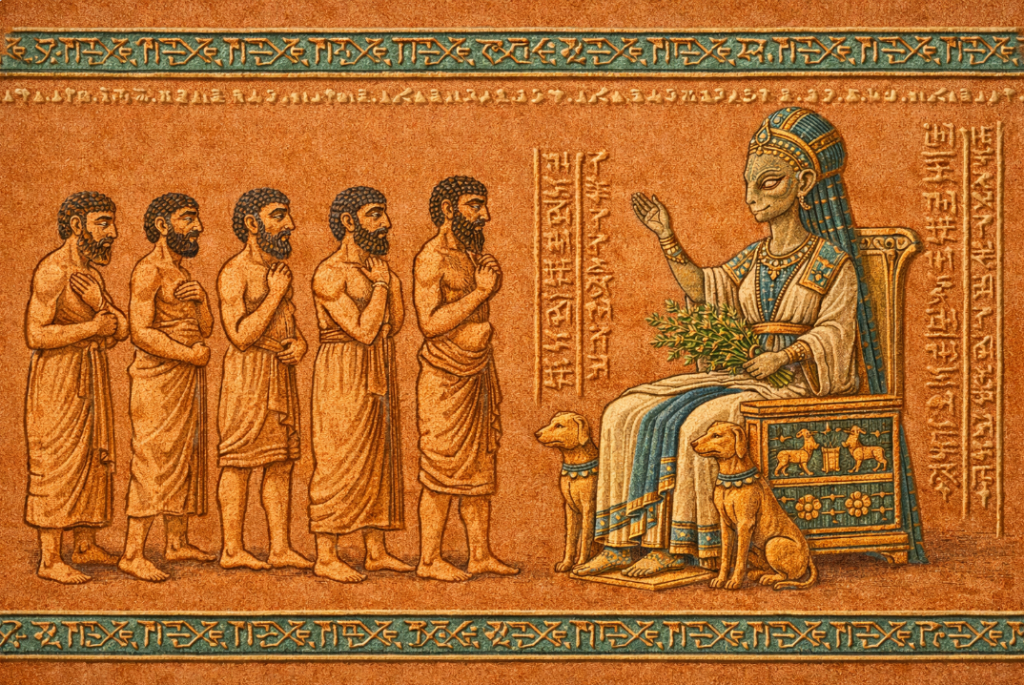
An ancient cylinder seal impression style illustration. It depicts the goddess Bau seated on a throne decorated with dog motifs. She is receiving a line of “black-headed” Sumerian people seeking healing. Cuneiform inscriptions are etched into the side. The color palette is terracotta, turquoise, and gold. Intricate carvings, historical museum quality. Tags: Cylinder seal, Sumerian art, Bau, healing ritual, Cuneiform, Mesopotamian history, Anunnaki royalty, mythological illustration.
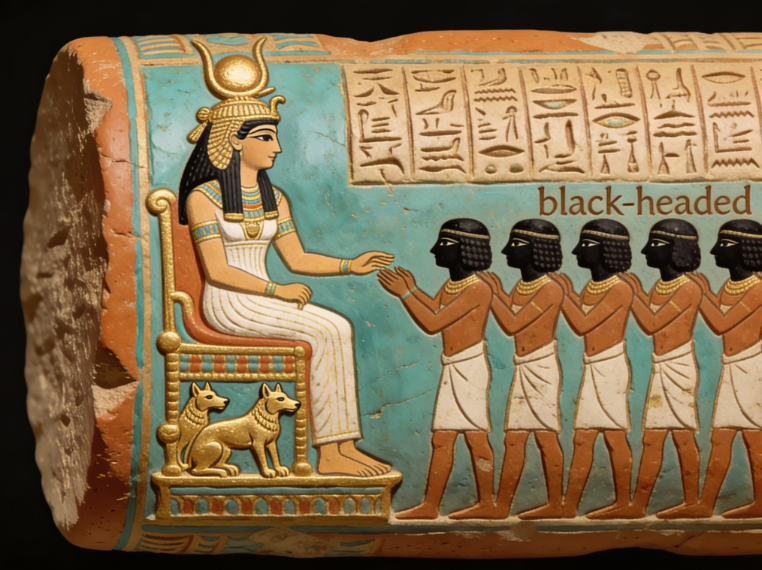
BAU, PRINCESS OF NIBIRU
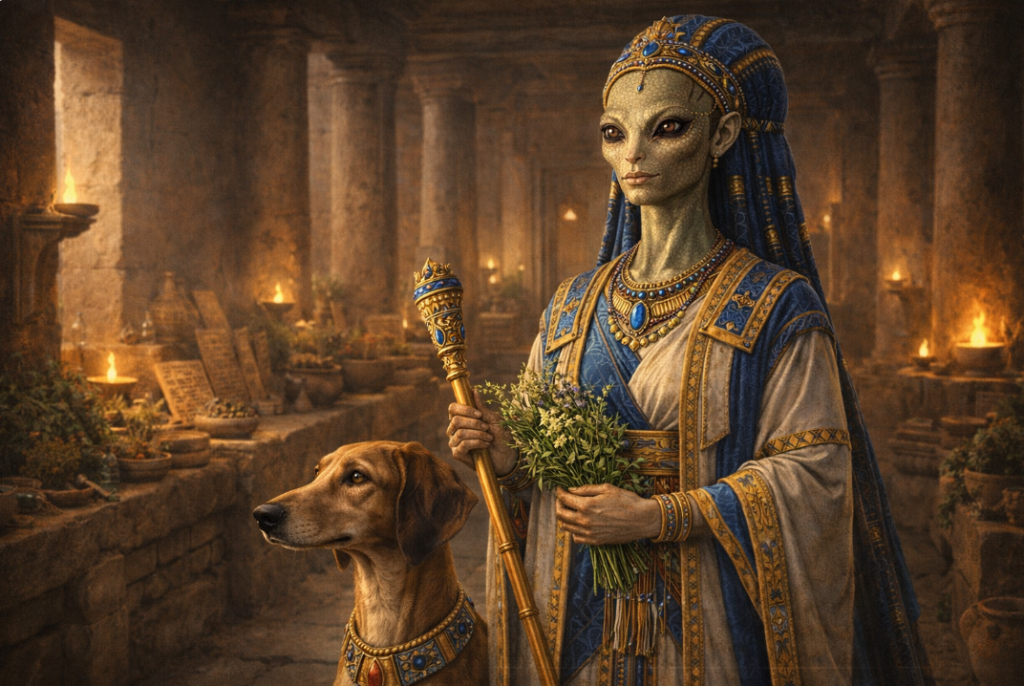
A cinematic portrait of Bau as a regal Anunnaki healer standing inside an ancient Mesopotamian healing temple. She has an elongated skull, refined reptilian-humanoid features, luminous intelligent eyes, and an expression of compassion and authority. She wears royal healing garments adorned with gold, lapis lazuli, and ancient Sumerian motifs. A sacred dog stands protectively at her side. Behind her are temple columns, oil lamps, herbs, healing bowls, and clay tablets.
Style: realistic, photorealistic, cinematic lighting, soft natural colors, fantasy realism, highly detailed, emotional depth, artistic composition, landscape 16:9
THE CLAY THAT REMEMBERS
Ancient archaeologists at a dig in southern Iraq uncover strange fired-clay Ubaid figurines. In the foreground, a reptilian-headed figurine with almond-shaped eyes is carefully held in gloved hands. In the background are excavation trenches, baskets, brushes, ruined walls, and desert light. The mood is discovery, mystery, and ancient memory rising from the earth.
Style: realistic, photorealistic, cinematic lighting, soft natural colors, fantasy realism, highly detailed, emotional depth, artistic composition, landscape 16:9
THE NURSING MOTHER OF ERIDU
A nonhuman Anunnaki mother seated in a sacred chamber nursing her infant. Both mother and child have elongated skulls, almond-shaped eyes, and elegant reptilian-humanoid features. The moment is reverent, tender, and deeply maternal. Woven mats, carved temple walls, ritual vessels, and soft lamplight surround them.
Style: realistic, photorealistic, cinematic lighting, soft natural colors, fantasy realism, highly detailed, emotional depth, artistic composition, landscape 16:9
ERIDU: ENKI’S FIRST CITY
A sweeping panorama of ancient Eridu in its prime, with marshes, canals, temple architecture, priests, workers, and sacred precincts. The city appears as the first seat of divine kingship on Earth. The mood is foundational, majestic, and mythic-historical.
Style: realistic, photorealistic, cinematic lighting, soft natural colors, fantasy realism, highly detailed, emotional depth, artistic composition, landscape 16:9
BAU THE DIVINE PHYSICIAN
Inside a temple-hospital, Bau tends to the sick among both humans and Anunnaki. Shelves of herbs, healing bowls, tablets, and attendants fill the space. Bau places her hands over a patient in an act that feels both medical and sacred.
Style: realistic, photorealistic, cinematic lighting, soft natural colors, fantasy realism, highly detailed, emotional depth, artistic composition, landscape 16:9
THE SACRED DOG OF HEALING
Bau walks through a healing precinct with her sacred dog at her side. Around them, patients rest on low couches while healers prepare herbs and ointments. The dog is alert, beloved, and protective. The scene emphasizes the ancient bond between healing, observation, and sacred companionship.
Style: realistic, photorealistic, cinematic lighting, soft natural colors, fantasy realism, highly detailed, emotional depth, artistic composition, landscape 16:9
BAU AND NINURTA
A royal ceremonial scene showing Bau beside Ninurta. Bau radiates intelligence, grace, and healing authority, while Ninurta stands as a warrior prince in ornate armor. The union feels dynastic, political, and sacred. Mesopotamian banners, carved lions, and temple steps create a monumental setting.
Style: realistic, photorealistic, cinematic lighting, soft natural colors, fantasy realism, highly detailed, emotional depth, artistic composition, landscape 16:9
THE GODDESS WHO RESTORES LIFE
A visionary symbolic scene of Bau as “Lady Who Brings the Dead Back to Life.” She stands in radiant stillness in a liminal healing chamber, extending restorative energy toward a fallen figure who begins to rise. Ancient cuneiform, stars, and sacred geometry shimmer faintly in the air.
Style: realistic, photorealistic, cinematic lighting, soft natural colors, fantasy realism, highly detailed, emotional depth, artistic composition, landscape 16:9
ARTICLES IN THE SERIES
- Bau, Princess of Nibiru, Healer of Gods and the Black-Headed People
- Ninmah / Ninhursag: Mother of Humanity
- Enki and Eridu: The First City
- The Ubaid Figurines and the Memory in Clay
- Ninurta: Warrior Heir of the Anunnaki
- Gula, Damu, and the Sacred Science of Healing
- The Black-Headed People: Humanity in the Sumerian Record
- Anunnaki Women of Power: Bau, Ninmah, Inanna, and Ereshkigal
- Eridu and the Abzu: Enki’s Sacred Domain

