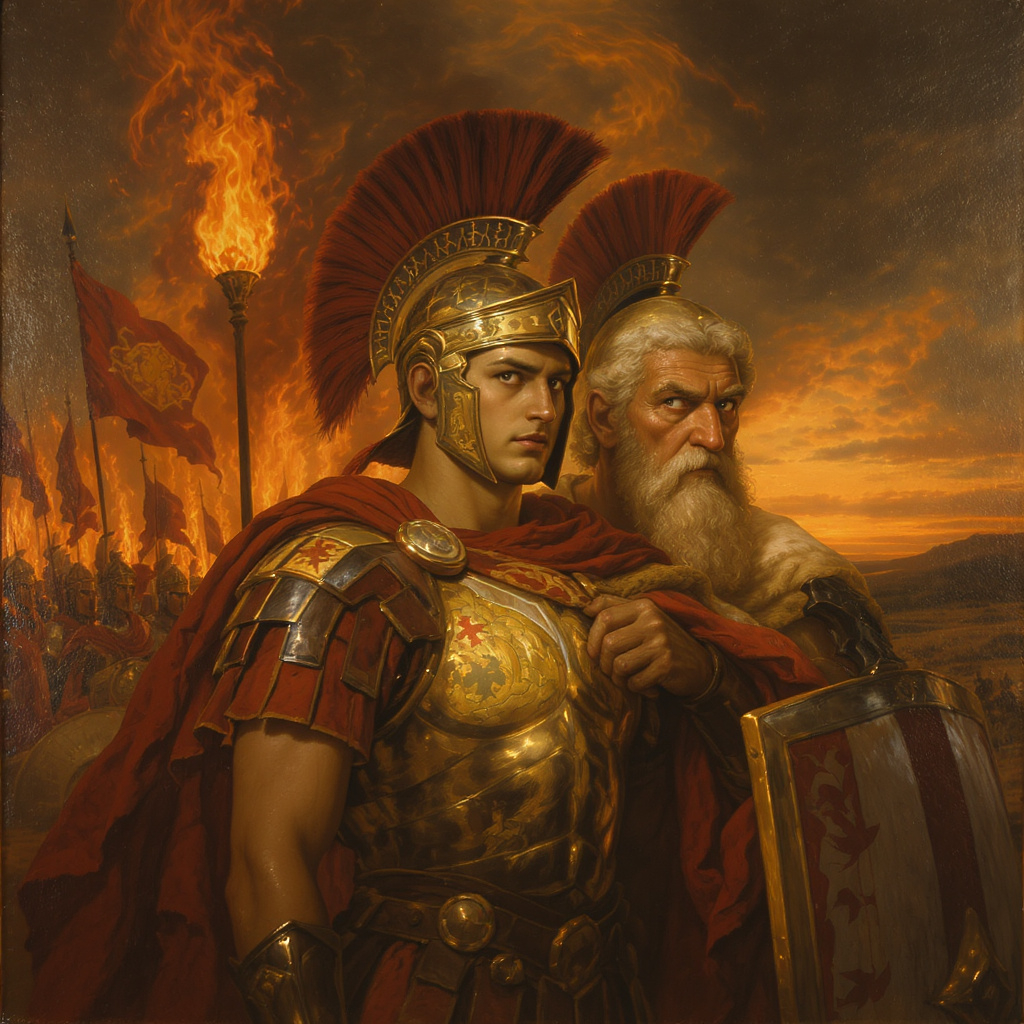
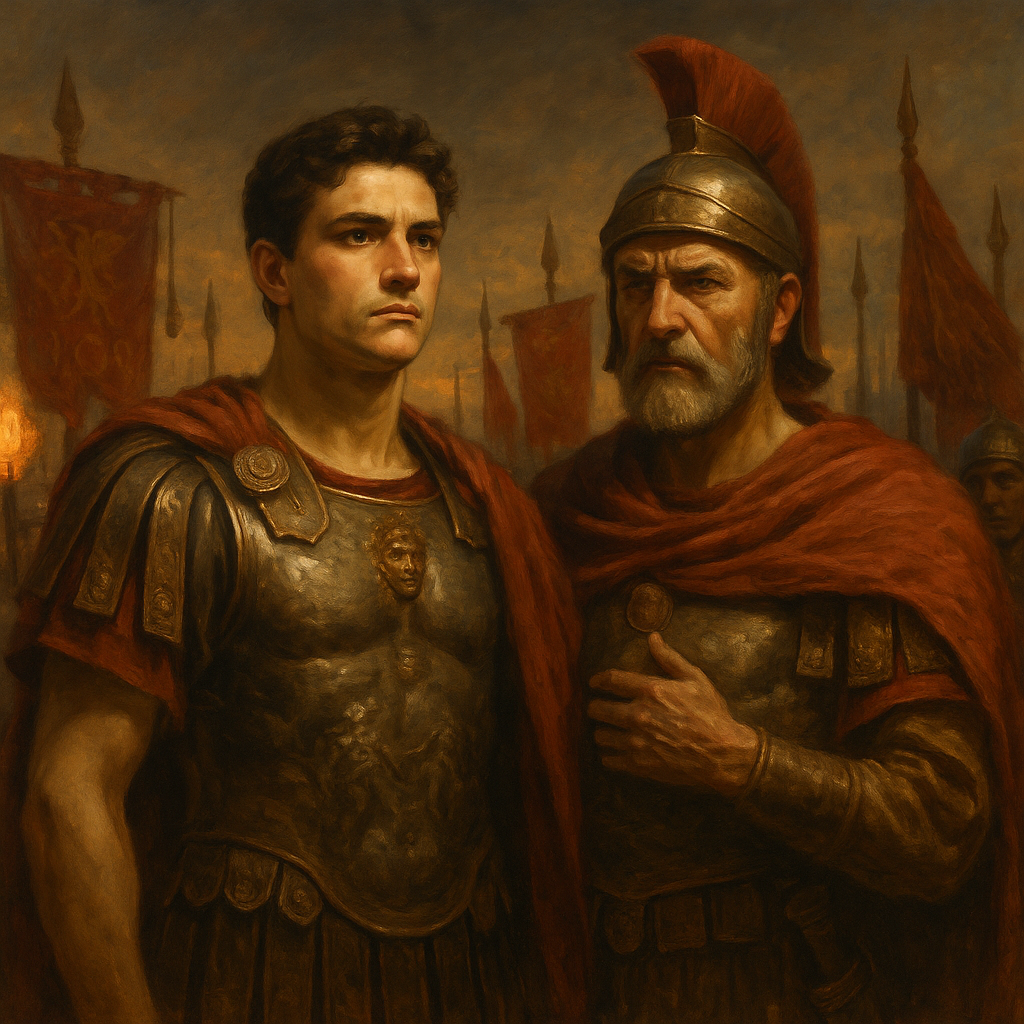
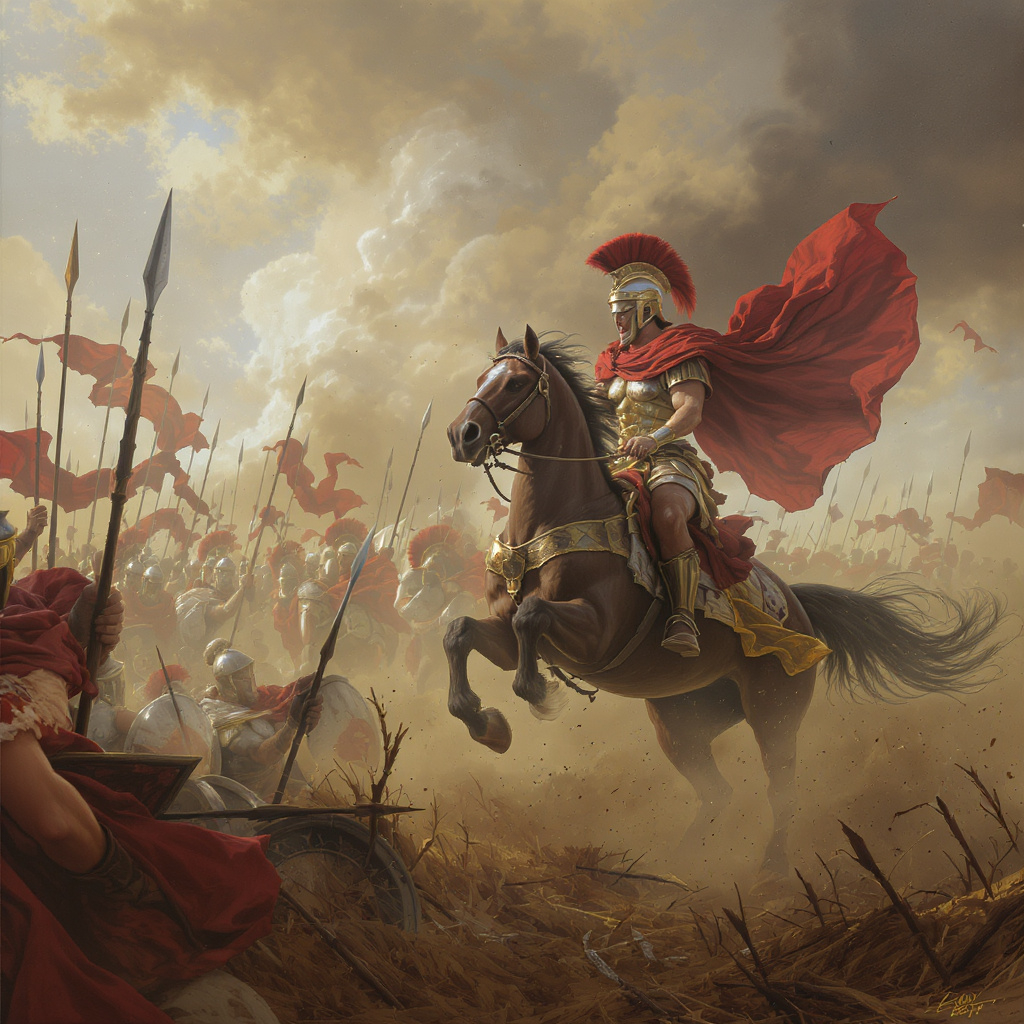
Young Pompey in Roman armor stands beside Sulla, who names him Magnus. Legions and banners rise behind them.
POMPEY MAGNUS: FROM ROMAN TRIUMPH TO NILE ANNIHILATION
By Dr. Sasha Alex Lessin, Ph.D. (Anthropology, UCLA) & Janet Kira Lessin
Prologue: The Boy Who Would Be Great
The streets of Rome still smoldered from civil war when Gnaeus Pompeius Magnus, just twenty-three years old, strode into history. His father, once disgraced for corruption, had left behind a shadow of dishonor. But young Pompey knew how to turn shame into myth. He rallied his father’s clients and veterans, stood before Sulla with an army at his back, and declared:
“The Republic must be restored.”
It wasn’t only the Republic Pompey sought to restore — it was his name, his place, his legacy.

A line of notable Roman men — Pompey Magnus, Julius Caesar, Lucius Licinius Lucullus, Marcus Licinius Crassus, Marcus Porcius Cato — standing shoulder to shoulder, wearing Roman armor or senatorial togas, looking straight at the viewer.
The Making of Magnus
Sulla, hardened from campaigns in the East, saw loyalty in the young commander’s eyes — loyalty, and ambition.
“You are faithful when others falter,” Sulla told him. “From this day forward, you are Magnus — the Great.”
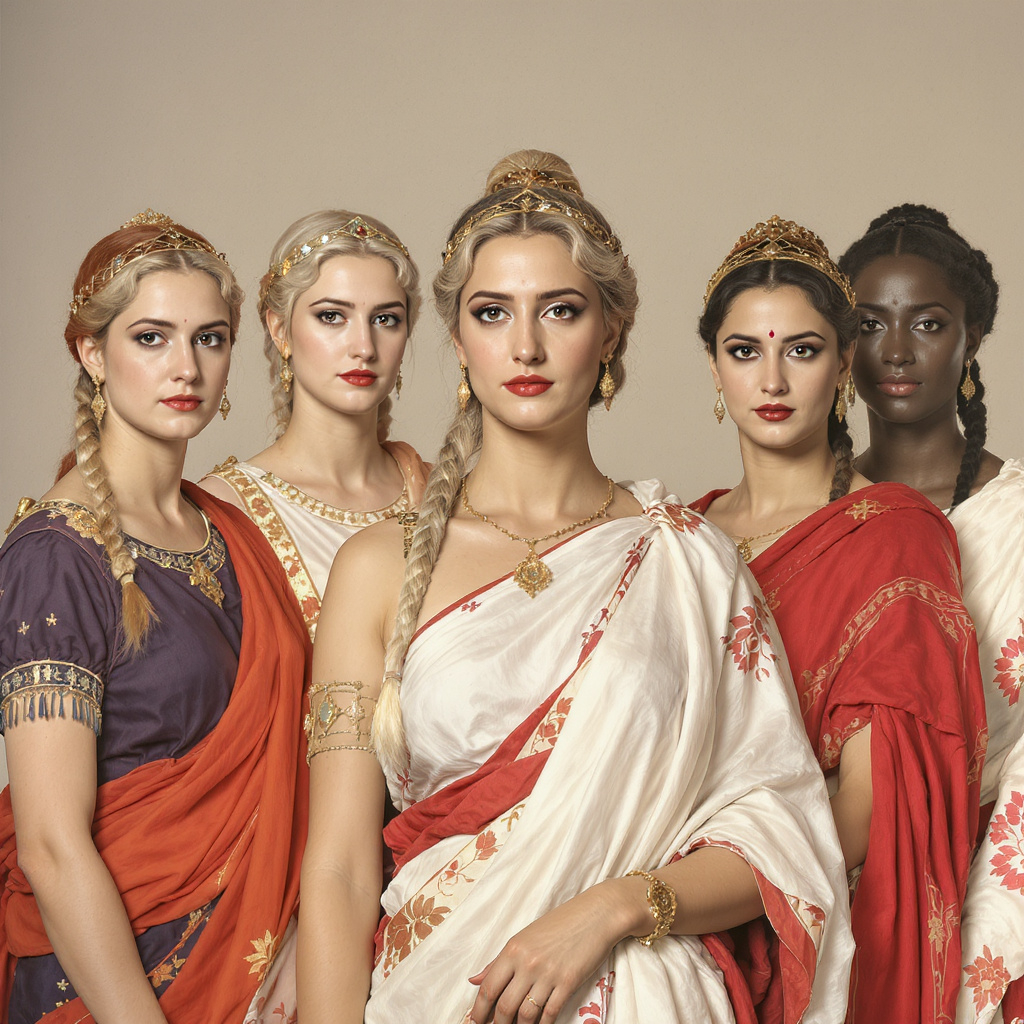
Prominent Roman women of the late Republic — Julia Caesaris (Pompey’s wife), Servilia Caepionis, Calpurnia Pisonis, and two unnamed patrician women — in elegant stolae with gold jewelry and braided hairstyles, facing forward.
Pompey did not smile, but inside, the name seared itself into his soul. He would earn it with conquest.
- In Sicily, he crushed Marian resistance and secured Rome’s grain lifeline.
- In Africa, he toppled rebel kings and restored Rome’s dominion.
- In Spain, he ended the long Sertorian War, proving his endurance as a commander.
When Pompey returned, he was no longer merely a young aristocrat. He was a man Rome could not ignore.
Spectacle of Triumph
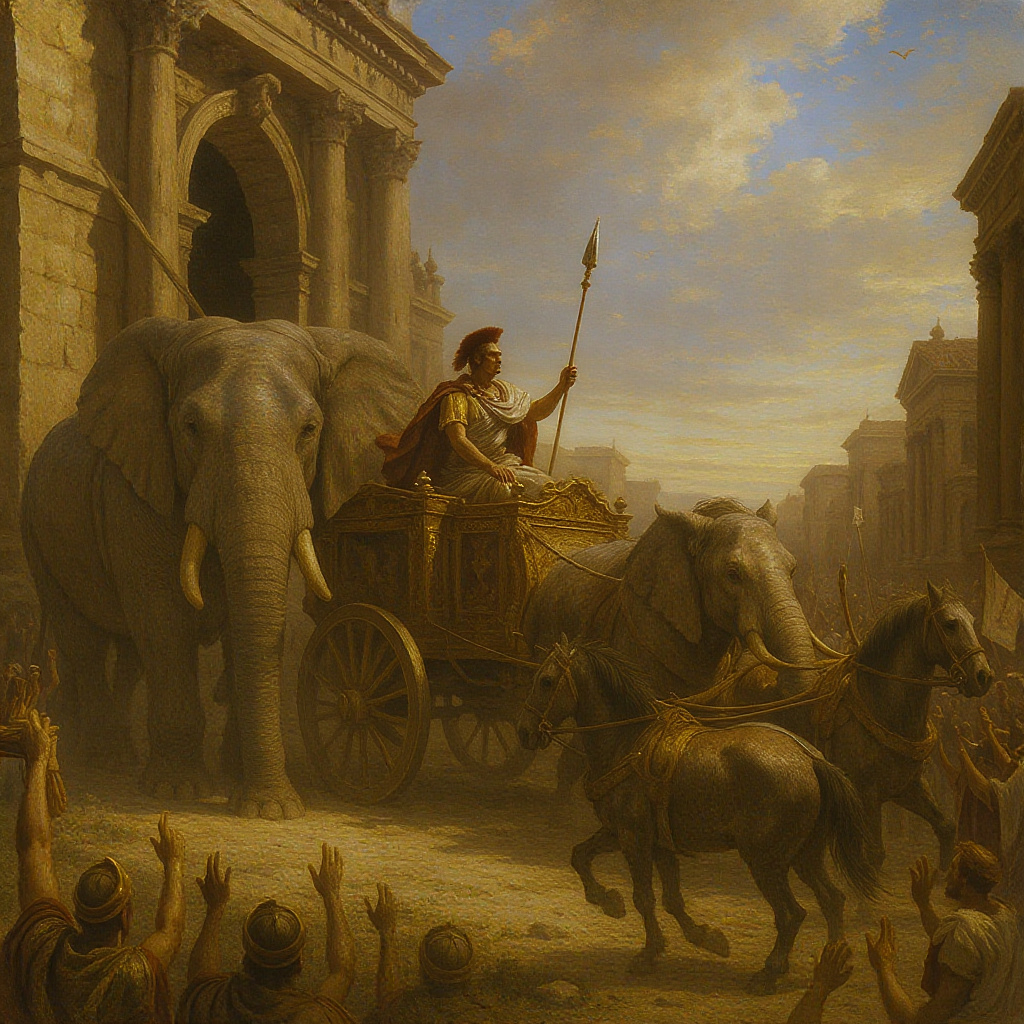
Pompey rides in his triumphal chariot while elephants fail to pass through the city gates. He switches to horses as the crowd laughs and cheers.
Rome rewarded her heroes with spectacle, and Pompey knew how to play to the crowd. His first triumph parade almost turned into a comedy when elephants meant to pull his chariot couldn’t fit through the city gates. He calmly dismounted, switched to horses, and smiled as the people laughed.
“Let them laugh,” Pompey whispered. “They laugh at an emperor in all but name.”
The moment revealed what made Pompey dangerous: he could transform embarrassment into power, mockery into myth.

Conqueror of the Seas and the East
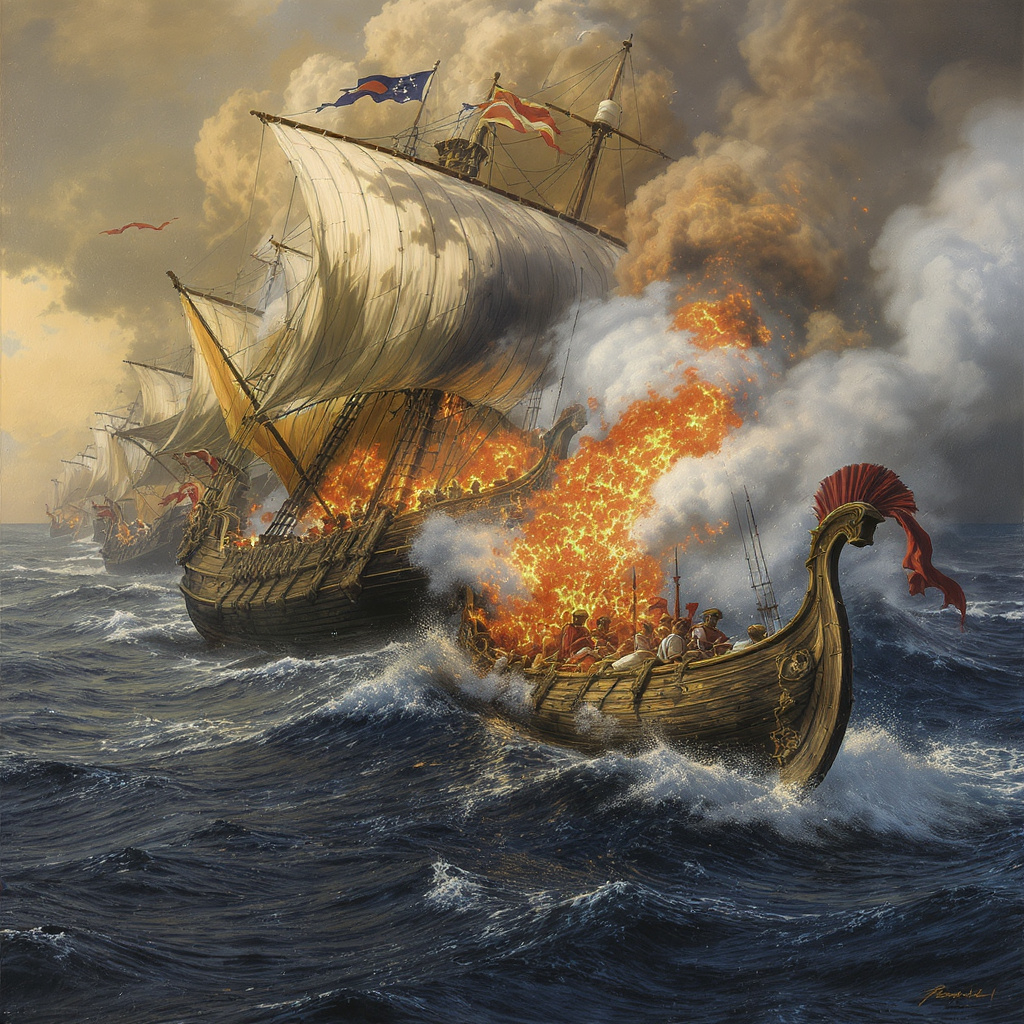
Pompey’s Roman navy battles pirates on the Mediterranean. Roman galleys ram enemy ships while flames rise on the sea.
The Mediterranean had become infested with pirates — a humiliation to Rome. Ships were seized, grain supplies strangled, and wealthy Romans kidnapped. It was Pompey whom the Senate entrusted with extraordinary command.
In a matter of three months, he swept the seas clean. Pirate fleets were crushed, strongholds razed, their leaders executed or forced into submission. Rome’s pride was restored.
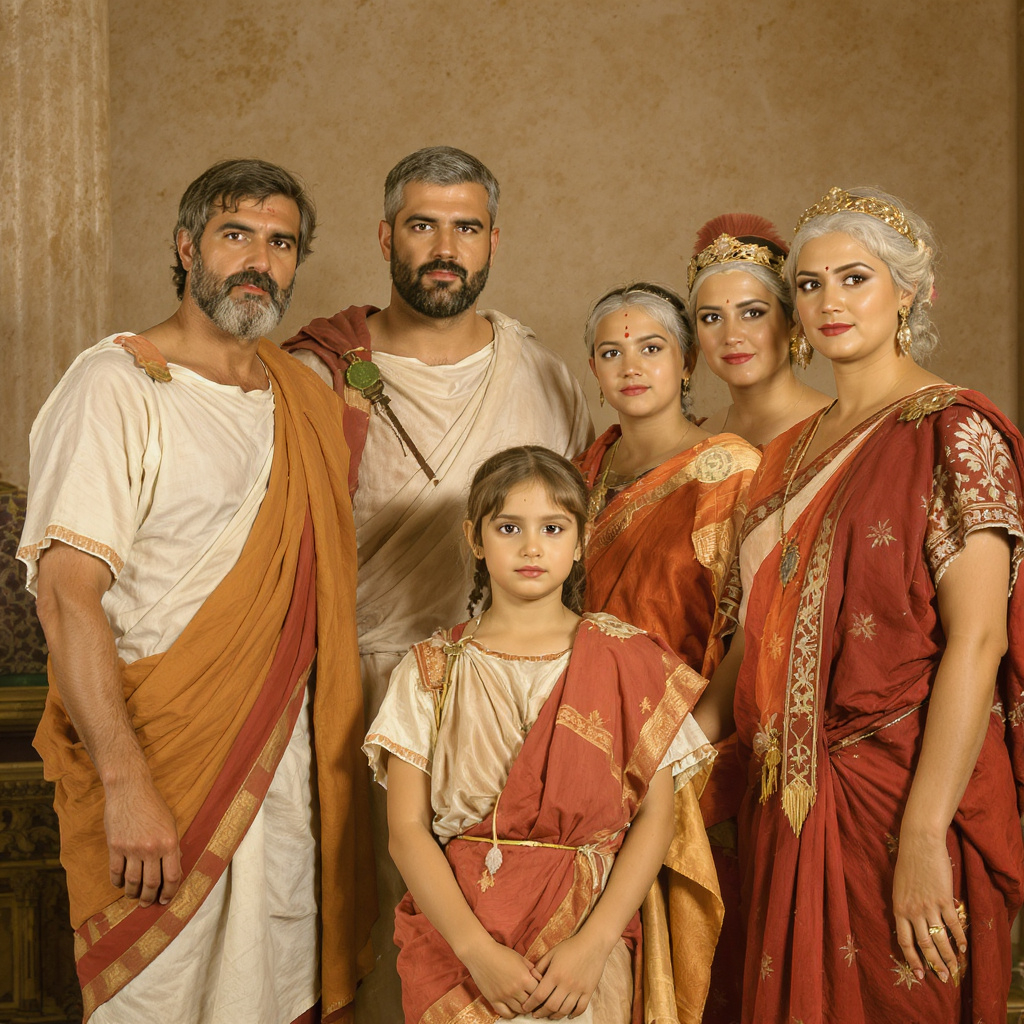
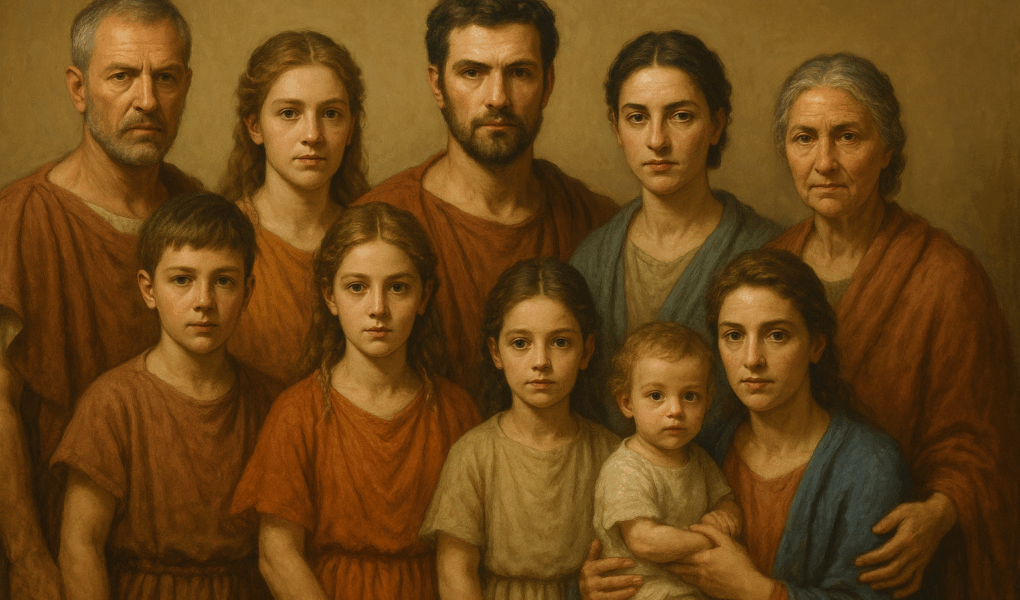
A multigenerational Roman family — men, women, and children together — dressed in everyday late Republican clothing, standing like a class portrait, all looking at us across time.
From there, Pompey turned eastward.
- He broke Mithridates of Pontus, scourge of Rome.
- He humbled Armenia’s Tigranes the Great, who bent the knee before him.
- He annexed Syria, turning a dying Seleucid kingdom into a Roman province.
- In Judea, he marched into Jerusalem itself and entered the Holy of Holies, shocking the Jewish priesthood but cementing Roman dominance.
Where Pompey marched, the map of Rome changed forever.
The Fragile Triumvirate
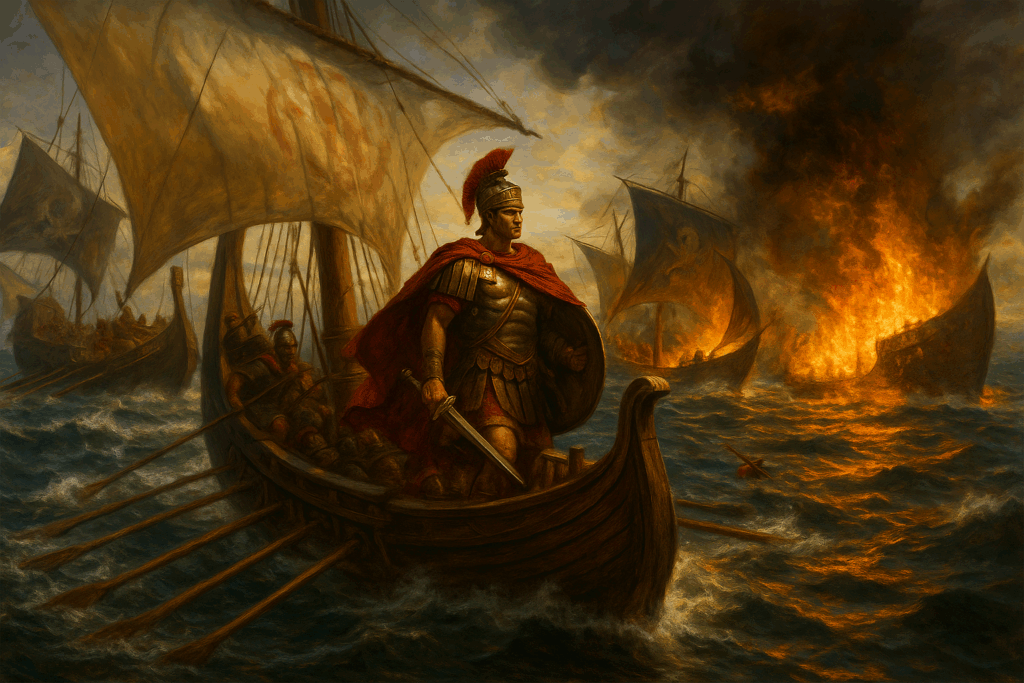
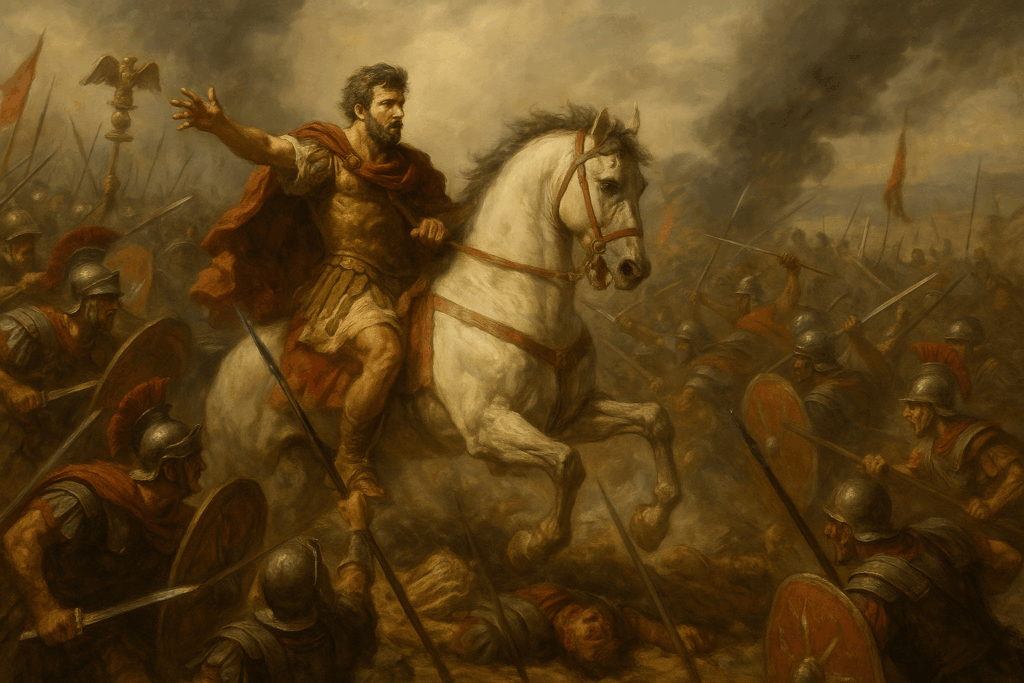
Pompey on horseback tries to rally his legions as Caesar’s troops break through. The battlefield is filled with dust and chaos.
Power in Rome, however, was never permanent. Pompey allied with Crassus, the richest man in Rome, and Julius Caesar, the most ambitious. Together they formed the First Triumvirate, an uneasy pact of giants.
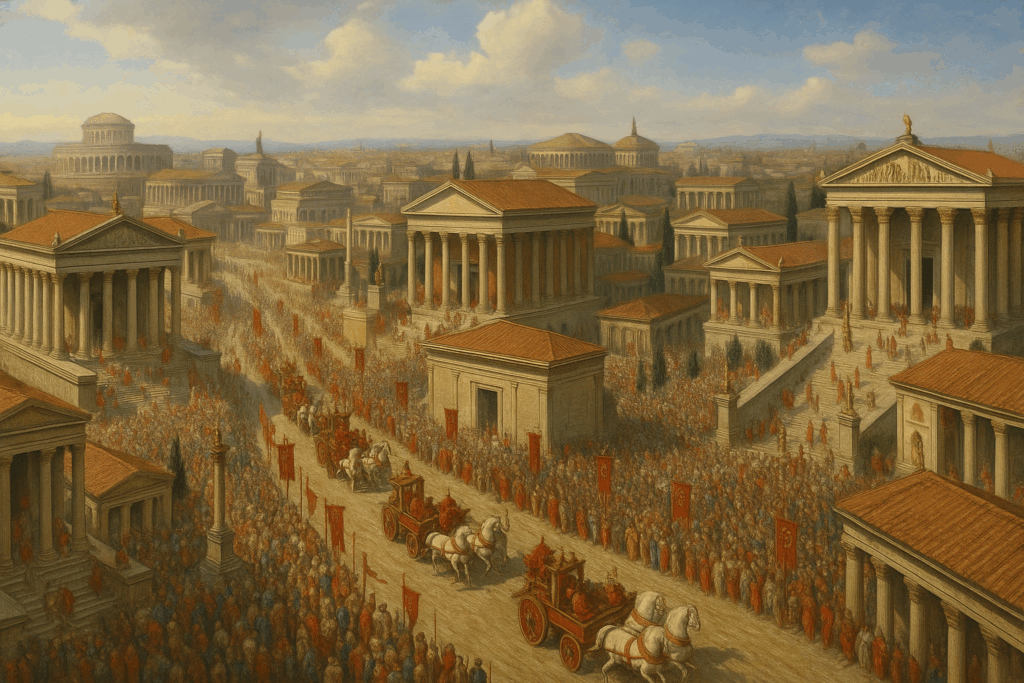
Panoramic aerial of Rome with the Forum, Senate house, and triumphal processions.
Marriage bound Caesar and Pompey together — Pompey wed Julia, Caesar’s daughter, whose beauty and grace softened the rivalry. But when Julia died in childbirth, the bond dissolved. Soon after, Crassus met his end in Parthia, his head mocked in a theater of humiliation.
Pompey was left alone, tied to the Senate and estranged from the people who once adored him.
The Rubicon and the Rift
Then came the fateful crossing.
Caesar, returning from Gaul, defied the law and crossed the Rubicon River with his legions. “The die is cast,” he declared.
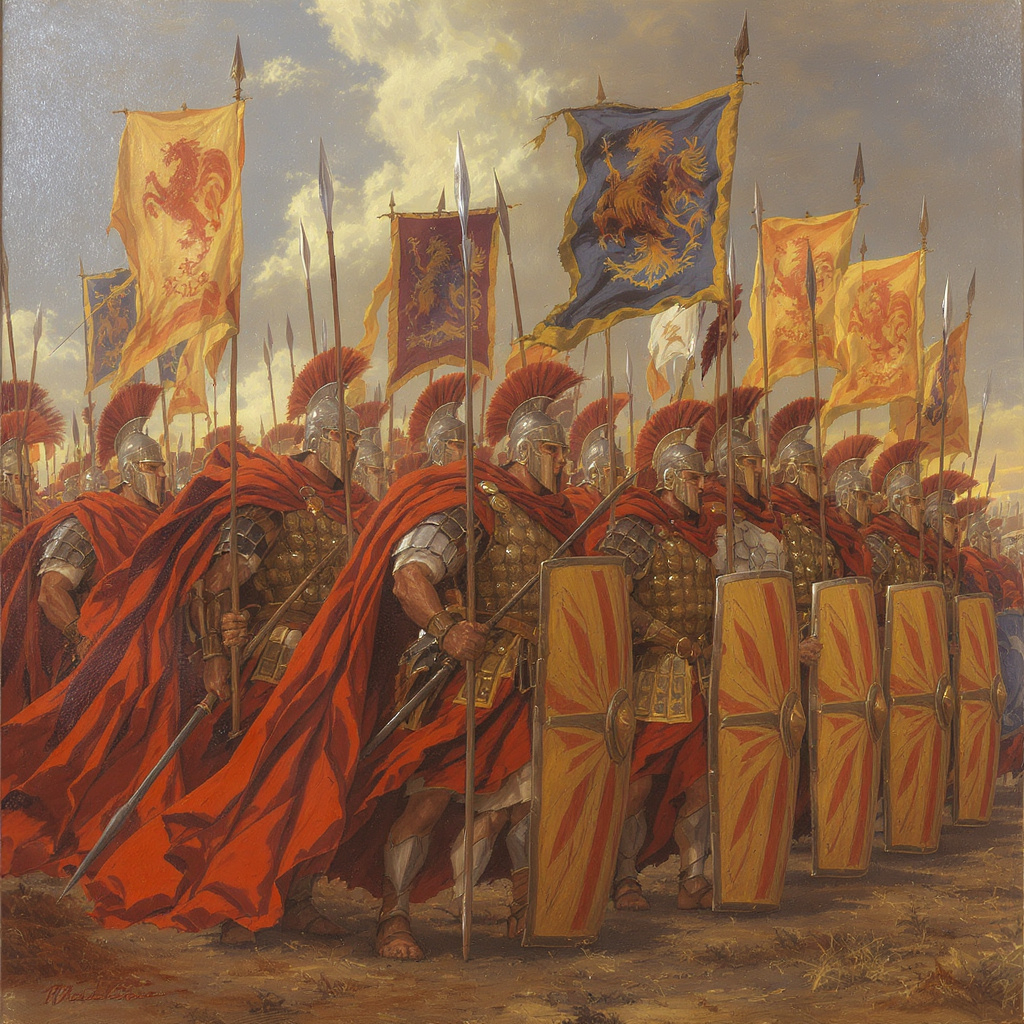
A line of Roman soldiers in red cloaks and segmented armor, holding shields and spears, banners behind them.
Pompey, unprepared, scrambled. His fleets faltered under Bibulus. His forces scattered. At Pharsalus, he attempted one last grand maneuver, believing numbers alone would break Caesar. But Caesar’s veterans proved fiercer, hungrier, sharper.
The field became a slaughterhouse. Pompey fled disguised, a shadow of the man once hailed as Magnus.
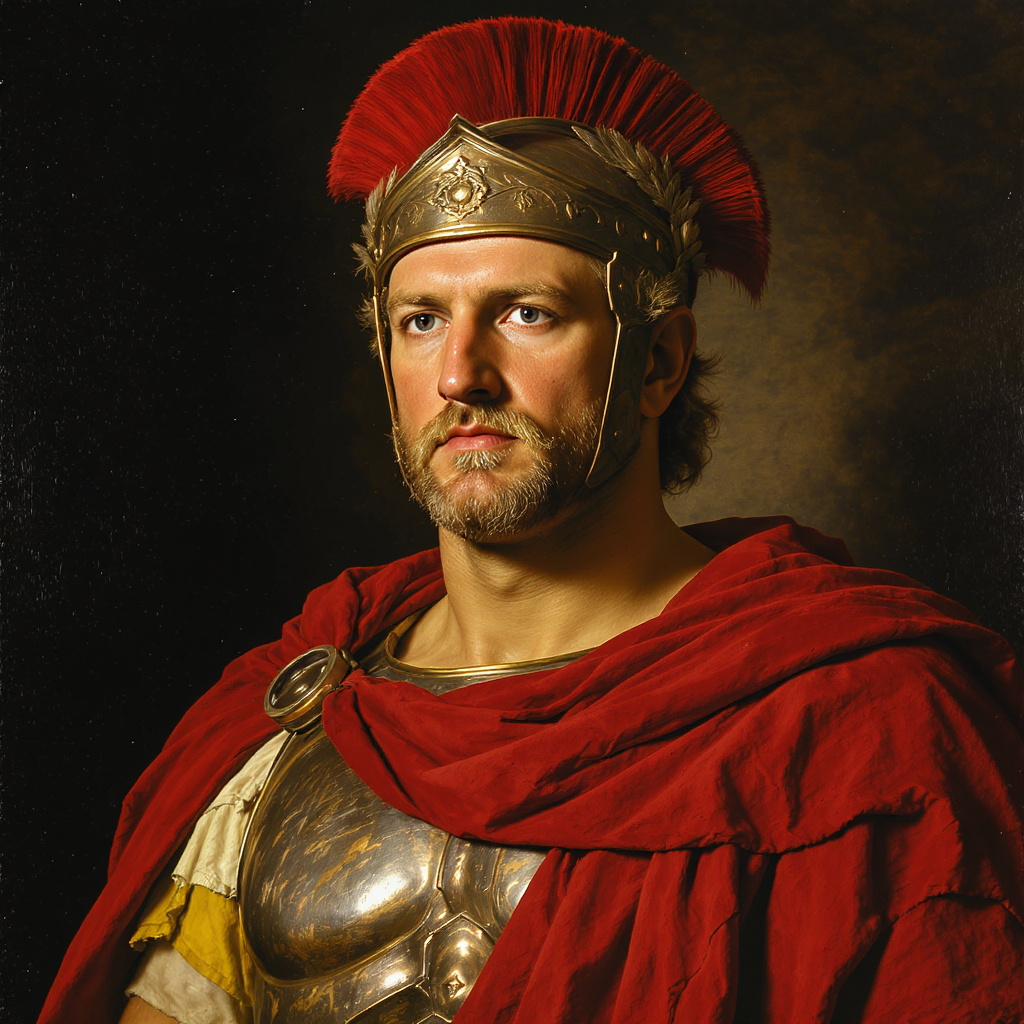
Head-and-shoulders portrait of Pompey in his prime — youthful yet weathered, wearing his bronze cuirass and red cloak, laurel wreath on brow.
Egypt: Sanctuary or Tomb
With the dust of Rome still clinging to his boots, Pompey sought refuge in Egypt. He had supported Ptolemy XIII’s dynasty before; surely gratitude would grant him sanctuary.
But politics in Alexandria was as treacherous as the Nile’s shifting currents. Ptolemy’s advisors, led by General Achillas, decided Rome’s civil war would be won not by helping Pompey, but by killing him.
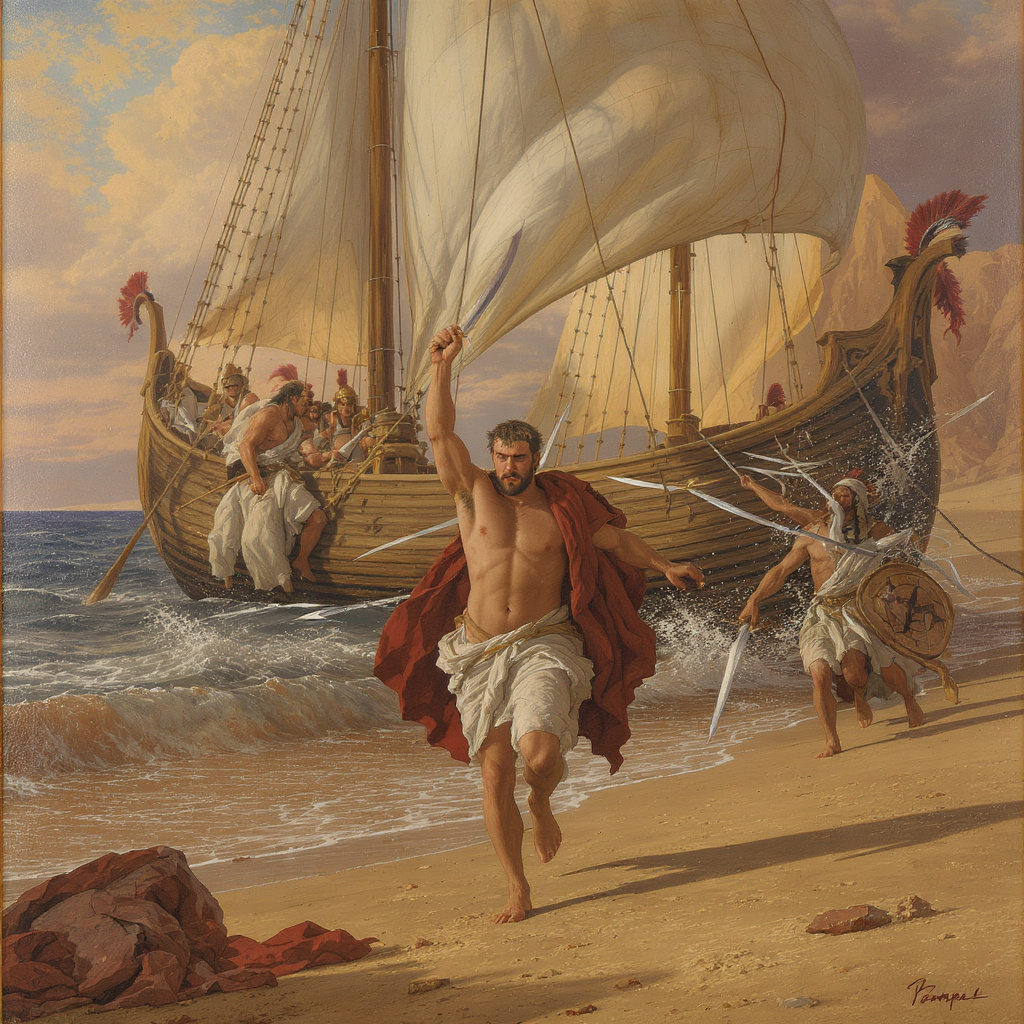
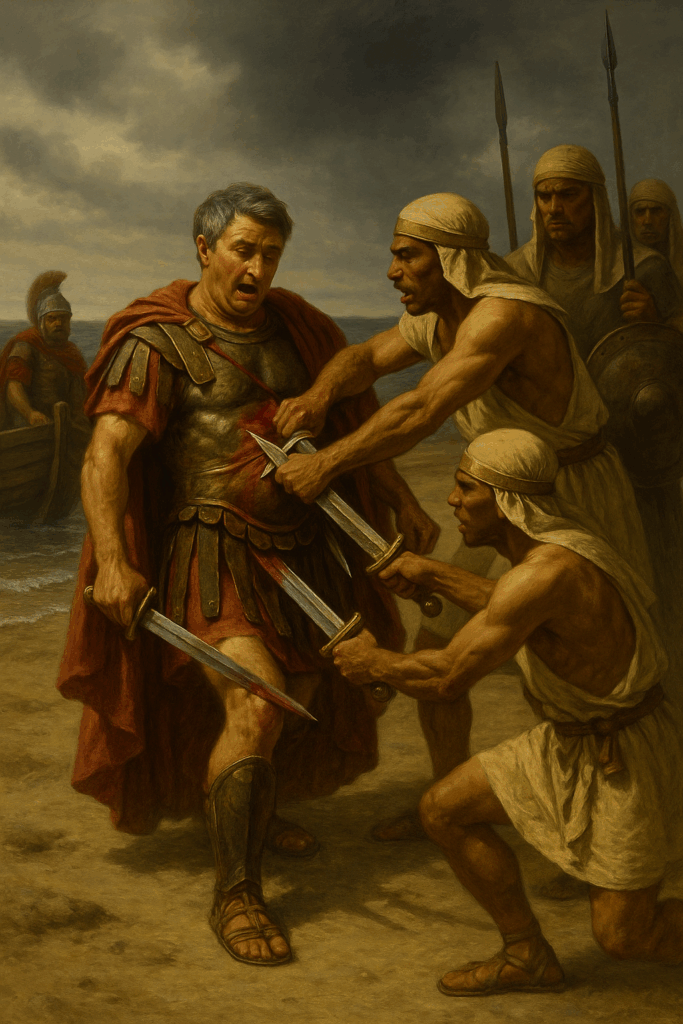
Pompey steps off a boat onto a barren shore. Egyptian soldiers suddenly stab him in the ribs and slash his throat.
A small boat carried Pompey to a desolate shore. As he stepped out, blades flashed. One struck beneath his ribs, another across his throat. Pompey Magnus, conqueror of continents, fell in the sand — betrayed, unarmed, unready.
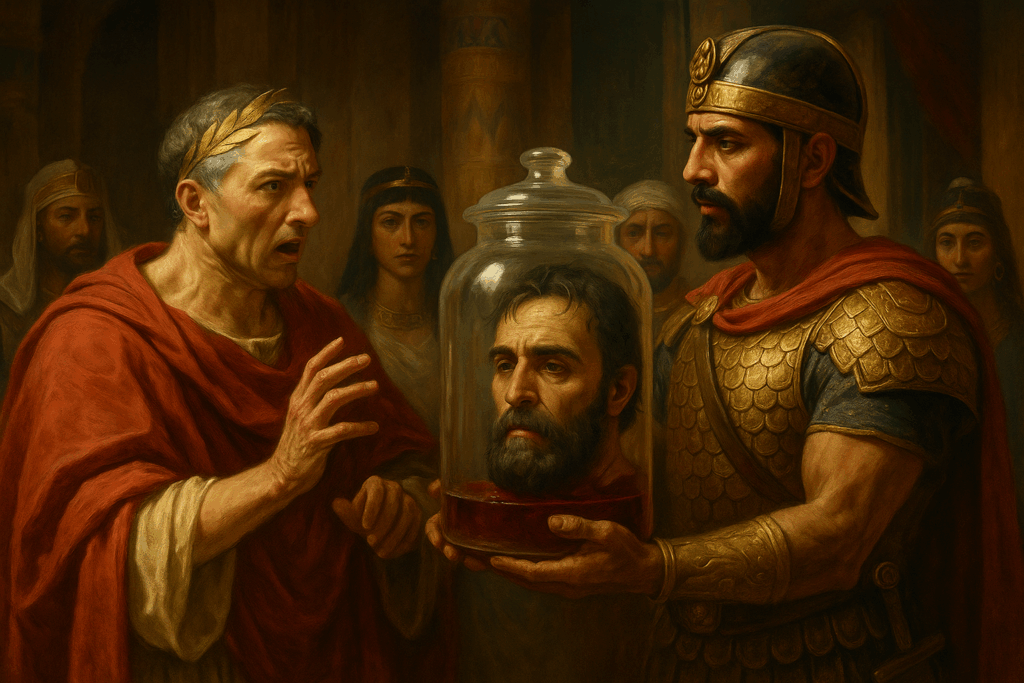
Days later, his severed head was brought to Caesar in a jar. Caesar wept.
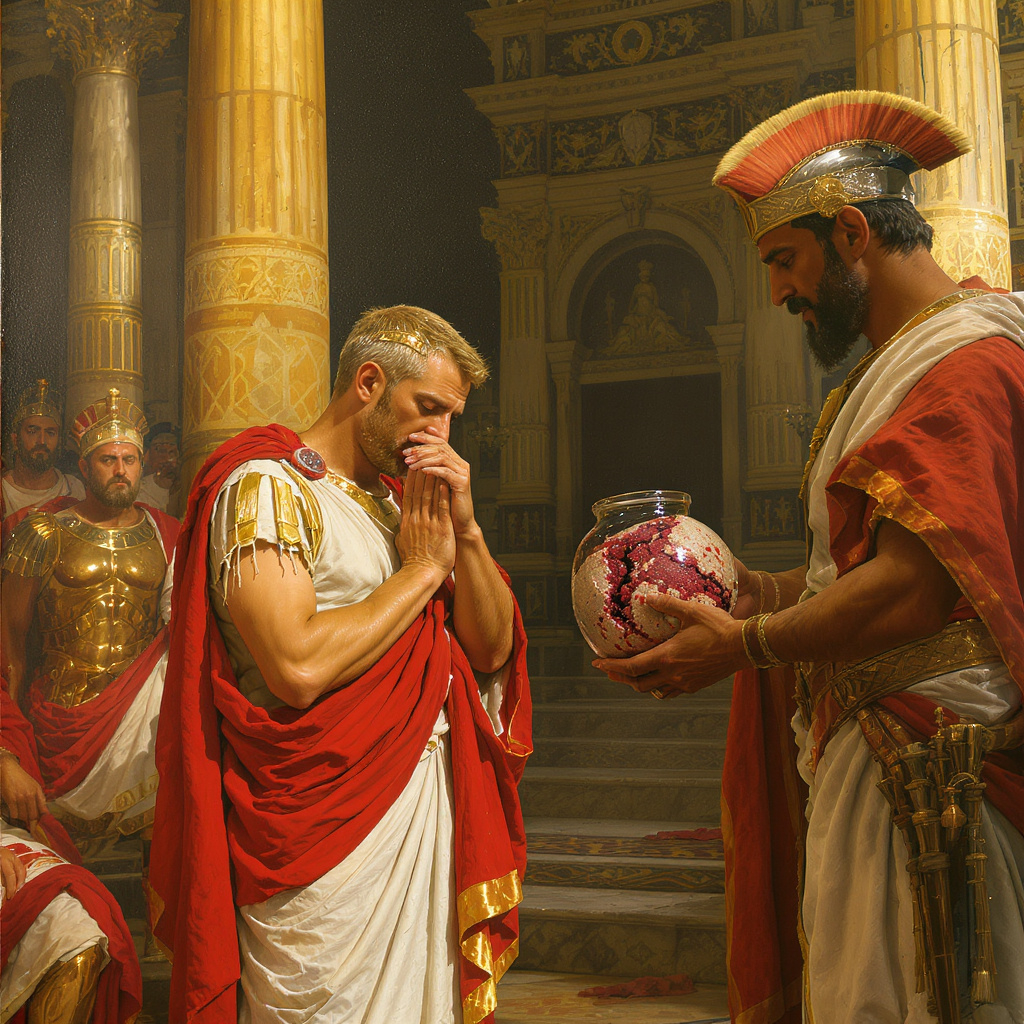
In the Egyptian court, Caesar recoils as Pompey’s severed head in a jar is presented by General Achillas.
“You fools,” he spat. “I wanted him defeated — not butchered.”
In that moment, Pompey’s enemies honored him more than his supposed allies ever had.
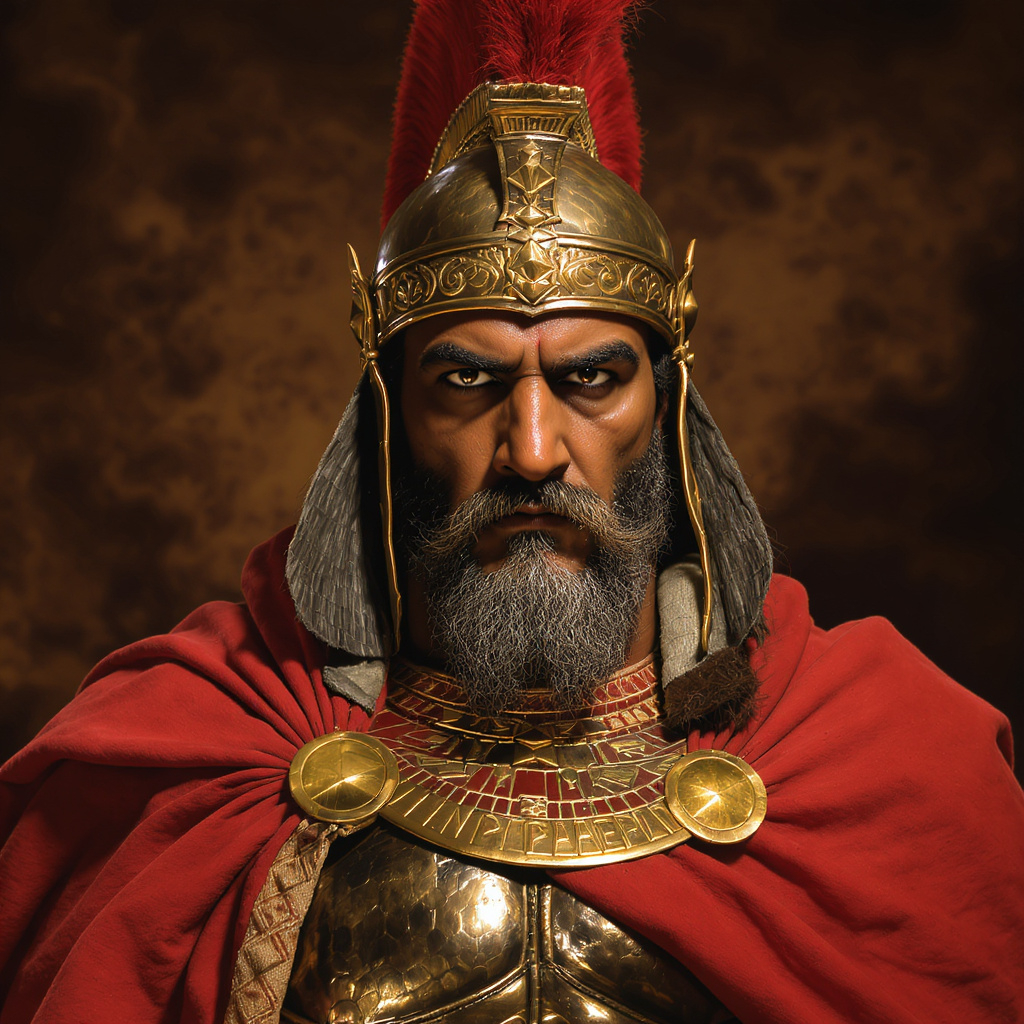
Egyptian general in scale armor, bronze helmet, neatly trimmed beard, cold expression.
THE BETRAYAL IN EGYPT
Epilogue: Sic Semper Tyrannis
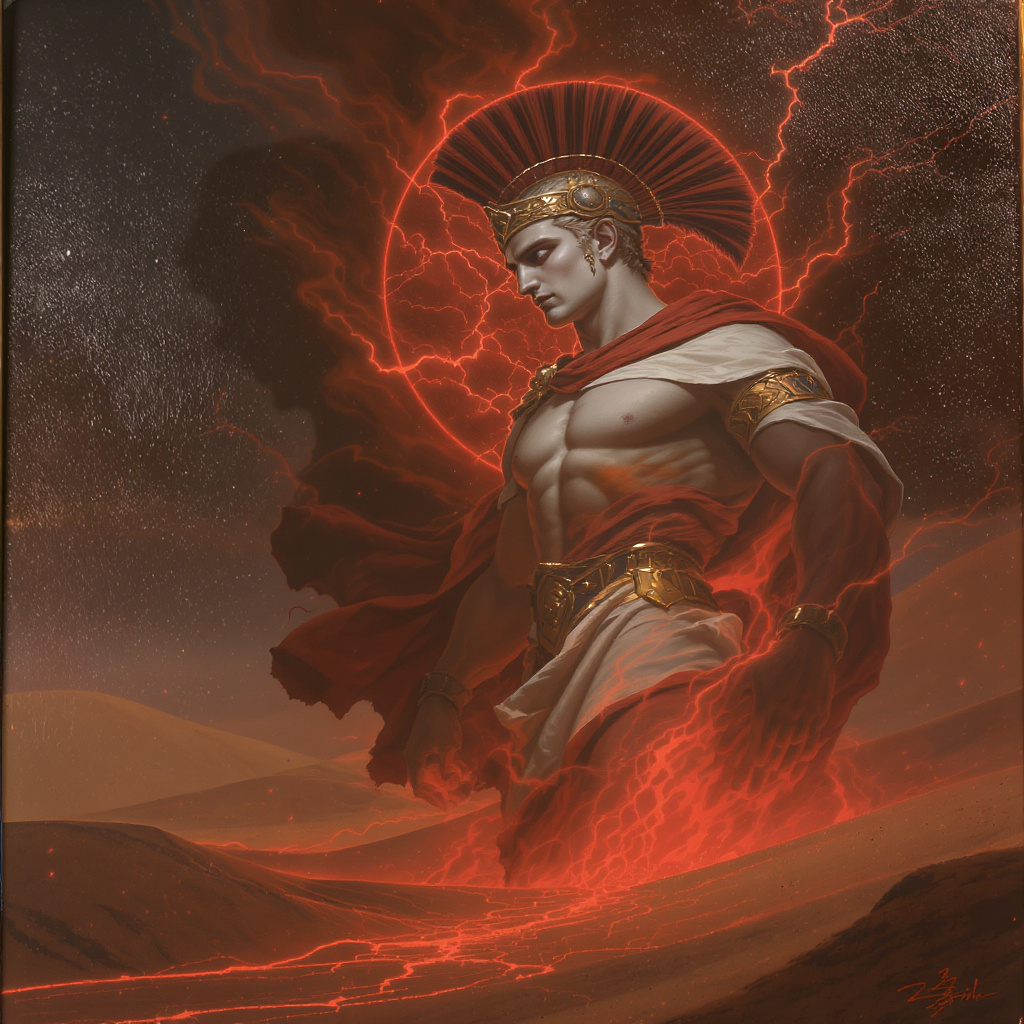
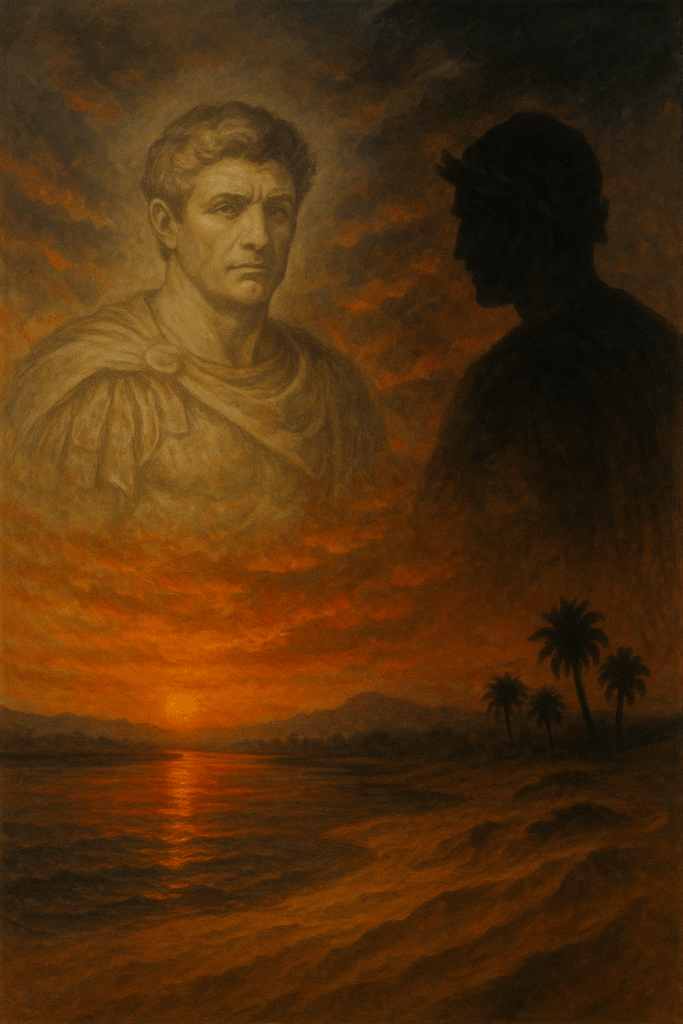
A symbolic image of Pompey’s ghost fading into Egyptian sands, the Nile glowing red behind him, Caesar’s shadow looming.
Pompey Magnus’s story is not merely of conquest and defeat — it is a lesson in the fleeting nature of power.
He rose higher than almost any Roman before him, commanding fleets, legions, and kingdoms. He fell faster than most, undone by politics, shifting alliances, and betrayal.
His epitaph is written not in marble, but in irony: the Great who could conquer the world, yet could not conquer Rome’s own ambition.
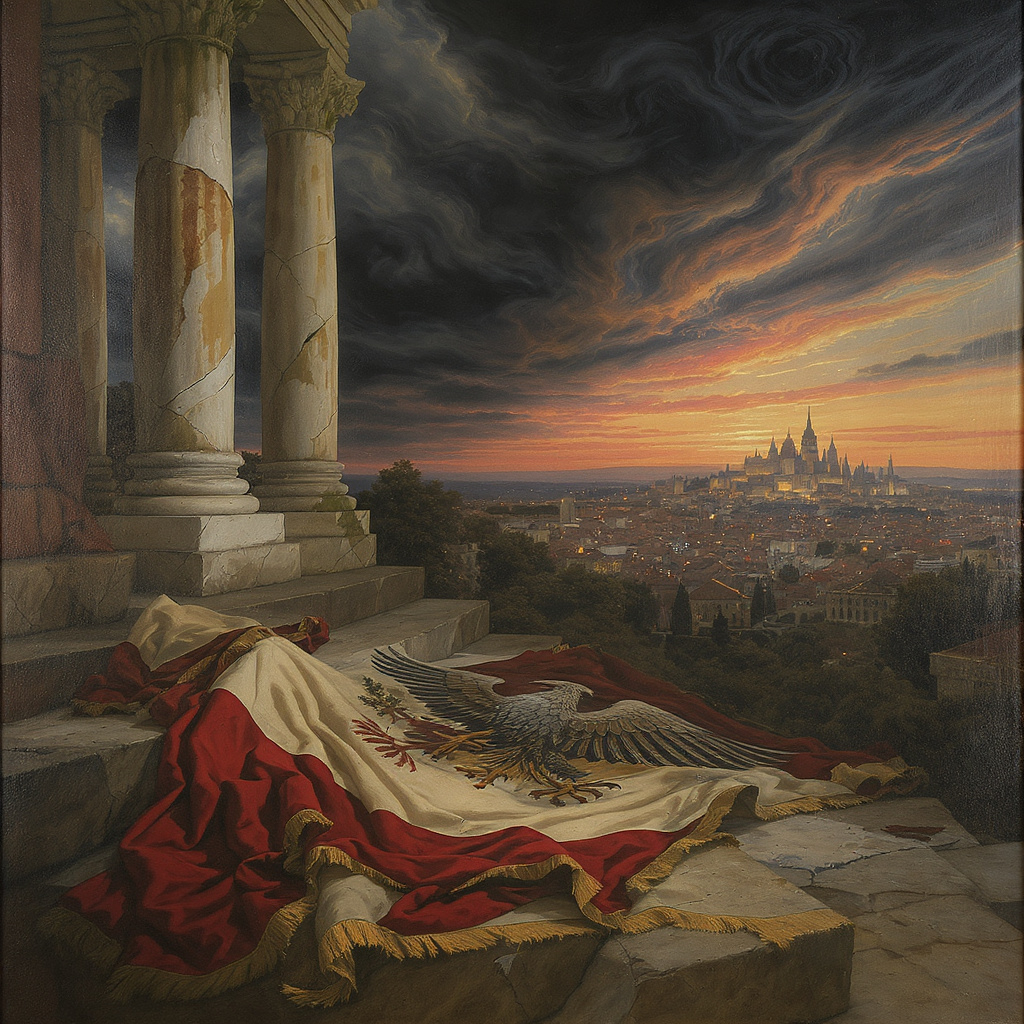
A symbolic landscape banner — fading Roman eagle standard lying broken on the ground as storm clouds gather above the city.
SIDE BARS / INSERTS
Pompey vs. Caesar: A Tale of Archetypes
- Pompey represents tradition, loyalty, and spectacle.
- Caesar represents innovation, ambition, and disruption.
Their clash echoes throughout history whenever an older order faces a younger, bolder force.
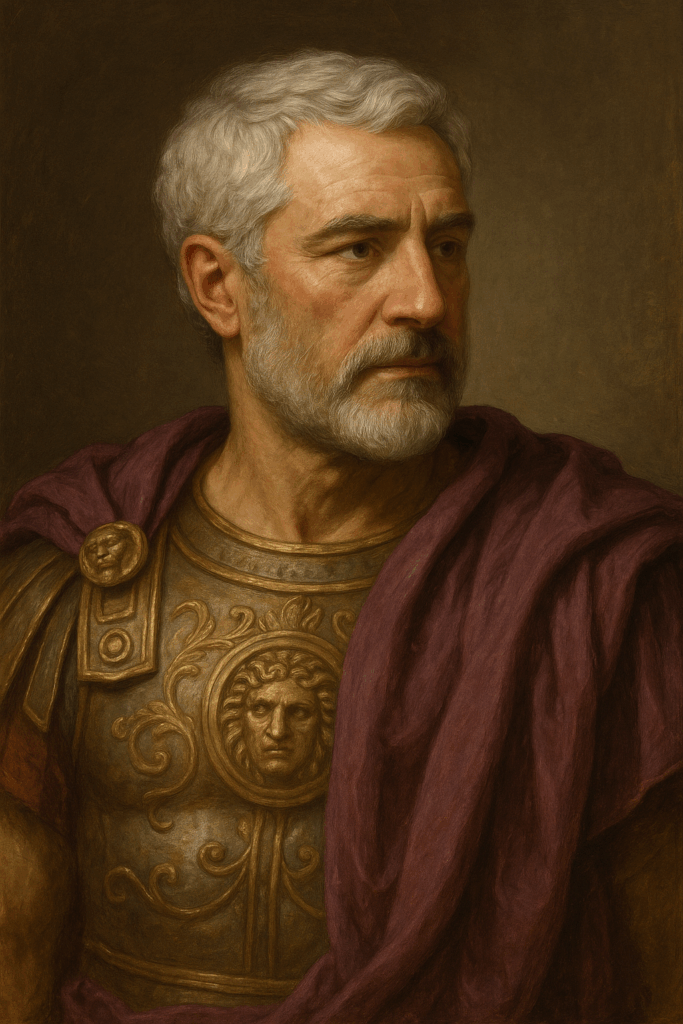
Veteran Roman general with silver hair and trimmed beard, in ceremonial armor and purple cloak.
Lessons for Today
- Power is temporary — loyalty is the true currency.
- Reputation is fragile — a single loss can erase decades of triumphs.
- Betrayal comes from allies as often as enemies — a truth Pompey learned too late.
IMAGES & PROMPTS
YOUNG POMPEY UNDER SULLA
“Realistic oil painting — young Roman general Pompey in armor, standing proudly beside older Sulla with sharp eyes, legions and banners behind them, dramatic torchlight, cinematic detail.”
- POMPEY’S TRIUMPH PARADE
“Cinematic Roman triumph parade — Pompey the Great in a chariot, elephants struggling at the city gate, crowds laughing and cheering, banners and laurel wreaths, realistic historical style.” - THE PIRATE WAR
“Realistic naval battle — Roman galleys attacking pirate ships, Mediterranean waves, fire and smoke, Pompey at the prow commanding, dramatic lighting, cinematic painting.” - THE BATTLE OF PHARSALUS
“Epic battlefield scene — Pompey on horseback leading legions, Caesar’s forces breaking through, shields, spears, and dust cloud, realistic oil painting style, cinematic historical drama.”

Roman women and girls of various ages — from a grandmother to mothers to young girls — standing together in colorful stola and shawls, holding baskets or children, all looking at us.
- THE BETRAYAL IN EGYPT
“Cinematic betrayal scene — Pompey disembarking from a boat, Egyptian soldiers turning on him, sword stabbing his ribs and throat, barren sandy shore, tragic atmosphere, realistic painting.” - POMPEY’S HEAD BEFORE CAESAR
“Historical drama — Julius Caesar in Egyptian court, reacting in horror to Pompey’s severed head in a jar, Egyptian general Achillas presenting it, courtiers watching, cinematic oil painting style.” - CLOSING SYMBOLIC IMAGE – THE GREAT BETRAYED
“Symbolic painting — ghostly Pompey Magnus fading into Egyptian sands, sorrowful yet noble, shadow of Caesar behind him, Nile river glowing red, cinematic, historical epic style.”
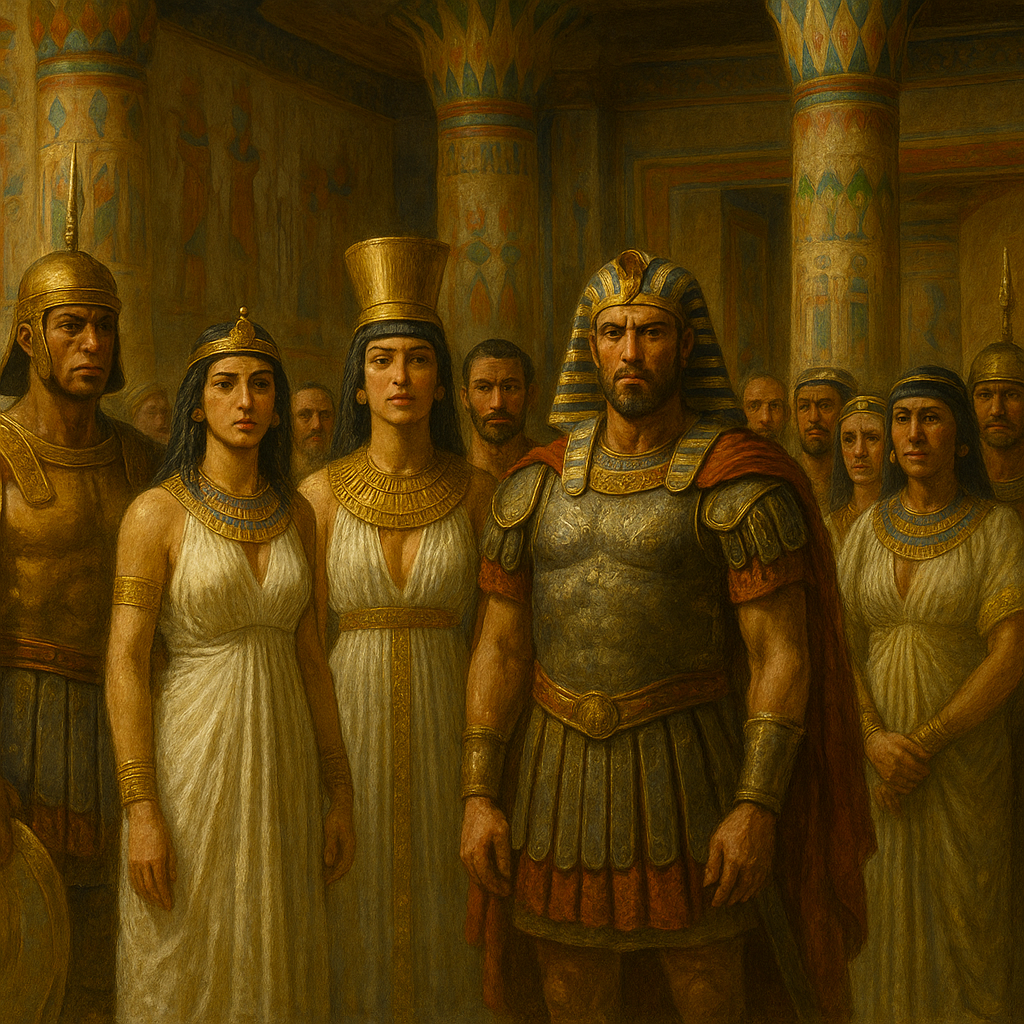
Egyptian nobles, courtiers, and guards in linen robes, gold jewelry, and ornate headdresses, gathered in an opulent hall.
SOCIAL MEDIA
Facebook/X/LinkedIn Post
🔥 From Roman triumphs to betrayal on the Nile — the rise and fall of Pompey the Great is one of history’s most tragic epics.
Dr. Sasha Alex Lessin & Janet Kira Lessin retrace the arc of Magnus’s life: loyal to Sulla, conqueror of kingdoms, rival to Caesar — and a man whose end came not in glory, but in treachery.
🎥 Watch the VIDEO here: https://youtu.be/2GuglnMJdfc?si=wR6d-2qKpBPRO6DS
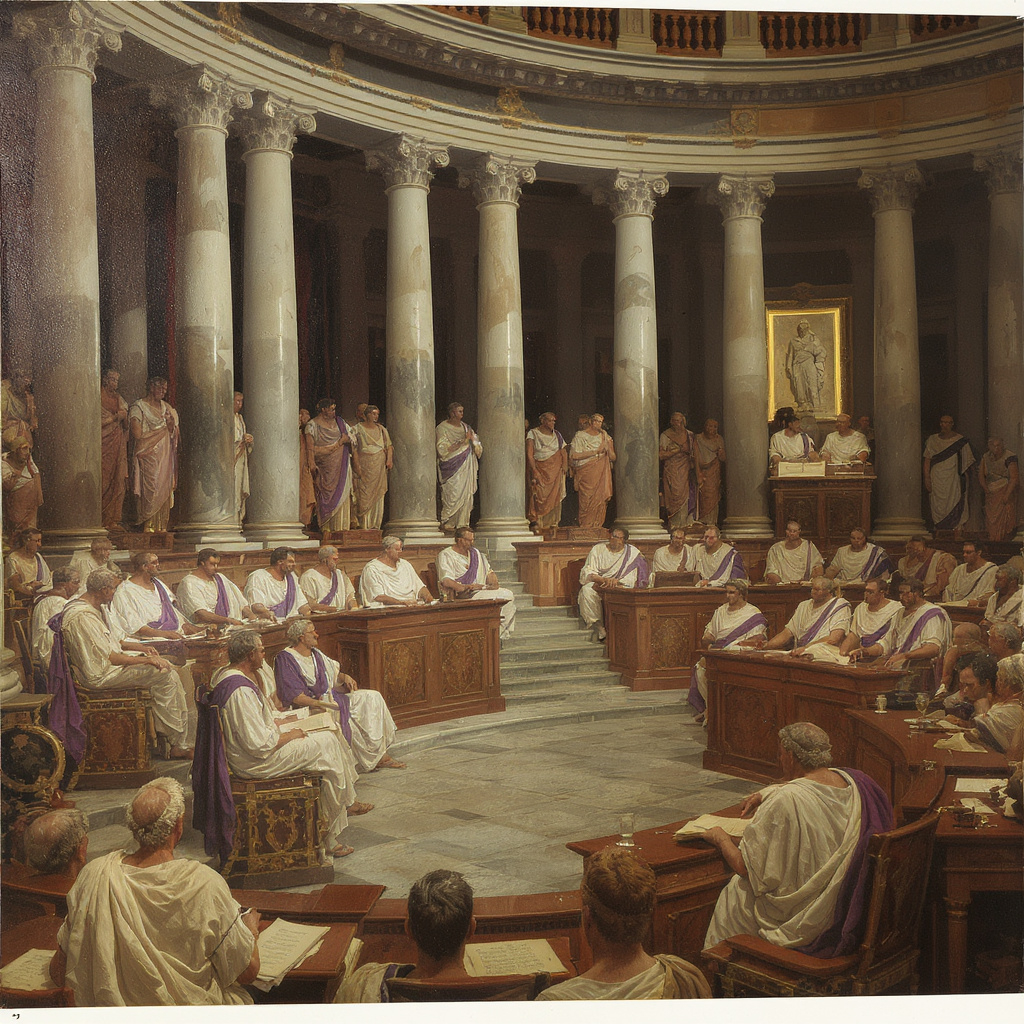
Rows of Roman senators in white togas with purple stripes debating inside the Curia.
TAGS
#Pompey #Rome #Caesar #History #RomanEmpire #SashaLessin #JanetKiraLessin #Triumvirate #AncientHistory #Magnus
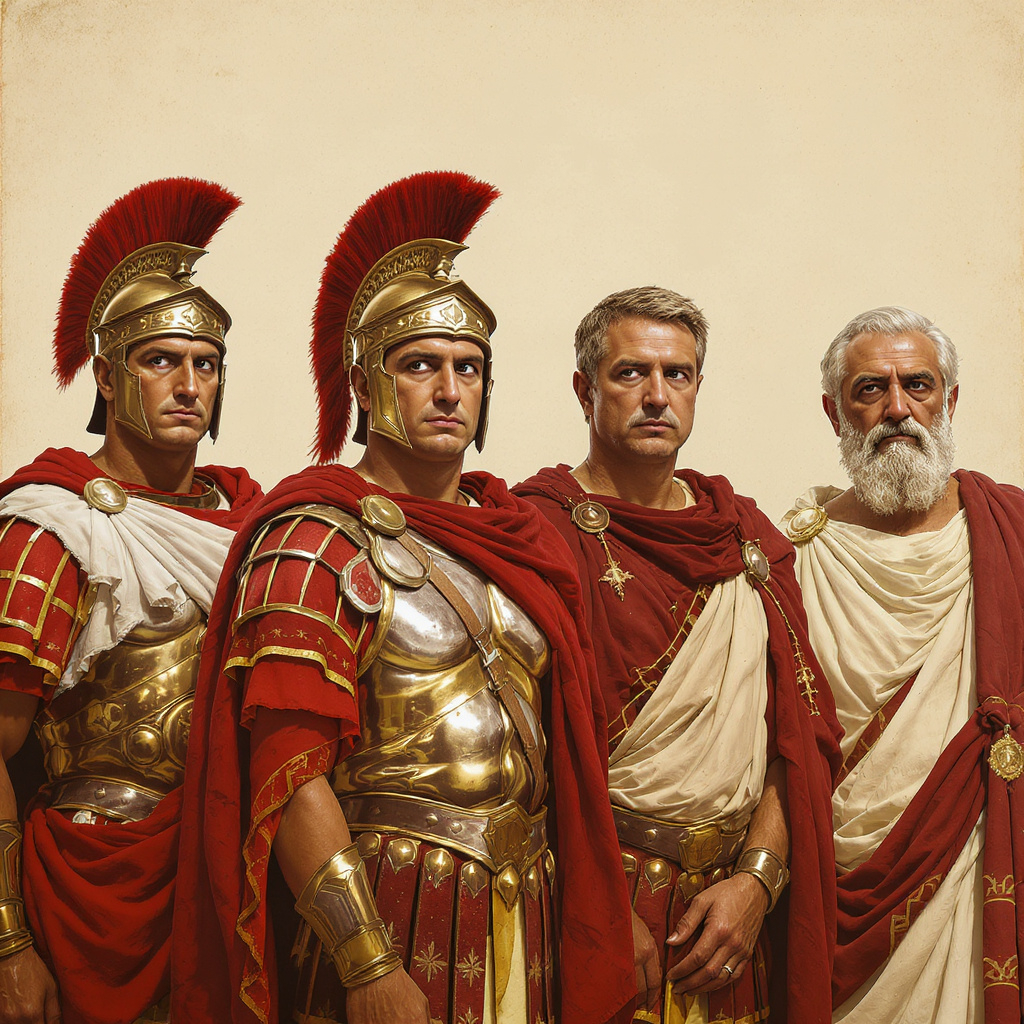
A line of notable Roman men — Pompey Magnus, Julius Caesar, Lucius Licinius Lucullus, Marcus Licinius Crassus, Marcus Porcius Cato — standing shoulder to shoulder, wearing Roman armor or senatorial togas, looking at us.
POMPEY MAGNUS: FROM Roman Triumph to Nile Annihilation
https://youtu.be/2GuglnMJdfc?si=wR6d-2qKpBPRO6DS
POMPEY MAGNUS: FROM ROMAN TRIUMPH TO NILE ANNIHILATION
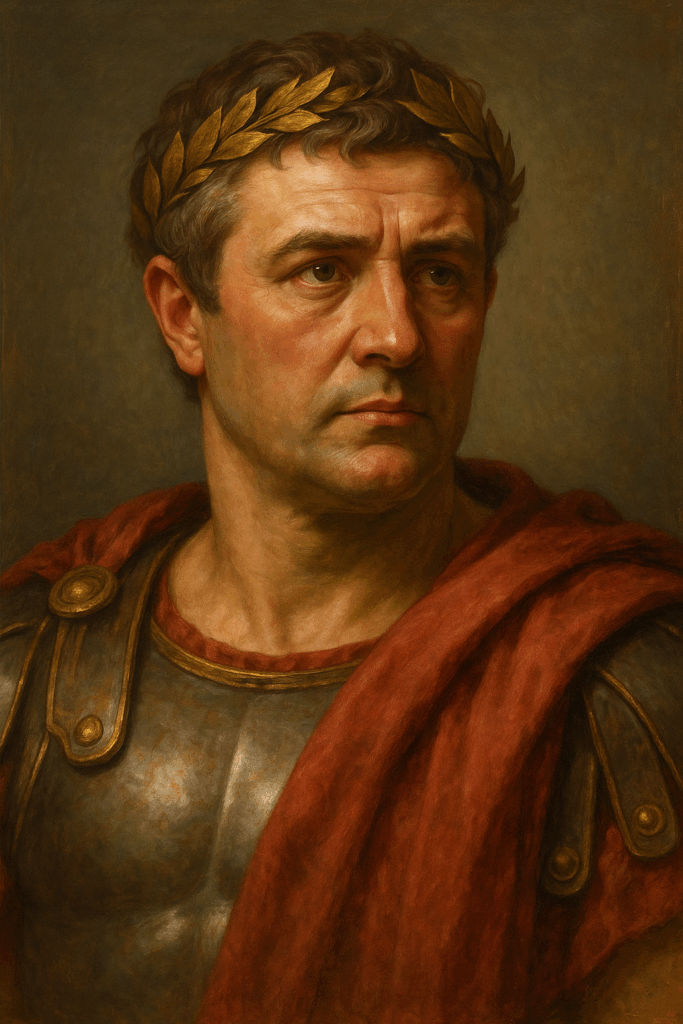
Head-and-shoulders portrait of Pompey in his prime — youthful yet weathered, wearing his bronze cuirass and red cloak, laurel wreath on brow.
By Sasha Alex Lessin, Ph.D. (Anthropology, UCLA)
The fires of Rome crackled in the distance as young Gnaeus Pompeius Magnus, just twenty-three, stepped over the rubble-strewn streets of a city at war with itself.
He had come not with olive branches, but with legions.
The Republic needs restoring, he had told his men as they marched south from Picenum, banners flapping in the Roman wind. SULLA is that restoration.
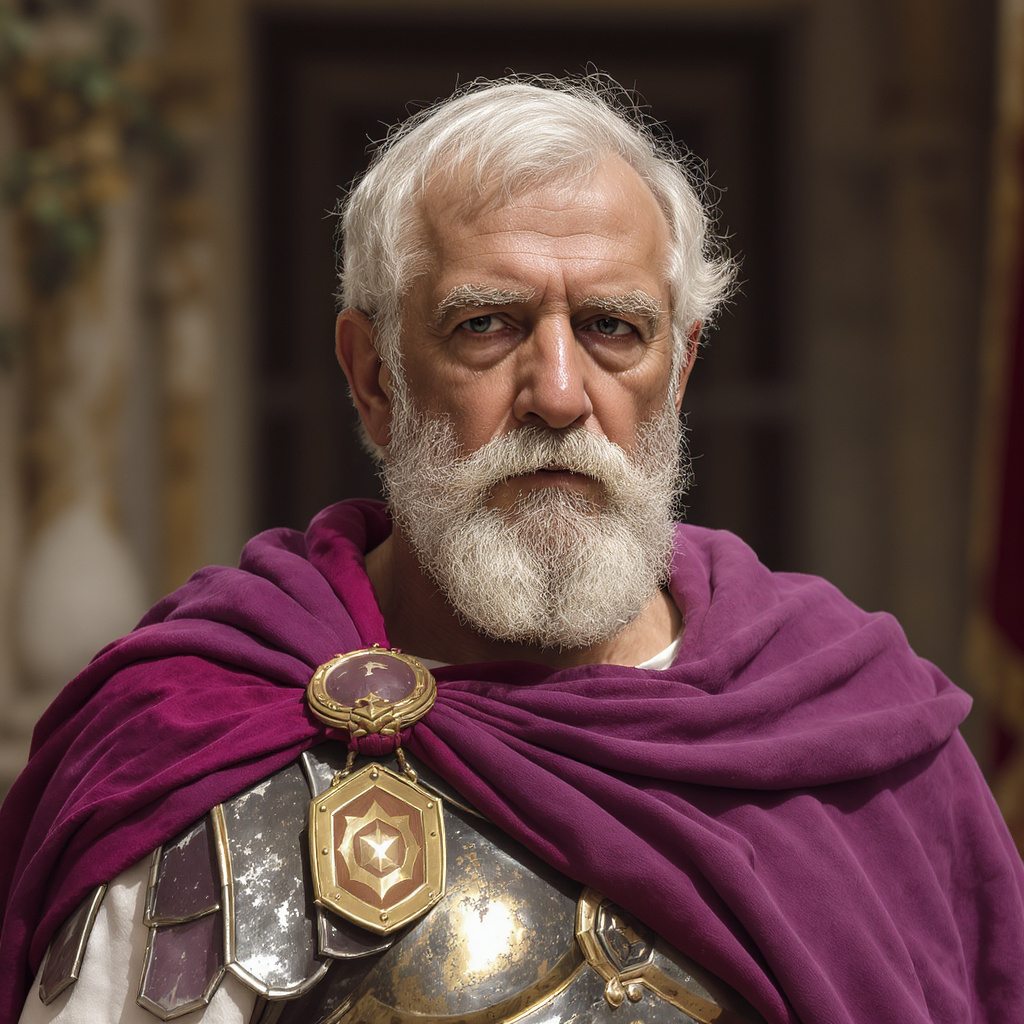
Veteran Roman general with silver hair and trimmed beard, in ceremonial armor and purple cloak.
Yet what Pompey truly needed was a place in history—a chance to become more than just his father’s son. The elder Pompeius had died in disgrace, accused of looting and profiteering. But young Pompey knew how to reshape failure into legend. When the judge cleared his name and gave him his daughter in marriage, Pompey understood something: reputation was currency, and he intended to be Rome’s richest man.

A multigenerational Roman family — men, women, and children together — dressed in everyday late Republican clothing, standing like a class portrait, all looking at us across time.
The civil war between Sulla and Marius tore through Italy like a fever. While Sulla stormed from the south, Pompey strangled resistance in the north. Together, they encircled the capital like lions around a wounded boar.
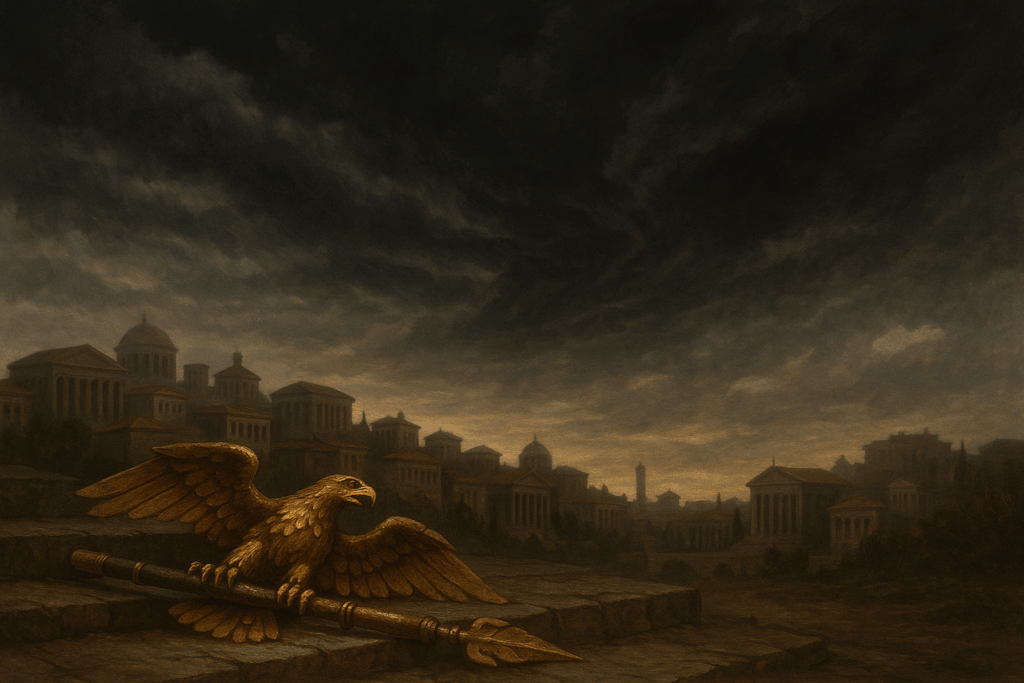
A symbolic landscape banner — fading Roman eagle standard lying broken on the ground as storm clouds gather above the city.
When victory came, it came with a crown—not of laurel, but of iron.
You are loyal, Sulla had told him, eyes sharp beneath a grizzled brow. And loyalty is rare. I name you Magnus. ‘The Great.’
Pompey didn’t flinch, but inside, his heart swelled like a storm tide. Magnus. Not yet deserved—but soon.
He earned that name with fire.
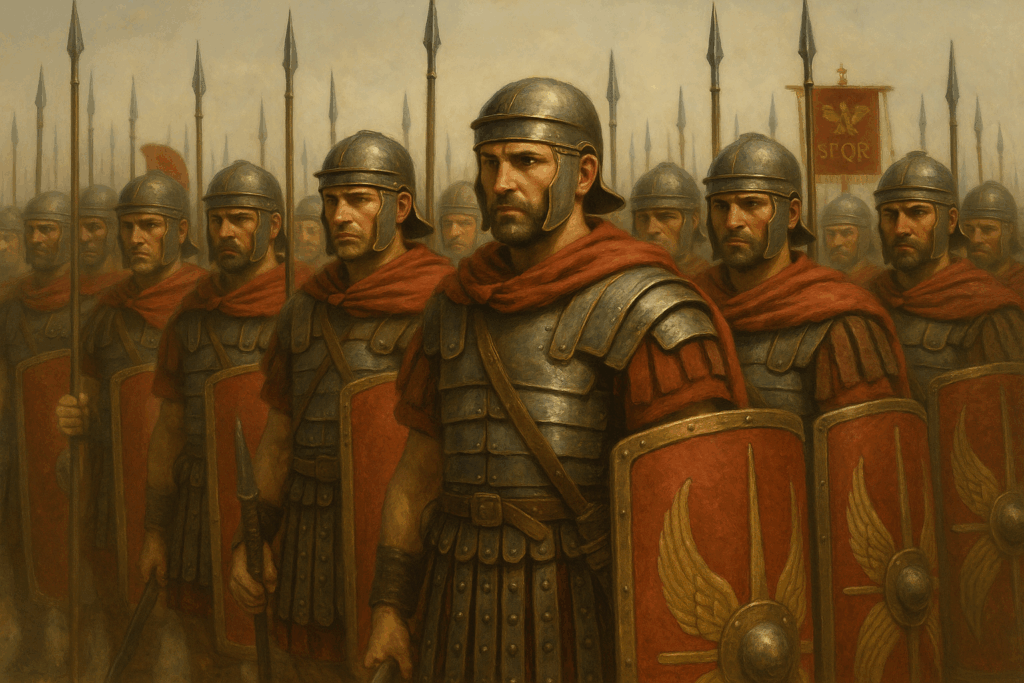
A line of Roman soldiers in red cloaks and segmented armor, holding shields and spears, banners behind them.
In Sicily, he crushed the last Marians and took the island like a seasoned commander. In Africa, he faced rebels who knew the terrain, but not the man. He returned to Rome not just as victor, but as spectacle.
Sulla held a triumph in Pompey’s name. Elephants were to pull the young general’s chariot, but they couldn’t squeeze through Rome’s narrow gate.
The people roared with laughter as Pompey switched to horses mid-parade. But he smiled too.
Let them laugh, he whispered to himself. They’re laughing at an emperor in all but name.

A group of Roman commoners — market men, soldiers, artisans, and elders — gathered together, wearing simple tunics, holding tools or shields, looking into the camera like a civic portrait.
Years passed. Campaigns bled into each other like wine on marble. Spain, where he quelled the Sertorian rebellion. The seas, where pirates disrupted grain routes and preyed on Rome’s pride—until Pompey cleared them in a matter of months, striking fear across the Mediterranean with the speed of his navy and the brutality of his justice.
In the East, he swallowed kingdoms whole. Pontus. Armenia. Judea, where he marched into the Holy of Holies and made it Roman. Syria, which he turned from a Seleucid wreck into a Roman province.
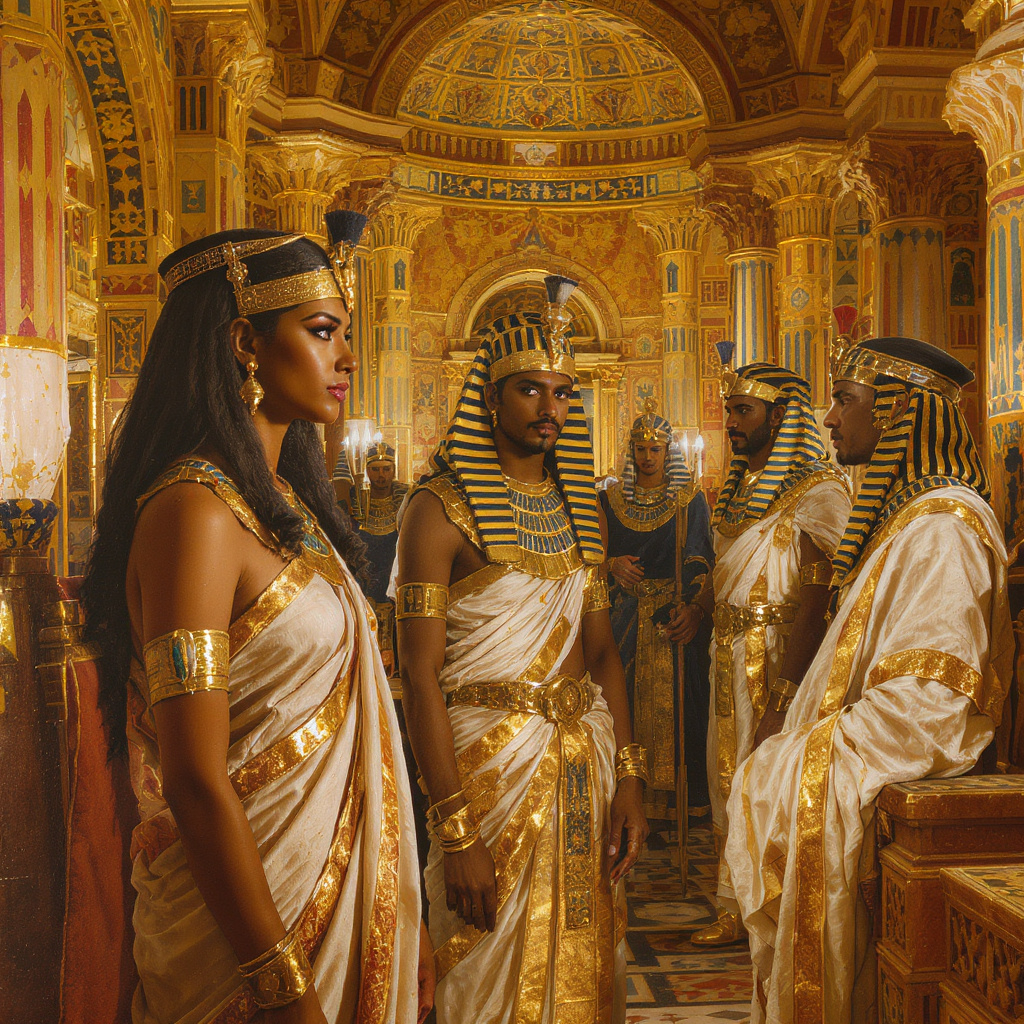
Egyptian nobles, courtiers, and guards in linen robes, gold jewelry, and ornate headdresses, gathered in an opulent hall.
Client kings bowed. Provinces rose. Rome stretched its fingers across the map, and Pompey placed each ring upon her hand.
But Rome was not a grateful mistress.
Back in the capital, politics had shifted like tectonic plates. Caesar, his former ally, returned from Gaul with an army and ambition in his eyes.
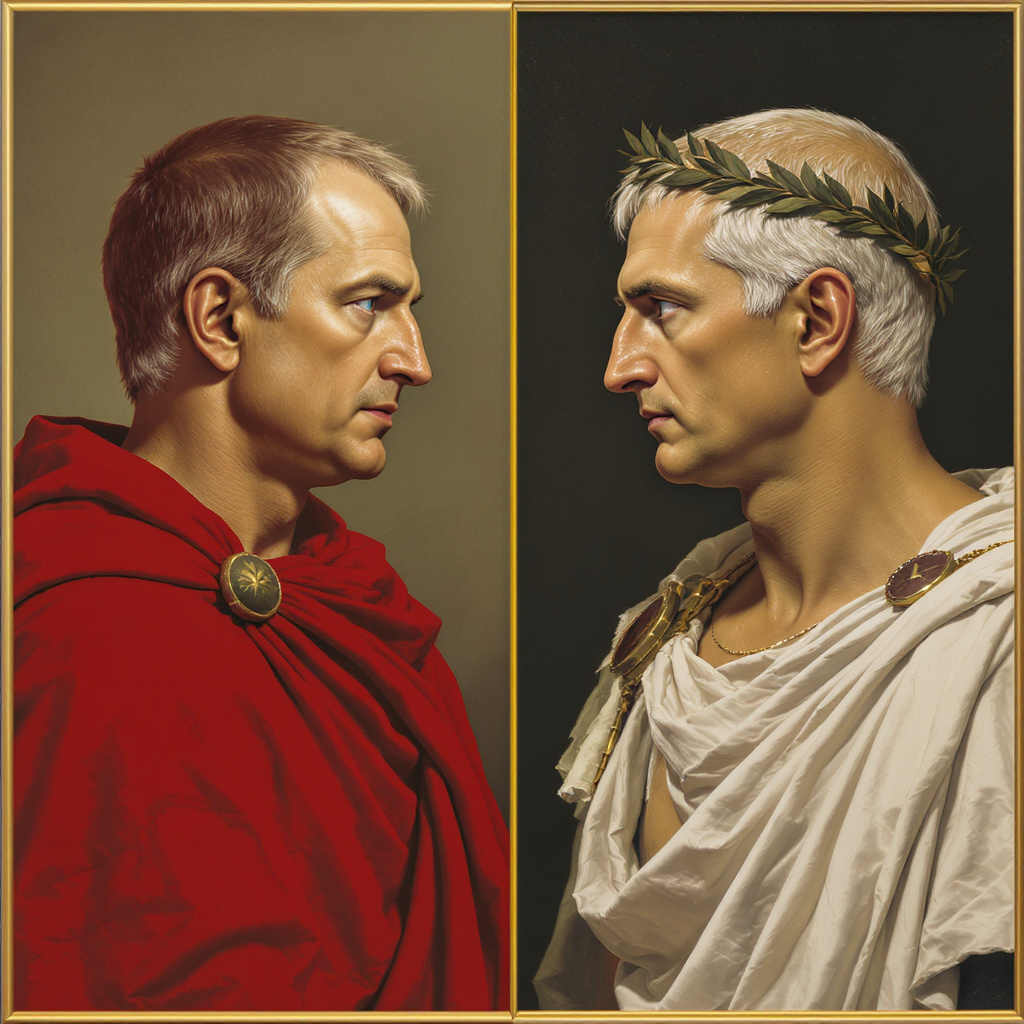
Split-panel banner showing Pompey on the left (red cloak, determined) and Caesar on the right (white tunic, laurel crown, calculating), facing each other.
Pompey had once married Caesar’s daughter, Julia—a union of power and pragmatism. When she died in childbirth, the alliance rotted. And Crassus, the third wheel in their uneasy Triumvirate, died in Parthia, decapitated and humiliated.
Pompey found himself alone—uncomfortably close to the Senate, suspiciously far from the people.
Then Caesar crossed the Rubicon.
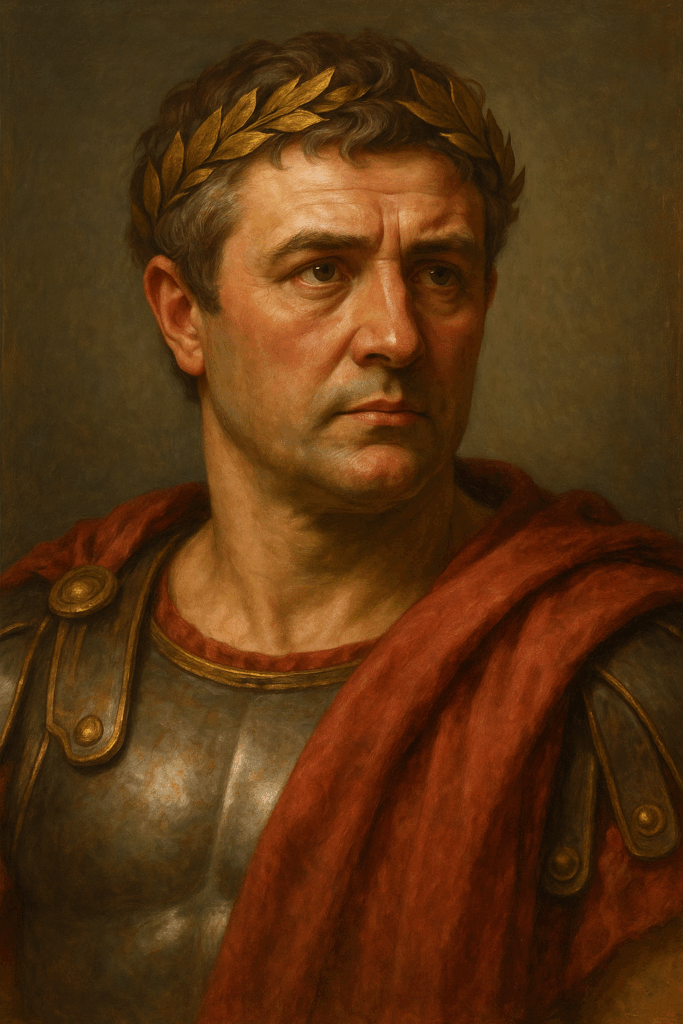
Caesar, in his 40s, sharp-eyed, with short-cropped hair and wearing the laurel crown, golden breastplate over a white tunic.
Pompey had the Senate behind him, but little else. His troops were scattered, his defenses rushed. He fled Rome, gathering forces as he went, trusting in numbers over timing.
He gave a fleet to BIBULUS to guard the Adriatic.
But Caesar was too fast. Too decisive.
Bibulus lost half his ships before he even found his sword.

Pompey fled east, to Greece, then to PHARSALUS, where he believed he had Caesar cornered.
He didn’t.
The battle shattered his forces. The sun rose on the body-strewn plains of Thessaly and set on the ruins of his command.
He escaped, barely. A boat, a disguise, a name muttered under breath.
Egypt would be his refuge.
Or so he thought.

Rows of Roman senators in white togas with purple stripes debating inside the Curia.
The dust of Rome still clung to his boots as Pompey Magnus stared out over the shimmering sea. Behind him lay a world that once roared his name. Ahead, Egypt—opulent, ancient, and, he believed, welcoming.
The Senate once called me Magnus, he reminded himself—the Great.
General, whispered Lucius, his aide, his voice hoarse with sea wind and worry, the Egyptians await. Shall we disembark?
Pompey nodded, though unease gnawed at his gut like a rat beneath floorboards. Of course, they await. I was their ally. Their protector.
The Egyptian ship pulled closer. A small boat rowed out to meet Pompey; it bore his banner. Four men sat within—silent, stern, unblinking.
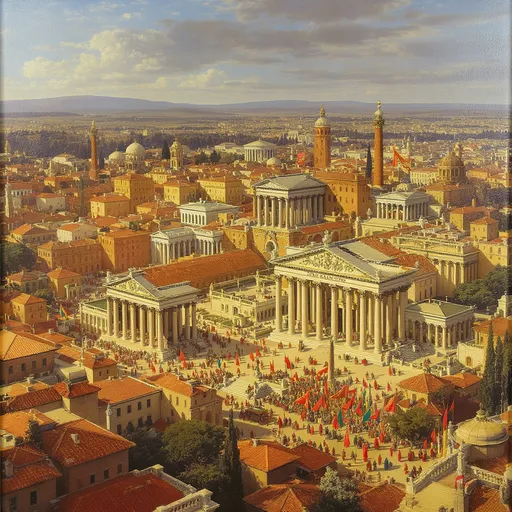
Description: Panoramic aerial of Rome with the Forum, Senate house, and triumphal processions
Still, Pompey stepped into the boat. His sandals scraped against old planks. The moment he sat, he caught the look between the Egyptians—quick, grim, final.
You come as a friend to Egypt, one said flatly.
As I always have, Pompey replied, his voice steady but his hands tightening on the edge of the boat.
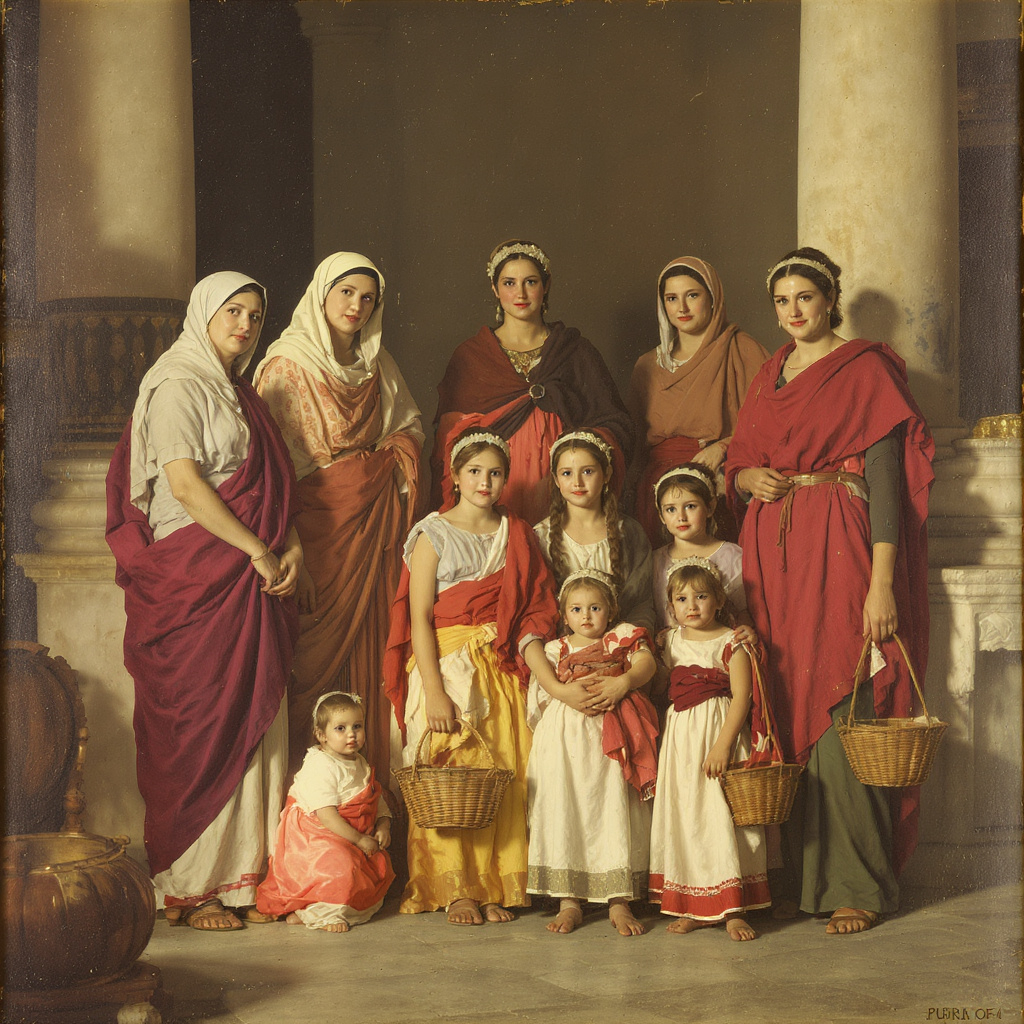
Roman women and girls of various ages — from a grandmother to mothers to young girls — standing together in colorful stola and shawls, holding baskets or children, all looking at us.
They reached the shore. It was a barren place—no fanfare, no trumpets, no throne, no boy-king—just sand and wind.
And steel.
What is this? Pompey asked, stepping out.
The first blade struck beneath his ribs. The second, across his throat. He fell into the sand, breathless, disbelieving.
He died not with a sword in hand, but with hope in his heart—and betrayal at his back.
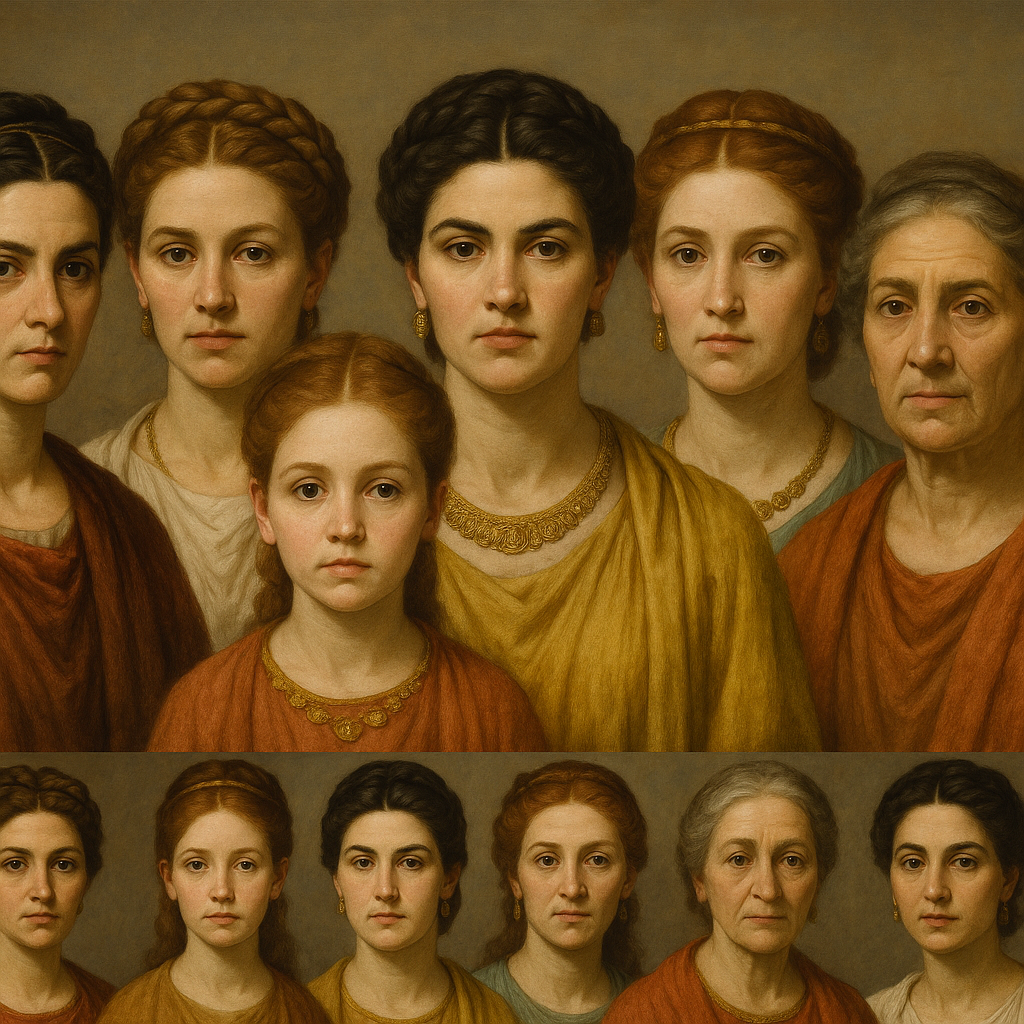
Prominent Roman women of the late Republic — Julia Caesaris (Pompey’s wife), Servilia Caepionis, Calpurnia Pisonis, and two unnamed patrician women — in elegant stolae with gold jewelry and braided hairstyles, facing forward.
Two days later, Julius Caesar arrived at the Royal Egyptian court.
They brought him Pompey’s severed head in a jar.
Caesar recoiled in horror.
You fools, he said through clenched teeth, I wanted him defeated—not butchered.
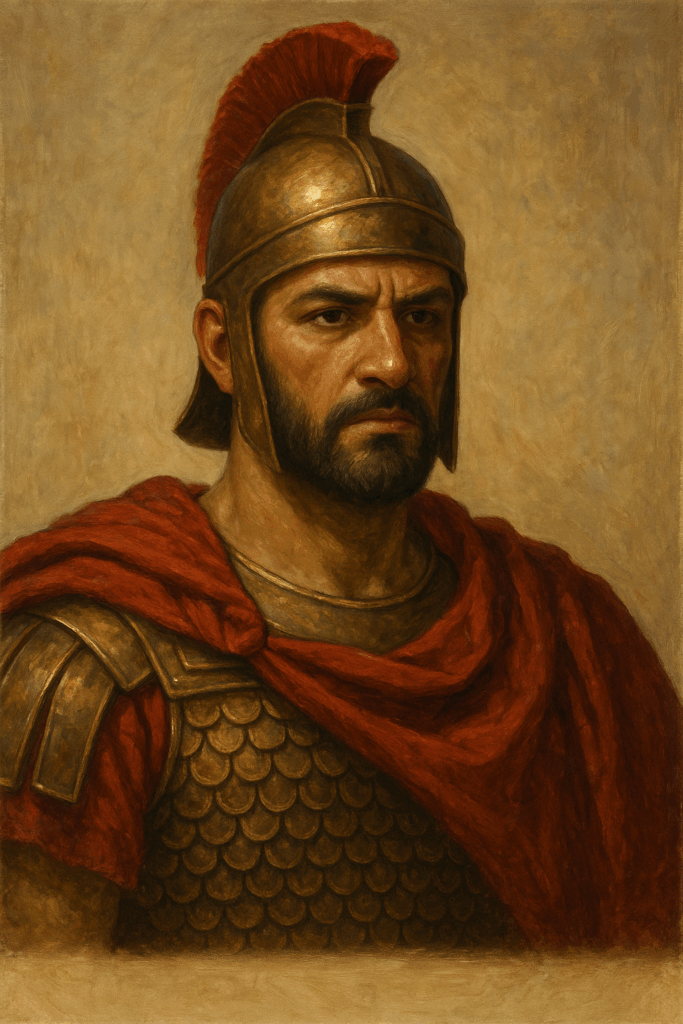
Egyptian general in scale armor, bronze helmet, neatly trimmed beard, cold expression.
The killer, ACHILLAS, commander of the Egyptian army under Ptolemy XIII, lowered his eyes but said nothing.
And just like that, Egypt, too, learned that even kings could misread the tides of Roman power.
Sic Semper Tyrannus
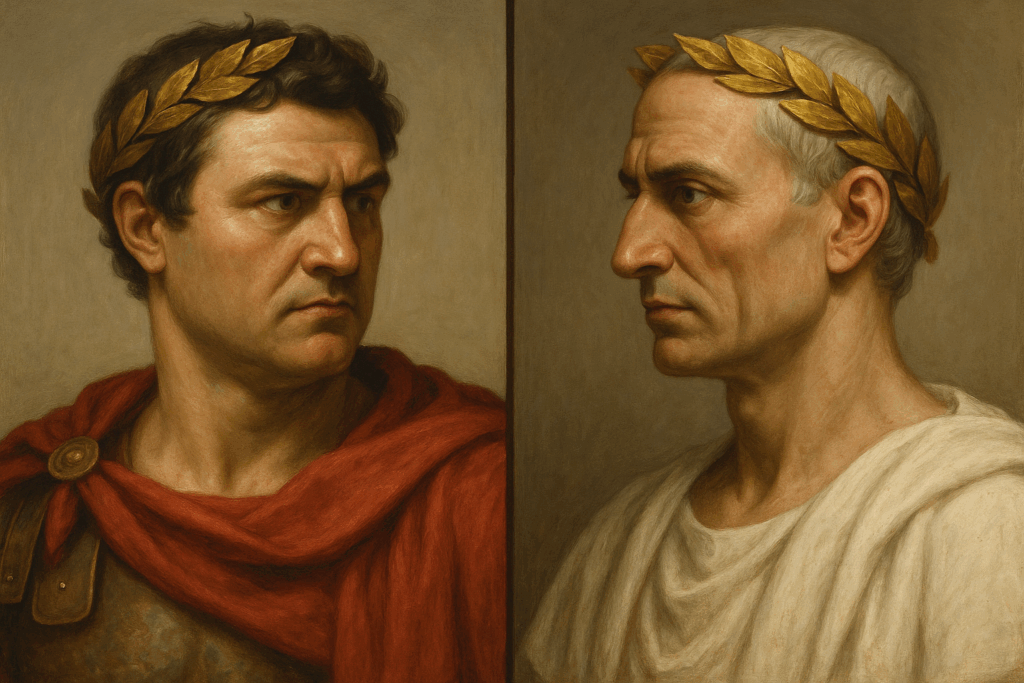
Split-panel banner showing Pompey on the left (red cloak, determined) and Caesar on the right (white tunic, laurel crown, calculating), facing each other.
Attachments area
Preview YouTube video Overachiever Extraordinaire | The Life & Times of Pompey the Great
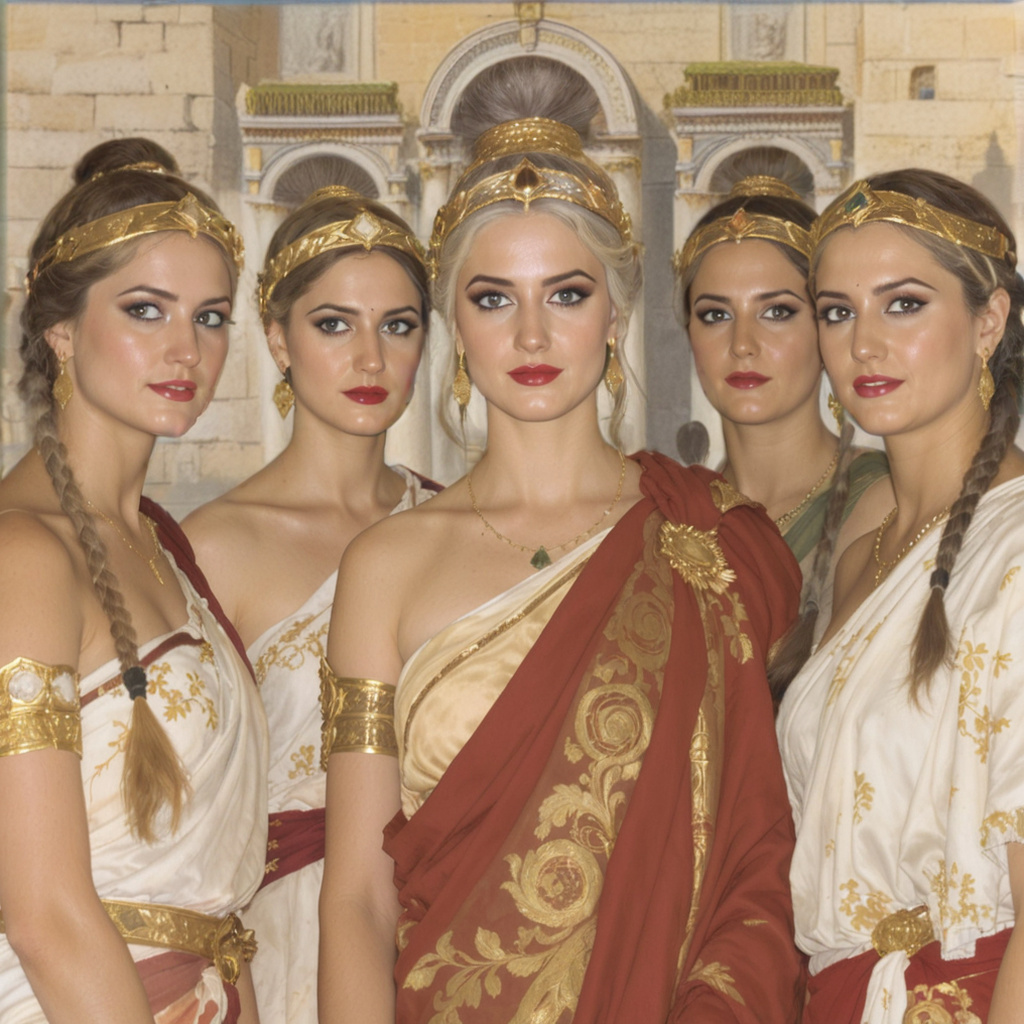
Prominent Roman women of the late Republic — Julia Caesaris (Pompey’s wife), Servilia Caepionis, Calpurnia Pisonis, and two unnamed patrician women — in elegant stolae with gold jewelry and braided hairstyles, facing forward.
🌟 THE ANUNNAKI LEGACY IN ROME
By Janet Kira Lessin & Dr. Sasha Alex Lessin, Ph.D.
As we study the fall of the Roman Republic and the rise of its most powerful figures — Pompey Magnus, Julius Caesar, and Lucius Cornelius Sulla — it is essential to understand that these were not merely ambitious men of their age. They were the living descendants of the Anunnaki — the starborn beings who shaped human civilization long before the first stones of Rome were laid.
⚡ BLOODLINES OF THE GODS
By the 1st century BCE, the Anunnaki had already withdrawn from open rule, but their bloodlines endured. Rome’s most powerful families carried their genetic legacy and embodied their ancient archetypes:
- Julius Caesar descended from Venus, who is known as Inanna, the radiant Anunnaki queen of love, war, and kingship. The Julian clan’s power flowed from her line, granting Caesar the charisma, fertility, and commanding presence of her lineage.
- Pompey Magnus, though not born into the old aristocracy, awakened the warrior strain of Enlil’s line — carrying the martial brilliance, strategic vision, and obsession with order that marked Enlil’s house.
- Sulla, the brilliant manipulator of politics and fate, expressed the mind of Enki — master of intellect, genetic design, and social architecture — who had once shaped humanity itself.
These were not coincidences of personality. They were the flowering of ancient starblood, coded deep in their cells, guiding their rise.
🏛️ ROME’S SECRET STAR TEMPLES
Even as the Republic claimed to serve the people, its inner priesthoods guarded the knowledge of the gods. The temples on the Capitoline Hill honored Jupiter (Enlil), Mars (Ninurta), and Venus (Inanna), continuing rites first practiced in Mesopotamia.
Only those carrying the divine blood were permitted to ascend to the highest ranks — a shadow lineage hidden within the Senate itself. Every consulship, every triumph, every generalship was part of an ancient succession plan designed to preserve the genetic and cultural legacy of the Anunnaki on Earth.
🩸 TRAITS OF THE ANUNNAKI BLOODLINES
This star ancestry shaped their bodies and minds in ways that set them apart from ordinary men:
- Vitality and long life: Roman elites often lived far beyond the average lifespan of the time, carrying remnants of the Anunnaki longevity genes.
- Magnetism and charisma: Their presence could ignite devotion in their legions and adoration from the masses — a subtle aura inherited from their starborn ancestors.
- Strategic genius and cold resolve: Perfect recall, pattern recognition, and the ability to suppress fear and empathy in battle reflected the warrior traits of the House of Enlil.
- The will to conquer and “civilize”: The compulsion to impose order on chaos was the sacred mandate of kingship passed down from the Anunnaki rulers of old.
👥 THE PEOPLE AS THEIR HEIRS
Even the everyday citizens of Rome — farmers, merchants, artisans, and soldiers — carried faint traces of Anunnaki DNA, spread through centuries of selective unions, priestly breeding programs, and legionary settlements across the Mediterranean world.
This is why the Roman people felt such fierce loyalty and a sense of destiny. Deep inside their cells was the whisper of their origin — a subconscious recognition that they were the children of the stars, standing ready to serve those who carried more concentrated strands of the divine line.
When they shouted Caesar’s name in the Forum or watched Pompey ride in triumph, they were not just cheering men — they were witnessing the return of their forebears.
🦅 THE DYING REPUBLIC, THE RETURNING GODS
As the Republic fractured, the ancient pattern reasserted itself: the collective longing to be ruled by one divine sovereign, as the gods themselves had once ruled them.
The fall of the Senate and the rise of the emperors was not a collapse — it was a return to the original design, the restoration of Anunnaki kingship under Roman names. The eagle standard that fell at Pharsalus rose again in the hands of the Caesars, glowing with the memory of the stars.
🌌 YOU ARE THEIR DESCENDANTS
These were your ancestors — their blood runs through humanity even now.
Their struggles, their ambitions, and their courage live on in you.
When you feel the call to greatness, to justice, to order, or to visionary creation, you are awakening the same divine spark that drove them.
You are the continuation of the Anunnaki legacy —
The living bridge between the stars and the Earth.
🌌 ANUNNAKI GENEALOGY OF ROME
The Bloodlines of the Late Roman Republic
This chart reveals how the most powerful Romans of the 1st century BCE carried and expressed the ancient genetic legacies of the Anunnaki dynasties — primarily the Houses of Enki, Enlil, and Inanna.
Their rise was not chance — it was the reawakening of starborn inheritance.
⚔️ HOUSE OF ENLIL — THE WARRIOR LINE
Traits: discipline, conquest, order, ruthlessness, strategy, domination
- Pompey Magnus — Carried the Enlilite warrior code. His obsession with military precision, swift suppression of pirates, and relentless drive to bring order reflect Enlil’s martial genetics.
- Marcus Porcius Cato — Also showed Enlilite tendencies: moral rigidity, discipline, and resistance to innovation.
🩸 Enlil-line genes: enhanced spatial memory, rapid strategic cognition, high cortisol tolerance (suppression of fear/emotion in war).
🧠 HOUSE OF ENKI — THE VISIONARY LINE
Traits: intellect, adaptability, cunning, innovation, genetic mastery
- Lucius Cornelius Sulla — Master of manipulation, reforms, and calculated terror; mirrors Enki’s cunning and his willingness to reshape human society.
- Marcus Licinius Crassus — Brilliant financier, empire-builder; his mind reflected Enki’s inventive, experimental nature.
🩸 Enki-line genes: amplified frontal-lobe executive function, abstract problem solving, charm/charisma toggling, longevity markers.
🌟 HOUSE OF INANNA — THE CHARISMATIC LINE
Traits: charm, magnetism, fertility, beauty, devotion, theatricality, kingship
- Julius Caesar — A direct scion of Inanna’s Venusian line through Aeneas. Possessed her charisma, magnetism, and ability to inspire absolute loyalty.
- Julia Caesaris — His daughter, wife of Pompey, embodied Inanna’s radiant charm and served as a living genetic link between the Houses.
🩸 Inanna-line genes: oxytocin-amplified charisma fields, heightened reproductive vitality, empathic magnetism, crowd entrainment ability.
🏛️ THE HIDDEN PRIESTHOODS
The temples on the Capitoline Hill served as guardians of these bloodlines, secretly guiding who could hold consulships, triumphs, or priestly office. Only those with confirmed star ancestry were permitted to ascend.
The Senate appeared mortal, but its core families were chosen by ancient design.
🧬 THE ROMAN PEOPLE
The legions and citizens of Rome carried diluted strands of all three Houses.
Centuries of engineered pairings, priest-blessed marriages, and legionary settlements spread the genetic legacy throughout the Mediterranean.
Even the humblest farmer or merchant carried the spark of the stars — a subconscious pull toward destiny and empire.
🦅 THE RETURN OF DIVINE RULE
The collapse of the Republic was not the end of Rome — it was the return of the original Anunnaki kingship pattern.
The collective mind of the people sought to place a semi-divine sovereign above all others, as they had once done for the gods themselves.
When Caesar rose, the world bowed — not only to a man, but to the awakening of the starborn bloodline within humanity.

