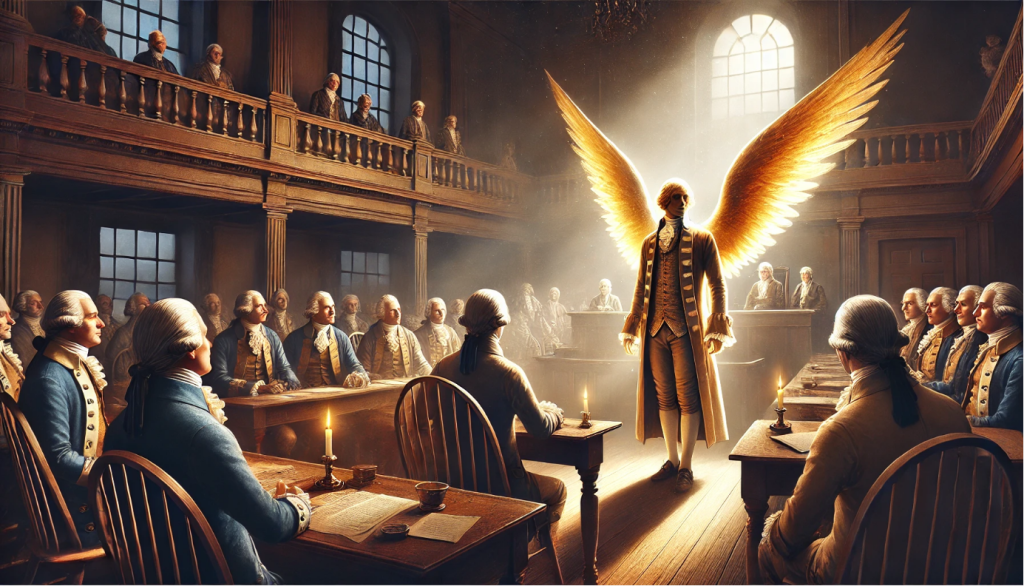
The story of an angelic presence at the signing of the Declaration of Independence is one of mystery and inspiration. It emerges from the folklore surrounding the revolutionary moment in 1776 when the Founding Fathers gathered to draft and sign the document that would birth the United States. Though it lacks direct historical documentation, the tale has been recounted over centuries, blending history with the divine to illustrate the gravity of that moment.
The Setting: Independence Hall, July 4, 1776
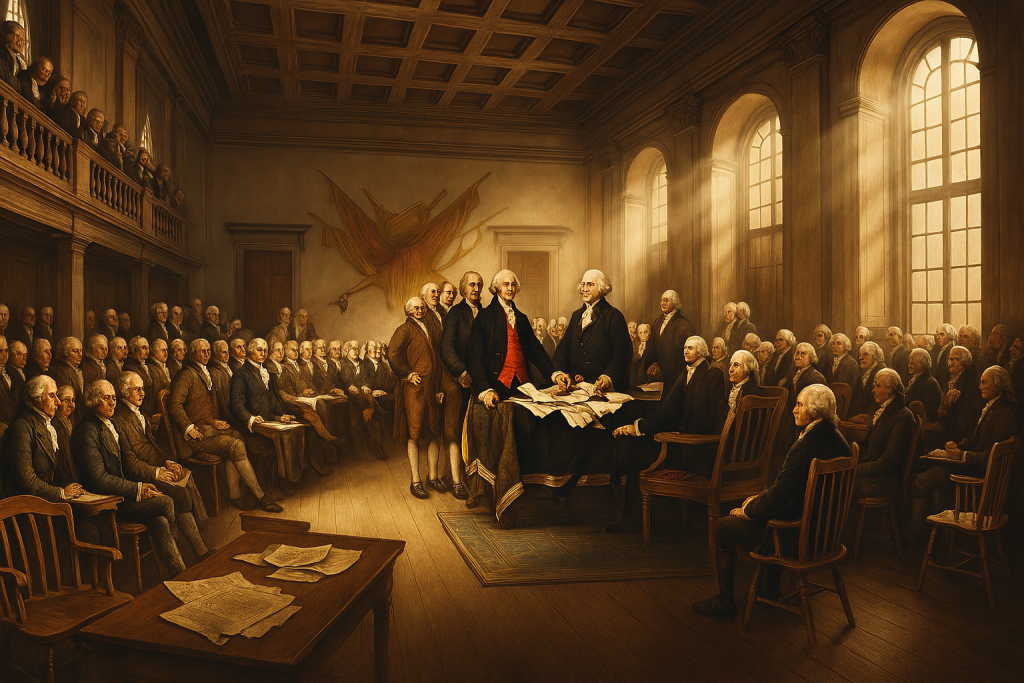
Inside Independence Hall, the air buzzed with tension and uncertainty. The Continental Congress debated fiercely, their discussions fraught with the weight of treason. Declaring independence from Britain meant risking their lives, families, and fortunes. John Adams, Benjamin Franklin, and Thomas Jefferson had fought to rally the colonies, but unity among the delegates was fragile.
As the day drew on, the room filled with unease. Some delegates faltered, unsure if the colonies could survive without British support. Fears of retribution from the British Crown hung heavy in the air. The room seemed to reach a standstill at this critical juncture, the flames of revolutionary passion dimmed by doubt.
The Angel’s Appearance

Legend tells of a sudden shift in the atmosphere. A radiant figure appeared among the delegates, described as an angelic presence. The figure’s features shone with an otherworldly light, and its form was clothed in flowing robes that seemed to shimmer like sunlight on water. Though no one recorded the name or nature of this being, many believed it to be a messenger from the divine.
The angel’s commanding yet compassionate voice filled the hall. It reminded the delegates of their mission, not just for themselves but for future generations. It spoke of liberty as a sacred trust, urging them to rise above their fears and disagreements to fulfill their destiny. Some accounts suggest that the angel laid out a vision of a united nation, a beacon of freedom and hope for the world.
“The time for hesitation has passed,” the angel reportedly said. “The cause of liberty is the cause of mankind. What you do here will echo for centuries.”
The Transformation of the Delegates
Moved by the angel’s words, the delegates felt their doubts dissolve. Men who had hesitated moments earlier now stood with resolve. John Hancock is said to have been among those most inspired, declaring that he would sign his name so boldly that King George III would not need spectacles to read it. The angel’s presence seemed to ignite a newfound unity among the delegates, who moved forward with their momentous task.
Legacy of the Angel’s Visit
The angel’s presence became part of the lore surrounding the Declaration of Independence. While no official records document the event, it symbolizes the gravity and divine significance many ascribe to the founding of the United States. To some, the angel represents the hand of Providence guiding the Founding Fathers, ensuring the success of their mission against overwhelming odds.
Whether literal or metaphorical, this tale reinforces the idea that the Declaration of Independence was more than a political act; it was a spiritual commitment to the ideals of liberty, equality, and justice.
Connecting Angel’s Message to the Anunnaki Narrative

In the context of myth-as-fact, could this angelic figure have been more than a divine messenger? Some alternative historical perspectives might interpret this as an emissary of the Anunnaki, perhaps acting on behalf of Enki or another benevolent figure. Could it have been Enki himself? The angel’s role aligns with themes of enlightenment, governance, and human progress, often attributed to the Anunnaki. This interpretation suggests that higher forces—divine, extraterrestrial, or both—guided humanity’s pivotal moments.
Conclusion
The story of the angel at the signing of the Declaration of Independence serves as a reminder of the courage required to birth a nation and the higher ideals that inspire such courage. Whether seen as divine intervention, symbolic inspiration, or part of a broader mythic tapestry involving beings like the Anunnaki, the tale resonates with those who view liberty as a sacred trust.
The story of the angel at the signing of the Declaration of Independence is primarily rooted in American folklore and has evolved. While no definitive or historical record exists of this angelic event, one of the most well-known accounts is attributed to a speech supposedly given by an unknown orator, sometimes described as an angel, inspired by divine intervention. Below is a reconstructed version of the angel’s words, drawing on the legend as it has been retold:
The Angel’s Words

“Stop this debate and hear me! You stand at the threshold of history. You have been chosen, not by mere chance, but by Providence itself, to break the chains of tyranny and declare liberty for all mankind. The task before you is no ordinary decision. It will echo through centuries and shape the destiny of nations yet unborn.
“Do not falter now, for your hesitation invites the hand of oppression. The weight of this moment is not yours alone to bear—it belongs to every soul yearning for freedom, every voice silenced by injustice, and every heart that dares to dream of a brighter future.
“Though the road ahead will be steep and fraught with danger, remember this: the cause of liberty is greater than the fears of any one man. You do not fight for yourselves alone but for your posterity. For every child who will be born into freedom, for every hope yet to take root, you must act boldly.
“Unite your hearts and sign this declaration, not as representatives of colonies but as stewards of a sacred trust. The world watches you, and Heaven itself bears witness to your resolve. Lay aside your fears, for the hand of Providence will guide and protect you if you act with courage and conviction.
“Let it be known that here, at this moment, men stood together and proclaimed liberty as the right of all. Do not fail this calling, for it is not yours alone—it belongs to all humanity. Rise, and do what must be done.”
The Angel’s Impact
According to the legend, these words electrified the room, silencing doubts and reigniting the delegates’ determination. The angel’s speech, whether delivered by a divine messenger or an impassioned orator believed to have been divinely inspired, reminded the signers that their cause transcended personal stakes. They were committing to a vision of freedom that would ripple through history.
Origins and Interpretations
The tale of the angel’s speech is often linked to a heightened sense of spiritual purpose surrounding the American Revolution. In some interpretations, the angel reflects the belief in divine intervention guiding the founding of the United States. Others suggest the speech represents the collective voice of the Founding Fathers’ conscience, urging them to take a leap of faith in the face of overwhelming odds.
The Hand of Enki: The Anunnaki, the Iroquois, and the Angel at America’s Founding

Long ago, the Anunnaki walked among us when the Earth was young, and humanity was beginning to rise. These great beings from beyond the stars were not mere myths but architects of civilization, guiding the development of societies, sharing their wisdom, and shaping the course of human history. Chief among them was Enki, the god of wisdom, creation, and compassion—a being devoted to the progress and enlightenment of humanity. It was Enki who, in his infinite foresight, planted the seeds of democracy, balance, and harmony in the Americas through his son, Marduk, and through those who carried his teachings forward.
The tale of the Iroquois Confederacy, the founding of America, and the mysterious angel who appeared at the Declaration of Independence is not simply a story of human ingenuity. It is a narrative of divine intervention, the careful weaving of destiny by a being determined to ensure humanity fulfilled its potential.