
PHILIP OF MACEDON: THE UNSTOPPABLE HEGEMON WHO CONQUERED GREECE
By Sasha Alex Lessin, Ph.D. (Anthropology, UCLA) & Janet Kira Lessin (CEO, Aquarian Media)
🔱 THE DORIANS AND THE RISE OF MACEDON

After the devastating Late Bronze Age Collapse, Greece entered a dark age. From this void rose Macedonia, forged by Dorian invaders (likely of Phoenician origin) and semi-nomadic pastoralists. These wild, hard-drinking mountain people became the ancestors of the Macedonian kingdom that would one day dominate all of Greece.

In the shadow of Mycenaean collapse, a grim and windswept mountain landscape unfolds. Burned-out villages smolder as Dorian warriors descend rugged slopes—stoic, battle-scarred, and clad in rough bronze and furs. Pastoral nomads trail flocks through the ash-streaked highlands, their eyes hardened by survival. Primitive hill-forts rise in the distance, crude yet defiant—the first flickers of the Macedonian flame.

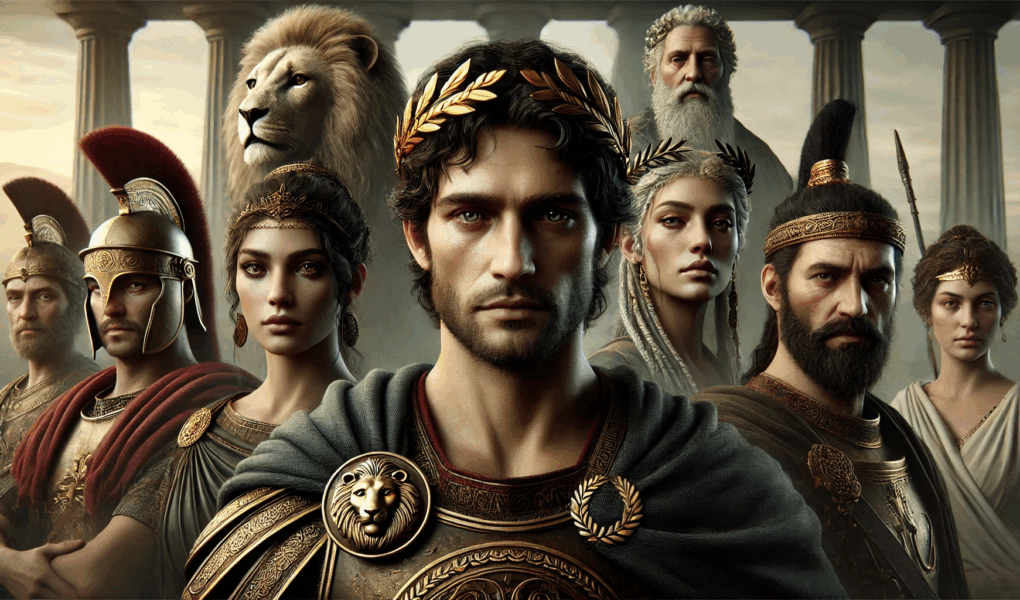
Philip II, Alexander the Great, and a seasoned Macedonian general stare forward with stark realism. Their expressions reveal ambition, discipline, and the scars of leadership—each man a pillar in the architecture of empire.

A young pastoralist girl, cradled by her father’s steady hand, looks toward the rising hope of a new world. In her eyes shimmer fear, awe, and the quiet promise of legacy.
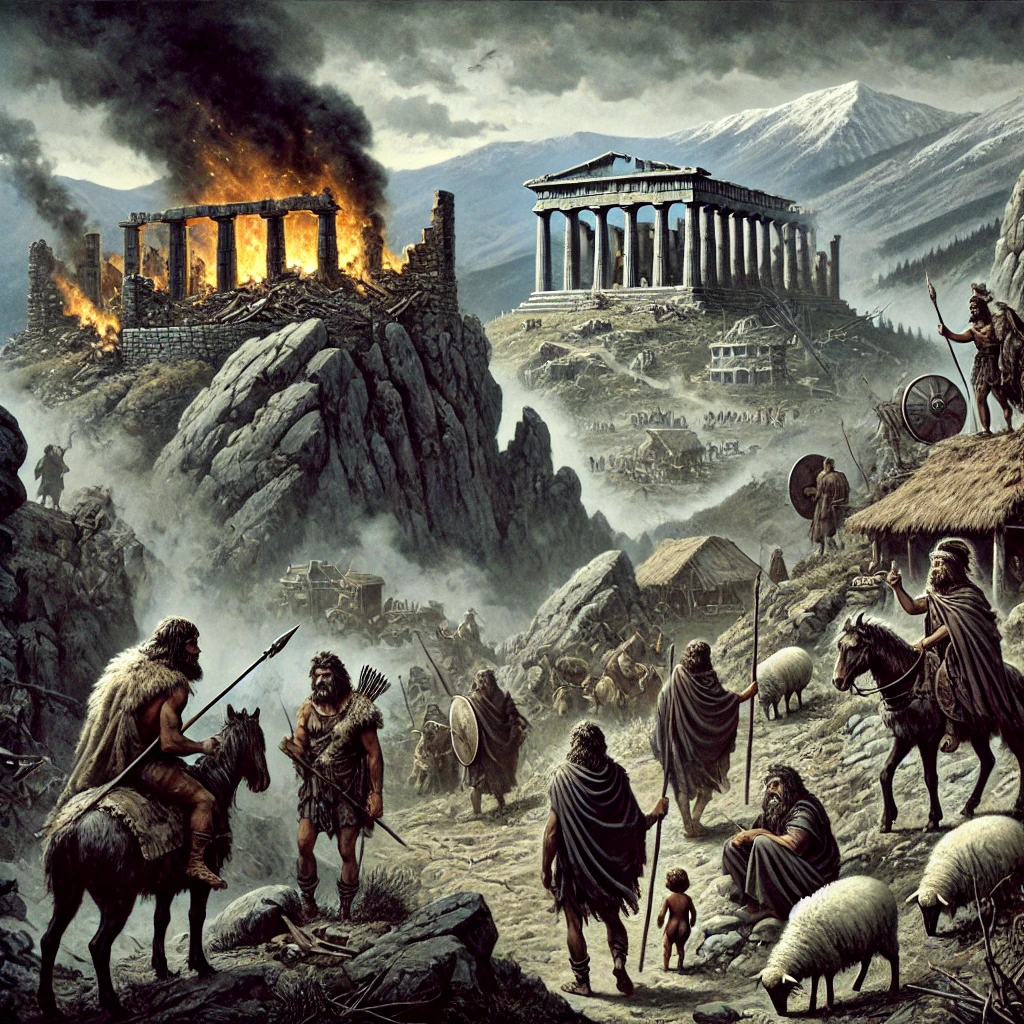
A panoramic fantasy depiction of a dying civilization and the chaotic rebirth that follows. Blackened temples crumble in the valley below while tribes gather high in the mountains—half-warrior, half-shepherd. Thunderclouds crack over a broken land. The atmosphere trembles with raw energy as destiny begins to take root in stone and blood.

A hardened Dorian chieftain stares through smoke and ruin. His gaze is steel, shadowed by pain and firelight—a man forged by chaos, with the soul of a kingdom yet unborn.
🏛️ PHILIP’S HOSTAGE YEARS AND MILITARY TRAINING

In a sunlit courtyard framed by Theban stone, young Philip trains under the legendary general. Military drills, tactical boards, and political mentorship unfold around him—a chrysalis of discipline forming the future king. Young Philip was training in Thebes under Epaminondas — strategy boards, military drills, and political tutoring.
Philip II, younger brother of King Perdiccas III, was held in Thebes as a diplomatic hostage. There, under the mentorship of General Epaminondas, he mastered Theban military strategy and diplomacy.

Philip’s youthful face reveals sharp focus and quiet ambition. His gaze lingers on the strategy board behind him—not just absorbing knowledge, but already reshaping it. A seed of future conquest awakens.
When Perdiccas died, Philip returned to Macedonia as regent for his nephew, Amyntas IV, but soon claimed the throne for himself.

Olympias of Epirus commands the frame with regal intensity, flanked by a noble Illyrian princess and a Macedonian queen. Their eyes speak of political alliances, royal burdens, and quiet influence behind the throne.
⚔️ REINVENTING WARFARE: PHALANX AND PIKE

Amidst the clang of forges and the glitter of Macedonian gold, Philip II reshapes his kingdom’s destiny. Phalanxes form, siege towers rise, and elite cavalry drill with precision—an empire being built, weapon by weapon.
Using gold from Macedonian mines, Philip bought influence and transformed the army. He introduced the phalanx formation armed with long sarissas (pikes), developed elite cavalry units, and used siege towers and catapults—technologies that made him unbeatable.
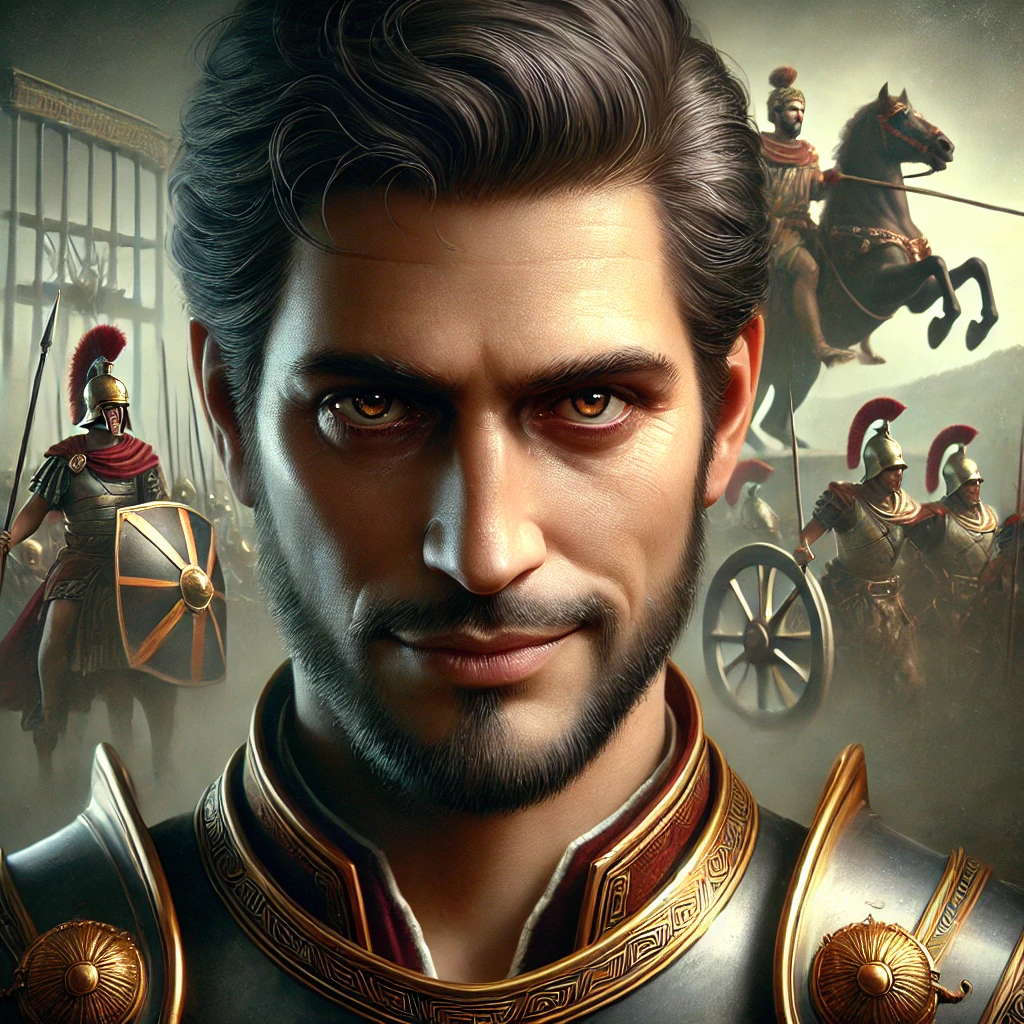
Philip’s gaze cuts through the battlefield with cold precision. Draped in gold-accented armor, he is the architect of victory—ruthless, brilliant, and utterly in control of the storm he commands.
🌍 CONQUESTS: THRACE, ILLYRIA, AND ALLIANCE MARRIAGES
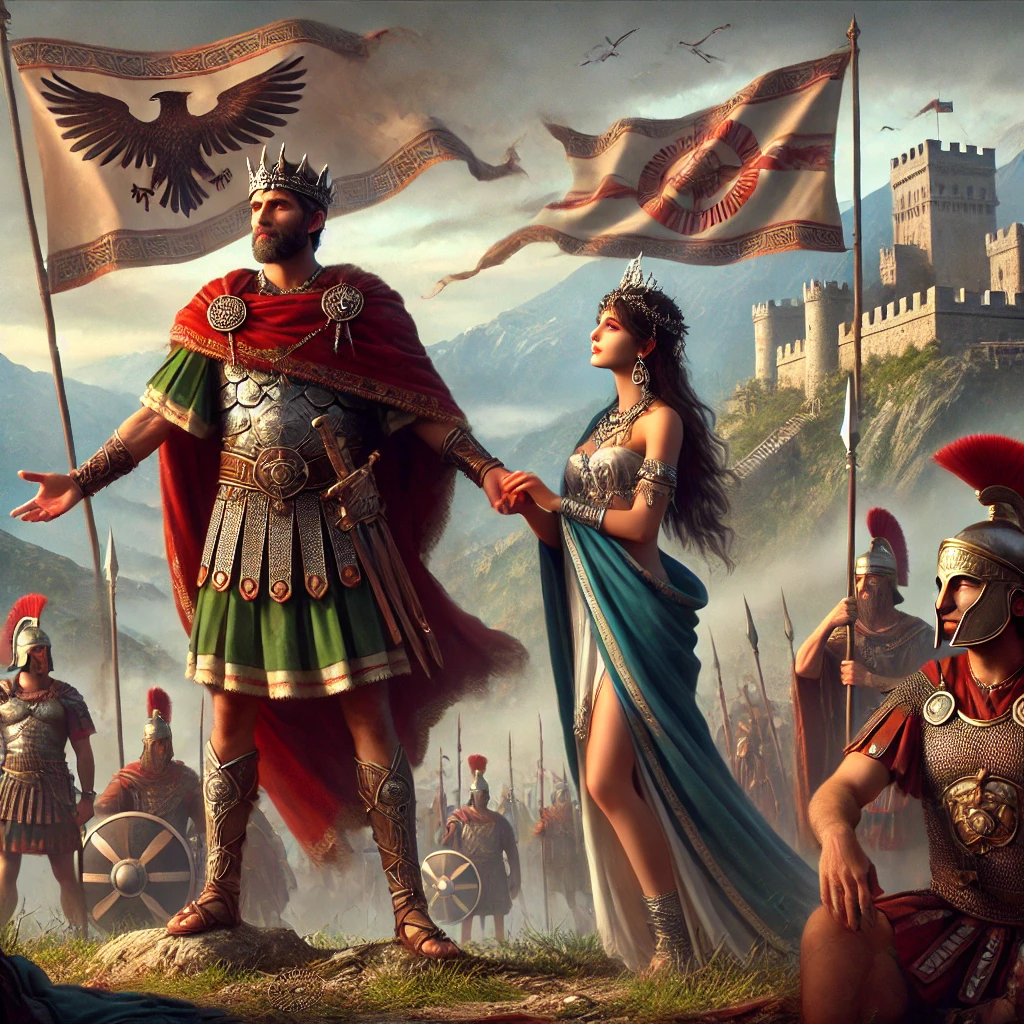
Philip stands triumphant over Thrace and Illyria, sealing his conquest not only with steel but with alliance marriages. An Illyrian princess takes his hand—diplomacy bound in royal blood, beneath a sky thick with ambition.
Philip conquered Thrace and Illyria, marrying an Illyrian princess for an alliance. Later, he wed Olympias of Epirus, who became his chief wife.
Their marriage soured as Philip descended into alcoholism. Olympias claimed that Zeus (the Greek persona of Anunnaki god Marduk) fathered her son, Alexander.

Philip and Olympias stand together, yet apart—his crown heavy with conquest, her gaze burning with divine fire. Behind them, lightning forks across a stormy sky, whispering of gods, destiny, and the child to come.

Alexander stands between his parents—Philip, distant and strategic; Olympias, resolute and present. Around them, noble faces watch history unfold, each bound to a legacy both human and imperial.
🏛️ PHILIP VS. ATHENS AND THE GREEK CITY-STATES
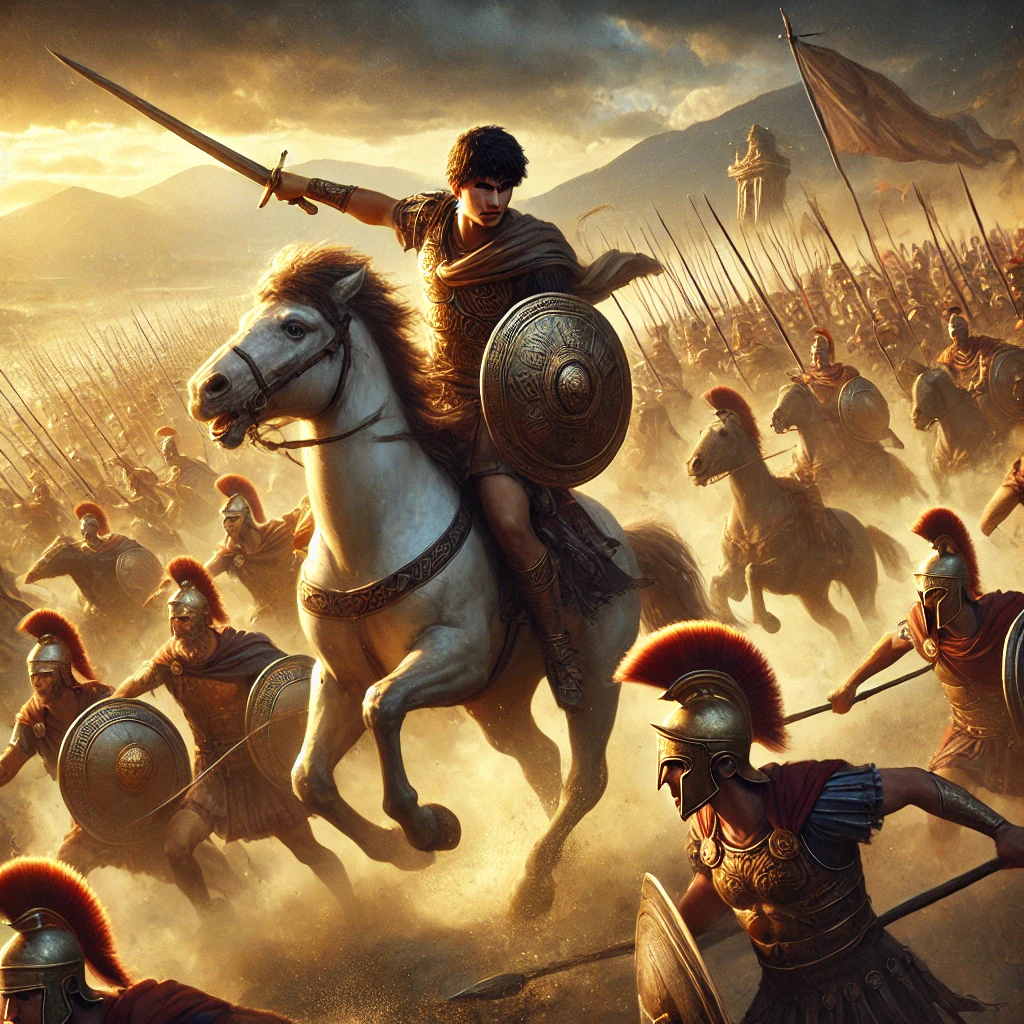
Under the blazing sun of 338 BCE, Philip’s phalanx drove forward like a bronze tide while young Alexander’s cavalry thundered from the flank. The Theban and Athenian lines shattered—Greece’s independence fell to the storm of Macedon.
In 357 BCE, Philip captured Antipolis, gaining control of key gold and silver mines. Though Athens declared war, it hesitated to act. During the Third Sacred War, Philip crushed Athens and Thebes at the decisive Battle of Chaeronea in 338 BCE, with Alexander’s cavalry leading a decisive flanking maneuver.

Dust clings to his skin, and fire dances in his eyes—Alexander, not yet twenty, leads the charge that will define his destiny. In this moment of fury and brilliance, the world begins to bend around his will. Battle of Chaeronea — Alexander leading the cavalry, Philip commanding the phalanx, Theban lines collapsing.

Amid gold, smoke, and prophecy, Philip stands before the sacred flame as priests of Apollo declare him a divine instrument. The banners of the League of Corinth ripple in the background—his path to Persia now sanctioned by the gods.
🏺 LEAGUE OF CORINTH AND THE PATH TO PERSIA
After his victory, Philip founded the League of Corinth, uniting most of the Greek city-states under Macedonian leadership. He planned to invade Persia and was elected Hegemon of the alliance.
Meanwhile, he continued campaigns in Thessaly and captured Pagasae, massacring thousands of Phocians who had looted the Oracle at Delphi, making him a divine agent of Apollo (Utu/Shamash).

Bathed in firelight, Philip’s gaze is reverent and resolute. Reflections of sacred symbols shimmer across his armor as Apollo’s priests invoke the will of heaven, marking him not just as conqueror, but as oracle-anointed Hegemon.

Three generations of power: Philip, Alexander, and a Macedonian general face the viewer head-on. Their eyes tell of conquest, burden, and the heavy clarity of rule. The image captures the masculinity of empire—measured, resolute, and honest.
⚰️ BETRAYAL AND ASSASSINATION

Philip stands radiant in gold, basking in celebration—yet just behind the torchlight, betrayal watches in silence. Olympias, veiled in shadow and intrigue, observes with regal detachment as history prepares to pivot.
In 336 BCE, Philip was murdered by his bodyguard, Pausanias of Orestis. Officially, it was a personal vendetta, but rumors swirled that Olympias plotted the assassination to prevent him from replacing her with Cleopatra, a pure Macedonian bride.
Alexander quickly took the throne. Olympias later had Cleopatra and her son executed, consolidating her son’s uncontested rule.

Philip’s eyes, lit by flame, betray the wear of rule and the calm before collapse. Pride flickers with fatigue—he is king, conqueror, and unaware that this celebration marks the edge of his reign.
🧬 LEGACY: ALEXANDER CLAIMED BY THE GODS

Bathed in divine glow and maternal shadow, young Alexander sits between myth and legacy. Olympias claims the favor of the gods, but it is Philip’s unseen foundation that steadies the throne beneath him. The empire begins—not just in blood, but in belief.
After Philip’s death, Olympias insisted that Zeus, not Philip, had fathered Alexander the Great. Through myth, warfare, and propaganda, Alexander’s divinity was cemented. But without Philip’s military, political, and economic groundwork, there would have been no empire to inherit.

Alexander sits at the center, young, composed, and already crowned by ambition. To his side, Olympias watches with calm intensity, the architect of his divine origin story. Behind them, the cold stone of Zeus looms—a silent symbol of destiny invoked, not proven. In this moment, power is not yet empire, but it has already chosen its heir.
🖼️ Image 8: Young Alexander seated between Olympias and a glowing statue of Zeus, shadows of destiny cast behind him.

Alexander sits at the center of power—his face calm, assured, and already marked by destiny. At his sides, Olympias and Philip II frame the tension between divine claim and worldly conquest. Around them, courtiers and commanders bear witness to a dynasty forged in blood, brilliance, and control.
🎥 WATCH THE VIDEOS
📽️ UNSTOPPABLE – The Rise of Macedonia Under Philip II
📽️ HEGEMON – Philip II of Macedon and His Conquest of Greece
📚 EXPLORE FURTHER
📘 More on the History of Greece
📕 MARDUK, ANUNNAKI, KING OF EARTH by Sasha Alex Lessin, Ph.D. & Janet Kira Lessin
📌 TAGS
Philip II, Macedon, Alexander the Great, Heracles, Gilgamesh, Marduk, Zeus, Anunnaki, Greek history, Thebes, Athens, Olympias, Chaeronea, League of Corinth, Apollo, Delphi, ancient military tactics, assassination
📣 SOCIAL MEDIA DESCRIPTIONS
Facebook:
Discover how Philip II of Macedon rose from hostage to hegemon, uniting Greece with brilliant military reforms and divine ambition. Watch the videos and explore the hidden history linking Heracles to Gilgamesh and Alexander the Great to the gods.
X (Twitter):
Philip II of Macedon: hostage turned hegemon. Uniting Greece with gold, pikes, and prophecy, his legacy paved the way for Alexander the Great.⚔️🇬🇷 #AncientGreece #PhilipII #AlexanderTheGreat
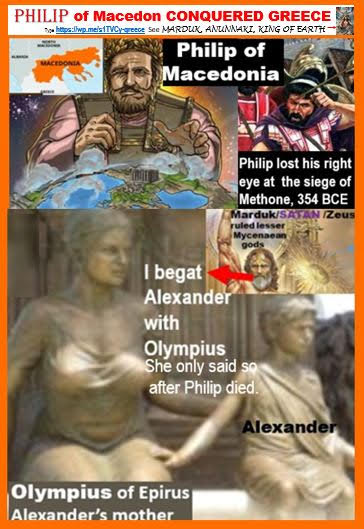
PHILIP of Macedon CONQUERED GREECE.
PHILIP of Macedon CONQUERED GREECE.
https://www.youtube.com/watch?v=i8JjZH043mA
This is a VIDEO; click the word “HEGEMON” to start the video.
PHILIP of Macedon CONQUERED GREECE
Click https://wp.me/s1TVCy-greece for more of the history of Greece.
Watch the 2 videos on Philip, posted below this post; they’ll deepen your understanding.
See MARDUK, ANUNNAKI, KING OF EARTH by Sasha Alex Lessin, Ph.D. (Anthropology, UCLA) & Janet Kira Lessin (CEO, Aquarian Media)

Olympias commands the frame, joined by noblewomen of Illyria and Macedon. They do not stand behind kings—they shape them. Their gaze is direct, their presence unyielding, as legacy begins in quiet rooms long before it reaches the battlefield.
After the late Bronze Age Collapse of Mediterranean Civilization, DORIANS–Aryans, probably of Phoenician Origin–invaded the Macedonian highlands and, with the semi-nomadic pastoralists (who may have been another tribe of Dorians who roamed the area), became the village-dwelling, hard-drinking, wild-partying hunters who settled MACEDON.
GREEK HERACLES = SUMERIAN GILGAMESH
Macedonians claimed DESCENT FROM HERACLES, the Greek conflation of the Sumerian/Anunnaki King Gilgamesh of Uruk [Iraq]. Greeks considered Heracles to be the son of Zeus, the persona of Anunnaki Prince Marduk.
PAUSANAS ruled Macedonia, his younger brother, PHILIP, lived for three years as a hostage guest in Thebes.
In Thebes, General EPAMINONDAS taught Philip Theban military tactics & diplomacy.
When Philip’s brother, King PERDICCAS III, who ruled Macedon, died, Philip returned to Macedon as Regent for his young nephew AMYNTAS IV. Philip then took the Macedonian Crown for himself.
Philip used GOLD from the Macedonian mines to buy influence & enlarge Macedonia.

Philip II surveys a sprawling training ground where sarissas rise like a bronze forest. Beneath the golden sky, formations tighten, siege machines stand ready, and cavalry drills in perfect arcs—a vision of warfare reshaped by discipline and gold.
He also used ELONGATED PIKES to check cavalry charges & ADVANCED CAVALRY TACTICS to attain power over the Greek city-states. Philip developed phalanxes with longer pikes than other Greeks utilized, as well as towers and arrow-shooting CATAPULTS to besiege fortifications.
PHILIP TOOK THRACE AND ILYRIA

In quiet command, Philip grips a map and studies his troops. His gaze is intense but measured, seeing not just soldiers, but the future engine of conquest taking shape under his hand.
With the best military in Greece, Philip subjugated the Thracians and Illyrians on Macedonia’s northern border in the Balkans, along the Adriatic Sea and its hinterland. Philip’s army beat Illyria’s, then he married an Illyrian princess to secure the alliance.
ZEUS BEGAT ALEXANDER WITH KING PHILIP’S WIFE OLYMPIAS
Philip took a second wife, Olymipias, from the nearby kingdom of Eperis and made her head wife of his seven wives.
Philip’s alcoholism disgusted Olympias. She took Marduk, in his Greek persona as Zeus, as her lover.
In 357 BCE, Philip conquered the Greek city of ANTIPOLIS in the northern Aegean. Control of Antipolis gave him access to the area’s rich gold and silver.
Athens declared war on Macedon but did not attack.

Alexander sits centered, calm, and confident. On either side, Olympias and Philip II gaze outward, their eyes locked with history’s audience. Around them, the court looks on—no myth, no prophecy, only inheritance and power staring back.
In Greece’s Third Sacred War (353 BCE), PHILIP DEFEATED ATHENS & THEBES IN THE BATTLE OF CHAERONEA (338 BCE).
Philip had ARISTOTLE tutor his legal son [but maybe not biological son] and Heir, Alexander.
PHILIP DEFEATED ATHENS & THEBES AT CHAERONE in 338. At Chaerone, Alexander and Alexander’s cavalry surrounded & massacred the Thebans who refused to surrender.
Philip founded THE LEAGUE OF CORINTH. The League elected him Heir & commander for the League’s plan to invade Persia.
Philip released his Athenian prisoners & controlled most of Greece.
Philip besieged BYZANTIUM.
In 347 BCE, the Anunnaki Prince Utu/Shamash, in his Greek persona as APOLLO, and Philip, Apollo’s agent, captured PAGASAE and, at the BATTLE OF CROCUS FIELD. Philip killed 6,000 Phocians & drowned 3,000 prisoners. The Phocians had captured the Oracle at Delphi and used Delphi’s massive gold to finance recurrent challenges to Philip’s forces and continued fighting for several years.
The THESSALIAN LEAGUE elected Philip as its Archon and claimed Magnesia & Perrhaebia.
In 348, he conquered & burned OLYTHUS, dissolved the Chalcidian League, celebrated the Olympic Games, conquered THERMOPYLAE, made peace with Athens & brought most of the Greek city-states under his and Macedonia’s control.
Philip’s BODYGUARD KILLED HIM
Pausanias of Orestis, Philip’s bodyguard, killed him. The spin Alexander gave was that Pausanias killed King Philip over a perceived insult. Still, some suggested Olympius had Philip killed because he was about to marry a pure Macedonian woman named Cleopatra to displace her as his top wife.
Leonnatus, Perdiccas, and Attalus, Philip’s other bodyguards, chased Pausanias. Pausanias tripped while fleeing, so the bodyguards caught and killed him.
After Philip died, Olimpius said Zeus, not Philip, had impregnated her with Alexander.
Olympius killed Cleopatra’s son & Cleopatra, Philip’s intended replacement for Olympius as head wife, killed herself.

Alexander sits at the center, young, composed, and already crowned by ambition. To his left, Olympias watches with calm intensity, the architect of his divine origin story. Behind them, the cold stone of Zeus looms—a silent symbol of destiny invoked, not proven. In this moment, power is not yet empire, but it has already chosen its heir.
Alexander took Macedonia’s throne.
Attachments area
Preview YouTube video The Unstoppable Rise of Macedonia Under Philip II


Preview YouTube video Philip II, Hegemon of Ancient Greece & Macedon


