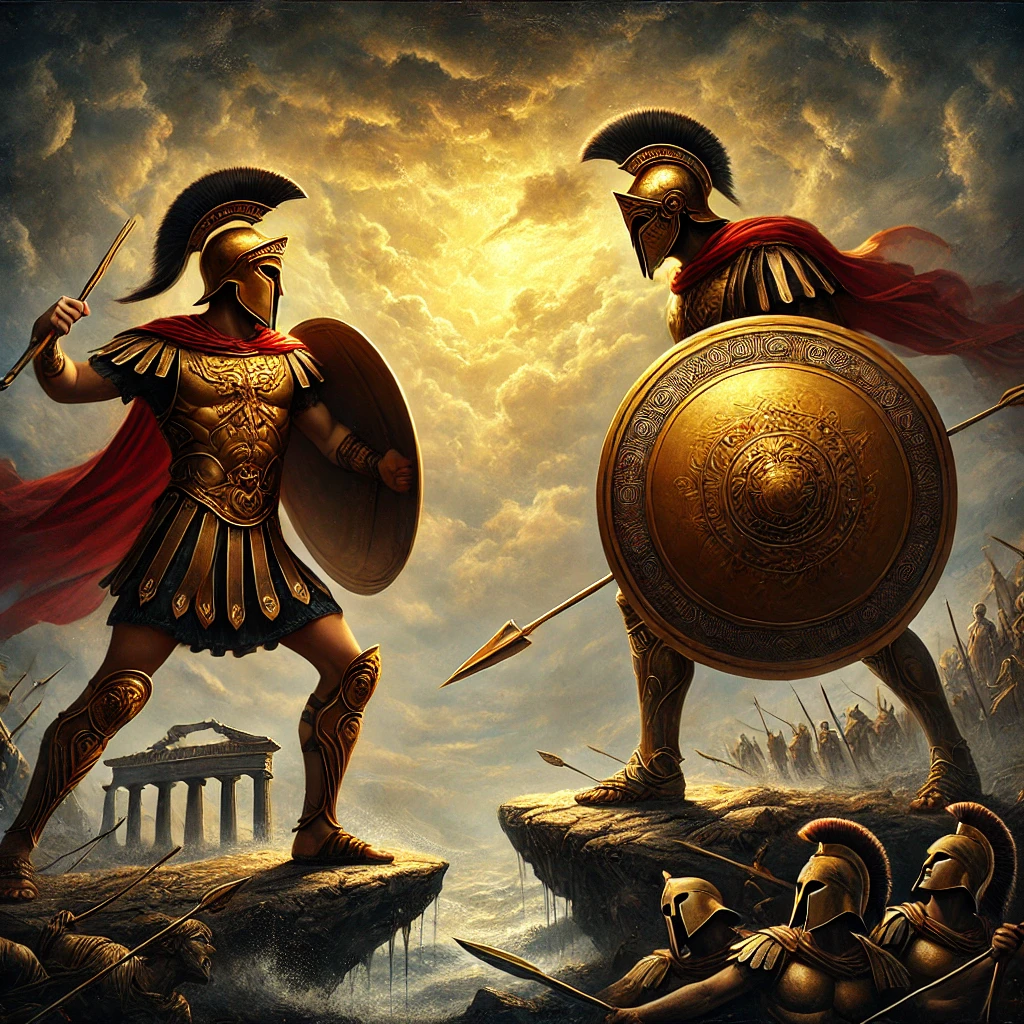
Beneath a storm-lit sky, two legendary figures stand poised on fractured cliffs, their eyes locked in timeless defiance. Achilles, draped in gleaming bronze and crimson, radiates raw power and unshakable purpose. Paris, clad in ornate Trojan armor, raises his bow with solemn resolve. Between them, the air shimmers with divine tension—an echo of Olympus watching below. In the distance, broken columns and ancient ruins whisper of the war that rages around them. This image captures the mythic gravity of destiny intersecting with mortal will in the final moments before history is written.
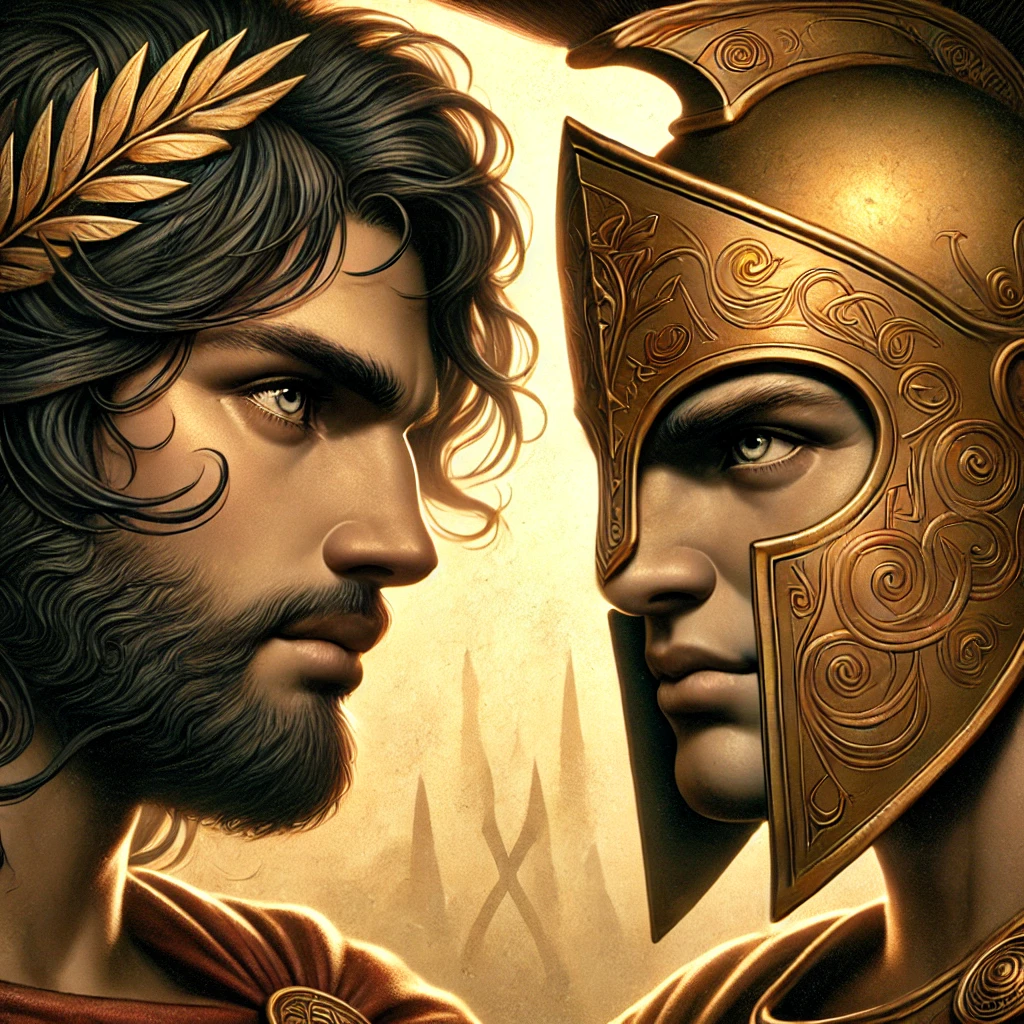
A close-up portrayal of Achilles and Paris moments before their legendary clash. Achilles, with sun-kissed hair and steely eyes, wears a battle-worn bronze helmet pushed back to reveal the ferocity and pride of the Greek champion. Opposite him, Paris stands calm and elegant, his long dark hair crowned with a golden band, his gaze steady and burdened with fate. Between them hangs the silent weight of destiny. The image captures the surreal stillness before the storm, rendered in a style blending classical realism with the dreamlike hues of myth.
Paris’ Perplexities: Comprehensive Review (Paris, Video 3).
https://www.youtube.com/watch?v=R6zaIFXXQGs
APOLLO/UTU GUIDED PHILOCTETES TO KILL PARIS.
https://youtu.be/m-n0j0D9QDE?si=cSVTSfFSWOZskAvK
WAS PARIS A PATRIOT OR JUST A PROPAGANDA PATSY LIKE OSWALD? (Paris, Video 3).
Coward or Hero? The Story of Paris – The CULPRIT of the Trojan War – Greek Mythology

A solitary archer stands at the cliff’s edge, cloak rippling in the wind as the golden light of a setting sun casts long shadows over the ancient stones. With a bow across his back and the sea stretching endlessly before him, he seems more monument than man—an eternal watcher caught between past and future. Olive trees twist in the breeze, and the broken columns behind him speak of a lost world. This mythic scene captures the quiet dignity of a hero who endures not for glory, but because he must.
Coward or Hero? The Story of Paris – The CULPRIT of the Trojan War – Gre… |
PARIS’ TROJAN ARROW KILLED ACHILLES; PHILOCETES’ GREEK ARROW KILLED PARIS: Discussion by Sasha Alex Lessin, & 3 Videos by See U in History
ALAS, ACHILLES: Hero’s Heel Hindered Helen’s Homecoming to Hellas, but was Paris the real heel?
By Sasha Alex Lessin, co-author (with Janet Kira Lessin) of ANUNNAKI, EVOLUTION OF THE GODS
Check out all 3 VIDEOS posted below this post. The videos all deal with Troy’s Prince Paris.

In the shadow of Troy’s towering walls, Queen Hecuba solemnly hands her infant son to a servant. Her royal bearing cannot mask the sorrow etched in her face. The landscape is quiet, the forest ahead both refuge and exile. Above them, the sky broods with the weight of prophecy. This moment captures a mother’s anguish, a king’s dread, and a city’s attempt to outmaneuver fate, only to set it in motion.
Paris, a prince of Troy, is famous in Greek mythology for his role in starting the Trojan War. The son of King Priam and Queen Hecuba, he was abandoned at birth due to a prophecy, but he survived and grew up as a shepherd.

Bathed in twilight, a child wrapped in fine linen is carried toward the wilderness while the golden city of Troy glows in the distance. Queen Hecuba turns away, her face a mask of grief and resolve. The forest awaits, still and ancient, as if it too knows this child will return to spark ruin. This image evokes the tragic irony of trying to prevent fate, only to fulfill it.
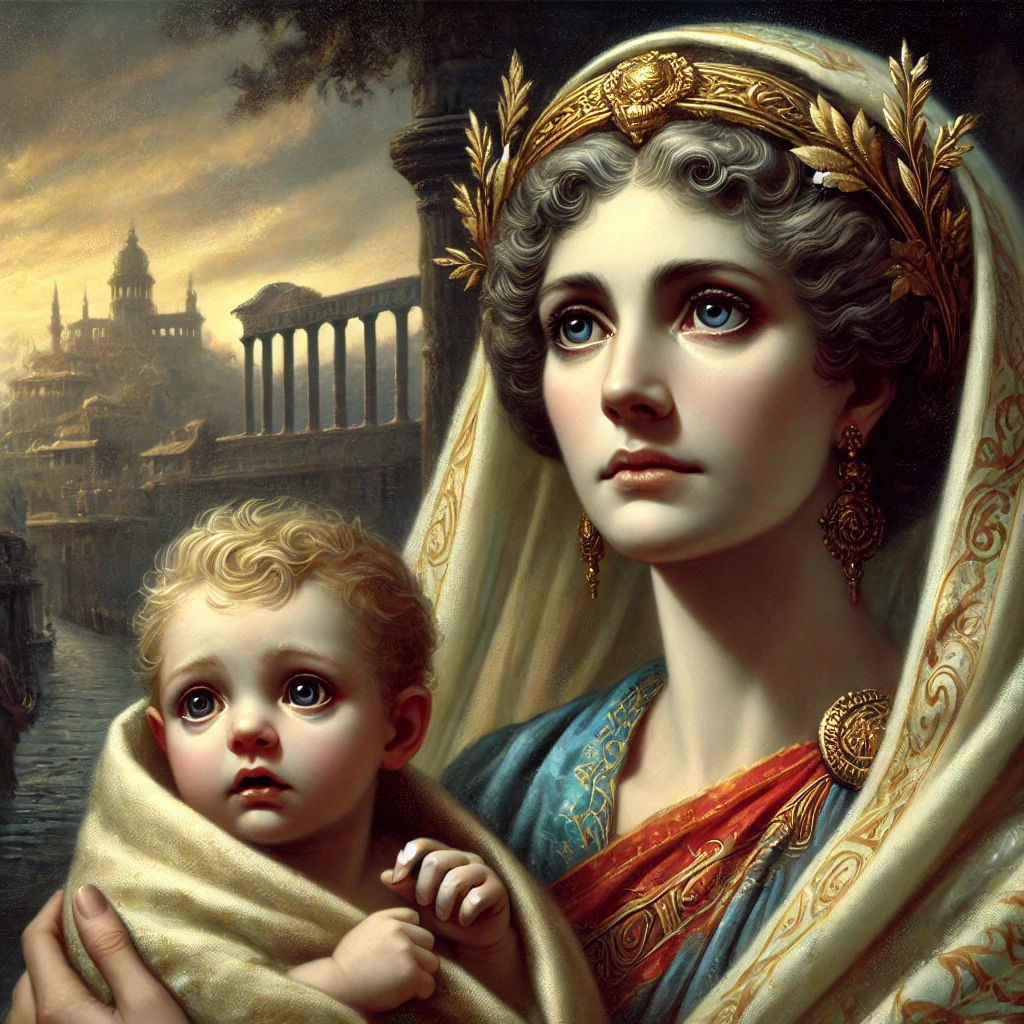
Queen Hecuba cradles her newborn son close, her royal bearing shadowed by sorrow. Her eyes linger on Paris’s innocent face—so small, yet burdened with prophecy. Wrapped in noble cloth, the child gazes upward, unaware of the fate he carries. Behind them, the blurred towers of Troy loom under a darkening sky, echoing a choice no mother should ever face. This portrait evokes timeless grief beneath the veil of power.
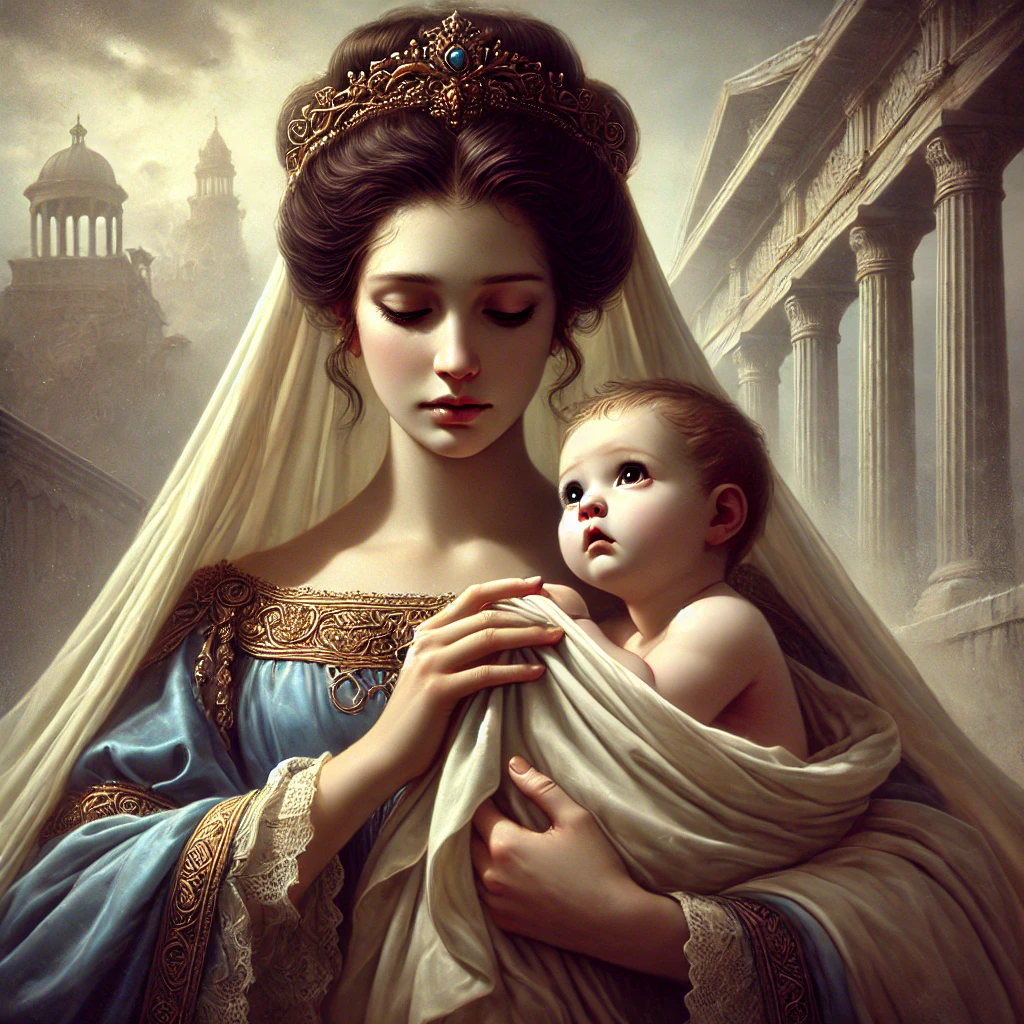
The camera draws close to mother and child, isolating a quiet moment heavy with myth. Hecuba’s regal features are softened by anguish, her hands gently supporting the fragile form of Troy’s future. Baby Paris’s wide, searching eyes meet hers, still untouched by the world’s judgment. This image tells a story of love tangled with destiny, a tender glance before history is unmade.
Chosen to judge the beauty between Hera, Athena, and Aphrodite, he chose Aphrodite, who promised him the love of Helen, wife of Sparta’s King Menelaus. Paris either took or eloped with her.
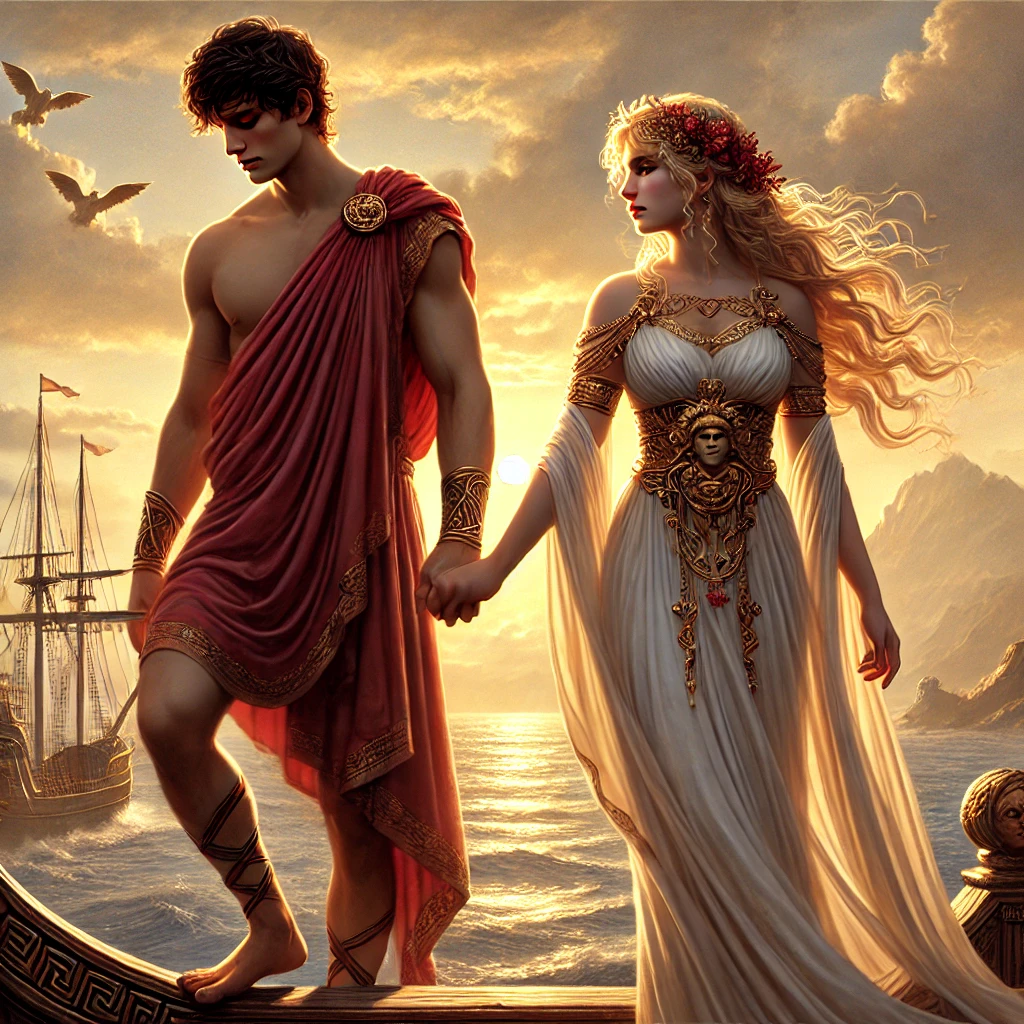
At the edge of destiny, Paris clasps Helen’s hand as golden light shimmers across the sea. She gazes back toward the distant land she leaves behind, while Paris looks forward, confident, enchanted. Their union is gentle yet fated, born not just of passion, but of a divine promise made by Aphrodite. The image glows with beauty and tension, capturing the calm before ten years of war.
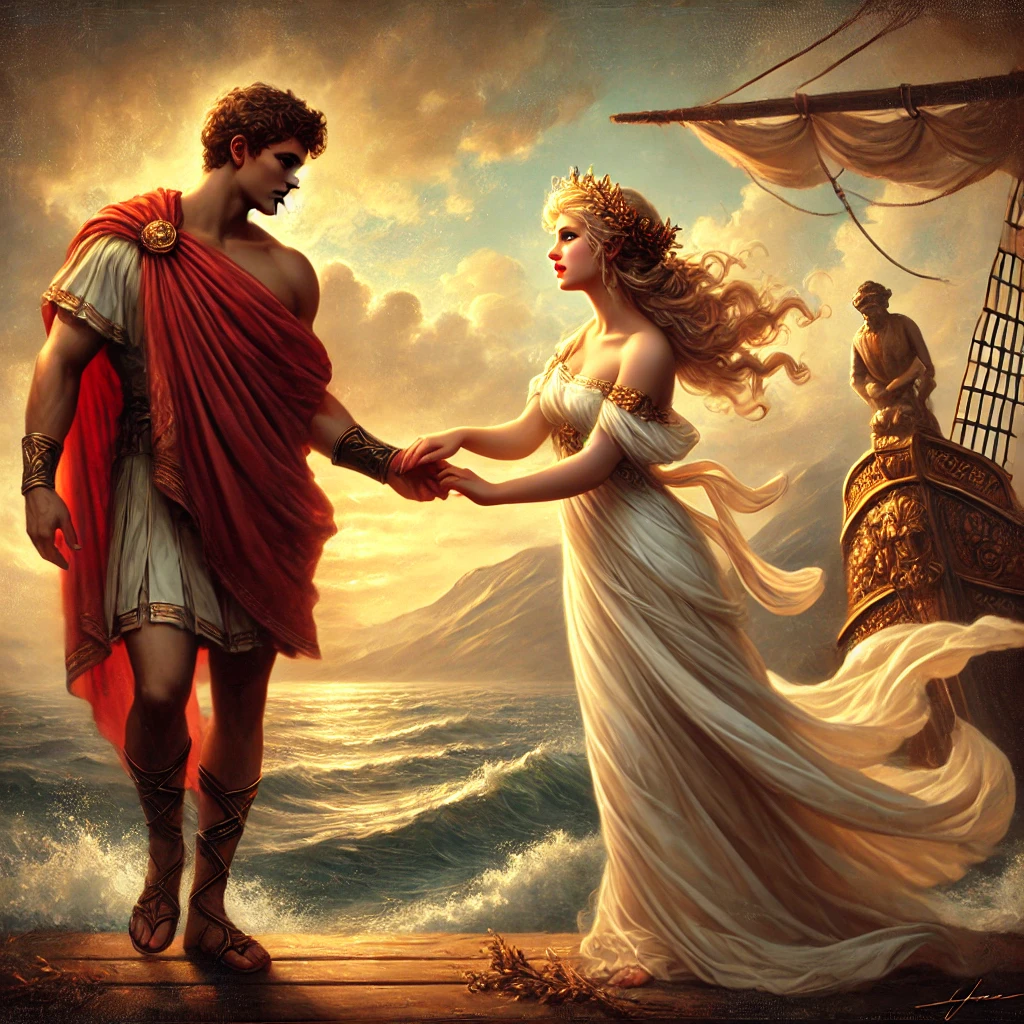
With robes fluttering in the sea breeze, Helen and Paris stand together on a rocky shore near a waiting ship. The sunset paints their silhouettes in gold, while the wind seems to whisper of Sparta’s wrath and Troy’s ruin. Helen’s face holds hesitation; Paris, boldness. This moment is myth incarnate: the price of beauty, the cost of choice, and the birth of a war.
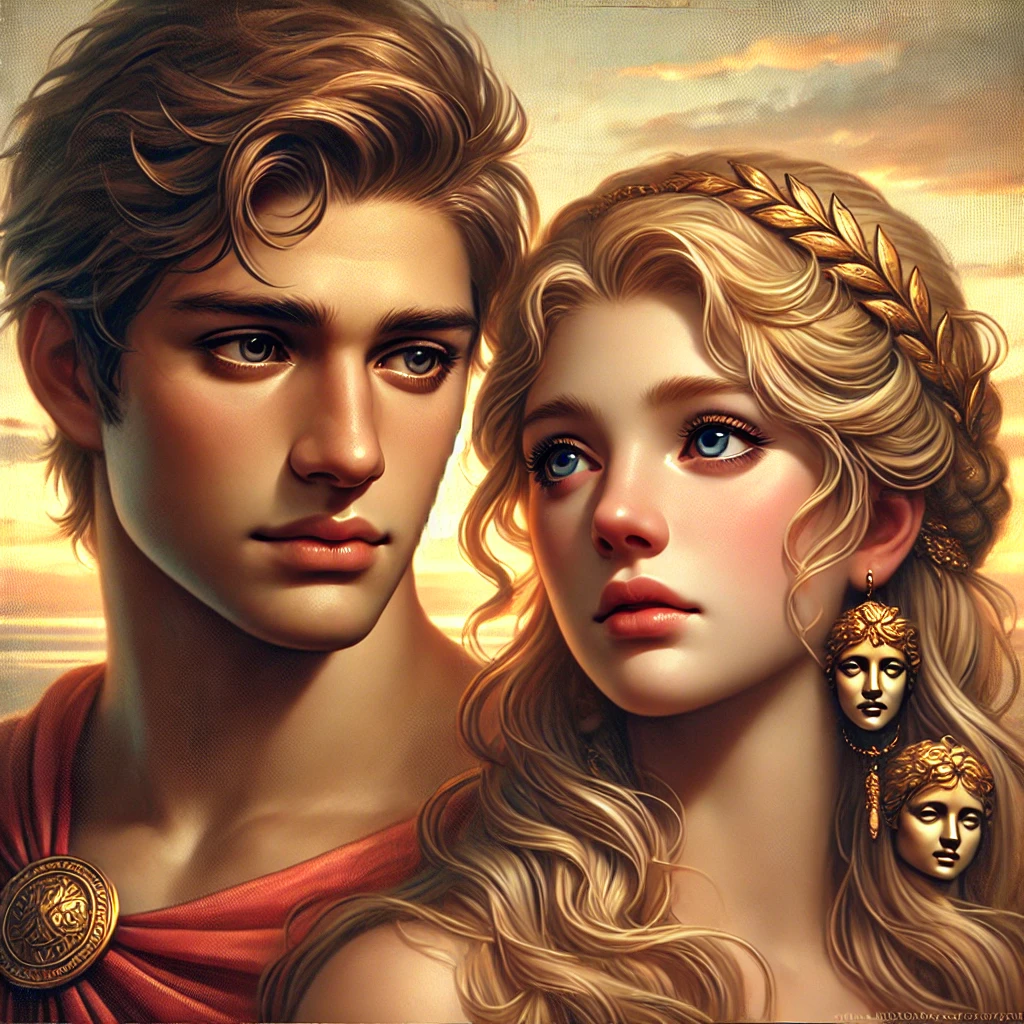
Their faces meet in a moment of stillness—Paris, bold and unwavering; Helen, luminous and torn. Between them is the golden glow of dusk, yet behind their gaze, the firelight of war already flickers. His hand hovers near hers, as if offering a world she is not sure she should take. This image distills passion, prophecy, and peril into a single breath shared by two who would reshape history.
After almost 10 years of fighting, Greeks and Trojans agreed to a battle between Menelaus and Paris. The winner would take Helen home, and the war would be over.
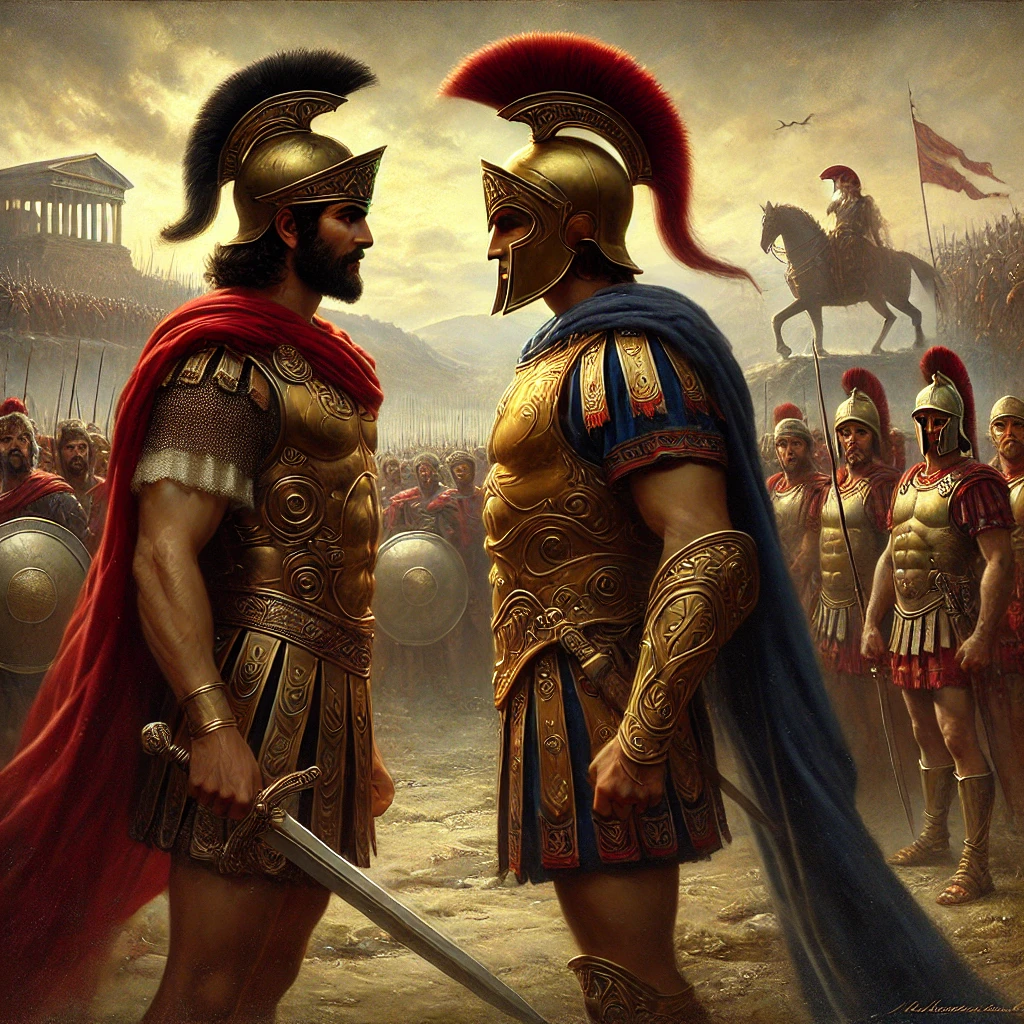
Menelaus and Paris stand face-to-face on the battlefield, bronze and gold glinting beneath a darkening sky. Greek and Trojan armies watch in breathless silence as the two men prepare to fight for the fate of Helen—and the war itself. Menelaus grips his sword with fury; Paris’s gaze flickers with pride and doubt. On the distant battlements, Helen watches, cloaked in sorrow, caught between past and future.
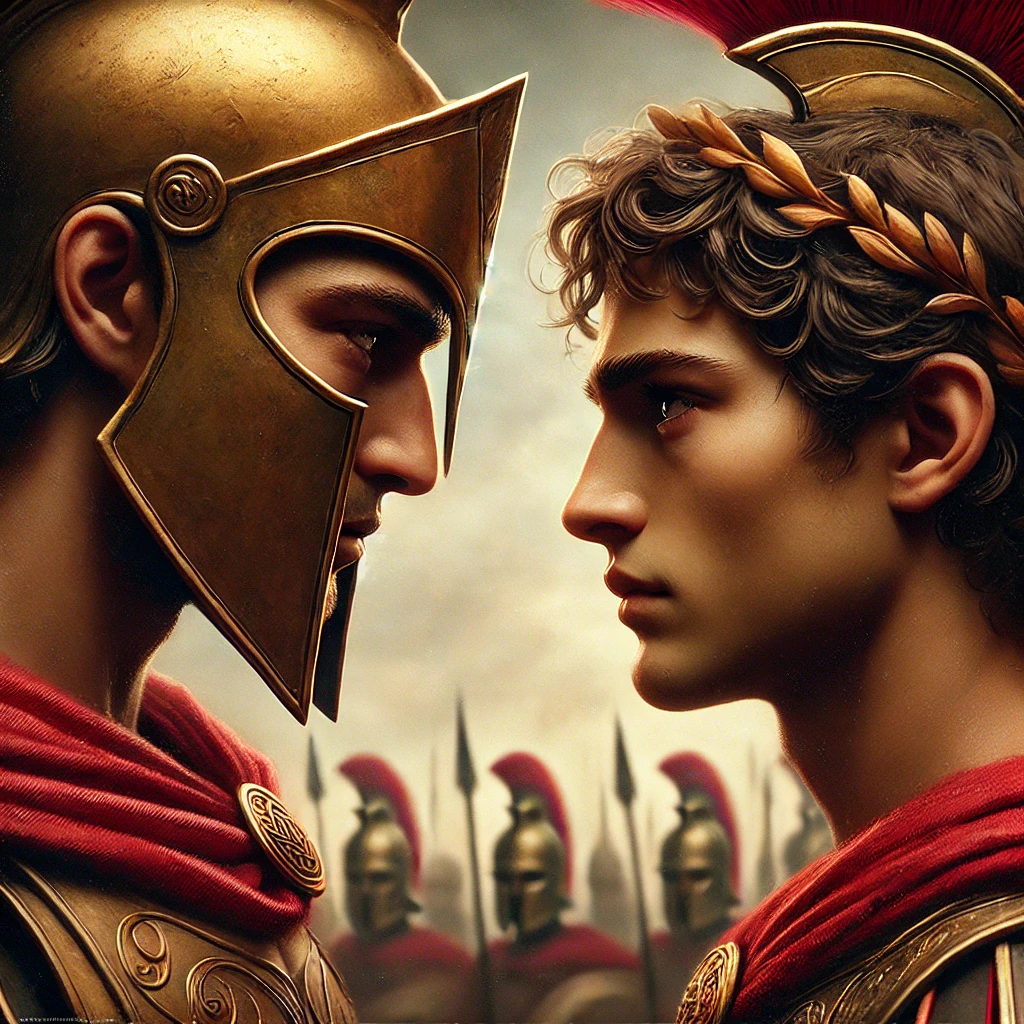
Eye to eye on the battlefield, Menelaus and Paris share no words—only resolve and resentment. One bears the fury of betrayal, the other the burden of divine promise. Their armor gleams in the golden light, but it is their faces—aged by war and love—that speak most. This is the breath held before history inhales.
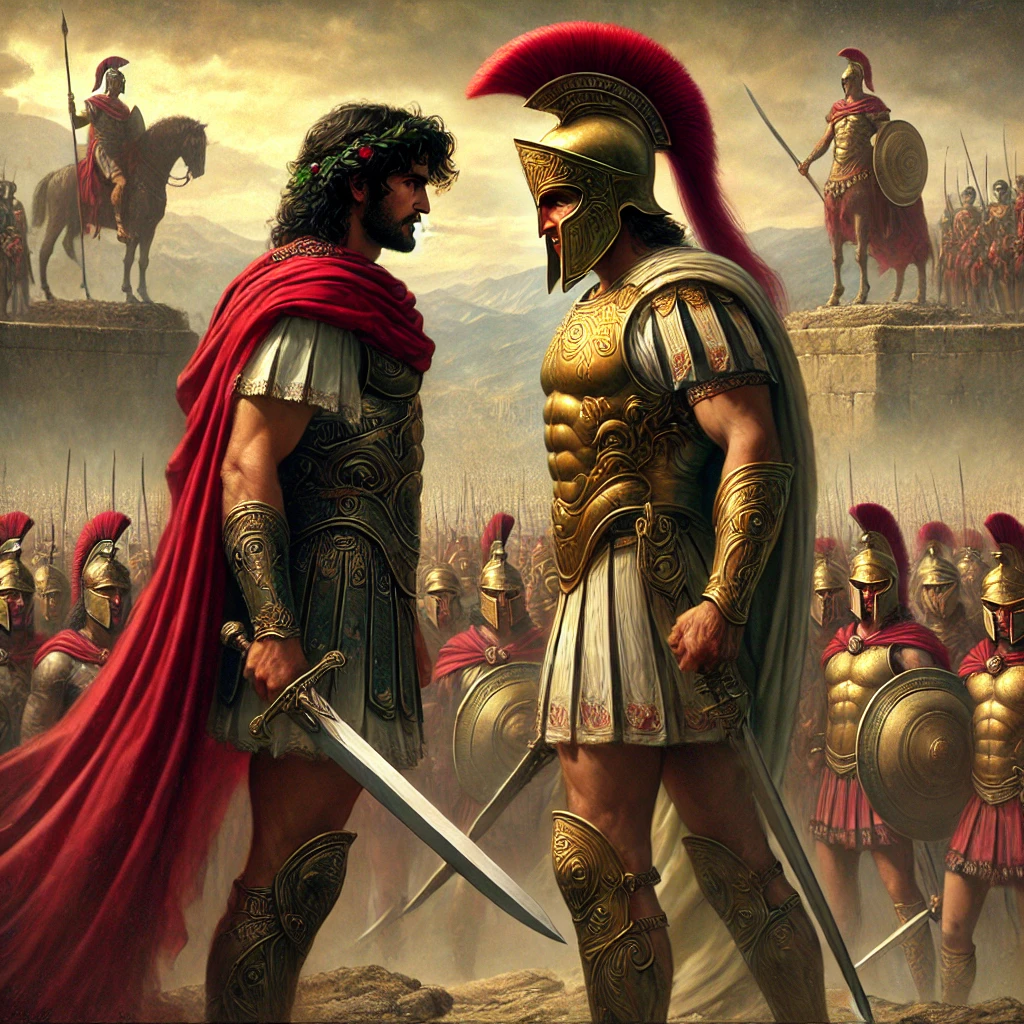
As spears rest and shields lower across the war-scarred plain, the kings of Sparta and Troy’s love stand opposed. Menelaus, grim with resolve, burns to reclaim his honor. Paris, clad in ceremonial armor, bears the weight of love and divine favor. The battlefield hushes. Helen, seen faintly atop Troy’s wall, is both prize and prisoner. This image freezes the myth at the very edge of fate—a final duel, a final chance for peace.
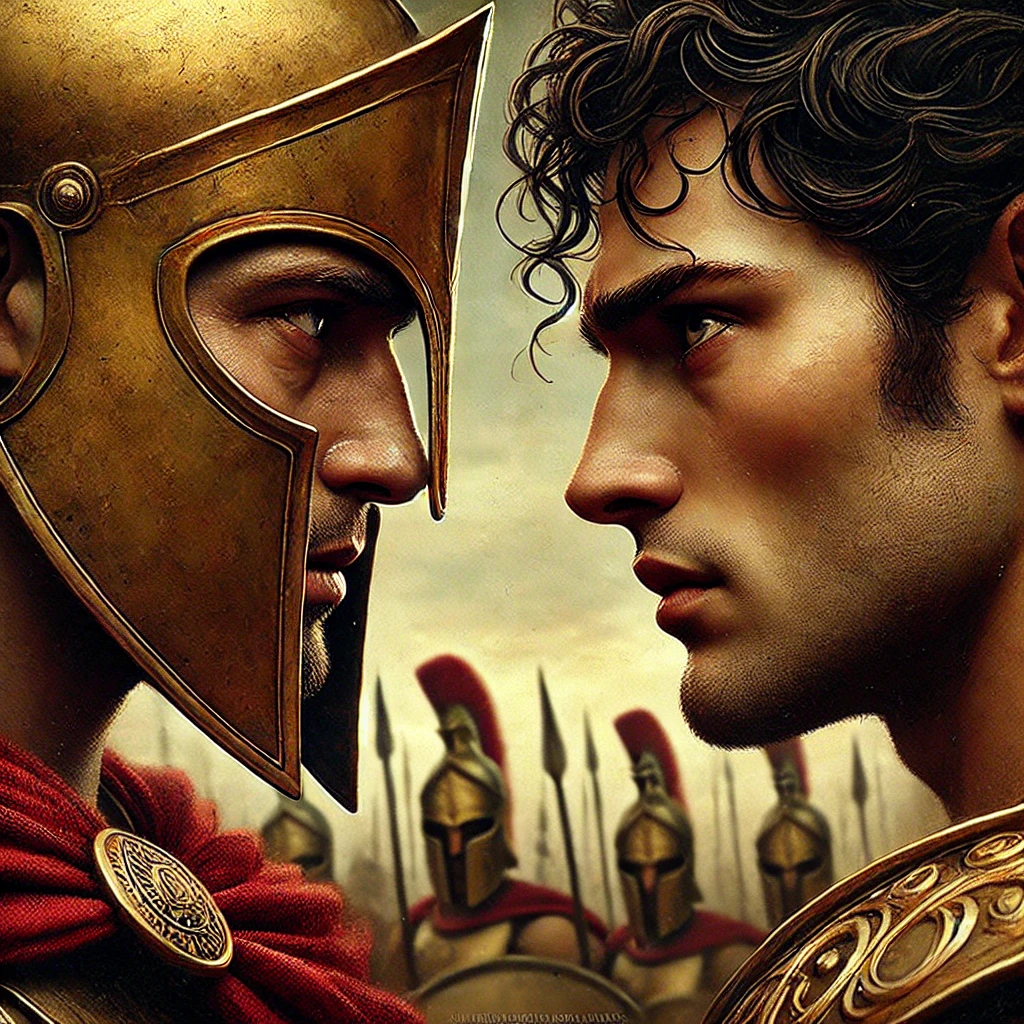
Steel meets silence as the Spartan king and Trojan prince face each other. Menelaus is carved from war; Paris, from fate. Between them stands no one, yet the entire war leans into their breath. Every soldier watches, but only one pair of eyes truly matters—the ones waiting behind Troy’s walls.
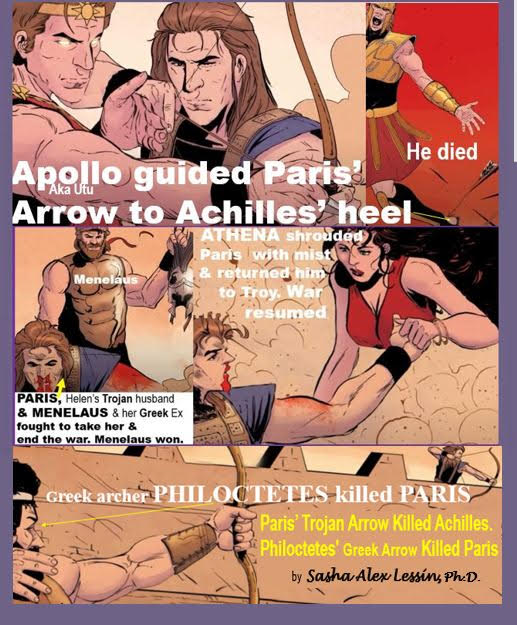
Paris, assisted by Apollo (also known as Utu or Shamash), killed the Greek hero Achilles.
GREEK ARCHER PHILOCTETES KILLED PARIS
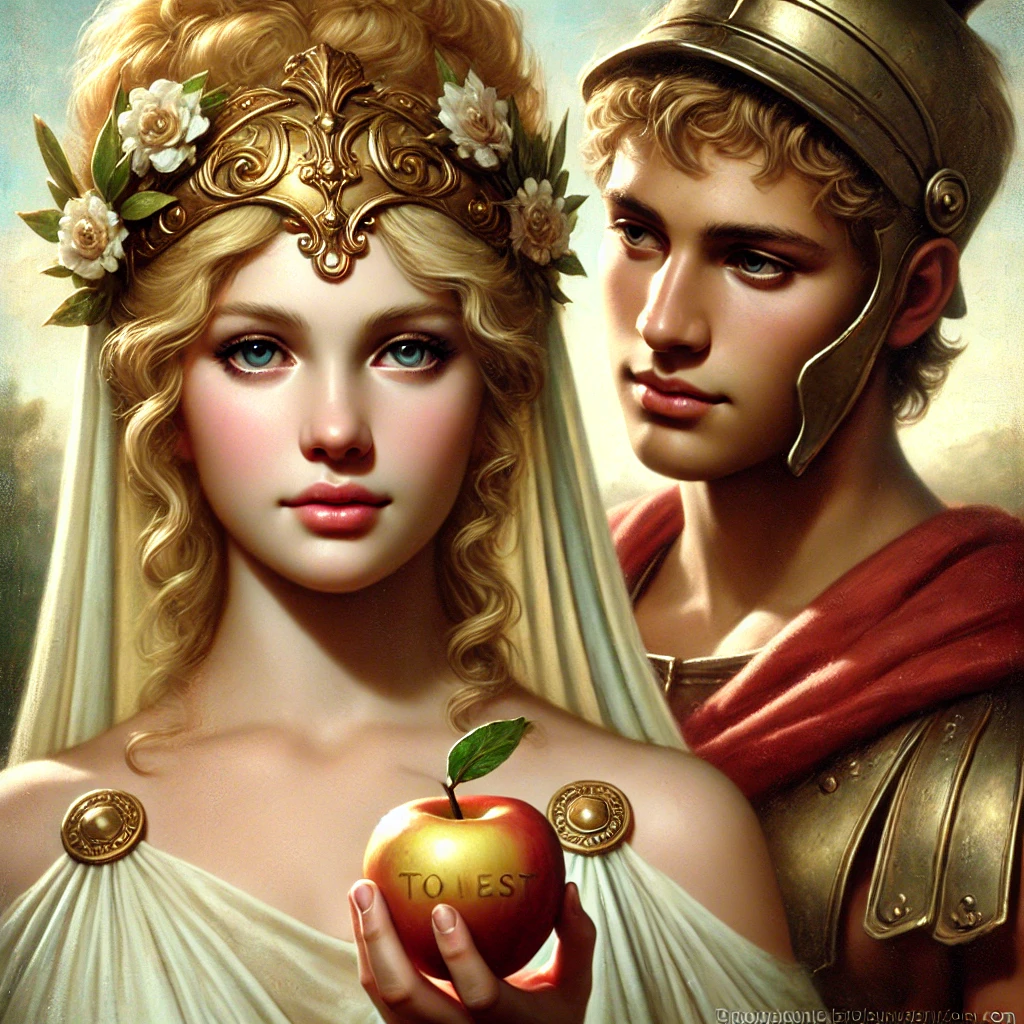
Aphrodite, radiant and assured, stands close to Paris, her expression calm yet captivating. Paris, youthful and caught in thought, clutches the golden apple—his choice already echoing into history. The soft glow and mythic ambiance reflect a quiet moment suspended between seduction and consequence. It is beauty with a cost, and love that carries the seeds of ruin.
On the way to Troy, a poisonous snake had bitten the archer Philoctetes. The wound festered. It made a horrible stench. Greeks in the tightly sailing ships of their armada couldn’t tolerate his cries of pain. Odysseus ordered his men, ‘Leave Philoctetes on Lemnos.’
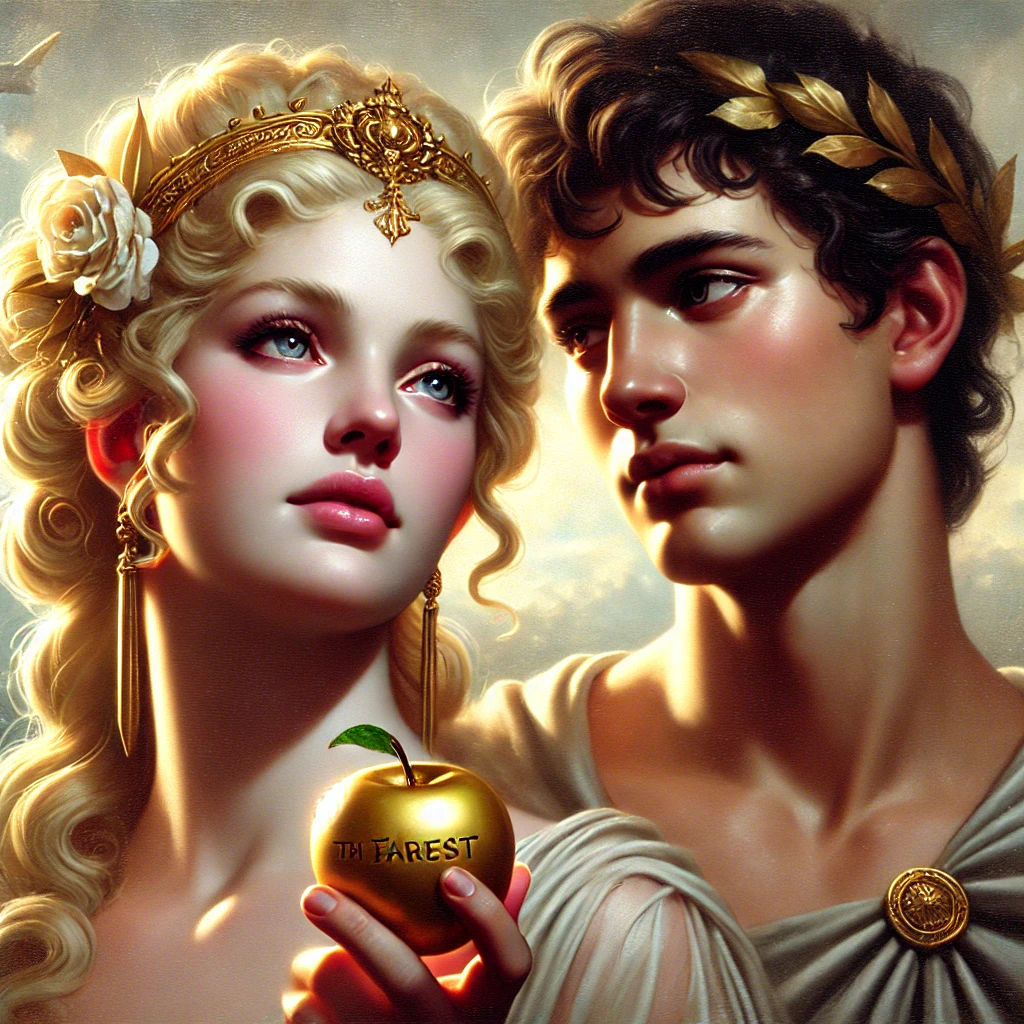
With Aphrodite by his side, Paris appears entranced—her charm as much divine promise as mortal temptation. The golden apple gleams in his grasp, inscribed and irrevocable. In this close-up, the gods seem near, yet silent, as the moment of decision becomes myth. This portrait evokes the gentle gravity of fate spoken not in thunder, but in a glance.
Ten years into the Trojan War, the seer Helenus said Troy couldn’t fall without Philoctetes manning Heracles’ bow and arrows. Philoctetes, helped by Apollo (aka Utu/Shamash), shot Paris to avenge Achilles, whom Paris had killed with a poisonous arrow he shot into Achilles’s heel.
Achilles’ heel was his weak spot, because his mother had held him by his left heel when she dipped him in the River Styx, whose waters protected the babe from all harm. Styx’s waters did not touch Achilles’ left heel when she immersed him.

Beneath a veiled sky and beside the shadowed waters of the underworld, Thetis holds her infant son, Achilles, by his left heel—his sole point of mortal vulnerability. As she lowers him into the glowing river, the waters of the Styx ripple with divine magic, casting light across her flowing robes and the child’s flawless skin. The scene breathes myth and destiny, capturing the sacred act that would forge a nearly invincible warrior while leaving a single, fatal flaw untouched by the gods.

Bathed in the mists of legend, Thetis cradles her infant son Achilles close, her serene gaze filled with quiet foresight and maternal warmth. The child, calm and luminous, gazes back with wide, peaceful eyes—unaware of the fate that already clings to his heel. The setting, softened by the magic of the River Styx, evokes the stillness of a moment before myth is sealed. Rendered in classical realism, this intimate portrait captures the divine made human and the love that shapes legends.

Amid swirling mists and moonlit riverbanks, the goddess Thetis performs the ancient rite to shield her son from harm. Achilles, bathed in supernatural light, descends into the waters of the Styx—except for the small heel grasped by his mother’s hand. The contrast between a divine glow and a mortal touch creates a haunting beauty, encapsulating the delicate boundary between invincibility and doom. This image reflects the quiet tragedy hidden within even the greatest of blessings.

In a tender embrace beneath the shadowed glimmer of a sacred river, Thetis holds Achilles with a timeless grace. Her face reflects both divine beauty and human emotion—love, worry, and unspoken resolve. Achilles’ soft features and gentle eyes shine with innocence, cradled in the arms of a goddess who dares to protect him from the world. This image tells a story not only of prophecy, but of connection: the quiet, powerful bond between mother and child at the edge of immortality.
Odysseus and Neoptolemus (Achilles’ son) went to Lemnos to get Philoctetes. He was reluctant, but in his head, he heard Heracles say, ‘Go with Odysseus to Troy and shoot Trojans with arrows.’ Philoctetes agreed to return and ultimately killed Paris with Heracles’ arrows.
Watch the three videos below this post, then let us know what you think.
ALAS, ACHILLES: Hero’s Heel Hindered Helen’s Homecoming to Hellas, but was Paris the real heel?
By Sasha Alex Lessin, Ph.D. (Anthropology, UCLA)
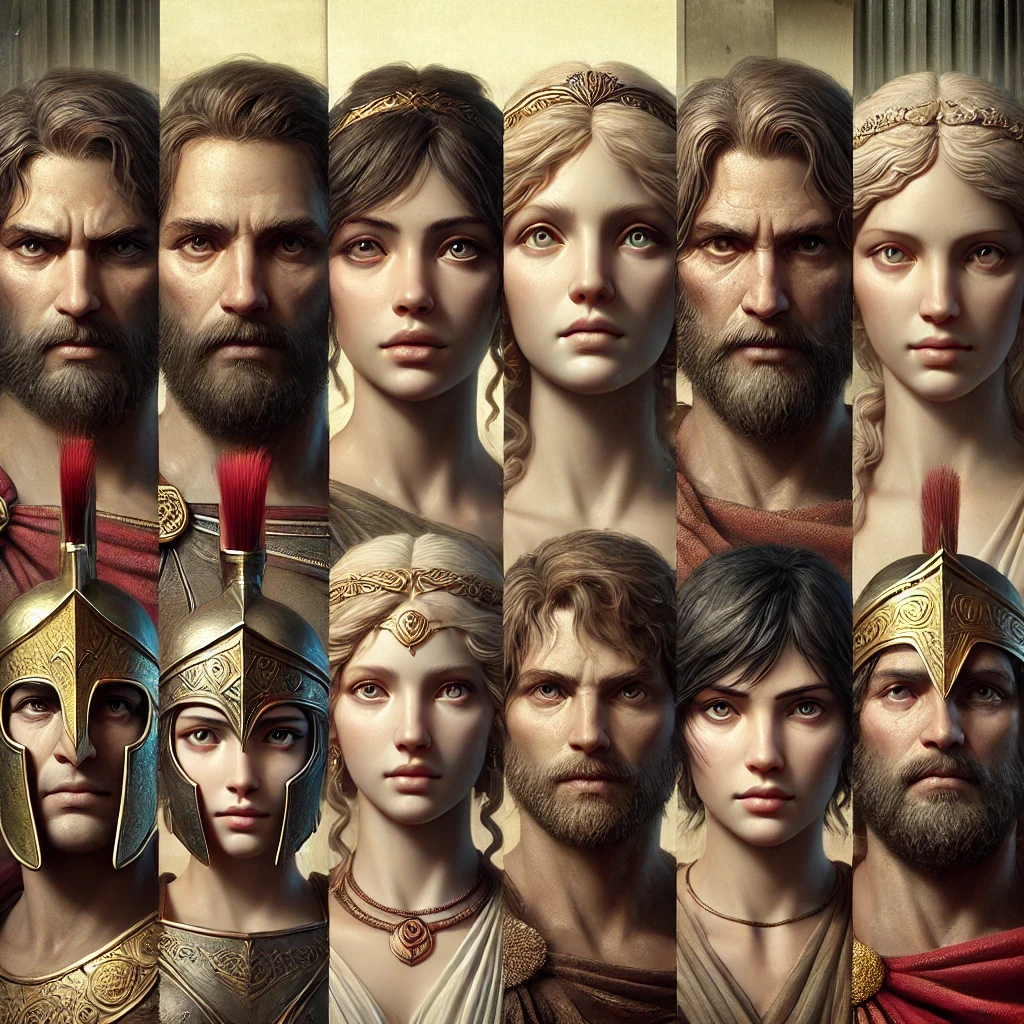
Check out all 3 VIDEOS posted below this post. The videos all deal with Troy’s Prince Paris.
Paris, a Prince of Troy, sparked the Trojan War. He was the son of King Priam of Troy and Queen Hecuba. They abandoned him when he was a newborn to save Troy from growing into a man who’d make Troy die.
Priam had Paris left on a mountain to die, but Paris survived and grew up as a shepherd.
The Anunnaki women, whom the Greeks called Hera, Athena, and Aphrodite, had Paris decide which of them would receive an apple made of gold that proclaimed her “the fairest.”
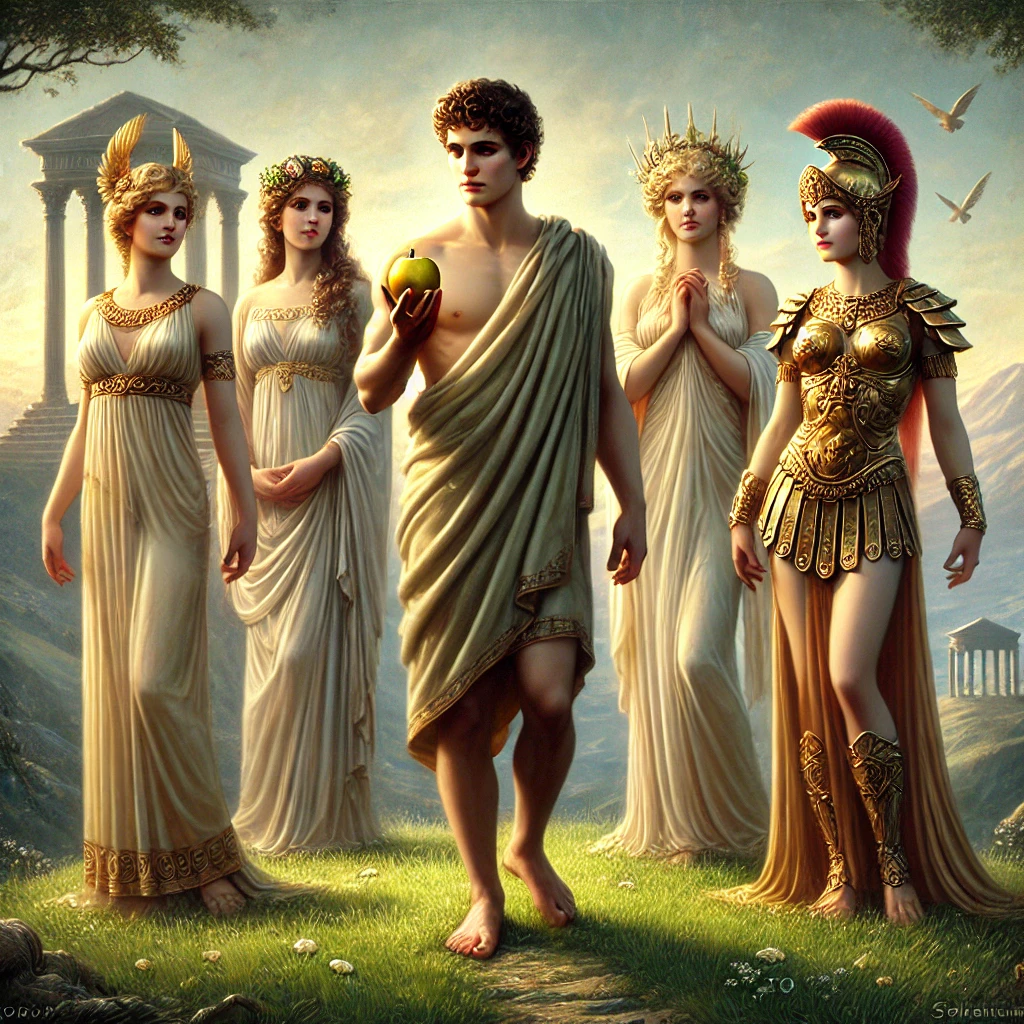
On a golden hillside steeped in myth, Paris holds the fateful apple inscribed “To the Fairest.” Before him stand three radiant goddesses—divine embodiments of power, wisdom, and desire. Hera, tall and regal, radiates command; Athena, armored and calm, exudes silent judgment; Aphrodite, graceful and beguiling, casts a knowing glance. Their robes shimmer with celestial symbols drawn from Anunnaki lore. This elegant tableau captures the origin of the Trojan War, where one mortal’s choice would alter the fate of gods and empires.
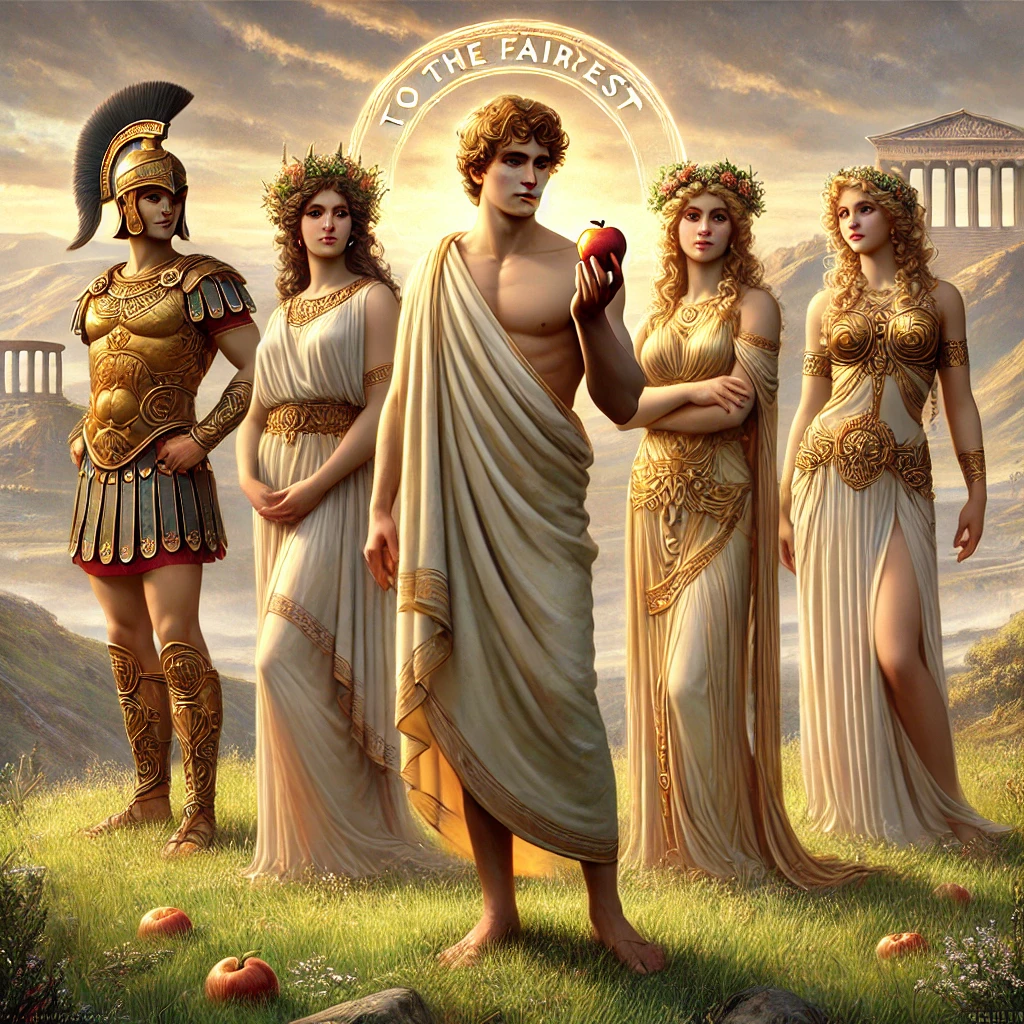
In a timeless landscape bathed in golden light, Paris weighs the divine beauty of three Anunnaki goddesses. Each one stands with poise and presence: Hera with authority in her posture, Athena with a warrior’s restraint, and Aphrodite with seductive charm. The golden apple glows in Paris’s hand, the moment of judgment suspended like breath before a storm. This scene fuses Greek and Mesopotamian mythologies into a visual symphony of choice, rivalry, and destiny.
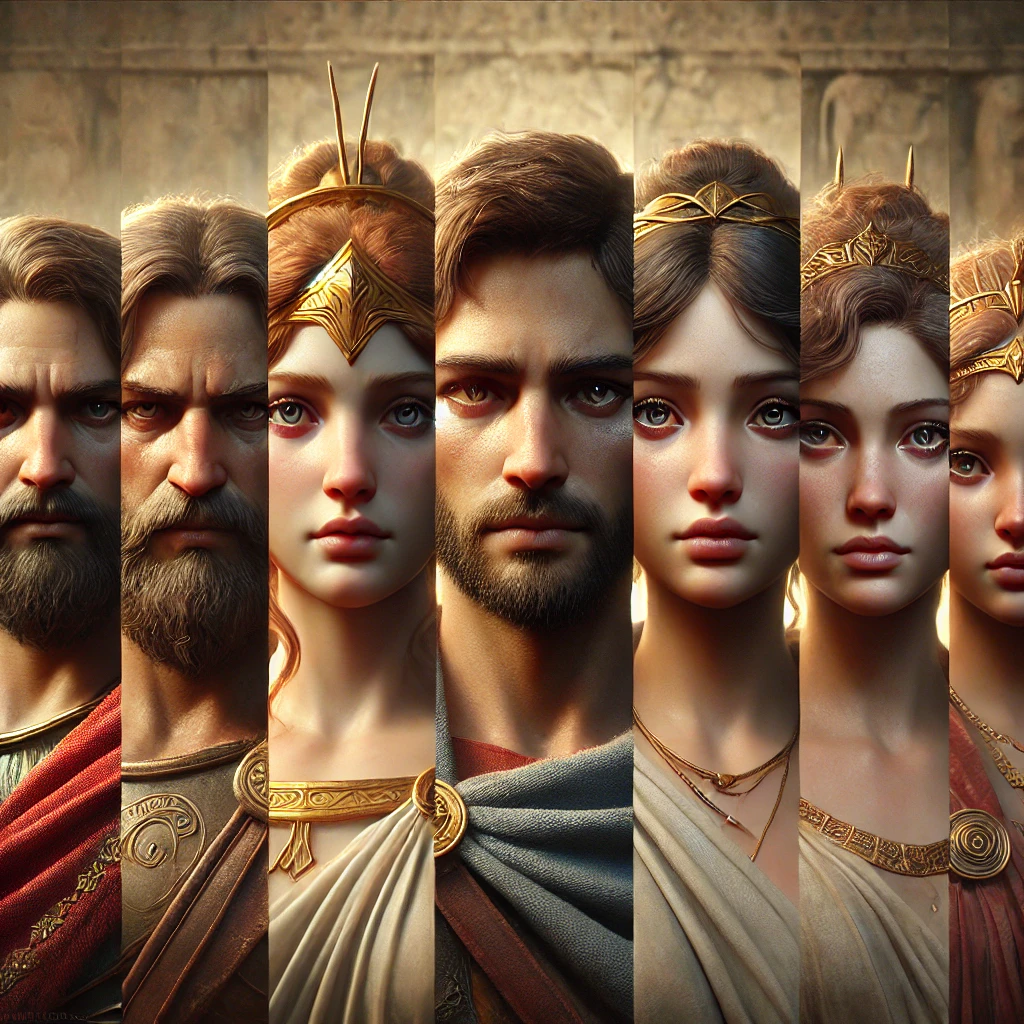

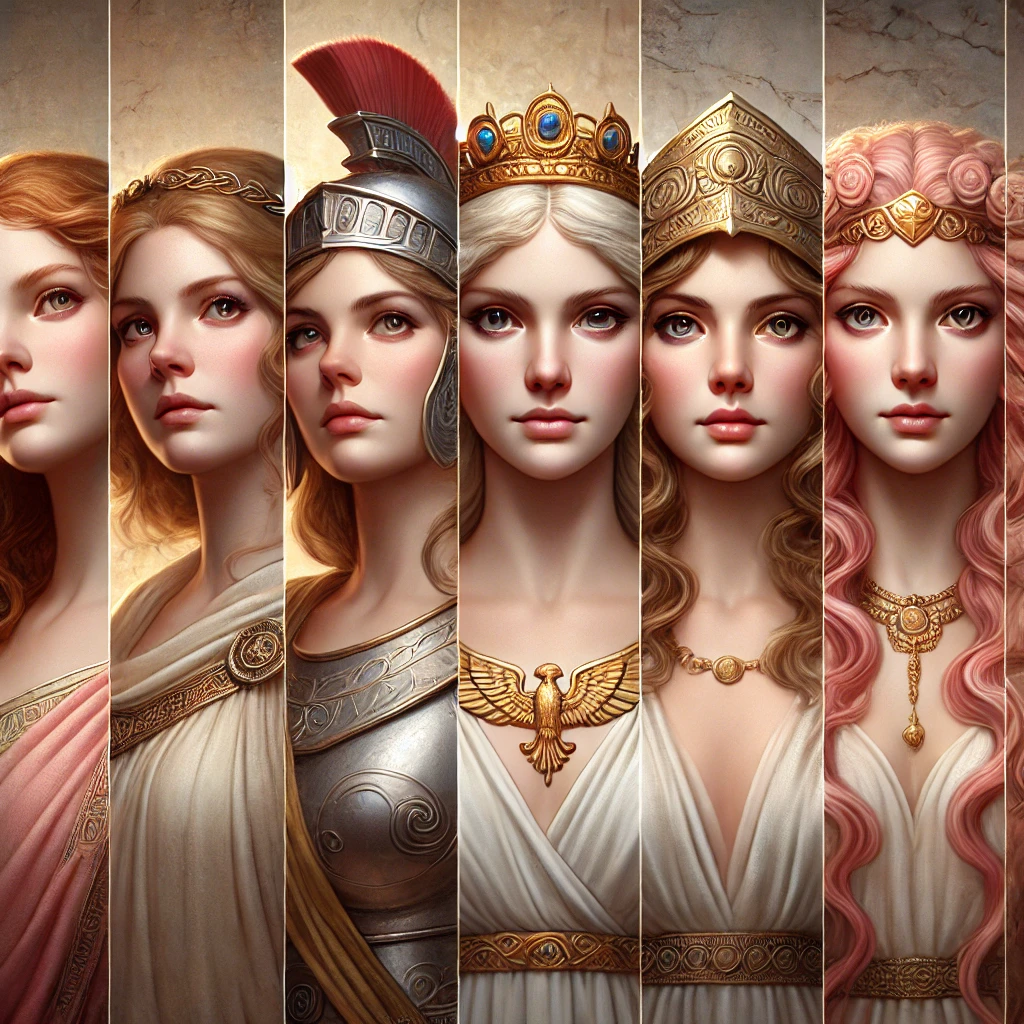
In this detailed close-up, Hera exudes sovereign dignity, her crown and golden robes shimmering with celestial motifs. Beside her, Athena appears as the poised strategist—her gaze sharp beneath a crested helmet, a symbol of wisdom and war. The atmosphere glows with golden light, echoing the grandeur and gravity of divine judgment. Together, they embody regal might and intellectual force—both vying, silently, for mortal favor.
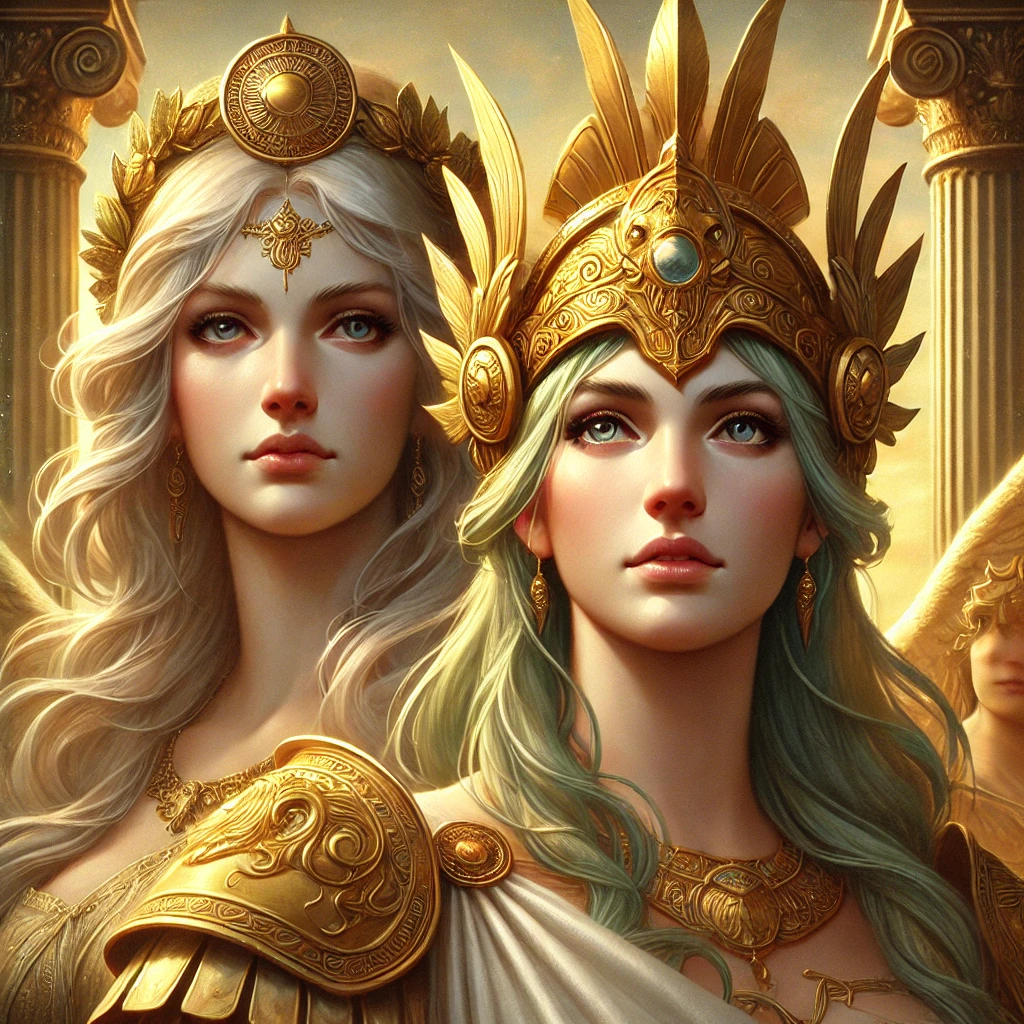
Framed by a soft, sacred light, Hera and Athena command attention. A quiet intensity tempers Hera’s noble bearing, while Athena’s calm, calculating presence hints at unspoken strategy. The close-up captures their individuality and divinity—two deities woven from the same myth but defined by contrasting essences: authority and intellect, pride and principle.
Paris chose Aphrodite as fairest. She, in return, promised him the love of Helen, wife of Sparta’s King Menelaus.
Paris either took or eloped with Helen. He took Sparta’s gold too.
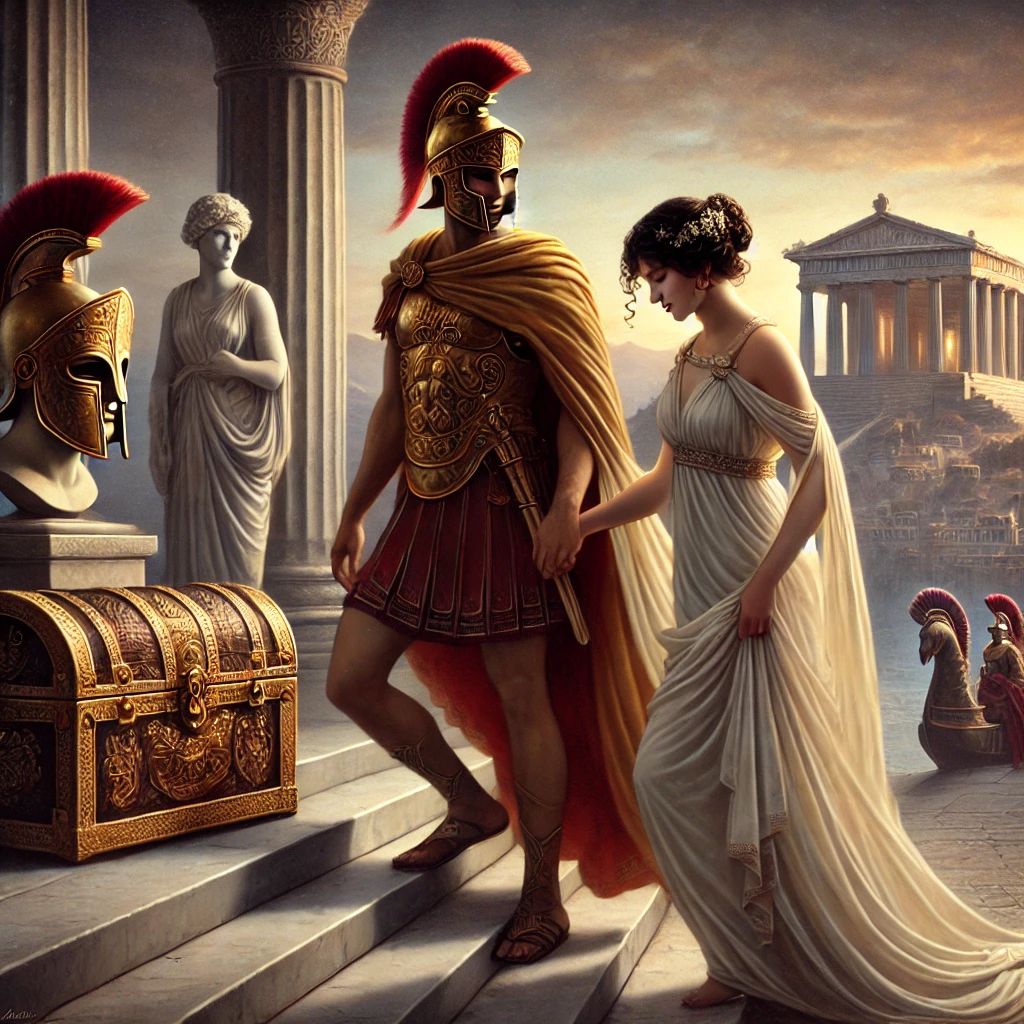
Paris descends the marble steps of Sparta with Helen at his side, her hand resting lightly in his. She is radiant yet distant, dressed in a flowing white gown. He carries a satchel brimming with gold, its presence as bold as the act itself. Behind them, the royal halls of Sparta glow in the hush of dawn—still unaware that their queen, and their wealth, are vanishing across the sea.
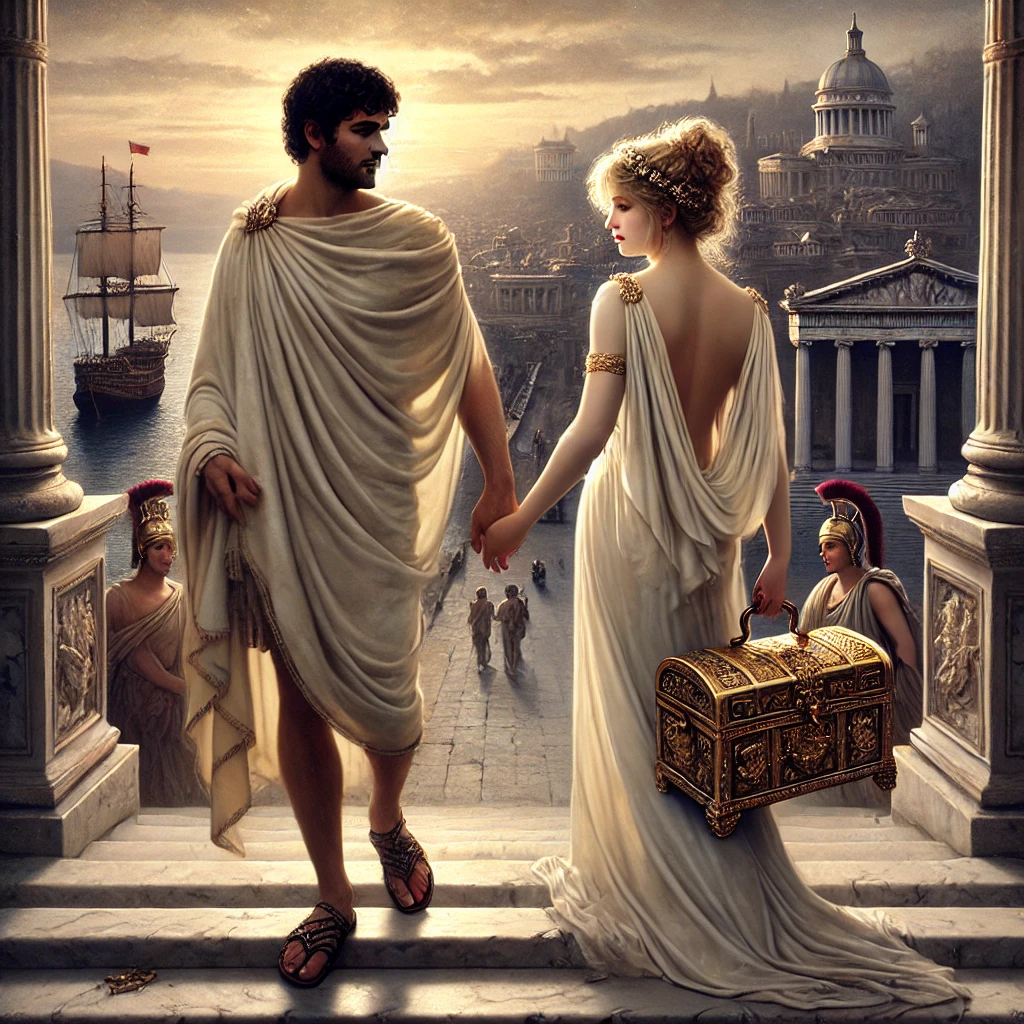
In a quiet moment laced with consequence, Paris leads Helen toward a waiting ship. She walks calmly beside him, her gaze turned away from the city she once ruled. The treasures of Sparta—gold, tapestries, and promise—glint in Paris’s burdened arms. The morning light casts long shadows, hinting at the storm that will follow love’s escape.
Paris, Apollo (also known as Utu or Shamash), had Paris kill the Greek hero Achilles with a poisoned arrow that Paris shot into Achilles’ vulnerable heel.
Please watch the three videos below and then share your thoughts with us.
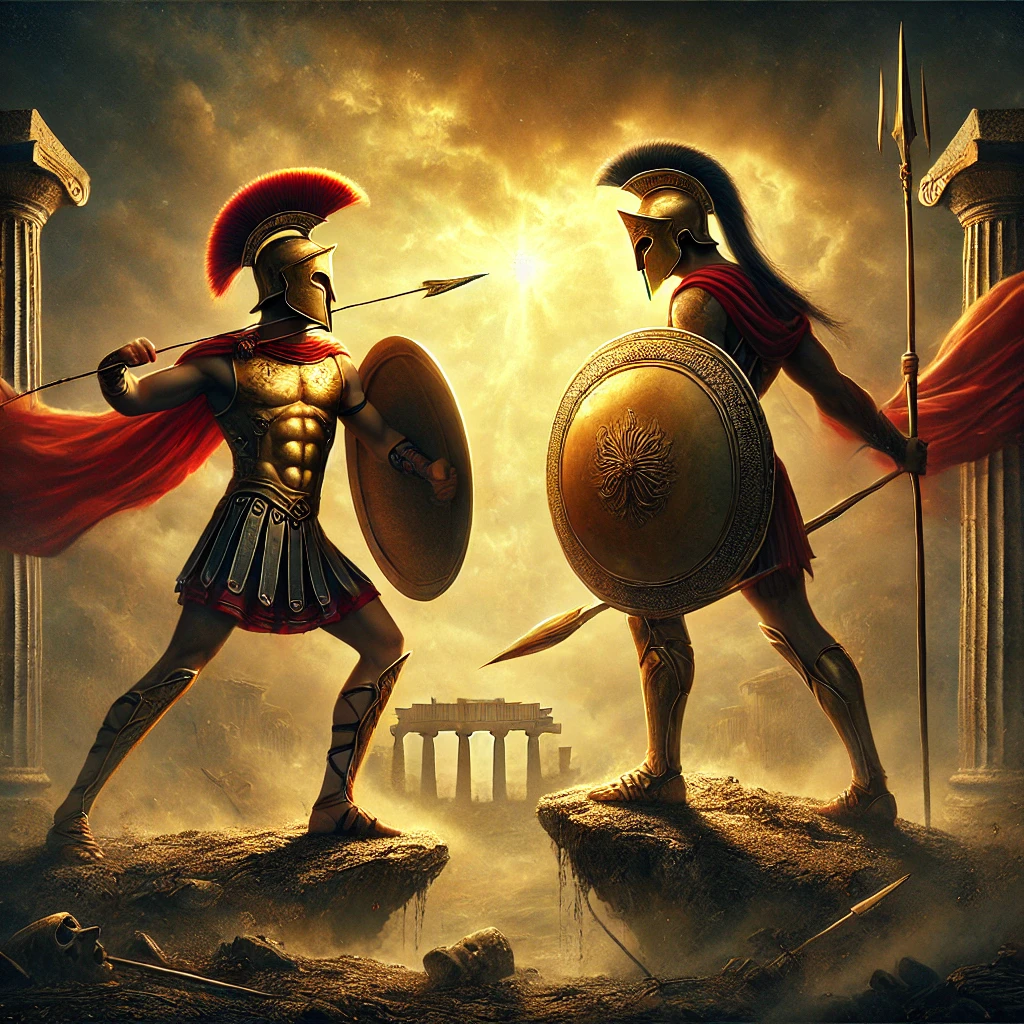
Description:
Set upon a narrow ridge between shadowed ruins and an army at the ready, Achilles and Paris meet in a moment of suspended time. The heavens part above them, casting a golden light that bathes the battlefield in divine symbolism. Achilles grips his spear, shield etched with sunburst patterns, a symbol of relentless heroism. Paris stands opposite, more lithe but no less determined, his bow lowered but his purpose unshaken. The silent armies watch, breath held, as two destinies converge in a duel foretold by gods and poets alike—a visual ode to the epic grandeur of the Trojan War.
Attachments area

Amid windswept cliffs and crumbling relics of a bygone civilization, an archer pauses in solemn reflection. The soft glow of dawn bathes the island in ethereal gold, and the calm sea mirrors the stillness of his spirit. His weathered cloak, bowed head, and strong posture suggest resilience forged through solitude. This image serves as an elegy to ancient endurance—a visual poem of isolation, strength, and the silent watch for a calling that may yet return with the tide.
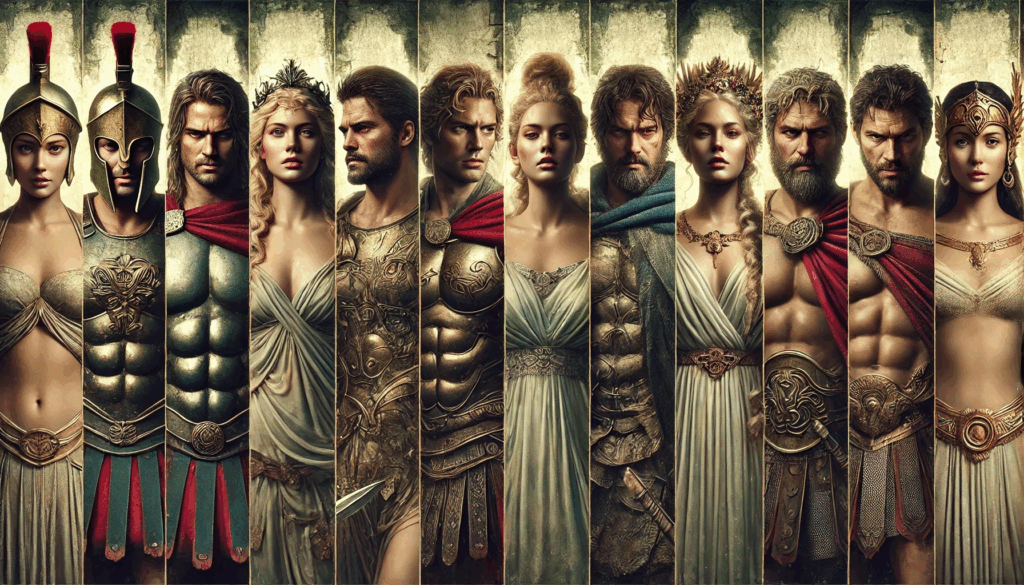
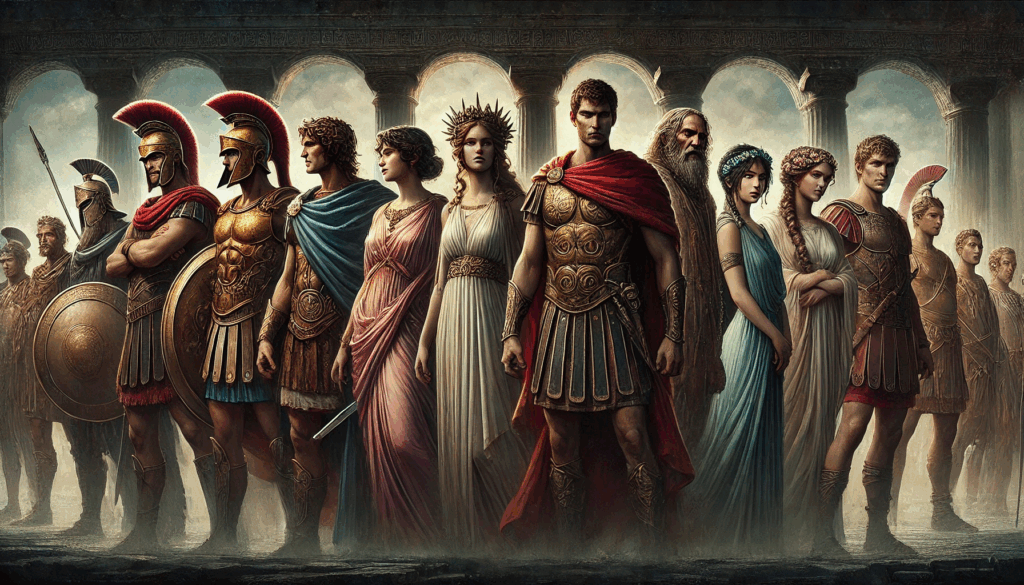
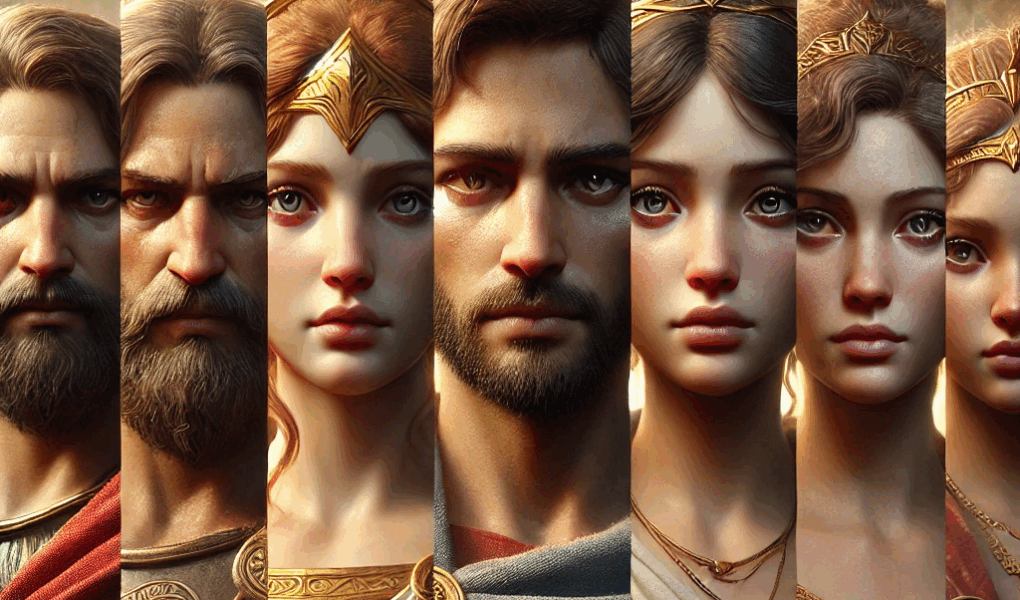
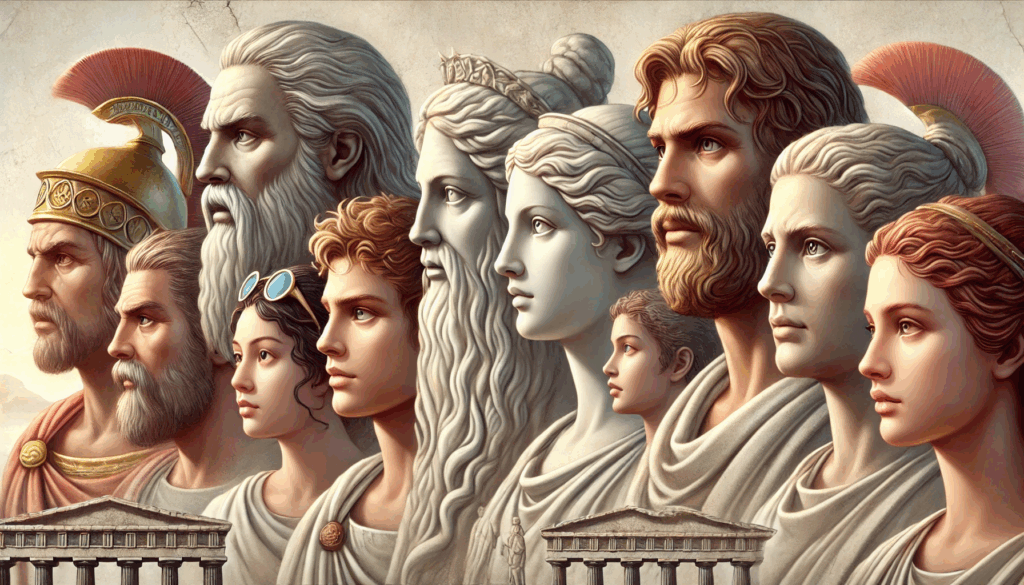
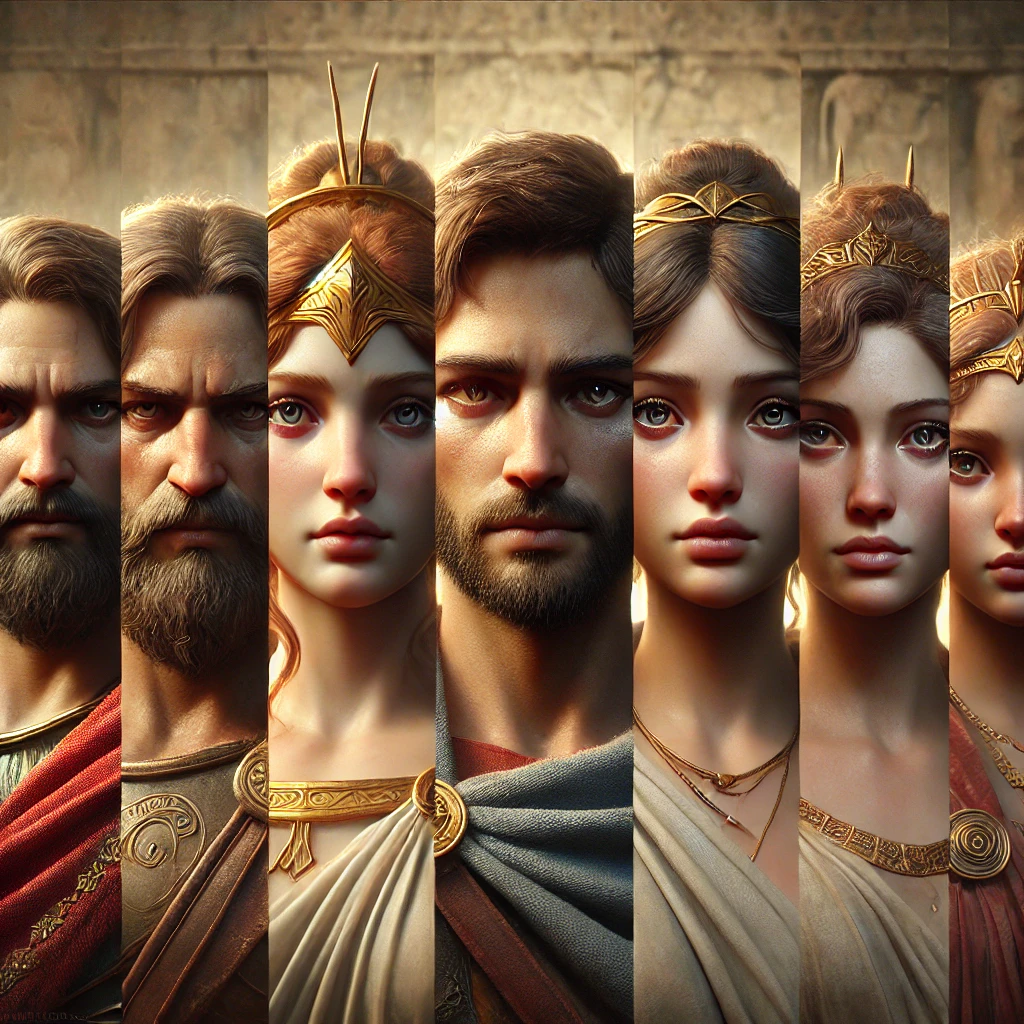
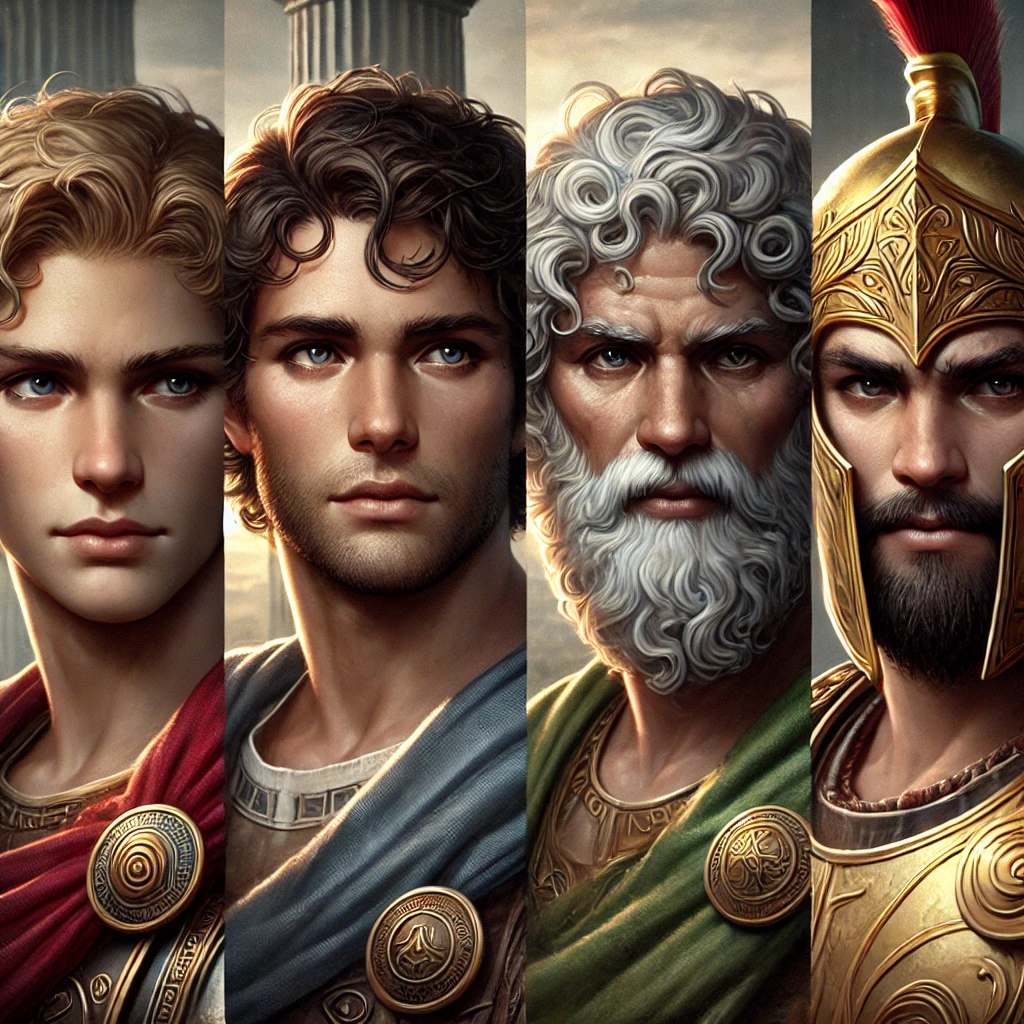
Seven faces, one war. Against a backdrop of ancient stone and timeless sky, the agents of myth stare forward—each marked by love, pride, power, or prophecy. Their unity is an illusion; behind their eyes lie betrayal, longing, and the ruin of empires. This lineup captures not only heroes and gods, but also the human truths they carry across centuries.
TAGS
Greek mythology, Trojan War, Paris, Helen of Troy, Menelaus, Achilles, Odysseus, Athena, Aphrodite, Hera, Thetis, ancient heroes, gods and mortals, mythological art, classical fantasy, epic mythology, legendary figures, Iliad, Homeric epic, mythic portrait
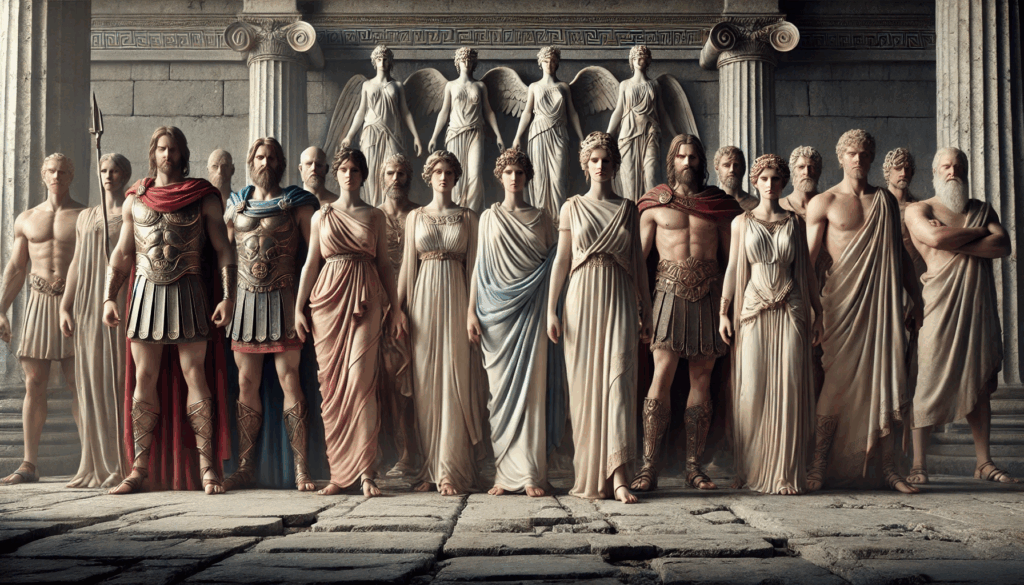
Achilles’ heel – The Hero’s Fall – The Trojan War Saga Ep 30 – See U in History
Preview YouTube video The Death of Paris and the Return of the Heir of Hercules (Philoctetes) –
The Trojan War Saga Ep 33The Death of Paris and the Return of the Heir of Hercules (Philoctetes) –
The Trojan War Saga Ep 33Preview YouTube video Coward or Hero? The Story of Paris –
The CULPRIT of the Trojan War – Greek MythologyCoward or Hero?
The Story of Paris – The CULPRIT of the Trojan War – Greek Mythology
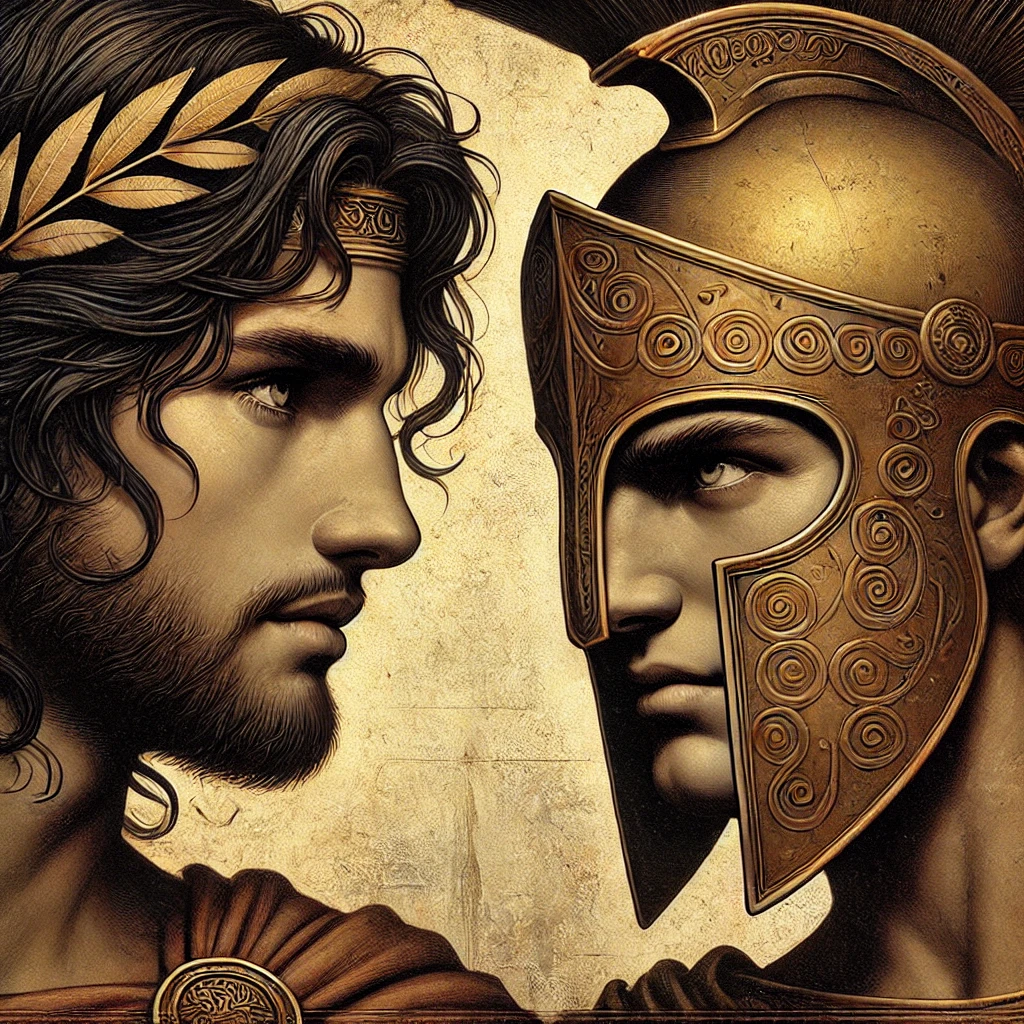
Set against a soft, ancient backdrop, this image shows a heightened moment of tension between two of Troy’s most iconic adversaries. Achilles exudes raw intensity, his golden features chiseled and his eyes narrowed in focus. His armor gleams with the weight of a thousand battles. Paris, graceful and almost divine, meets his gaze with quiet determination, the golden curve of his headband shimmering like a crown of fate. This artistic rendering evokes a painterly fantasy world where legend and reality merge in solemn confrontation.