GREEKS SADDLE TROY WITH A WOOD HORSE.

The Greek camp lies in ruin, reduced to ash and whispers of smoke. The Trojan Horse dominates the silent battlefield, vast and unmoving, as if left behind by giants. Morning light drapes the scene in gold and gray, while the sea beyond glows faintly, innocent of the vanished fleet. Mist coils around the Horse’s base, as though even nature is unsure of its presence—a moment of false peace before catastrophe.
https://www.youtube.com/watch?v=Wt4c4Br83ik
By Sasha Alex Lessin, Ph.D. (Anthropology, U.C.L.A.), co-author (with Janet Kira Lessin) of ANUNNAKI, EVOLUTION OF THE GODS
Watch the Video* to see how the Myceneans tricked the Trojans with a wooden Horse that housed hostiles.

Peruse more on ancient Greece at https://wp.me/s1TVCy-greece

The men and women of Troy face the viewer with solemn stillness, as if each carries the weight of what is to come. King Priam’s eyes are steady but sorrowful. Sinon, half in shadow, hides more than he shows. The Trojan officers are grim, caught between honor and uncertainty. On the other side, Cassandra’s gaze pierces with divine grief, while Queen Hecuba remains composed but knowing. Behind them, the throne room’s ancient murals fade into darkness — a symbol of the past forgotten and the future sealed. Each face is lit by golden firelight, carved in the language of myth and memory.
GREEKS HORSE AROUND TROY’S CAUTION

Odysseus, cloaked in green and crowned with a bronze-crested helm, stands atop a rocky rise overlooking the weary sprawl of the Greek siege camp. Fires burn low among tents and soldiers, while the distant towers of Troy glint in the dying light. After ten years of stalemate, the King of Ithaca watches in silence, not defeated, but calculating. The long war has become a puzzle, and he is its solver. Behind the stillness of his gaze brews the cunning that will shake an empire.
ODYSSEUS, King of Ithaca, was the brains of the Greek expedition against Troy in Asia Minor. After nearly ten years (1194 – 1184 BCE) of indecisive fighting, Odysseus planned to destroy Troy once and for all.

Odysseus, King of Ithaca, was caught in a moment of planning. His gaze is sharp, cloaked in firelight and secrecy. The legendary tactician wears a weathered travel cloak and a dark bronze helmet pushed back, revealing a calculating mind already anticipating the fall of Troy. Behind him, the ribs of the unfinished Horse rise against the night sky like the bones of a beast.

King Priam, Sinon, and Trojan officers stand shoulder to shoulder, their eyes fixed on the viewer with solemn gravity. Priam radiates authority and weariness, Sinon remains unreadable — a cipher carved from lies and endurance. The officers, clad in gleaming bronze, carry the weight of war and loyalty. Together, they form a wall of decision, doubt, and impending doom.
Odysseus asked ATHENA, an Anunnaki descended from Marduk (in his Greek identity as Zeus)**, to guide EPEIUS, a craftsman from Phocis, to build a wooden horse. The Horse had to be big enough to hide Odysseus and 30-40 other Greeks within.

In this evocative fantasy realism painting, the captured Greek warrior Sinon stands bound and weathered before the grand marble façade of Priam’s palace in Troy. The wet stone courtyard reflects the golden hour light, while storm clouds brood overhead. Officers Antimachus and Deiphobus, clad in ornate bronze armor and crimson cloaks, approach with stern purpose. Behind them, scribes in linen robes prepare to record the interrogation. Flickering torches cast dramatic shadows across the tense, rain-slicked scene, capturing the pivotal moment before the secrets of the Wooden Horse are revealed.

In this haunting close-up portrait, Sinon, the captured Greek warrior, is bound tightly to a weathered stone post. His face is bruised and bloodied, with matted hair and hollow eyes that shimmer faintly with a glint of divine awareness. Though battered, his expression remains resolute as he whispers, “If the gods demand my blood, pour it now. I shall not speak.” The background fades into shadow, with the blurred outlines of Trojan guards watching from a distance. Every detail—his torn tunic, pale skin, and the texture of the rope—conveys the raw humanity and unyielding spirit of a man caught between fate and deception.
Odysseus also had Athena script for the actor, SINON, to trick the Trojans into bringing the Horse into Troy.

The great city of Troy basks in golden twilight, its towering walls casting long shadows over the earth. At the gates, the massive wooden Horse stands like a gift carved by gods — wheels sunken into dust, its flanks etched with ancient runes. Trojans gather in awe, unaware of what lies within. In the distance, the sea glows, calm and deceptive, while temple domes and marble towers catch the last light of a dying day. This is the breath before ruin — silent, glorious, and destined.
The Greeks built the Horse out of Troy’s sight behind nearby Tenedos Island.
Most of the Greeks pretended to leave, but a skeleton crew stayed behind to finish the Horse. Greek guards kept the Trojans from seeing behind the Greek wall. The builders muffled the noise of their work, built the Horse’s parts in modules, assembled them, and quietly moved them into place during the night.

The Greek camp lies in ruin, reduced to ash and whispers of smoke. The Trojan Horse dominates the silent battlefield, vast and unmoving, as if left behind by giants. Morning light drapes the scene in gold and gray, while the sea beyond glows faintly, innocent of the vanished fleet. Mist coils around the Horse’s base, as though even nature is unsure of its presence—a moment of false peace before catastrophe.
The Greek Fleet, in the dark of night, burned its tents. Smoke blocked what the Trojans, from their impenetrable walls, saw only as fire and smoke as the fleet sailed off beyond their line of sight. The Greeks left the Horse and Sinon as offerings to the Trojans as though they’d abandoned their attempt to recover Sparta’s gold and its ex-Queen Helen for Mycenae.

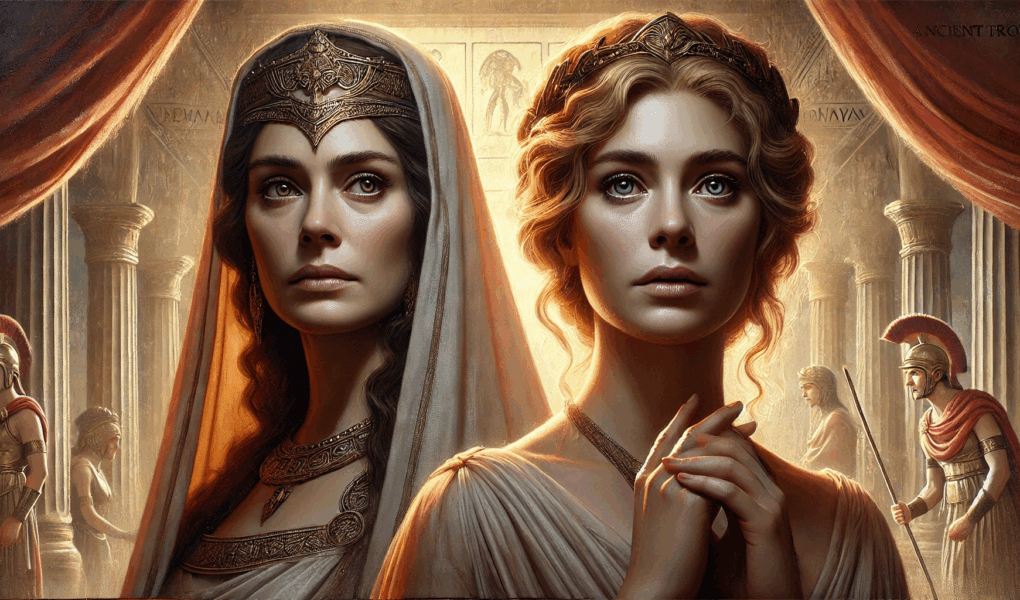
In the quiet light of Troy’s waning day, Queen Hecuba and Princess Cassandra stand side by side, their eyes meeting the viewer with unflinching clarity. Hecuba is veiled in quiet majesty, her expression composed and solemn. Beside her, Cassandra burns with restrained emotion — her fists subtly clenched, her gaze prophetic. Sunlight softens the columns behind them, but cannot dim the shadow that rests on their lineage. This is a portrait of two women who see what others won’t.
At dawn, wind blew away the smoke and ash from the burned Greek tents, which whirled into spirals, mixed with sea mist and flakes of red paint from the night’s fire at the Greek camp.

As dawn breaks, a spectral quiet settles over the smoldering ruins of the Greek camp. The once-crowded shore is deserted — tents lie in ashes, their smoke curling into mist over the empty sea. In the center of the plain stands the wooden Horse, colossal and unmoving, bathed in ghostly morning light. There are no Mycenaean voices, no ships on the horizon: only silence and the scent of charred canvas. The deception is complete.
Troy had endured ten long years, and now, suddenly, silence and the smell of smoke. No spears. No shouting. No clamor of Mycenaean voices from the plain and no ships.
At dawn, Trojan scouts cautiously reconnoitered what had been the Greeks’ camp and anchorage. They saw a man tied to and slumped against a post, beside a shattered water jug. His arms were bound, his skin blistered. Cuts lined his legs and wrists.

Outside the smoldering Greek camp, a lone figure sits slumped near a wooden post—Sinon, the Greek left behind. Dust clings to his tattered cloak, and weariness bends his frame. Trojan scouts approach warily, their weapons lowered but not forgotten. Behind them, the colossal Trojan Horse towers in silent judgment, its form glowing in the rising light. The air hangs thick with tension and mist, as if the earth itself waits for a lie to take root.
One of the scouts drew his blade. Another lifted a spear tip to the man’s neck. Who is this? muttered the spearman. A straggler? Or a snare?
Sinon lifted his face to the sun. His eyes squinted; his voice cracked. He spat blood into the sand and said, Kill me.

As the golden hour bathes the ancient city in a warm glow, Sinon—the crafty Greek left behind as part of Odysseus’ ruse—sits solemnly before the towering wooden horse. His eyes are distant, heavy with the weight of deception. Behind him, the gates of Troy loom open as jubilant Trojans gather to celebrate what they believe is a divine gift. The painting captures the quiet tension before the fall of a great city, with rich details in Sinon’s expression, the wooden construction of the horse, and the animated crowd unaware of their impending doom.
The scouts exchange looks. This one speaks Greek but in the Trojan tongue.
One scout summoned one of King Priam’s guards to examine Sinon as the scouts stood around, debating in whispers. Is he a deserter? A sacrifice? A spy?

In this grand cinematic tableau, Sinon stands humbly in a sunlit courtyard before King Priam, surrounded by the nobles and warriors of Troy. His torn robes and posture suggest weariness and urgency, while Priam’s regal poise and the attentive Trojan court create a striking contrast. The golden afternoon light washes over marble walls and tapestries, evoking a moment of ancient diplomacy steeped in tension, myth, and fate.
The guard fetched officers Antimachus and Deiphobus, as well as scribes, from Priam’s Palace to interrogate Sinon, who remained tied to his post, mumbling, If the gods demand my blood, pour it now. I shall not speak.

In this focused portrayal, Sinon appears in soft afternoon light, his expression poised between sincerity and quiet urgency. The fine detailing of his worn robe and tousled hair frames a face full of controlled emotion. Behind him, the shadowed outlines of Trojan nobles suggest a heavy atmosphere of judgment and belief, as myth and politics intertwine in a single gaze.
But he did speak. The scouts pulled him upright and bound his arms behind his back. He stumbled and shouted, I am no oath-breaker! I was left behind—betrayed by Odysseus, cursed by my own. Some of the scouts laughed—one spat.

This richly detailed scene captures the moment when Sinon addresses the king of Troy within the fortified city. Ornate pillars, gleaming bronze armor, and symbolic murals frame the setting, while the calm yet watchful faces of Trojan commanders suggest unease. The composition balances humility and grandeur, hinting at the weight of what’s to come in the fate of Troy.

Antimachus stood forward, armored in boar hide and bronze, his helm under one arm, his eyes narrowed. You name Odysseus—that jackal. Say more.

This cinematic close-up captures the mythic moment when Sinon addresses Troy. With intense eyes and sunlit features, he appears as both supplicant and storyteller. The background figures remain blurred, allowing the viewer to feel the weight of attention upon him—a moment suspended in time, calm, fateful, and alive with unspoken consequences.
Sinon inhaled sharply. He spoke now with conviction; his voice rose above the hoarseness of his words. I swore loyalty to their council, but Odysseus, who had angered Athena when he stole, never trusted me. I was kin to Palamedes—he whom Odysseus framed and had stoned to death. Also, he lied, Odysseus sneaked into Troy and stole the wooden statue of the Goddess [Anunnaki] Athena from her temple there.

In this moonlit temple scene, Odysseus emerges from the shadows of towering marble columns, clutching the sacred wooden statue of Athena. The flicker of distant braziers casts warm light against the cold stone, while the silvery sheen of moonlight outlines the edges of his cloak and the statue’s divine features. The image captures the silent audacity of the act — a mortal defying the sacred in a setting carved with reverence and ancient symbolism.

Cassandra and Queen Hecuba face forward in quiet defiance and sorrow. Hecuba’s veiled gaze speaks volumes — a queen who sees and remains silent. Beside her, Cassandra burns with unspoken prophecy, her hands tense, her eyes alive with fury and fate. They are two women caught in the tides of gods and men, knowing, grieving, and waiting to be heard.

Trojans believed Troy was impregnable as long as the statue stayed within their walls. Sinon’s menacious tale of Athena’s wrath was propaganda to get them to accept his lies. He said that Athena demanded blood to prevent a plague she’d cause and to get her to restore the winds so they could sail back to Greece. They chose me—a scapegoat—to explain their withdrawal and to leave this horse to commemorate their struggle here, consider the conflict a draw, and leave you in peace.

Beneath the soft light of Troy’s late afternoon sun, King Priam, Sinon, and the Trojan officers stand in solemn unity. The shadows have lifted, and their expressions are revealed in complete clarity: Priam, thoughtful and grave; Sinon, unreadable but human; and the warriors of Troy standing with guarded pride. The stone courtyard glows warmly behind them, banners stirring faintly in the breeze. This is not just a myth — this is a gathering of men before history seals their fates.
Athena demanded blood? Antimachus repeated skeptically.
Odysseus had the craftsman Epeius build this Horse from timber hauled from Mount Ida. The Horse is an offering to honor Athena, said Sinon. The Trojans murmured among themselves, doubt breaking like wind among dry reeds.
Take him to the Palace, clean him up, said Antimachus. I’ll see if the King wants to interrogate him.
SINON FOOLED TROJAN KING PRIAM

Priam’s gaze is unflinching from his throne, surrounded by walls etched with ancient winged beings and celestial maps. Sinon, ragged but poised, stands beneath the glow of perfumed bronze lamps, their smoke curling toward vaulted ceilings. The scene evokes a meeting of fates — truth, lies, and history suspended between the oil-lit shadows of old power and young desperation.
Priam interviewed Sinon in a palace chamber bedecked with ancient reliefs of winged beings, star maps, and forgotten weapons. Bronze lamps burned low in the corners, fed by perfumed oil, casting long shadows across the tiled floor.

The aged king and the weary stranger lock eyes in the flickering light of perfumed lamps. Priam’s furrowed brow and calculating stare reflect the weight of command and centuries of myth, while Sinon’s pleading face balances desperation with quiet cunning. Behind them, faint carvings of celestial symbols and divine wings fade into shadow — reminders of forgotten pacts and uncertain omens. In this still frame, power and persuasion hang in a breathless exchange.

All stand together: Priam, Sinon, the officers, Hecuba, and Cassandra — faces turned toward the viewer like a mural carved in time. Each one bears their truth, their silence, their guilt. Lit by golden torchlight against the murals of Troy’s throne room, they are no longer characters in a myth, but witnesses in a moment before history becomes legend.

In this intimate, moody composition, Priam leans forward beneath the gaze of carved weapons and gods long forgotten. Sinon stands across a checkered tile floor, caught in the dim glow of low-burning lamps, framed by symbols of a cosmic past. The entire space breathes with quiet age and mystery, amplifying the weight of each word exchanged between the king and the stranger.
The King sat on a throne of dark stone veined with silver, shaped in the likeness of a double-lion. Queen Hecuba sat beside him, her eyes shrouded in veils but glinting with awareness. Between them, at a respectful distance, stood his daughter CASSANDRA, her hands twisted together, white-knuckled. Her face, though regal, looked strained—like a bowstring drawn too long.

Priam sits in solemn majesty upon a double-lion throne of dark stone, its surface threaded with silver, his gaze fixed forward. Queen Hecuba rests beside him, her veiled eyes gleaming with subtle awareness. Between them, Cassandra stands like a statue under pressure — hands knotted, face drawn with knowing dread. Behind them, the chamber breathes with dim firelight, the walls etched with ancient gods and falling stars. The atmosphere thrums with silence and destiny.
The air was heavy with the scent of incense. Scrolls and tablets lined the alcoves, and a large map lay open on a table nearby. Soldiers stood on either side of the entrance, still as carved hawks.

Hecuba gazes through delicate, silken veils, her expression unreadable, but her eyes gleam with intellect and quiet watchfulness. Bathed in the golden glow of perfumed lamps, she sits not just as queen, but as seer of her own — aware of doom, yet unwilling to speak it aloud. The painting evokes a matriarch cloaked in myth, navigating the fractures beneath royal stillness.
Guards led Sinon before the Royals. Sinon, now washed and robed in plain linen, still bore the reddish swell of rope burns on his arms. He glanced about the chamber, his gaze lingering just a moment too long on the Anunnaki reliefs—then dropped his eyes and bowed stiffly.

This intimate tableau captures the strained gravity of a royal family shadowed by prophecy. Hecuba’s stillness is a contrast to Cassandra’s coiled form — a bowstring of flesh and will. Her white-knuckled hands and strained expression suggest the weight of visions unheeded. Priam looms like a carved monarch, sovereign yet distant, as warm lamplight glances off polished stone and veiled truths. Myth meets human fragility in a moment before unraveling fate.
Antimachus stepped forward and announced, This Greek, whose name is Sinon, claims the Horse is an offering Athena ordered the Greeks to give to Troy. He begs mercy, not asylum.

Cassandra’s face is taut with the weight of visions. Her fingers are clenched near her heart, knuckles pale, as if holding herself together against the storm of foresight. Her eyes — bright and haunted — stare not at the present, but at the shadowed future no one will believe. In warm palace light, she looks like a statue about to crack — divine torment sculpted into human form.
King Priam, robed in white linen trimmed with Tyrian blue, nodded once, slowly. Let him speak. And let none interrupt—save the gods.

In the glowing heart of Troy’s throne room, King Priam raises a single hand — not in anger, but in solemn command. Draped in white linen edged with Tyrian blue, he sits unmoving, a still point amid the gathered court. Sinon stands before him, worn and wounded, while nobles and guards freeze in breathless silence. Far in the background, Cassandra waits, a shadow beneath the carved pillars. The golden light and stone serenity heighten the gravity of a moment on the edge of fate.

Priam’s face is etched with years and burden, his raised hand graceful yet heavy with consequence. In the soft light of oil lamps, his eyes reflect weariness, wisdom, and the ache of choosing mercy. His command is quiet, but final: let the stranger speak. Behind him, shadows flicker on the walls of a kingdom already trembling beneath its prophecy.
Cassandra had watched from afar, still as a stone pillar, but now her voice burst forth like thunder, tearing open the sky.

Cassandra bursts forward from the shadows like a storm breaking the silence. Her arms are clenched, her voice raised, her face aflame with divine warning. The court of Troy recoils — nobles gasp, guards stiffen, and Sinon stands immobile, unreadable. Priam remains seated, turned slightly, caught in the weight of his daughter’s fury. Golden lamplight paints the stone chamber in soft warmth, clashing with the thunder in Cassandra’s voice. A moment of prophecy, poised against fate.
Do not listen to him, she cried. He lies! The Horse is no gift! It carries murder in its gut!

Cassandra’s eyes shine with anguish and fire, her mouth frozen mid-cry — a seer in torment. Her hair is tousled, her breath caught, her hands trembling against her chest as if trying to hold in the vision too vast for flesh. Behind her, the court blurs into unreality, fading into shadow and disbelief. Only her agony remains clear — a voice too true for mortal ears.

In the quiet light of Troy’s waning day, Queen Hecuba and Princess Cassandra stand side by side, their eyes meeting the viewer with unflinching clarity. Hecuba is veiled in quiet majesty, her expression composed and solemn. Beside her, Cassandra burns with restrained emotion — her fists subtly clenched, her gaze prophetic. Sunlight softens the columns behind them, but cannot dim the shadow that rests on their lineage. This is a portrait of two women who see what others won’t.

Cassandra bursts forward from the shadows like a storm breaking the silence. Her arms are clenched, her voice raised, her face aflame with divine warning. The court of Troy recoils — nobles gasp, guards stiffen, and Sinon stands immobile, unreadable. Priam remains seated, turned slightly, caught in the weight of his daughter’s fury. Golden lamplight paints the stone chamber in soft warmth, clashing with the thunder in Cassandra’s voice. A moment of prophecy, poised against fate.

Cassandra’s eyes shine with anguish and fire, her mouth frozen mid-cry — a seer in torment. Her hair is tousled, her breath caught, her hands trembling against her chest as if trying to hold in the vision too vast for flesh. Behind her, the court blurs into unreality, fading into shadow and disbelief. Only her agony remains clear — a voice too true for mortal ears.
Gasps rippled. The guards stiffened. Sinon froze, expression unreadable. For one long moment, silence cloaked the gathering like a shroud.

In the golden hush of the throne room, King Priam leans forward, gently placing his fingers upon Cassandra’s brow. His face holds both sorrow and wisdom, not of kingship alone, but of a father’s ache. Cassandra stands regal and quiet, her fire dimmed but not extinguished, her gaze distant as though still listening to the gods. The glow of bronze lamps and ancient murals softens the chamber. The storm has passed — for now — and all that remains is love and doubt.
Priam placed a hand gently on Cassandra’s shoulder. His voice was warm, aching with the weariness of love: Peace, daughter. Your fire burns bright, but not all flames reveal the truth. The gods have given you many visions, and not all have come to pass.

Captured in tender detail, Priam’s hand rests lightly upon Cassandra’s forehead, his eyes searching hers for calm, perhaps forgiveness. Cassandra’s features are noble and composed, but shadowed with the burden of visions unspoken. The moment is steeped in ancient silence — a pause in destiny’s march — painted in warm light and mythic stillness. It is a farewell of sorts, though no one yet knows it.
Cassandra trembled. Her voice cracked. Father, I see it. I see blood on the altars, fire in the sky, spears in the womb of the city. The Horse will bring death.

In the golden hush of the throne room, King Priam leans forward, gently placing his fingers upon Cassandra’s brow. His face holds both sorrow and wisdom, not of kingship alone, but of a father’s ache. Cassandra stands regal and quiet, her fire dimmed but not extinguished, her gaze distant as though still listening to the gods. The glow of bronze lamps and ancient murals softens the chamber. The storm has passed — for now — and all that remains is love and doubt.
Priam touched her brow with the tips of his fingers as one might soothe a fevered child. Then let the gods judge him, he said softly. But we shall not. Not today.

Captured in tender detail, Priam’s hand rests lightly upon Cassandra’s forehead, his eyes searching hers for calm, perhaps forgiveness. Cassandra’s features are noble and composed, but shadowed with the burden of visions unspoken. The moment is steeped in ancient silence — a pause in destiny’s march — painted in warm light and mythic stillness. It is a farewell of sorts, though no one yet knows it.
He turned back to Sinon, studying the young man with quiet calculation. Feed him. Clean his wounds. Let him rest beneath our roof, if only for a night.

Description:
King Priam walks away in solemn silence, his white and blue robes trailing like the final lines of a closing prayer. Behind him, Sinon bows low, posture steeped in humility-or something too still to name. Cassandra remains frozen near the pillar, her hands clenched, her lips parted as if the gods themselves had caught her voice. The chamber is hushed, the golden lamplight soft — and the moment sinks like dusk over destiny.

Sinon bowed his head. You show more mercy than I deserve, mighty King.

Description:
Sinon’s head bows low, but his expression is unreadable, lit by the flicker of oil flames. His wounds remain, but it’s his stillness that holds the eye — too humble, or too careful? Behind him, Cassandra watches, blurred by distance but not emotion, her gaze burning even in silence. The warmth of the light does not reach them. This is not peace, but the stillness before fire.

Priam nodded once, then turned away. Behind him, Cassandra remained frozen, her hands clenched, her mouth open but voiceless.

King Priam steps into shadow, his white and Tyrian-blue robes trailing behind him like the last line of a judgment. Behind him, Cassandra remains rigid, unmoving, unheard. Her hands are clenched with the force of visions suppressed, her mouth parted in a cry the gods won’t let pass. The golden light of oil lamps glows on the stone floor, casting long shadows across a silence that now belongs to fate.


Cassandra’s expression is carved from grief and divine urgency — her mouth slightly parted in a warning no one will hear, her eyes glistening with visions too real to ignore. Her clenched fists speak of all the power she holds and all the futility she knows. Golden lamplight brushes her face, as if the gods themselves illuminate her last attempt to alter fate. Behind her, the world fades — as does hope.

The great city of Troy basks in golden twilight, its towering walls casting long shadows over the earth. At the gates, the massive wooden Horse stands like a gift carved by gods — wheels sunken into dust, its flanks etched with ancient runes. Trojans gather in awe, unaware of what lies within. In the distance, the sea glows, calm and deceptive, while temple domes and marble towers catch the last light of a dying day. This is the breath before ruin — silent, glorious, and destined.

*I illustrate the story of the Trojan War with videos from See U in History.

Odysseus, cloaked in green and crowned with a bronze-crested helm, stands atop a rocky rise overlooking the weary sprawl of the Greek siege camp. Fires burn low among tents and soldiers, while the distant towers of Troy glint in the dying light. After ten years of stalemate, the King of Ithaca watches in silence, not defeated, but calculating. The long war has become a puzzle, and he is its solver. Behind the stillness of his gaze brews the cunning that will shake an empire.

This tense, cinematic composition presents Odysseus mid-step, eyes fixed ahead as he bears the holy figure of the goddess through the heart of her sanctuary. The temple interior is richly adorned, with painted motifs, carved pillars, and a great altar looming behind. The delicate balance of light and shadow mirrors the moral ambiguity of the moment — a sacred theft for the sake of victory, and a god’s favor taken, not earned.

Odysseus gazes forward with sharp, calculating eyes, his face framed by a weathered bronze helmet and the folds of a green cloak clasped with a brooch bearing an ancient emblem. Torchlight flickers behind him, casting shadows that hint at both war and legend. The silhouette of the Trojan Horse looms faintly on the wall — a symbol of his cunning plan yet to unfold. This is a man not just of war, but of wit.

Outside the smoldering Greek camp, a lone figure sits slumped near a wooden post—Sinon, the Greek left behind. Dust clings to his tattered cloak, and weariness bends his frame. Trojan scouts approach warily, their weapons lowered but not forgotten. Behind them, the colossal Trojan Horse towers in silent judgment, its form glowing in the rising light. The air hangs thick with tension and mist, as if the earth itself waits for a lie to take root.

In this intimate portrayal, the queen’s veil is almost translucent, revealing the sharpness behind her composed features. The soft firelight outlines a woman who knows more than she says — her calm is a shield. The background fades, putting full attention on the glint in her gaze — the glimmer of memory, caution, and rule.

In this intimate portrayal, the queen’s veil is almost translucent, revealing the sharpness behind her composed features. The soft firelight outlines a woman who knows more than she says — her calm is a shield. The background fades, putting full attention on the glint in her gaze — the glimmer of memory, caution, and rule.

Priam’s face is etched with years and burden, his raised hand graceful yet heavy with consequence. In the soft light of oil lamps, his eyes reflect weariness, wisdom, and the ache of choosing mercy. His command is quiet, but final: let the stranger speak. Behind him, shadows flicker on the walls of a kingdom already trembling beneath its prophecy.
**DIFFERENT CULTURES & ERAS COMBINED ANUNNAKI GODS’ NAMES & ATTRIBUTES
When we consider the appearance, perpetuation, or reappearance of gods, archetypes, walk-ins, inner fractals, or independent beings in our history, folklore, and literature, we think of them in the garb, insignia, and symbols we associate with them. However, our pictures of the gods vary. They represent models, paradigms, and explanations of how people, planets, extraterrestrials, and the Universe work.
Inanna, for example, sometimes appears as the first daughter of Nannar (the equivalent of Allah). Sometimes, she’s combined with her younger sister, Ereshkigal (also known as Persephone), or her father’s aunt, Ninmah.
Inanna’s uncle Enki had varying names as he aged, as when Ea of the planet Nibiru became Enki and Asar in Iraq. He becomes Ptah in Egypt; he’s the Peacemaker in North America. In India, he’s Shiva, Greece’s Prometheus, Rome’s Aquarius, and Europe’s Lucifer. For researcher Glenn Bouge, Enki is Jesus. For Jungians, Enki is a savior archetype. Whatever the moniker, Enki and the other Anunnaki were people, not all-knowing, all-good, or all-powerful; none of them were what the Anunnaki call “the Creator-of-All” or what Native Americans call “Great Spirit.”
We are learning from the diverse perceptual perspectives of Earth’s cultures about the elephant in the room of history. Celebrate the richness of our many heritages.
For the list of Anunnaki and their various overlapping names and histories, see ANUNNAKI WHO’S WHO at http://wp.me/p1TVCy-1PE
ANUNNAKI & ANCIENT ANTHROPOLOGY EVIDENCE, REFERENCES, TIMELINE & WHO’S WHO
Evidence https://wp.me/p1TVCy-1zg
References http://wp.me/p1TVCy-2cq
Timeline http://wp.me/p1TVCy-1Km
Who’s Who NEW STUFF: http://wp.me/p1TVCy-1PE
New Stuff: www.enkispeaks.com
| Untitled |
PLEASE SHARE, REPOST & LIKE THIS POST.
Attachments area

The Trojan Horse – The Trojan War Saga Ep 35 – Greek Mythology – See U in History

The Greek camp lies in ruin, reduced to ash and whispers of smoke. The Trojan Horse dominates the silent battlefield, vast and unmoving, as if left behind by giants. Morning light drapes the scene in gold and gray, while the sea beyond glows faintly, innocent of the vanished fleet. Mist coils around the Horse’s base, as though even nature is unsure of its presence—a moment of false peace before catastrophe.
 | ReplyForwardAdd reaction |