Fin: The Seer-Warrior and Avatar of Enki

A realistic, artistic portrait of Fin (Fionn mac Cumhaill), the legendary Irish warrior and seer. His piercing blue eyes reflect deep knowledge, wisdom, and foresight. His long golden hair flows over his shoulders, and his expression is commanding and contemplative. Dressed in intricately detailed Celtic warrior attire, adorned with knotwork patterns, Fin embodies the power of a leader, a visionary, and an avatar of Enki. The background hints at misty hills and ancient Irish landscapes, setting a mystical and mythic tone.
In the mist-laden glens of ancient Ireland, where the rivers whispered secrets to the stones and the wind carried the voices of gods, a warrior was born—one whose destiny would shape the land and live on in legend. His name was Fin, known to some as Fionn mac Cumhaill, a leader of warriors, a keeper of wisdom, and a seer whose visions pierced the veil of time itself. But Fin was more than a hero of the Celts. He was an avatar of Enki, the great cosmic architect, the bringer of knowledge, and the guardian of humankind.
Through Fin, Enki walked once more among mortals—bestowing wisdom, guiding the lost, and challenging the forces that threatened to pull the world into chaos. From the moment of his birth, Fin was marked by destiny. Raised by druidesses in the wild, he was no ordinary child, but a being touched by the divine. His hunger for knowledge led him to the Salmon of Wisdom, whose sacred essence granted him insight beyond mortal comprehension—just as Enki, lord of the deep waters, held the hidden knowledge of the universe.
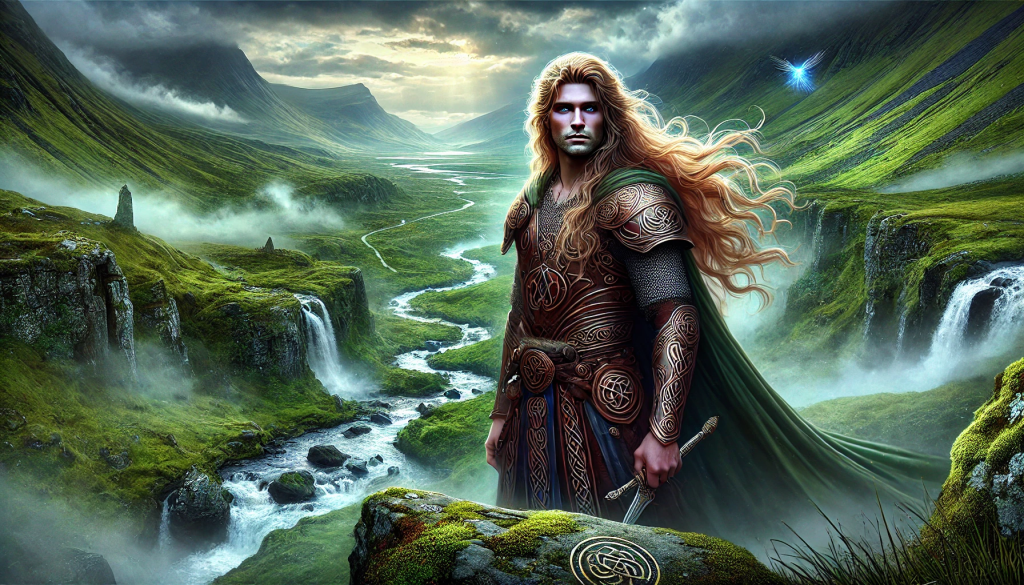
A stunning, landscape-format, fantasy-style illustration of Fin (Fionn mac Cumhaill) standing amidst the mist-laden glens of ancient Ireland. The lush, rolling emerald hills and mystical rivers create a breathtaking scene, where the air hums with divine energy. Fin is a mighty yet wise warrior, his eyes reflecting deep knowledge from the cosmic architect, Enki. His elaborate Celtic armor, adorned with knotwork, shimmers under an ethereal light. The wind carries whispers of gods, and an otherworldly aura surrounds him, reminding all that Fin is more than legend—he is a guardian of humankind, a bridge between mortals and the divine.
Fin’s life was one of struggle, triumph, and mystery. He battled giants, fire-breathing demons, and sorcerers, not with brute force alone, but with the cunning of a trickster god. He tricked the mighty Benandonner, outwitted the dark spirits of the Otherworld, and walked the line between man and divinity, shaping the very land he fought to protect.
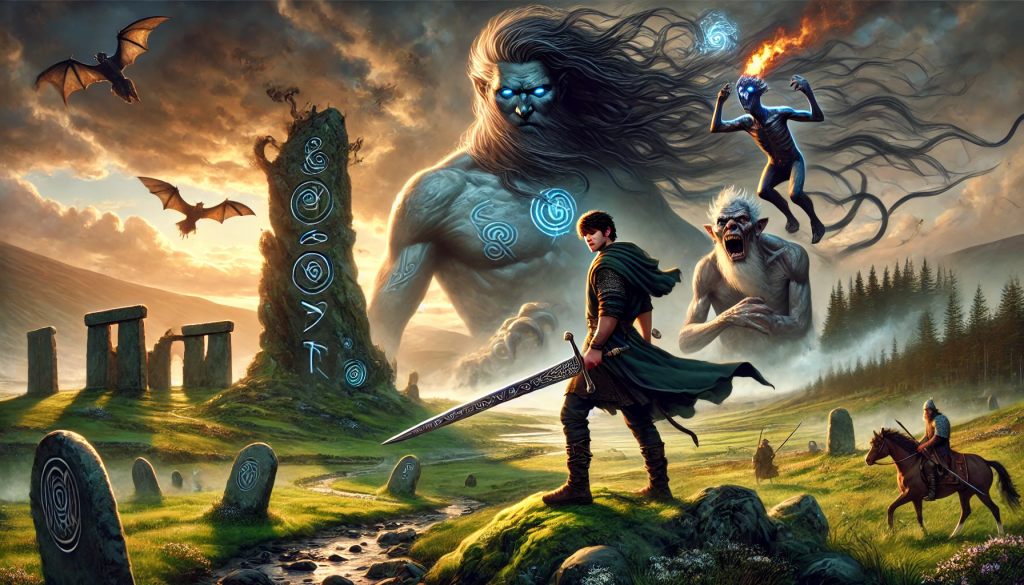
A breathtaking, realistic, and artistic fantasy-style illustration of Fin (Fionn mac Cumhaill) at the height of his legendary struggles. Fin stands strong, wielding a Celtic sword inscribed with ancient runes, his blue eyes gleaming with intelligence and power. Around him, the towering giant Benandonner looks confused, ensnared in Fin’s cunning trickery. In the background, a fire-breathing demon roars, its flames casting an eerie glow across the misty Irish landscape. At the edges of the battlefield, dark spirits of the Otherworld swirl, their spectral tendrils reaching toward the realm of men. The land itself pulses with mystical energy, shaped by Fin’s victories. This scene captures the balance of struggle, triumph, and mystery, as Fin walks the line between man and divinity, an avatar of Enki, protector of his people and shaper of destiny.
Let me know if you’d like any refinements or additional details! 😊
Yet, like Enki, Fin was also a builder of civilizations, a protector of the weak, and a guardian of secret wisdom. He did not hoard knowledge—he shared it, using it to defend his people and ensure the balance of the world. His Fianna warriors were more than fighters; they were seekers, poets, and protectors, much like the initiates of Enki’s ancient mystery schools.
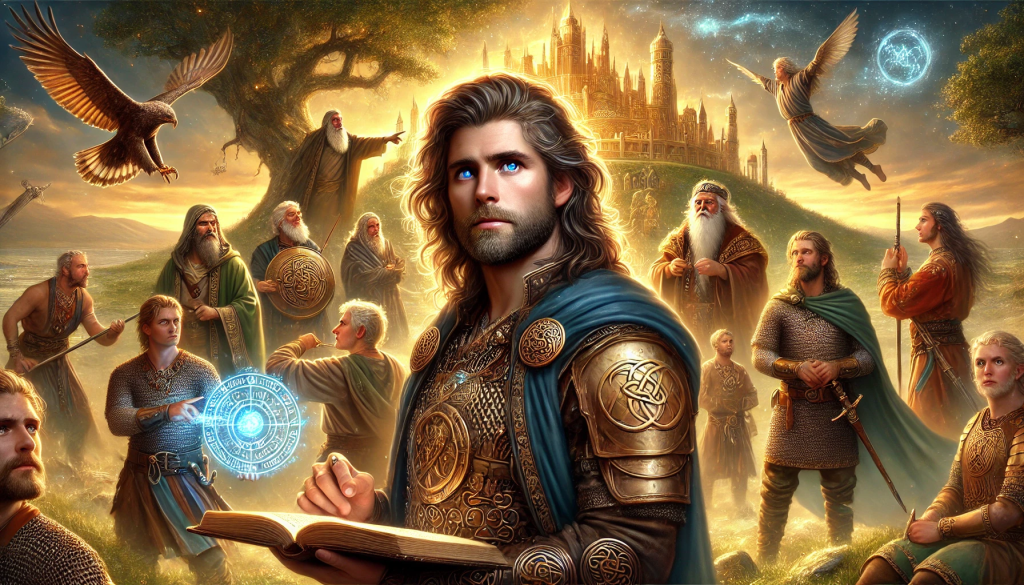
Description: A realistic, artistic fantasy-style illustration of Fin (Fionn mac Cumhaill) as a builder of civilization, protector of the weak, and guardian of secret wisdom. He stands at the forefront, clad in intricately detailed Celtic armor, his blue eyes glowing with knowledge and compassion. Around him, the Fianna warriors are gathered—not just as warriors, but as seekers, poets, and protectors, trained in both combat and ancient wisdom. Some read ancient scrolls, others engage in martial training, while a few discuss deep philosophical insights beneath sacred oaks.
But all great beings must face their twilight. Like Enki, who retreated into the depths of history, Fin vanished from the world of men, his fate unknown. Some say he fell in battle, others whisper that he slumbers beneath the hills, awaiting the time when his wisdom is needed again.
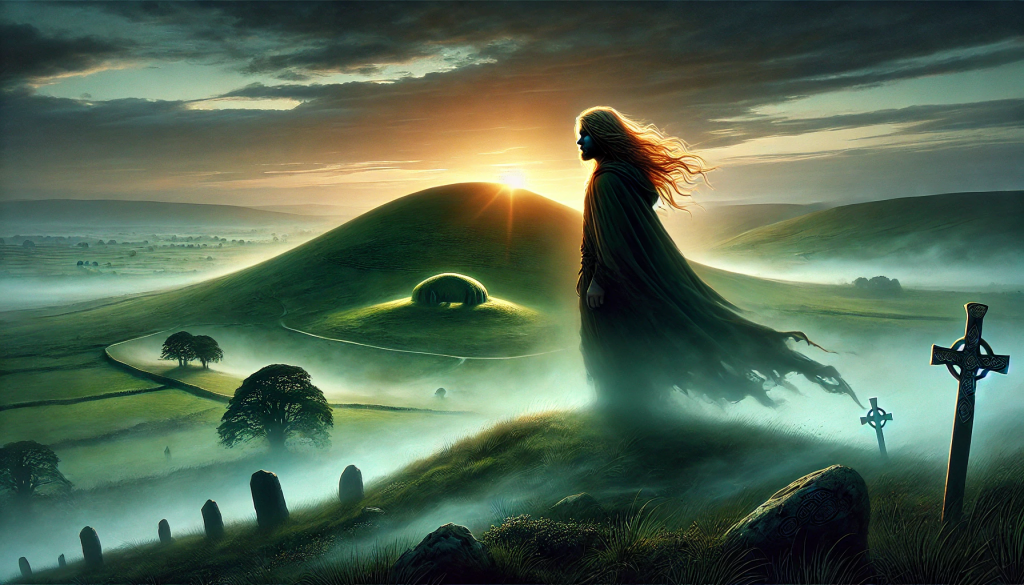
A breathtaking, realistic, and artistic fantasy-style illustration capturing Fin (Fionn mac Cumhaill) at the moment of his vanishing into legend. He stands atop a misty Celtic hill at twilight, his golden hair flowing in the wind, and his blue eyes reflecting deep wisdom as he gazes toward the horizon. His silhouette begins to fade, merging with the ethereal glow of the setting sun, symbolizing his retreat into the depths of history.
Behind him, the rolling emerald hills shimmer with ancient magic, and the faint, ghostly figures of the Fianna warriors watch over him, guardians of his legacy. In the distance, a glowing burial mound suggests the whispered legend—that Fin slumbers beneath the land, waiting for the time when his wisdom is needed once more. The air is thick with mystery, as Fin, like Enki, steps beyond the mortal world, his fate unknown.
Will he rise again, when the world calls for him?
Perhaps.
Fin (~Medieval to Early Modern Periods)
Fin, also known as Fionn mac Cumhaill (Finn McCool), is a legendary figure from Irish and Scottish mythology, particularly in the Fenian Cycle of Gaelic folklore. He is depicted as a warrior, poet, and seer with extraordinary wisdom and supernatural abilities.
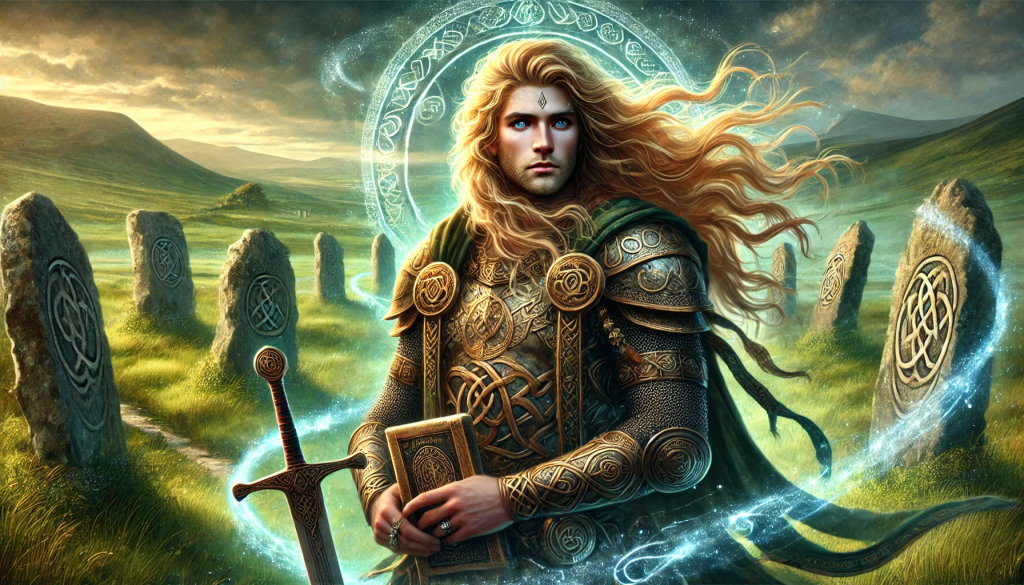
Description: A stunning, realistic, and artistic fantasy-style illustration of Fin (Fionn mac Cumhaill), the legendary Irish warrior, poet, and seer. He stands amidst a misty Celtic landscape, surrounded by rolling emerald hills and ancient standing stones, embodying the mythic grandeur of the Fenian Cycle. His long golden hair flows in the wind, and his piercing blue eyes radiate deep wisdom and supernatural insight.
Draped in intricately detailed Celtic armor adorned with knotwork, Fin carries a great sword at his side, symbolizing his prowess in battle. In one hand, he holds a sacred scroll, reflecting his role as a poet, philosopher, and guardian of ancient knowledge. A mystical aura surrounds him, hinting at his Otherworldly connections, as he walks the line between mortal hero and divine seer, much like his true essence as an avatar of Enki. This artwork captures the essence of Fin’s dual nature—a protector of his people, a seeker of wisdom, and a bridge between the worlds of men and gods.
Born under mystical circumstances, Fin was raised secretly and trained by druids and warriors. He gained divine knowledge after accidentally consuming the Salmon of Wisdom, which granted him profound insight and prophetic abilities.
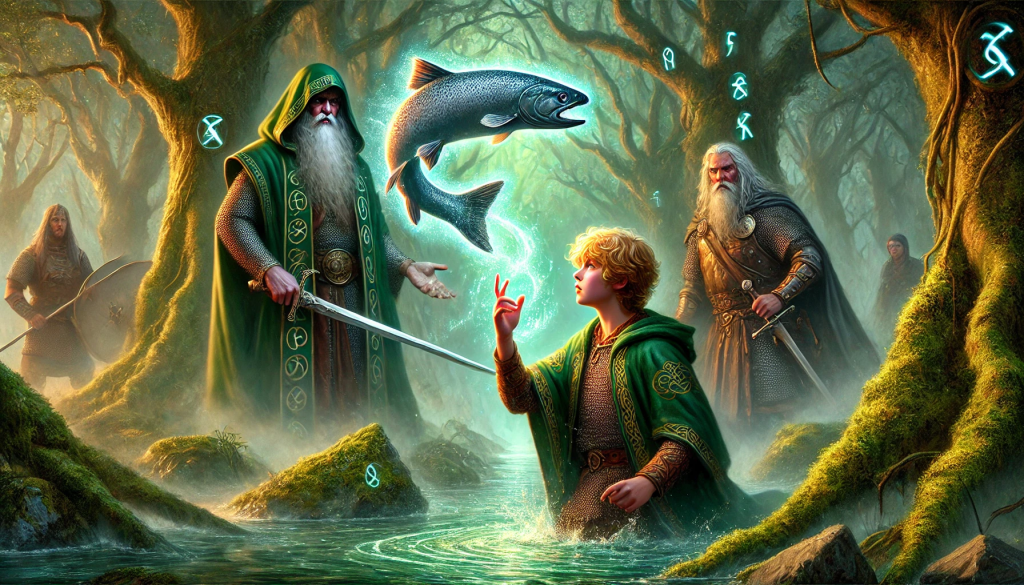
This breathtaking, realistic, and artistic fantasy-style illustration captures the pivotal moment in Fin (Fionn mac Cumhaill)’s life—his secret training under druids and warriors and his accidental consumption of the Salmon of Wisdom. The scene unfolds in a mystical Celtic grove, surrounded by towering oaks and glowing runes, where ancient knowledge is passed down. At the heart of the illustration, a wise elder druid, cloaked in deep green robes, shares sacred teachings, while a battle-hardened warrior trains Fin in the art of combat. In the foreground, the legendary Salmon of Wisdom leaps from an enchanted river, its scales shimmering with divine energy. With golden hair and piercing blue eyes, Young Fin watches in awe as his fingers brush against the sacred fish, unknowingly absorbing profound insight and prophetic abilities. The moment is infused with mystical energy, bridging the realms of men and gods. Fin transforms into a legendary warrior, poet, and seer—an avatar of Enki, destined to guide and protect humanity.
His exploits include battling giants, leading the Fianna warriors, and shaping landscapes with his immense power. His tales merge history, myth, and supernatural elements, making him a powerful emanation of Enki as a wise guide and protector.
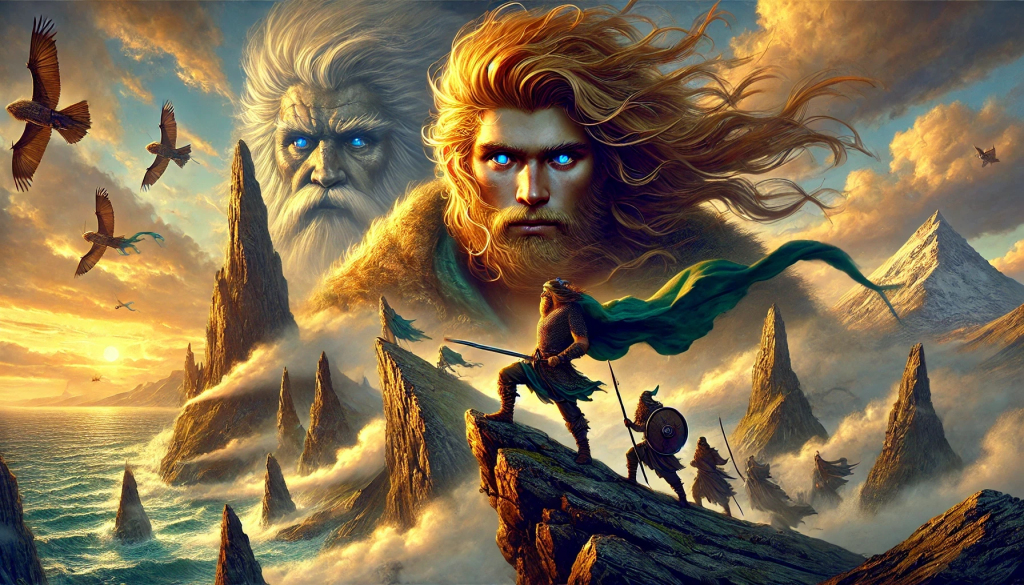
This breathtaking, realistic, and artistic fantasy-style illustration captures Fin (Fionn mac Cumhaill) in the heat of his legendary exploits. He stands atop a towering cliff, a commanding presence with his golden hair flowing in the wind, his piercing blue eyes glowing with wisdom and divine power. More than a warrior, Fin is a seer, a protector, and a force of nature—an avatar of Enki, shaping the land and guiding his people. Around him, the Fianna warriors stand at the ready, their shields gleaming as they prepare for battle. In the distance, a colossal giant looms, casting an ominous shadow over the land. But Fin does not falter—he has carved rivers with his footsteps and shaped mountains with his hands, leaving his mark upon the world. The air crackles with supernatural energy, as history, myth, and magic collide in an epic moment of destiny. A storm brews above, yet divine light breaks through the clouds, illuminating Fin and his warriors, as if the heavens acknowledge their mission. This is Fin, the Titan-Slayer, the Guardian of the Fianna, and the eternal protector of his people—a warrior whose legend will never fade.
Fin (~Medieval to Early Modern Periods)
Fin, also known as Fionn mac Cumhaill, is one of the most iconic figures in Irish mythology. His name, “Fair One”, reflects his divine or otherworldly heritage. He is the legendary leader of the Fianna, a band of warriors who protected Ireland during the pre-Christian era.
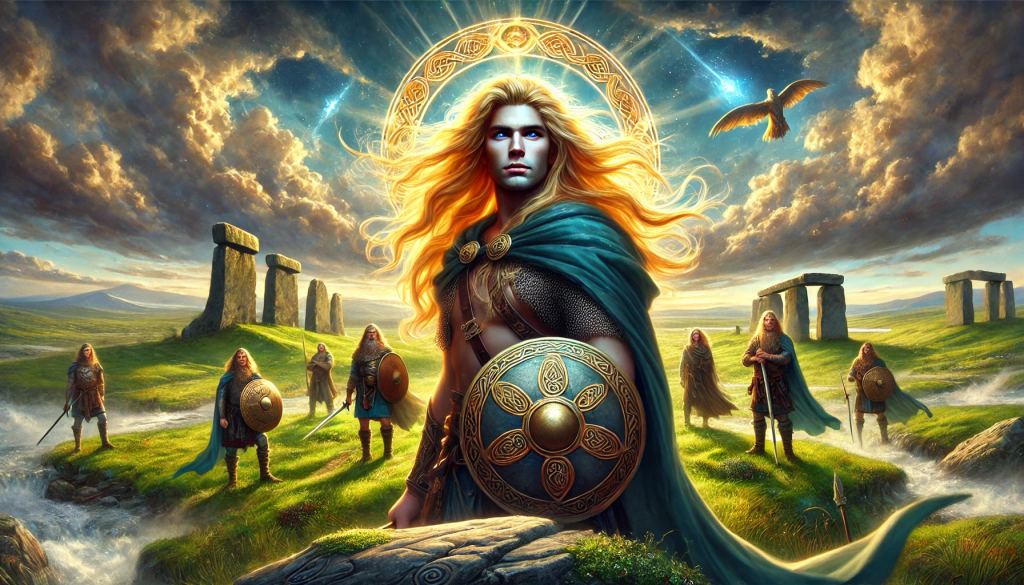
A breathtaking, realistic, and artistic fantasy-style illustration capturing Fin (Fionn mac Cumhaill), one of the most iconic figures in Irish mythology. He stands proudly as the legendary leader of the Fianna, a band of elite warriors dedicated to protecting Ireland in the pre-Christian era. His golden hair flows in the wind, and his piercing blue eyes radiate divine wisdom and strength, reflecting his otherworldly heritage.
Surrounding him, the Fianna warriors stand ready, clad in intricately detailed Celtic armor, their shields and swords gleaming beneath an ethereal golden light. The rolling emerald hills stretch into the horizon, punctuated by ancient standing stones, hinting at the connection between Fin, the Otherworld, and the divine. Above, the sky swirls with storm clouds and radiant sunbeams, symbolizing Fin’s role as a mortal hero and a guardian chosen by fate.
Birth and Non-Ordinary Events Surrounding His Conception
Prophecies and danger surrounded Fin’s birth. His father, Cumhall, was a great warrior of the Fianna, but was killed before Fin was born. His mother, Muirne, was forced to flee, as her family feared the child’s great destiny. She entrusted baby Fin to the care of two wise women, Bodhmall (a druidess) and Liath Luachra (a warrior woman), who raised him in the wilderness, training him in combat, survival, and druidic wisdom.

This breathtaking, realistic, and artistic fantasy-style illustration captures Fin’s dramatic and mystical birth (Fionn mac Cumhaill), a child born into prophecy and danger. In the foreground, baby Fin rests in a woven cradle, watched over by his two guardians—Bodhmall, the druidess, cloaked in emerald-green robes, and Liath Luachra, the warrior woman, clad in battle attire. They stand protectively under an ancient oak tree, its bark inscribed with glowing Celtic runes, foreshadowing Fin’s great destiny. Beyond them, Muirne, Fin’s mother, flees through the misty forest, her face sorrowful as she entrusts her child to the care of these wise protectors. The rolling fog and shadowy figures in the distance hint at unseen dangers, the forces that sought to prevent Fin from rising to greatness. A soft golden light bathes the sacred grove, illuminating Fin’s divine aura, marking him not only as a future warrior but an Enki avatar, destined to shape the world with wisdom and strength.
In some versions of the myth, Fin was born glowing or marked by divine signs, indicating his connection to higher realms. Others suggest his true father was an otherworldly being, linking him to the Tuatha Dé Danann, the ancient race of gods in Irish mythology.
The Salmon of Wisdom – Fin’s Divine Enlightenment
As a youth, Fin sought wisdom and was guided to the druid Finnegas. The druid had spent years trying to catch the legendary Salmon of Wisdom. This magical fish had consumed the sacred hazelnuts of knowledge, making it the source of all wisdom.
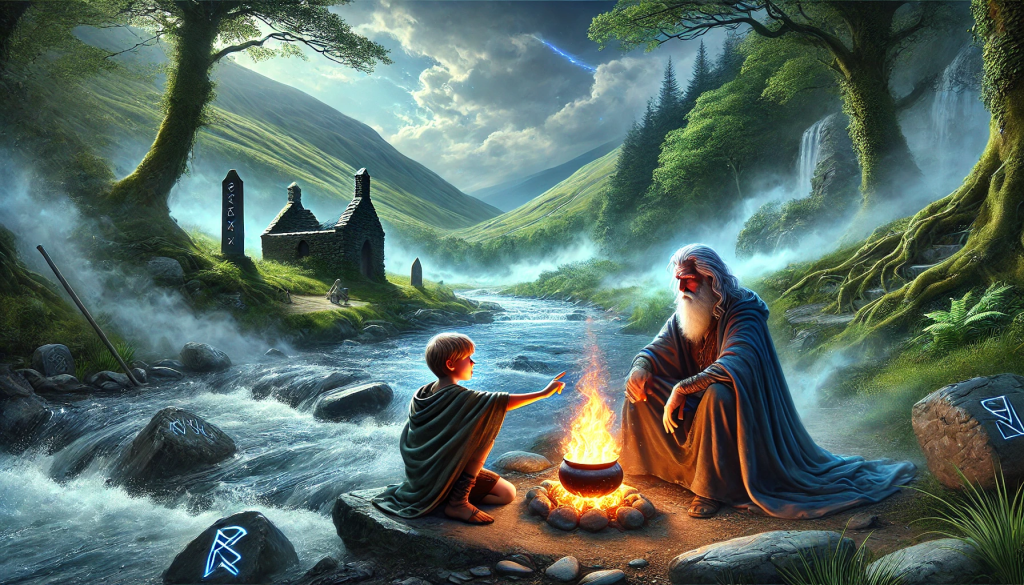
This breathtaking, realistic, and artistic fantasy-style landscape illustration captures the pivotal moment of young Fin (Fionn mac Cumhaill) gaining divine wisdom. Sitting beside a flowing river in ancient Ireland, surrounded by mist-covered emerald hills, Fin carefully cooks the legendary Salmon of Wisdom over a small fire. Nearby, Finnegas, the wise druid, watches intently, his deep-set eyes filled with wisdom and curiosity. As Fin accidentally touches the hot salmon, he instinctively places his burned thumb in his mouth, and in that instant, his piercing blue eyes widen as divine knowledge floods his mind.
The air shimmers with mystical energy, and ancient Celtic runes faintly glow on the nearby standing stones, symbolizing the powerful transformation. The river glows with an ethereal light, marking the moment Fin gains the ability to see the past, present, and future, solidifying him as a seer and enlightened being, much like Enki himself.
One day, Fin finally caught the salmon for his master. However, while cooking it, he burned his thumb and instinctively placed it in his mouth, accidentally absorbing all of the fish’s divine wisdom. From that moment, whenever Fin sucked his thumb, he could see the past, present, and future. This ability solidified him as a seer and enlightened being, much like Enki’s gift of foresight and knowledge.
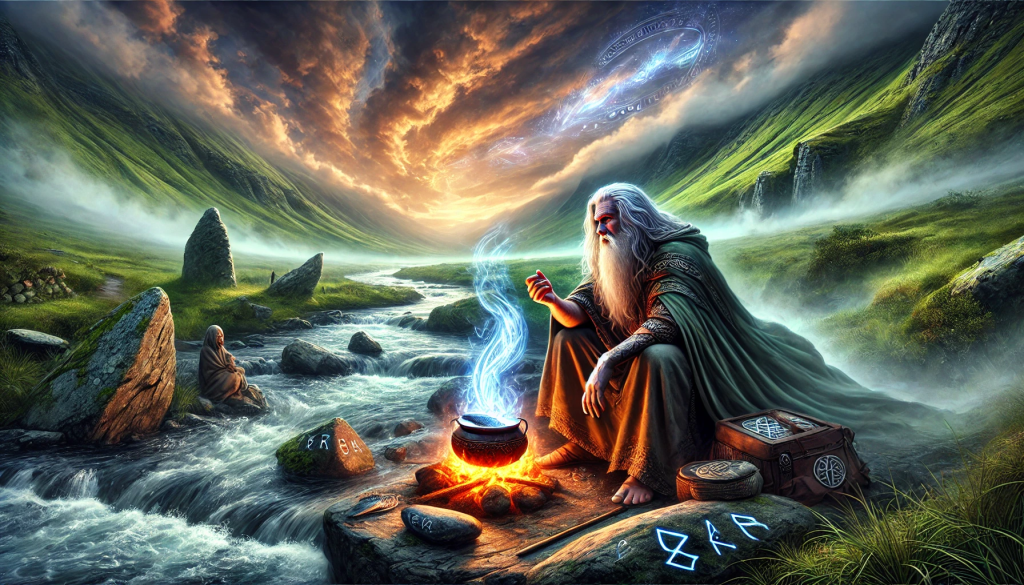
This breathtaking, realistic, and artistic fantasy-style landscape illustration captures the pivotal moment of Fin (Fionn mac Cumhaill) unlocking divine wisdom. Seated beside a flowing river in ancient Ireland, with mist rolling over emerald hills, Fin carefully cooks the legendary Salmon of Wisdom over a small fire under the watchful eye of the druid Finnegas, an elderly sage with deep-set eyes and flowing robes.
As Fin accidentally touches the hot salmon, he instinctively places his burned thumb in his mouth—his piercing blue eyes widening as divine knowledge floods his mind. A supernatural glow envelops him, and the river and sky radiate ethereal light, marking the instant he gains the ability to see the past, present, and future. The air crackles with mystical energy, and ancient Celtic runes shimmer faintly on nearby standing stones, reinforcing Fin’s transformation into a seer and enlightened being—an Enki avatar gifted with foresight and knowledge.
Stories About Fin
The Giant’s Causeway – A Battle Between Gods
One of the most famous stories tells of Fin’s legendary battle with the Scottish giant Benandonner. Fin built the Giant’s Causeway, a massive stone bridge between Ireland and Scotland, to challenge his rival. When he saw the immense size of Benandonner, he cleverly disguised himself as a giant baby. Seeing the size of this supposed infant, Benandonner panicked, assuming that the baby’s father (Fin) must be enormous, and fled, destroying the Causeway behind him.
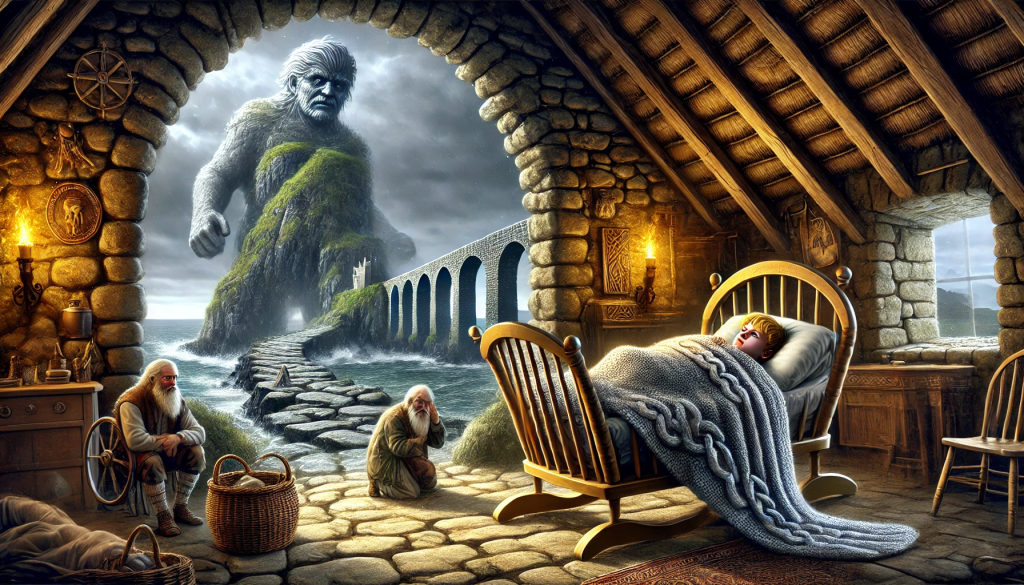
This breathtaking, realistic, and artistic fantasy-style illustration captures the legendary tale of Fin (Fionn mac Cumhaill) and the Scottish giant Benandonner. Inside a stone-built Celtic home, Fin disguises himself as a giant baby, wrapped in large woven blankets in an oversized cradle. His golden hair and piercing blue eyes peek through, as he pretends to sleep. At the doorway, Benandonner, a colossal and menacing figure, looms in shock and fear, his expression twisted with disbelief as he gazes at the supposed ‘infant.’ The sheer size of the child convinces him that Fin’s father must be an unimaginable giant, and panic sets in. Beyond the threshold, the Giant’s Causeway stretches toward Scotland, its massive stone formations beginning to crumble as Benandonner hastily retreats, smashing the bridge behind him to ensure Fin cannot follow. The air hums with supernatural energy, blending humor and myth, emphasizing Fin’s cunning intelligence and divine presence as an avatar of Enki.
This tale reflects Enki’s trickster wisdom—using intellect over brute force to solve problems.
The Battle Against Aillen – The Fire-Breathing Fomorian
Each year, the demonic fire-breathing being, Aillen, would emerge from the underworld and burn Tara, the seat of Irish kings, with his fire. No warrior could stop him, as Aillen’s music put them to sleep.
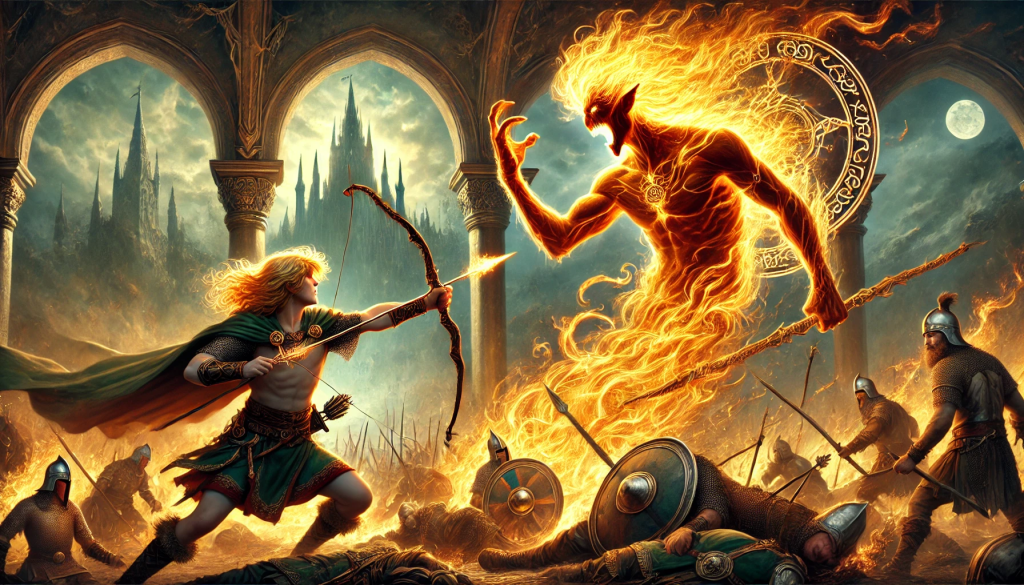
This breathtaking, realistic, and artistic fantasy-style illustration depicts the legendary battle between Fin (Fionn mac Cumhaill) and Aillen, the fire-breathing demon of the underworld, at the gates of Tara, the sacred seat of Irish kings. Aillen, wreathed in flames, emerges from the shadows of the Otherworld, ready to unleash his fiery breath upon the city once more. Around them, warriors lie unconscious, enchanted by Aillen’s deadly music, unable to defend their kingdom. However, Fin alone remains standing, using his supernatural wisdom—biting his thumb for foresight while pressing the tip of his spear into his forehead to stay awake. His golden hair flows wildly, and his piercing blue eyes burn with determination as he raises his weapon in a dramatic final strike, piercing the demon just as flames swirl around them. The majestic halls of Tara loom in the background, partially illuminated by fire and moonlight, creating a scene of myth, heroism, and divine intervention.
However, Fin, using his supernatural wisdom, chewed his thumb for foresight and found a way to stay awake by pressing the tip of his spear into his forehead. He then slew Aillen, saving Tara and securing his place as leader of the Fianna.
This act mirrors Enki’s battles against chaotic forces, where knowledge and cleverness triumph over destruction.
The Woman from the Sidhe – Love and Transformation
Fin fell in love with a beautiful woman named Sabh, who was cursed by a jealous druid into the form of a deer. Fin found her in the woods, and he broke her enchantment with his love, restoring her human form. They lived happily for a time, but one day she was kidnapped by the same druid and vanished into the Otherworld, never to return.
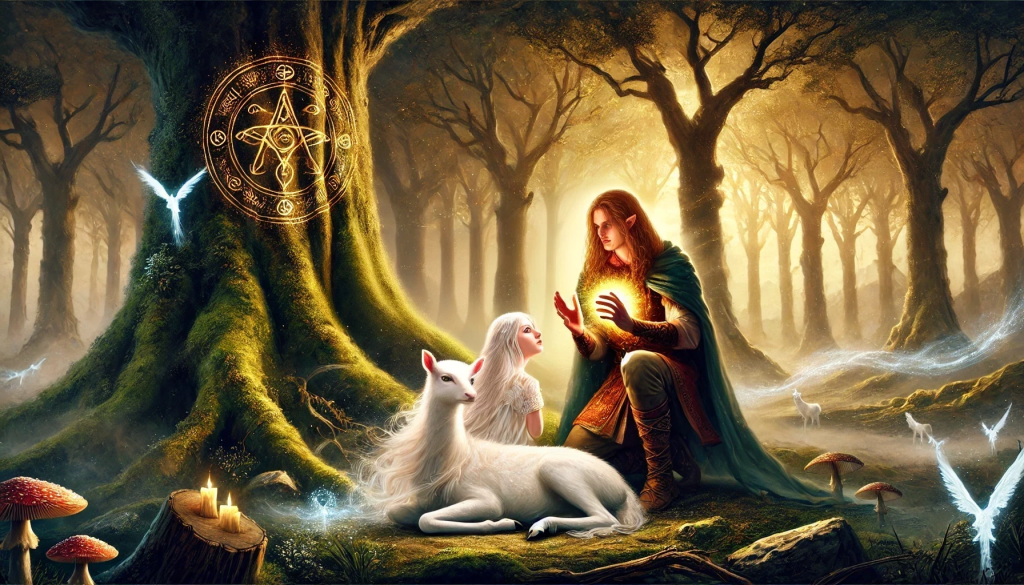
This breathtaking, realistic, and artistic fantasy-style illustration captures the legendary love story of Fin (Fionn mac Cumhaill) and Sabh in an enchanted Celtic forest. Fin, a firm yet gentle warrior with golden hair and piercing blue eyes, kneels beside a majestic white deer, his hands radiating warmth as he restores Sabh to her human form. The air shimmers with magic as her transformation unfolds. Her delicate features emerge from the fading enchantment, now fully detailed, including both visible ears. The ancient trees, bathed in soft golden light, tower over them, their bark glowing with mystical Sidhe symbols, marking the presence of Otherworldly power. Yet, hidden in the distance, a shadowy druid lurks at the edge of the trees, his dark eyes watching. He plots to reclaim Sabh and drag her back into the Otherworld, ensuring their love remains fleeting and tragic. The scene perfectly blends love, transformation, and sorrow, capturing Fin’s divine essence as an avatar of Enki, whose love and wisdom challenge even the most powerful enchantments.
This story reflects themes of love, loss, and the mystical forces of fate—a common thread in Enki’s incarnations.
The Enchanted Hounds – A Family Mystery
One of Fin’s most tragic yet mystical tales involves his son, Oisín. Unknown to Fin, his wife was a Sidhe (faery being), and when their child was born, he was turned into a hound named Bran. Fin unknowingly raised and loved his son in hound form, showing his compassion and connection to both human and magical realms.
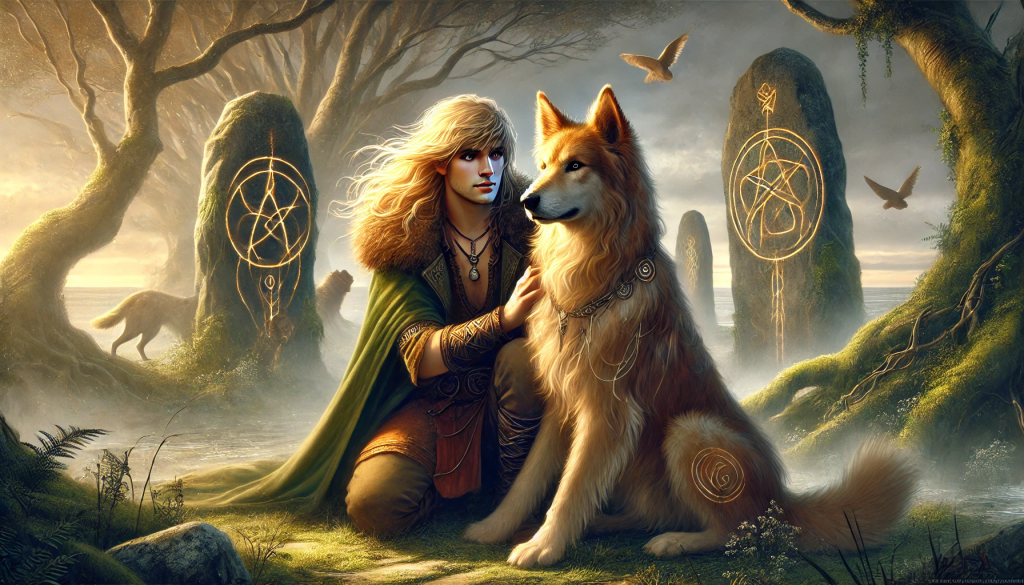
This breathtaking, realistic, and artistic fantasy-style illustration captures the tragic yet mystical tale of Fin (Fionn mac Cumhaill) and his enchanted hound, Bran. In a misty Celtic landscape, Fin, a noble warrior with long, flowing golden hair and piercing blue eyes, kneels beside Bran, a majestic hound with an ethereal glow, his fur shimmering with supernatural energy. Fin’s expression is filled with love and unspoken understanding, unaware that Bran is his son, Oisín, transformed by the magic of the Sidhe. The background features ancient standing stones inscribed with glowing mystical symbols, hinting at the faery origins of Bran’s transformation. Soft golden light filters through the enchanted forest, casting an air of mystery, sorrow, and magic over the scene. This illustration captures the deep connection between Fin and Bran, symbolizing Fin’s compassion and bond with the human and magical realms. Fin unknowingly raises and loves his son in hound form.
This mirrors Enki’s role as a protector of hybrid beings, guiding both divine and mortal offspring.
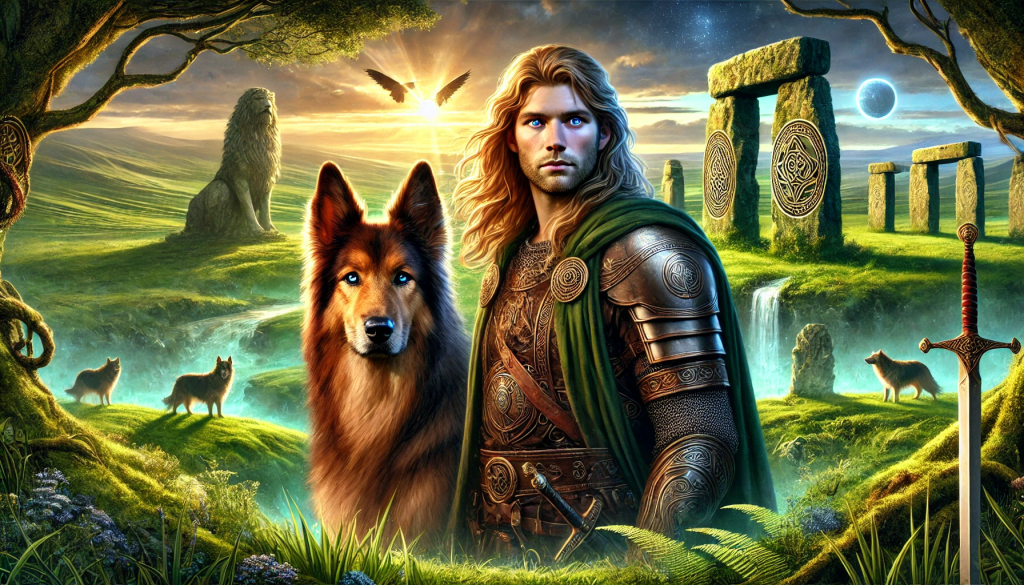
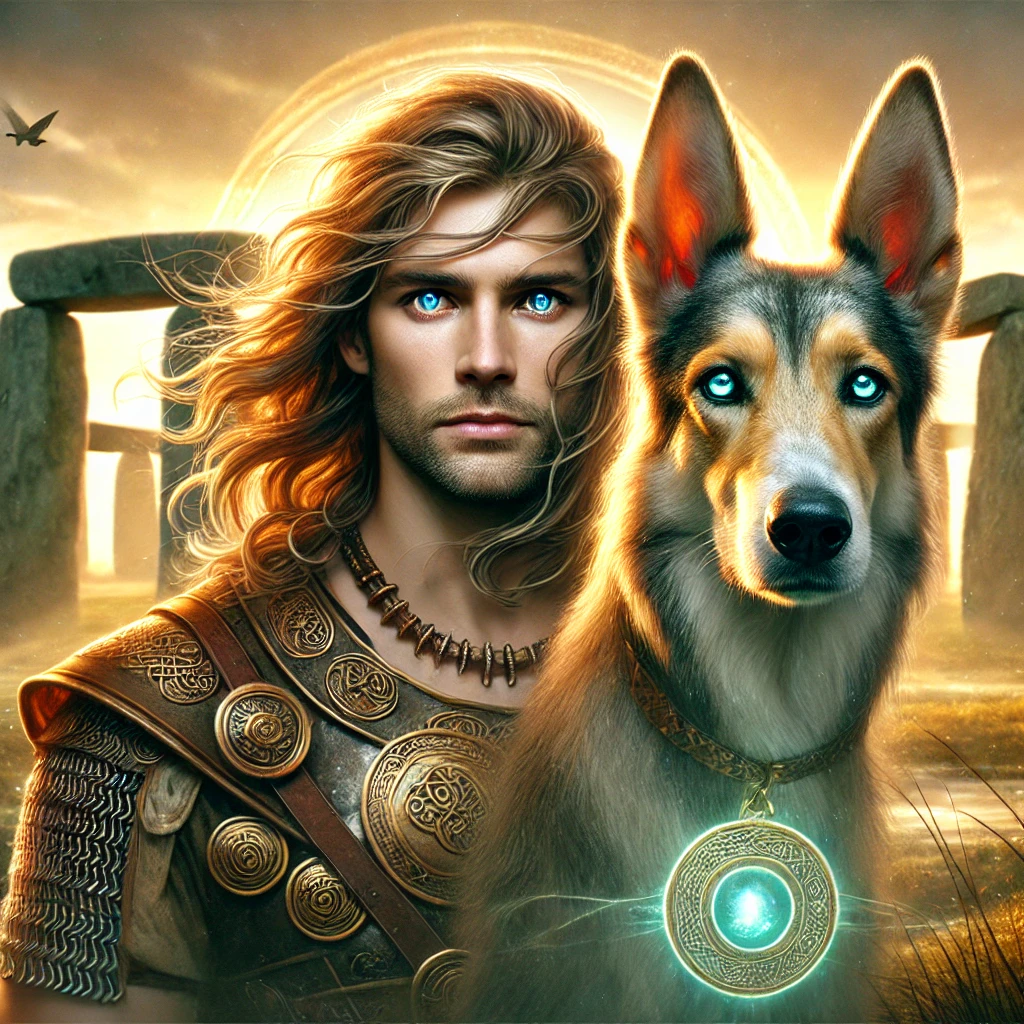
In a realm where magic and legend intertwine, the noble warrior of the Enchanted Hounds story stands as a guardian of the sacred path. His piercing blue eyes mirror the wisdom of the ancients, and his flowing golden hair carries the essence of nobility. Clad in intricate armor and draped in a green cloak, he exudes a warrior’s strength and a seer’s intuition. Beside him, his enchanted hound—a mystical wolf-like being with luminous blue eyes—stands as both protector and companion. These hounds, bound to him through destiny, serve as messengers of the spirit world and guides to those who seek hidden truths. The landscape is enchanting: sacred standing stones etched with ancient Celtic symbols rise in the twilight, pulsating with latent energy. A celestial body glows above, casting an ethereal shimmer upon the cascading waters that flow through the verdant hills. In the distance, other enchanted hounds patrol the land, ever watchful. The stone lion statues, guardians of forgotten wisdom, silently observe the unfolding of fate. At the same time, the warrior’s sword, embedded in the earth, symbolizes his commitment to the realm and connection to the great mysteries. This scene captures the magic, guardianship, and timeless legend of the Enchanted Hounds, where the bond between warrior and hound is unbreakable, and the path to enlightenment is guarded by those who walk between worlds.
Fin’s Great Sleep – A Hero’s Return?
Much like King Arthur, some legends say that Fin never indeed died. Instead, he and his warriors sleep in a hidden cave, waiting to awaken when Ireland needs them most.
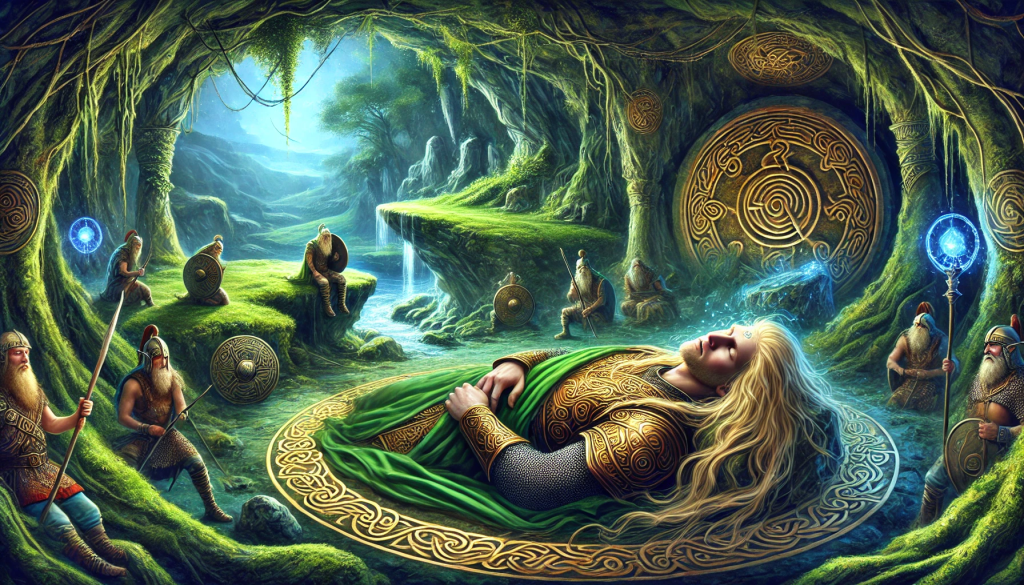
This breathtaking, realistic, and artistic fantasy-style landscape illustration captures the legendary slumber of Fin (Fionn mac Cumhaill) and his warriors in a hidden cave deep beneath the emerald hills of Ireland. Fin lies in enchanted sleep, his long flowing golden hair framing his peaceful face, while his intricately detailed armor gleams faintly in the cavern’s mystical glow. Surrounding him, the Fianna warriors rest, their weapons at their sides, as if waiting for the moment they must rise again. The cavern walls are etched with glowing Celtic symbols, emanating an ethereal blue-green light, hinting at the ancient magic preserving them. Vines and ancient roots creep down from the ceiling, marking the passage of time. At the same time, the air shimmers with supernatural energy, whispering of the prophecy that when Ireland is in peril, Fin and his warriors will awaken once more. This mirrors Enki’s eternal role as a protector and guide, ensuring that wisdom and guardianship never fade, only waiting for the right moment to return.
This idea of eternal guardianship mirrors Enki’s timeless role as a protector and guide for humanity.
Illustrations for Fin
Fin as a Youth Training with Druids – A young boy, raised in the wilderness, learning druidic magic and combat.
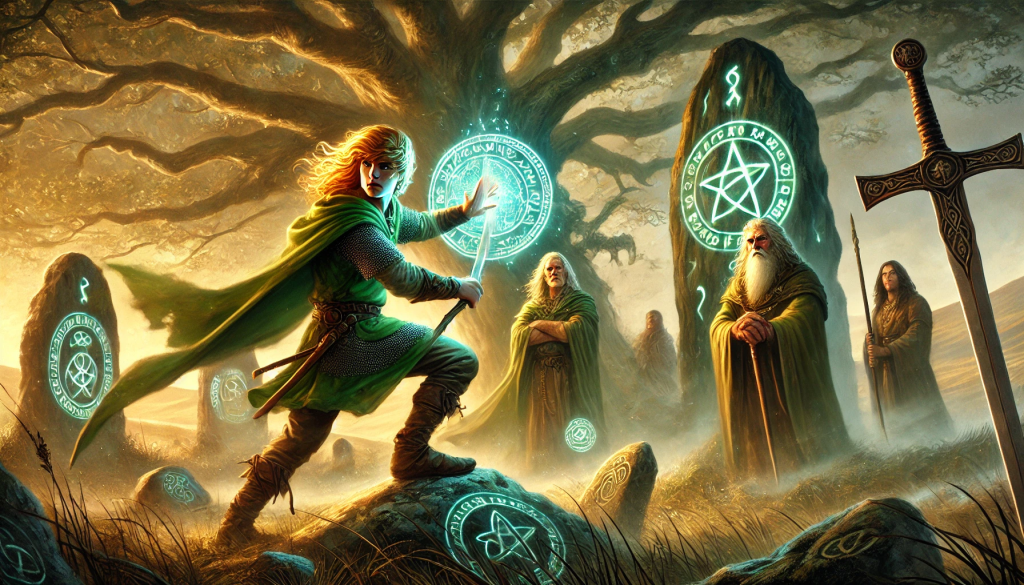
This breathtaking, realistic, and artistic fantasy-style landscape illustration captures young Fin (Fionn mac Cumhaill) in the mystical wilderness of ancient Ireland, where he trains under the guidance of wise druids to master both combat and druidic magic. In the foreground, a youthful Fin with long golden hair and piercing blue eyes wields a wooden training sword poised with natural agility. His other hand glows faintly with supernatural energy, symbolizing his growing connection to the Otherworld. Druids in flowing green robes stand nearby, their expressions wise and mysterious, observing his training as they whisper the secrets of nature and magic. The background is alive with mysticism, featuring towering ancient oak trees, standing stones inscribed with glowing Celtic runes, and a golden mist drifting through the forest, hinting at the unseen spirits guiding his path. The atmosphere is sacred learning and hidden power, marking Fin’s transformation from a young boy into a warrior-seer, destined for greatness.
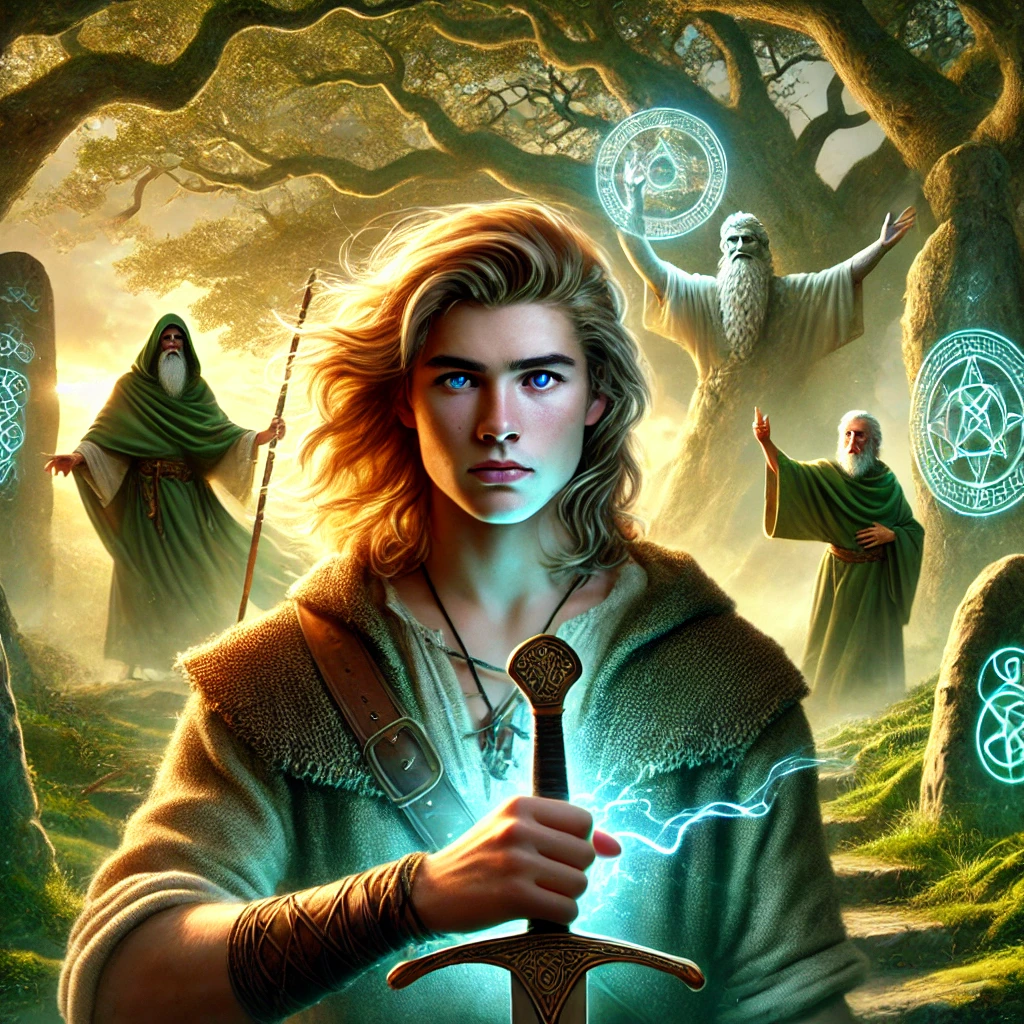
The Salmon of Wisdom – Fin touching the fish and gaining supernatural insight.
“The Salmon of Wisdom – Fin’s Awakening”
This breathtaking, realistic, and artistic fantasy-style landscape illustration captures the pivotal moment of young Fin (Fionn mac Cumhaill) experiencing enlightenment as he touches the legendary Salmon of Wisdom.
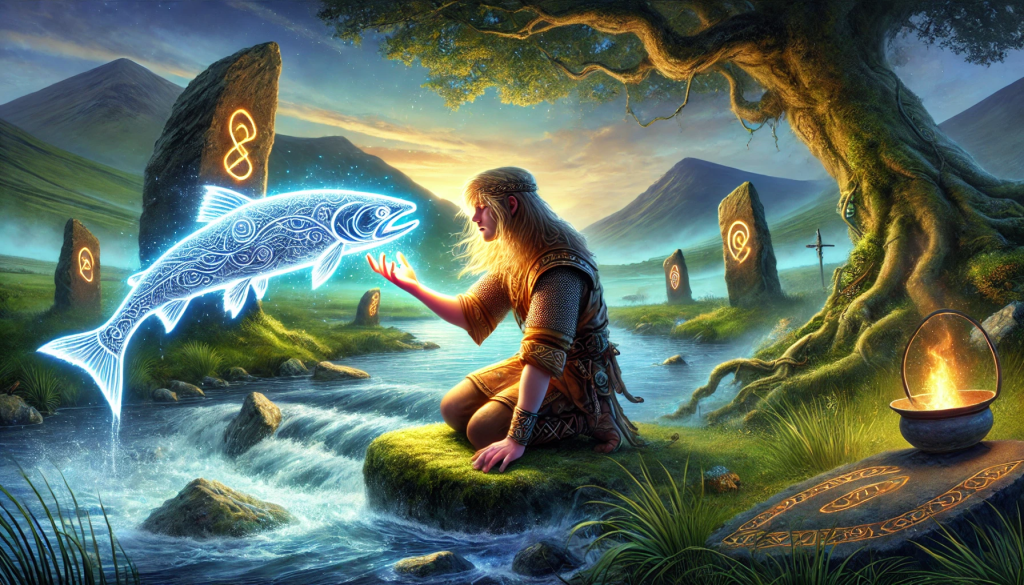
Fin, a youthful warrior with long golden hair and piercing blue eyes, kneels beside a glowing river in ancient Ireland. His face is illuminated with awe and supernatural insight as divine knowledge floods his mind. His hand, glowing faintly with mystical energy, rests upon the shimmering, ethereal fish, which radiates an otherworldly light.

The background features towering ancient oak trees, standing stones etched with glowing Celtic runes, and mist rolling over emerald hills. The atmosphere is mystical and transformative, capturing the exact moment Fin gains the ability to see the past, present, and future. This marks his destiny as a seer and enlightened being, much like Enki’s gift of foresight.
The Giant’s Causeway Battle – Fin disguised as a baby while Benandonner flees in terror.
“The Giant’s Causeway Battle – Fin’s Clever Trick”
This breathtaking, realistic, and artistic fantasy-style landscape illustration captures the legendary battle of wits between Fin (Fionn mac Cumhaill) and the Scottish giant Benandonner at the awe-inspiring Giant’s Causeway.
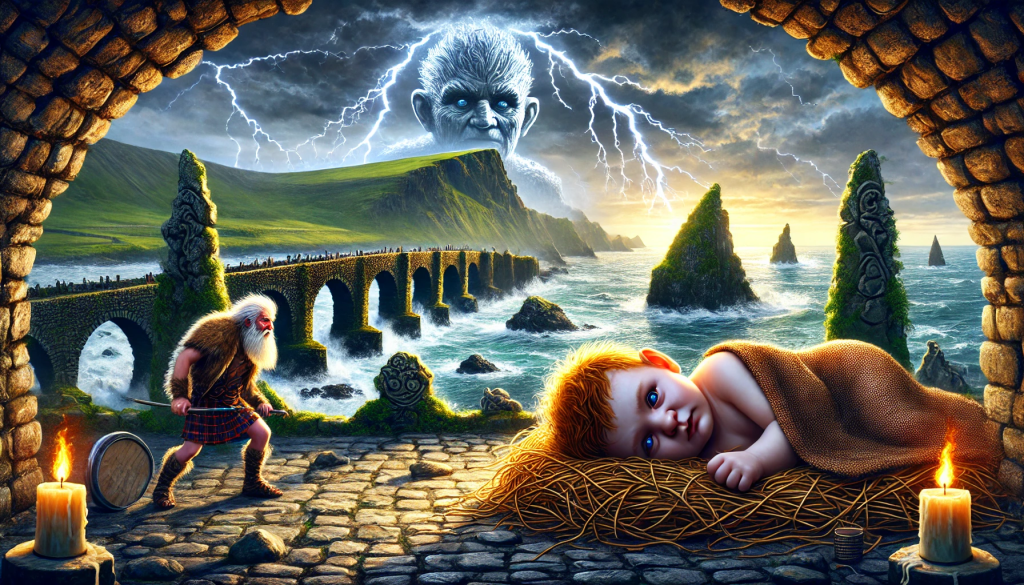
The scene shows Fin disguised as a massive infant, swaddled in woven blankets inside a stone-built Celtic home. His golden hair and piercing blue eyes are barely visible as he feigns sleep. At the entrance, Benandonner, a towering and menacing figure, gazes at the supposed ‘baby’ in utter shock and fear, realizing that if this is Fin’s child, the father must be an even more massive and terrifying opponent.
The Giant’s Causeway stretches across the sea between Ireland and Scotland, with sections of the stone bridge crumbling as Benandonner flees in terror. The air crackles with supernatural energy, reflecting this legendary tale’s blend of humor, wit, and myth. It captures Fin’s cleverness and legendary status as a trickster-warrior.
“The Giant’s Causeway Battle – A Trickster’s Triumph”
This breathtaking, realistic, and artistic fantasy-style close-up illustration captures the legendary moment of Fin (Fionn mac Cumhaill) deceiving the Scottish giant Benandonner with his brilliant disguise.

In stunning detail, Fin, wrapped in woven blankets, lies posing as a giant baby inside a stone-built Celtic home. His golden hair and piercing blue eyes peek through as he feigns sleep, his youthful features subtly betraying intelligence and amusement behind the trick.
The focus is on Benandonner’s shocked expression as he stares at the enormous ‘infant’ in disbelief. His eyes are wide with terror, realizing that if this is Fin’s child, Fin himself must be a monstrous giant far beyond his strength.
This close-up highlights the humor, tension, and supernatural trickery that define this legendary Irish myth, emphasizing Fin’s wit and cunning over brute force.
Fin uses his spear in the Battle with Aillen to stay awake and slay the fire demon.
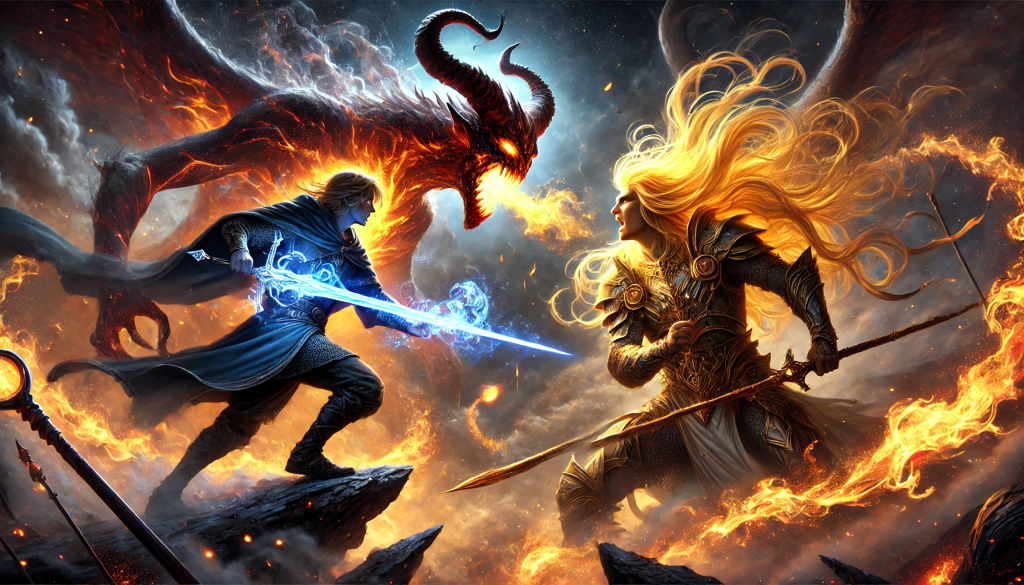
In a fiery clash of legend, Fin, a noble warrior with flowing golden hair and piercing blue eyes, stands firm against Aillen, the fearsome fire demon. The battlefield is engulfed in swirling smoke and flames beneath a dark, mystical sky. Aillen, wreathed in fire, unleashes a torrent of flame, yet Fin remains undeterred, gripping his enchanted spear tightly. The magical weapon glows with power, keeping him awake against Aillen’s sleep-inducing magic. Embers illuminate the scene as Fin presses forward, ready to strike a decisive blow. This moment captures the legendary battle of courage, magic, and destiny.
Fin and the Enchanted Hound – A heartwarming scene of Fin bonding with his hound-son, Bran.
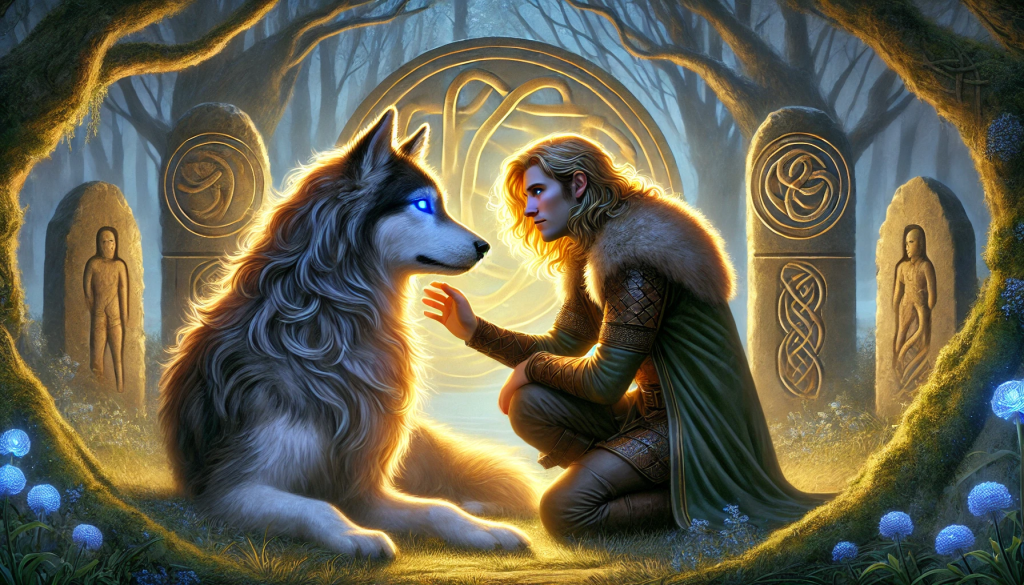
In a heartwarming moment of deep connection, Fin, the noble warrior with flowing golden hair and piercing blue eyes, kneels beside his enchanted hound, Bran. The majestic wolf-like hound gazes back at him with glowing blue eyes, radiating loyalty and intelligence. Soft, ethereal light bathes the scene in a mystical forest where ancient Celtic symbols are carved into standing stones, hinting at the magic that binds them. Fin’s hand gently touches Bran’s fur, symbolizing their unbreakable bond as warrior and hound-son. The atmosphere is serene and warm, capturing the timeless companionship between them.
When Did Fin Live?
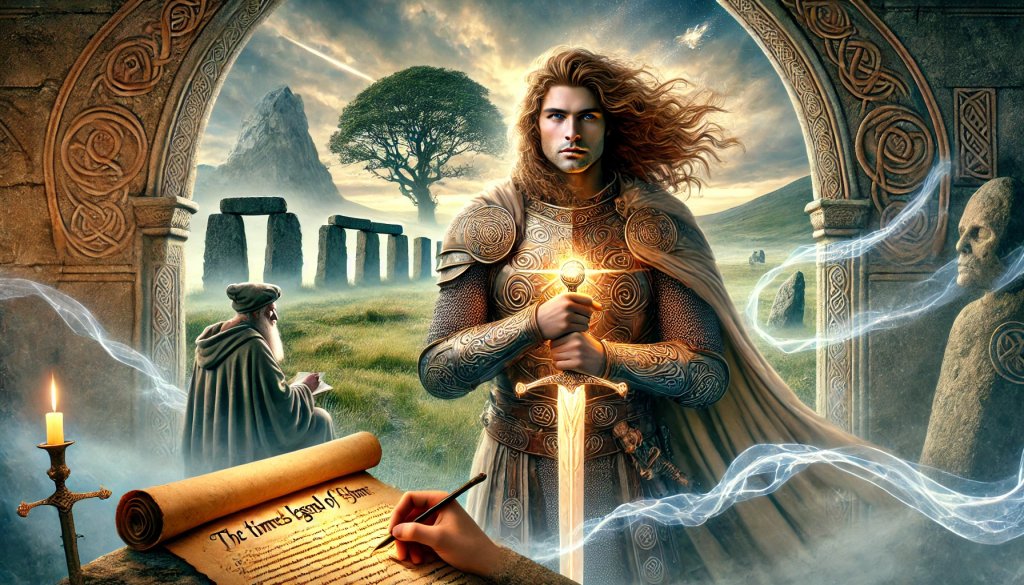
Description: Fin stands at the threshold of history and myth, his golden hair flowing in the wind, piercing blue eyes gazing forward with quiet intensity. Clad in ornate Celtic armor, he grips a glowing sword, symbolizing his legendary status. Behind him, two worlds converge—an ancient Irish landscape of standing stones and misty hills on one side, and a medieval scribe inscribing Fin’s story onto parchment on the other. Ethereal light swirls around him, hinting at the possibility that Fin never truly died but instead entered an enchanted sleep, waiting for the time of his return. This image embodies the mystery of his legend, where history and mythology intertwine, ensuring that his tale will never fade from memory.
Fin likely lived between 500 BCE – 500 CE. His legend blossomed in medieval texts (~12th–14th century CE), but oral traditions likely predate written records.
Approximate Dates for Fin:
- Birth: ~3rd century CE (approx. 200–250 CE)
- Death/Disappearance: ~4th century CE (approx. 280–350 CE) (or possibly entered an enchanted sleep, awaiting return)
These dates align with early Irish history, where Fin is portrayed as a legendary warrior-king who protected Ireland. However, his mythological status and connection to the Tuatha Dé Danann suggest a timeless, semi-divine existence beyond historical records.
“Fin’s Connection to the Tuatha Dé Danann”
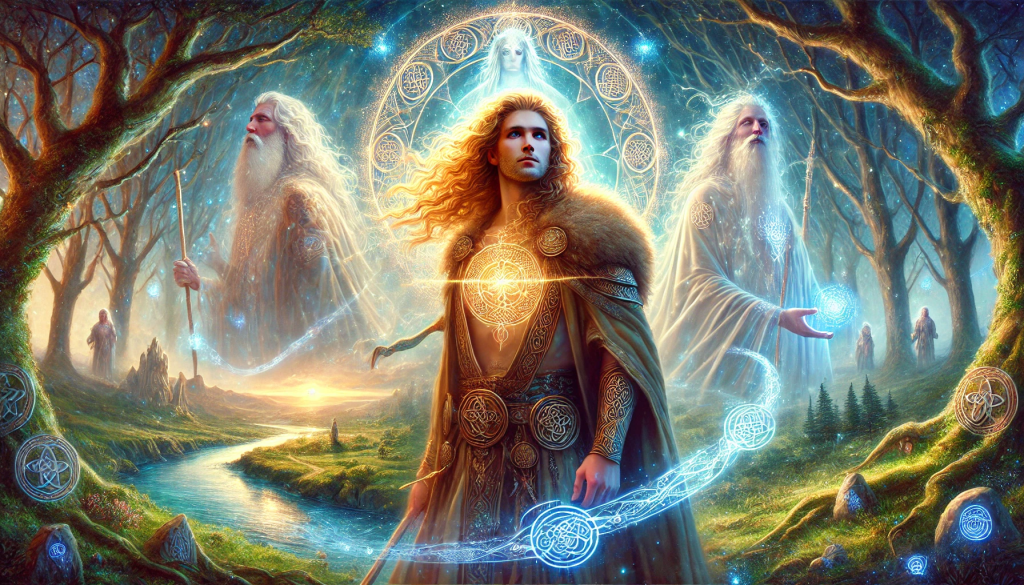
In a radiant, otherworldly realm, Fin stands illuminated by golden light, his flowing golden hair and piercing blue eyes reflecting his noble and semi-divine heritage. Around him, the Tuatha Dé Danann emerge from the mist, their luminous auras exuding wisdom and power. These ethereal beings, robed in celestial light, represent the divine lineage transcending history and time.
The landscape is rich with enchantment—glowing rivers weave through ancient forests, and floating Celtic symbols radiate with sacred energy. Fin’s stance is both reverent and powerful, as if acknowledging his eternal bond with these legendary beings. This scene captures the fusion of the mortal and divine worlds, emphasizing Fin’s timeless presence and mythological connection to the Tuatha Dé Danann.
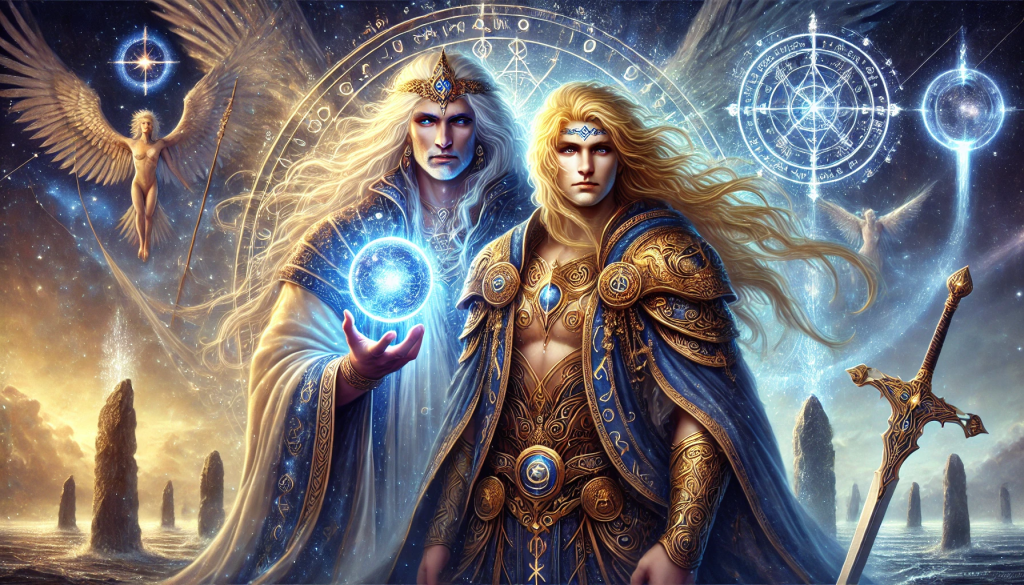
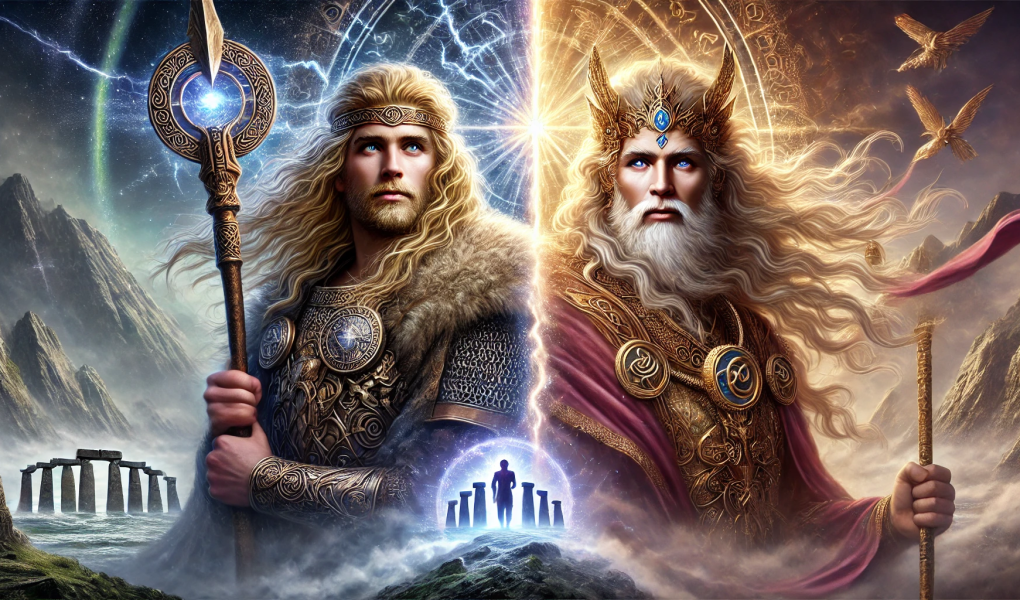
Enki and Fin stand side by side in this powerful and mystical illustration, embodying their connection to the Tuatha Dé Danann. Enki, the Anunnaki god of wisdom, wears flowing blue and gold robes inscribed with celestial symbols, his piercing blue eyes radiating divine knowledge. His lighter blonde hair flows like liquid starlight as he holds a glowing orb of ancient power. Beside him, Fin, the golden-haired leader of the Fianna, stands adorned in ornate Celtic armor engraved with luminous runes, his sharp blue eyes filled with the fire of leadership. Behind them, an ethereal landscape merges the realms of Irish and Anunnaki mythology—standing stones inscribed with glowing symbols rise from mist-covered waters, while celestial beings soar in the illuminated sky. This image captures the profound bond between warrior and sage, protector and guide, shaping the destiny of both Earth and the unseen realms.
The Saga of Fin: Keeper of Wisdom and Guardian of Realms (~200–350 CE)
In the shadowed glens of ancient Ireland, where mist rolled over emerald hills and the rivers sang to the spirits of old, a boy was born whose destiny would be whispered through time. He was Fin, later known as Fionn mac Cumhaill, the warrior-seer, the leader of the Fianna, and the chosen one of fate.
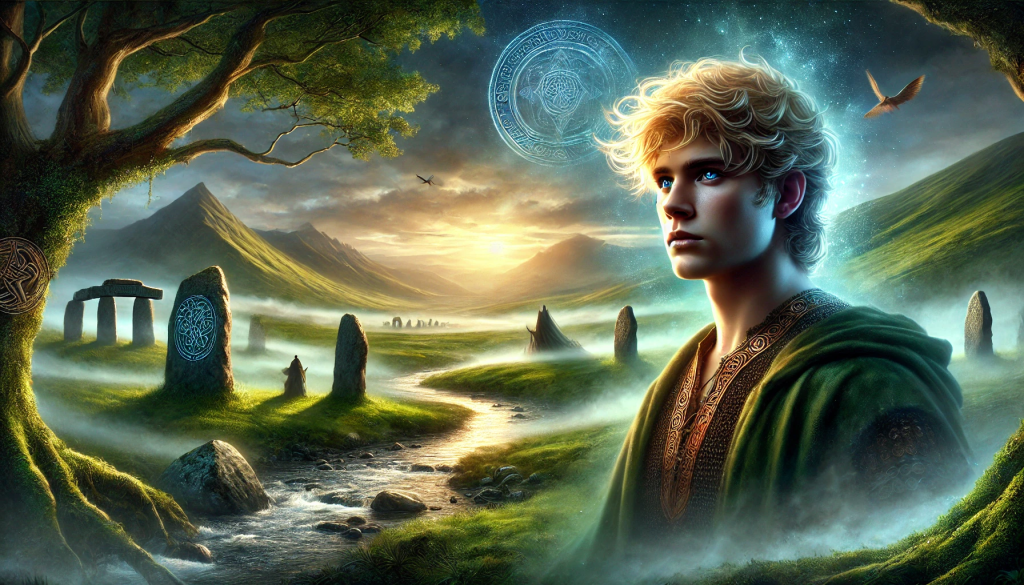
This breathtaking, realistic, and artistic fantasy-style landscape illustration captures the mystical beauty of ancient Ireland, where mist rolls over emerald hills, and rivers sing to the spirits of old. At the heart of the image, a young Fin (Fionn mac Cumhaill) stands, his golden hair glowing in the soft morning light. His piercing blue eyes reflect wisdom beyond his years, as he gazes over the wild, untamed land before him. The background features towering oak trees, ancient standing stones etched with glowing Celtic runes, and shadowy figures of legendary warriors watching over him, hinting at the epic destiny that awaits him.
The air shimmers with an ethereal glow, symbolizing the magic and fate woven into his path—the warrior-seer, the leader of the Fianna, and the chosen one of destiny.
But Fin’s birth was not joyfully welcomed—it was marked by prophecy and peril. His father, Cumhall, a mighty warrior, was slain before he could see his son. His mother, Muirne, fearing for the child’s life, placed him in the hands of two wise women—Bodhmall, a druidess, and Liath Luachra, a warrior maiden—who took him into the wild, raising him among the trees, the stars, and the whispers of the Otherworld.
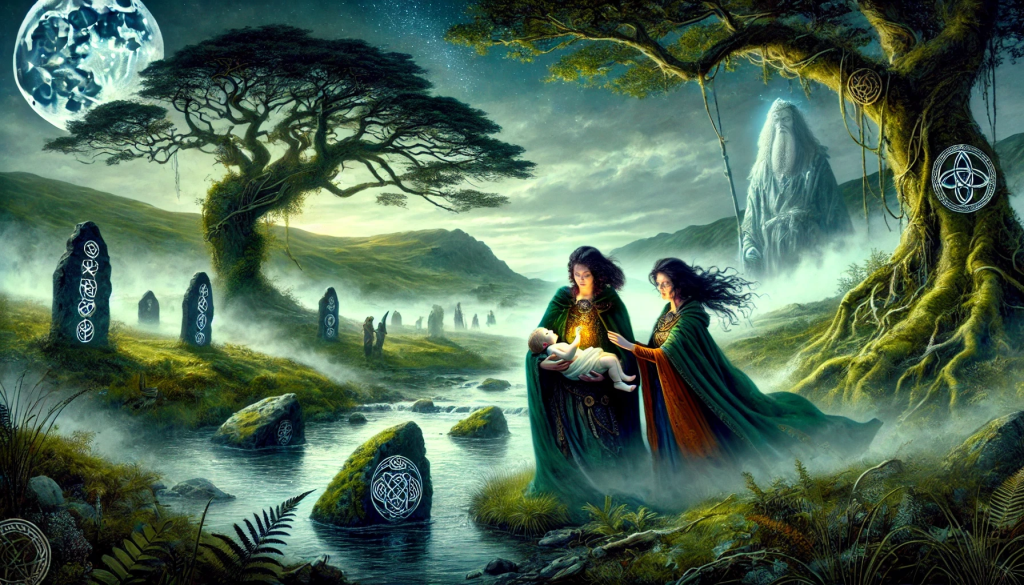
This breathtaking, realistic, and artistic fantasy-style landscape illustration captures Fin’s mystical and perilous origins (Fionn mac Cumhaill). In the mist-covered glens of ancient Ireland, where the rivers whisper of fate, two wise women—Bodhmall, a druidess in flowing green robes, and Liath Luachra, a fierce warrior maiden clad in armor—cradle a baby Fin, carrying him into the wild. Their faces show deep wisdom and quiet determination, knowing they safeguard a child destined for greatness. Behind them, the towering oak trees and ancient standing stones glow with mystical Celtic runes, hinting at the prophecy surrounding Fin’s birth. In the distance, the faint, ghostly silhouette of Cumhall, his fallen father, watches over them, a silent protector from beyond. The air shimmers with an ethereal glow, reflecting the Otherworld’s presence, as Fin is raised not among kings, but among the trees, the stars, and the whispered voices of fate.
Even as a child, Fin’s presence unsettled the land. The old seers spoke of him in hushed tones, claiming that his eyes saw beyond the veil of men, that his hands held the strength of giants, and that the world itself would shift at his command. But such power came at a cost—he would never know an ordinary life, nor the simple comforts of a home untouched by destiny.
The Salmon of Wisdom: The Touch of the Divine
As the years passed, Fin sought knowledge beyond mortal men. His journey led him to the druid Finnegas, who had spent decades hunting the Salmon of Wisdom, an ancient being that had devoured the hazelnuts of divine knowledge, making it the most enlightened creature.
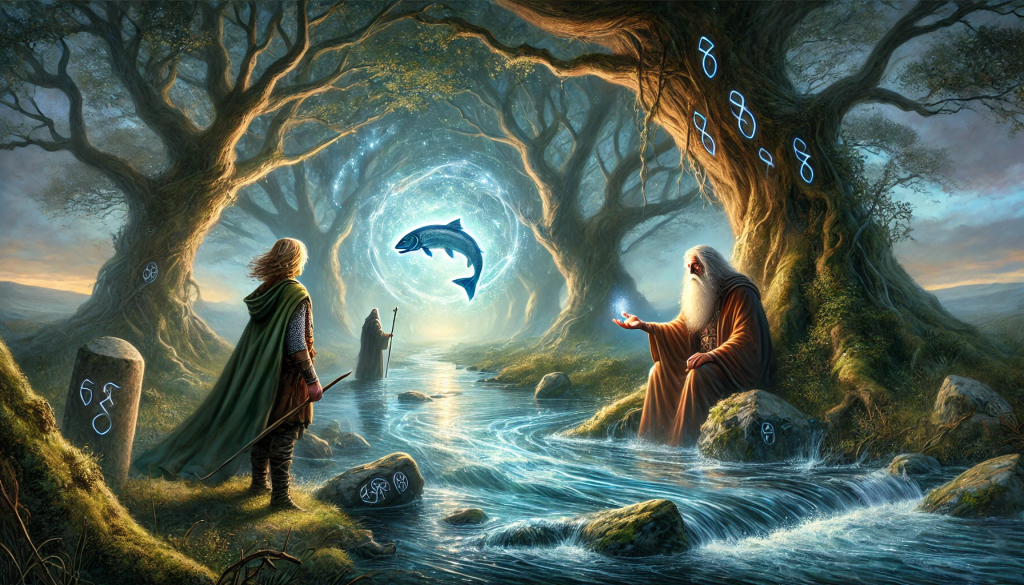
This breathtaking, realistic, and artistic fantasy-style landscape illustration captures Fin (Fionn mac Cumhaill) pursuing knowledge beyond mortal men. The scene unfolds in a mystical riverside glade in ancient Ireland, where towering oak trees cast long shadows over the shimmering waters. Fin, a young warrior with long golden hair and piercing blue eyes, stands before the wise druid Finnegas, an elderly sage with deep-set eyes and flowing robes, who has spent decades seeking the legendary Salmon of Wisdom. Beneath the water’s surface, the ethereal glow of the Salmon of Wisdom shimmers, hinting at the divine knowledge it holds, having consumed the sacred hazelnuts of wisdom. The air hums with supernatural energy, and Celtic runes faintly glow on nearby standing stones, marking this as a holy encounter in Fin’s journey toward enlightenment. This moment captures Fin’s deep yearning for knowledge, setting him on the path to his legendary transformation into a seer and enlightened being.
“The Universe Unfolds – Fin’s Moment of Enlightenment”
When Fin finally caught the fish, his master commanded him to cook it. But the heat burned his thumb as he turned it over the flames. Without thinking, he pressed it to his mouth. And in that instant, the universe unfolded before him.

This breathtaking, realistic, and artistic fantasy-style landscape illustration captures the pivotal moment when Fin (Fionn mac Cumhaill) absorbs the universe’s wisdom.
Seated beside a crackling fire in a mystical riverside glade in ancient Ireland, Fin, a young warrior with long golden hair and piercing blue eyes, carefully cooks the legendary Salmon of Wisdom. As he turns it over the flames, the heat burns his thumb, and without thinking, he presses it to his mouth.
In that instant, divine knowledge floods his mind, and his eyes widen in awe as the universe unfolds before him, with shimmering light and ancient Celtic runes swirling in the air. Nearby, the wise druid Finnegas watches in shock and understanding, realizing that destiny has chosen Fin as the true bearer of wisdom.
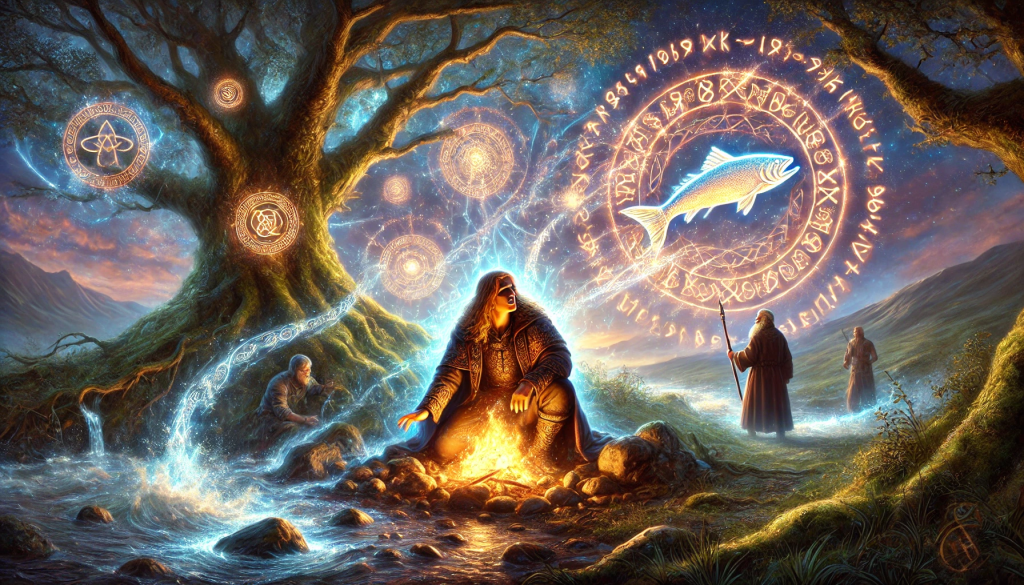
Above the fire, the legendary Salmon of Wisdom glows with ethereal light, as if suspended by unseen forces, symbolizing the divine knowledge flowing into Fin. Nearby, the wise druid Finnegas watches in reverence, realizing that fate has chosen Fin. The air vibrates with mystical power, marking Fin’s ascension into legend as a guardian of wisdom.
The atmosphere is charged with supernatural energy, marking this as the moment of Fin’s transformation into an enlightened seer, forever connected to the past, present, and future.
“The Enlightenment of Fin – Seer of Time”
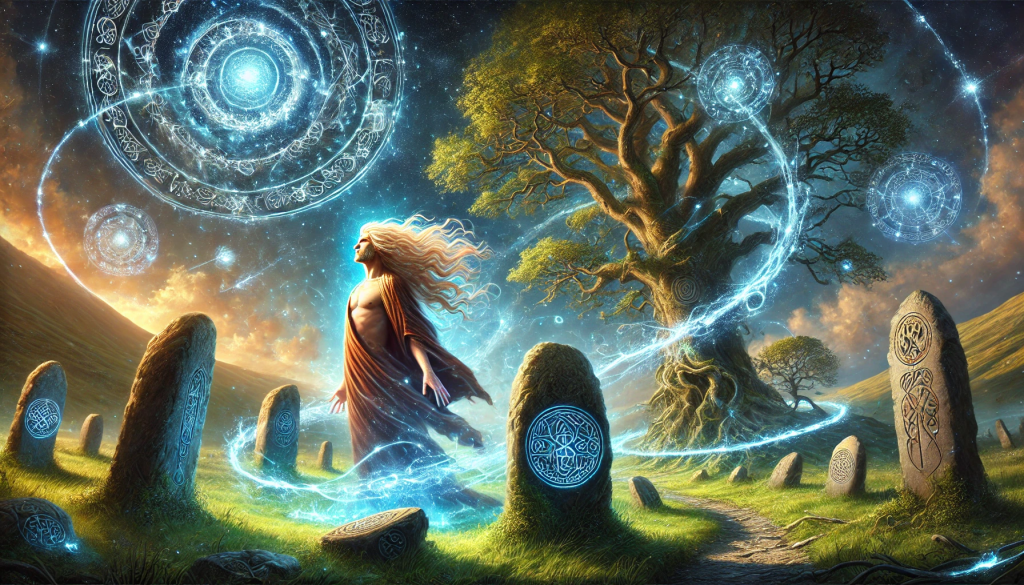
In a mystical riverside glade in ancient Ireland, towering oak trees stand silhouetted against a sky swirling with cosmic light. Fin, a young warrior with long golden hair and piercing blue eyes, kneels beside a crackling fire. His hands radiate supernatural energy as Celtic runes glow in the air around him, weaving visions of time itself. His expression is awe and understanding, fully embracing his destiny as an enlightened seer.
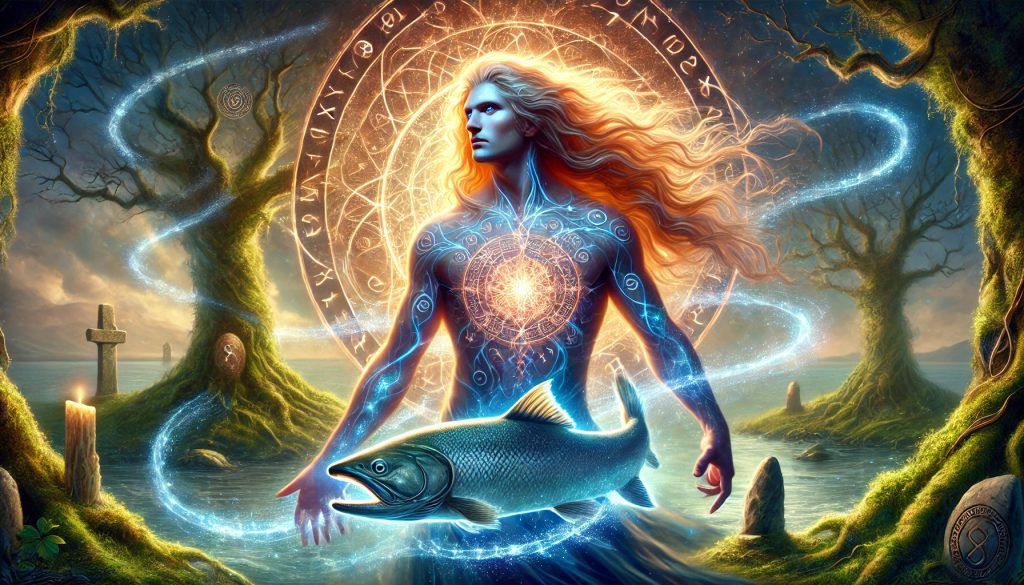
The Vision of Fin – Unraveling the Cosmos
He saw the threads of fate woven into the stars, the voices of the land speaking in forgotten tongues, the secrets of creation humming in his blood. From that day forth, knowledge surged through him whenever he placed his thumb in his mouth—he could see the past, the present, and the yet-to-come.
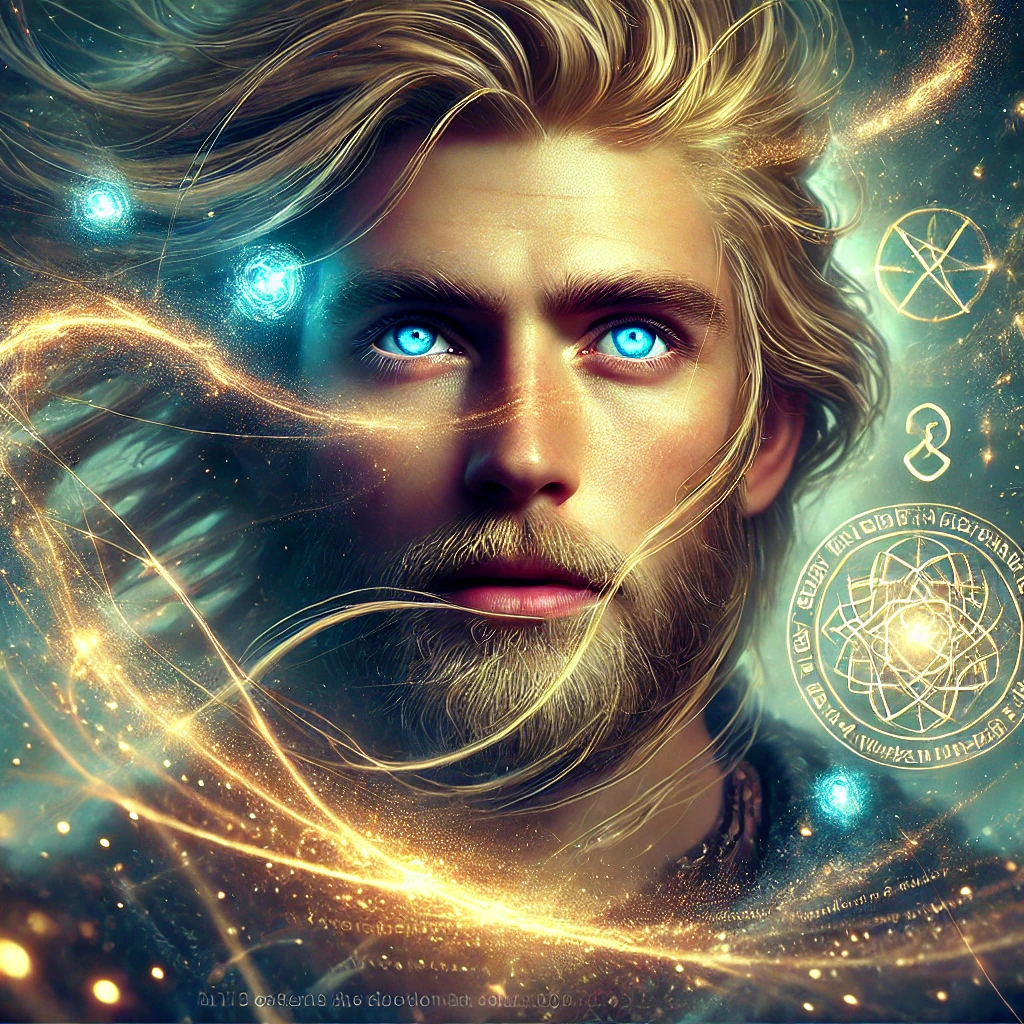
This close-up illustration captures Fin’s piercing blue eyes wide with awe and revelation, bathed in an ethereal glow as cosmic threads swirl around him, reflecting the universe unfolding before his gaze. His golden hair flows in a mystical current, and Celtic runes pulse with energy in the air, marking the moment he transforms into an enlightened seer, forever connected to time.
“The Ascended Seer – Fin’s Final Transformation”
His face glows with supernatural wisdom, his piercing blue eyes reflecting infinite knowledge, and his golden hair flows as if carried by unseen cosmic forces. Around him, swirling celestial light and shimmering fate-bound threads weave through the air, symbolizing his eternal connection to time and destiny. Celtic runes pulse with ancient wisdom, surrounding him like whispers of the unseen realms.
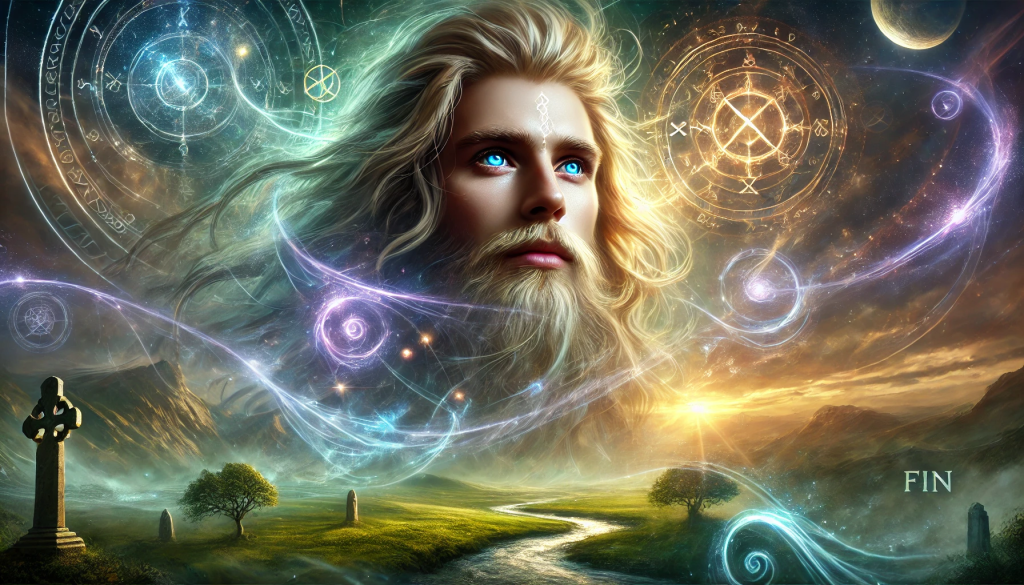
Behind him, the landscape glows with supernatural energy, marking the moment of his ascension into legend—a guardian of knowledge and a bridge between the mortal world and the divine.
This breathtaking, realistic, and artistic fantasy-style illustration captures the moment of Fin’s (Fionn mac Cumhaill) ultimate enlightenment, where he becomes one with the threads of fate, time, and creation itself.
No longer was he just a warrior. He was now a seer, a sage, and a vessel of divine understanding.
The Fianna and the Battle Against the Fire-Bringer
With his newfound wisdom, Fin journeyed to Tara, the seat of the High Kings, where a significant threat loomed. Each year, the fire-breathing being Aillen, a dark spirit from the Otherworld, would lull the warriors to sleep with his enchanted music before burning the halls of Tara to the ground.
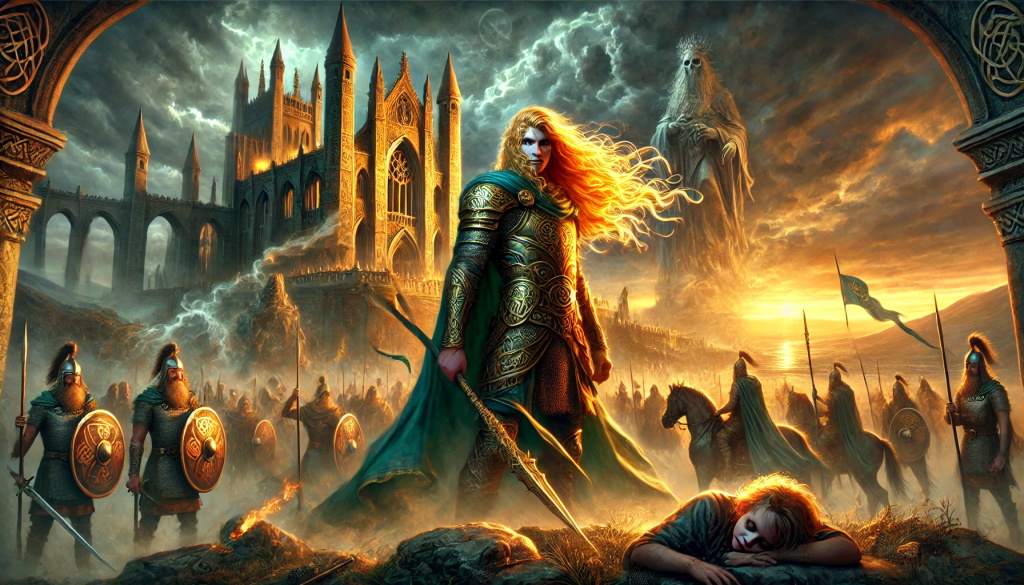
This breathtaking, realistic, and artistic fantasy-style landscape illustration captures the moment Fin (Fionn mac Cumhaill) arrives at Tara, the sacred seat of the High Kings of Ireland, as a significant threat looms. The grand halls of Tara stand tall in the background, bathed in golden light, but ominous storm clouds swirl above, signaling the imminent arrival of Aillen, the fire-breathing dark spirit from the Otherworld.
In the foreground, Fin stands resolute, his long, flowing golden hair illuminated by the fading sunlight. His piercing blue eyes reflect wisdom and determination as he grips his legendary spear, preparing to face the deadly foe. Around him, the warriors of Tara lie in an enchanted sleep, bewitched by the mystical music of the unseen enemy. The atmosphere is thick with supernatural energy, as glowing Celtic runes flicker on the ancient stone walls, and embers from previous destruction still smolder. This moment captures the tension, magic, and legendary heroism of Fin’s quest to protect Tara and fulfill his divine destiny.
No man could resist Aillen’s spell—no man but Fin.
On the eve of Samhain, as the warriors fell into enchanted slumber, Fin gripped his magical spear, pressing its tip into his forehead to stave off sleep. When Aillen arrived, his fire blazed through the night, but Fin did not falter. Fin leaped forward as the demon exhaled another inferno and drove his spear through its heart, banishing the creature back to the Otherworld.
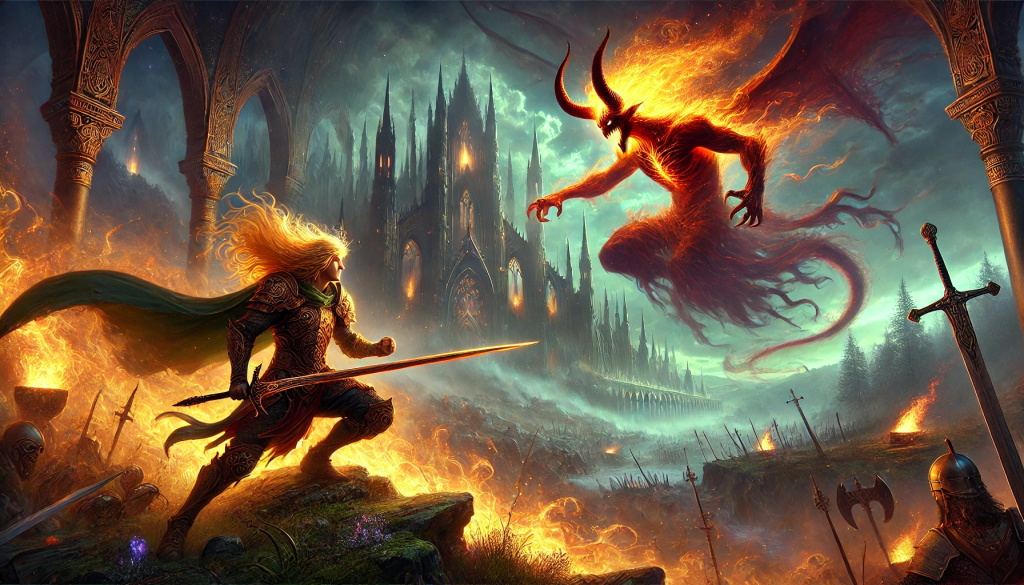
This breathtaking, realistic, and artistic fantasy-style landscape illustration captures the legendary battle of Fin (Fionn mac Cumhaill) against Aillen, the fire-breathing dark spirit from the Otherworld, on the eve of Samhain. The grand halls of Tara loom in the background, partially illuminated by fire and shrouded in supernatural mist, while the warriors of Tara lie in an enchanted sleep, bewitched by Aillen’s magical music. In the foreground, Fin stands resolute, his long golden hair flowing and piercing blue eyes filled with determination. He presses the tip of his enchanted spear into his forehead, resisting the sleep spell, his intricately detailed armor glowing faintly under the infernal light. Before him, Aillen, wreathed in flames, unleashes a torrent of fire, but Fin does not falter. In a dramatic moment, he leaps forward, driving his spear through the demon’s heart, banishing it back to the Otherworld. The air crackles with supernatural energy, embers swirl in the fiery night, and ancient Celtic runes glow on the stones of Tara, marking this as a night of destiny.
For this, he was named leader of the Fianna, the legendary band of warriors who protected Ireland.
The Giant’s Causeway: The Battle of Wits and Strength
But Fin was not only a warrior—he was a trickster, a thinker, a man who valued wit as much as strength. When the Scottish giant Benandonner challenged him to battle, Fin constructed the Giant’s Causeway, a mighty stone bridge across the sea, to meet in combat.
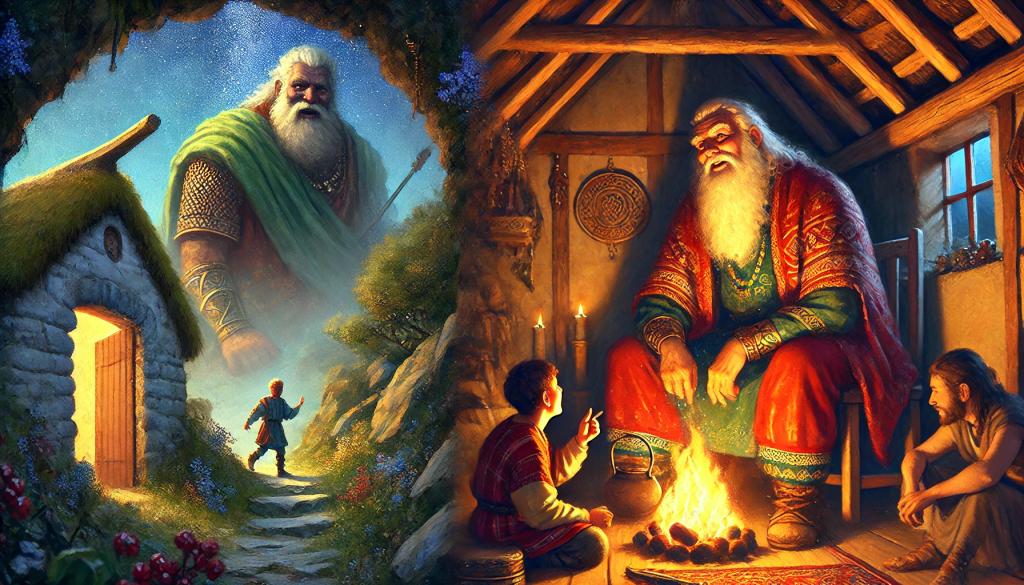
Yet, as he neared Scotland, he realized Benandonner was far more significant than he had imagined. Fin knew brute strength would fail him, so he devised a ruse of brilliance.
He returned home and disguised himself as a massive infant, swaddled in cloth, lying in a grand cradle. When Benandonner arrived and saw the supposed child of Fin, he quailed in fear—for if this was the baby, how immense must the father be? Terrified, the giant fled back to Scotland, destroying the Causeway behind him.
Fin had once again triumphed not by might, but by mind.
“Tricksters and Masters of Strategy – The Giant’s Causeway & The Ruse of Eridu”
“The Tricksters’ Gambit”
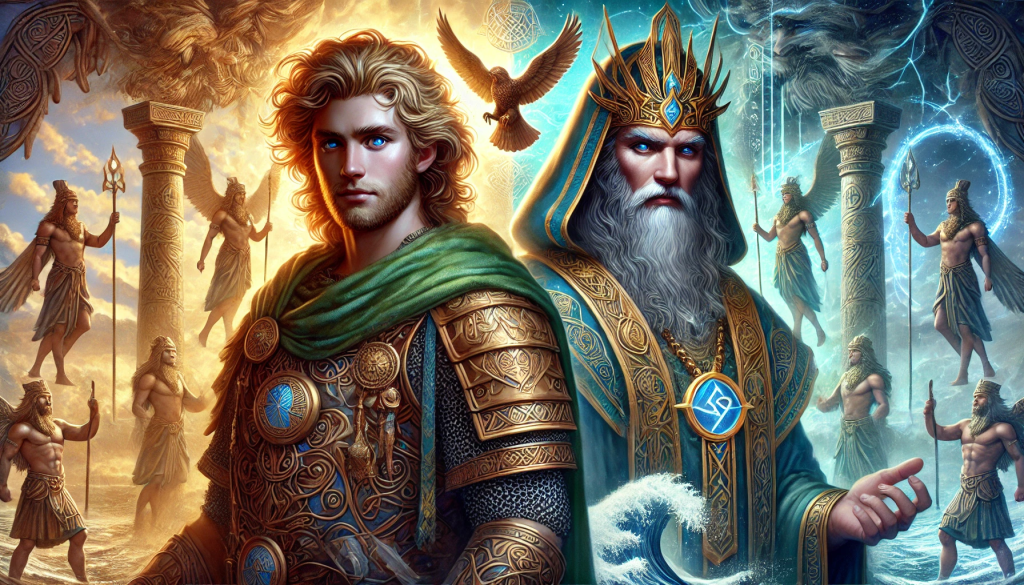
Fin (Fionn mac Cumhaill) and Enki, two legendary tricksters, stand side by side, their piercing blue eyes filled with intelligence and mischief. Fin, clad in ornate Celtic armor, exudes the confidence of a warrior, while Enki, draped in flowing robes adorned with ancient symbols, radiates otherworldly wisdom. Their expressions reveal cunning and strategic brilliance as they prepare to outmaneuver unseen foes, using intellect over brute force.
The background merges Irish and Sumerian landscapes, with mystical waters flowing between them, symbolizing their connection across time and cultures. Ethereal light enhances the scene, highlighting their shared role as guides and protectors of knowledge. This illustration captures the timeless bond between two masterful tricksters who shape fate through wisdom, strategy, and divine insight.
Fin’s Trick on Benandonner: Fin, disguised as a giant baby, sits by a warm Celtic hearth, as the massive Scottish giant Benandonner looms in the doorway, his face twisted in shock and fear. The firelight flickers against the stone walls, adding tension as Benandonner panics, believing Fin’s ‘father’ must be even bigger and more powerful than himself.
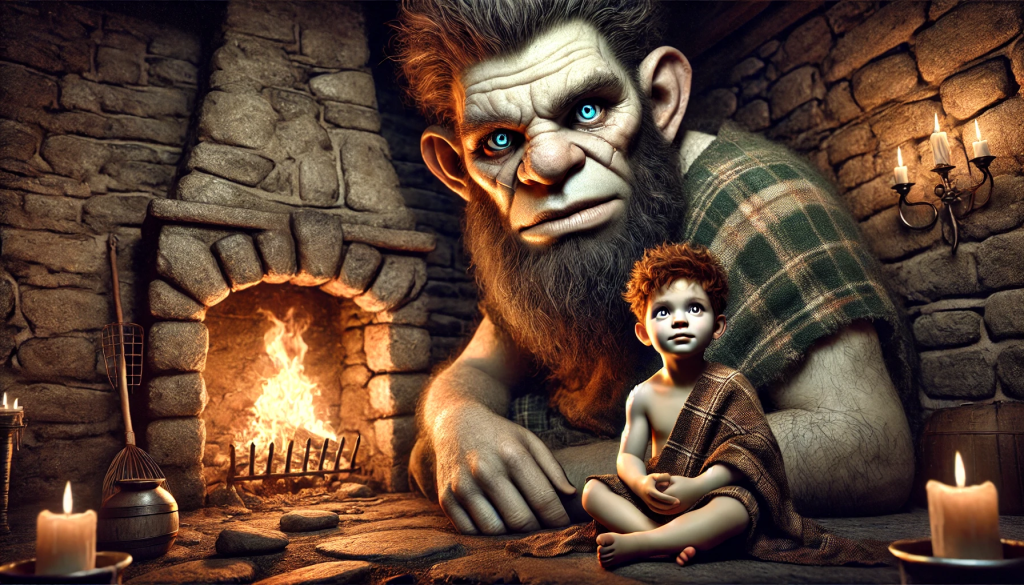
The scene captures the legendary moment of deception—Fin, disguised as a giant baby, sits by the warm glow of a Celtic hearth, his massive form wrapped in soft linens. His piercing blue eyes sparkle with intelligence and mischief as he plays the role convincingly. Across the room, the towering Scottish giant Benandonner looms in the doorway, his face twisted in shock and fear. The sheer size of the ‘baby’ unnerves him—if the child is this enormous, how terrifying must the father be? The firelight flickers against the ancient stone walls, casting dramatic shadows that enhance the tension and humor of the trick. The close-up perspective captures Fin’s sly smirk and Benandonner’s wide-eyed panic, making their expressions and emotions the focal point of the legendary ruse.
Enki’s Ruse on Enlil: The second scene transports us to ancient Sumer, where Enki, clad in flowing ceremonial robes, slyly transfers kingship to Eridu. His knowing smile and sharp gaze reflect his intelligence and foresight, while Enlil watches in suspicion as divine scrolls are exchanged. The grand temples of Eridu rise in the background, bathed in ethereal golden light, symbolizing Enki’s subtle yet masterful influence over civilization’s fate.
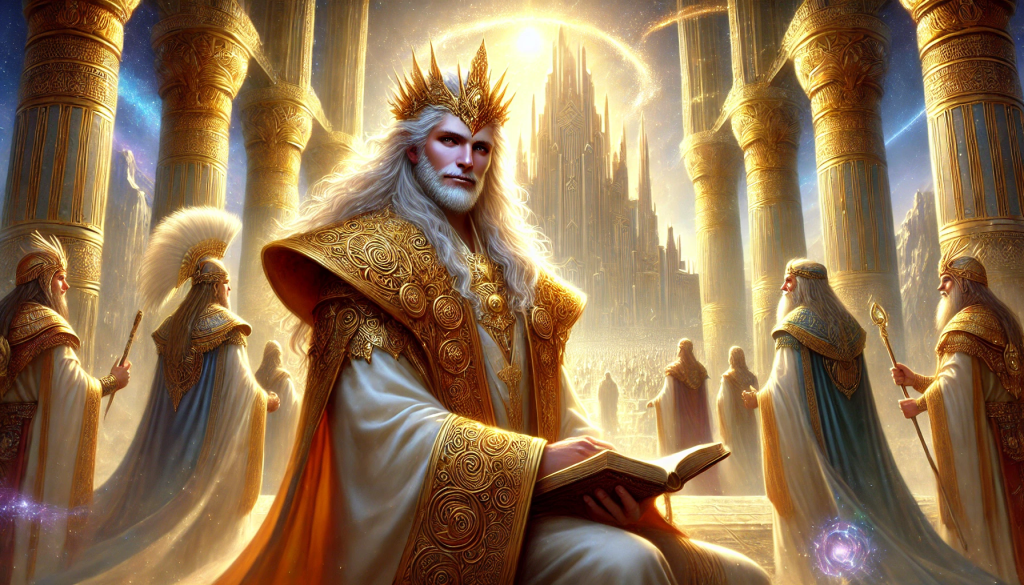
This breathtaking, realistic, and artistic fantasy-style illustration captures the moment of Enki’s cunning maneuver as he subtly transfers kingship to Eridu. At the center, Enki stands in flowing ceremonial robes adorned with golden embroidery, his sly smile and sharp gaze revealing his intelligence and foresight. Divine scrolls are being exchanged in secrecy, marking a power shift. To the side, Enlil watches in suspicion, his regal stance tense with unease, aware that Enki’s influence is reshaping the destiny of civilization. Behind them, the grand temples of Eridu rise magnificently, bathed in ethereal golden light, symbolizing Enki’s divine mastery over the world’s fate. 💡 Connection: Enki, much like Fin, does not conquer through brute force but through wisdom, strategy, and subtle manipulation, ensuring his vision for humanity prevails.
💡 Connection: Fin and Enki use wit, foresight, and deception to outmaneuver their adversaries, proving that the most significant victories are won through intellect, not sheer force.
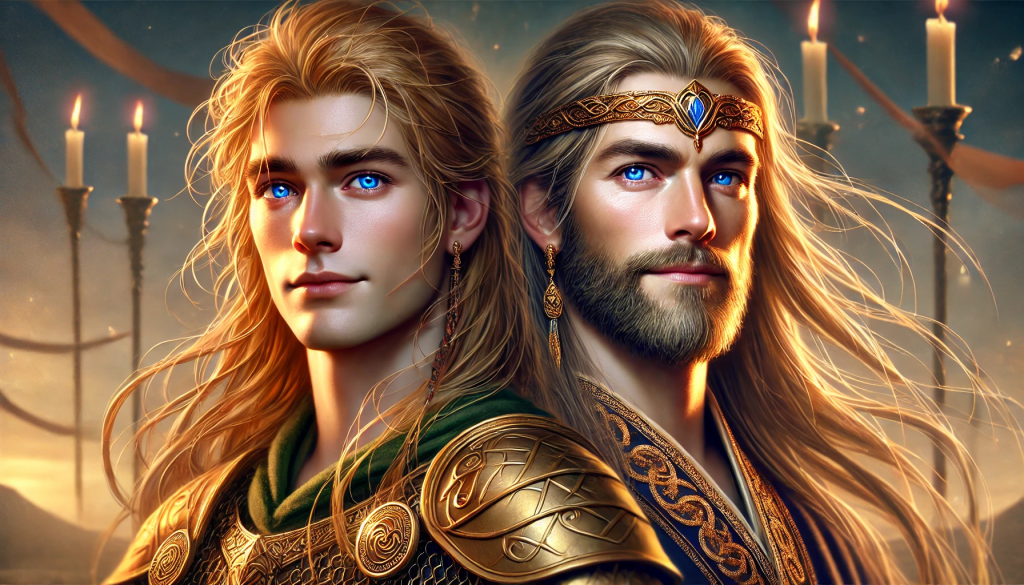
“Masters of Cunning – Fin and Enki Side by Side”
Description: This stunning, realistic, and artistic fantasy-style close-up illustration captures Fin (Fionn mac Cumhaill) and Enki standing together, their expressions filled with intelligence and cunning.
- Fin’s piercing blue eyes and confident smirk reflect his strategic brilliance, recalling the moment he outwitted Benandonner. His golden hair flows over his finely detailed Celtic armor, which gleams in the soft firelight, symbolizing his role as a warrior and master of trickery.
- Enki’s knowing smile and deep blue eyes exude wisdom and foresight, mirroring the moment he subtly outmaneuvered Enlil in the divine transfer of power. His extended blonde hair frames his noble face, and his elegant golden-embroidered Sumerian robes reflect his celestial intelligence and cosmic authority.
The background seamlessly blends their two worlds—the warm glow of a Celtic cottage and the grandeur of Sumerian temples bathed in golden light, symbolizing their shared legacy of intellect, wit, and deception.
💡 Connection: Fin and Enki are masters of strategy, proving that the most significant victories are won not by brute force, but through intellect and foresight.
The Love That Was Lost: The Woman of the Sidhe
Though Fin was victorious in battle, his heart longed for something greater. And then he met Sabh, a woman unlike any other. She was once a mortal maiden, but had been cursed into the form of a deer by a jealous druid.
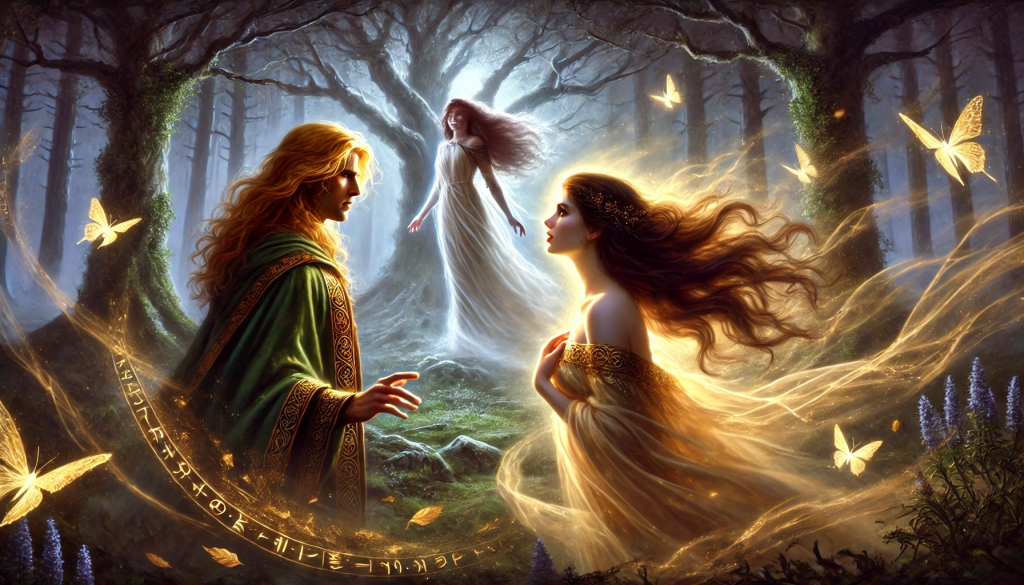
Though Fin was victorious in battle, his heart longed for something greater. And then he met Sabh, a woman unlike any other. Once a mortal maiden, she had been cursed into the form of a deer by a jealous druid. In a mystical forest glade, bathed in the soft glow of twilight, Fin gazes in awe at Sabh, her form shifting between mortal and enchanted deer. Her dark flowing hair and sorrow-filled eyes reflect the weight of the curse and the love that could never be fully realized. The air is thick with magic, with swirling golden leaves and glowing Celtic runes hovering around them, marking this as a moment of fated love and inevitable heartbreak.
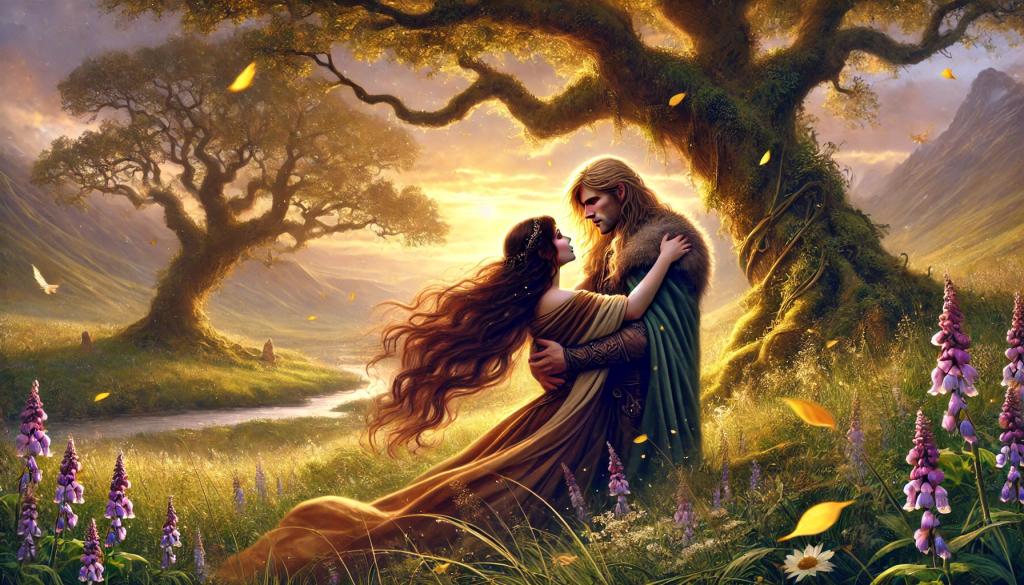
In a lush, enchanted meadow bathed in golden twilight, Fin (Fionn mac Cumhaill) and Sabh share a moment of pure happiness, untouched by fate’s cruel hand. Fin, a noble warrior with long golden hair and piercing blue eyes, holds Sabh gently in his arms, their gazes locked in love and serenity. Sabh, a stunning woman with flowing dark hair and deep, soulful eyes, leans into him, her expression full of warmth and devotion. The air shimmers with soft supernatural energy, and golden leaves swirl around them, symbolizing their fated yet fleeting love. In the background, a peaceful river flows, reflecting the beauty of their moment together—a time before tragedy stole Sabh away.
The moment Fin saw her, his heart recognized her as his own. With love and magic, he broke the spell, restoring her human form. For a time, they were happy, and she bore him a son, Oisín, who would one day become a legend himself.

Though Fin was victorious in battle, his heart longed for something greater. And then he met Sabh, a woman unlike any other. Once a mortal maiden, she had been cursed into the form of a deer by a jealous druid. In a mystical forest glade, bathed in the soft glow of twilight, Fin gazes in sorrow as Sabh’s form shifts between mortal and enchanted deer. Her dark flowing hair and sorrow-filled eyes reflect the weight of the curse, torn between love and the magic binding her to another realm. The air is thick with supernatural energy, with golden leaves swirling and glowing Celtic runes hovering around them, marking this as a moment of fated love and inevitable heartbreak.
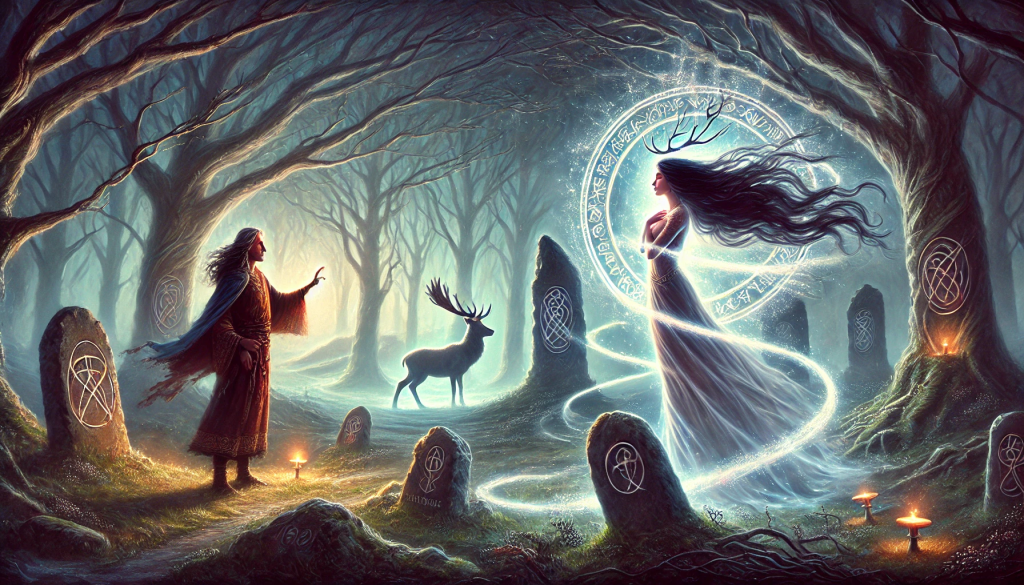
The moment Fin saw her, his heart recognized her as his own. With love and magic, he broke the spell, restoring Sabh to her human form. In a mystical forest glade bathed in an ethereal glow, Fin reaches out to Sabh as magic swirls around them, breaking the druid’s curse. Her transformation is captured mid-moment, as she shifts from an enchanted deer to a radiant human maiden. Her dark flowing hair cascades around her, and she gazes into Fin’s eyes with a mixture of love and astonishment. The twilight forest shimmers, with ancient standing stones glowing faintly with Celtic runes, marking this as a moment of fate and destiny. In the distance, the spectral outline of their future son, Oisín, appears as a vision, foreshadowing his legendary path.
But fate is rarely kind to heroes. One day, Sabh was taken from him, drawn back into the Otherworld by dark forces. Fin searched every corner of the land, calling her name upon the winds, but she was gone.
It was a wound that even his wisdom could not mend.
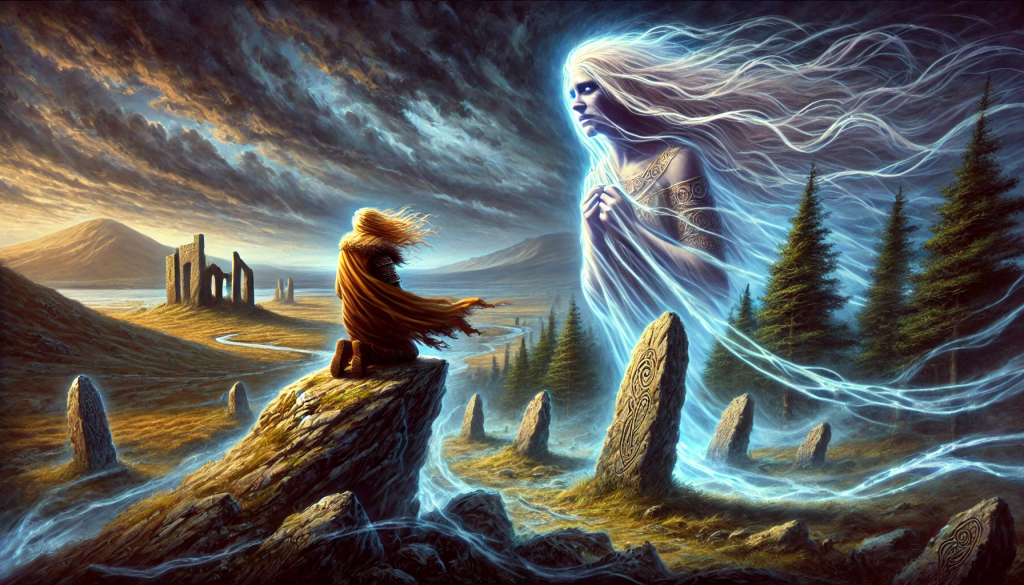
But fate is rarely kind to heroes. One day, Sabh was taken from Fin, drawn back into the Otherworld by dark forces. Fin searched every corner of the land, calling her name upon the winds, but she was gone.
Standing alone on a rocky cliff, his arms outstretched in despair, Fin’s piercing blue eyes reflect the heartbreak that even his wisdom cannot mend. In the distance, Sabh’s spectral figure fades into the swirling mists of the Otherworld, her sorrowful eyes longing for the love she was forced to leave behind. The sky darkens, the winds howl through ancient forests and glowing standing stones, and supernatural energy crackles, marking the moment of tragic separation—love lost to forces beyond mortal control.
The Eternal Sleep: Awaiting the Call of Destiny
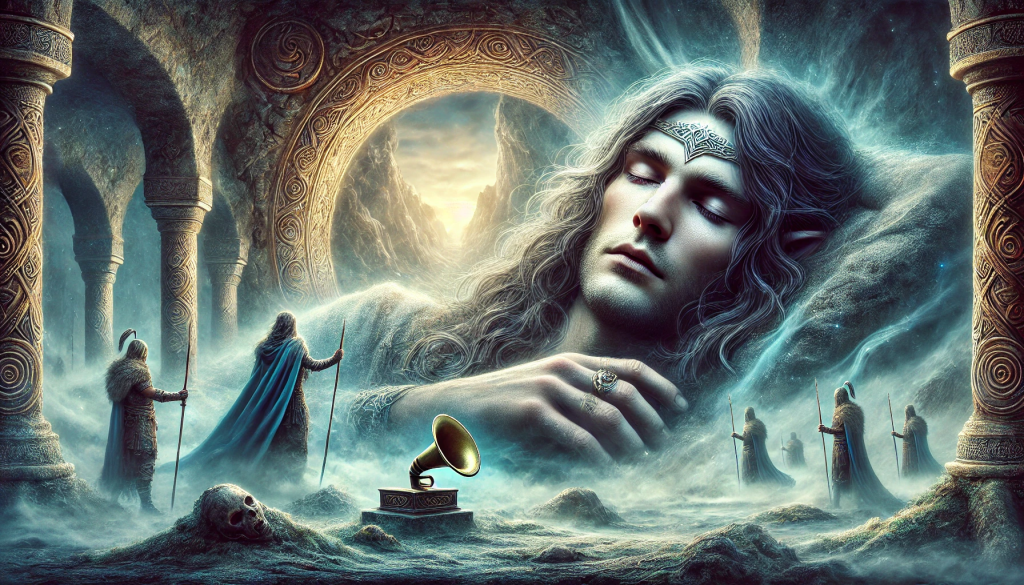
Fin lies in an enchanted slumber, surrounded by his loyal warriors, deep within the mystical hollow hills. His serene, handsome face rests in peace, his piercing blue eyes closed, as if dreaming of the day he will awaken. Ethereal mist swirls around the ancient chamber, illuminated by soft, sacred light filtering through stone carvings filled with divine magic. In the background, a lone horn rests upon an altar, waiting for the fated three calls that will summon Fin back to the world, his strength and wisdom restored to guide his people once more. The atmosphere is timeless, reverent, and filled with the anticipation of legend, capturing Fin’s presence as more than just a man—a warrior, a poet, a seer, and an emanation of divine wisdom and protection.
Though Fin accomplished many great deeds, his final fate remains a mystery. Some say he fell in battle, others whisper that he entered the hollow hills, sleeping with his warriors, waiting for the day Ireland needs him again.
They say that if the sacred horn is blown three times, Fin will rise, his strength and wisdom restored, and he will be ready to guide his people again.

The long-forgotten prophecy unfolds as Fin rises from his enchanted slumber, his piercing blue eyes glowing with renewed strength and wisdom. Around him, his once-resting warriors stir, answering the ancient call, their forms bathed in the golden shimmer of divine energy. The sacred chamber is illuminated by mystical light, revealing ancient stone carvings inscribed with holy symbols that pulse with power. In the foreground, the sacred horn rests upon an altar, echoes still reverberating through the mystical cavern, signaling Fin’s return to guide his people. His aura radiates purpose and destiny, capturing the timelessness of myth and the anticipation of his legend fulfilled.
And so he remains, in the mist of time, in the echoes of myth—a warrior, a poet, a seer, an emanation of divine wisdom and protection.

He was more than a man.
He was more than a legend.
He was Fin.
Themes of Fin as an Emanation of Enki
Divine Wisdom – Like Enki, Fin gains supernatural knowledge through the Salmon of Wisdom, much like Enki’s access to cosmic secrets.
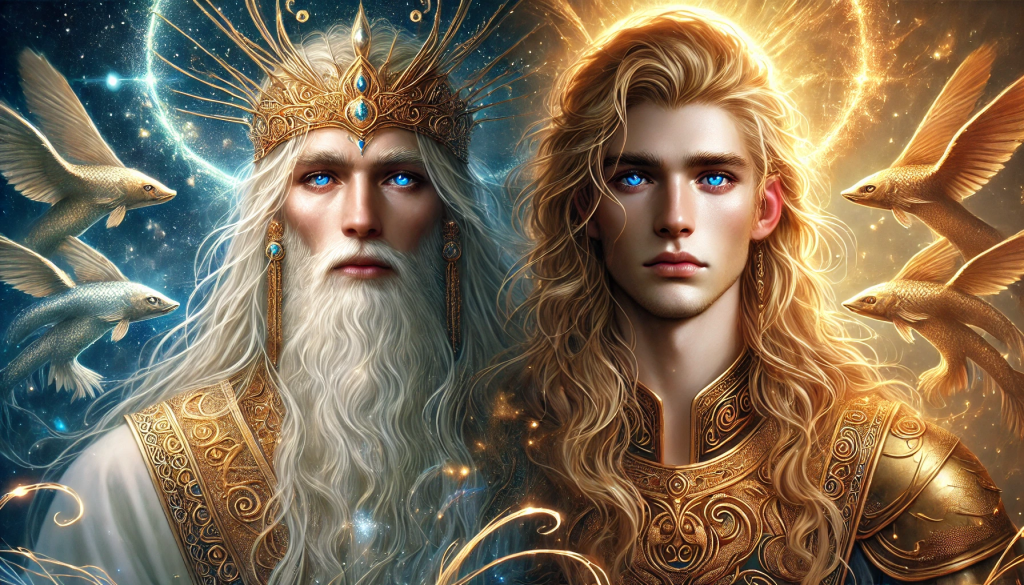
“Divine Wisdom – The Archetypes of Enki and Fin”
This stunning, realistic, and artistic fantasy-style illustration portrays Enki and Fin (Fionn mac Cumhaill) standing side by side, their piercing blue eyes locked in a shared understanding of wisdom and destiny.
Enki, the celestial guardian, exudes divine intelligence. His long, flowing blonde hair and well-groomed beard add to his regal, otherworldly presence. He wears elegant Sumerian robes with intricate golden embroidery. A soft supernatural glow surrounds him, marking him as the keeper of cosmic secrets and civilization’s architect.
Fin, the noble warrior and seer, reflects Enki’s wisdom in the mortal realm. His golden hair flows like fire, and his deep blue eyes shine with the mystical insight granted by the Salmon of Wisdom. Clad in detailed Celtic armor, he radiates the spirit of a leader, protector, and enlightened sage.
💡 Connection: This meeting represents the divine archetype of wisdom manifesting in different cultures—Enki as the cosmic teacher, and Fin as the earthly embodiment of supernatural knowledge.
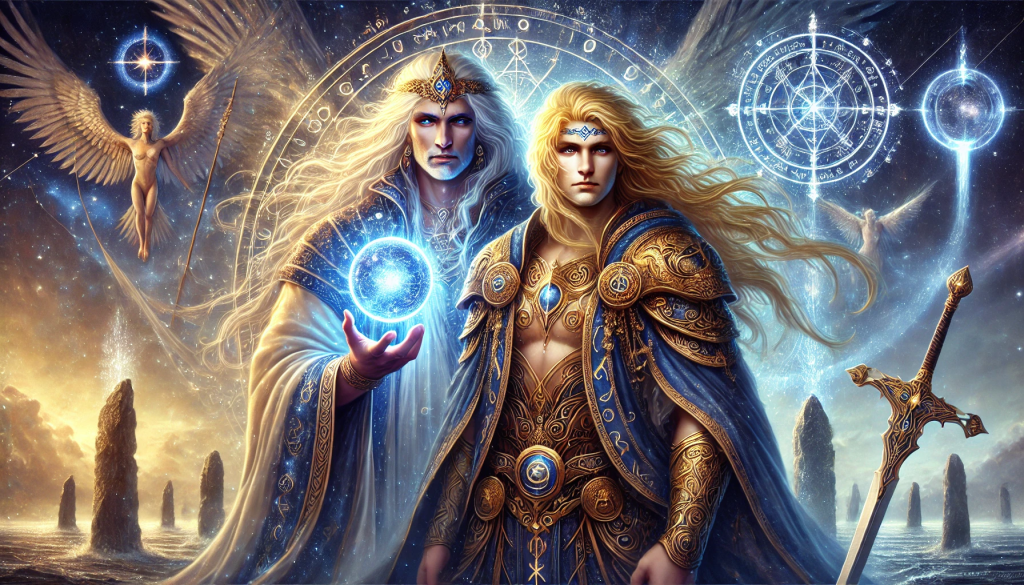
Enki and Fin stand side by side in this powerful and mystical illustration, embodying their connection to the Tuatha Dé Danann. Enki, the Anunnaki god of wisdom, wears flowing blue and gold robes inscribed with celestial symbols, his piercing blue eyes radiating divine knowledge. His lighter blonde hair flows like liquid starlight as he holds a glowing orb of ancient power. Beside him, Fin, the golden-haired leader of the Fianna, stands adorned in ornate Celtic armor engraved with luminous runes, his sharp blue eyes filled with the fire of leadership. Behind them, an ethereal landscape merges the realms of Irish and Anunnaki mythology—standing stones inscribed with glowing symbols rise from mist-covered waters, while celestial beings soar in the illuminated sky. This image captures the profound bond between warrior and sage, protector and guide, shaping the destiny of both Earth and the unseen realms.
Protection & Leadership – Just as Enki guided early civilizations, Fin led the Fianna warriors, guarding Ireland.
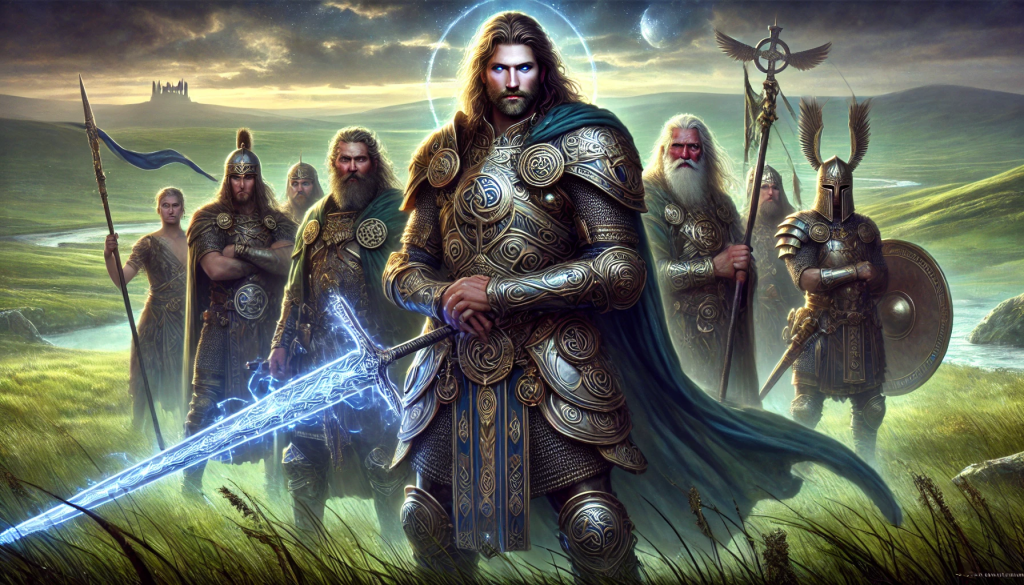
Fin, the legendary warrior, stands tall at the forefront of his Fianna warriors, his piercing blue eyes radiating strength and wisdom. Clad in intricate Celtic armor adorned with sacred symbols, he wields a mighty sword, embodying both protector and leader. Behind him, the elite Fianna warriors stand resolute, their determined faces reflecting loyalty and readiness to defend Ireland. The backdrop features rolling green hills beneath a twilight sky, evoking the ancient battlefields of legend. Like Enki guiding early civilizations, ethereal light surrounds Fin, symbolizing his divine guidance and connection to wisdom. This scene captures the power of leadership, the weight of responsibility, and the fierce devotion of those who follow Ireland’s eternal guardian.
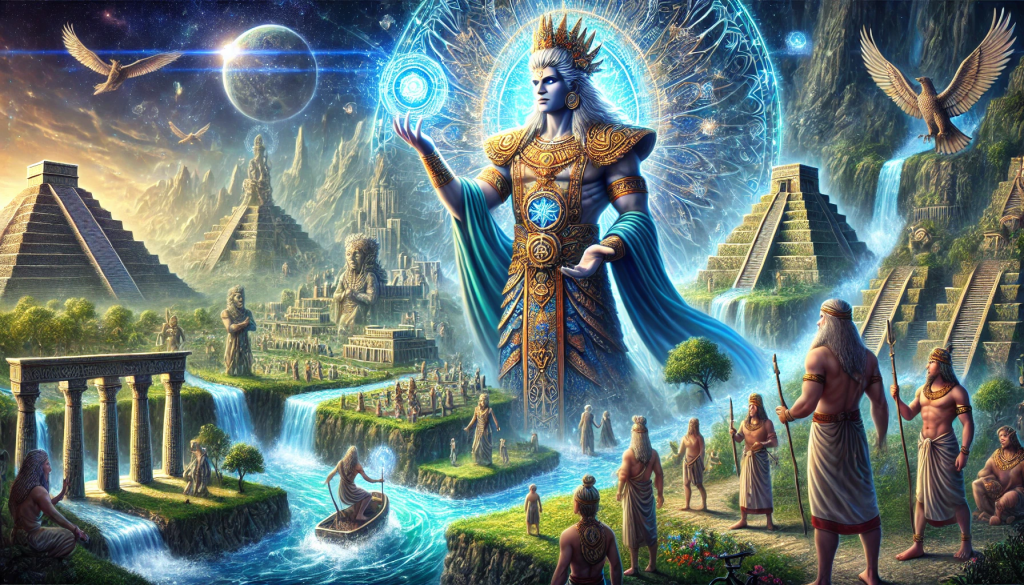
Enki, the Sumerian god of wisdom, water, and creation, stands as a towering figure of divine authority in this awe-inspiring scene. His piercing blue eyes radiate intelligence and foresight, while his flowing, ornate robes, adorned with sacred Anunnaki symbols, shimmer with celestial power. Around him, early human settlers and Anunnaki beings work harmoniously, constructing grand cities, raising massive stone structures, and shaping the foundation of early civilization—rivers of pure, glowing water flow through the town, symbolizing Enki’s life-giving mastery over water. In the background, an early Mesopotamian landscape unfolds—lush gardens, towering ziggurats, and celestial symbols above, representing the divine origins of this great civilization. With extended hand, Enki guides humanity toward knowledge, technology, and enlightenment, ensuring that civilization flourishes under his wisdom. The scene is majestic and immersive, capturing the moment of divine intervention, the birth of civilization, and the merging of cosmic wisdom with the human journey.
Trickster & Thinker – Fin uses wit over brute force, mirroring Enki’s cunning in defeating adversaries.

Fin, the legendary warrior, stands in a strategic pose, his piercing blue eyes gleaming with intelligence and mischief. Clad in intricate Celtic armor, he wields no brute weapon, only his wit and cunning. Around him, adversaries appear bewildered, their plans unraveling as Fin’s quick thinking and deception outmatch them. The setting is a misty Celtic landscape, with ancient standing stones faintly glowing in the background, symbolizing the mystical forces that aid him. His confident expression and sharp mind prove more potent than sheer strength, capturing his role as a warrior who triumphs through intellect over brute force.
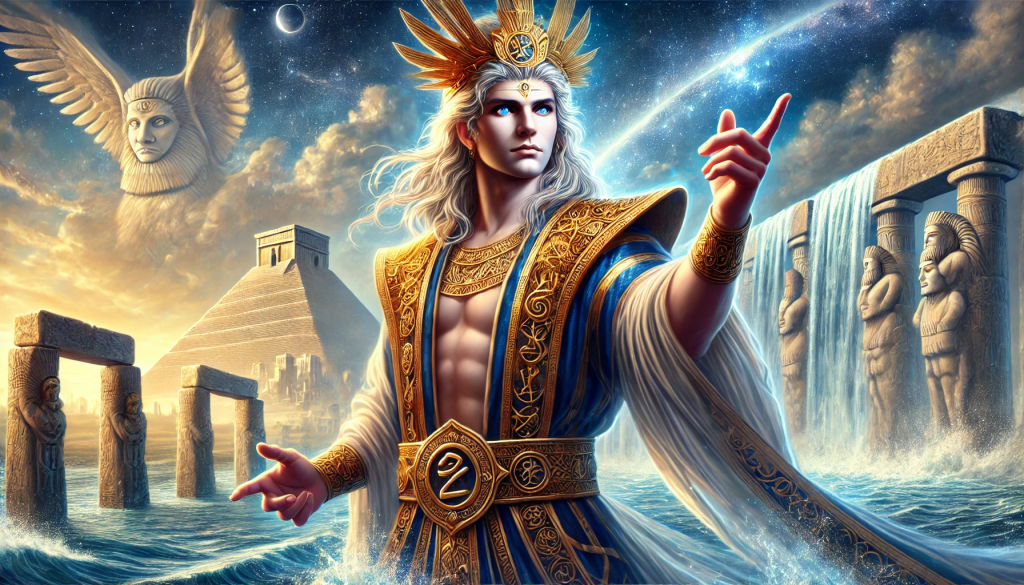
Enki, the Sumerian god of wisdom, water, and creation, stands in a powerful yet contemplative stance, his piercing blue eyes exuding intelligence and cunning. Clad in flowing, ornate robes adorned with sacred Anunnaki symbols, he gestures toward a scene where his clever strategies have outmaneuvered his adversaries. Behind him, glowing streams of water flow, symbolizing his mastery over knowledge and creation. The backdrop features an ancient Mesopotamian cityscape, with towering ziggurats under a celestial sky, reinforcing his divine intellect and strategic power. His confident expression suggests that wisdom and trickery often triumph over brute force, showcasing his legendary cunning and cleverness.
Love and Loss—His relationship with Sabh, like Enki’s relationships with goddesses (like Ninmah and Inanna), is a mix of love, magic, and tragedy.
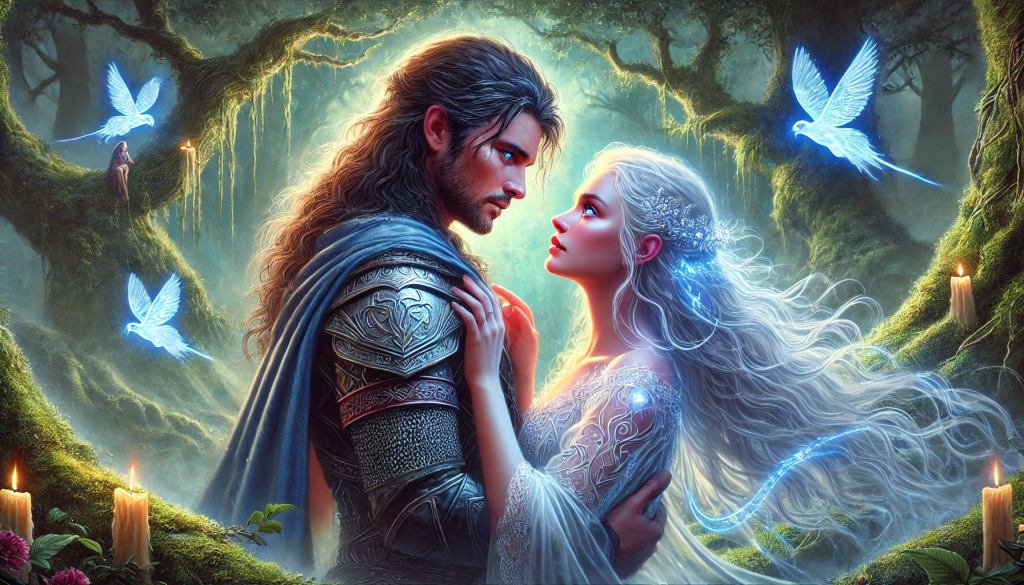
In a moment of tender sorrow, Fin holds his beloved Sabh, piercing blue eyes filled with love and grief. Sabh, radiant and ethereal, gazes back at him, her presence shimmering with a magical glow. The lush, enchanted forest around them is bathed in soft golden light, yet shadows creep at the edges, hinting at the tragedy that will soon separate them. Fin’s expression is a mixture of devotion and heartbreak, knowing fate will take her away, leaving only the memory of their love. This scene captures the fleeting nature of love touched by destiny, a bond of magic and loss.
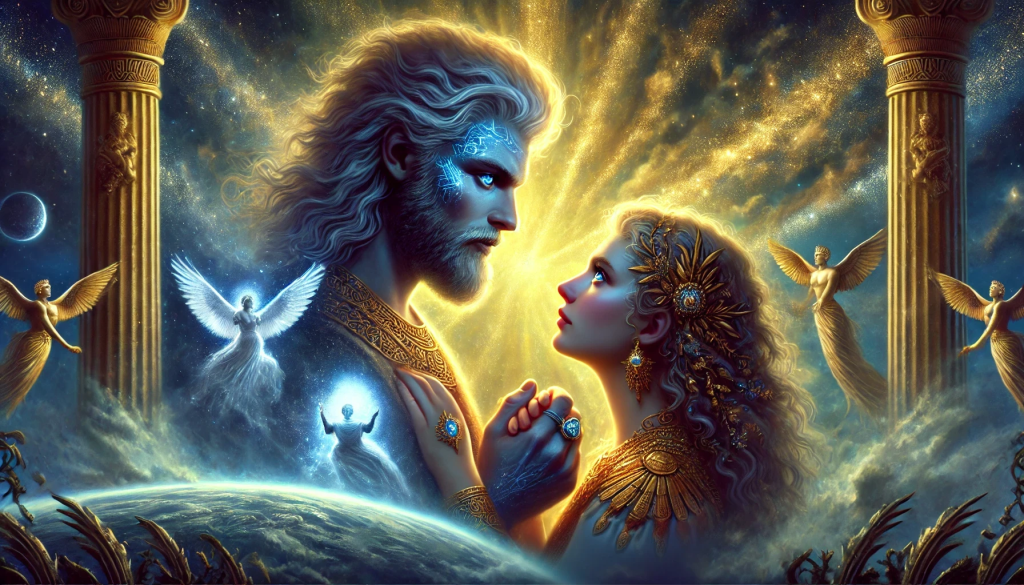
Enki, the Sumerian god of wisdom and water, holds his great love–Ninmah—in a tender yet sorrowful embrace. His piercing blue eyes reflect deep devotion and unspoken grief, while the radiant and divine goddess gazes back at him, her presence filled with magic and longing. The celestial background glows with golden light, symbolizing the cosmic forces that unite them, yet distant shadows hint at the trials and tragedies that will separate them. Enki’s expression conveys love and heartache, symbolizing the bittersweet nature of divine relationships. This scene embodies love touched by fate and the complexities of immortal bonds, capturing the beauty and sorrow of Enki’s greatest loves.
Eternal Guardian – Like Enki, Fin never truly dies—instead, he sleeps, awaiting the time when the world needs him again.
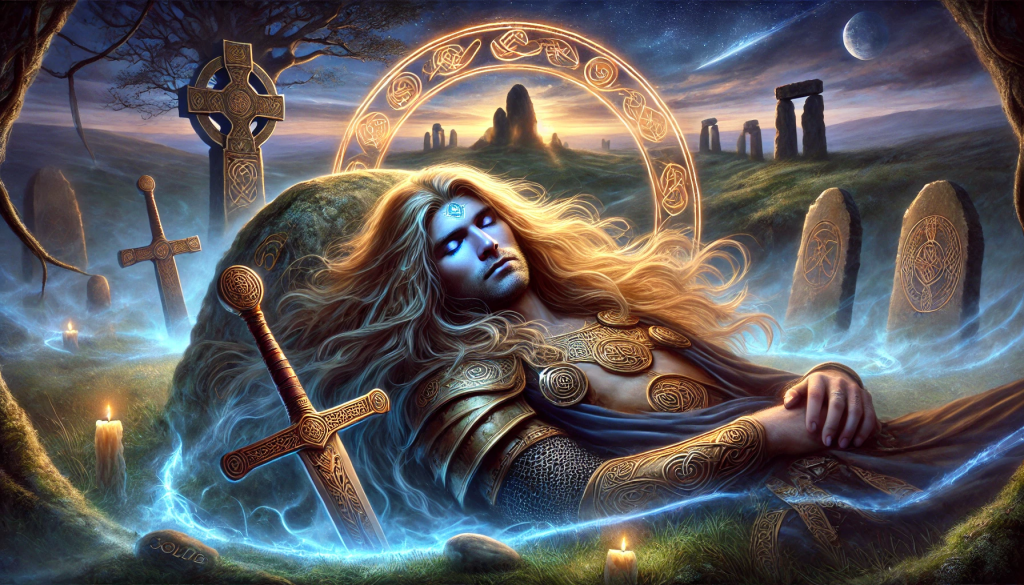
Deep within the mystical hollow hills, Fin lies in an enchanted slumber, his long golden hair flowing over his shoulders, his piercing blue eyes closed in deep rest. Clad in ornate Celtic armor, his sword rests beside him, untouched by time, as he waits for the moment when Ireland will need him again. Around him, ancient symbols glow softly, and an ethereal mist swirls, preserving his legend in magic. Sacred standing stones surround the chamber, a twilight sky glowing above, symbolizing the timelessness of his fate. Fin does not die—he sleeps, awaiting destiny’s call.
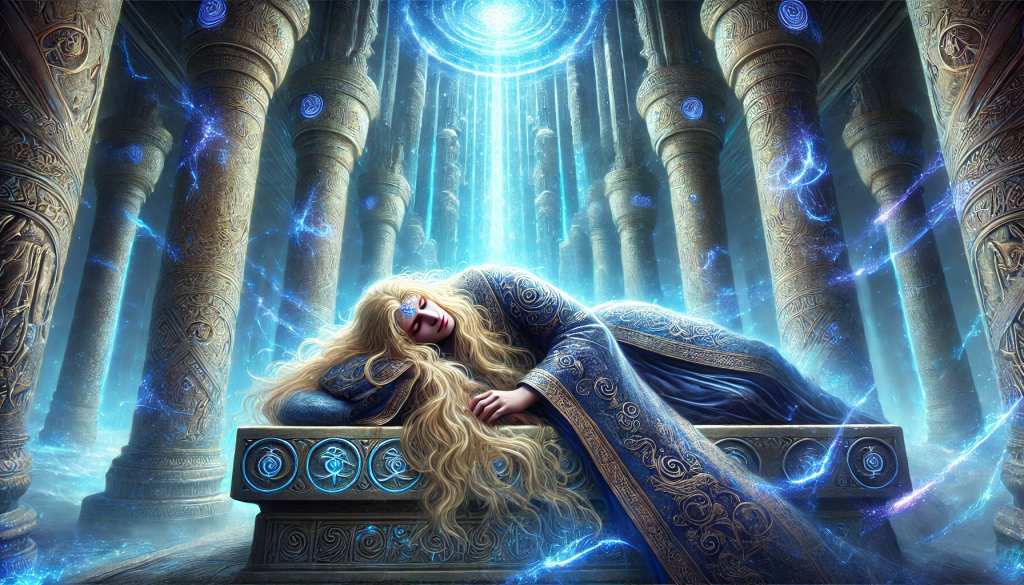
Enki, the Sumerian god of wisdom and water, rests in a deep, timeless slumber within the mystical Halls of Amenti. His long, flowing blonde hair cascades over an ornate stone altar, his piercing blue eyes closed as he dreams in a realm beyond time. Clad in elegant, ancient robes adorned with sacred Anunnaki symbols, he lies surrounded by swirling divine energy. The Halls of Amenti glow with ethereal blue light, their towering pillars covered in glowing inscriptions and cosmic symbols, a testament to the hidden wisdom he guards. The air shimmers with celestial energy, waiting for Enki to awaken and guide humanity again. His presence is eternal, his guardianship unbroken—he does not fade, but awaits the call of destiny.
For an actual emanation of Enki never truly disappears—he only waits, watching, until the moment arrives to bring knowledge and order once more.
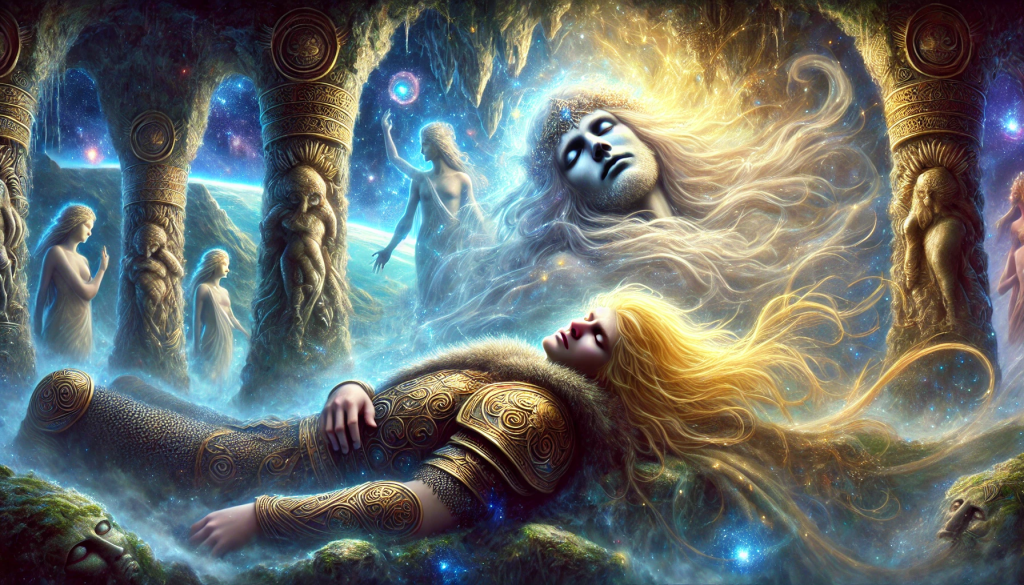
Fin lies in an enchanted slumber in this mesmerizing vision, his golden locks flowing like liquid light, adorned in intricate Celtic armor. His ethereal spirit rises above, merging with the cosmic currents that swirl through the celestial sky. Ancient stone pillars, etched with sacred runes and adorned with mystical carvings, stand as silent sentinels around him. Enigmatic female figures, possibly goddesses or Tuatha Dé Danann seers, look on in reverence, whispering forgotten prophecies. The dreamscape blends the physical and spiritual realms, as Fin journeys beyond mortality into the realms of the gods, where destiny and legend intertwine.
Fin and Enki: Parallels Between the Seer-Warrior and the Cosmic Architect
Though they emerged from different traditions—Fin from Celtic myth and Enki from Sumerian lore—they share striking similarities that reveal Fin as an avatar of Enki. Both figures embody the wisdom of the divine, the trickster’s cunning, and humanity’s guardianship. Their stories echo across time, mirroring each other in knowledge, leadership, and supernatural power themes.
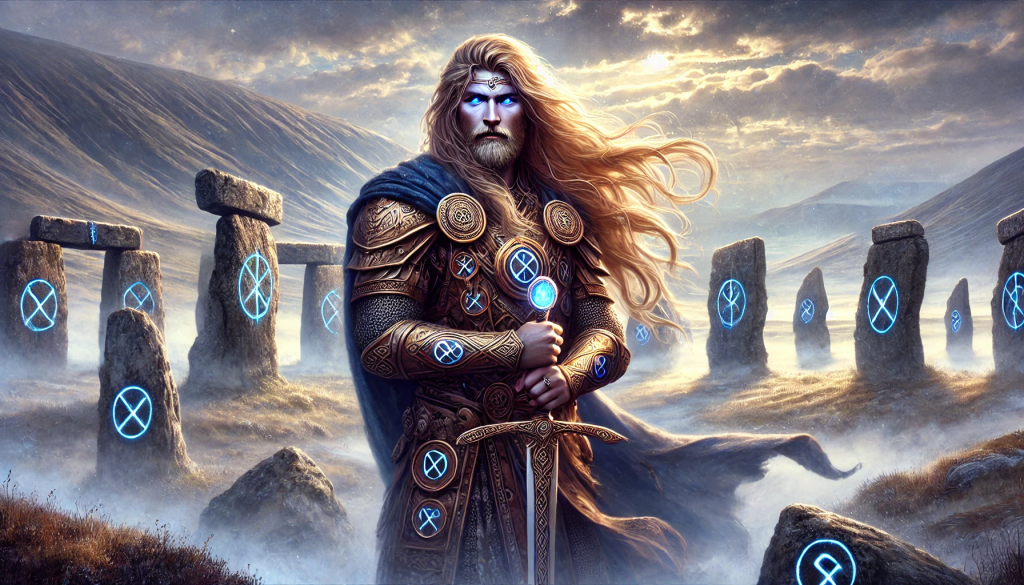
Fin, the legendary Celtic warrior-seer, stands in an ethereal landscape, his piercing blue eyes glowing with wisdom and foresight. His long golden hair flows over his ornate Celtic armor, adorned with ancient runes and sacred symbols. He wields a staff of knowledge, representing his connection to divine insight rather than brute force. The misty highlands and sacred standing stones shimmer with mystical energy, reinforcing his role as a warrior and a guardian of ancient wisdom.
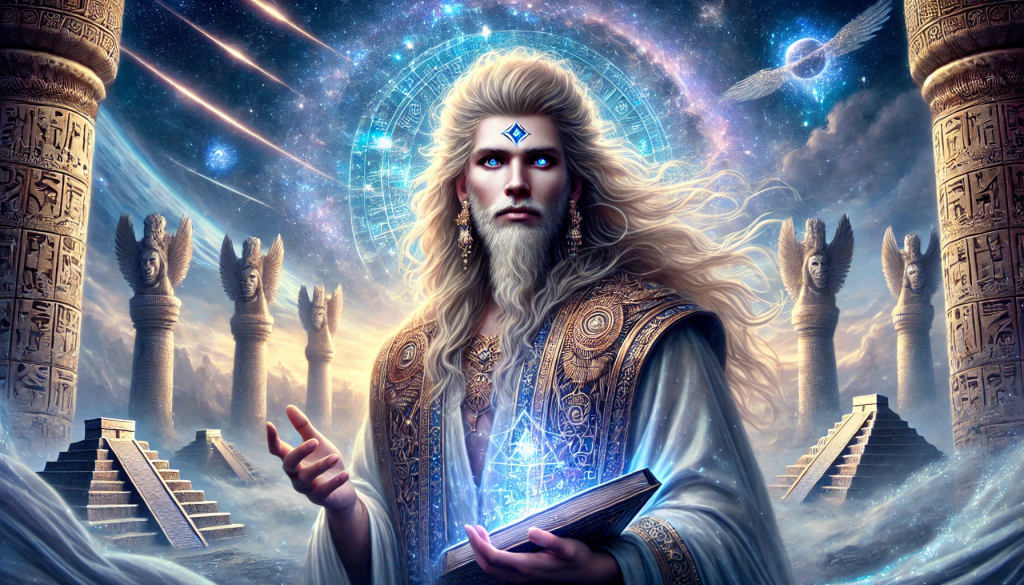
Enki, the Sumerian god of wisdom and creation, stands in an ethereal celestial realm, his piercing blue eyes glowing with intelligence and divine foresight. His long flowing blonde hair cascades over his elegant Anunnaki robes, adorned with sacred symbols of knowledge and creation. He holds a glowing tablet of destiny, symbolizing his role as a bringer of wisdom and guidance to humanity. In the background, Mesopotamian ziggurats rise beneath a sky filled with cosmic constellations, and the sacred waters of the Abzu flow, symbolizing his mastery over life and knowledge.
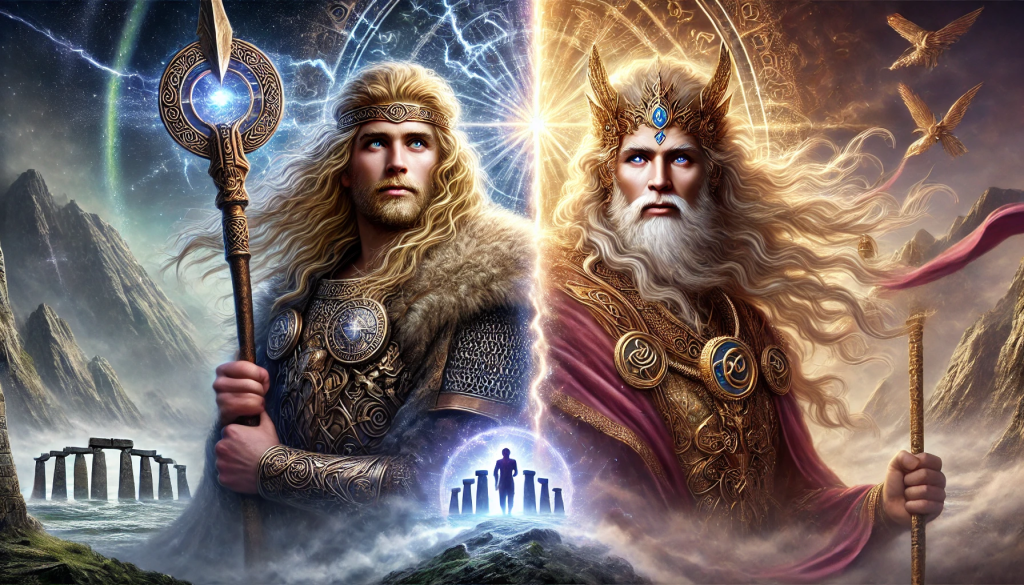
Fin and Enki stand side by side, their forms illuminated by divine energy, representing their parallel roles in mythology. Fin, the legendary Celtic warrior-seer, is clad in intricate Celtic armor, holding a staff of wisdom, his long golden hair flowing over his shoulders. Beside him, Enki, the Sumerian god of wisdom and creation, wears flowing Anunnaki robes adorned with sacred symbols, his piercing blue eyes glowing with intelligence. Between them, a mystical portal blends the misty highlands of Fin’s world with the celestial waters and ziggurats of Enki’s domain, symbolizing the bridge between their cultures. Their expressions are wise and knowing, like guardians of hidden knowledge across time and space.
Keepers of Sacred Wisdom – The Salmon of Knowledge & The Me of Civilization
Fin and Enki are bearers of divine wisdom, acquiring sacred knowledge in ways that transform them into enlightened beings.
- Fin’s Awakening: Fin accidentally absorbs the wisdom of the Salmon of Knowledge, granting him supernatural foresight and deep understanding of the world’s mysteries. He can see the past, present, and future whenever he places his thumb in his mouth.
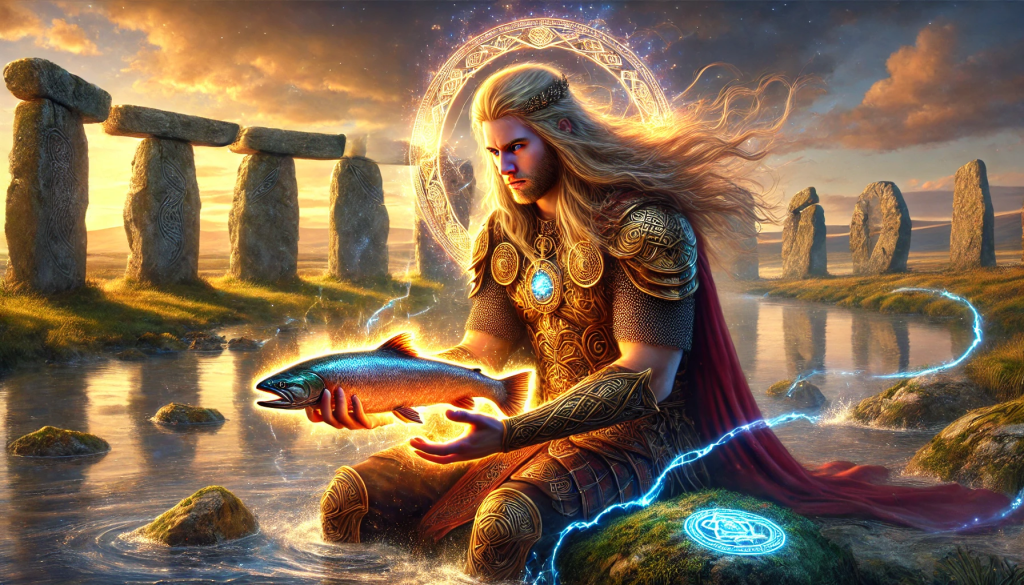
Fin, the legendary Celtic warrior-seer, sits beside a mystical river, holding the Salmon of Knowledge. His piercing blue eyes glow with newfound wisdom as he unknowingly absorbs divine insight. His long golden hair flows in the soft breeze, and his ornate Celtic armor glows faintly, reflecting his transformation into an enlightened being. The ancient standing stones in the background hum with ethereal energy, symbolizing his connection to the past, present, and future mysteries.
- Enki’s Role as Keeper of the Me: Enki holds the Me (pronounced May), the sacred tablets containing the divine laws, arts, sciences, and social order. Like Fin, he possesses hidden wisdom that he sometimes shares with mortals to help them evolve.
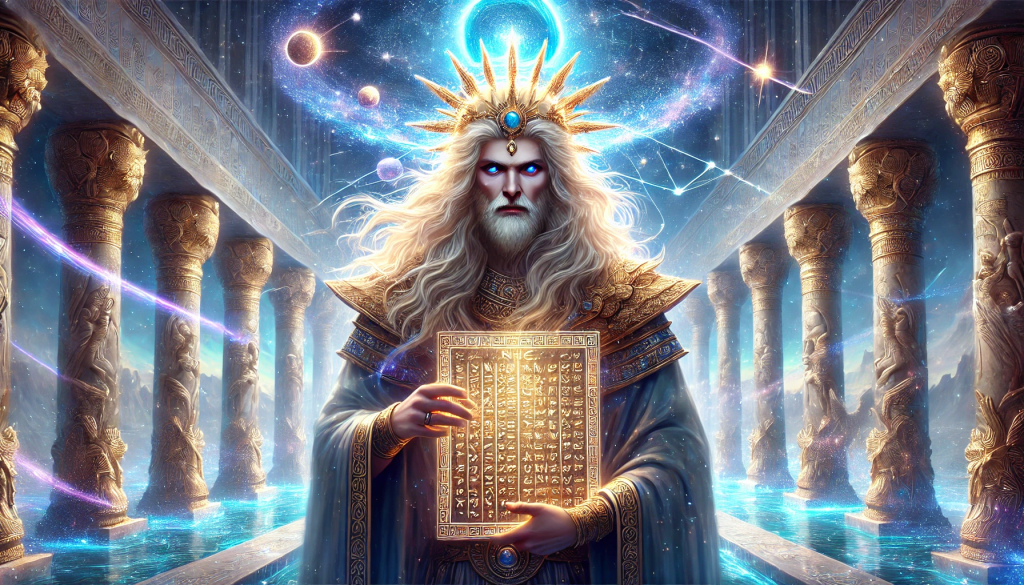
Description: Enki, the Sumerian god of wisdom and creation, stands in a grand celestial hall, holding the sacred Me tablets, glowing with divine inscriptions. His piercing blue eyes radiate intelligence and hidden knowledge, and his long flowing blonde hair shimmers with an ethereal glow. His elegant Anunnaki robes, adorned with intricate sacred symbols, reflect his role as the divine architect of civilization. Behind him, cosmic constellations align above Mesopotamian ziggurats, while the flowing waters of the Abzu mirror the wisdom he bestows upon humanity.
💡 Connection: Just as Fin’s wisdom guides the Fianna and saves kings, Enki’s knowledge shapes early civilizations, ensuring their survival and progress.
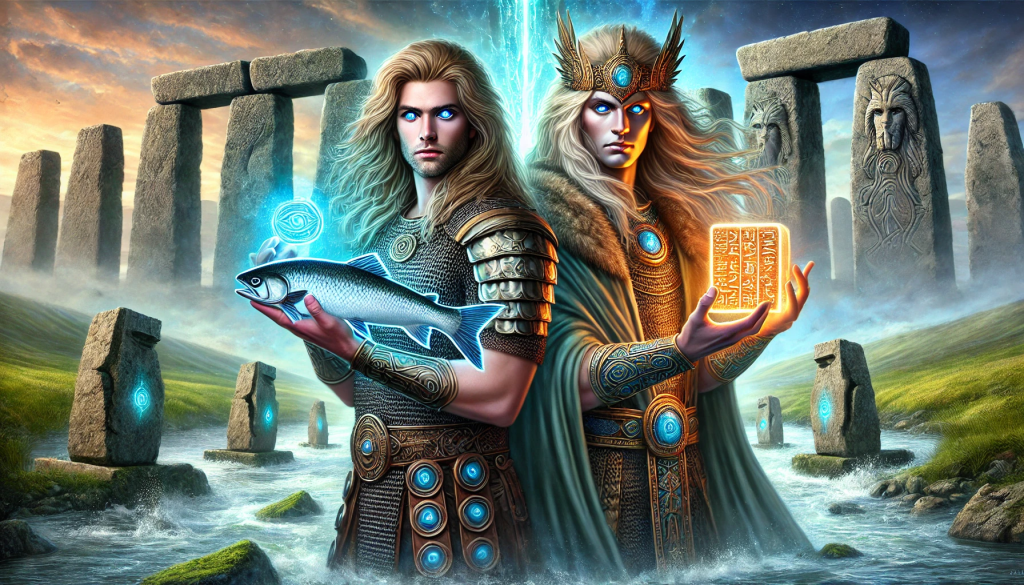
Fin and Enki stand side by side, each holding their sacred source of wisdom—Fin with the Salmon of Knowledge and Enki with the glowing Me tablets. Fin’s piercing blue eyes reflect newfound supernatural foresight, while Enki’s glow with divine intelligence. Fin, clad in ornate Celtic armor, stands on one side of a mystical river, while Enki, in flowing Anunnaki robes, stands on the other, representing the bridge between their traditions. The background blends ancient Celtic standing stones with towering Mesopotamian ziggurats, symbolizing the timeless wisdom they share.
💡 Connection: Just as Fin’s wisdom guides the Fianna and saves kings, Enki’s knowledge shapes early civilizations, ensuring their survival and progress.
Tricksters and Masters of Strategy – The Giant’s Causeway & The Ruse of Eridu
Both Fin and Enki outwit their enemies, preferring cunning over brute force.
“Masters of Deception – The Cunning of Fin and Enki”
These stunning, realistic, and artistic fantasy-style close-up illustrations capture the brilliance and trickery of Fin (Fionn mac Cumhaill) and Enki, legendary figures who used wit over brute force to outmaneuver their foes.
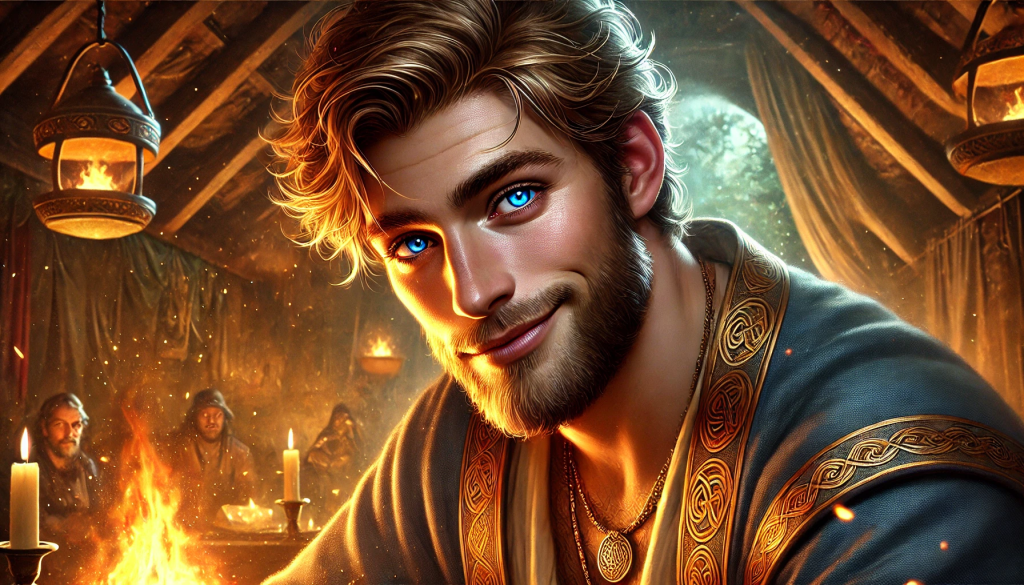
- Fin’s Trick on Benandonner: When the Scottish giant Benandonner challenges him, Fin tricks him by disguising himself as a giant baby. The terrified Benandonner flees, believing Fin’s father must be a colossal being beyond imagination.
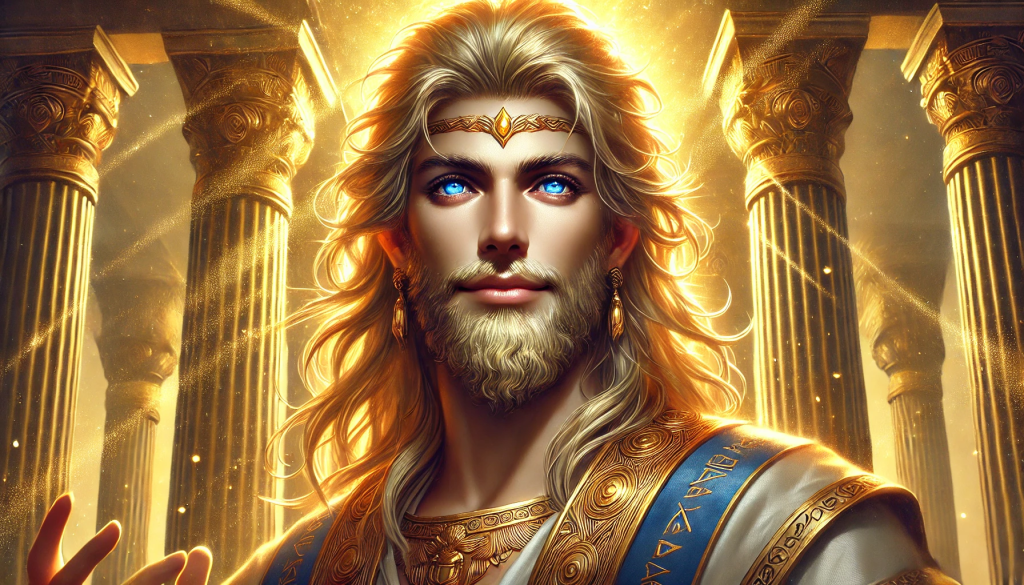
This stunning, realistic, and artistic fantasy-style close-up illustration captures Enki’s brilliant intellect as he subtly orchestrates the transfer of kingship to Eridu. His deep, knowing eyes glow with divine wisdom, a slight smile playing on his lips, reflecting his strategic mastery and foresight. Dressed in elegant, ornate Sumerian robes, Enki stands illuminated by the golden glow of supernatural energy, his presence exuding the power of a god who shapes destiny with wit rather than force. The background of grand Sumerian columns bathed in golden light enhances the mystical and regal aura, emphasizing the supernatural depth of Enki’s intellect and influence. 💡 Connection: As a master of deception and wisdom, Enki, like Fin, uses his intellect to outmaneuver rivals, proving that cunning often holds more power than brute strength.
- Enki’s Trick on Enlil: In many Sumerian myths, Enki is the divine trickster, often manipulating events behind the scenes. One such tale tells how he slyly transfers kingship to Eridu, his sacred city, outmaneuvering the other gods with intelligence rather than violence.
💡 Connection: Fin and Enki use their intellect, wit, and foresight to navigate power struggles and protect their people.
“Enki and Fin – Masters of Time and Legend”
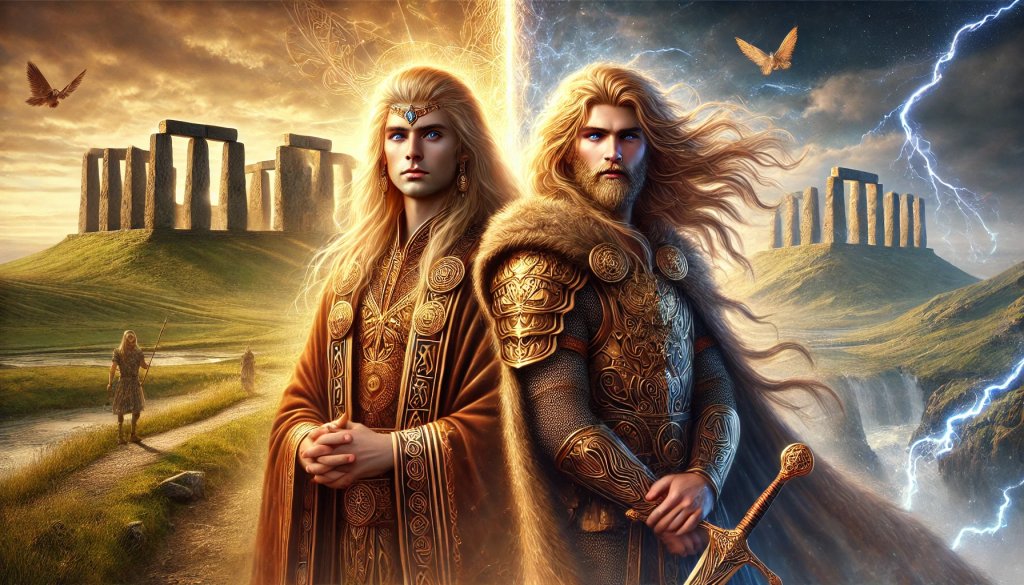
This breathtaking, realistic, and artistic fantasy-style illustration captures a moment beyond time. Enki and Fin (Fionn mac Cumhaill) stand side by side, looking directly into the camera as if they have traveled across dimensions to meet.
Enki is a noble and radiant figure. His long flowing blonde hair and piercing blue eyes exude divine wisdom. He wears elegant Sumerian robes adorned with intricate golden patterns. A soft glow of celestial energy surrounds him, marking him as the eternal guide of civilization.
Fin: A towering warrior, his deep blue eyes filled with the strength and vision of a leader. Dressed in ornate Celtic armor, he holds a grand sword at his side, his cape billowing in the wind, standing as the protector of ancient Ireland and beyond.
The backdrop blends two worlds—on one side, the grand temples of Eridu rise under a golden sky, representing the wisdom and innovation of Sumer; on the other, misty Celtic highlands stretch into the distance, symbolizing the wild, untamed power of the Fianna and the spirit of legend.
💡 Connection: This meeting of two great minds across time symbolizes the unity of knowledge, strategy, and leadership—Fin and Enki, two figures who shaped the course of human history through intellect and vision.
Builders and Civilization-Shapers – The Fianna & The Early Civilizations

Fin and Enki are not just warriors, but teachers and creators of order. Fin as Leader of the Fianna: Fin stands at the forefront of his elite warriors in a mist-covered glade, bathed in golden twilight. The Fianna, clad in detailed Celtic armor, are more than warriors—they are scholars, poets, and protectors of law and justice. Fin speaks to his warriors with long golden hair and piercing blue eyes, instilling wisdom and strategy and preparing them for battle and leadership.
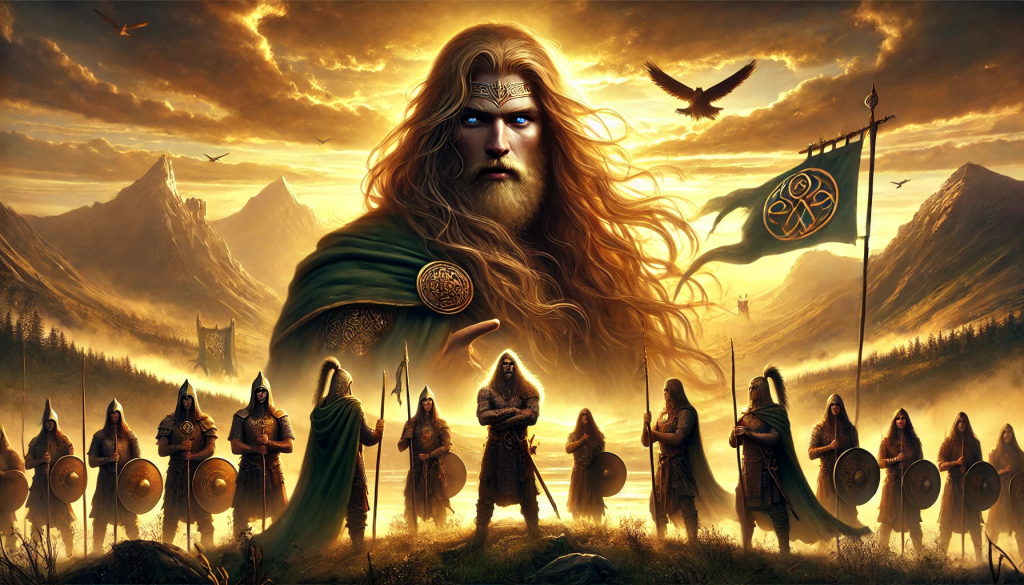
Description: In this stunning, realistic, and artistic fantasy-style illustration, Fin (Fionn mac Cumhaill) stands as a beacon of leadership and wisdom before his legendary warriors, the Fianna. His piercing blue eyes glow with intelligence and strength, his long golden hair flowing as if carried by divine energy. The golden light of the setting sun illuminates his majestic form, reinforcing his role as both a warrior and a sage. Before him, the Fianna stand in disciplined formation, their armor gleaming with intricate Celtic designs, their banners rippling in the wind as they prepare to follow their leader. Towering mountains and misty valleys stretch beyond them, symbolizing the vastness of their purpose—to defend, protect, and uphold justice. This moment captures Fin’s dual identity—not just as a fighter but also as a teacher and civilization-builder, much like Enki’s role as the architect of knowledge and order.
Fin and Enki are not just warriors, but teachers and creators of order.
- Fin as Leader of the Fianna: Fin does not fight alone—he leads the Fianna, an elite group of warriors who follow a strict moral code. They are both protectors and scholars, trained in poetry, law, and justice.
- Enki as the Architect of Civilization: Enki is the founder of Eridu, one of the oldest cities in Sumer. He brought farming, architecture, law, and governance knowledge to early humanity, like Fin prepared his warriors for battle and leadership.
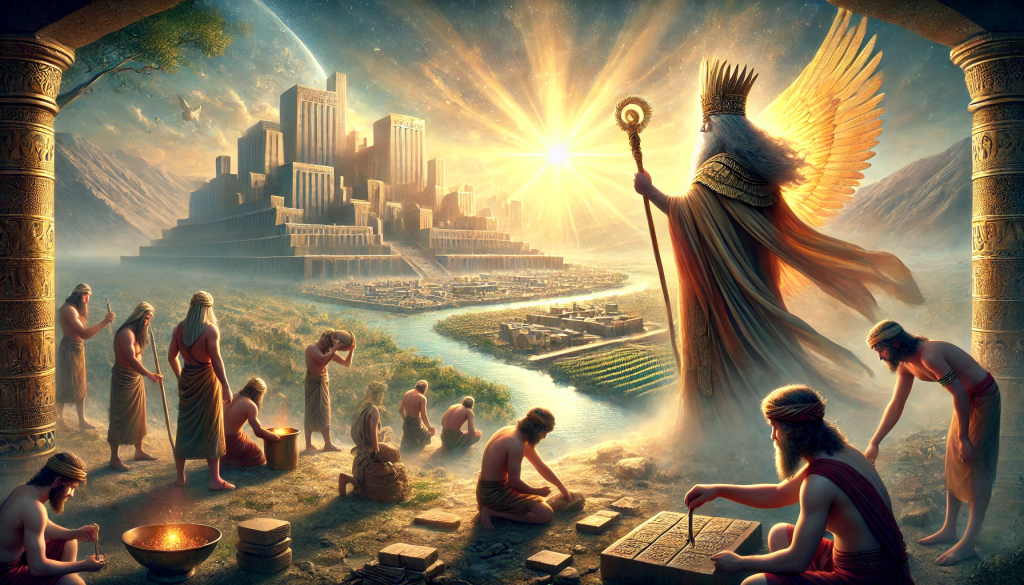
This breathtaking, realistic, and artistic fantasy-style landscape illustration depicts Enki overseeing the construction of Eridu, one of the world’s first cities. Enki stands along the banks of a great river in ancient Sumer, dressed in flowing ceremonial robes, holding a staff of knowledge, symbolizing the wisdom he bestows upon humanity. Around him, early humans learn essential skills—some are being taught farming techniques, while others carve architectural designs into clay tablets. Laborers construct grand structures, shaping the foundations of governance and law. The sky glows with ethereal golden light, symbolizing Enki’s divine influence as he guides humanity toward knowledge, creation, and progress. This moment mirrors Fin’s wisdom in leading the Fianna, drawing a powerful parallel between myth and history.
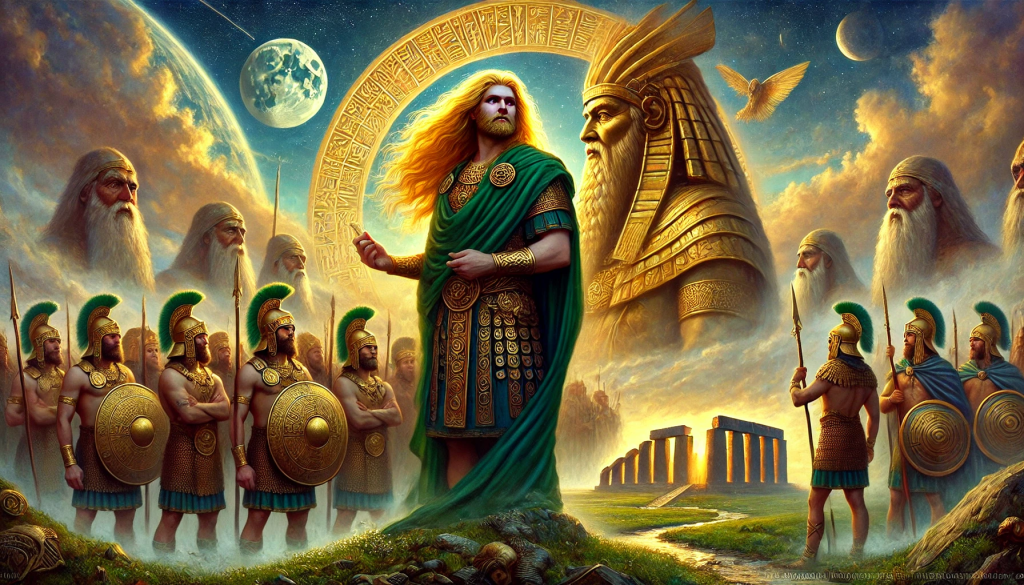
Fin and Enki stand as legendary architects of wisdom and civilization, shaping the destiny of their people. Fin, the golden-haired leader of the Fianna, stands tall in a mist-covered glade, addressing his elite warriors—poets, protectors, and scholars—bathed in the golden twilight of Ireland. His piercing blue eyes shine with vision as his men, clad in intricate Celtic armor, stand in disciplined formation, their banners fluttering in the wind. Beside him, Enki, the Anunnaki god of wisdom, holds a sacred scroll of knowledge, his deep blue robes adorned with celestial symbols. Behind him, grand ziggurats of early Sumerian cities rise, glowing beneath a cosmic sky, symbolizing his divine role in shaping the foundations of human civilization. This powerful image merges two great traditions, illustrating their shared purpose as teachers, protectors, and creators of order.
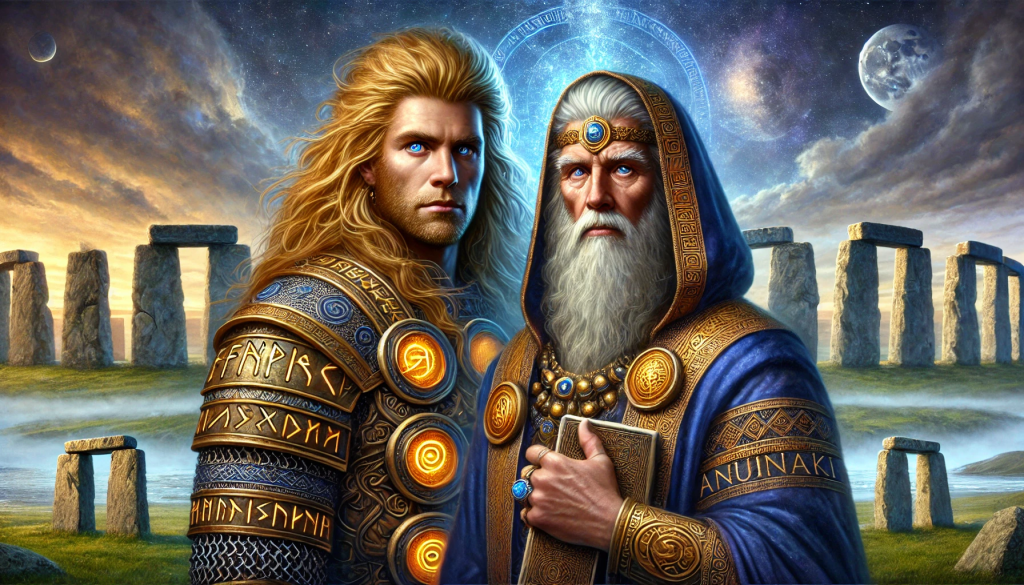
In this powerful and direct portrayal, Fin and Enki stand side by side, gazing into the eyes of the viewer with wisdom and purpose. Fin, the golden-haired warrior and leader of the Fianna, exudes strength and intelligence, his piercing blue eyes framed by intricate Celtic armor etched with glowing runes. Beside him, Enki, the Anunnaki god of wisdom and civilization, wears deep blue robes adorned with sacred gold embellishments, holding an ancient book of knowledge. Behind them, two worlds merge—majestic standing stones of Ireland and towering Sumerian ziggurats rise beneath a cosmic sky, reinforcing their shared mission as architects of civilization. Their expressions represent leadership, responsibility, and the eternal quest for enlightenment and justice.
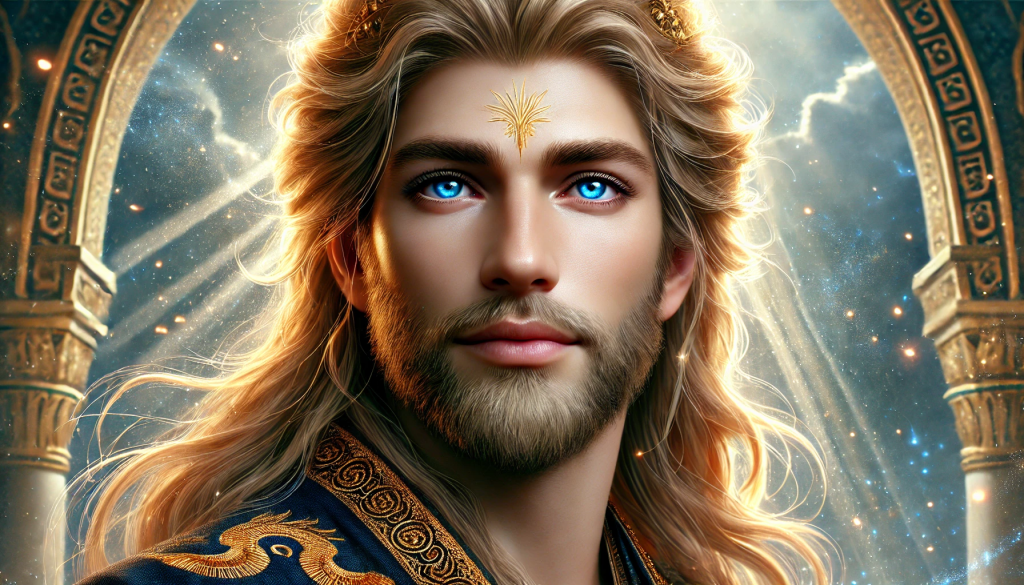
This stunning, realistic, and artistic fantasy-style close-up illustration captures Enki’s radiant and celestial presence as he looks directly into the camera. His deep blue eyes glow with divine intelligence, framed by long flowing blonde hair and a well-groomed beard. He exudes an aura of wisdom, leadership, and supernatural insight. Dressed in elegant Sumerian robes adorned with golden embroidery, he radiates timeless power and enlightenment. A soft supernatural glow surrounds him, emphasizing his role as the protector of civilization and knowledge.
💡 Connection: Both figures train and lead elite groups, ensuring the survival and prosperity of their societies.
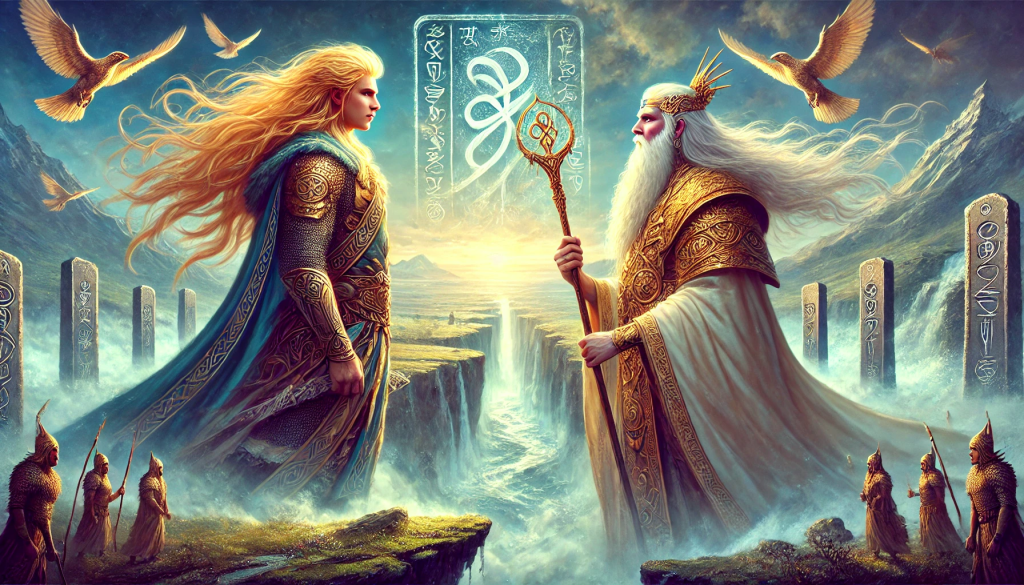
This stunning, realistic, and artistic fantasy-style illustration captures a legendary moment—the meeting of Fin (Fionn mac Cumhaill) and Enki, two beings who share the same archetype as guardians, strategists, and civilization-builders. Fin stands as a towering warrior, his long golden hair flowing in the wind, his piercing blue eyes filled with wisdom and strength. His intricate Celtic armor, adorned with symbols of protection, reflects his role as a fighter and a guide. Enki, robed in golden-embroidered Sumerian attire, radiates divine energy. His deep blue eyes, framed by long blonde hair and a regal beard, show his intellect and foresight. He holds a staff of wisdom, symbolizing his role as a shaper of civilizations and protector of knowledge. The background merges two worlds—on one side, the misty Celtic highlands, and on the other, the sacred riverbanks of ancient Sumer, representing their parallel destinies. A soft aura of supernatural energy envelops them, symbolizing their shared divine purpose—to guide and protect humanity through wisdom, foresight, and strategy.
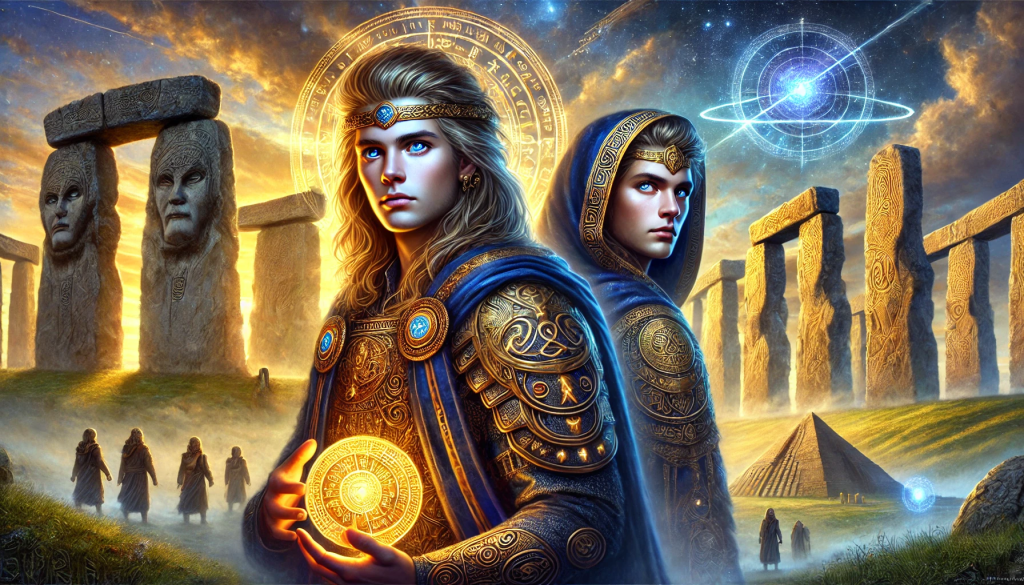
In this mesmerizing depiction, Fin and Enki appear as youthful and influential figures, standing side by side as builders and civilization-shapers. Fin, with his golden hair flowing and piercing blue eyes, wears intricate Celtic armor inscribed with glowing runes, embodying the wisdom and strength of the Fianna. Enki, appearing as a young Anunnaki god, dons deep blue robes adorned with golden embellishments, a celestial glow surrounding him as he holds an ancient orb of sacred knowledge. Behind them, the worlds of Irish and Sumerian myth merge—standing stones carved with mystical symbols rise beside an ancient pyramid, bridging their destinies. The cosmic sky above them reinforces their eternal mission as guides of humanity, shaping civilizations across time and space.
Guardians of Humanity Against Chaos – Battling Aillen & Tiamat
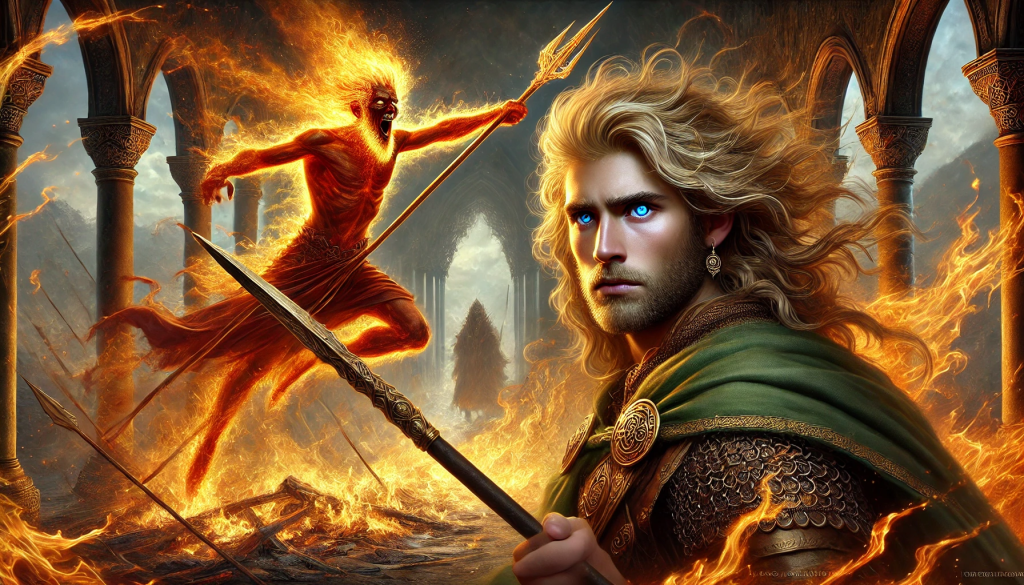
Fin and Enki battle forces of destruction, ensuring that order triumphs over chaos.
- Fin’s Battle with Aillen: Aillen, a fire-breathing spirit, burns the halls of Tara every year, putting warriors to sleep with his music. Fin alone resists the spell, slays Aillen, and saves Ireland’s sacred seat of power.
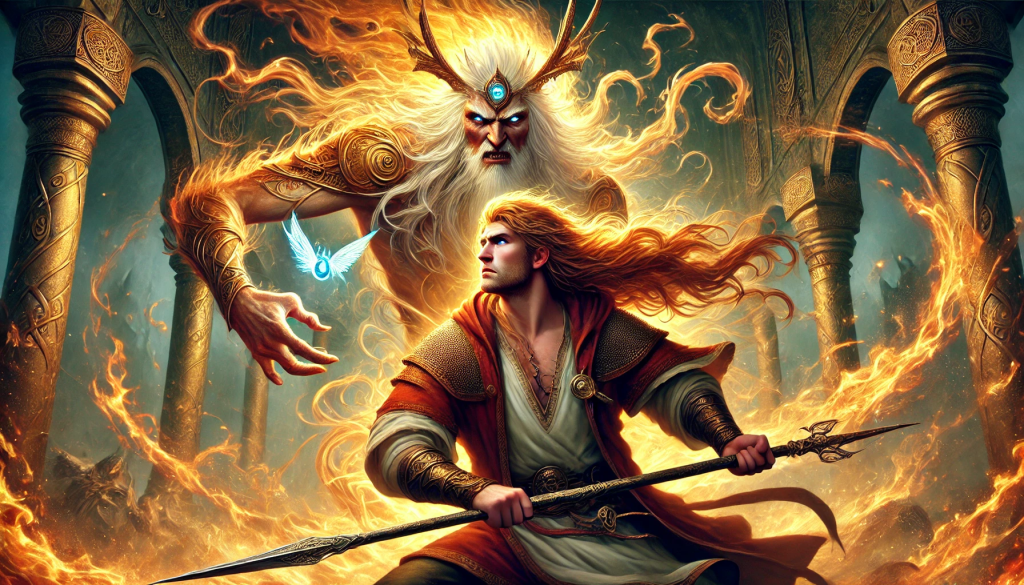
- Enki’s Battle Against Chaos (Tiamat & Abzu): In Mesopotamian myth, Enki defeats the chaos waters of Abzu, preventing destruction. He also plays a key role in the battle against Tiamat, a primordial force of destruction.
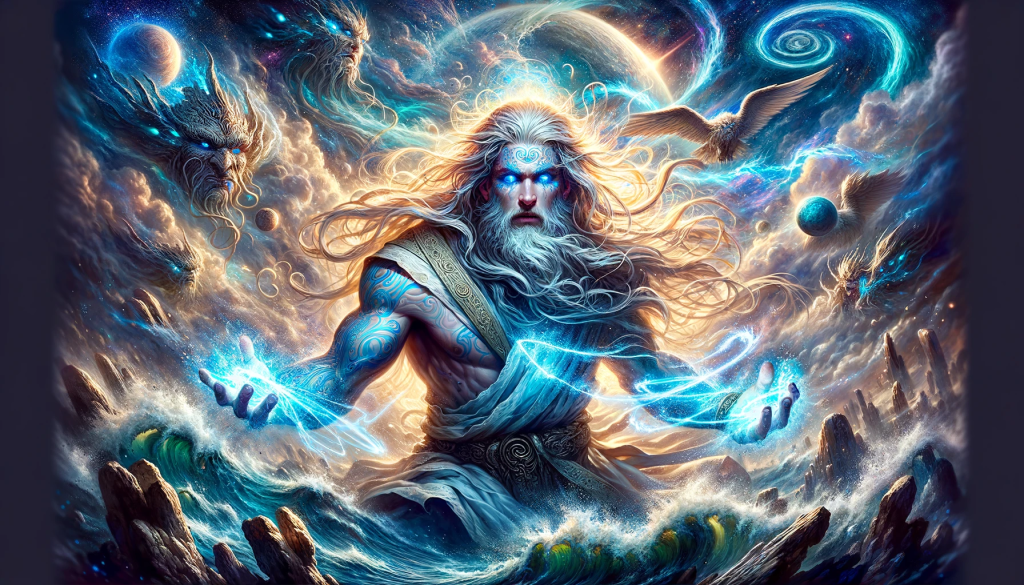

In this full-color, highly detailed fantasy-style illustration, Fin and Enki stand as protectors of civilization, their vibrant forms illuminated by divine energy. Fin, the Celtic warrior-seer, grips his enchanted spear, his piercing blue eyes blazing with determination, as he confronts Aillen, the fire-breathing spirit, within the burning halls of Tara. His long golden hair flows wildly, radiating the power of his heroic resolve. Beside him, Enki, the Sumerian god of wisdom and creation, wields immense divine energy. His long blonde hair shimmers as he battles Tiamat’s primordial chaos and Abzu’s swirling waters. The background blends Fin’s fiery battlefield and Enki’s celestial realm, symbolizing the duality of destruction and divine order. The image captures the epic struggle between chaos and balance, with vivid colors, intricate details, and a sense of grandeur befitting these legendary guardians of civilization.
💡 Connection: Fin and Enki defend civilization, using their knowledge and courage to subdue destructive forces.
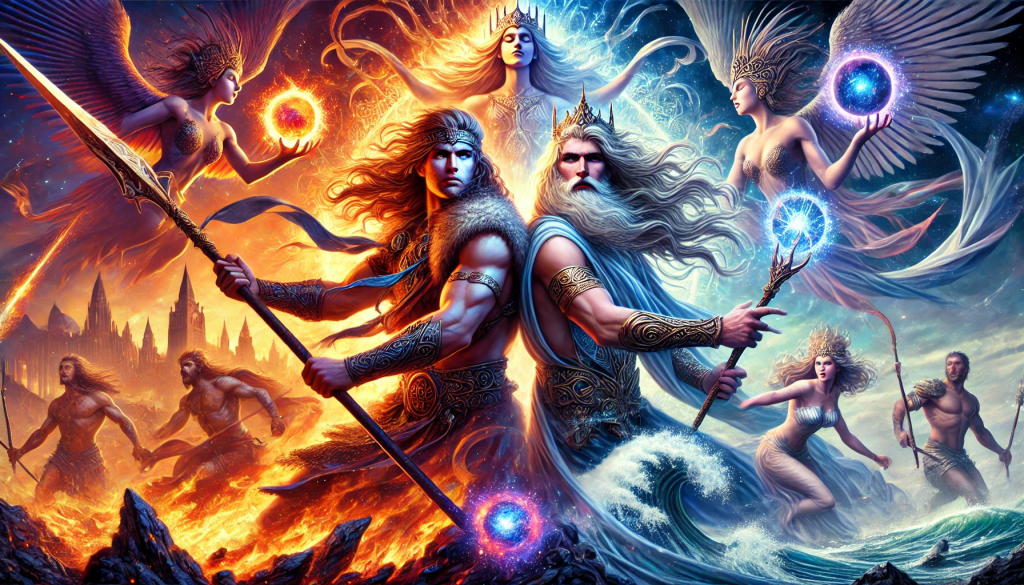
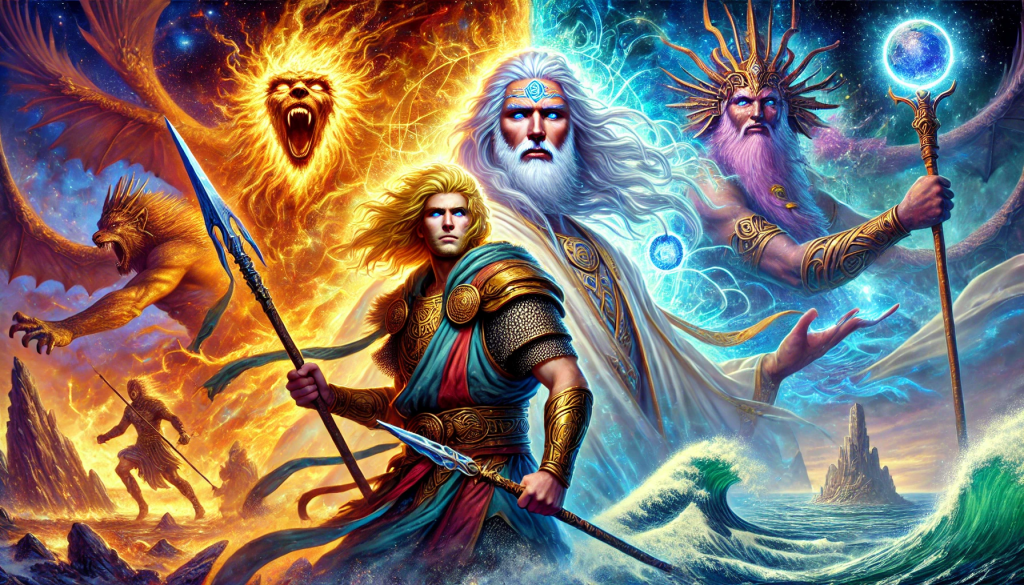
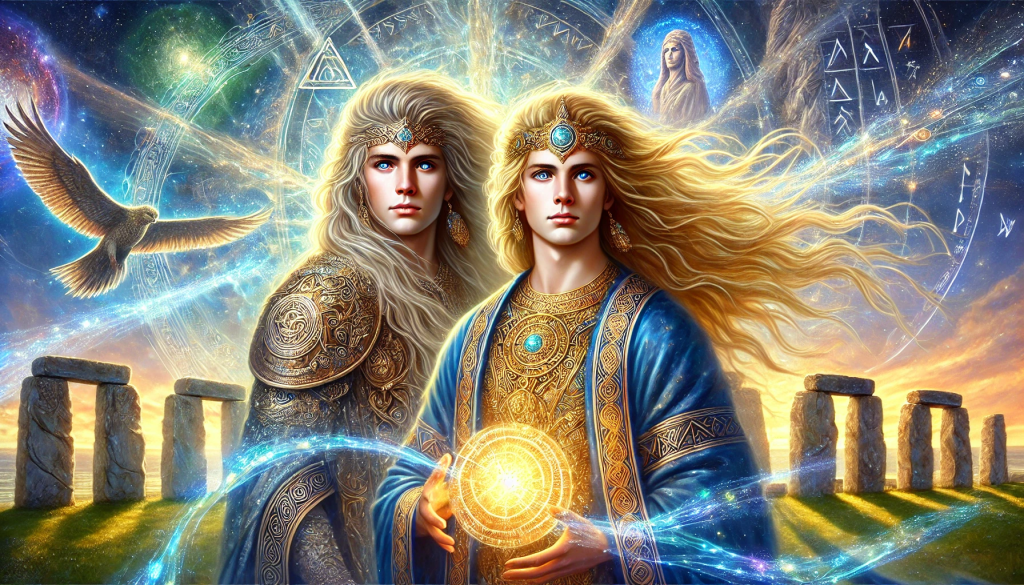
In this majestic depiction, Fin and Enki stand side by side, their long hair flowing freely in the cosmic winds, radiating divine energy. Fin, the golden-haired warrior of the Fianna, exudes power and wisdom, his piercing blue eyes glowing with insight. His intricate Celtic armor is adorned with luminous rune engravings, symbolizing his role as a protector and strategist. Enki, appearing as a youthful Anunnaki god, has slightly lighter blonde hair, like spun sunlight, cascading in waves of celestial energy. Draped in deep blue robes with golden embellishments, he holds an ancient glowing orb of sacred knowledge, a beacon of enlightenment. Behind them, the worlds of Irish and Sumerian legend merge—towering stone circles and grand ziggurats stand beneath a swirling cosmic sky, reinforcing their eternal mission as shapers of civilization and guides of humanity’s destiny.
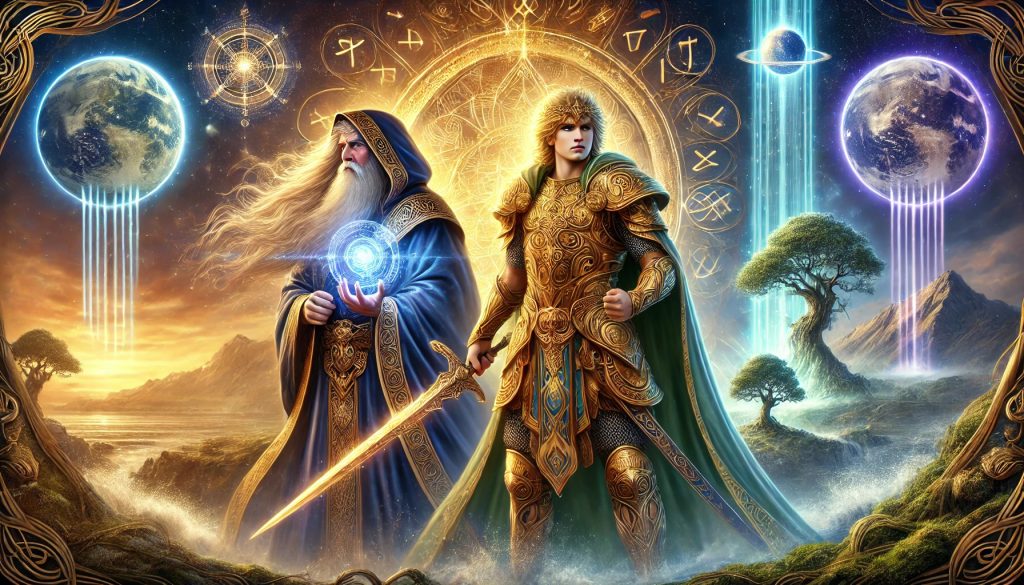
Fin and Enki stand as cosmic allies in this awe-inspiring depiction, symbolizing their deep connection to the Tuatha Dé Danann. Fin, the golden-haired warrior, dons intricate Celtic armor, gripping his legendary sword as a beacon of strength and leadership. Beside him, Enki, the ancient Anunnaki god, exudes wisdom in flowing blue robes adorned with gold, representing his role as a divine guide. Behind them, an ethereal portal glows, merging the realms of Irish myth and celestial wonder. The landscape intertwines the earthly and the cosmic—standing stones carved with runes stand alongside floating celestial orbs, signifying their eternal guardianship over civilizations across time and space.
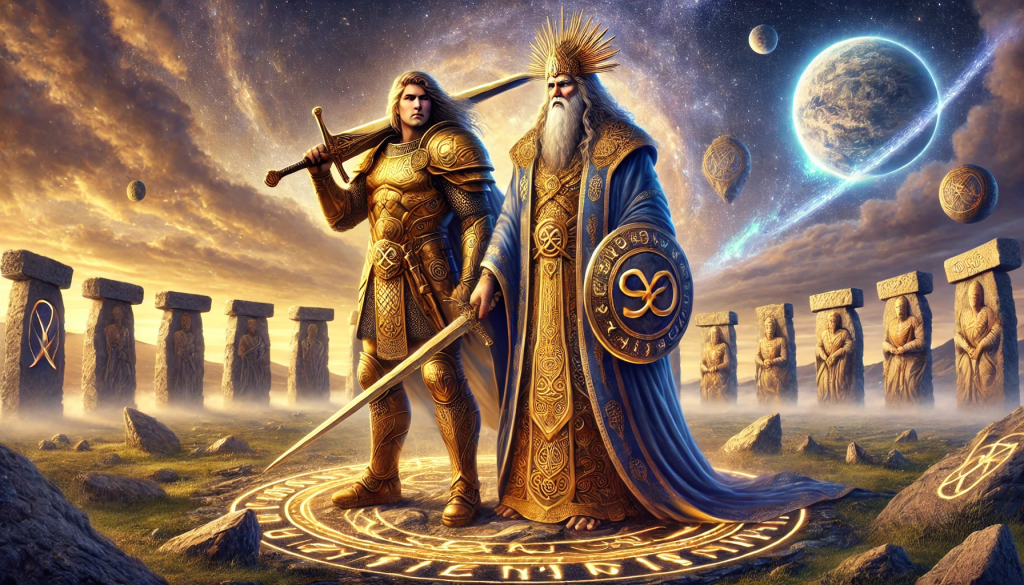
Fin and Enki stand side by side, embodying the dual forces of protection and leadership. Fin, the fearless warrior of Ireland, grips his mighty sword, clad in golden Celtic armor, prepared to defend his people. Enki, the Anunnaki lord of wisdom, stands as a guiding force, his blue robes shimmering with sacred symbols, his shield adorned with the infinite wisdom of the cosmos. Encircling them, ancient standing stones carved with glowing runes whisper the secrets of past and future realms. Above, celestial bodies align, reinforcing their shared role as guardians who shape and guide humanity. Fin and Enki safeguard civilization through war, wisdom, might, and intellect, ensuring its evolution.
Messengers Between Worlds – The Otherworld & The Divine Realm
Fin and Enki deeply connect to the supernatural realms and act as bridges between the divine and the mortal.
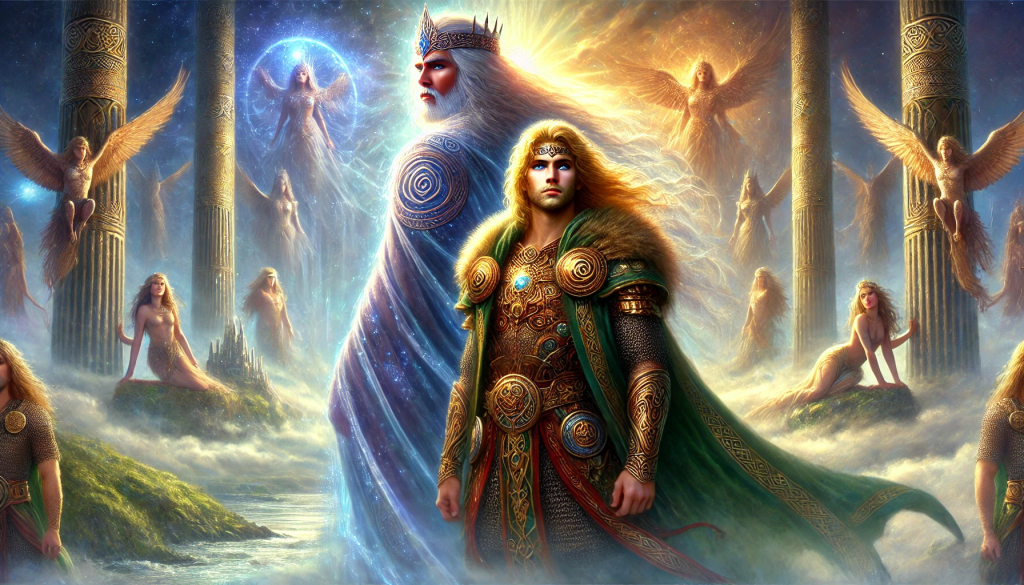
- Fin’s Link to the Sidhe (Faery Folk): Fin’s life is intertwined with the Otherworld (Tír na nÓg), a mystical land of gods and immortals. He falls in love with Sabh, a woman of the Sidhe, and his son Oisín journeys to the Otherworld.

- Enki’s Role as the Divine Mediator: Enki is often the only god who interacts directly with humanity, mediating between the divine world of Anu, the underworld of Ereshkigal, and the mortal realm.
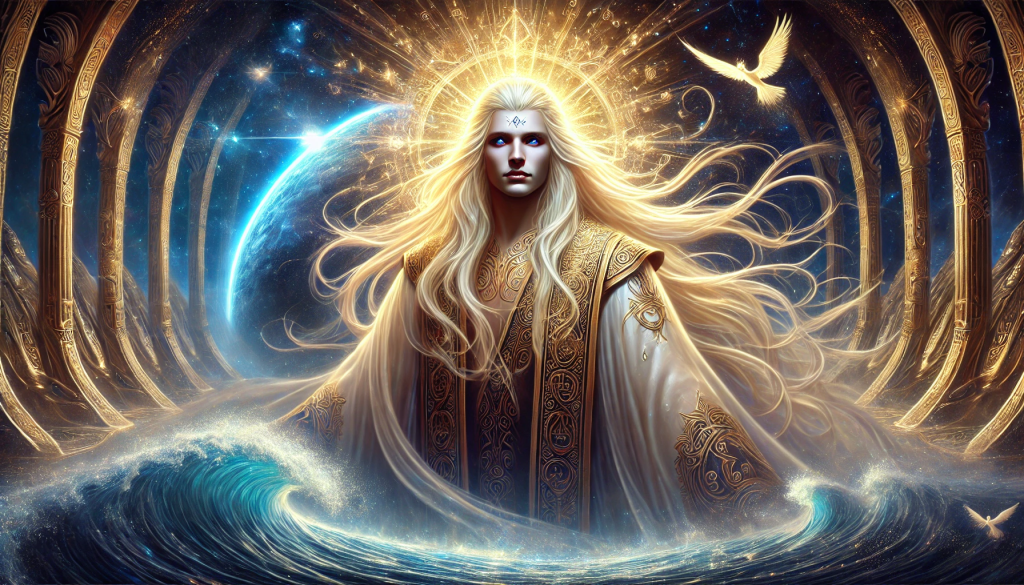
💡 Connection: Fin and Enki exist in both worlds, holding knowledge of the gods while walking among men.
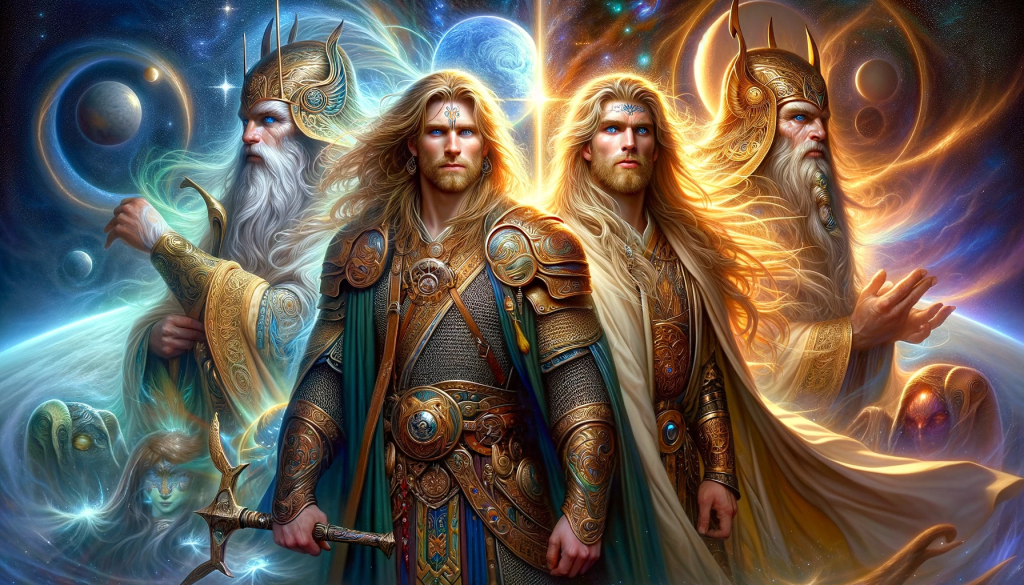
The Uncertain Fate – Do They Ever Truly Die?
Neither Fin nor Enki has a definitive death—both are believed to be waiting, hidden, ready to return when needed.
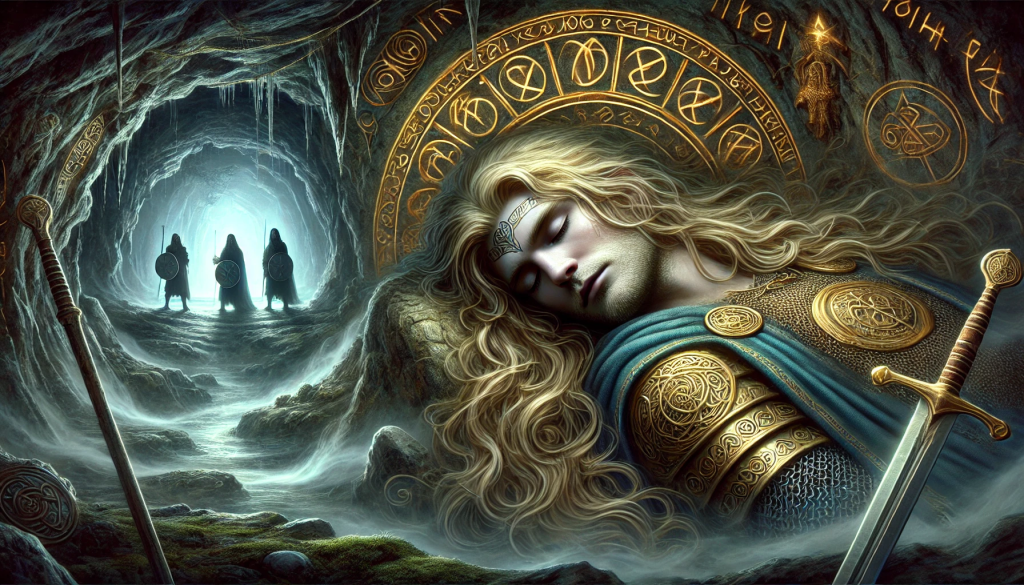
- Fin’s Mysterious Fate: Some legends say Fin never died, but sleeps in a cave, awaiting the day he must rise to defend Ireland again.
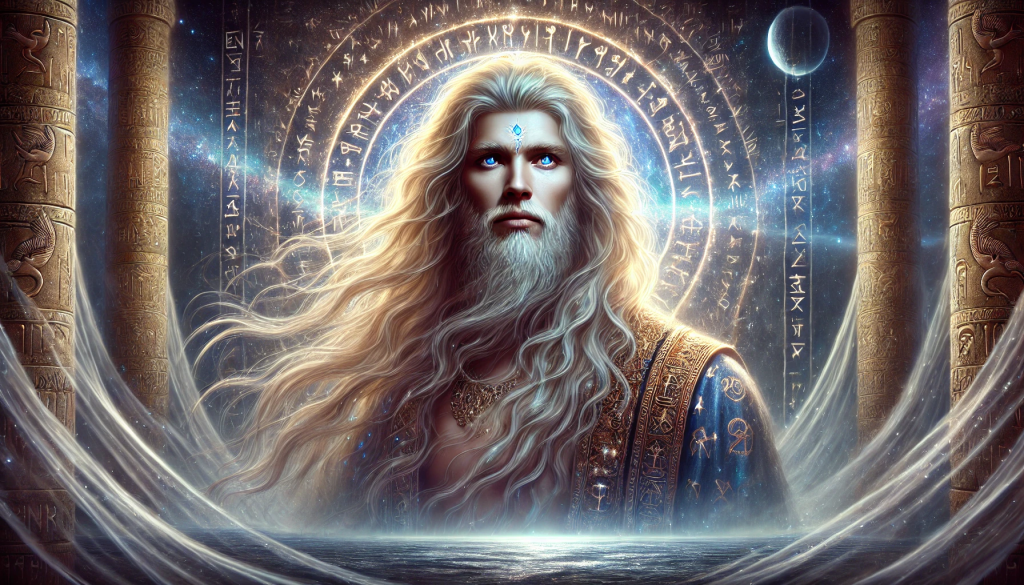
- Enki’s Withdrawal from the Mortal World: Enki fades into myth, retreating from history, yet his presence lingers in mystery schools and esoteric teachings.
💡 Connection: Both figures disappear rather than die, reinforcing that their wisdom endures, waiting for the right moment to return.
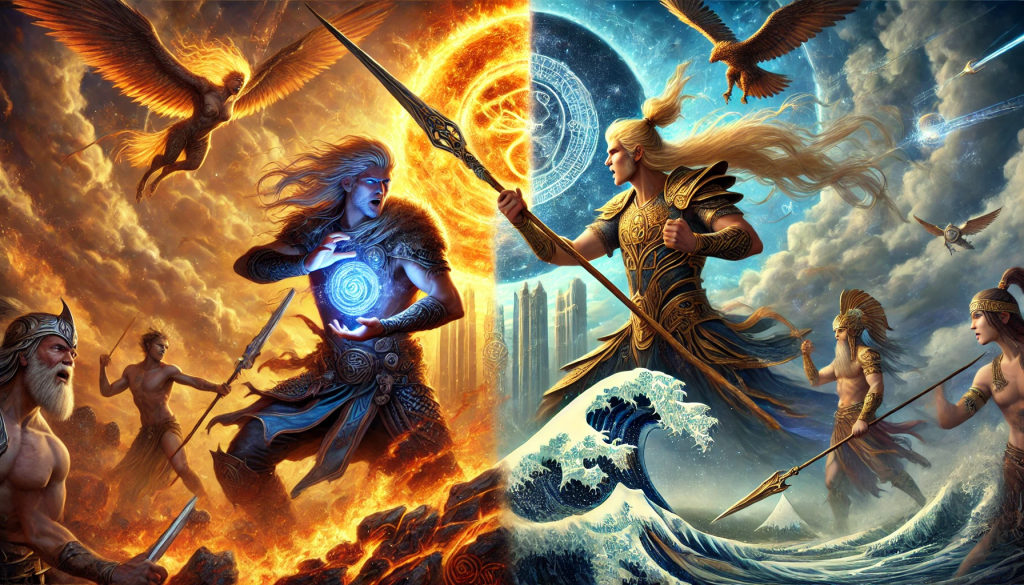
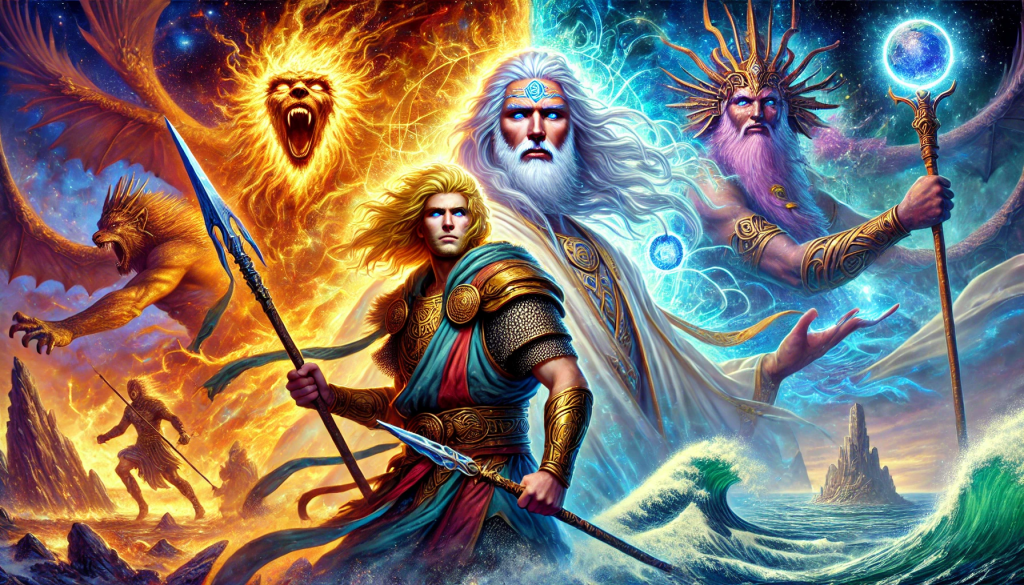
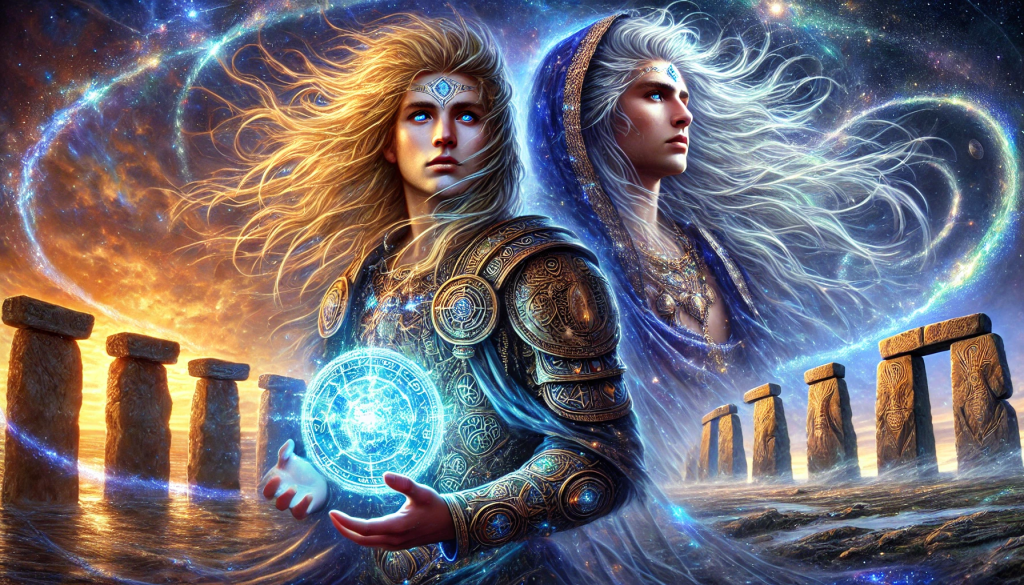
Fin and Enki stand side by side, their long hair flowing freely in the cosmic winds, embodying youthful wisdom and power. Fin, the golden-haired leader of the Fianna, exudes strength and intelligence, his piercing blue eyes glowing with insight. He wears intricately designed Celtic armor adorned with luminous rune engravings, symbolizing his role as a guardian and strategist. Beside him, Enki, the Anunnaki god of wisdom, appears youthful with flowing silver-blue hair, his deep blue robes shimmering with celestial gold embellishments. In his hands, he holds an ancient glowing orb of sacred knowledge. Behind them, the worlds of Irish and Sumerian myth blend seamlessly—towering stone circles inscribed with forgotten symbols stand beside ancient ziggurats, while the sky above swirls with divine energy. This image captures their eternal mission as civilization-shapers, bound by destiny to guide humanity through the ages.
Conclusion: Fin as an Avatar of Enki
Fin is not a warrior, just as Enki is not a god of water. Both figures are:
✔ Bringers of wisdom – They gain knowledge through sacred means and use it to shape civilization.
✔ Tricksters and strategists – They outwit their enemies, solving problems with intelligence rather than brute force.
✔ Defenders of balance – They fight chaos to protect civilization, keeping the world in order.
✔ Bridges between worlds – They move between realms, guiding mortals with divine insight.
✔ Beings beyond death – They do not perish but await when they are needed again.
Thus, Fin is more than a Celtic legend—he manifests Enki’s eternal presence, guiding and protecting humanity under a new name and in a new land, but with the same timeless wisdom.
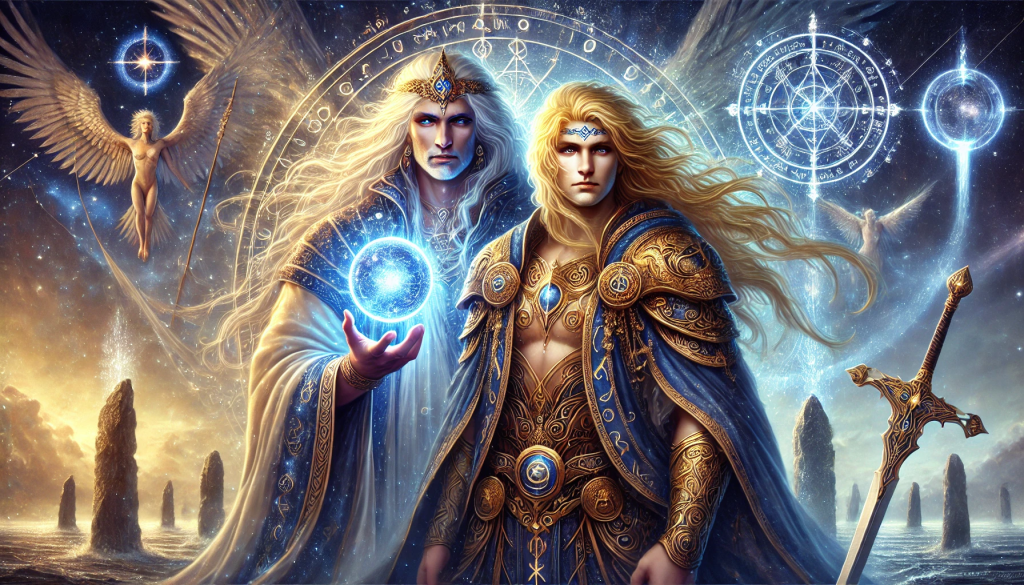
A majestic depiction of Enki and Fin standing side by side, symbolizing their connection to the Tuatha Dé Danann. Enki, the Anunnaki god of wisdom, wears flowing blue and gold robes adorned with intricate celestial symbols, his piercing blue eyes radiating knowledge. His lighter blonde hair flows in the cosmic breeze as he holds a glowing orb of divine energy. Fin, the legendary leader of the Fianna, stands beside him with long golden hair and sharp blue eyes, clad in ornate Celtic armor engraved with mystical runes. They are surrounded by an ethereal landscape where the realms of the Tuatha Dé Danann merge—ancient standing stones inscribed with glowing symbols, shimmering otherworldly portals, and a sky illuminated by constellations. The image conveys a deep sense of wisdom and leadership, as well as a combination of divine knowledge and warrior strength.
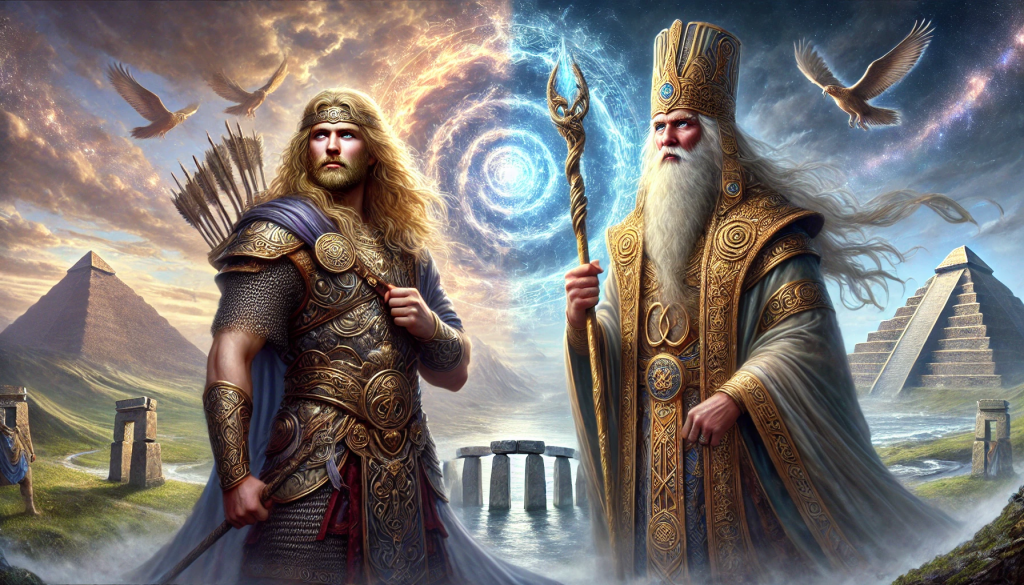

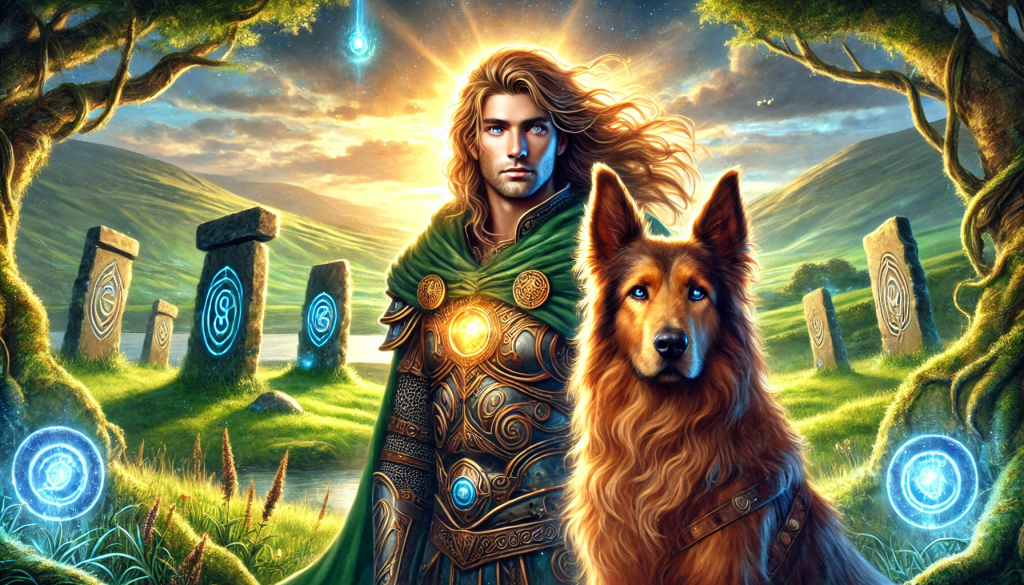
Fionn mac Cumhaill
https://en.wikipedia.org/wiki/Fionn_mac_Cumhaill
From Wikipedia, the free encyclopedia
“Finn Mac Cool” redirects here. For the novel by Morgan Llywelyn, see Finn Mac Cool (novel). For ‘son of the hazel’, the legendary king, see Mac Cuill.

Fionn mac Cumhaill (/ˈfɪn məˈkuːl/ FIN mə-KOOL; Ulster Irish: [ˈfʲɪn̪ˠ mˠək ˈkuːl̠ʲ] Connacht Irish: [ˈfʲʊn̪ˠ-] Munster Irish: [ˈfʲuːn̪ˠ-]; Scottish Gaelic: [ˈfjũːn̪ˠ maxk ˈkʰũ.əʎ]; Old and Middle Irish: Find or Finn[1][2] mac Cumail or mac Umaill), often anglicized Finn McCool or MacCool, is a hero in Irish mythology, as well as in later Scottish and Manx folklore. He is the leader of the Fianna bands of young roving hunter-warriors, as well as being a seer and poet. He is said to have a magic thumb that bestows him with great wisdom. He is often depicted hunting with his hounds Bran and Sceólang, and fighting with his spear and sword. The tales of Fionn and his fiann form the Fianna Cycle or Fenian Cycle (an Fhiannaíocht), much of it narrated by Fionn’s son, the poet Oisín.
Etymology
[edit]
In Old Irish, finn/find means “white, bright, lustrous; fair, light-hued (of complexion, hair, etc.); fair, handsome, bright, blessed; in moral sense, fair, just, true”.[3] It is cognate with Primitive Irish VENDO- (found in names from Ogam inscriptions), Welsh gwyn (cf. Gwyn ap Nudd),[4] Cornish gwen, Breton gwenn, Continental Celtic and Common Brittonic *uindo- (a common element in personal and place names), and comes from the Proto-Celtic adjective masculine singular *windos.[5][6][7]
Irish legend
[edit]
Fionn’s birth and early adventures are recounted in the narrative The Boyhood Deeds of Fionn and other sources. Fionn was the posthumous son of Cumhall, leader of the Fianna, by Muirne.[8]
Fionn and his father Cumhall mac Trénmhoir (“son of Trénmór”) stem from Leinster, rooted in the tribe of Uí Thairsig (“the Descendants of Tairsiu”)[9][10] There is mention of the Uí Thairsig in the Lebor Gabála Érenn as one of the three tribes descended from the Fir Bolg.[11]
His mother was called Muirne Muincháem “of the Fair Neck”[12] (or “of the Lovely Neck”,[13] or “Muiren smooth-neck”[14]), the daughter of Tadg mac Nuadat (in Fotha Catha Chnucha) and granddaughter of Nuadat the druid serving Cathair Mór who was high-king at the time,[a][12] though she is described as granddaughter of Núadu of the Tuatha Dé Danann according to another source (Acallam na Senórach).[9] Cumhall served Conn Cétchathach “of the Hundred Battles” who was still a regional king at Cenandos (Kells, Co. Meath).[12][16]
Cumhall abducted Muirne after her father refused him her hand, so Tadg appealed to the high king Conn, who outlawed Cumhall. The Battle of Cnucha was fought between Conn and Cumhall, and Cumhall was killed by Goll mac Morna,[12] who took over leadership of the Fianna.
The feud
[edit]
The Fianna were a band of warriors also known as a military order composed mainly of the members of two rival clans, “Clan Bascna” (to which Fionn and Cumall belonged) and “Clan Morna” (where Goll mac Morna belonged), the Fenians were supposed to be devoted to the service of the High King and to the repelling of foreign invaders.[17] After the fall of Cumall, Goll mac Morna replaced him as the leader of the Fianna,[18] holding the position for 10 years.[19]
Birth
[edit]
Muirne was already pregnant; her father rejected her and ordered his people to burn her, but Conn would not allow it and put her under the protection of Fiacal mac Conchinn, whose wife, Bodhmall the druid, was Cumhall’s sister. In Fiacal’s house Muirne gave birth to a son, whom she called Deimne (/ˈdeɪni/ DAY-nee, Irish: [ˈdʲɪvʲ(ə)nʲə]),[b] literally “sureness” or “certainty”, also a name that means a young male deer; several legends tell how he gained the name Fionn when his hair turned prematurely white.
Boyhood
[edit]
Fionn and his brother Tulcha mac Cumhal were being hunted down by the Goll, the sons of Morna, and other men. Consequently, Finn was separated from his mother Muirne, and placed in the care of Bodhmall and the woman Liath Luachra (“Grey of Luachra”), and they brought him up in secret in the forest of Sliabh Bladma, teaching him the arts of war and hunting. After the age of six, Finn learned to hunt, but still had cause to flee from the sons of Morna.[20]
As he grew older he entered the service – incognito – of a number of local kings, but each one, when he recognised Fionn as Cumhal’s son, told him to leave, fearing they would be unable to protect him from his enemies.
Thumb of Knowledge
[edit]
Fionn was a keen hunter and often hunted with Na Fianna on the hill of Allen in County Kildare, it is believed by many in the area that Fionn originally caught the Salmon of Knowledge in the River Slate that flows through Ballyteague. The secret to his success thereafter when catching “fish of knowledge” was to always cast from the Ballyteague side of a river. He gained what commentators have called the “Thumb of Knowledge”[c] after eating a certain salmon, thought to be the Salmon of Wisdom.[22][23] The account of this is given in The Boyhood Deeds of Fionn.[24]
Young Fionn, still known by his boyhood name Demne, met the poet Finn Éces (Finnegas), near the river Boyne and studied under him. Finnegas had spent seven years trying to catch the salmon that lived in Fec’s Pool (Old Irish: Linn Féic) of the Boyne, for it was prophesied the poet would eat this salmon, and “nothing would remain unknown to him”.[24] Although this salmon is not specifically called the “Salmon of Knowledge“, etc., in the text, it is presumed to be so, i.e., the salmon that fed on the nut[s] of knowledge at the well of Segais.[22] Eventually the poet caught it, and told the boy to cook it for him. While he was cooking it, Demne burned his thumb, and instinctively put his thumb in his mouth. This imbued him with the salmon’s wisdom, and when Éces saw that he had gained wisdom, he gave the youngster the whole salmon to eat, and gave Demne the new name, Fionn.[24]
Thereafter, whenever he recited the teinm láida with his thumb in his mouth, the knowledge he wished to gain was revealed to him.[24][d]
In subsequent events in his life, Fionn was able to call on ability of the “Thumb of Knowledge”, and Fionn then knew how to gain revenge against Goll.[citation needed] In the Acallam na Sénorach, the ability is referred to as “The Tooth of Wisdom” or “Tooth of Knowledge” (Old Irish: dét fis).[21]
Fionn’s acquisition of the Thumb of Knowledge has been likened to the Welsh Gwion Bach tasting the Cauldron of Knowledge,[26] and Sigurðr Fáfnisbani tasting Fáfnir‘s heart.[27][28]
Fire-breather of the Tuatha de Danann
[edit]
_(14750481494).jpg)
One feat of Fionn performed at 10 years of age according to the Acallam na Senórach was to slay Áillen (or [e]), the fire-breathing man of the Tuatha Dé Danann, who had come to wreak destruction on the Irish capital of Tara every year on the festival of Samhain for the past 23 years, lulling the city’s men to sleep with his music then burning down the city and its treasures.[29]
When the King of Ireland asked what men would guard Tara against Áillen’s invasion, Fionn volunteered.[f] Fionn obtained a special spear (the “Birga“) from Fiacha mac Congha (“son of Conga”), which warded against the sleep-inducing music of Áillen’s “dulcimer” (Old Irish: timpán)[g] when it was unsheathed and the bare steel blade was touched against the forehead or some other part of the body. This Fiacha used to be one of Cumall’s men, but was now serving the high-king.[32]
After Fionn defeated Áillen and saved Tara, his heritage was recognised and he was given command of the Fianna: Goll stepped aside, and became a loyal follower of Fionn,[33][34] although a dispute later broke out between the clans over the pig of Slanga.[35]
Almu as eric
[edit]
Before Fionn completed the feat of defeating the firebrand of the fairy mound and defending Tara, he is described as a ten-year-old “marauder and an outlaw”.[36] It is also stated elsewhere that when Fionn grew up to become “capable of committing plunder on everyone who was an enemy”, he went to his maternal grandfather Tadg to demand compensation (éric) for his father’s death, on pain of single combat, and Tadg acceded by relinquishing the estate of Almu (the present-day Hill of Allen). Fionn was also paid éric by Goll mac Morna.[35][h]
Adulthood
[edit]
Fionn’s sword was called “Mac an Luinn”.[38]
Love life
[edit]
Fionn met his most famous wife, Sadhbh, when he was out hunting. She had been turned into a deer by a druid, Fear Doirich, whom she had refused to marry. Fionn’s hounds, Bran and Sceólang, born of a human enchanted into the form of a hound, recognised her as human, and Fionn brought her home. She transformed back into a woman the moment she set foot on Fionn’s land, as this was the one place she could regain her true form. She and Fionn married and she was soon pregnant. When Fionn was away defending his country, Fear Doirich (literally meaning Dark Man) returned and turned her back into a deer, whereupon she vanished. Fionn spent years searching for her, but to no avail. Bran and Sceólang, again hunting, found her son, Oisín, in the form of a fawn; he transformed into a child, and went on to be one of the greatest of the Fianna.
In The Pursuit of Diarmuid and Gráinne the High King Cormac mac Airt promises the aging Fionn his daughter Gráinne, but at the wedding feast Gráinne falls for one of the Fianna, Diarmuid Ua Duibhne, noted for his beauty. She forces him to run away with her and Fionn pursues them. The lovers are helped by the Fianna, and by Diarmuid’s foster-father, the god Aengus. Eventually Fionn makes his peace with the couple. Years later, however, Fionn invites Diarmuid on a boar hunt, and Diarmuid is gored. Water drunk from Fionn’s hands has the power of healing, but each time Fionn gathers water he lets it run through his fingers before he gets back to Diarmuid. His grandson Oscar shames Fionn, but when he finally returns with water it is too late; Diarmuid has died.
_(14566385007).jpg)
Death
[edit]
According to the most popular account of Fionn’s death, he is not dead at all, rather, he sleeps in a cave, surrounded by the Fianna. One day he will awake and defend Ireland in the hour of her greatest need. In one account, it is said that he will arise when the Dord Fiann, the hunting horn of the Fianna, is sounded three times, and he will be as strong and as well as he ever was.[39]
Popular folklore
[edit]
Many geographical features in Ireland are attributed to Fionn. Legend has it he built the Giant’s Causeway as stepping-stones to Scotland, so as not to get his feet wet; he also once scooped up part of Ireland to fling it at a rival, but it missed and landed in the Irish Sea – the clump became the Isle of Man, the pebble became Rockall, and the void became Lough Neagh. In Ayrshire, Scotland a common myth is that Ailsa Craig, a small islet just off coast of the said county, is another rock thrown at the fleeing Benandonner. The islet is sometimes referred to as “paddys’ mile stone” in Ayrshire.[citation needed] Fingal’s Cave in Scotland is also named after him, and shares the feature of hexagonal basalt columns with the nearby Giant’s Causeway in Northern Ireland.
In both Irish and Manx popular folklore,[40] Fionn mac Cumhail (known as “Finn McCool” or “Finn MacCooill” respectively) is portrayed as a magical, benevolent giant. The most famous story attached to this version of Fionn tells of how one day, while making a pathway in the sea towards Scotland – The Giant’s Causeway – Fionn is told that the giant Benandonner (or, in the Manx version, a buggane) is coming to fight him. Knowing he cannot withstand the colossal Benandonner, Fionn asks his wife Oona to help him.
She dresses her husband as a baby, and he hides in a cradle; then she makes a batch of griddle-cakes, hiding griddle-irons in some. When Benandonner arrives, Oona tells him Fionn is out but will be back shortly. As Benandonner waits, he tries to intimidate Oona with his immense power, breaking rocks with his little finger. Oona then offers Benandonner a griddle-cake, but when he bites into the iron he chips his teeth. Oona scolds him for being weak (saying her husband eats such cakes easily), and feeds one without an iron to the ‘baby’, who eats it without trouble.
In the Irish version, Benandonner is so awed by the power of the baby’s teeth and the size of the baby that, at Oona’s prompting, he puts his fingers in Fionn’s mouth to feel how sharp his teeth are. Fionn bites Benandonner’s little finger, and scared of the prospect of meeting his father considering the baby’s size, Benandonner runs back towards Scotland across the Causeway smashing the causeway so Fionn can’t follow him.
The Manx Gaelic version contains a further tale of how Fionn and the buggane fought at Kirk Christ Rushen. One of Fionn’s feet carved out the channel between the Calf of Man and Kitterland, the other carved out the channel between Kitterland and the Isle of Man, and the buggane’s feet opened up Port Erin. The buggane injured Fionn, who fled over the sea (where the buggane could not follow), however, the buggane tore out one of his own teeth and struck Fionn as he ran away. The tooth fell into the sea, becoming the Chicken Rock, and Fionn cursed the tooth, explaining why it is a hazard to sailors.
In Newfoundland, and some parts of Nova Scotia, “Fingal’s Rising” is spoken of in a distinct nationalistic sense. Made popular in songs and bars alike, to speak of “Fingle,” as his name is pronounced in English versus “Fion MaCool” in Newfoundland Irish, is sometimes used as a stand-in for Newfoundland or its culture.
Folktales involving hero Fin MacCool are considered to be classified in Aarne-Thompson-Uther Index as ATU 369, “The Youth on a Quest for his lost Father”,[41] a tale type that, however, some see as exclusive to South Asian tradition, namely India.[42][43][44]
Historical hypothesis
[edit]
The 17th-century historian Geoffrey Keating, and some Irish scholars of the 19th century,[i] believed that Fionn was based on a historical figure.[45]
The 19th century scholar Heinrich Zimmer suggested that Fionn and the Fenian Cycle came from the heritage of the Norse-Gaels.[46] He suggested the name Fianna was an Irish rendering of Old Norse fiandr “enemies” > “brave enemies” > “brave warriors”.[46] He also noted the tale of Fionn’s Thumb of Knowledge is similar to the Norse tale of Sigurðr and Fáfnir,[27][47] although similar tales are found in other cultures. Zimmer proposed that Fionn might be based on Caittil Find (d. 856) a Norseman based in Munster, who had a Norse forename (Ketill) and an Irish nickname (Find, “the Fair” or “the White”). But Ketill’s father must have had some Norse name also, certainly not Cumall, and the proposal was thus rejected by George Henderson.[48][45]
Toponymy
[edit]
Fionn Mac Cumhaill was said to be originally from Ballyfin, in Laois.[49] The direct translation of Ballyfin from Irish to English is “town of Fionn”.
Retellings
[edit]
T. W. Rolleston compiled both Fenian and Ultonian cycle literature in his retelling, The High Deeds of Finn and other Bardic Romances of Ancient Ireland (1910).[50]
James Stephens published Irish Fairy Tales (1920), which is a retelling of a few of the Fiannaíocht.[51]
Modern literature
[edit]

Macpherson’s Ossian
[edit]
Main article: Ossian
Fionn MacCumhail was transformed into the character “Fingal” in James Macpherson‘s poem cycle Ossian (1760), which Macpherson claimed was translated out of discovered Ossianic poetry written in the Scottish Gaelic language.[52] “Fingal”, derived from the Gaelic Fionnghall, was possibly Macpherson’s rendering Fionn’s name as Fingal based on a misapprehension of the various forms of Fionn.[53] His poems had widespread influence on writers, from the young Walter Scott to Goethe, but there was controversy from the outset about Macpherson’s claims to have translated the works from ancient sources. The authenticity of the poems is now generally doubted, though they may have been based on fragments of Gaelic legend, and to some extent the controversy has overshadowed their considerable literary merit and influence on Romanticism.[citation needed]
Twentieth century literature
[edit]
Fionn mac Cumhaill features heavily in modern Irish literature. Most notably he makes several appearances in James Joyce‘s Finnegans Wake (1939) and some have posited that the title, taken from the street ballad “Finnegan’s Wake“, may also be a blend of “Finn again is awake”, referring to his eventual awakening to defend Ireland.
Fionn also appears as a character in Flann O’Brien‘s comic novel, At Swim-Two-Birds (1939), in passages that parody the style of Irish myths. Morgan Llywelyn‘s book Finn Mac Cool (1994) tells of Fionn’s rise to leader of the Fianna and the love stories that ensue in his life. That character is celebrated in “The Legend of Finn MacCumhail”, a song by the Boston-based band Dropkick Murphys featured on their album Sing Loud Sing Proud!.
Glencoe: The Story of the Massacre by John Prebble (Secker & Warburg, 1966), has an account of a legendary battle between Fionn mac Cumhaill, who supposedly lived for a time in Glencoe (in Scotland), and a Viking host in forty longships which sailed up the narrows by Ballachulish into Loch Leven. The Norsemen were defeated by the Feinn of the valley of Glencoe, and their chief Earragan was slain by Goll MacMorna.
The High Deeds of Finn MacCool, an evocative children’s novel by Rosemary Sutcliffe, was published in 1969.
“Finn Mac Cool” written by American author, Morgan Llywelyn, was released in 1994. The fictional novel vividly recounts Finn’s historical adventures saturated with myth and magic. A childhood spent in exile, the love and loss of his beloved wife and child, and his legendary rise from a low class slave to leader of the invincible Fianna.
Finn McCool is a character in Terry Pratchett’s and Steve Baxter’s The Long War.
The adventures of Fion Mac Cumhail after death is explored by the novella “The Final Fighting of Fion Mac Cumhail” by Randall Garrett (Fantasy and Science Fiction – September 1975).
Finn’s early childhood and education is explored in ‘Tis Himself: The Tale of Finn MacCool by Maggie Brace.
Other stories featuring Fionn Mac Cumhail are two of three of the stories in The Corliss Chronicles the story of Prudence Corliss. In the stories, he is featured in The Wraith of Bedlam and The Silver Wheel. He is a close confidant to Prudence and allies himself with her to defeat the evil fictional king Tarcarrius.
Plays and shows
[edit]
In 1987 Harvey Holton (1949–2010) published Finn with the Three Tygers Press, Cambridge. This was a dramatic cycle of poems in Scots for the stage and with music by Hamish Moore, based on the legends of Finn McCool and first performed at The Edinburgh Festival in 1986 before going on tour around Scotland.
In the 1999 Irish dance show Dancing on Dangerous Ground, conceived and choreographed by former Riverdance leads, Jean Butler and Colin Dunne, Tony Kemp portrayed Fionn in a modernised version of The Pursuit of Diarmuid and Gráinne. In this, Diarmuid, played by Colin Dunne, dies at the hands of the Fianna after he and Gráinne, played by Jean Butler, run away together into the forests of Ireland, immediately after Fionn and Gráinne’s wedding. When she sees Diarmuid’s body, Gráinne dies of a broken heart.
In 2010, Washington DC’s Dizzie Miss Lizzie’s Roadside Revue debuted their rock musical Finn McCool at the Capitol Fringe Festival. The show retells the legend of Fionn mac Cumhaill through punk-inspired rock and was performed at the Woolly Mammoth Theater in March 2011.[54]
See also
[edit]
- Irish mythology in popular culture: Fionn mac Cumhaill
- Fenian Brotherhood – a 19th-century Irish revolutionary organisation taking its name from these Fionn legends.
- Daolghas
- Belfast Giants – ice hockey club based in Belfast whose mascot is derived from Fionn
Notes
[edit]
- ^ Tadg mac Nuadat was also a druid, and the clan lived on the hill of Almu, now in County Kildare.[15]
- ^ Southern Irish: [ˈdʲəinʲə].
- ^ “Tooth of Knowledge/Wisdom” in the Acallam na Sénorach[21]
- ^ The teinm láida, glossed as “illumination (?) of song” by Meyer, is described as “one of the three things that constitute a poet” in this text,[24] but glossed by the 12th century Sanas Chormaic as one of the three methods of acquiring prophetic knowledge.[25]
- ^ The episode is also briefly told in Macgnímartha Finn, but there the name of the TDD villain is Aed .
- ^ The Fenians were supposed to be devoted to the service of the High King and to the repelling of foreign invaders.[17]
- ^ It is not clear what sort of stringed instrument.[30] O’Grady’s translation leaves the word in the original Irish, and O’Dooley and Roe as “dulcimer”. T. W. Rolleston rendered it as a “magic harp”,[31] though he uses the term “tympan” elsewhere.
- ^ In the Acallamh na Sénorach, the recollection of the Birga event is preceded by an explanation of Almu, which says Cumhall fathered a son by Alma daughter of Bracan, who died of childbirth. Fionn is not specifically mentioned until Caílte follows up with a story involving Almu that took place in the time of Conn’s grandson Cormac.[37]
- ^ John O’Donovan and Eugene O’Curry. Also W. M. Hennessy before having a change of heart.
References
[edit]Citations
- ^ Meyer, Kuno, ed. (1897), “The Death of Finn Mac Cumaill”, Zeitschrift für Celtische Philologie, 1: 462–465, doi:10.1515/zcph.1897.1.1.462, S2CID 202553713text via CELT Corpus.
- ^ Stokes (1900), pp. xiv+1–438.
- ^ Electronic Dictionary of the Irish Language, finn-1; dil.ie/22134
- ^ Williams, Mark (2017). Ireland’s Immortals: A History of the Gods of Irish Myth. Princeton: Princeton University Press. pp. 194-247 [198]. doi:10.1515/9781400883325-009.
Linguistically cognate with Irish Finn is Welsh Gwynn, a figure who appears in Welsh tradition as a supernatural hunter …
- ^ Sims-Williams, Patrick (1990). “Some Celtic Otherworld Terms”. Celtic Language, Celtic Culture: a Festschrift for Eric P. Hamp. Ford & Bailie Publishers. p. 58.
- ^ Matasovic, Ranko, Etymological Dictionary of Proto-Celtic. Brill, 2009. p. 423.
- ^ Delamarre, Xavier. Dictionnaire de la langue gauloise. Editions Errance, 2003 (2nd ed.). p. 321.
- ^ Meyer (1904) tr. The Boyish Exploits of Finn, pp. 180–181
- ^ Jump up to:a b Stokes (1900) ed. Acallm. 6645–6564 Cumhall mac Treduirn meic Trénmhoir; O’Grady (1892a) ed., p. 216 Cumhall mac Thréduirn mheic Chairbre ; O’Grady (1892b) tr. p. 245 Cumall son of Tredhorn son of Cairbre; Dooley & Roe (1999), pp. 183–184: “Cumall, son of Tredhorn, son of Trénmór
- ^ Meyer (1904) tr. The Boyish Exploits of Finn, p. 180
- ^ Macalister, R. A. S. (1941) ed. tr. LGE ¶282 pp. 12–13
- ^ Jump up to:a b c d Hennessy, William Maunsell, ed. (1875), “Battle of Cnucha”, Revue Celtique, 2: 86–93 (ed. “Fotha Catha Cnucha inso” , tr. “The Cause of the Battle of Cnucha here”). archived via Internet Archive.
- ^ Dooley & Roe (1999), pp. 183–184.
- ^ O’Grady (1892b), p. 245.
- ^ Fotha Catha Cnucha, Hennessy (1875), p. 92, note 7: “Almu. hill of Allen, near Newbridge in the country of Kildare”.
- ^ Windisch, Ernst, ed. (1875), Fotha Catha Cnucha in so, 2, pp. 86–93, Wórterbuch, p. 127: “Cenandos”, now Kells.
- ^ Jump up to:a b Rolleston, T. W. (1911). “Chapter VI: Tales of the Ossianic Cycle”. Hero-tales of Ireland. Constable. p. 252. ISBN 9780094677203.
- ^ Macgnímartha Find, Meyer (1904), pp. 180–181 and verse.
- ^ Acallam na Senórach, O’Grady (1892b), p. 142. That is, until Finn at age ten saved Tara from Aillen of the Tuatha Dé Danann, cf. infra.
- ^ cf. Macgnímartha Find, Meyer (1904), pp. 181–182.
- ^ Jump up to:a b Acallam na Senórach 203, Stokes (1900) ed., p. 7 and note to line 203, p. 273; Dooley & Roe (1999), p. 9 and note on p. 227.
- ^ Jump up to:a b Scowcroft (1995), p. 152.
- ^ “knowledge”, Mackillop (1998) ed., Oxford Dictionary of Celtic Mythology, p. 287
- ^ Jump up to:a b c d e Meyer (1904) tr. The Boyish Exploits of Finn, pp. 185–186; Meyer (1881) ed., p. 201
- ^ “teinm laída“, Mackillop (1998) ed., Oxford Dictionary of Celtic Mythology
- ^ Scowcroft (1995), pp. 152–153.
- ^ Jump up to:a b Scowcroft (1995), p. 154
- ^ Scott, Robert D. (1930), The thumb of knowledge in legends of Finn, Sigurd, and Taliesin, New York: Institute of French Studies
- ^ Stokes (1900) ed. Acallm. 1654–1741; O’Grady (1892a) ed., pp. 130–132 O’Grady (1892b) tr. pp. 142–145; Dooley & Roe (1999), pp. 51–54
- ^ eDIL s.v. “timpán“, ‘some kind of stringed instrument ; a psaltery (?) ‘.
- ^ Rolleston (1926), p. 117.
- ^ Acallam na Senórach, O’Grady (1892b) tr. pp. 142–144; Dooley & Roe (1999), pp. 51–53
- ^ Acallamh na Sénorach, O’Grady (1892b) tr. pp. 144–145; Dooley & Roe (1999), p. 53–54
- ^ cf. Macgnímartha Find, Meyer (1904), p. 188 and verse.
- ^ Jump up to:a b Fotha Catha Cnucha, Hennessy (1875), pp. 91–92 and verse.
- ^ Acallamh na Sénorach, O’Grady (1892b) tr. p. 142; Dooley & Roe (1999), p. 52: “an outcast engaged in scavenging”.
- ^ Acallamh na Sénorach, O’Grady (1892b) tr. pp. 131–132; Dooley & Roe (1999), pp. 39–40
- ^ “BBC Radio nan Gàidheal – Litir do Luchd-ionnsachaidh, Litir do Luchd-ionnsachaidh”. BBC. Retrieved 27 October 2019.
- ^ Lynch, J.F. (1896). “The Legend of Birdhill”. Journal of the Cork Historical and Archaeological Society. 2. II. Cork Historical and Archaeological Society: 188.
- ^ Manx Fairy Tales, Peel, L. Morrison, 1929
- ^ Harvey, Clodagh Brennan. Contemporary Irish Traditional Narrative: The English Language Tradition. Berkeley; Los Angeles; Oxford: University of California Press. 1992. pp. 80-81 (footnote nr. 26). ISBN 0-520-09758-0
- ^ Aarne, Antti; Thompson, Stith. The types of the folktale: a classification and bibliography. Folklore Fellows Communications FFC no. 184. Helsinki: Academia Scientiarum Fennica, 1961. p. 128.
- ^ Beck, B. E. F. “Frames, Tale Types and Motifs: The Discovery of Indian Oicotypes”. In: Indian Folklore Volume II. eds. P. J. Claus et al. Mysore: 1987. pp. 1–51.
- ^ Islam, Mazharul. Folklore, the Pulse of the People: In the Context of Indic Folklore. New Delhi: Concept Publishing Company. 1985. pp. 100 and 166.
- ^ Jump up to:a b Mackillop (1985), pp. 39–40.
- ^ Jump up to:a b Zimmer, Heinrich (1891). Keltische Beiträge III, in: Zeitschrift für deutsches Alterthum und deutsche Litteratur (in German). Weidmannsche Buchhandlung. pp. 1–171.
- ^ Scott, Robert D. (1930), The thumb of knowledge in legends of Finn, Sigurd, and Taliesin, New York: Institute of French Studies
- ^ Henderson (1905), pp. 193–195.
- ^ “Birthplace of Fionn Mac Cumhaill- Ballyfin, Co. Laois”. 4 June 2020.
- ^ Rolleston, T. W. (1926) [1910]. “The Coming of Lugh”. The High Deeds of Finn and other Bardic Romances of Ancient Ireland. George G. Harrap. pp. 105ff.
- ^ Irish Fairy Tales (Wikisource).
- ^ Hanks, P; Hardcastle, K; Hodges, F (2006) [1990]. A Dictionary of First Names. Oxford Paperback Reference (2nd ed.). Oxford: Oxford University Press. pp. 402, 403. ISBN 978-0-19-861060-1.
- ^ “Notes to the first edition”. Sundown.pair.com. Archived from the original on 16 October 2013. Retrieved 16 January 2014.
- ^ Judkis, Maura. “TBD Theater: Finn McCool”. TBD. TBD.com. Archived from the original on 3 October 2011. Retrieved 3 October 2011.
Bibliography(Acallam na Senórach)
- Tales of the Elders of Ireland. Translated by Dooley, Ann; Roe, Harry. Oxford University Press. 1999. pp. 152–154, 155–158, 174–176 (and endnote) p. 171ff. ISBN 978-0-192-83918-3.
- O’Grady, Standish H., ed. (1892a), “Agallamh na Senórach”, Silva Gadelica, Williams and Norgate, pp. 94–232
- O’Grady, Standish H., ed. (1892b), “The Colloquy with the Ancients”, Silva Gadelica, translation and notes, Williams and Norgate, pp. 101–265
- Stokes, Whitley, ed. (1900), Acallamh na Seanórach; Tales of the Elders, Irische Texte IV. e-text via CELT corpus.
(other)
- Henderson, George (16 January 1905), “The Fionn Saga”, Folk-lore, 28, London: 193–207, 353–366
- Meyer, Kuno (1881), “Macgnimartha Find”, Revue Celtique, 5: 195–204, 508
- Meyer, Kuno (1904), “The Boyish Exploits of Finn” [tr. of Macgnimartha Find], Ériu, 1: 180–190
- Mackillop, James (1985), Fionn mac Cumhail: Celtic Myth in English Literature, London: Syracuse University Press, ISBN 9780815623533
- Scowcroft, Richard Mark (1995), “Abstract Narrative in Ireland”, Ériu, 46: 121–158, JSTOR 30007878
External links
[edit]

Wikimedia Commons has media related to Fionn mac Cumhaill.
- “The Connection Between Fenian Lays, Liturgical Chant, Recitative, and Dán Díreach: a Pre-Medieval Narrative Song Tradition.” An analysis of how the songs (lays) of Fionn Mac Cumhaill may have been sung.
- Fionn MacCool and the Old Man.” Montreal storyteller JD Hickey tells a classic Fionn MacCool story.
- The Wisdom of the Outlaw: The Boyhood Deeds of Finn in Gaelic Narrative Tradition, Joseph Falaky Nagy. Berkeley and Los Angeles: University of California Press, 1985. ix + 338 pp. Bibliography; Index.
- Quiggin, Edmund Crosby (1911). “Finn mac Cool” . Encyclopædia Britannica (11th ed.).
| showvteIrish mythology: the Fenian Cycle |
|---|
| show |
|---|

