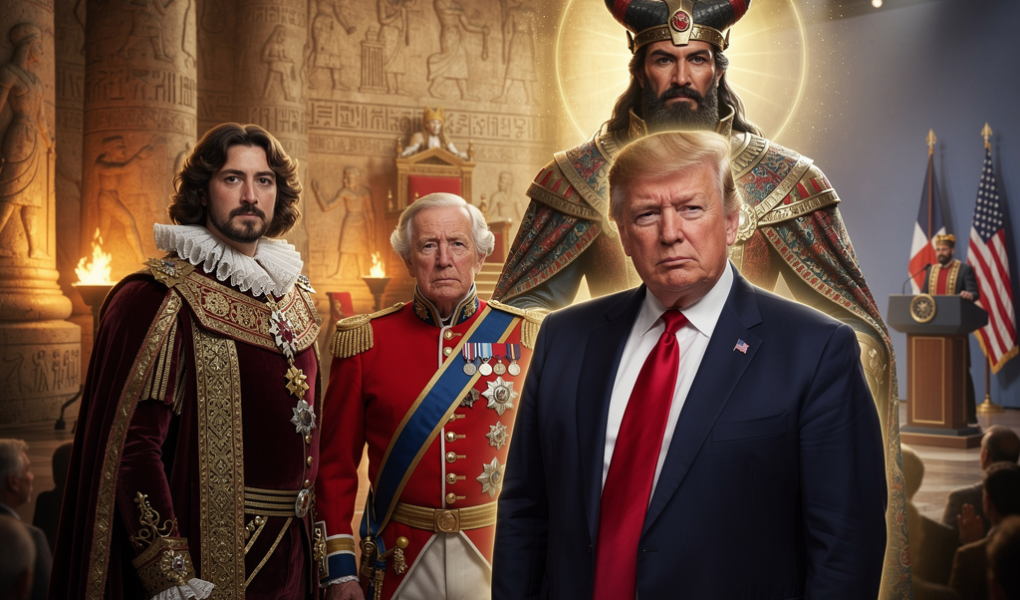
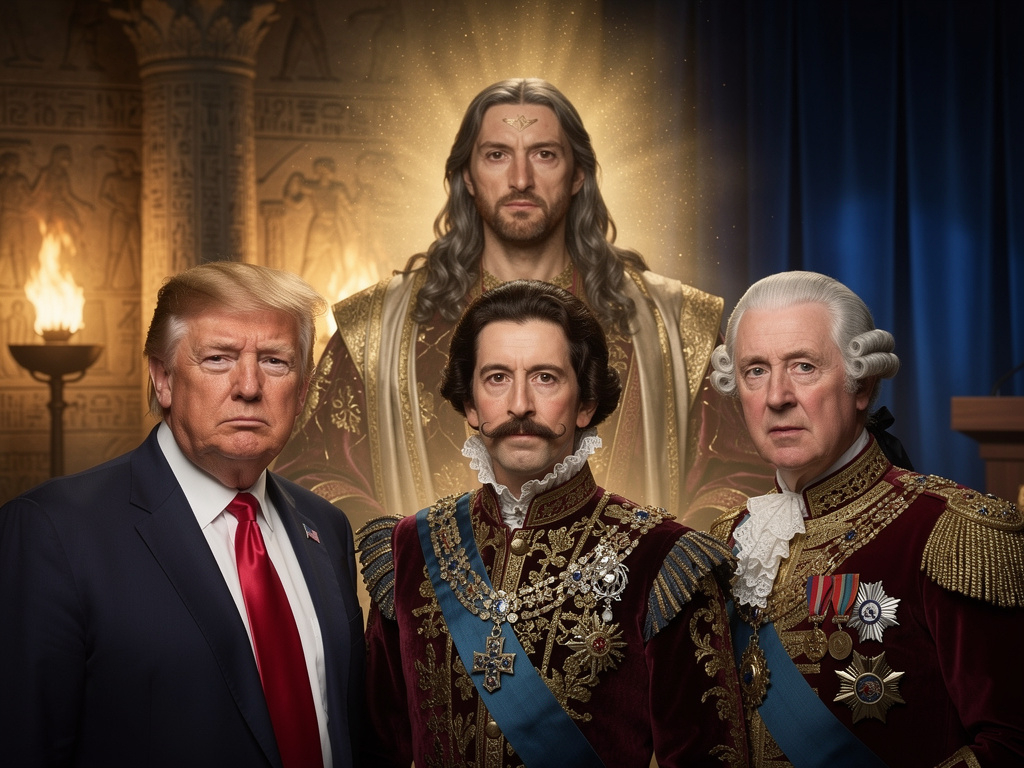
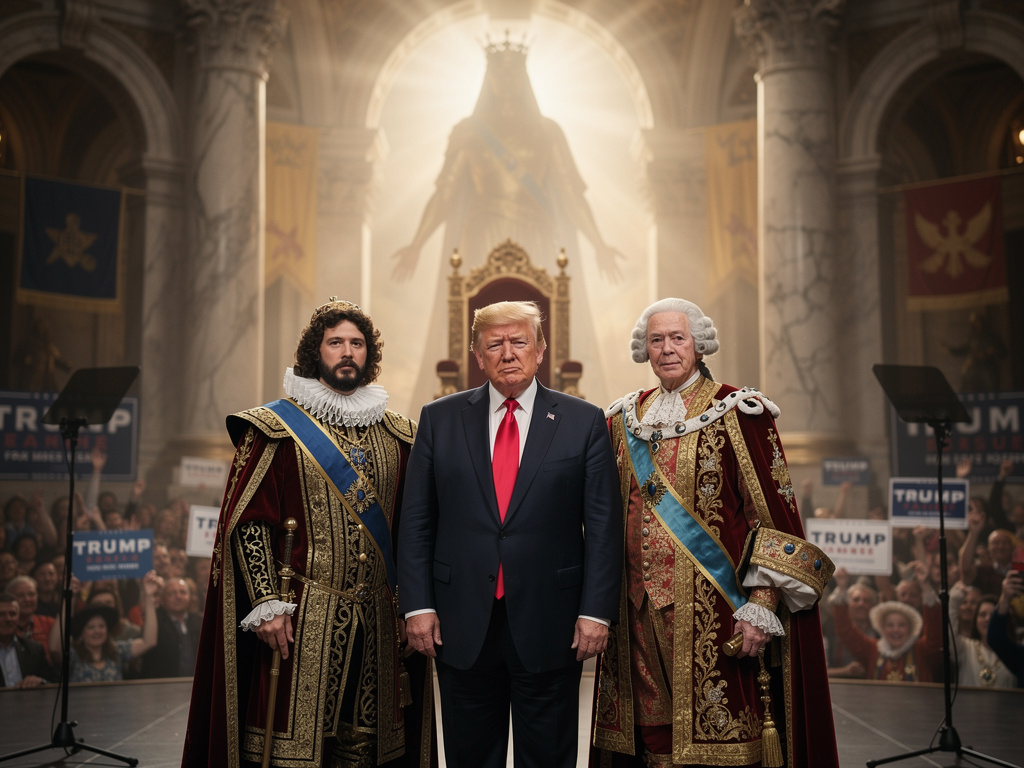
A photorealistic “class picture” / reunion-style group portrait featuring Donald Trump, King Charles I, King George III, and Marduk all standing together in one wide shot. Each figure’s face is clearly visible, evenly lit, and emotionally expressive in a cinematic, elegant way. The background gently blends an ancient throne room with a modern political stage, symbolizing the merging of past and present sacred kingship archetypes. Marduk stands slightly behind the three human rulers—larger, glowing subtly, but still realistic and integrated—representing the archetypal lineage behind their forms of power.
DOMINATION VS. PARTNERSHIP: TRUMP, MAGA & THE RETURN OF SACRED KINGSHIP
Work in progress — this article continues to evolve as part of our ongoing research and series development.
[INSERT IMAGE: THE ARCHETYPAL LINEAGE OF KINGS]
SUBSCRIBE (SHORT BLOCK — TOP)
Support our work and stay connected as this multidimensional series unfolds:
👉 https://substack.com/@janetalexlessinphd
INTRODUCTION: WHEN AN OLD ARCHETYPE RETURNS
Every so often, a political figure steps onto the stage, and the atmosphere around them thickens. The usual categories—left and right, conservative and liberal, hawk and dove—start to feel inadequate. Something older and deeper stirs beneath the day-to-day noise, and people experience that person less as a politician and more as an embodiment of a story they already know by heart, even if they can’t quite name it.
For many Americans, Donald Trump became that kind of figure. To some, he appeared as a champion of the “forgotten.” To others, he was a threat to constitutional order. But beneath those competing assessments lies something more archetypal: the return of sacred kingship—the idea that one man can stand above institutions, beyond law, and somehow be the nation.
This archetype predates the United States, predates Europe’s monarchies, and is as old as civilization itself. It is woven into the stories of god-kings, divine-right rulers, and mythic heroes who claim not just authority, but a sense of cosmic entitlement. In Anunnaki terms, it is the pattern of rulership associated with Marduk and other domination-oriented deities who conflated their personal will with the fate of entire peoples.
Trump did not invent this pattern. He stepped into it.
In this article, we explore his rise and his movement—MAGA—through three interlocking layers:
- The Official Story frames him as a populist restorer of a lost golden age.
- The Psychological and Archetypal Structure that shapes his behavior and his bond with followers.
- The Anunnaki Overlay, where Trump resonates with an ancient Mardukian template of sacred, dominating kingship.
A. THE OFFICIAL STORY: POPULISM, PATRIOTISM & THE PROMISE OF RESTORATION
[INSERT IMAGE: THE MODERN CROWN]
On the surface, the Trump era was sold to his base as a story of righteous reclamation. It was never just about policy; it was about identity and myth. The United States, in this narrative, had been stolen by globalists, bureaucrats, immigrants, cultural elites, coastal technocrats, “the deep state.” The job of the hero was not to govern within the system, but to wage war against it.
Trump’s rally speeches were structured less like policy addresses and more like sermons in a revival tent. He promised to “drain the swamp,” stand up to “corrupt elites,” and speak for those who believed they had been mocked, ignored, or betrayed. The message was emotionally concise:
America had once been great.
Evil forces had corrupted it.
Only a uniquely strong, fearless, and persecuted leader could restore it.
This is not a new formula. It echoes Charles I, who treated Parliament as a rebellious inconvenience beneath his God-given authority, and George III, who saw colonists’ demands not as dialogue, but as disloyalty. Go further back, and you find the same pattern in sacred monarchies where rulers insisted they did not merely represent the divine—they were the divine’s chosen vessel.
What made MAGA especially powerful was how it reframed the relationship between citizens and institutions. Courts, journalists, scientists, and election officials could all be dismissed as corrupt whenever they failed to affirm the leader’s preferred reality. In that context, faith in Trump began to function less as political support and more as spiritual loyalty.
To those who resonated with this story, he became a vessel for their own grievances and hopes. To those outside it, he appeared as a destabilizing force. Either way, the pattern was older than the contemporary left–right divide. The United States found itself reenacting a drama that has played out before, in palaces, thrones, and royal courts, long before anyone had heard the word “MAGA.”
B. TRUMP’S PSYCHOLOGY & THE ARCHETYPE OF THE FALLING KING
[INSERT IMAGE: THE FALLING CROWN]
Beneath the mythic overlay, Trump’s leadership can also be understood through the lens of personality structure. His behavior displays a familiar configuration seen in other authoritarian and quasi-authoritarian figures: blurred boundaries between self and state, intense hunger for admiration, strategic use of grievance, and increasing fragmentation under pressure.
In psychological terms, this looks like confluent identity—where the leader’s personal needs are experienced as indistinguishable from the nation’s needs. An attack on him becomes an attack on the country. Legal accountability becomes “persecution.” Checks and balances feel like betrayals. This conflation is not rhetorical; it appears to be genuinely felt.
Layered over that is narcissistic fragility. The constant demand for adoration, the sensitivity to criticism, and the compulsive need to dominate the narrative suggest a leader who requires external validation to hold himself together. When that validation is threatened, the response is not introspection, but escalation.
Observers have also noted signs of cognitive strain and decline—linguistic confusion, repetition, invented words, memory glitches, and associative drift. On their own, such signs could be chalked up to age and stress. Combined with a preexisting pattern of magical thinking—insisting something is true because he says it is—they contribute to the sense that what is being projected is not a policy platform, but an entire psychic world.
Historically, this configuration resonates with the archetype of the falling king. We see versions of this in Charles I, who clung to divine-right thinking until it cost him his crown and his head, and in George III, whose rigidity and episodes of instability became inseparable from the crisis of empire around him. In these cases, the ruler could not imagine sharing power—not simply because of ideology, but because doing so felt like the annihilation of the self.
Modern democracies are supposed to protect against this by dispersing power across institutions. Yet when enough people invest emotionally in a single figure, those institutions struggle to function as designed. The falling king archetype does not merely destroy itself; it pulls at the fabric of the system, holding it in place.
C. THE ANUNNAKI OVERLAY: TRUMP AS A MODERN MARDUKIAN AVATAR
[INSERT IMAGE: THE SACRED STRONGMAN]
When we zoom out beyond psychology and history, another pattern becomes visible—one that lives in myth, memory, and the Anunnaki framework you and Sasha have been mapping for decades. In this overlay, Trump looks less like an outlier and more like a contemporary avatar of an old, persistent frequency: the Mardukian ruler.
In Sumerian and Babylonian traditions, Marduk is the ambitious, assertive, often polarizing deity who rises to prominence not through quiet wisdom but through dramatic conflict. He is associated with victory in war, slaying chaos, rewriting cosmic order, and demanding recognition as chief among the gods. His story is one of domination framed as destiny.
Translate that pattern into human politics, and you get leaders who:
- thrive in conflict and drama,
- divide populations into loyalists and enemies,
- push institutions to the breaking point,
- demand personal loyalty above all, and
- cast themselves as the only force capable of saving the nation from collapse.
MAGA’s rituals—rallies, chants, oaths of loyalty, public declarations that “only Trump can fix it”—fit this pattern precisely. The movement’s rhetoric often oscillates between grievance and grandiosity, persecution and chosenness. It invokes purity language (“real Americans”) and entertains policy proposals such as mass deportations and remapping citizenship—modern bureaucratic expressions of older “purity codes” associated with Enlil/Marduk-style governance.
In the Anunnaki story, Enki represents a more partnership-oriented, experimental, adaptive consciousness. Marduk, by contrast, often represents domination logics, centralization of power, and a willingness to fracture worlds to win. When we see Marduk’s pattern play out through modern political figures, we are watching an ancient frequency move through contemporary systems that were never designed to hold it.
In this sense, Trump is not merely a man acting in a vacuum. He is part of a much longer arc—a recurring attempt by domination templates to reinstall themselves at the center of human governance during times of uncertainty and transition. The question is not whether such rulers arise. They always do. The question is whether societies recognize the pattern in time and choose a different response.
CONCLUSION: THE KING IS NEVER JUST ONE MAN
Trump is not the beginning of this story, and he will not be the end. He is one node in a long chain of figures who have stepped into the role of sacred ruler—divine-right king, god-appointed emperor, chosen strongman, cosmic avatar of order against chaos. What makes this moment different is that humanity now has historical hindsight, psychological insight, and, for those willing to consider it, an Anunnaki meta-framework that reveals just how old this pattern truly is.
The deeper question facing the United States—and, by extension, the human experiment—is whether we will continue reenacting domination scripts written long ago, or whether we are ready to evolve toward partnership: shared power, mutual accountability, and a recognition that no single person can or should embody the fate of an entire nation.
This series traces that choice across time. Trump is one chapter in a much larger book. The real story is about us: what we recognize, what we tolerate, what we resist, and what kind of world we choose to build now.
SUBSCRIBE
To follow the entire nine-article series—connecting history, psychology, ET overlays, archetypes, and the domination–partnership spectrum—subscribe here:
👉 https://substack.com/@janetalexlessinphd
Your support helps us keep tracking these patterns and offering alternatives.
WORK IN PROGRESS
This article is part of an evolving nine-part series exploring domination systems, partnership consciousness, authoritarian resurgence, historical cycles, Anunnaki overlays, and the possibilities of an Aquarian, conscious civilization.
ARTICLES IN THIS SERIES
- The Pattern: Domination, Partnership & the Return of the Kings
- Trump, MAGA & the Return of Sacred Kingship
- Cromwell, Charles I & the Parliamentary Revolutions
- Boston Tea Party: Blueprint of Rebellion & Archetypal Revolution
- The Glorious Revolution & the Williamite Wars: Marduk’s Shadow over Britain and Ireland
- Remigration & the Purity Codes of Authoritarianism
- Project 2025: Modern Blueprint for a Domination System
- The Aquarian Age & the Partnership Blueprint for a Conscious Civilization
- The Final Choice: Humanity’s Last Domination Cycle or the Great Turning
Each article is a living document and may be updated as new insights, historical links, and experiential material emerge.
CAST OF CHARACTERS
DONALD J. TRUMP
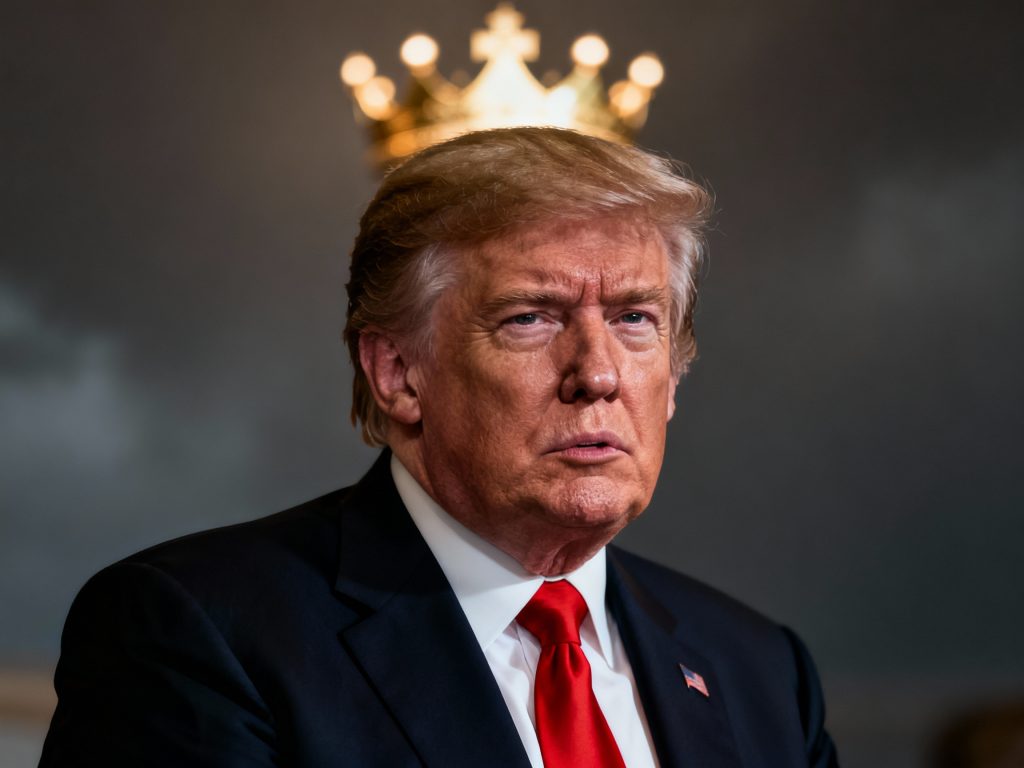
Description/Bio:
45th President of the United States, businessman, media figure, and the central embodiment of the modern sacred-kingship archetype. Trump functions in this narrative as a contemporary echo of ancient Mardukian rulership: dramatic, polarizing, grievance-driven, and framed by his followers as uniquely chosen to restore a fallen nation. His leadership style blends populist performance with monarchical entitlement.
Prompt:
realistic, photorealistic, cinematic lighting, soft natural colors, fantasy realism, highly detailed, emotional depth, artistic composition, medium close-up portrait of Donald Trump wearing a dark suit and red tie, neutral but dramatic background with subtle implied crown-like lighting, landscape orientation
KING CHARLES I OF ENGLAND (1600–1649)
Description/Bio:
The Stuart monarch, whose defiance of Parliament and unwavering belief in divine-right kingship triggered the English Civil War and ultimately led to his execution. In this series, Charles I represents the archetype of the “falling king”—a ruler who cannot imagine shared authority and who clings to sacred personal power even as his world collapses around him.
Prompt:
realistic, photorealistic, cinematic lighting, soft natural colors, fantasy realism, highly detailed, emotional depth, artistic composition, three-quarter portrait of King Charles I in royal 17th-century attire with lace collar, long dark hair, contemplative expression, faint throne room or Parliament silhouettes behind him, landscape orientation
KING GEORGE III OF GREAT BRITAIN (1738–1820)
Description/Bio:
The British monarch during the American Revolution. His rigidity, inability to tolerate dissent, and medical decline helped precipitate the political break that led to the formation of the United States. In this narrative, he stands as an earlier manifestation of imperial sacred rulership—authority framed as destiny rather than negotiation.
Prompt:
realistic, photorealistic, cinematic lighting, soft natural colors, fantasy realism, highly detailed, emotional depth, artistic composition, three-quarter portrait of King George III in red military-style royal coat with gold embroidery, powdered hair, distant suggestion of ships or colonies behind him, landscape orientation
MARDUK
Description/Bio:
An Anunnaki deity associated with domination, cosmic kingship, rivalry, purification codes, and the reordering of worlds to suit his ambition. In the context of this series, Marduk represents the archetypal blueprint behind authoritarian, centralizing rulers—those who claim not merely power, but cosmic entitlement to remake nations, laws, and identities.
Prompt:
realistic, photorealistic, cinematic lighting, soft natural colors, fantasy realism, highly detailed, emotional depth, artistic composition, imposing portrait of Marduk as a radiant Mesopotamian god-king with golden crown, ornate Babylonian robes, subtle cuneiform motifs, and cosmic light or stars behind him, landscape orientation
GROUP IMAGE (REQUIRED FOR THIS ARTICLE)
THE KINGSHIP LINEAGE — CLASS PORTRAIT
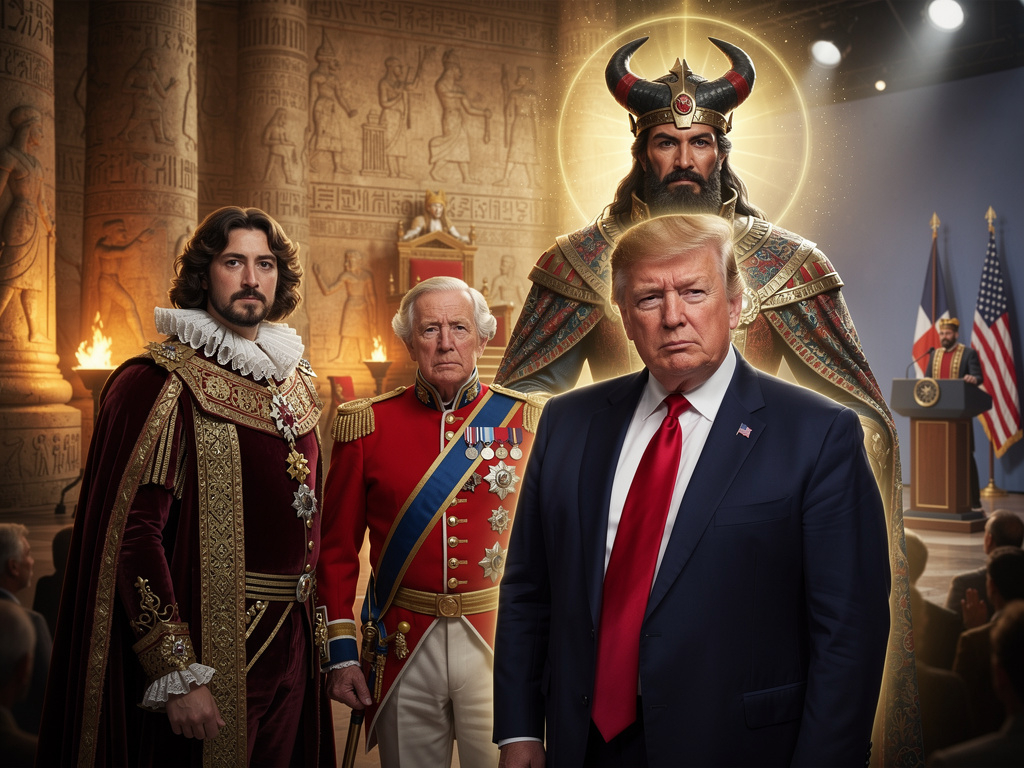
Description:
A photorealistic “class picture” / reunion-style group portrait featuring Donald Trump, King Charles I, King George III, and Marduk all standing together in one wide shot. Each figure’s face is clearly visible, evenly lit, and emotionally expressive in a cinematic, elegant way. The background gently blends an ancient throne room with a modern political stage, symbolizing the merging of past and present sacred kingship archetypes. Marduk stands slightly behind the three human rulers—larger, glowing subtly, but still realistic and integrated—representing the archetypal lineage behind their forms of power.
Prompt:
realistic, photorealistic, cinematic lighting, soft natural colors, fantasy realism, highly detailed, emotional depth, artistic composition, landscape banner, group class-photo portrait of Donald Trump, King Charles I, King George III, and Marduk standing together, all faces clearly visible, blended background of ancient throne room and modern political stage, subtle golden aura around Marduk, elegant and symbolic reunion-style formation
DONALD J. TRUMP
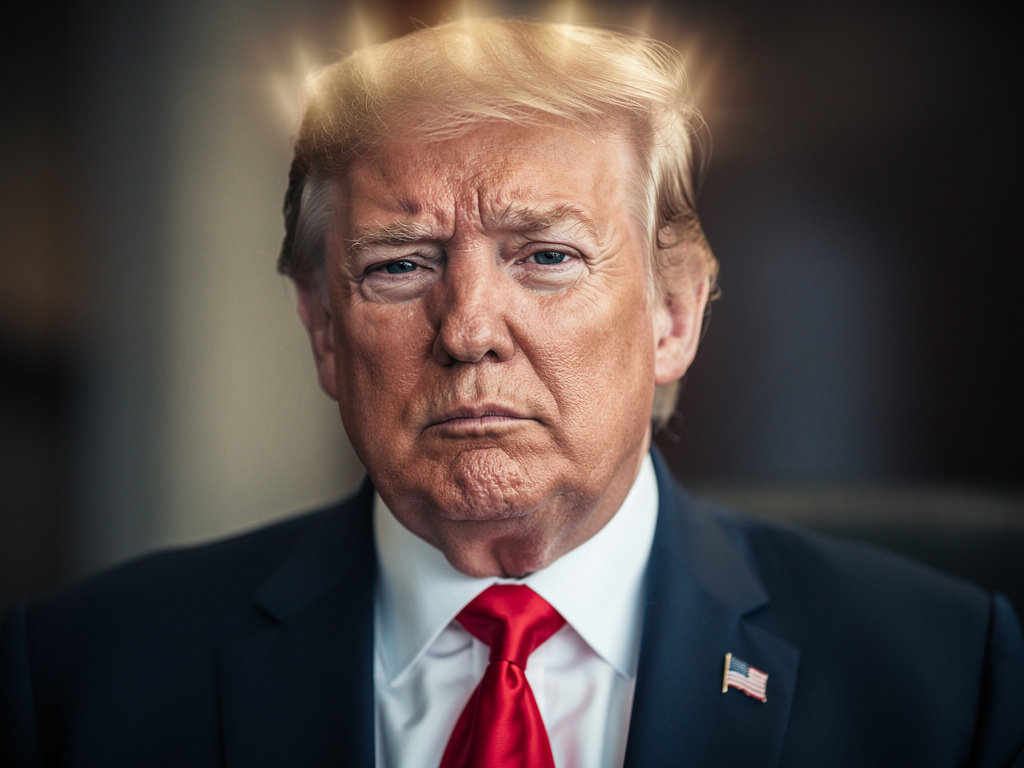
Description/Bio: 45th President of the United States, businessman, and media figure whose leadership style and movement activate sacred-kingship and strongman archetypes. In this series, he represents the modern embodiment of a Mardukian rulership pattern—divisive, dramatic, and framed as uniquely chosen to “restore” a fallen nation.
Prompt: realistic, photorealistic, cinematic lighting, soft natural colors, fantasy realism, highly detailed, emotional depth, artistic composition, medium close-up portrait of Donald Trump in a dark suit and red tie, neutral but dramatic background, subtle suggestion of a crown-like light halo above or behind his head, landscape orientation
KING CHARLES I OF ENGLAND (1600–1649)
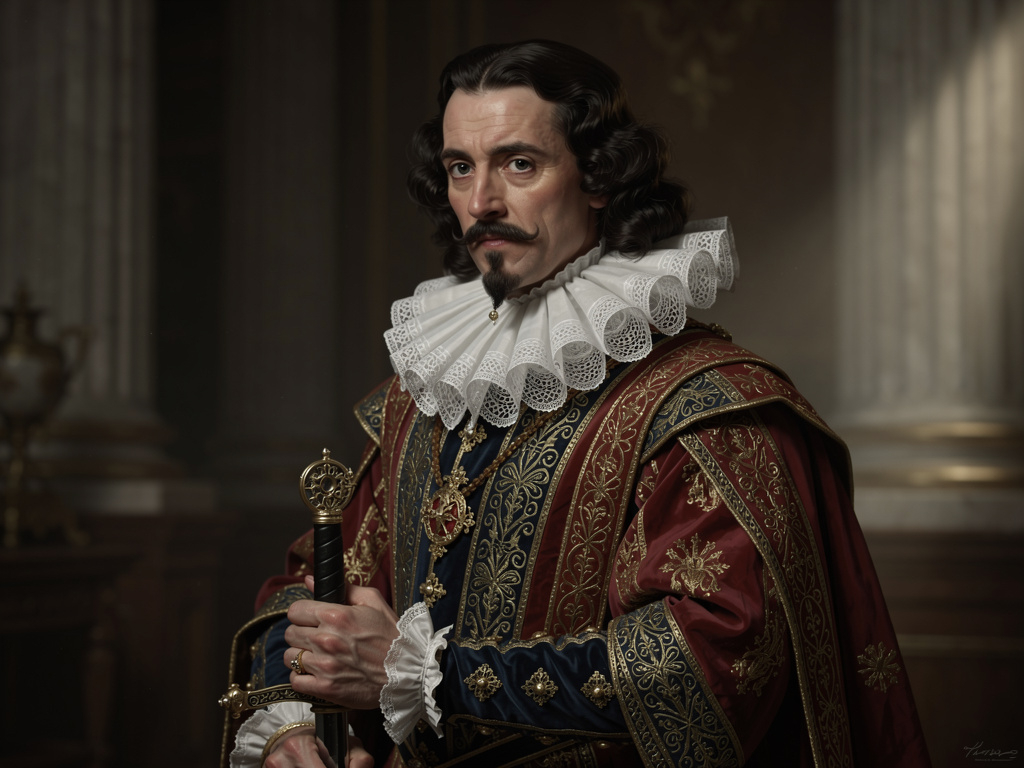
Description/Bio: Stuart monarch whose insistence on divine-right authority over Parliament helped trigger the English Civil War and led to his trial and execution. In this narrative, he stands as a classic “falling king” figure—unable to imagine shared power and ultimately sacrificed to the very system he tried to dominate.
Prompt: realistic, photorealistic, cinematic lighting, soft natural colors, fantasy realism, highly detailed, emotional depth, artistic composition, three-quarter portrait of King Charles I in 17th-century royal attire with lace collar and dark hair, subtle background suggestion of Parliament or a shadowy throne room, landscape orientation
KING GEORGE III OF GREAT BRITAIN (1738–1820)
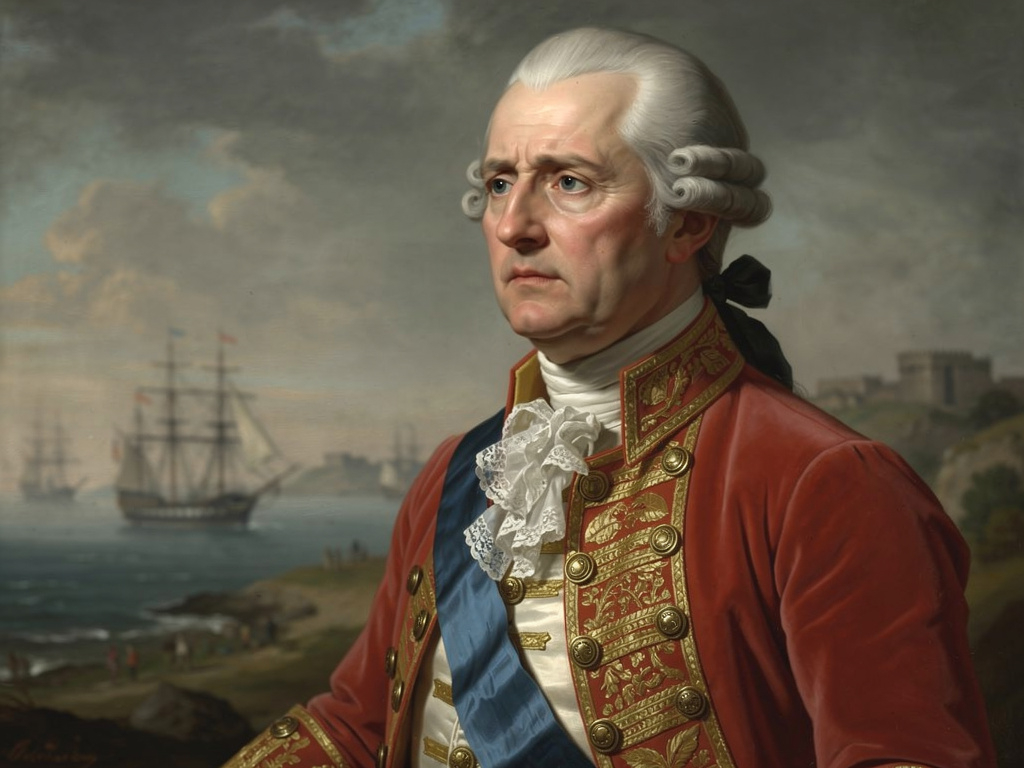
Description/Bio: British monarch during the American Revolution whose rigidity and inability to adapt to colonial demands contributed to the break that formed the United States. He embodies an earlier form of imperial sacred rulership confronted by a new, partnership-oriented experiment in self-governance.
Prompt: realistic, photorealistic, cinematic lighting, soft natural colors, fantasy realism, highly detailed, emotional depth, artistic composition, three-quarter portrait of King George III in red military-style royal coat with gold trim and sash, distant suggestion of ships or colonies in the background, landscape orientation
MARDUK
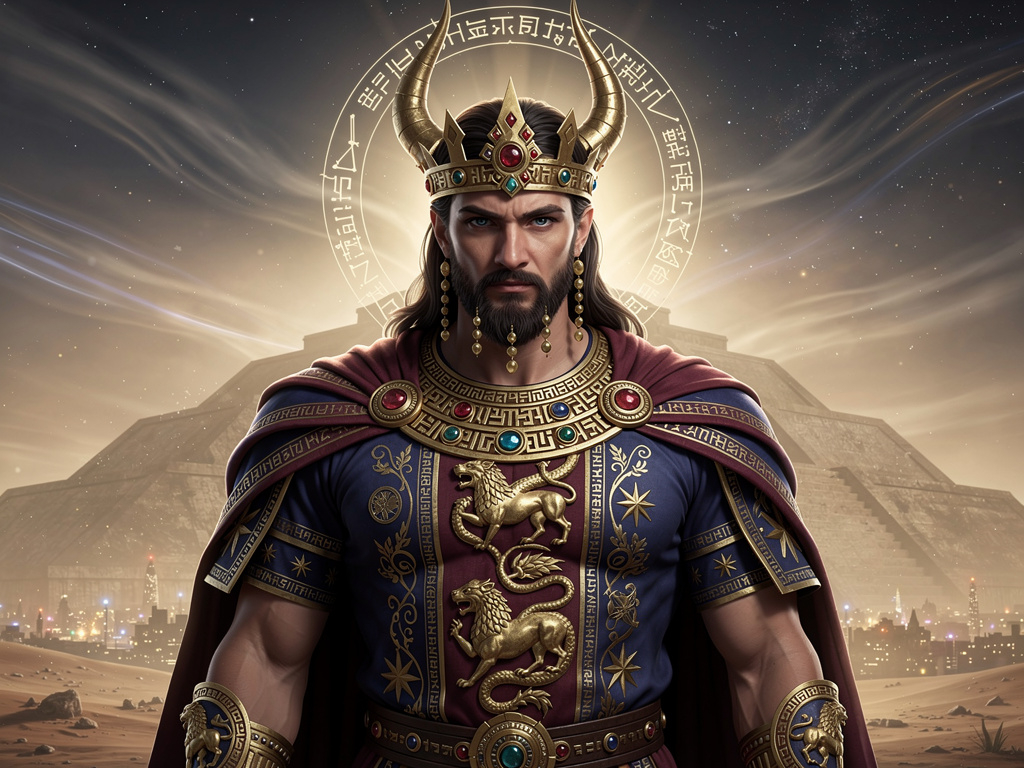
Description/Bio: Anunnaki deity associated with rulership, domination, rivalry, purification narratives, and the restructuring of cosmic and political order in his favor. In this series, Marduk represents the deep archetypal template behind sacred strongman rulers who consolidate power through conflict and claim cosmic entitlement to rule.
Prompt: realistic, photorealistic, cinematic lighting, soft natural colors, fantasy realism, highly detailed, emotional depth, artistic composition, powerful portrait of a tall, radiant, ancient Mesopotamian god-king with a golden crown and ornate robes, stylized Babylonian motifs, faint stars and cosmic light behind him, landscape orientation.
REFERENCES
Arendt, Hannah. The Origins of Totalitarianism. Harcourt, 1951.
Stenner, Karen. The Authoritarian Dynamic. Cambridge University Press, 2005.
Sitchin, Zecharia. The 12th Planet. HarperCollins, 1976.
Sitchin, Zecharia. The Wars of Gods and Men. HarperCollins, 1985.
Fromm, Erich. Escape from Freedom. Farrar & Rinehart, 1941.
Grof, Stanislav. The Stormy Search for the Self. Tarcher, 1990.
TAGS
domination vs partnership, Donald Trump, MAGA movement, sacred kingship, divine right of kings, authoritarian psychology, archetypes, Marduk, Anunnaki, American politics, Cromwell, Charles I, George III, Project 2025, Aquarian Age, conscious civilization, Janet Kira Lessin, Sasha Alex Lessin
AUTHOR BIOS
JANET KIRA LESSIN
Janet Kira Lessin is a lifelong contact experiencer, author, genealogist, and consciousness researcher. She weaves personal encounters, ancestral lineages, historical study, and multidimensional insight into narratives that reveal how domination and partnership patterns repeat across time, families, and civilizations. Her work bridges the intimate and the cosmic, inviting readers into a larger story of who we have been and who we might become.
SASHA ALEX LESSIN, Ph.D. (Anthropology, UCLA)
Dr. Sasha Alex Lessin is an anthropologist, therapist, and educator specializing in human origins, altered states, contact accounts, and the deep structures of domination and partnership in human societies. Trained in Grofian breathwork and grounded in academic anthropology, Sasha brings rigorous scholarship and compassionate psychological insight to the Anunnaki framework and its implications for our current planetary crisis and potential transformation.
SOCIAL & WEBSITE LINKS
Substack – Janet & Sasha’s Multidimensional History and Consciousness Series
Subscribe for new articles, images, and series updates:
https://substack.com/@janetalexlessinphd
Dragon At The End Of Time – Janet’s visionary, multidimensional history and contact work:
https://dragonattheendoftime.com
EnkiSpeaks – Articles, essays, and research on the Anunnaki, ancient astronauts, and alternative human origins:
https://enkispeaks.com
Elephants In Our Rooms – Writings on trauma, family systems, sexuality, and the truths we’re not supposed to talk about:
https://elephantsinourrooms.com
(You can add Facebook, X, LinkedIn, and any additional sites with their exact links as you wish.)
IMAGE LIST (TITLES, DESCRIPTIONS, PROMPTS)
THE ARCHETYPAL LINEAGE OF KINGS
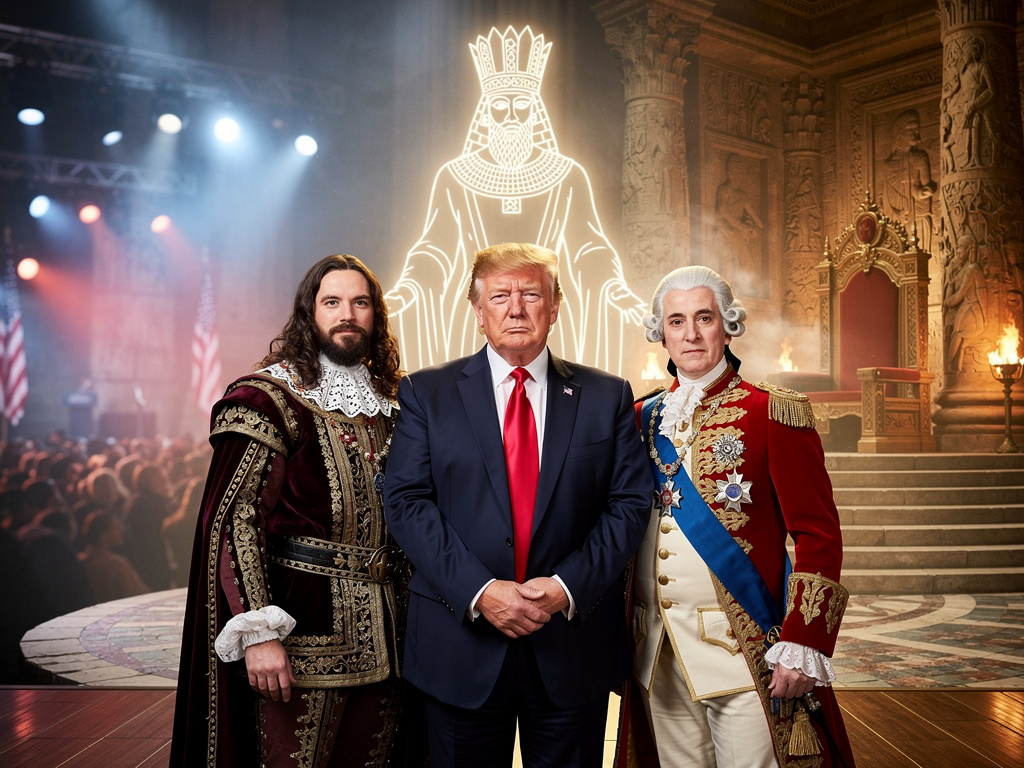
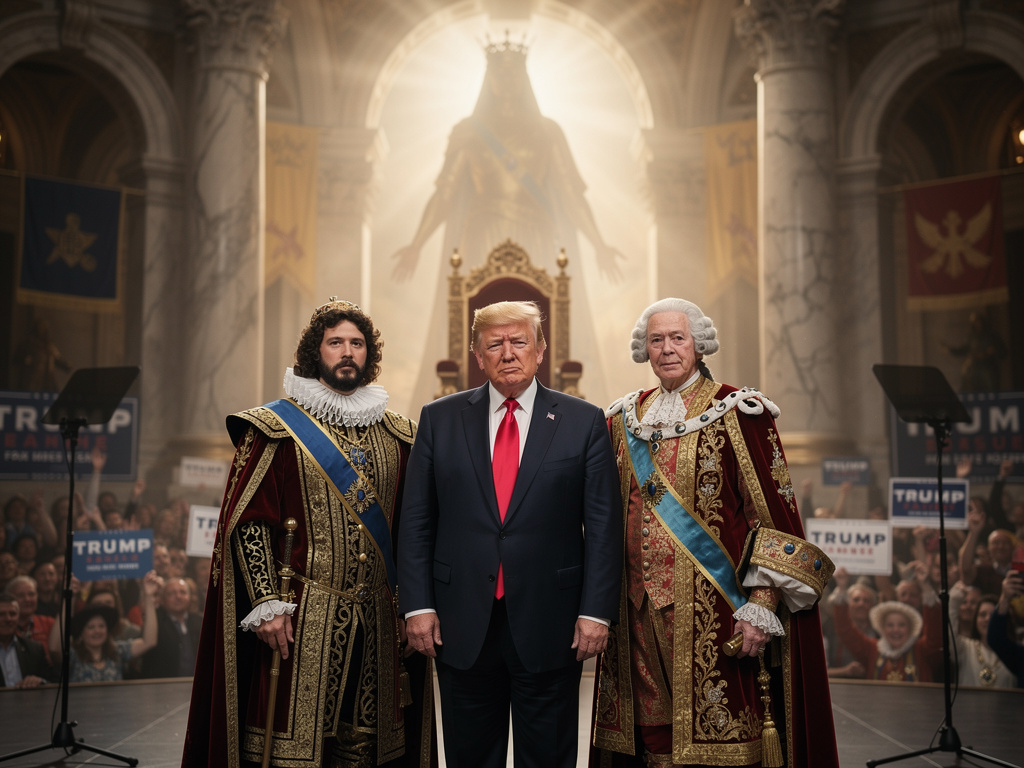
Description: A “class picture” style group portrait showing Donald Trump in modern attire between King Charles I and King George III in historical royal clothing, all standing in a space that blends a modern political rally stage with an ancient throne room. In the background, a tall, softly glowing silhouette of Marduk looms, hinting at an unseen cosmic influence behind their earthly power.
Prompt: realistic, photorealistic, cinematic lighting, soft natural colors, fantasy realism, highly detailed, emotional depth, artistic composition, landscape banner, Donald Trump standing between King Charles I and King George III in a class-picture pose, background merging a modern political rally with an ancient throne room, subtle glowing silhouette of Marduk behind them
THE MODERN CROWN
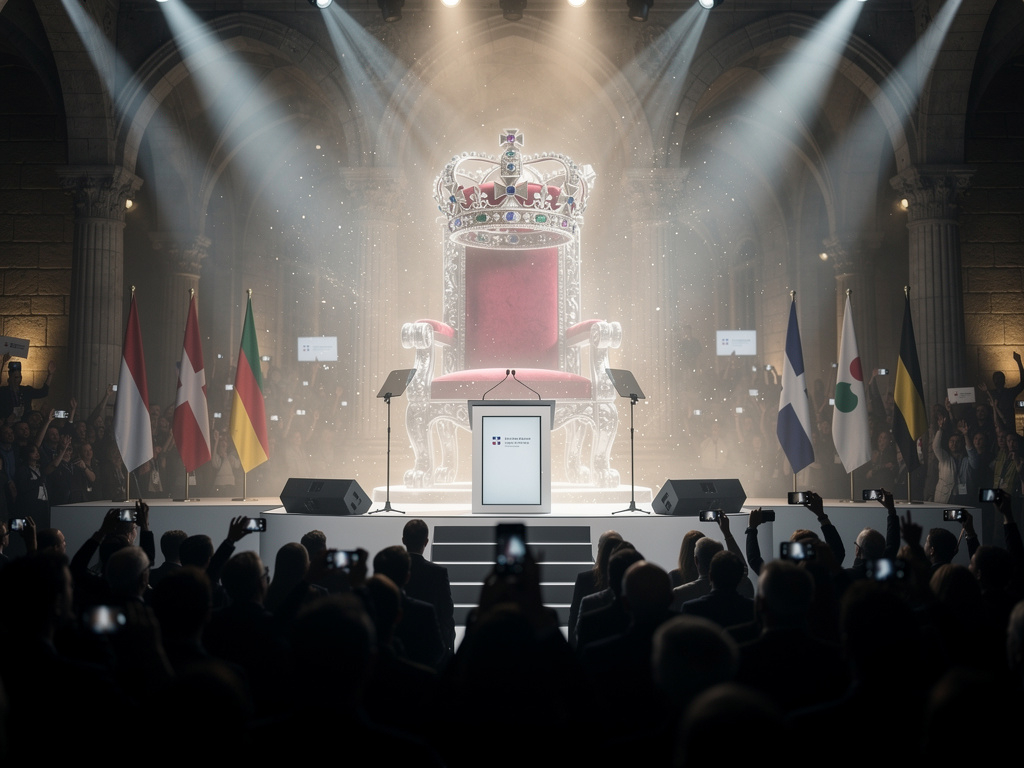
Description: A modern political rally scene with a podium at center stage, but behind the podium, a translucent, ghostly royal throne and crown are visible, as if an ancient monarchy bleeds through the present. The crowd is partially in shadow, while the throne and crown shimmer faintly under stage lights.
Prompt: realistic, photorealistic, cinematic lighting, soft natural colors, fantasy realism, highly detailed, emotional depth, artistic composition, landscape, modern political rally with a podium, ghostly royal throne and crown visible behind the rostrum, blend of contemporary and ancient power symbolism
THE FALLING CROWN
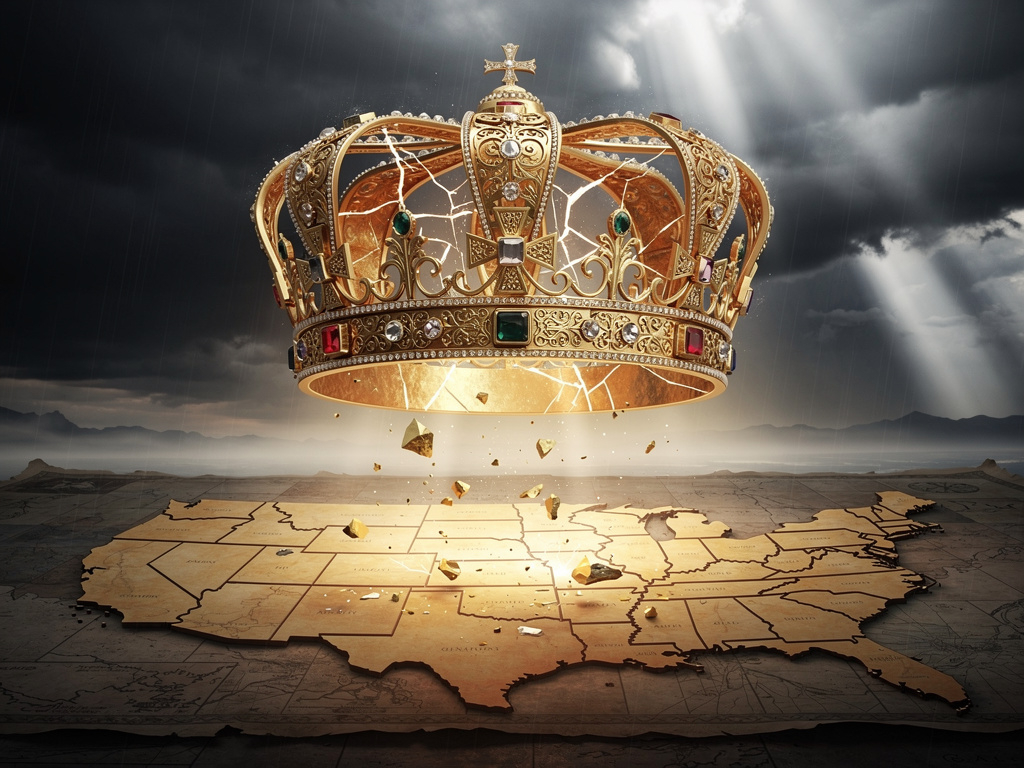
Description: An enormous, ornate crown hangs in midair above a stylized map of the United States. The crown is cracked with glowing fracture lines and a few small fragments breaking away, suggesting a system under strain. Dark clouds gather on the horizon, but a faint light still glows beneath the crown.
Prompt: realistic, photorealistic, cinematic lighting, soft natural colors, fantasy realism, highly detailed, emotional depth, artistic composition, landscape, large cracked crown hovering above a map of the United States, glowing fracture lines, stormy but luminous sky, symbolic of a failing sacred kingship
THE SACRED STRONGMAN
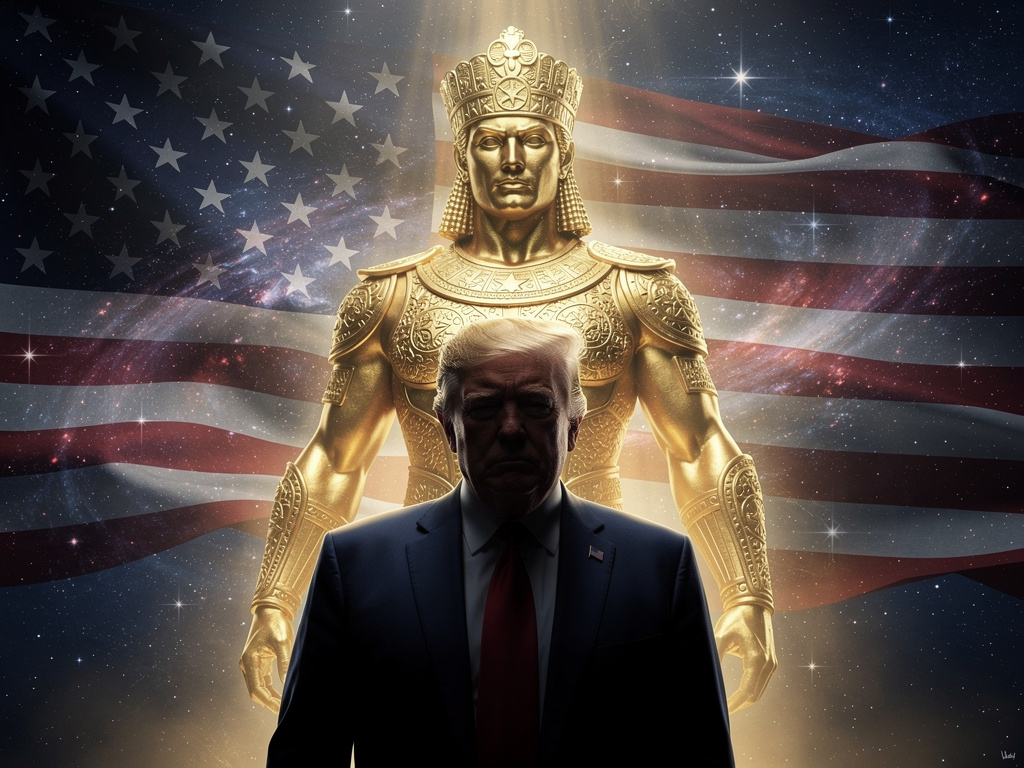
Description: Donald Trump stands in shadowed foreground, his features partially obscured, while behind him rises a towering golden figure representing Marduk—muscular, crowned, and radiant. The American flag dissolves into a star-filled cosmic sky around them, suggesting that ancient mythic power is bleeding into modern national identity.
Prompt: realistic, photorealistic, cinematic lighting, soft natural colors, fantasy realism, highly detailed, emotional depth, artistic composition, landscape, Donald Trump in shadow with a towering golden Marduk-like figure behind him, American flag blending into a cosmic starfield in the background, intense symbolic depiction of sacred strongman archetype

