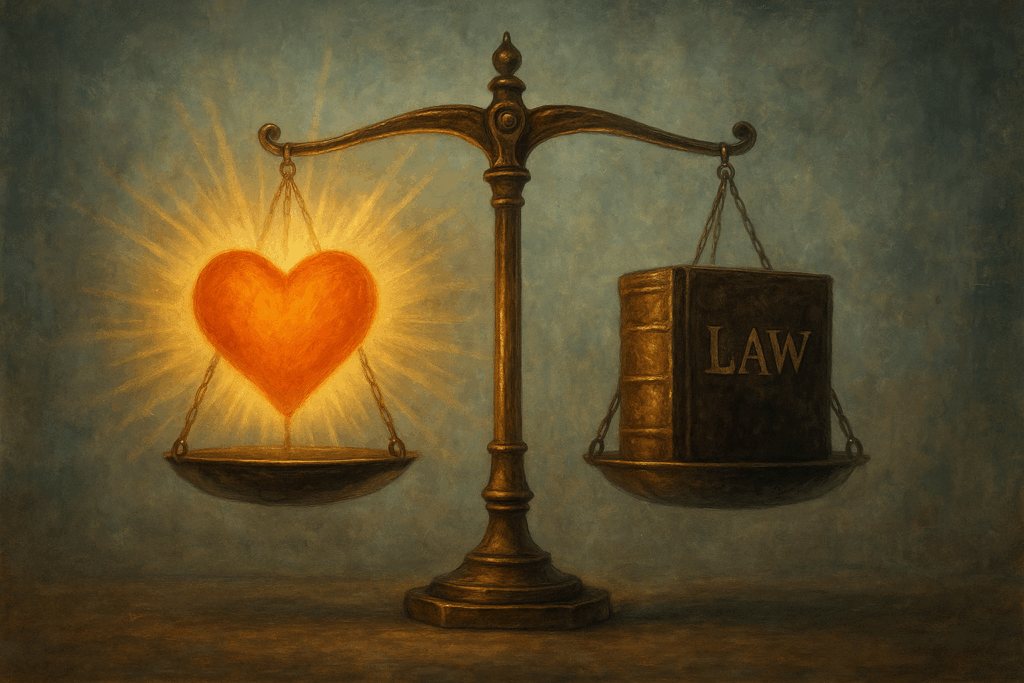
THE WEIGHING OF LAW A glowing heart and an aged law book sit on opposite sides of a golden scale. The heart glows with radiant light, tipping the scale ever so slightly, symbolizing the triumph of compassion over rigid legality. This symbolic image represents the central question of the article: Is it humane?
BEFORE IT BECOMES LAW: A TEST OF HUMANITY
What if every law had to pass the kindness test before it passed Congress? By Janet Kira Lessin
“It’s legal,” they say. “But is it humane?” I ask.
That one question—Is it humane?—may be the single most important challenge we can pose to modern lawmaking. As we witness authoritarianism rise, compassion fall, and cruelty get codified under the guise of order, it’s time we reconsider what law actually means—and who it’s meant to protect.
Too often, we’re told to obey. But should we? Obedience to cruelty isn’t morality. It’s programming.
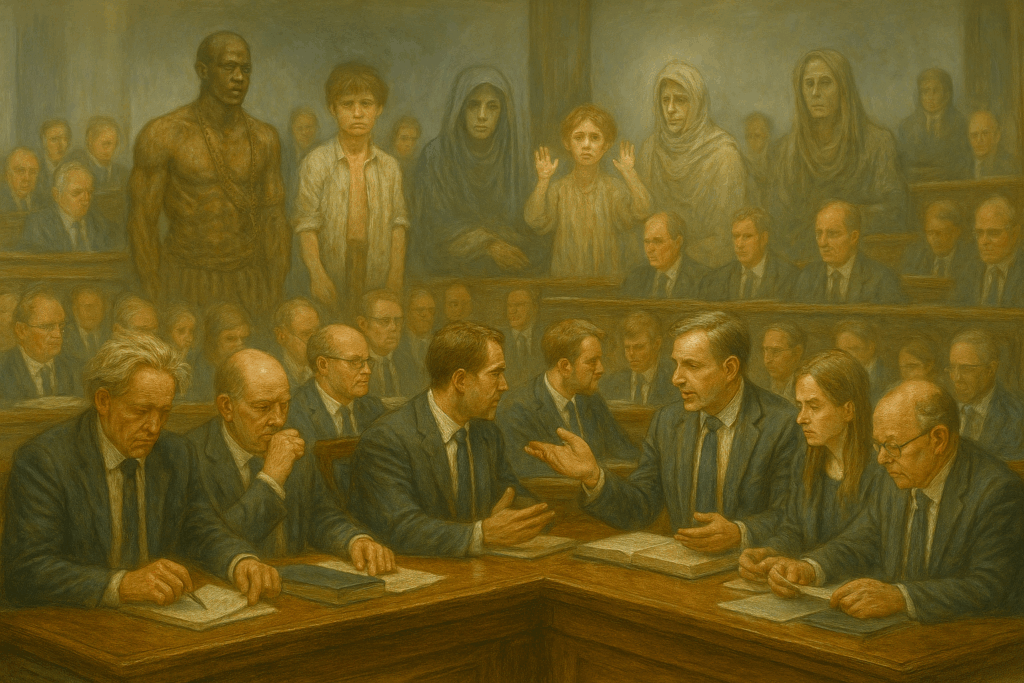
THE UNSEEN WITNESSES A solemn courtroom scene filled with modern lawmakers debating policy. In the shadows behind them stand ghostlike figures: slaves in chains, silenced children, abused animals, and war victims—witnesses of historical “legal” cruelty who were never invited to speak.
WHEN LEGALITY IS NOT MORALITY
Slavery was once legal. This was also a denial of women’s right to vote. So was genocide.
Legality is not the same as justice. It is merely the result of the political process—votes, power, deals, and influence. It is a product of administration, not necessarily conscience.
And because laws are written by the winners of conflict—not always the wisest or kindest among us—what is “legal” can still be deeply, institutionally harmful.
What we need is a Humanity Test: A simple but powerful question that precedes every rule, policy, or law:
Will this cause unnecessary harm?
If the answer is yes, the legislation must be re-examined, restructured, or rejected. Full stop.
THE PRINCIPLE OF AHIMSA
I live by a spiritual practice known as ahimsa—a Sanskrit word meaning nonviolence, or do no harm. It’s an ethic of gentle living, practiced by saints and sages, but urgently needed by lawmakers and policy drafters.
Ahimsa asks us to consider not just outcomes, but intentions. Not just actions, but consequences. It doesn’t matter if harm was legalized—if it was avoidable, it was a failure of love and reason.
When ahimsa becomes a civic value, rather than just a spiritual one, we begin to establish a more ethical foundation for civilization.
MORALITY VS. RELIGION: A DANGEROUS CONFUSION
Many confuse morality with religion. But religion has often been the instrument of institutionalized harm. Ask Ishmael. Ask Isaac. Ask the women burned at the stake. Ask the children locked in pews while predators wore robes of authority.
Morality, unlike religion, must be based on universal principles—compassion, fairness, consent, empathy, and sustainability. It must evolve with consciousness.
That’s why we need a new continuum, one not rooted in dogma or partisanship, but in kindness.
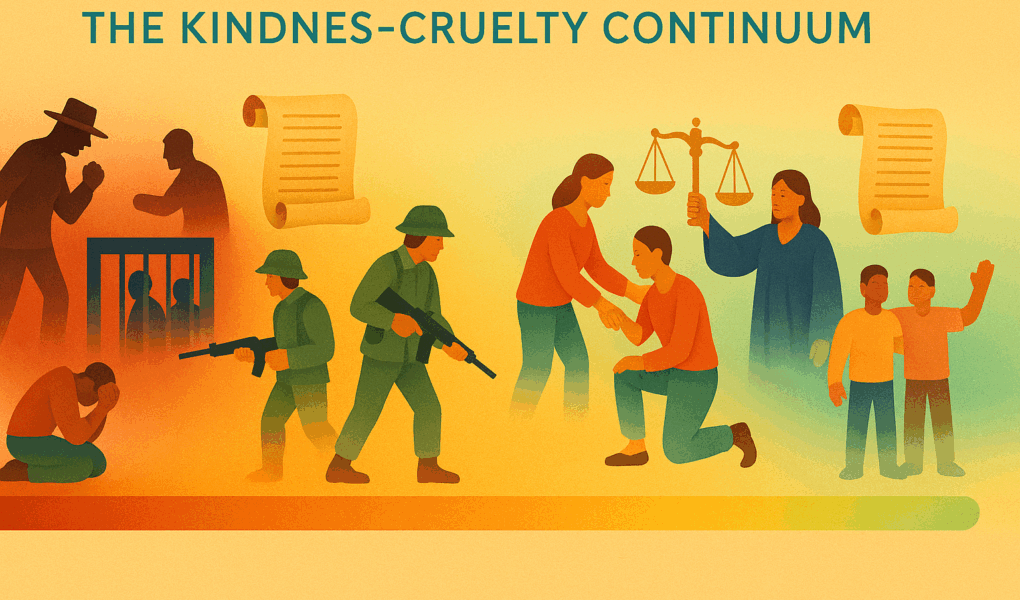
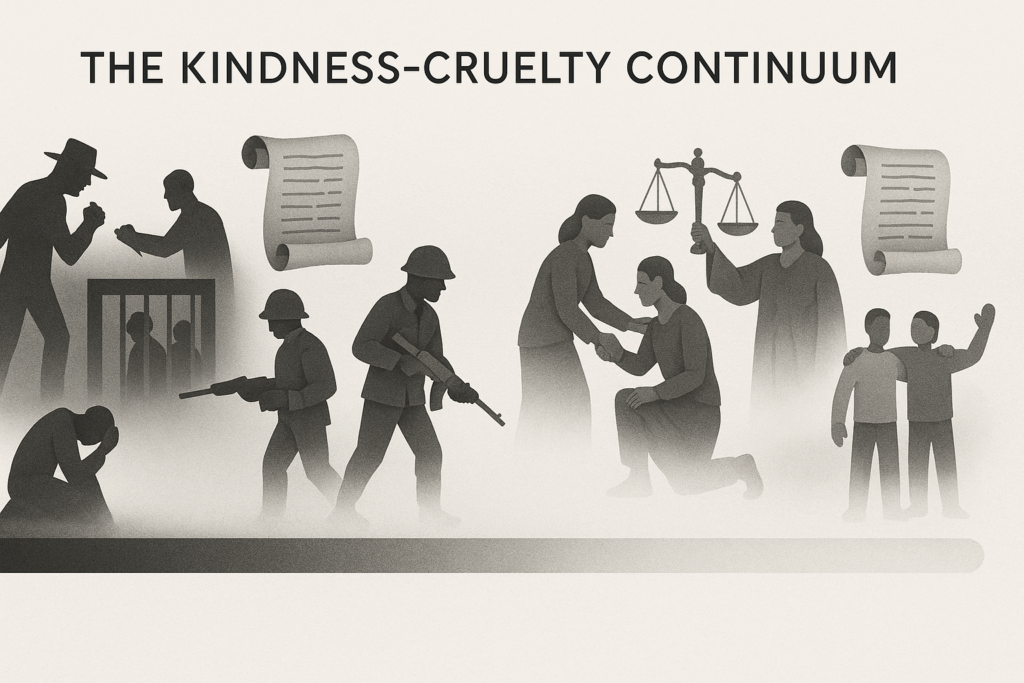
THE KINDNESS–CRUELTY CONTINUUM A symbolic horizontal line fades from darkness to light. On the left are haunting scenes of violence and control; on the right, images of care, justice, and community. Scrolls of laws float above the spectrum, each subtly marked along the kindness-cruelty continuum.
A CONTINUUM OF KINDNESS VS. CRUELTY
Imagine if every law, policy, or system were rated like movies—except instead of a PG-13 rating, we scored it on a Kindness Scale and a Cruelty Index.
Does this action uplift or suppress?
Heal or wound?
Include or exclude?
Empower or punish?
No law should be passed unless it prioritizes kindness over cruelty. That simple idea could transform everything—from prisons to healthcare to immigration to education.
WHO IS THIS FOR, REALLY?
The question we must always return to is:
Who benefits—and who suffers?
If the answer reveals suffering of the many for the comfort of the few, we must return to the drawing board. We must craft laws that not only reflect power but also reflect consciousness.
Laws should nourish life, not control it. They should protect the weak, not shield the corrupt. They should honor freedom with responsibility, not freedom from responsibility.
THE FIRST STEP TOWARD A CONSCIOUS CIVILIZATION
This article is a call to insert humanity into lawmaking. To stop asking only, “Is it legal?” and instead demand:
Is it humane? Is it wise? Is it kind?
If it’s not, it has no place in our future.
And who enforces this?
We do. Each and every one of us. Because these laws affect someone somewhere we love. Or if not now, they will. They already have. We need to think about our children, our future.
Therefore, we must consider the consequences before we vote, legislate, enforce, or even turn a blind eye. We must walk in our neighbor’s shoes, our brother’s, our sister’s, even those whose pain we’ll never fully understand.
And if we cannot walk the entire journey in those shoes?
Then maybe, just maybe… That law ain’t fittin’.
🌍 Series: The Conscious Civilization Manifesto
This is the First Article in a series exploring how humanity, nature, and consciousness must guide the laws of the future.
🖼️ Suggested Illustrations
THE WEIGHING OF LAW A scale of justice tipped by a glowing heart on one side and a heavy legal tome on the other. A subtle aura of light surrounds the heart.
THE UNSEEN WITNESSES A dim courtroom scene where oppressed figures from history—slaves, children, refugees, animals—stand ghostlike in the background while lawmakers argue.
KINDNESS–CRUELTY CONTINUUM A symbolic line stretching from darkness to light, with symbolic laws marked along the spectrum. On one end, images of war and control; on the other, care and healing.
All illustrations should be realistic, artistic, and in landscape mode.
What if every law had to pass the kindness test before it passed Congress? Explore how a Humanity Test could transform legislation and build a more compassionate civilization.
🐦 X (Twitter) Description
Before it becomes law, ask: Is it humane? Is it kind? Is it just? #ConsciousCivilization #HumanityTest
1. Article I — Before It Becomes Law: A Test of Humanity Laws must pass a humanity test before they are enforced. This article introduces the idea of kindness as the first principle in lawmaking and governance.
2. Article II — The Triple Test: Humanity, Gaia, and Consciousness(Coming Next) Before any policy becomes law, it should pass three sacred tests:
Is it humane?
Is it good for the Earth?
Does it honor awakening and freedom of consciousness?
3. Article III — How We Enforce the Should: From Moral Cry to Legal Change(Coming Soon) How do we translate noble ideals into actionable steps? This article examines public pressure, structural redesign, and the ethical force of outrage in driving genuine change.
The word humane means marked by compassion, empathy, and a desire to reduce suffering, especially toward other beings, whether human or animal.
🔍 Definition of Humane:
Humane (adj.) Characterized by tenderness, compassion, sympathy, and a commitment to minimizing harm or cruelty, especially to others in vulnerable positions.
It comes from the same root as human, but being “humane” is the ideal of what it means to be a good, feeling, responsible human being—not just biologically human, but ethically awake.
💠 Key Qualities of Humane Behavior:
Compassion – The ability to feel and respond to the suffering of others.
Empathy – Imagining yourself in another’s situation.
Mercy – Choosing kindness over vengeance or excessive punishment.
Fairness – Acting with justice and equity.
Gentleness – Avoiding unnecessary harm or violence.
Dignity – Respecting the worth of all life, regardless of utility.
🕊️ Examples of Humane Actions:
Providing aid to refugees or the homeless
Creating laws that protect both people and animals from abuse
Offering rehabilitation over punishment
Adopting non-lethal practices in pest control
Speaking out against cruelty, even when it’s “legal”
⚖️ In Law and Ethics:
To be humane is to treat others—especially the powerless, voiceless, or suffering—with care, restraint, and respect. Humane lawmaking entails considering the emotional and spiritual implications of our actions, not just their legality or economics.
🔍 Definition of Moral:
Moral (adj.) Concerned with principles of right and wrong behavior and the goodness or badness of human character or actions.
Moral (noun) A lesson or principle about what is right or ethical, often derived from a story, experience, or system of values.
💠 Key Aspects of Morality:
Ethical Judgment – Distinguishing right from wrong.
Integrity – Aligning one’s actions with one’s principles.
Responsibility – Being accountable for the effects of one’s actions.
Justice – Promoting fairness and opposing exploitation.
Altruism – Acting with concern for others, even at personal cost.
Conscience – The internal sense that guides moral decision-making.
🧭 Sources of Morality:
Morality can be shaped by many influences, including:
Empathy and compassion
Cultural norms and traditions
Philosophy and reason
Religious or spiritual beliefs
Legal systems (though law ≠ and morality)
Personal conscience
Importantly, morality evolves as society becomes more conscious. Practices once seen as “moral” (like public punishment, slavery, or denying education to women) are now seen as deeply unjust.
🕊️ Morality vs. Religion:
While religion often includes moral teachings, morality is not the exclusive domain of religion. Morality can exist outside of any religious framework and must be judged independently from doctrine. A moral society uplifts all beings, not just those who follow a particular faith.