
Arthur Dudley
Arthur Dudley Sutton (11th GG Uncle)
1561–1588
BIRTH 1561 • Netherwood, Herefordshire, England
DEATH 1588 • England1st cousin 12x removed
From Wikipedia, the free encyclopedia
| Arthur Dudley | |
|---|---|
| Born | c.1562 London, England |
| Parent(s) | ostensibly Queen Elizabeth I, Robert Dudley |
Arthur Dudley was a 16th-century man famous for the controversial claim that he was the son of Queen Elizabeth I and Robert Dudley, a man known to have had a (not necessarily consummated) long love affair with the queen.
Arthur-Dudley-WikipediaQueen Elizabeth I and Robert Dudley[edit]
See also: Elizabeth I and Robert Dudley, 1st Earl of Leicester


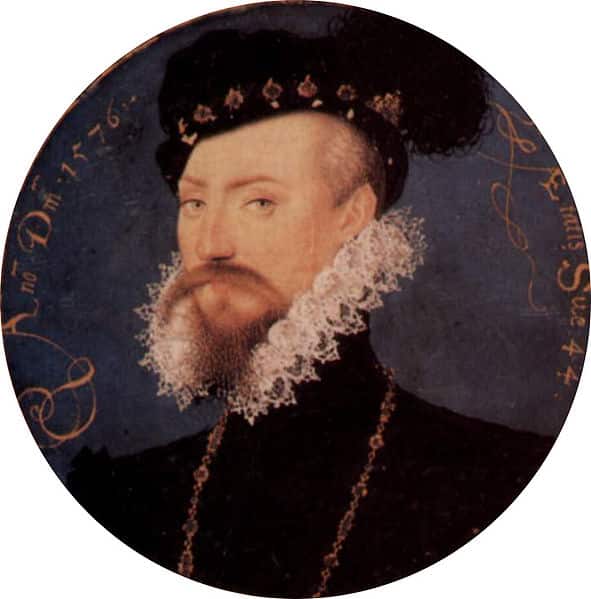
Pair of miniatures of Elizabeth and Leicester, c. 1575, by Nicholas Hilliard. Their friendship lasted for over thirty years, until his death.
In the spring of 1559, it became evident that Elizabeth was in love with her childhood friend Robert Dudley.[1] It was said that Amy Robsart, his wife, was suffering from a “malady in one of her breasts” and that the Queen would like to marry Dudley if his wife should die.[2] By the autumn of 1559, several foreign suitors were vying for Elizabeth’s hand; their impatient envoys engaged in ever more scandalous talk and reported that a marriage with her favourite was not welcome in England:[3] “There is not a man who does not cry out on him and her with indignation … she will marry none but the favoured Robert.”[4] Amy Dudley died in September 1560, from a fall from a flight of stairs and, despite the coroner’s inquest finding of accident, many people suspected Dudley of having arranged her death so that he could marry the queen.[5] Elizabeth seriously considered marrying Dudley for some time. However, William Cecil, Nicholas Throckmorton, and some conservative peers made their disapproval unmistakably clear.[6] There were even rumours that the nobility would rise if the marriage took place.[7]
Among other marriage candidates being considered for the queen, Robert Dudley continued to be regarded as a possible candidate for nearly another decade.[8] Elizabeth was extremely jealous of his affections, even when she no longer meant to marry him herself.[9] In 1564, Elizabeth raised Dudley to the peerage as Earl of Leicester. He finally remarried in 1578, to which the queen reacted with repeated scenes of displeasure and lifelong hatred towards his wife, Lettice Knollys.[10] Still, Dudley always “remained at the centre of [Elizabeth’s] emotional life”, as historian Susan Doran has described the situation.[11] He died shortly after the defeat of the Spanish Armada in 1588. After Elizabeth’s own death, a note from him was found among her most personal belongings, marked “his last letter” in her handwriting.[12]
Claim of relation to Elizabeth I[edit]
A central issue, when it comes to the question of her virginity, was whether Elizabeth ever consummated her love affair with Robert Dudley. In 1559, Elizabeth had Dudley’s bedchambers moved next to her own apartments.[13] In 1561, she was mysteriously bedridden with an illness that caused her body to swell.[14]
Years later in 1587, a man calling himself Arthur Dudley was detained by the Spanish[15] after rescue from a shipwreck on the Biscay Coast under suspicion of being a spy.[16]
Taken to Madrid, Dudley claimed to be the son of Queen Elizabeth and Robert Dudley, conceived in 1561, the timing of which would have been consistent with when she was bedridden. Dudley was examined by Francis Englefield, a Catholic aristocrat exiled to Spain and secretary to King Philip II.[16] Three letters exist today describing the interview, detailing what Arthur proclaimed to be the story of his life, from birth in the royal palace to the time of his arrival in Spain.[16]
As told by Arthur, Elizabeth had a governess, Katherine Ashley, whose servant was summoned to the court in 1561 and told to obtain a nurse for the newborn infant of someone at the palace. That servant, Robert Southern, was told to take the boy to London and raise him as one of his own children. That infant, named Arthur, was to be raised as a gentleman. He was indeed raised well, Arthur recounted, and taught music, arms, Classical languages, and dance. A youthful attempt to run away to a life of adventure in his teens was ended when a surprisingly forceful and officious letter demanding his return arrived while he awaited a ship in Wales. He was taken to a palace in London, Pickering Place, meeting John Ashley, who said that it was he, not Arthur’s father, who had paid for his upbringing.
Arthur did not return home immediately, but was accommodated in travels between England and France, until years later when his adoptive father was on his deathbed. At that point, Robert Southern confessed Arthur’s Royal origins to him, prompting considerable worry that the safety of both of them was jeopardized.[16] After more travel between England and France, Arthur had voyaged to Spain, and in the return had been shipwrecked, he claimed.
However, Dudley’s story failed to convince the Spanish: Englefield admitted to the King that Arthur’s “claim at present amounts to nothing”, but suggested that “he should not be allowed to get away, but […] kept very secure.”[17] The King agreed, and Arthur was never heard from again.[18]
Modern scholarship dismisses the story’s basic premise as “impossible”,[19] and asserts that Elizabeth’s life was so closely observed by contemporaries that she could not have hidden a pregnancy.[20][18]
References[edit]
- ^ Loades, 42; Wilson, 95.
- ^ Wilson, 95.
- ^ Skidmore, 162, 165, 166–168.
- ^ Chamberlin, 118
- ^ Somerset, 166–167. Most modern historians have considered murder unlikely; breast cancer and suicide being the most widely accepted explanations (Doran, Monarchy, 44). The coroner‘s report, hitherto believed lost, came to light in The National Archives in the late 2000s and is compatible with a downstairs fall as well as other violence (Skidmore, 230–233).
- ^ Wilson, 126–128.
- ^ Doran, Monarchy, 45.
- ^ Doran, Monarchy, 212.
- ^ Adams, 384, 146.
- ^ Jenkins (1961), 245, 247; Hammer, 46.
- ^ Doran, Queen Elizabeth I, 61.
- ^ Wilson, 303.
- ^ Inside the Bedchamber of the Virgin Queen
- ^ Robert Dudley: Queen Elizabeth I’s great love
- ^ The Most Expensive Marriage Proposal in History
- ^ Jump up to:a b c d British History Online: Simancas: June 1587, 16–30
- ^ Levin, Carole (1994). The Heart and Stomach of a King: Elizabeth I and the Politics of Sex and Power. University of Pennsylvania Press. p. 82. ISBN 9780812232523.
- ^ Jump up to:a b Levin, Carole (2 December 2004). “All the Queen’s Children: Elizabeth I and the Meanings of Motherhood”. Explorations in Renaissance Culture. 30 (1): 57–76. doi:10.1163/23526963-90000274. ISSN 2352-6963.
- ^ Levin, Carole (1994). The Heart and Stomach of a King: Elizabeth I and the Politics of Sex and Power. University of Pennsylvania Press. pp. 81–82. ISBN 9780812232523.
- ^ Rozett, Martha (2003). Constructing a World: Shakespeare’s England and the New Historical Fiction. State University of New York Press. p. 129. ISBN 9780791455517.
Arthur Dudley was a 16th-century man famous for the controversial claim that he was the son of Queen Elizabeth I and Robert Dudley, a man known to have had a (not necessarily consummated) long love affair with the queen.
| Arthur Dudley | |
|---|---|
| Born | c.1562 London, England |
| Parent(s) | ostensibly Queen Elizabeth I, Robert Dudley |
Queen Elizabeth I and Robert Dudley
https://www.wikiwand.com/en/Arthur_Dudley
See also: Elizabeth I and Robert Dudley, 1st Earl of Leicester

In the spring of 1559, it became evident that Elizabeth was in love with her childhood friend Robert Dudley. It was said that Amy Robsart, his wife, was suffering from a “malady in one of her breasts” and that the Queen would like to marry Dudley if his wife should die. By the autumn of 1559, several foreign suitors were vying for Elizabeth’s hand; their impatient envoys engaged in ever more scandalous talk and reported that a marriage with her favourite was not welcome in England: “There is not a man who does not cry out on him and her with indignation … she will marry none but the favoured Robert.” Amy Dudley died in September 1560, from a fall from a flight of stairs and, despite the coroner’s inquest finding of accident, many people suspected Dudley of having arranged her death so that he could marry the queen. Elizabeth seriously considered marrying Dudley for some time. However, William Cecil, Nicholas Throckmorton, and some conservative peers made their disapproval unmistakably clear. There were even rumours that the nobility would rise if the marriage took place.
Among other marriage candidates being considered for the queen, Robert Dudley continued to be regarded as a possible candidate for nearly another decade. Elizabeth was extremely jealous of his affections, even when she no longer meant to marry him herself. In 1564, Elizabeth raised Dudley to the peerage as Earl of Leicester. He finally remarried in 1578, to which the queen reacted with repeated scenes of displeasure and lifelong hatred towards his wife, Lettice Knollys. Still, Dudley always “remained at the centre of [Elizabeth’s] emotional life”, as historian Susan Doran has described the situation. He died shortly after the defeat of the Spanish Armada in 1588. After Elizabeth’s own death, a note from him was found among her most personal belongings, marked “his last letter” in her handwriting.
Claim of relation to Elizabeth I
A central issue, when it comes to the question of her virginity, was whether Elizabeth ever consummated her love affair with Robert Dudley. In 1559, Elizabeth had Dudley’s bedchambers moved next to her own apartments. In 1561, she was mysteriously bedridden with an illness that caused her body to swell.
Years later in 1587, a man calling himself Arthur Dudley was detained by the Spanish after rescue from a shipwreck on the Biscay Coast under suspicion of being a spy.
Taken to Madrid, Dudley claimed to be the son of Queen Elizabeth and Robert Dudley, conceived in 1561, the timing of which would have been consistent with when she was bedridden. Dudley was examined by Francis Englefield, a Catholic aristocrat exiled to Spain and secretary to King Philip II. Three letters exist today describing the interview, detailing what Arthur proclaimed to be the story of his life, from birth in the royal palace to the time of his arrival in Spain.
As told by Arthur, Elizabeth had a governess, Katherine Ashley, whose servant was summoned to the court in 1561 and told to obtain a nurse for the newborn infant of someone at the palace. That servant, Robert Southern, was told to take the boy to London and raise him as one of his own children. That infant, named Arthur, was to be raised as a gentleman. He was indeed raised well, Arthur recounted, and taught music, arms, Classical languages, and dance. A youthful attempt to run away to a life of adventure in his teens was ended when a surprisingly forceful and officious letter demanding his return arrived while he awaited a ship in Wales. He was taken to a palace in London, Pickering Place, meeting John Ashley, who said that it was he, not Arthur’s father, who had paid for his upbringing.
Arthur did not return home immediately, but was accommodated in travels between England and France, until years later when his adoptive father was on his deathbed. At that point, Robert Southern confessed Arthur’s Royal origins to him, prompting considerable worry that the safety of both of them was jeopardized. After more travel between England and France, Arthur had voyaged to Spain, and in the return had been shipwrecked, he claimed.
However, Dudley’s story failed to convince the Spanish: Englefield admitted to the King that Arthur’s “claim at present amounts to nothing”, but suggested that “he should not be allowed to get away, but […] kept very secure.” The King agreed, and Arthur was never heard from again.
Modern scholarship dismisses the story’s basic premise as “impossible”, and asserts that Elizabeth’s life was so closely observed by contemporaries that she could not have hidden a pregnancy
The Arthur Dudley Myth
PUBLISHED DATE:NOVEMBER 19, 2009 65 COMMENTSON THE ARTHUR DUDLEY MYTH
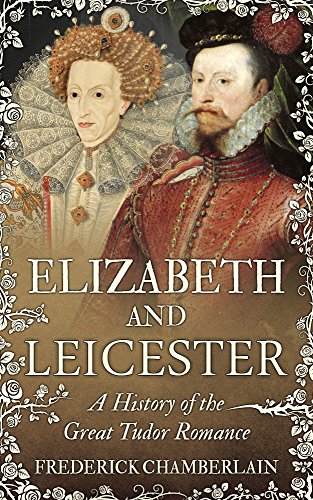
Following on from the Bisley Boy legend and the myth that Elizabeth I was really genetically male, I just had to write about Arthur Dudley, a man who has been the subject of books and documentaries, a man who some say was the illegitimate son of Elizabeth I and Robert Dudley.
I decided to research the story after Jennifer commented on the Bisley Boy post saying that she had read of a man turning up at the Spanish Court and claiming he was Elizabeth and Dudley’s son. I love mysteries and conspiracy theories so I just had to know more and I actually found some great research material – a chapter in Sarah Gristwood’s “Elizabeth & Leicester” and an article on the Dudley Genealogy website. So, are you sitting comfortably? Then let me begin…
Arthur Dudley – Heir to the Throne or Impostor?
The Tudor era had seen many people claiming that they were heirs to the throne – Perkin Warbeck, the famous pretender who claimed to be Richard Duke of York, one of the Princes in the Tower; Lambert Simnel who pretended to be Edward Plantagenet, Earl of Warwick, son of George, Duke of Clarence (Edward IV’s brother) ; and the madwoman Anne Burnell who claimed to be the daughter of Mary I and Philip of Spain – so there was really nothing new about Arthur Dudley and his story, particularly when there were already rumours circulating during Elizabeth’s reign that her summer progresses were cover-ups for her giving birth to illegitimate children! However, the fact that he turned up at King Philip of Spain’s court might have been worrying to Elizabeth, unless he was in fact an English spy.
Arthur’s Story https://www.elizabethfiles.com/the-arthur-dudley-myth/3298/
In the summer of 1587, a Spanish ship intercepted a boat off the coast of San Sebastian which was heading for France. One of the passengers aboard this boat was a young man in his 20s who claimed to be a Catholic who had undertaken a pilgrimage to a shrine at Montserrat. The Spanish officials arrested the man, suspecting that he was an English spy, and incarcerated him at San Sebastian. The man asked to Sir Francis Englefield, a Catholic who had once been an adviser to Mary I and who was now in exile at the Spanish Court, and it was then that he told his story.
The young man, claiming to be called Arthur Dudley, told of how he had been raised by Robert Southern, a man who had once been a servant of Kat Ashley, Elizabeth I’s governess and friend, in a village around 60 miles outside of London. On Southern’s deathbed, he had told Arthur that he was not his real father but refused to tell him any more. Arthur had stormed off but Smyth, a schoolmaster who was sent after Arthur by Southern, told Arthur the truth, that he was the son of Robert Dudley and the Queen.
Arthur went on to tell Englefield that Southern had been handed a baby after being summoned to Hampton Court and that he had been told to name him Arthur and raise him as his own. Southern had been told at first that the baby belonged to one of the Queen’s ladies, but, when Arthur ran away to sea as a teenager and was stopped by a letter from Elizabeth I’s privy councillors and ordered back to London with John Ashely, Kat Ashley’s husband, it became clear that he was someone important.
Arthur told Englefield of how he had taken flight abroad, fearing for his life, when it became known that Arthur knew the secret of his birth. He also told of how, at one point, he had been taken before Robert Dudley, Earl of Leicester, by officers named Blount and Fludd (who did exist), and that Dudley had shown him affection “by tears, words, and other demonstrations” and had said “You are like a ship under full sail at sea, pretty to look upon but dangerous to deal with”. Dudley had then ordered Arthur to be taken out of the country under the supervision of Sir Francis Walsingham. Arthur then told Englefield of how Walsingham’s manner had scared him so he escaped once again and joined a group of English soldiers who were on their way to serve in Flanders.
Arthur’s rather long and complicated story told of his many travels and his fear that he would be tracked down and murdered by Elizabeth’s agents to hush him up. It was a brilliantly told story and the fact that it contained plausible events and real people, like Fludd and Blount, must have made it seem slightly plausible but Englefield was suspicious. He sent a statement to King Philip and included a letter from Arthur with it. Arthur’s letter to the King said:-
“If God grants that his Majesty should take me under his protection, I think it will be necessary to spread a rumour that I have escaped, as everybody knows that I am here, and my residence in future can be kept secret. I could then write simply and sincerely to the Earl of Leicester all that has happened to me, in order to keep in his good graces; and I could also publish a book to any effect that might be considered desirable, in which I should show myself to be everybody’s friend and nobody’s enemy…”
Gristwood writes of how Englefield made further reports back to the King after he had questioned Arthur again and Sandy Sellers, in the article “Arthur Dudley”, writes of how Englefield tested Arthur on his education, his knowledge of the Queen’s household (because he claimed to have spent his summers at one of the Queen’s houses in Enfield) and his knowledge of the people he had mentioned in his elaborate story. Apparently, Arthur passed these tests but Englefield was convinced that he was a spy and wrote to the King:-
“I am of the opinion that he should not be allowed to get away, but should be kept very secure to prevent his escape.”
According to the Venetian ambassador in Madrid, Arthur Dudley was then sent to the castle of Lameda, proof that he was thought to be an English spy. Sellers writes of how Englefield believed that Elizabeth was planning to acknowledge Arthur as her son and nominate him as heir to the throne to obstruct the claims of James VI of Scotland and King Philip. In Englefield’s opinion, Arthur Dudley was both an English spy and a English tool:-
“I think it very probable that the revelations that this lad is making everywhere may originate in the queen of England and her Council, and possibly with an object that Arthur himself does not yet understand. Perhaps, if they have determined to do away with the Scottish throne, they may encourage the lad to profess Catholicism, and claim to be the queen’s son, in order to discover the minds of other princes as to his pretensions, and the queen thereupon acknowledge him, or give him such other position as to neighbouring princes may appear favourable. Of perhaps in some other way they may be making use of him for their iniquitous ends.”
Englefield also wrote:-
“It also manifests that he has had much conference with the Earl of Leicester, upon whom he mainly depends for the fulfillment of his hopes. This and other things convince me that the queen of England is not ignorant of his pretensions; although, perhaps, she would be unwilling that they should be thus published to the world.”
Gristwood believes that Englefield thought that Arthur was a “stooge” of Elizabeth I and her government, and the Venetians thought him to be a spy. Historian Martin Hume wondered if Arthur had actually been on a secret mission to report back to the English government on Spain’s preparations for war and was forced to concoct his story as a cover when he was arrested.
Whoever we believe Arthur to be, historical evidence shows him to have definitely existed and we even know from a letter sent to William Cecil in May 1588 that Arthur was costing the King of Spain 6 crowns a day to keep imprisoned. In 1590 a report to England mentioned a man purporting to be Leicester’s son being imprisoned in Alcantara, but Arthur is never mentioned again.
Could his Story Have Been True?
Sarah Gristwood writes of how Arthur’s story has been given credence in “The Secret Life of Elizabeth I”, a book by Paul Doherty who is an historian and novelist, and in novelist Robin Maxwell’s “The Queen’s Bastard”. But could Elizabeth really have had an illegitimate son by the Earl of Leicester or anyone else?
The letter written to William Cecil in 1588 about Arthur Dudley described him as being 27 which would give him a date of birth in 1561, a year where, according to Gristwood, records of Elizabeth’s movements are somewhat scanty. Gristwood goes on to write of how there are reports from the summer of 1561 of how Elizabeth looked like she had come from her childbed and how, according to the Spanish ambassador, she was “swelling extraordinarily” and was “dropsical”. When you put this together with:-
- The fact that Elizabeth would have conceived in the winter of 1560/61, when marriage to Robert Dudley would have been impossible because of the scandal surrounding his wife’s death.
- The fact that the name Arthur was in both the Dudley and Tudor trees
- The fact that in 1562, when she was gravely ill, Elizabeth wanted to appoint Dudley as Lord Protector.
then you may begin to wonder if this is more than a conspiracy theory or tall tale.
But how on earth could Elizabeth have hidden a pregnancy?
I for one cannot believe that she could have hidden her pregnancy or childbirth from her council. Her ladies would have certainly noticed her weight gain and swelling and such scandal would surely have got out somehow, however hushed up Elizabeth tried to keep it. As Sarah Gristwood says:
“Do we really believe that someone as closely watched, as incessantly accompanied, as Elizabeth could have carried a pregnancy to term and given birth with no one knowing? Do we really believe that her ladies and councillors, her chambermaids and doctors were in on the act? And that no one, ever, would have breathed a word about the most saleable secret of the century?”
A resounding no!
Even when we consider that there are often stories today of teenage girls giving birth in secret after hiding their pregnancy under baggy clothes or the fact that Anne Vavasour, one of Elizabeth’s ladies, was able to keep her condition secret, I just can’t see how someone who was always in the public eye and always the centre of scandal and rumour could have given birth to an illegitimate child without anyone knowing, or without the story getting out. Also, can we really believe that Spanish officials managed to capture Elizabeth I’s illegitimate son just by chance? As Gristwood concludes, ” In the end I feel like the White Queen in “Alice”, asked to believe too many impossible things before breakfast”!
So, who was Arthur Dudley?
We just don’t know.
Gristwood wonders if he was in fact an English agent. She points out that Walsingham made good use of “agents provocateurs”, sending them undercover to gather information on foreign enemies, and that this may explain why Arthur Dudley suddenly disappears from history, perhaps he escaped and resumed his own identity. Whoever he was, it is very unlikely that he was the son of Dudley and the Queen.
Gristwood concludes her examination of the story of Arther Dudley by saying that we actually don’t know that Elizabeth slept with anyone, never mind giving birth to an illegitimate child, and by saying:
“In the world of fact, not fiction, I still believe that the “Virgin Queen” as more than just mythology”
and I have to agree with her. For me, there is no reason to believe that Elizabeth was not the person she said she was. Why is it so difficult for us to believe that she was a virgin and why, if we do believe in her virginity, do we have to explain it by implying that there was something wrong with her? I think Elizabeth made a life choice and stuck to it – period, end of story. What do you think?
More Conspiracy Theories
While browsing on the internet, I found a press release about a book called “Oxford, Son of Queen Elizabeth I” by Paul Streitz which claims that the Edward de Vere, 17th Earl of Oxford, (AKA William Shakespeare) was the illegitimate son of Elizabeth I. The press release goes on to say:
“”Oxford, Son of Queen Elizabeth I” is the result of seven years of painstaking, meticulous historical research. Mr. Streitz reveals that historians have omitted or ignored historical documents that throw doubt on the myth of the Virgin Queen. He further uses new historical documents that show John de Vere, 16th Earl of Oxford, was forced into
marriage to provide a foster home for the newborn. The result of this research is a remarkable story of royal scandal, sex, murder, betrayal and incest with all the hallmarks of a gripping Elizabethan drama.The book reveals:
- How Elizabeth gave birth to the first of several illegitimate children and how that first child came to be known as ‘William Shakespeare.’
- How ‘Shake-speare’s Sonnets’ reveals the relationship between Oxford, the Queen and the Earl of Southampton.
- How Oxford’s story is found in the character of Hamlet and in Shakespeare’s Sonnets.
- How there is line of descendants from Queen Elizabeth and the rightful King of England should be a descendant of the Tudor line of monarchs and of William Shakespeare.”