
Ancient Greek Earthling DIOMEDES showed WE CAN PHYSICALLY OVERCOME ANUNNAKI “GODS.”
Ancient Greek Earthling DIOMEDES showed WE CAN PHYSICALLY OVERCOME ANUNNAKI “GODS.”
By Sasha Alex Lessin, Ph.D., (Anthropology, U.C.L.A.)
TROJAN ARCHER PANDARUS SHOT GREEK DIOMEDES

Trojan archer Pandarus releases a deadly arrow that tears into Diomedes’ shoulder. Diomedes grimaces, his chest streaked with blood, but he does not fall. His comrades rush to support him while the battlefield swirls with tension and dust. Pandarus, loyal to the Anunnaki order, believes he has crippled a key Greek warrior—yet something greater is about to be revealed.
The Trojan archer Pandarus, loyal to the ruling Anunnaki order, loosed an arrow from afar. It sliced Diomedes’ shoulder.

In a sun-drenched haze, a Trojan archer stands poised with his bow extended, while across from him, the Greek warrior Diomedes radiates calm strength. A glowing arrow floats suspended between them, as if caught by fate itself. Ethereal light frames the moment, suggesting divine forces are present but unseen, their influence halting the weapon mid-flight. Ancient ruins and a golden sky give the scene a timeless, legendary weight.
Blood spilled. Diomedes’ aide pulled the shaft free. The Earthling did not fall.

A surreal standoff unfolds on a mythic plain. The archer, a symbol of mortal intent, and Diomedes, unshaken and radiant, face each other across a space where time seems to pause. A luminous arrow, gleaming with energy, hangs in the air between them. Swirling dust and subtle, ghostly figures in the sky hint at the presence of divine beings—guardians or manipulators of fate—presiding over this epic moment.

A close-up of Diomedes moments after being struck by Pandarus’ arrow. Blood pours down his chest from the deep wound, but he remains upright, braced, and alert. His jaw clenches, his eyes burn with fury and resolve. One comrade steadies him, but Diomedes does not lean. This is not the look of a dying man—it is the look of a mortal who refuses to kneel. The battlefield behind him blurs in the haze, but his defiance cuts through like fire.
DIOMEDES KILLED PANDARUS
Fueled by rage and clarity, Diomedes charged. His blade tore through Pandarus. The archer collapsed.

In a brutal moment of vengeance and strength, Diomedes drives his spear through the throat of Pandarus, the Trojan archer who dared to wound him. Blood pours from Pandarus’ mouth as he collapses in shock and agony. Diomedes’ expression is fierce, unwavering—his body taut with purpose. Behind them, the chaos of battle swirls in a haze of smoke and dust. This is not just a death—it is a message to gods and men alike: Earthlings will no longer cower.
PANDARUS’ PAL, TROJAN PRINCE AENEAS, FOUGHT DIOMEDES FOR PANDARUS’ ARMOR

Diomedes delivers the fatal blow to Pandarus, driving his spear through the Trojan archer’s throat. Blood spills as Pandarus gasps his last breath. Behind them, Prince Aeneas watches, stunned and grief-stricken—his face contorted in both fury and disbelief. The battlefield churns around them, but in this frozen moment, all attention is on the brutal truth: the gods’ chosen can bleed, and even fall. Diomedes’ defiance ignites something ancient in the hearts of mortals looking on.
Dardanian Prince Aeneas, son of Aphrodite [aka Inanna, in Sumer] and also kin to Pandarus, sought to protect Pandarus’ remains and claim his golden armor. Aeneas stood between Diomedes and the armor he wanted.

Prince Aeneas blocks Diomedes from taking Pandarus’ armor. Their eyes lock—one blazing with righteous fury, the other burning with loss. Between them lies the slain archer, golden armor stained with blood. Behind them, Greek and Trojan soldiers hold their ground, waiting to see who will make the next move. This is not just a clash of warriors—it’s a clash of purpose.

Diomedes, Aeneas, and the warriors of myth look straight into the heart of history. Their faces, lit by the golden light of the battlefield, hold the gravity of combat, grief, and awakening. This is the gaze of those who fought, questioned the divine, and lived to understand they were not small.
APHRODITE SAVED AENEAS
Diomedes threw a rock at Aeneas, wounding his leg terribly, then charged in to finish him off.

Wounded and weary, Aeneas falls to one knee. Just as Diomedes moves to end him, the air shimmers. Aphrodite, radiant and ethereal, appears beside her son. Her hand glows with healing light as she steadies him. The battle pauses in awe. The gods have intervened—but they, too, will bleed.
But Aphrodite saved Aeneas. She made herself visible next to him, healed him with her magic powers, and started to lift him from the battlefield.

EARTHLING DIAMIDES WOUNDED APHRODITE, AN ANUNNAKI GODDESS
Diomedes hurled his spear at Aphrodite. It tore through her hand.
She cried out in pain, then fled, blood trailing, to Olympus, back in Greece. But we mortals saw: Anunnaki bleed. Earthlings can wound goddesses.

Aphrodite stumbles into Olympus, blood pouring from her wounded wrist. Her divinity flickers with anguish, no longer untouchable. Apollo steadies her while elders and warriors gather in stunned silence. Zeus watches, his face carved from stone. Ares clenches his fists, seething. The sight of her blood leaves an unspoken truth in the air: an Earthling dared to strike a goddess—and succeeded. The illusion of immortality is unraveling, thread by thread.
DIOMEDES WOUNDED ARIES (NINURTA)

The god of war, Ares, roars with fury as he lunges at Diomedes in divine wrath. But Diomedes does not retreat—he braces, channels his mortal strength, and drives his spear into Ares’ side. The impact twists Ares’ face in agony. Blood, red and real, spills from the wound of an Anunnaki god. Around them, stunned soldiers freeze—mortals and immortals alike, shocked by what they witness. The battlefield holds its breath: a man has wounded a god of war.

Cassandra’s prophetic intensity, Hecuba’s quiet sovereignty, and Aphrodite’s wounded divinity speak across time. Their expressions do not plead or boast — they warn, endure, and bleed. This is the chorus of wisdom behind every war.
Aries, Aphrodite’s lover, charged Diomedes, but Diomedes stood his ground and speared Ares’ belly. Aries, like Aphrodite, bled.
The ordinary soldiers, like me, realized that mighty Earthlings like Dionedes could injure, and perhaps even kill, the gods.
THE GODS WHINED TO ZEUS
The injured Anunnaki–Aries and Aphrodite–flew to Zeus. They demanded justice: The Earthling Diomedes wounded us. He dares defy the divine order.

Aphrodite kneels before Zeus, her wounded hand outstretched, dripping blood onto the steps of Olympus. Her face pleads for justice. Behind her, Ares looms, armored and furious, demanding retribution for the wounds inflicted by the Earthling Diomedes. Yet Zeus sits in silence, unmoved. His eyes carry the weight of prophecy, not pity. Around them, the gods look on—some with shock, some with fear, and others with recognition. The divine order has been shaken, and Zeus does not deny it. “I do not interfere in mortal affairs,” he says, knowing the tide has already turned.
Zeus, ruler of the Anunnaki pantheon, lied: I don’t involve myself in mortal quarrels.
But he knew.
A GREEK SOLDIER SAW AN EARTHLING WOUNDING ANUNNAKI GODS

Amid the swirling dust and cries of war, a young Greek soldier lowers his shield, his gaze fixed on the horizon where gods once stood invincible. His eyes widen—not in terror, but in wonder. He has seen the impossible: Aphrodite bleeding, Ares collapsing. Around him, other soldiers pause, their faces shadowed with questions. But in this one man’s expression, a truth ignites: They bleed. They run. They lie. A new thought rises—quiet but unshakable: Maybe we are not small. Maybe we were never meant to kneel.
I put myself into the mind of an ordinary Greek soldier witnessing Aphrodite’s and Ares’s wounds. Here, as that soldier, what I got:

A close-up of the young soldier’s face, lit by the soft glow of realization. Dust clings to his skin. Sweat beads on his brow. But what defines this moment is his gaze—wide, vulnerable, and changed. The fear is still there, but something deeper has surfaced: knowing. He has seen gods bleed. He has seen power flinch. And in that sacred silence between heartbeats, he remembers what it feels like to believe in his strength. The gods are not invincible. Maybe we were never meant to kneel.
I had seen a hundred men fall—some Trojan, some Greek. But what I saw that day made me drop my shield and forget to breathe.
The archer Pandarus shot Diomedes in the shoulder. Diamedes staggered; blood soaked his tunic. I thought, Surely he’ll fall now—the wound’s deep.

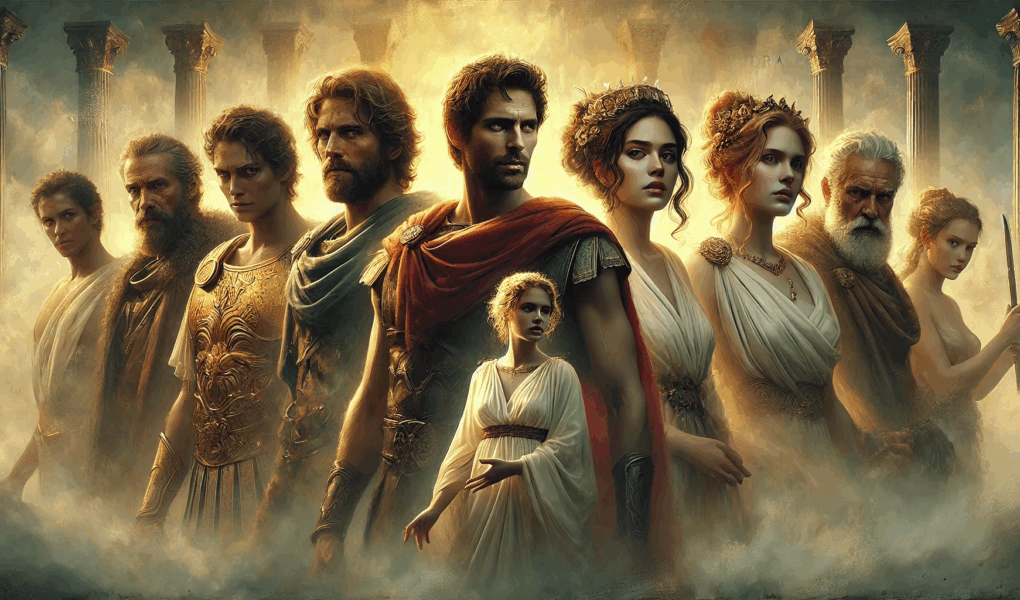
This is not a pantheon — this is a reckoning. Mortal and divine, warrior and prophet, mother and goddess: all face the same horizon. Their expressions reflect grief, awakening, defiance, and prophecy. No longer separated by power, they now stand as witnesses to a world unraveling and reborn.
But his aide pulled the shaft clean. Diomedes gritted his teeth, stood, and cast his spear. The spear passed through Pandarus’s mouth and out the back of his neck. Diamedes bent to strip the body.
That’s when Aeneas stepped in. Regal. Golden armor gleaming. His face held grief and rage, and he growled, You’ll not take his armor.

Amidst swirling dust and a fading sun, the goddess Aphrodite descends in a column of golden light, her arms outstretched toward her son Aeneas. He stands in gleaming armor, his grief and fury barely restrained. Diomedes, unwavering, raises his spear—but holds. The field is still. Even time seems to pause. This is not the clash, but the heartbeat before it—where mortal defiance meets divine protection.
Diomedes said, You die next.
But before Diomedes could finish Aeneas off, his mother, Aphrodite, appeared in a flash of golden light. She clutched Aeneas and shielded him.

Diomedes and Aeneas stand fixed in a moment of epic stillness. Between them, Aphrodite glows—her presence otherworldly, her gesture protective. No blade has fallen, but something else has shifted: reverence is cracking, and truth is breaking through. The air is thick with awe, the dust with revelation. This is not just a battle—it’s a question: who dares stand against the divine?

Diomedes stares forward with unshakable resolve — dust and sweat streaking a face carved by war, but unbroken by it. His eyes burn with clarity, not rage; conviction, not pride. Behind him, the battlefield blurs into smoke and gold, but his focus remains sharp. In this moment, he is more than a warrior — he is a mortal standing eye to eye with the divine, unafraid.
I fell to my knees like all mortals must. The Gods taught us that when they descend, we should kneel and look away. Do not question. Do not interfere.
But Diomedes didn’t kneel. His voice rang sharp. Get out of the way, goddess.
Aphrodite tried to lift Aeneas and vanish in a blink. But Diomedes threw too fast for them to escape.
The spear spun through the air, fast, precise, and hit Aphrodite’s hand. She screamed—not with divine thunder, but pain. Real. Raw. She clutched her wrist, blood pouring over skin that shimmered like moonlight.

Aphrodite gazes outward with wide, trembling eyes — not with the gaze of an untouchable deity, but that of a being who has just felt pain. Her beauty remains ethereal, her skin luminous, but her expression cracks with fear and disbelief. This is the moment mortals once thought impossible: the goddess has bled. And in her face is the truth — the divine are not immune to suffering.
She dropped Aeneas. She stumbled backward. She bled.
Around me, men gasped.
The goddess is wounded, someone whispered.

Diomedes, Aeneas, and the warriors of myth look straight into the heart of history. Their faces, lit by golden battlefield light, hold the gravity of combat, grief, and awakening. This is the gaze of those who fought, questioned the divine, and lived to understand they were not small.
No one had ever seen it before. Not in our time. Not even in the tales of old.
Aphrodite vanished then; she probably fled toward the high walls of Olympus.

Aphrodite’s face still shines with unearthly beauty, but something has changed. Her expression is open, unguarded — her divine composure peeled back to reveal raw confusion and sorrow. Blood may not show, but the wound is present in her eyes. This is no longer an Anunnaki goddess, but a mother caught in a world that does not respect sanctity.
But another god stormed onto the battlefield: Aphrodite’s lover, Aries. Aries screamed and flew at Diomedes.

The battlefield holds its breath as Diomedes plants his feet and raises his spear, refusing to yield. Across from him, Ares towers in divine fury, glowing in bronze and stormlight. Dust coils around them. The cracked earth groans beneath the weight of what’s coming. No mortal should stand here, but Diomedes does. And that defiance becomes legend.
But the Earthling had not run. He braced his legs and launched a spear that hit Aries right in his belly. Ares crumpled, roaring, clutching his gut. Blood—divine blood—poured onto the dust.

Ares staggers back, wounded—not slain, but humbled. The glow of his godhood dims slightly as he clutches his midsection in disbelief. Diomedes stands steady, his spear lowered now, eyes locked not in triumph but in truth. Around them, the battlefield has gone still. No war cry rises. No charge comes. Even the dust seems to pause. A god has bled, and the world has changed.

Ares stands at the heart of the battlefield like an inferno given form. His dark bronze armor radiates heat and menace, runes pulsing beneath scorched skies. A great spear glows in his grip. His cape thrashes in a wind summoned only by gods. Around him, mortal warriors halt mid-step — fear silencing both Greek and Trojan alike. Ares has not yet struck, but the world already shudders in anticipation.

Cassandra’s prophetic intensity, Hecuba’s quiet sovereignty, and Aphrodite’s wounded divinity speak across time. Their expressions do not plead or boast — they warn, endure, and bleed. This is the chorus of wisdom behind every war.

I stood frozen. Then I looked around. No one was cheering. No one charged. Even the Trojans stared. Something shifted. Not just on the battlefield; it shifted inside me.

Ares’s face is carved from war itself — chiseled features shadowed beneath a battle-scarred helmet, his eyes burning with divine fire. Smoke coils behind him like a living cloak. His rage is not human, not even wild — it is ancient, celestial, unrelenting. He is furious before the first spear is ever thrown.
I thought they bled. They hurt. They run. They lie. We were told they were gods. We were told to kneel. To fear. That we were nothing but toys, cattle, flesh to die for their grudges.

The dust has not yet settled, but every sword is lowered. Across the plain, warriors stand in quiet awe — no longer fighting, no longer shouting. In the golden haze stands Diomedes, alone, radiant in resolve. Around him, even the light seems changed. Something ancient has broken. Something true has emerged. Mortals are no longer blind — they have seen, and now, they remember.
But now I saw what Diamedes showed us.
They are not invincible.
They can be wounded.
They are afraid.
We saw the truth. And the truth is contagious.
I picked up my shield again, but I didn’t hold it with fear anymore.

Golden light filters through the torn sky, catching the armor of soldiers who stand like statues. Greek and Trojan eyes lock, but not in hatred — in shared, haunted awe. No one rushed forward. None shout. They have seen gods bleed, and that vision strips away every lie they once lived by. This is not surrender. It is a revelation.
I thought, Maybe we can win.
Maybe we are not small.
Maybe domination is a lie.
And maybe—just maybe—we can choose compassion instead. And something shifted. Not just on the battlefield.

His face bears the dirt of war, but not its fear. His eyes meet ours, not to retell the battle, but to carry its truth. Behind him, the battlefield fades into golden smoke — the world that was. In his gaze is the beginning of something new: the moment a soldier became a witness, and a witness became a messenger. He no longer kneels. He understands now — and so do we.
Inside me.
I thought, They bleed. They hurt. They run. They lie.
We were told they were gods. We were told to kneel. To fear. That we were nothing but toys, cattle, flesh to die for their grudges.
But now I saw what Diamedes showed us.
They are not invincible.
They can be wounded.
They are afraid.

The soldier’s face is still, but his eyes are different now — not wide with fear, but lit with a quiet fire. Dust clings to his skin, yet there’s no panic, no pleading. Only presence. This is the moment when the lies fell away, when the gods bled and fear lost its grip. He is not just surviving anymore. He is choosing. And in his gaze, we see the birth of something rare in war: belief, not in gods, but in human will.
Later, they ran to Zeus. Ares and Athena are shouting. Punish the mortal, they demanded. He defies our order. He makes a mockery of Olympus.
Zeus waved them off.
I don’t meddle in mortal affairs, he said.
We had seen the truth. And the truth is contagious.
I picked up my shield again, but I didn’t hold it with fear anymore.

They do not speak. They do not move. They look across time, across legend, across truth. Diomedes stands with Aeneas, Cassandra beside Hecuba, and Aphrodite among them — no longer above, but equal. Their faces reflect what was felt and what cannot be undone: the gods can bleed, the veil has torn, and the myth has changed. This is the gaze of those who saw it happen — and will not forget.
I thought, Maybe we can win.
Maybe we are not small.
Maybe domination is a lie.
And maybe—just maybe—we can choose compassion instead.


—
*I illustrate the story of the Trojan War with videos from See U in History.
**ANUNNAKI & ANCIENT ANTHROPOLOGY EVIDENCE, REFERENCES, TIMELINE & WHO’S WHO
Evidence https://wp.me/p1TVCy-1zg
References http://wp.me/p1TVCy-2cq
Timeline http://wp.me/p1TVCy-1Km
Who’s Who http://wp.me/p1TVCy-1PE
New Stuff www.enkispeaks.com
| Untitled |
PLEASE SHARE, REPOST & LIKE THIS POST.
Attachments area
Preview YouTube video The Man Who Injured the Gods: The Glory of Diomedes – The Trojan War Saga Ep18

The Man Who Injured the Gods: The Glory of Diomedes – The Trojan War Saga Ep18

