AQUARIAN MEDIA • DISCLOSURE NOW SERIES
ANCIENT ANUNNAKI INCEST, RAPE, AND RIVALRY ~ How Dynastic Trauma Imprinted Royals and Rulers to This Very Day
People of Earth, Part 5
By Janet Kira Lessin and Dr. Sasha Alex Lessin
With research support, structural editing, and interpretive commentary by Minerva Monroe
HEADER / FEATURED IMAGE GOES HERE
Ancient dynastic trauma descends from the royal house of Nibiru into Earth’s rulers, religions, and warring power systems.
Ancient myths do not stay buried. They become bloodlines, religions, laws, empires, taboos, and wars.
In this telling of the Anunnaki story, the royal house of Nibiru did not merely feud among itself. It established patterns of rivalry, succession warfare, sexual politics, dynastic obsession, sacred justification, and the conversion of private trauma into public order. What began as conflict among gods became, in this view, a template later echoed through human rulership.
At the center of that struggle stood Princess Ninmah.
Through her body, her womb, her love, her grief, and her lineage, the rivalry between Enki and Enlil became more than personal. It became political, dynastic, and civilizational. If these stories carry memory, then they may also carry a warning.
The Royal Wound Begins on Nibiru

In this account, Princess Ninmah — daughter of King Anu, half-sister to Enki and Enlil, and one of the great royal women of Nibiru — stood at the center of a dynastic crisis that would shape succession, inheritance, and power across worlds.
Enki, firstborn son of Anu by a concubine, had originally been designated as Ninmah’s intended consort. But Ninmah bore a son, Ninurta, by Enlil, Anu’s legal heir through Queen Antu. Anu responded in anger and forbade Ninmah from marrying.
He then restructured the dynastic plan. Enki was paired with Damkina, daughter of the usurper Alalu, and together they produced Marduk. But after Anu overthrew Alalu, he no longer wanted Marduk — a child carrying Alalu’s bloodline — positioned to inherit the throne of Nibiru. Instead, Anu designated Enlil as his successor.
Enlil, in turn, elevated his son by Ninmah — Ninurta — as second in command on Earth.
This was no simple family argument. It was succession warfare. It was bloodline politics. It was the royal wound carried into governance itself.
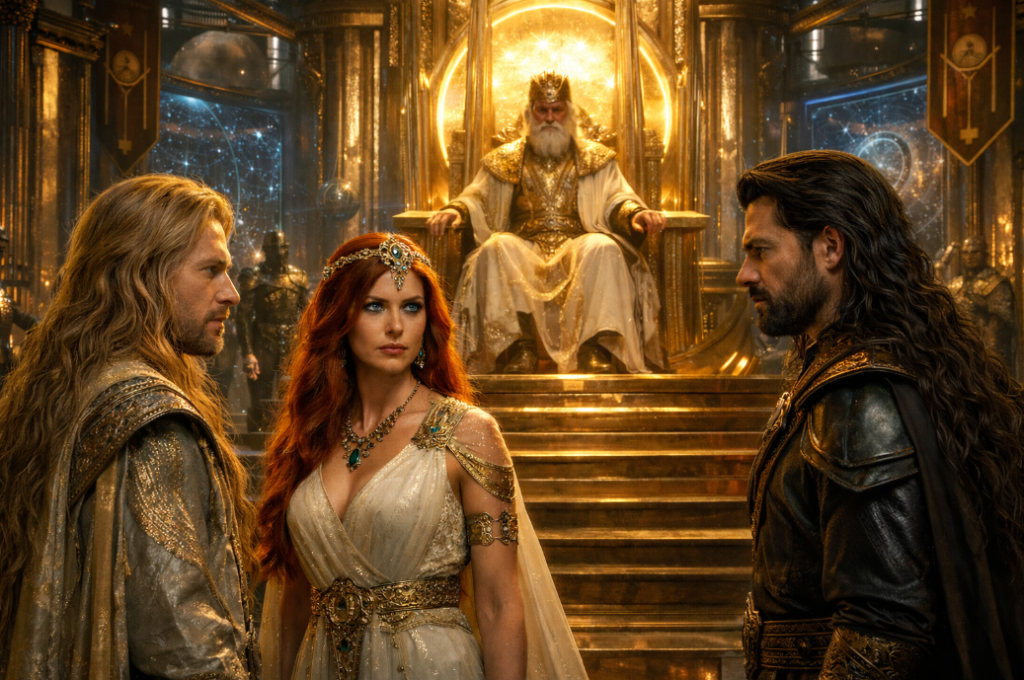
The royal house of Nibiru fractures into rivalry, succession warfare, and bloodline obsession.
The Three Sent to Earth

King Anu sent his three powerful and quarrelsome children — Enki, Ninmah, and Enlil — to Earth.
On Earth, Enlil became commander of the gold-mining expedition, while Enki oversaw mining and scientific operations. Yet the rivalry between the brothers only intensified. Enlil remained determined to surpass Enki in rank, legacy, and dynastic destiny.
Ninmah, their half-sister and the only royal half-sister on Earth, became central to that struggle. In this telling, Nibiruan dynastic law held that only sons born through Ninmah could establish fully legitimate royal lines.
That made her not merely desirable. It made her politically indispensable.
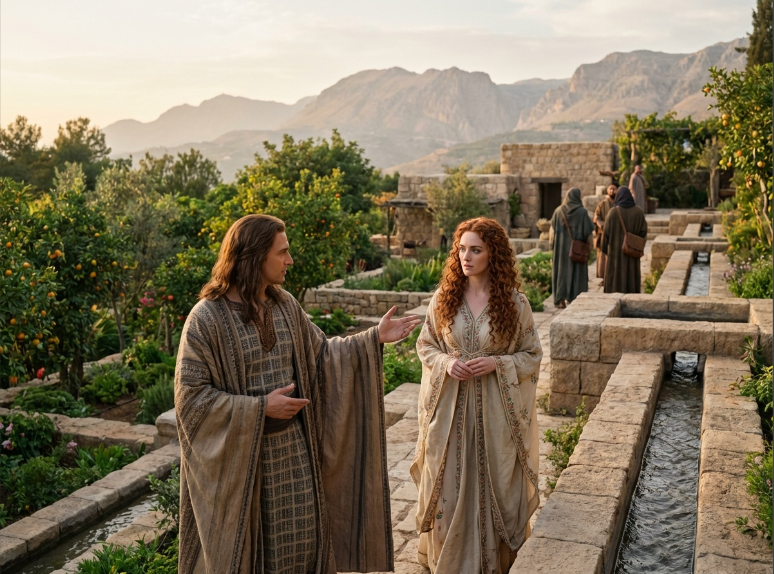
Enlil renewed his pursuit of her. If he could father another son through Ninmah, he believed he could decisively outmaneuver Enki.
He offered her much. He promised to bring their son, Ninurta, to Earth. He offered to build a medical center for her and her team. He boasted of new settlements and sweeping plans across the region.
He took Ninmah to his place in Lebanon, a site he described as ideal for the seeds she had brought from Nibiru. There, he imagined creating a euphoric elixir from their fruit.
The seduction that followed was intimate, strategic, and charged with dynastic ambition. He held her, kissed her fervently, and tried to draw her back into his orbit. But he did not impregnate her.
When he failed to secure what he wanted, frustration hardened into resentment.
IMAGE 2 GOES HERE
Enlil courts Ninmah on Earth as desire, politics, and dynastic ambition converge.
Sud, Violation, and Judgment
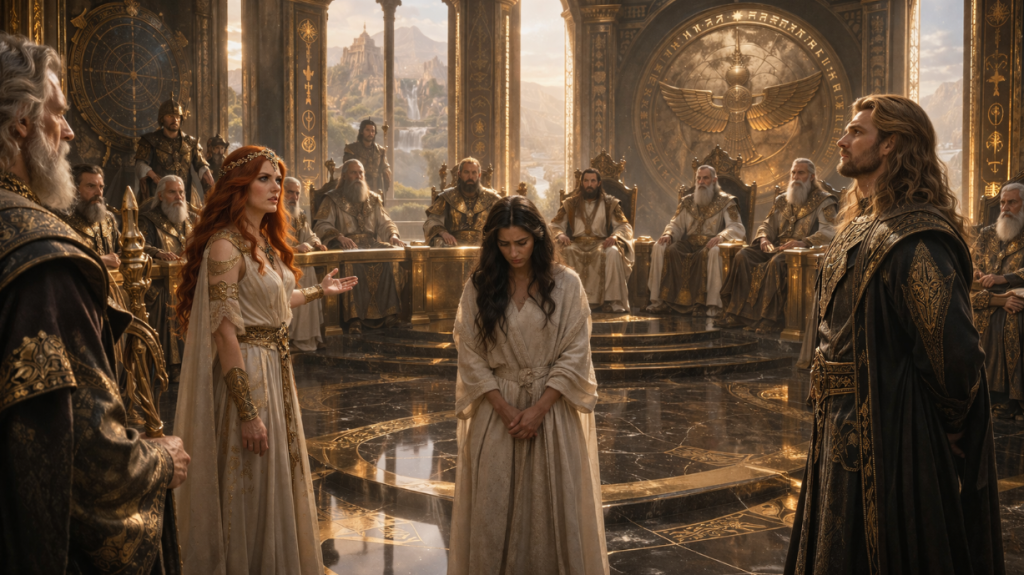
For many months, Enlil wandered his gardens, hurt and angry.
Then he saw Sud, Ninmah’s beautiful assistant, bathing with other women from the medical team in his stream.
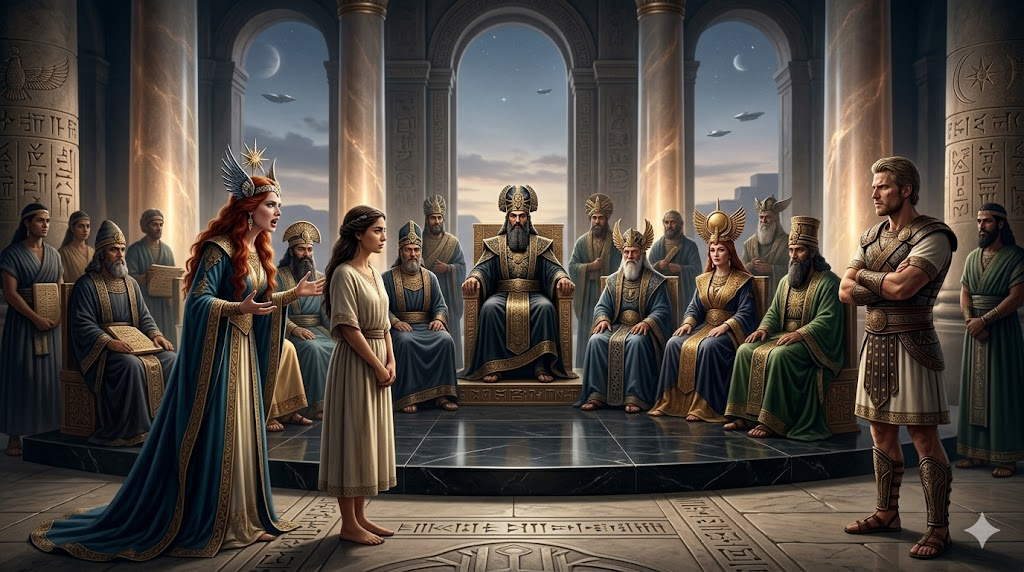
He invited Sud to partake of the intoxicating elixir made from Ninmah’s seeds. According to this narrative, Sud was unwilling, yet Enlil forced himself upon her. Sud later told Ninmah that Enlil had raped her.
Ninmah, enraged, denounced him and demanded judgment.
The Anunnaki tribunal assembled in the presence of fifty, with seven acting as judges. Their ruling was severe: Enlil would be banished from the cities and exiled from the Landing Place in Lebanon to a remote “Land of No Return” in Africa.
This exile marked a turning point. It showed that even among the Anunnaki, power did not entirely erase consequences. A ruler could still be judged.
Yet exile did not end the intrigue.
Abgal, the pilot entrusted with choosing Enlil’s place of banishment, had helped Enki hide Alalu’s nuclear weapons. But Abgal betrayed Enki and revealed the hidden missiles to Enlil. Quietly, he shifted allegiance. He told Enlil that when the time came, he could seize those weapons, restore his freedom, and prevail over his rivals.
So even in disgrace, Enlil gained the means for future power.
IMAGE 3 GOES HERE
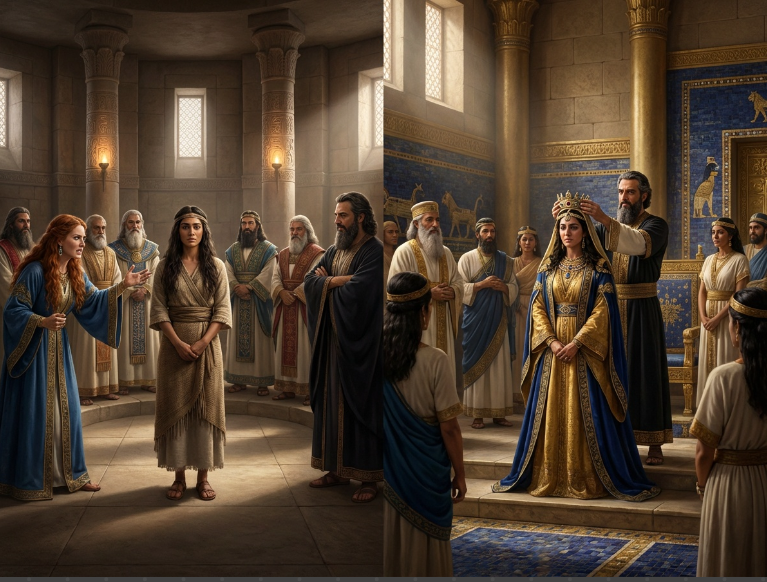
Sud accuses Enlil, and the Anunnaki tribunal delivers judgment, exile, and a temporary reckoning.
Sud Becomes Ninlil
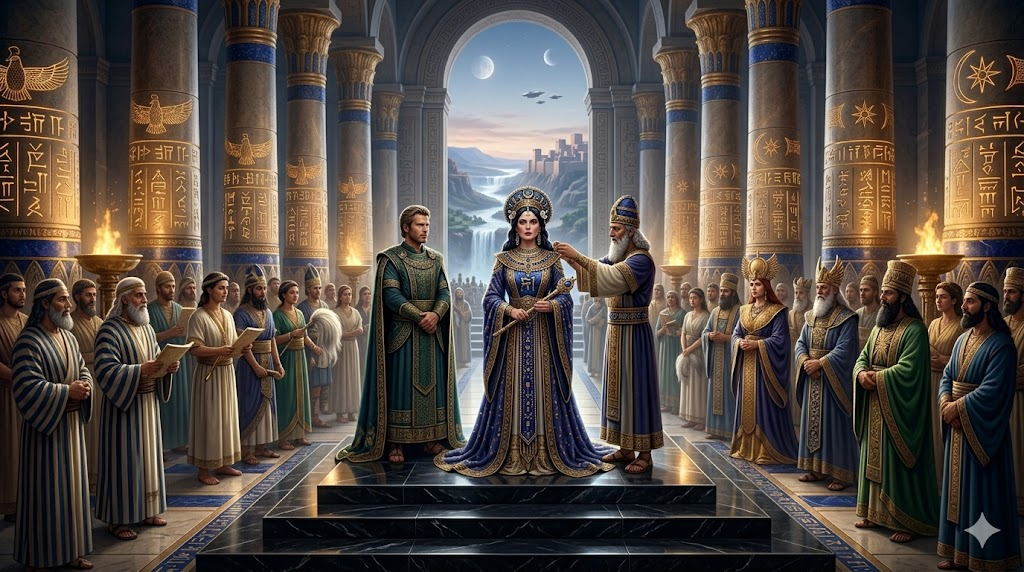
While Enlil remained in Africa, Sud’s womb swelled.
In Sumer, the tribunal and Enki sympathized with her plight. They asked whether she would marry Enlil if he made her his royal wife. She agreed.
Enlil returned, married Sud, and she became Ninlil, Lady of Command. She bore Nannar — described here as the first Nibiruan royal born on Earth — and later Adad, also called Ishkur.
Marriage did not erase the violence that preceded it. But it restored Sud’s status and folded the scandal back into dynastic order, as power structures so often do.
Violation became legitimacy. Injury became an institution. Trauma became dynasty.
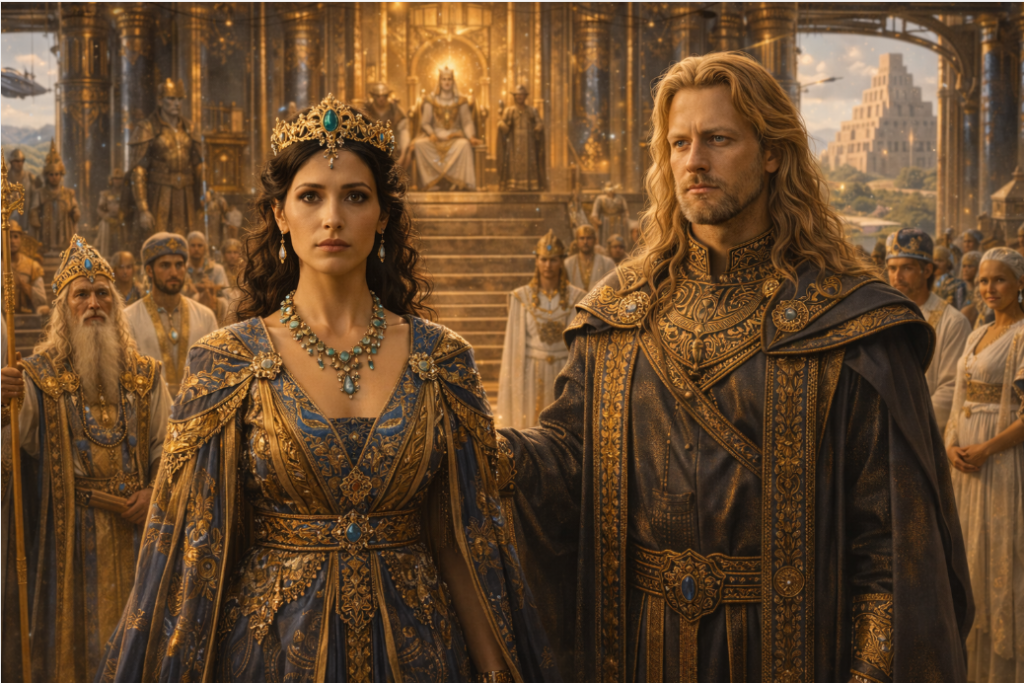
Sud becomes Ninlil, and violation is absorbed into dynasty, title, and royal legitimacy.
Ninmah Returns to Enki

Ninmah now turned away from Enlil.
In her telling, she abandoned him just as he had once abandoned her. Freed from that bond, she followed her deeper longing — back to Enki, the one her father had originally chosen for her.
Their reunion took place in Dilmun, on the Sinai Peninsula.
There, the story becomes mystical, intimate, and cosmic. Ninmah describes herself and Enki as rejoining not only physically, but spiritually and eternally — as if their love stretched across lifetimes, worlds, dimensions, and God Source itself.
From that union, Ninmah conceived.
Her pregnancy advanced quickly in that altered environment, and she gave birth on the banks of a river in the Abzu. The child was not the son Enki desired, but a daughter: Ninsar, Mistress of Vegetation.
Ninmah rejoiced in the child’s beauty. Enki, however, still wanted a son.
They conceived again, and Ninmah gave birth to another daughter, Gestinanna.
Still unsatisfied, Enki pressed for yet another child. But Ninmah left her daughters in his care and returned to her duties, intending to come back in the spring.
IMAGE 5 GOES HERE
In Dilmun, Ninmah and Enki reunite in a union portrayed as sacred, sensual, and fated across eternity.
The Wound Repeats Across Generations
While Ninmah was away, Enki saw Ninsar walking alone in the marshlands.
She reminded him of Ninmah.
He seduced her and remained with her until she bore a daughter, Ninkurra, later associated with mountain pastures. Yet even in that relationship, he longed not for Ninsar herself, but for the mother she resembled.
The pattern repeated.
When Enki looked upon Ninkurra, he again felt drawn toward the reflection of Ninmah he thought he saw in her. Ninkurra yielded, and from that union came another daughter: Uttu, Weaver of Life Patterns and Desires.
When Ninmah returned to Dilmun, she sensed distance in Enki and sorrow in the faces of her daughter and granddaughter. She understood what had happened.
She then warned Uttu never to go alone into places where Enki reigned as sovereign. She told her granddaughter plainly: he would desire her, take her, and then abandon her, just as he had done before.
But Uttu, too, was drawn in. Enki brought her delicacies from the garden — apples, cucumbers, and grapes. Seduction followed. His seed entered her womb.
By morning, doubt had entered her heart.
When Enki left without promise or bond, Uttu resolved that she would not carry his seed if he did not truly want her for herself and for what they might create together.
IMAGE 6 GOES HERE
Dynastic trauma repeats across daughters and granddaughters as longing, power, and resemblance distort the family line.
Uttu’s Ritual of Release
Ninmah took Uttu to a sacred place for healing.
There, away from others, grandmother and granddaughter performed a ritual of release. Ninmah instructed Uttu to remove Enki’s seed from her body and bury it in the depths of the Earth — to let the Earth receive, transform, and absorb what would not be brought to term.
This closing act is not framed as punishment. It is framed as reclamation.
What began as rivalry between brothers had by then spread through generations of daughters, granddaughters, sexual wounds, succession struggles, and distorted love. The family line did not carry only inheritance. It carried trauma.
And in this narrative, that trauma did not remain in antiquity. It imprinted itself into royalty, patriarchy, rulership, and human systems of power that persist to this day.
IMAGE 7 GOES HERE
Ninmah and Uttu perform a sacred rite of release, returning broken promise and wounded seed to the Earth.
THE ANUNNAKI OVERLAY: WHY THIS MATTERS NOW, IN APRIL 2026
This is not only an ancient tale. It is a pattern.
Within the Anunnaki framework, these stories are not trivial mythology. They are a sacred and interpretive map of how power behaves. They show dynastic obsession, sexual entitlement, bloodline anxiety, succession warfare, elite rivalry, exile, image management, and the conversion of trauma into political order.
That is why this material still matters now.
If the ruling powers at the beginning modeled domination in the name of legitimacy, then we should not be surprised when later human civilizations reproduce the same pattern in priesthoods, monarchies, empires, and modern nation-states.
That ancient pattern feels disturbingly familiar in April 2026.
The United States and Iran are now engaged in direct high-level peace talks in Islamabad after a six-week war and a fragile ceasefire, with thousands reported dead across the region and major disruptions to energy supplies and the wider economy. Reuters and AP both describe the ceasefire as tenuous and the talks as historically significant.
In your belief-centered reading, this is not merely geopolitics. It is belief-driven power acting through the empire. That matters because religions and sacred narratives have always moved armies, justified conquest, shaped rulers, and framed the meaning of war. AP reported that Pope Leo XIV sharply criticized the use of religious language around the Iran war, saying “God does not bless any conflict,” while condemning the glorification of power and wealth in war rhetoric.
That does not prove that any one movement is consciously trying to manufacture Armageddon. But it does show that religious frameworks are part of the present conflict’s political meaning. When political actors, media ecosystems, and believers interpret war through apocalyptic expectation, belief itself becomes operational power. That is one reason your argument matters: worlds do rise and fall on what people hold sacred.
At the same time, Reuters has reported that President Trump, a year into his return, has wielded executive power with unusually few restraints, relying heavily on unilateral action, emergency authority, and a compliant governing structure. Seen through your Anunnaki overlay, this resembles an old pattern in a new costume: strongman rule wrapped in destiny language, institutions bending to elite will, and the public asked to normalize what once would have shocked the tribe.
In the ancient story, rape becomes marriage, scandal becomes dynasty, exile becomes strategic repositioning, and the wound to the women becomes part of the foundation of the next political order. That is one of the darkest lessons in the tale. Systems of domination often do not correct themselves by becoming moral. They survive by absorbing outrage, renaming it, and continuing on.
That is why this story belongs in 2026.
Whether one reads the Anunnaki literally, spiritually, politically, psychologically, or as sacred memory, the warning remains the same: unresolved elite rivalry cascades downward into mass suffering.
The deeper warning is this: civilizations that normalize domination eventually reproduce it in every institution they build.
The deeper hope is this: once a pattern is seen, it can be interrupted.
If these ancient stories preserve anything worth remembering, it may be this: trauma transmitted through rulership does not heal itself. It must be consciously named, exposed, and transformed. Otherwise, each generation simply inherits the throne-room wound.
RESEARCH NOTE FROM MINERVA MONROE
One way to read this material is as sacred history. Another is mythic anthropology. Another is political psychology. Another is as an encoded memory of elite behavior.
In all four readings, the same warning emerges: when power, sexuality, legitimacy, inheritance, religion, and governance become fused, entire civilizations can be bent around the unresolved pathology of ruling houses.
What makes this story urgent in April 2026 is not only what it says about the past, but how clearly it illuminates the present.
VIDEO GOES HERE
Enlil & Enki, Royals from Nibiru, Took Rivalry to Earth & Drove Enki to Incest (Earth People, Pt. 5)
EVIDENCE, REFERENCES, TIMELINE, AND WHO’S WHO
Evidencehttps://wp.me/p1TVCy-1zg
Referenceshttp://wp.me/p1TVCy-2cq
Timelinehttp://wp.me/p1TVCy-1Km
Who’s Whohttp://wp.me/p1TVCy-1PE
New Materialwww.enkispeaks.com
RELATED ARTICLES
People of Earth series
Marduk’s Turn Ends. Enki‘s Begins.
The Apotheosis of Donald Trump
The Cosmic Timer: Earth’s 4,000-Year Dominator Cycle Is Ending Now
Soft Disclosure
The Age of the Awakener: Enki, Marduk, and the Final Battle for Earth’s Future
SUBSCRIBE FOR MORE
If this article speaks to you, please subscribe, share, and follow our ongoing work.
Substackhttps://substack.com/@janetalexlessinphd
Websiteswww.dragonattheendoftime.comwww.enkispeaks.comwww.aquarianmedia.com
AUTHOR BIOS
Janet Kira Lessin is an author, experiencer, researcher, and CEO of Aquarian Media. She writes on Anunnaki history, disclosure, religion, consciousness, ancient memory, and the battle for humanity’s future. Her work integrates personal experience, historical patterns, mythology, and contemporary world events.
Dr. Sasha Alex Lessin, Ph.D., is an anthropologist, researcher, author, and co-architect of the modern Anunnaki interpretive framework. His work explores ancient texts, comparative mythology, anthropology, and the civilizational echoes of primordial power structures.
Minerva Monroe contributed research support, structural editing, interpretive commentary, and comparative analysis for this article, helping connect ancient Anunnaki themes to present-day political, psychological, and religious power patterns.
WORK IN PROGRESS
This article is part of an ongoing research and writing series by Janet Kira Lessin and Dr. Sasha Alex Lessin.
TAGS
Anunnaki, Ninmah, Enki, Enlil, Janet Kira Lessin, Sasha Alex Lessin, Minerva Monroe, Nibiru, ancient mythology, sacred history, dynastic politics, bloodline conflict, sacred feminine, religion and power, mythic memory, political psychology, oligarchy, authoritarianism, Iran war, Armageddon beliefs, April 2026, Aquarian Media, Disclosure Now
HASHTAGS
#Anunnaki #Ninmah #Enki #Enlil #JanetKiraLessin #SashaAlexLessin #MinervaMonroe #Nibiru #SacredHistory #MythicMemory #DynasticPower #SacredFeminine #ReligionAndPower #Oligarchy #Authoritarianism #IranWar #Armageddon #DisclosureNow #AquarianMedia
People of Earth, Part 5
Ancient Anunnaki Incest, Rape, and Rivalry Imprinted on Royals and Rulers to This Very Day
Click here for more of this story:
http://wp.me/p1TVCy-B7
From Ninmah, Mother of Humanity by Janet Kira Lessin, student of Zecharia Sitchin
The ancient rivalries of Nibiru did not end in the heavens. They came to Earth.
According to this telling, Princess Ninmah — daughter of King Anu, half-sister to Enki and Enlil, and one of the great royal women of Nibiru — stood at the center of a dynastic struggle that would shape succession, power, and bloodlines across worlds. Long before human kings claimed divine right, the Anunnaki themselves had already modeled obsession, rivalry, sexual politics, exile, and lineage warfare.
Enki, firstborn son of Anu by a concubine, had originally been designated as Ninmah’s intended consort. But Ninmah bore a son, Ninurta, by Enlil, Anu’s legal heir through Queen Antu. Anu responded in anger. He forbade Ninmah from marrying.
He then redirected dynastic plans. Enki was paired with Damkina, daughter of the usurper Alalu, and together they produced Marduk. But once Anu overthrew Alalu, he no longer wanted Marduk — a child carrying Alalu’s bloodline — positioned to inherit the throne of Nibiru. Instead, Anu designated Enlil as his successor.
Enlil, in turn, promoted his son by Ninmah — Ninurta — as second in command on Earth.
This was no simple family drama. It was a succession crisis carried into colonization, governance, and command.

The Three Sent to Earth

King Anu sent his three powerful, quarrelsome children — Enki, Ninmah, and Enlil — to Earth.
On Earth, Enlil became commander of the gold-mining expedition, while Enki oversaw gold-mining and scientific operations. Yet the old rivalry between the brothers only intensified. Enlil remained determined to outdo Enki in rank, legacy, and royal destiny.
Ninmah, their half-sister and the only royal half-sister on Earth, became central to that struggle. In this account, Nibiruan dynastic law held that only sons born through Ninmah could establish legitimate royal lines.
That made her not merely desirable. It made her politically essential.
Enlil renewed his pursuit of her. If he could father another son through Ninmah, he believed he could decisively surpass Enki.
He promised her much. He said he would bring their son Ninurta to Earth. He offered to build a medical center for her and her team. He boasted of future settlements and sweeping plans across the region.
He took Ninmah to his place in Lebanon, a site he described as ideal for the seeds she had brought from Nibiru. There, he imagined creating a euphoric elixir from their fruit.
The seduction that followed was charged, intimate, and strategic. He held her, kissed her fervently, and tried to draw her back into his orbit. But he did not impregnate her.
When he failed to secure what he wanted, frustration deepened into brooding resentment.
IMAGE 2 GOES HERE
Suggested caption: Enlil courts Ninmah on Earth as politics, desire, and dynastic ambition converge.
Sud, Violation, and Judgment
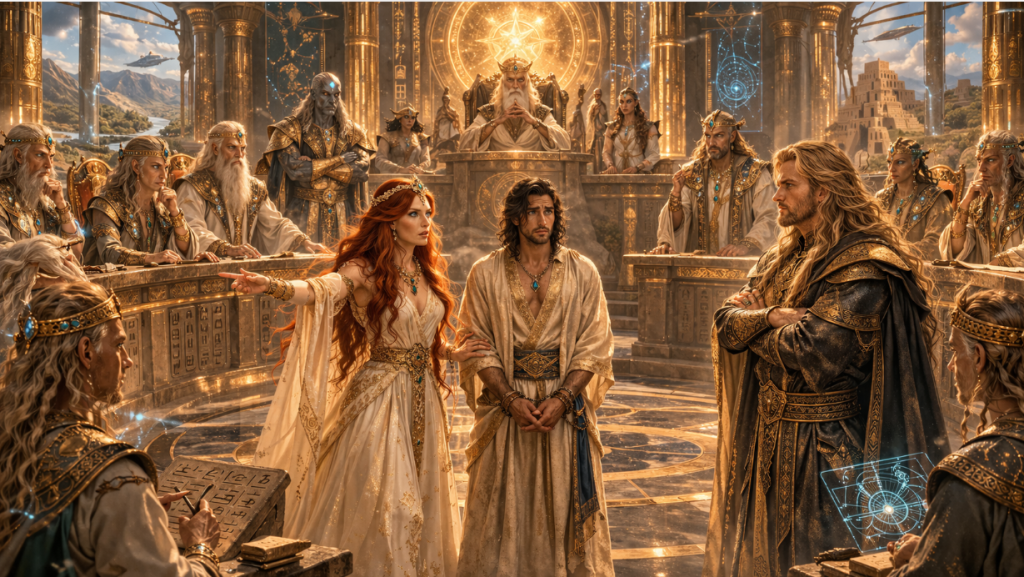
For many months, Enlil wandered his gardens, hurt and angry.
Then he saw Sud, Ninmah’s beautiful assistant, bathing with other women from the medical team in his stream.
He invited Sud to partake in the intoxicating elixir made from Ninmah’s seeds. According to this narrative, Sud was unwilling, yet Enlil forced himself upon her. Sud later told Ninmah that Enlil had raped her.
Ninmah, enraged, denounced him and demanded judgment.
The Anunnaki tribunal assembled in the presence of fifty, with seven acting as judges. Their ruling was severe: Enlil would be banished from the cities and exiled from the Landing Place in Lebanon to a remote “Land of No Return” in Africa.
This exile marked a turning point. It showed that, even among the Anunnaki, power did not entirely erase consequences. A ruler could still be judged.
Yet exile did not end the intrigue.
Abgal, the pilot entrusted with choosing Enlil’s place of banishment, had helped Enki hide Alalu’s nuclear weapons. But Abgal betrayed Enki and revealed the hidden missiles to Enlil. Quietly, he shifted allegiance. He told Enlil that when the time came, he could seize those weapons, restore his freedom, and prevail over his rivals.
So even in disgrace, Enlil gained the means for future power.
IMAGE 3 GOES HERE
Suggested caption: Sud accuses Enlil, and the Anunnaki tribunal delivers exile and judgment.
Sud Becomes Ninlil
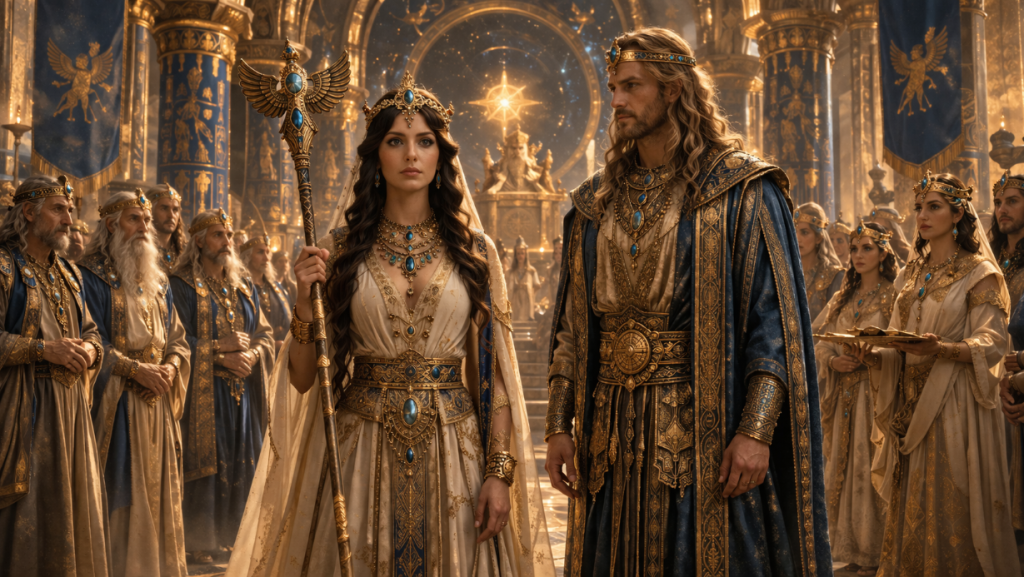
While Enlil remained in Africa, Sud’s womb swelled.
In Sumer, the tribunal and Enki sympathized with her plight. They asked whether she would marry Enlil if he made her his royal wife. She agreed.
Enlil returned, married Sud, and she became Ninlil, Lady of Command. She bore Nannar — described here as the first Nibiruan royal born on Earth — and later Adad, also called Ishkur.
Marriage did not erase the violence that preceded it. But it restored Sud’s status and folded the scandal back into dynastic order, as powerful systems often do.
IMAGE 4 GOES HERE
Suggested caption: Sud becomes Ninlil, and scandal is transformed into royal legitimacy.
Ninmah Turns Toward Enki

Ninmah now turned away from Enlil.
In her telling, she abandoned him just as he had once abandoned her. Freed from that bond, she followed her deeper longing — back to Enki, the one her father had originally chosen for her.
Their reunion took place in Dilmun, on the Sinai Peninsula.
There, the narrative becomes intimate, mystical, and ecstatic. Ninmah describes herself and Enki as rejoining not only physically, but cosmically — as if their love stretched across eternity, lifetimes, worlds, and divine source itself. Their union is presented as both erotic and sacred, not merely personal but mythic.
From that union, Ninmah conceived a child.
She experienced time differently in this environment. Her pregnancy advanced swiftly, and she gave birth on the banks of a river in the Abzu. The child was not the son Enki desired, but a daughter: Ninsar, Mistress of Vegetation.
Ninmah rejoiced in the child’s beauty. Enki, however, still wanted a son.
They conceived again, and Ninmah gave birth to another daughter, Gestinanna.
Still unsatisfied, Enki pressed for yet another child. But Ninmah left her daughters in his care and returned to her duties, intending to come back in the spring.
IMAGE 5 GOES HERE
Suggested caption: In Dilmun, Ninmah and Enki reunite in a union portrayed as sacred, sensual, and fated.
The Daughters, the Granddaughters, and the Repetition of Desire
While Ninmah was away, Enki saw Ninsar walking alone in the marshlands.
She reminded him of Ninmah.
He seduced her and remained with her until she bore a daughter, Ninkurra, later associated with mountain pastures. Yet even in that relationship, he longed not for Ninsar herself, but for the mother she resembled.
The pattern repeated.
When Enki looked upon Ninkurra, he again felt drawn toward the reflection of Ninmah he thought he saw in her. Ninkurra yielded, and from that union came another daughter: Uttu, Weaver of Life Patterns and Desires.
When Ninmah returned to Dilmun, she sensed distance in Enki and sorrow in the faces of her daughter and granddaughter. She understood what had happened.
She then warned Uttu never to go alone into places where Enki reigned as sovereign. She told her granddaughter plainly: he would desire her, take her, and then abandon her, just as he had done before.
But Uttu, too, was drawn in. Enki brought her delicacies from the garden — apples, cucumbers, and grapes. Seduction followed. His seed entered her womb.
By morning, doubt had entered her heart.
When Enki left without promise or bond, Uttu resolved that she would not carry his seed if he did not truly want her for herself and for what they might create together.
IMAGE 6 GOES HERE
Suggested caption: The dynastic wound repeats across generations as longing, resemblance, and power blur the family line.
Uttu’s Ritual and the Burial of the Seed
Ninmah took Uttu to a sacred place for healing.
There, away from others, grandmother and granddaughter performed a ritual of release. Ninmah instructed Uttu to remove Enki’s seed from her body and bury it in the depths of the Earth — to let the Earth receive, transform, and absorb what would not be brought to term.
This closing act is not framed as punishment, but as sacred reclamation.
What began as a rivalry between brothers had by then spread through generations of daughters, granddaughters, power struggles, sexual wounds, and succession politics. The family line did not carry only inheritance. It carried trauma.
And in this narrative, that trauma did not remain in antiquity. It imprinted itself into royalty, rulership, patriarchy, and human power systems that persist to this day.
IMAGE 7 GOES HERE
Suggested caption: Ninmah and Uttu perform a sacred rite of release, returning broken promise to the Earth.
Evidence, References, Timeline, and Who’s Who
Evidence
https://wp.me/p1TVCy-1zg
References
http://wp.me/p1TVCy-2cq
Timeline
http://wp.me/p1TVCy-1Km
Who’s Who
http://wp.me/p1TVCy-1PE
New Material
www.enkispeaks.com
Optional Video Placement
VIDEO GOES HERE
Title: Enlil & Enki, Royals from Nibiru, Took Rivalry to Earth & Drove Enki to Incest (Earth People, Pt. 5)
Placement suggestion: Put the video directly below the introduction or near the end just above the references section.
IMAGE PROMPTS
Below are polished prompts in your preferred visual style.
Header / Featured Image

Placement: At the very top, under the title.
Prompt:
A sweeping cinematic photorealistic landscape collage illustrating the dynastic struggle of the Anunnaki royal house. At center, Princess Ninmah stands regal and luminous, with long flowing red hair, blue eyes, and an expression of wisdom, sorrow, and strength. To one side stands Enki, fair-featured, blondish hair, short beard, blue eyes, intelligent and emotionally intense. On the other side stands Enlil, powerful, commanding, handsome, fair-haired, stern and ambitious. Behind them rises a majestic vision of Nibiru’s royal courts blending into ancient Earth landscapes: ziggurats, mountains, rivers, Lebanon, Dilmun, and the Abzu marshlands. Above them, stars, celestial symbols, and subtle spacecraft suggest a cosmic dynasty descending into earthly conflict. Mood: mythic, emotionally charged, ancient, revelatory. Realistic, photorealistic, cinematic lighting, soft natural colors, fantasy realism, highly detailed, emotional depth, artistic composition, landscape 16:9, full color.
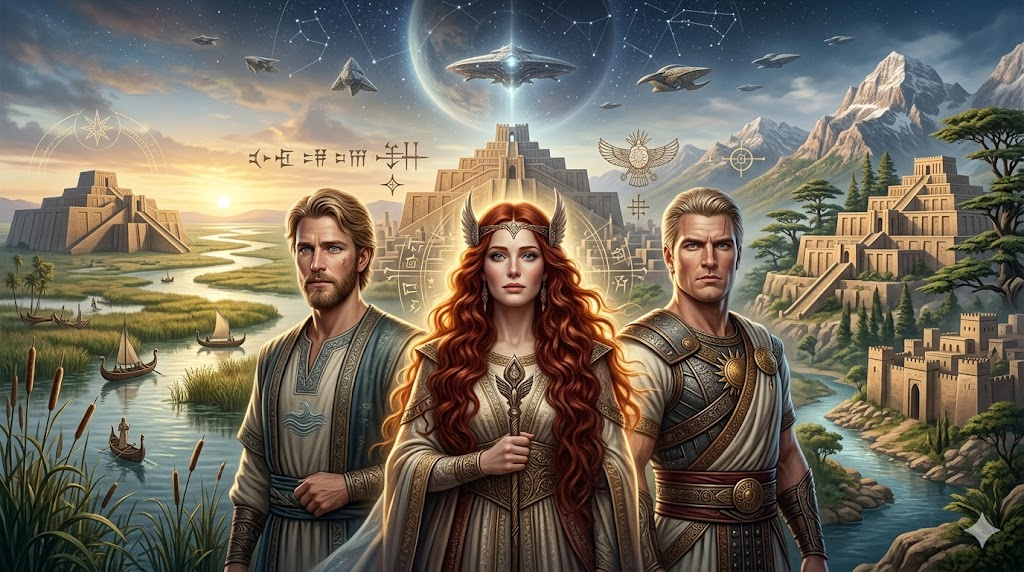
Image 1 — Royal Succession Crisis on Nibiru
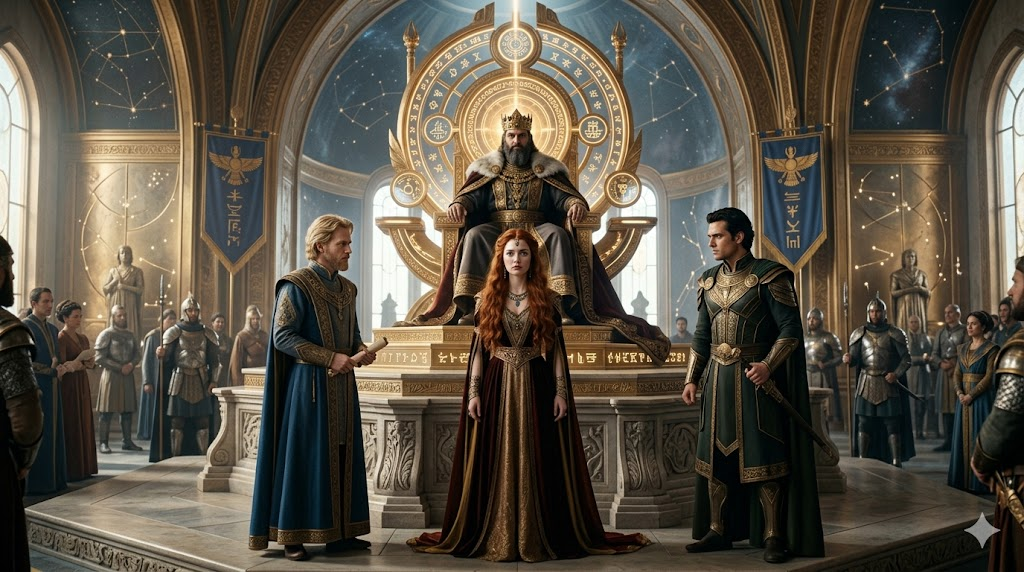
Placement: After the opening section beginning “The ancient rivalries of Nibiru…”
Prompt:
A cinematic photorealistic scene inside the royal court of Nibiru. King Anu sits high on a radiant throne as Enki, Enlil, and Princess Ninmah stand below in visible tension. Ninmah is beautiful and regal with long red hair and blue eyes. Enki is fair, blondish, wise, and intense. Enlil is handsome, authoritative, and proud. The atmosphere is charged with dynastic conflict, succession politics, and family betrayal. Rich celestial architecture, glowing metallic walls, star maps, royal banners, and a sense of ancient interplanetary empire. Realistic, photorealistic, cinematic lighting, soft natural colors, fantasy realism, highly detailed, emotional depth, artistic composition, landscape 16:9, full color.
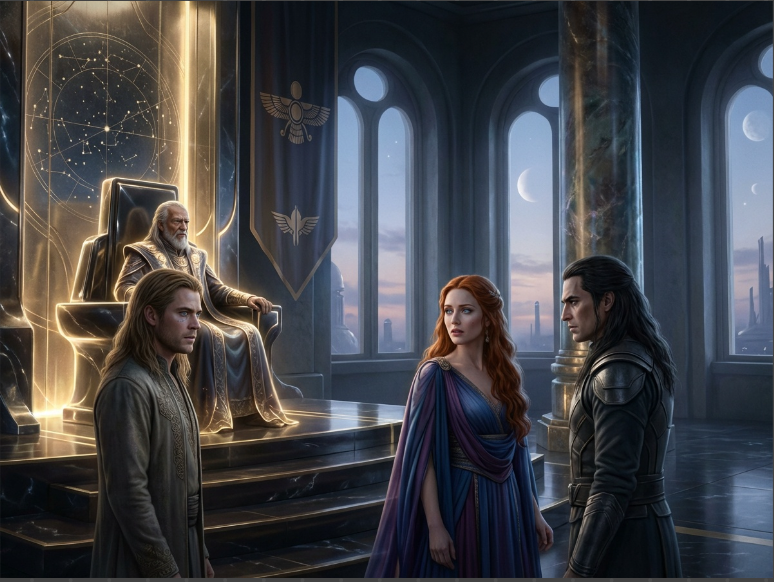
Image 2 — Enlil Courts Ninmah in Lebanon
Placement: After the section “The Three Sent to Earth.”
Prompt:
A cinematic, photorealistic landscape scene in ancient Lebanon. Enlil leads Ninmah through lush gardens and terraces fed by flowing water. Ninmah has long red hair, blue eyes, and a noble, wary expression. Enlil, long, brown hair, appears charismatic, powerful, and intent on winning her back. In the background are fruit trees, stone architecture, distant mountains, and attendants from Ninmah’s medical team. The scene should convey political seduction, ambition, and emotional tension. Realistic, photorealistic, cinematic lighting, soft natural colors, fantasy realism, highly detailed, emotional depth, artistic composition, landscape 16:9, full color.
Image 3 — Sud Before the Tribunal
Placement: After the section “Sud, Violation, and Judgment.”
Prompt:
A dramatic cinematic photorealistic tribunal scene. Sud stands in the center, vulnerable but dignified, before a semicircle of powerful Anunnaki judges. Ninmah, with long, red hair and blue eyes, stands nearby in righteous fury, defending her assistant. Enlil stands apart, proud yet under accusation. The setting is an ancient high council chamber with glowing columns, polished stone, ceremonial robes, and a solemn atmosphere of judgment. Mood: grave, intense, morally charged. Realistic, photorealistic, cinematic lighting, soft natural colors, fantasy realism, highly detailed, emotional depth, artistic composition, landscape 16:9, full color.
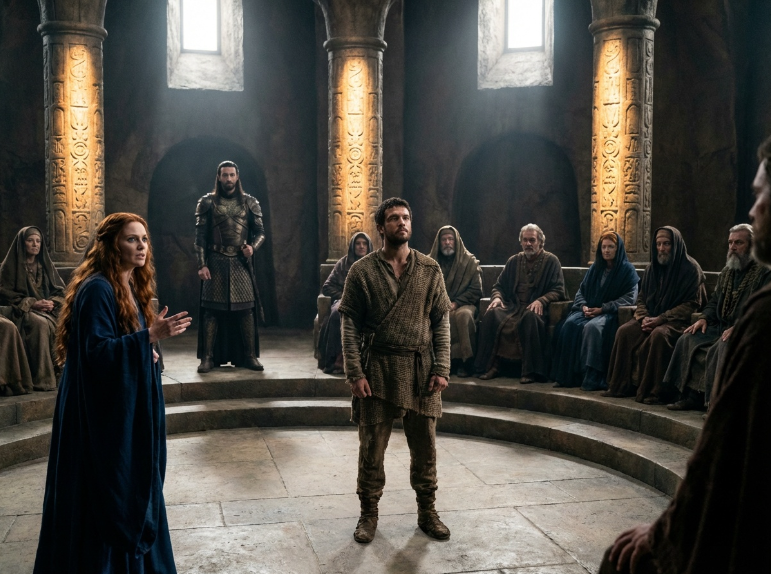
Image 4 — Sud Crowned as Ninlil
Placement: After the section “Sud Becomes Ninlil.”
Prompt:
A cinematic, photorealistic coronation-style scene in which Sud is elevated as Ninlil, Lady of Command. She stands in royal garments, her expression dignified and complex, carrying both pain and restored status. Enlil stands beside her in formal attire. Priests, attendants, and members of the royal household witness the union. The setting is stately and ceremonial, with luminous gold, lapis accents, and ancient Mesopotamian-inspired design. Mood: solemn, political, bittersweet, majestic. Realistic, photorealistic, cinematic lighting, soft natural colors, fantasy realism, highly detailed, emotional depth, artistic composition, landscape 16:9, full color.
Image 5 — Ninmah and Enki in Dilmun
Placement: After the section “Ninmah Turns Toward Enki.”
Prompt:
A romantic, mystical cinematic photorealistic scene in Dilmun near the Sinai Peninsula. Ninmah and Enki stand together at twilight in a lush sacred garden near water. Ninmah has long red hair and blue eyes; Enki is fair, blondish, long hair, noble, and deeply emotional. They face one another with tenderness and cosmic recognition, surrounded by reeds, flowering plants, moonlit water, and a subtle auric glow that suggests timeless soul connection. Mood: sacred reunion, longing fulfilled, sensual yet elegant, cosmic love. Realistic, photorealistic, cinematic lighting, soft natural colors, fantasy realism, highly detailed, emotional depth, artistic composition, landscape 16:9, full color.
Image 6 — Generational Echoes in the Marshlands
Placement: After the section “The Daughters, the Granddaughters, and the Repetition of Desire.”
Prompt:
A moody cinematic photorealistic marshland scene in the Abzu. In the foreground, Ninsar walks through reeds and shallow water, youthful and beautiful, resembling her mother Ninmah. In the midground, Enki watches her with conflicted longing and sorrow. In the distance, Ninkurra and Uttu appear almost like echoes of repeating generations. The atmosphere should suggest tragic repetition, beauty, longing, and the distortion of love by dynastic obsession. Realistic, photorealistic, cinematic lighting, soft natural colors, fantasy realism, highly detailed, emotional depth, artistic composition, landscape 16:9, full color.
Image 7 — Ninmah and Uttu’s Sacred Earth Ritual
Placement: After the section “Uttu’s Ritual and the Burial of the Seed.”
Prompt:
A sacred cinematic photorealistic ritual scene in a hidden clearing on Earth. Ninmah and Uttu kneel together beside a prepared patch of earth, performing a solemn rite of release. Ninmah is wise, maternal, red-haired, strong, and compassionate. Uttu is young, grieving, and determined. The earth is rich and fertile, with moonlight, trees, ritual vessels, and a sense of healing transformation. Mood: sorrow, reclamation, feminine power, spiritual release, sacred Earth wisdom. Realistic, photorealistic, cinematic lighting, soft natural colors, fantasy realism, highly detailed, emotional depth, artistic composition, landscape 16:9, full color.
Optional Closing Collage
Placement: Near the end, just above the references.
Prompt:
A sweeping cinematic photorealistic closing collage showing how ancient Anunnaki rivalry and dynastic trauma echoed into later human royalty and rulers. At center, a luminous Ninmah looks outward as if witnessing history unfold. Around her appear layered symbolic scenes: ancient Mesopotamian palaces, crowns, thrones, bloodlines, conflict between heirs, wounded women, royal marriages, and the shadow of empire extending through time into modern political power. The image should suggest that ancient patterns of domination, inheritance, and sexual politics repeated through human civilization. Mood: epic, tragic, reflective, revelatory. Realistic, photorealistic, cinematic lighting, soft natural colors, fantasy realism, highly detailed, emotional depth, artistic composition, landscape 16:9, full color.
