Alice (Immigrant) Martin Clark Bishop
1616–1648
BIRTH 1616 • Billerica, Essex, England
DEATH 4 OCT 1648 • Eastham, Barnstable, Massachusetts, United States
9th great-grandmother
When Alice (Immigrant) Martin Clark Bishop was born in 1616 in Billericay, Essex, England, her father, Christopher, was 34, and her mother, Prudence, was 39. She married George Clarke on January 22, 1638. She then married Richard (1635 Immigrant) Bishop (Salem) and they had eight children together. She died as a young mother on October 4, 1648, in Eastham, Massachusetts, at the age of 32.
Alice Martin Bishop
Just a word of caution, the following exerpt is a bit grizzley. Alice Martin Bishop murdered her daughter from her first marriage, Martha Clarke in Plymouth Colony in 1648 and is among first women executed in the colonies. We are descended from her other daughter, Demarais through Lester Larue’s line. Demarais and her father, Richard Bishop, eventually moved to New Jersey after this happened. Richard Bishop was accused of thievery several times in Plymouth. Demarais married William Sutton and they settled in New Jersey. Her father lived with them. We are related to Alice Martin Bishop through Lester Larue’s line.
Below is a narrative quoted directly from: Stratton, Eugene Aubrey, FASG. Plymouth Colony: Its History and People 1620-1691. Salt Lake City, UT, USA: Ancestry Incorporated, 1986. (Available in Google Books)
In July 1648 a coroner’s jury reported that “coming into the house of the said Richard Bishope, wee saw at the foot of a [p.160] ladder which leadeth into an upper chamber, much blood; and going up all of us into the chamber, wee found a woman child, of about foure yeares of age, lying in her shifte uppon her left cheeke, with her throat cut with divers gashes crose wayes, the wind pipe cut and stuke into the throat downward, and a bloody knife lying by the side of the child, with which knife all of us judge, and the said Allis hath confessed to five of us att one time, that shee murdered the child with the said knife.” Rachel Ramsden testified that when she went to Richard Bishop’s house on an errand, “the wife of the said Richard Bishope requested her to goe fetch her some buttermilke at Goodwife Winslows, and gave her a ketle for that purpose, and shee went and did it; and before shee went, shee saw the child lyinge abed asleepe , but when shee came shee found [Alice Bishop] sad and dumpish; shee asked her what blood was that shee saw at the ladders foot; shee pointed unto the chamber, and bid her looke, but shee perseived shee had killed her child, and being afraid, shee refused, and ran and tould her father and mother. Moreover, shee saith the reason that moved her to thinke shee had killed her child was that when shee saw the blood shee looked on the bedd, and the child was not there.” The child was Alice (Martin) (Clarke) Bishop’s daughter, Martha Clarke, by Alice’s first husband, George Clarke. On 1 August 1648 Alice Bishop confessed she had murdered her daughter and said she was sorry for it. And on 4 October 1648 she was sentenced to be hanged, “which accordingly was executed.”Searching the web comes up with quite a few interesting links with more about the trial. Here are two good ones:
Voyage of the Mayflower

The Mayflower was hired in London, and sailed from London to Southampton in July 1620 to begin loading food and supplies for the voyage–much of which was purchased at Southampton. The Pilgrims were mostly still living in the city of Leiden, in the Netherlands. They hired a ship called the Speedwell to take them from Delfshaven, the Netherlands, to Southampton, England, to meet up with the Mayflower.
The two ships planned to sail together to Northern Virginia. The Speedwell departed Delfthaven on July 22, and arrived at Southampton, where they found the Mayflower waiting for them. The Speedwell had been leaking on her voyage from the Netherlands to England, though, so they spent the next week patching her up.
On August 5, the two ships finally set sail for America. But the Speedwell began leaking again, so they pulled into the town of Dartmouth for repairs, arriving there about August 12. The Speedwell was patched up again, and the two ships again set sail for America about August 21. After the two ships had sailed about 300 miles out to sea, the Speedwell again began to leak. Frustrated with the enormous amount of time lost, and their inability to fix the Speedwell so that it could be sea-worthy, they returned to Plymouth, England, and made the decision to leave the Speedwell behind. The Mayflower would go to America alone. The cargo on the Speedwell was transferred over to the Mayflower; some of the passengers were so tired and disappointed with all the problems that they quit and went home. Others crammed themselves onto the already very crowded Mayflower.
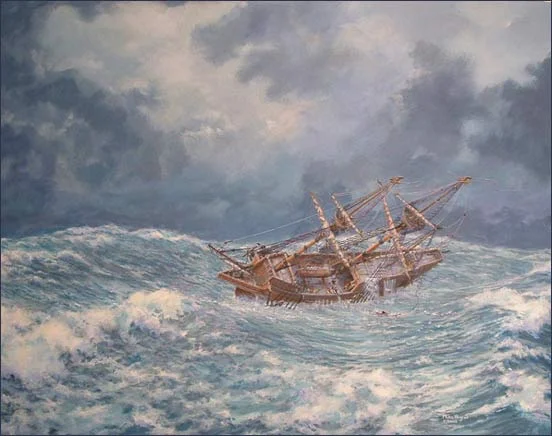
Finally, on September 6, the Mayflower departed from Plymouth, England, and headed for America. By the time the Pilgrims had left England, they had already been living onboard the ships for nearly a month and a half. The voyage itself across the Atlantic Ocean took 66 days, from their departure on September 6, until Cape Cod was sighted on 9 November 1620. The first half of the voyage went fairly smoothly, the only major problem was sea-sickness. But by October, they began encountering a number of Atlantic storms that made the voyage treacherous. Several times, the wind was so strong they had to just drift where the weather took them, it was not safe to use the ship’s sails. The Pilgrims intended to land in Northern Virginia, which at the time included the region as far north as the Hudson River in the modern State of New York. The Hudson River, in fact, was their originally intended destination. They had received good reports on this region while in the Netherlands. All things considered, the Mayflower was almost right on target, missing the Hudson River by just a few degrees.
As the Mayflower approached land, the crew spotted Cape Cod just as the sun rose on November 9. The Pilgrims decided to head south, to the mouth of the Hudson River in New York, where they intended to make their plantation. However, as the Mayflower headed south, it encountered some very rough seas, and nearly shipwrecked. The Pilgrims then decided, rather than risk another attempt to go south, they would just stay and explore Cape Cod. They turned back north, rounded the tip, and anchored in what is now Provincetown Harbor. The Pilgrims would spend the next month and a half exploring Cape Cod, trying to decide where they would build their plantation. On December 25, 1620, they had finally decided upon Plymouth and began construction of their first buildings.
Mayflower (1620)
View the original list of passengers (PDF, 2.6Mb) from the handwritten manuscript of Gov. William Bradford, written up about 1651 (file link is to the State Library of Massachusetts). Below is a complete list of all Mayflower passengers, along with a link to each for further information.
- John Alden
- Isaac and Mary (Norris) Allerton, and children Bartholomew, Remember, and Mary
- John Allerton
- John and Eleanor Billington, and sons John and Francis.
- William and Dorothy (May) Bradford
- William and Mary Brewster, and children Love and Wrestling
- Richard Britteridge
- Peter Browne
- William Butten
- Robert Carter
- John and Katherine (White) Carver
- James and Mrs. Chilton, and daughter Mary
- Richard Clarke
- Francis Cooke and son John
- Humility Cooper
- John Crackstone and son John
- Edward Doty
- Francis and Sarah Eaton, and son Samuel
- Thomas English
- Moses Fletcher
- Edward and Mrs. Fuller, and son Samuel
- Samuel Fuller
- Richard Gardiner
- John Goodman
- William Holbeck
- John Hooke
- Stephen and Elizabeth (Fisher) Hopkins and children Constance, Giles and Damaris; son Oceanus was born during the voyage.
- John Howland
- John Langmore
- William Latham
- Edward Leister
- Edmund Margesson
- Christopher and Mary (Prower) Martin
- Desire Minter
- Ellen, Jasper, Richard, and Mary More
- William and Alice Mullins and children Priscilla and Joseph
- Degory Priest
- Solomon Prower
- John and Alice Rigsdale
- Thomas Rogers and son Joseph
- Henry Samson
- George Soule
- Myles and Rose Standish
- Elias Story
- Edward Thompson
- Edward and Agnes (Cooper) Tilley
- John and Joan (Hurst) Tilley and daughter Elizabeth
- Thomas and Mrs. Tinker, and a son
- William Trevore
- John Turner, and two sons
- Richard Warren
- William and Susanna (Jackson) White, and son Resolved (son Peregrine was born shipboard in Provincetown Harbor after arrival).
- Roger Wilder
- Thomas Williams
- Edward and Elizabeth (Barker) Winslow
- Gilbert Winslow
- “Mr. Ely”
- Dorothy (John Carver’s maidservant)
