
Artemis stands radiant and imposing, her silver robes billowing, bow in hand. The goddess’s stern gaze is fixed on Agamemnon across the scene. Her divine aura glows among symbols of nature—an ethereal stag and a flurry of birds—communicating her fury over the sacrilege. This confrontation captures the divine demand for justice in mythic form.

Agamemnon stands at the edge of his encampment, clad in bronze armor and a crimson cloak. Behind him, warships lie motionless, caught in the stillness of divine disfavor. His expression is resolute but shadowed with the burden of impending sacrifice—a man trapped between duty to the gods and love for his family.
AGAMEMNON KILLED AREMIS’ STAG; SHE MADE HIM KILL HIS DAUGHTER BEFORE SHE LET HIS ARMADA SAIL FOR TROY.
AGAMEMNON KILLED AREMIS’ STAG; SHE MADE HIM KILL HIS DAUGHTER BEFORE SHE LET HIS ARMADA SAIL FOR TROY.

In this close-up, the king’s face shows a hardened resolve, yet his eyes betray inner turmoil. The looming shadows of anchored ships hint at the suspended campaign. The image captures the intimate conflict of a leader condemned by his own decisions.

This close-up captures the fierce serenity of Artemis, Greek goddess of the hunt and protector of nature. Her silver hair flows like moonlight, and her glowing eyes are filled with celestial intensity. The crescent on her brow radiates quiet authority, while her shimmering bow rests at the ready. A faint stag behind her reminds us of the sacred bond that was broken. The forest glows subtly, framing her as both judge and force of divine balance.

He rallied Mainland Greeks: Uphold your vows. Restore Helen to her husband, my brother Menelaus. Troy’s Prince Paris took her & Sparta’s gold; get them back.
AGAMEMNON RALLIED THE MAINLAND GREEKS, ‘Uphold your vows. Restore Helen to her husband, my brother Menelaus. Troy’s Prince Paris took her and Sparta’s gold; get them back. But he’d killed Aremis’ stag; she made him kill his daughter Iphigenia or else fail to sail his armada sail for Troy in Asia Minor.
By Sasha Alex Lessin, Ph.D. (Anthropology, UCLA)
Backstory: For more on Ancient Greece & its Anunnaki connection*, hit this hotlink: https://wp.me/s1TVCy-greece

Agamemnon rallies the armies of Greece, invoking the oath sworn by the Greek kings to protect Helen’s marriage. As his words stir the warriors, spectral images of Helen and Paris drift behind him—symbols of love betrayed and honor wounded. But across the field of vision, divine justice watches: Artemis, stern and radiant, demands recompense for her slain stag. Between them stands Iphigenia, caught in the tragic balance. The ships remain still, the wind held hostage by fate. This is a moment where mortal ambition and divine will collide.


The goddess Artemis stares forward with a calm but unyielding presence. Her bow glows with divine energy, but her human-like eyes carry sorrow and resolve. She does not rage—she judges. By her side lies the white stag, peaceful and sacred. Her silver robes blend into the forest light behind her, emphasizing her deep connection to the natural order. She is not vengeance—she is balance.

Agamemnon’s face shows the strain of a commander who must lead and obey all at once. His bronze armor gleams in the gray light, but it cannot shield the pain reflected in his eyes. Behind him, the ships wait like suspended fate. The war he calls for has a cost already paid, and yet still to come. In this moment, he is both king and victim, bearer of war and father of loss.
ATREUS and THYESTES were brothers locked in a bitter feud, vying for the throne of Mycenae. THYESTES had an affair with Atreus’s wife, AEROPE. Enraged, Atreus killed, cooked, and served Thyestes’s sons in a stew. He had the stew served to Thyestes, who, unaware that the butchered kids in it were his kids, not sheep’s. Then he had his servants bring in the heads of boys whose flesh he’d eaten in the stew. An oracle told Thyestes, ‘Impregnate your daughter Pelopia.’ Thyestes and Pelopia begat a son, AEGISTHUS.

Atreus stands grimly in his palace, the feast laid out before him shrouded in ambiguity. Thyestes sits unaware, his face clouded by unease. The veiled servants approach, their burden hidden but heavy with implication. This is a moment suspended in dread — not of gore, but of realization. Above, fate stirs in silence.

To the side, the oracle raises her hand, caught between worlds. The prophecy she delivers has already set the future in motion: above her, a vision reveals Pelopia cloaked in sorrow, and Aegisthus glowing with tragic destiny. He is both the instrument of revenge and its inheritor.

Atreus wears the crown of Mycenae, but his eyes betray no triumph. They burn cold with wrath and calculation. His face is worn by betrayal and vengeance, a ruler who believes in justice served cold. The torchlight doesn’t soften him — it casts deeper shadows across the lines of his grim expression.

Thyestes appears lost in thought, a man unaware that fate has already consumed him. His weary eyes hold a trace of sorrow, as if sensing danger without knowing its source. His expression is soft compared to his brother’s — touched more by confusion than cruelty.

Pelopia’s face is soft yet strained, her downward gaze shadowed by fate. Cloaked in muted tones, she stands as both victim and vessel of prophecy. The sorrow in her eyes reflects choices not made, but endured—a haunting portrait of maternal grief and mythic entrapment.

Aegisthus appears young, almost cherubic, yet his solemn eyes reveal the seeds of destiny. Around him swirl ghostly symbols: a crown he has not claimed, a sword he has not yet drawn. This child is not merely born—he is fated, molded by curse and prophecy.
SPARTA DEFEATED THYESTES & RESTORED & MADE AGAMEMNON MYCENAE’S KING

On the left, Agamemnon and Menelaus flee their ancestral city, Mycenae, under a fading twilight sky. Their eyes are fixed forward, carrying the weight of exile and the hope of restoration.

In the heart of the image, King Tyndareus of Sparta opens his arms in welcome. The golden light bathing this moment symbolizes new bonds of trust. Agamemnon and Menelaus find refuge, but also the foundation for a campaign to reclaim their throne.
When Aegisthus had grown, he killed Atrius and, with Thyestes, ruled Mycenae. Atreus’ sons, Agamemnon and Menelaus, escaped Mycenae and fled to Sparta, where King Tyndareus allied with them and helped them overthrow Thyestes. Agamemnon jailed Thyestes and told Aegisthus to kill him.

Agamemnon stands in golden light, crowned as King of Mycenae. His face is composed and resolute, framed by a laurel circlet adorned with the face of a deity — a symbol of divine sanction and royal authority. He wears a crimson cloak and polished bronze armor, embodying both warrior and ruler. Behind him, stone columns stretch into the distance, representing the restored power of his ancestral palace. His eyes are steady, reflecting hard-won triumph and the solemn weight of destiny.
No way, said Aegisthus. Thyestes is my father. Agamemnon exiled Aegisthus.

Aegisthus is young, but no longer innocent. Half of his face is lit by justice, the other steeped in doubt. Behind him, the prison door looms — a symbol of family, vengeance, and fate. His eyes shift away, torn between inherited duty and personal conscience.
MENELAUS MARRIED HELEN; GREECE’S KINGS VOWED TO PROTECT THEIR UNION

In a radiant courtyard framed by marble columns and golden sky, Helen of Sparta, daughter of Zeus and Leda, weds Menelaus, noble son of Atreus. Helen shines in a flowing white gown, crowned with a diadem. Menelaus stands in ornate bronze armor, gently clasping her hand. The divine presence of Zeus looms subtly above, wreathed in light, while King Tyndareus watches with both pride and gravity. The scene glows with divine heritage and royal destiny.

To the side of the ceremony, the great kings of Greece gather in solemn formation — Odysseus, Ajax, Diomedes, Nestor, and others. With drawn swords, raised hands, or bowed heads, they swear a sacred oath to defend Helen’s marriage. This vow, born of unity and pride, will echo through the coming age as the spark that ignites the Trojan War.
Helen was the daughter of the Anunnaki Lord Marduk (in his Greek avatar, Zeus)** and Zeus’s Earthling wife, Leda. Spartan King TYNDAREUS, Helen’s stepfather, raised Helen.

Helen’s golden hair is crowned with a delicate diadem of laurel and pearls. Olive leaves frame her face as she gazes forward with serene grace. Her expression carries both divine beauty and human vulnerability — the perfect harmony of her lineage as the daughter of Zeus and Leda. She is not only a bride, but the silent axis around which the fate of empires will turn.
Helen fell in love with and married Menelaus. At their wedding, the GREEK NOBLES VOWED TO UPHOLD THEIR MARRIAGE, a vow that later compels them to go to war.

Menelaus stands in rich red and gold, crowned in laurel and clad in ceremonial armor. His youthful face is proud and contemplative, his eyes steady with honor. As Helen’s new husband, and future king of Sparta, he embodies the noble spirit that will one day call Greece to war in her name. Behind him, the marble halls of Sparta glow with wedding firelight — a promise of joy, and the shadow of what’s to come.
AGAMEMNON BOUND SPARTA TO HIM WHEN HE MARRIED SPARTAN KING TYNDAEUS’S DAUGHTER CYLTEMNESTRA

In a sun-drenched Spartan courtyard, the marriage of Agamemnon and Clytemnestra seals a powerful alliance between two great houses. Draped in crimson and gold, Agamemnon extends his hand to Clytemnestra, who kneels gracefully beside their young son, Orestes. Around them, armored warriors and noble guests bear witness, while King Tyndareus observes with regal approval. Behind them, temples and gardens bloom in the golden light of peace. This is not only a wedding — it is a moment of legacy, politics, and the brief glow of joy before the dark turns of fate.
Agamemnon and Clytemnestra had one son, Orestes, and three daughters, Iphigenia, Electra, and Chrysothemis. Agamemnon, now the most powerful King in Greece, enjoyed his kids.

In a stately Spartan hall beneath the open sky, Clytemnestra sits crowned in golden robes, her gaze poised and commanding. Agamemnon, clad in full armor and crimson cloak, stands before her in solemn reverence, having secured not only her hand but an alliance with Sparta. Behind her, King Tyndareus sits enthroned, the guardian of her future and symbol of her noble lineage. Spartan nobles and warriors line the colonnade as music and ritual unfold in the background. Young attendants and children gather around the new queen, evoking a moment of grandeur touched with familial tenderness — the rise of a royal house bound by strength, politics, and fate.

Clytemnestra gazes forward with composed strength. Her auburn hair is crowned in gold, her shoulders draped in rich crimson embroidered with divine symbols. Columns rise behind her, framing a woman who is both royal bride and future wielder of fate. Her eyes hint at intellect, loyalty, and the quiet force of a queen who remembers everything.

Agamemnon stands strong in bronze and red, flanked by his young children. His smile is faint but warm — a warrior softened by fatherhood. A son leans on his shoulder, a daughter clutches a garland. Behind him, a peaceful courtyard glows in sunlight, showing a rare glimpse of joy before the burdens of command return.

In a quiet garden lit by golden light, the children of Agamemnon and Clytemnestra stand together. Orestes holds a wooden sword, his gaze serious beyond his years. Iphigenia wears a crown of flowers, her expression gentle. Electra watches with a fierce intelligence, while Chrysothemis clutches a doll and smiles — a vision of youth and promise. Together they form a fragile constellation, soon to be scattered by destiny.
He also hunted. Alas, he killed a stag in a forest in which the goddess [Anunnaki] ARTEMIS roamed. When she confronted him for killing the stag, saying it was sacred to her, he replied, Get over it; I’m just a better hunter than you.

In a twilight-lit forest humming with divine stillness, Agamemnon stands firm, gripping his bow with pride. His stance is bold, but the calm authority of Artemis facing him is unmistakable. Surrounded by deer and forest light, she is the embodiment of nature’s divine order. Between them, no words are needed — the silence speaks of insult, judgment, and the fragile line between mortal pride and sacred law.

With silver robes flowing and a crescent diadem glowing upon her brow, Artemis stands serene yet immovable. Her eyes are steady, her lips firm — not in wrath, but in divine resolve. Forest creatures gather quietly near her, as if drawn to her unspoken command. She is not only a goddess — she is the guardian of what should not be touched.

Bathed in golden forest light, Agamemnon stands in quiet strength. His face, softly lit and rendered with lifelike detail, carries not just pride but reflection — a moment between confidence and consequence. His bronze armor and crimson cloak shimmer subtly, blending heroism with humility. Around him, the forest glows with enchantment, the tension softened into a timeless, mythic stillness.
In the meantime, Menelaus sailed to Troy, where Prince Paris hosted him. Menelaus invited Paris to visit him in Sparta in return. When Paris visited Sparta, Menelaus had to go to Crete for a funeral, leaving Queen Helen to care for Paris. Did she ever! Paris and Helen connected, and he returned to Troy with her & Sparta’s treasures.

This wide tableau captures the unfolding drama of one of myth’s most fateful decisions. On the left, Menelaus greets Paris of Troy with royal courtesy, standing in a golden-lit hall flanked by guards and statues. In the center, Menelaus departs for Crete, leaving behind Helen, who stands beside Paris beneath a rising moon. On the right, in the shadows of a colonnade, Helen and Paris share a moment of intense connection. Beyond them, a Trojan ship waits in silence — loaded not only with treasure, but with the promise of war.

Paris’s eyes sparkle with charm and mischief, his red cloak draped over golden armor. He looks sideways with the calm confidence of someone who knows the power he wields. Behind him, marble pillars and a glint of sea hint at the voyage to come — a seduction not just of a queen, but of fate itself.

Moonlight spills over Helen’s face as she turns toward the sea, a delicate veil draped over her. Her eyes reflect uncertainty — torn between devotion and longing. The soft shadow of olive leaves crosses her cheek, as if the gods themselves are watching. In this moment, she is not only the most beautiful woman in the world, but its most tragic.
Enraged, Menelaus and Agamemnon reminded the Mycenaeans of their vow to support Helen’s marriage to Menelaus. Thousands of warriors from Greece gathered at the port of Aulis in Boeotia. They prepared ships, arms, and provisions for the massive army and were ready to sail.
But no wind blew for weeks.

On a still and windless shore, the Greek army waits, paralyzed. The seer Calchas lifts his hands to the heavens, proclaiming the will of Artemis, who appears in radiant form above the sea. Her silver bow gleams with divine judgment. Agamemnon stands in grief, his soldiers hushed in fear. Beside him, Iphigenia kneels calmly, bathed in sacred light, unaware she is the key to the fleet’s fate. This is the moment where pride meets prophecy.

The Seer Calchas revealed that Artemis was angry and stopped the wind from moving Agamemnon’s fleet because Agamemnon killed her stag and said he was a better hunter than she. The only way she would give the Greeks the wind they needed to sail was if they sacrificed Agamemnon’s daughter, Iphagenia, to her.

Calchas, the aged seer, commands the scene with eyes lit by divine vision. His staff and laurel crown mark his sacred role, but the burden of truth weighs on his face. Behind him, the sea is eerily calm — as though nature itself waits for Artemis to be appeased.

Soft golden light falls on Iphigenia’s youthful face. Her eyes hold innocence, not fear — the expression of someone raised with honor and trust. Her white robe glows with purity, a painful contrast to the fate awaiting her. In the background, the Greek ships lie silent, still tethered to divine justice.
ODYSSEUS ADVISED AGAMEMNON TO SACRIFICE IPHIGENIA FOR GREECE TO TAKE TROY
Just before dawn, in a tent near the altar where a priest would sacrifice Iphigenia, Agamemnon shared his distress with Odysseus, explaining how he had to deceive Clytemnestra, his wife, and Iphigenia’s mother.

In the gray stillness before sunrise, Agamemnon and Odysseus confer in secret within a Spartan war tent at Aulis. Agamemnon slumps in sorrow, clutching a scroll — the summons that lured his daughter to the altar. His crimson cloak drapes heavily, a symbol of royal burden and blood yet unspilled. Opposite him, Odysseus listens with firm resolve, offering strategy wrapped in reason. Outside, the Greek fleet remains anchored, unmoved by wind or will. On the horizon, Artemis’s glow lingers like a divine sentence — silent and unwavering. Within this moment, a father is undone, a hero hardened, and the fate of nations quietly sealed.

Agamemnon’s face is lined with anguish, his eyes fixed downward as he clutches the scroll that sealed Iphigenia’s fate. The glow of dawn barely reaches his bronze armor, casting long shadows that mirror his torment. This is not the face of a king triumphant, but of a father unraveling — caught in a divine snare spun from pride, prophecy, and war.

Odysseus leans in, composed and deliberate. His eyes are clear, his gaze unwavering — a man who sees the cost but measures it against a greater strategy. Draped in worn armor and a dark tunic, he looks every bit the tactician of myth: persuasive, pragmatic, and relentless in pursuit of what must be done for Greece.
Odysseus asked the King, “You’ve done it, then.” Is the letter gone?
Barely audibly, Agamemnon said, Yes.

Agamemnon stands at the edge of his war tent in the soft hush of dawn, his face marked by quiet grief. He holds a scroll bearing the false promise of marriage — a letter to Clytemnestra, telling her that Achilles awaits their daughter as a bride. Odysseus listens nearby, his gaze fixed on the horizon where Clytemnestra’s chariot approaches, unaware of the truth. On a nearby table, ceremonial garlands and a silver bowl glisten — symbols of a wedding that will never be. The colors of the morning sky belie the weight of the unspoken betrayal.

Did you tell her of the wedding?
A union most false, forged in fear, Agamemnon whispered. I told her Achilles waits with garlands and vows for Iphigenia, his bride. I said that that joy, not death, calls our daughter to Aulis. I wrote the lie with my hand.

Agamemnon sits in quiet torment, his hand still resting on the scroll that summoned his daughter to a wedding that will never be. The golden dawn filters into the tent, illuminating a garland and silver bowl beside him — innocent symbols of joy twisted by necessity. His face bears the weight of command, deception, and fatherhood, all at once.
And now? Asked Odysseus.
Now, said the King, I wait like a coward behind a king’s title. I have sent for my wife to bring her child to her death.

A royal chariot arrives bathed in morning light. Clytemnestra smiles, unaware, regal in her golden diadem. At her side, Iphigenia glows with youthful joy, crowned with a floral garland and dressed for what she believes is her wedding day. Their eyes reflect trust, love, and anticipation — a mother and daughter stepping into a carefully staged illusion.
You had no choice, Odysseus said. Without Artemis’s wind, we rot here. The armies grumble—morale frays like a rope in the salt air. You are the fulcrum, Agamemnon. The war tilts on you.

At the edge of the unmoving sea, Agamemnon and Odysseus stand in stark contrast — one torn by grief, the other firm with reason. Agamemnon gestures toward the horizon where silent ships lie idle, his voice cracked with despair. Odysseus, wrapped in shadow and strategy, speaks plainly: without Artemis’s favor, all is lost. Above them, faint and glowing, the goddess and her sacred stag shimmer — not in fury, but in silent, celestial control. Soldiers loiter in the background, the tension among them mirroring the frayed resolve of their king. This is the turning point where prophecy and pride converge.

Agamemnon, his voice shaking, said, Do you think I don’t hear it? The hiss beneath the silence? The gods’ mocking laughter? Artemis manipulated, baited, and provoked me. I boasted of a hunt, and now the price is my bloodline. My daughter’s blood for wind!

Agamemnon stares out to sea, his face etched with torment. His hand, barely raised, reaches toward the still fleet that waits for wind — and for sacrifice. The early light softens the steel of his armor, but not the anguish in his eyes. This is the burden of kingship: to weigh a daughter’s life against a nation’s future.
Odysseus responded with cold truth: ‘It’s not your bloodline, my friend; it’s your pride.’

Odysseus stands composed, his cloak worn by time, his eyes untouched by illusion. He speaks without cruelty, only clarity — the brutal clarity of war. Behind him, the anchored ships fade into dawn haze, silent witnesses to hard truths. He does not waver; he convinces, because he must.
Agamemnon fell to his knees. What father offers his child and lives to rule again?

At sunrise, Agamemnon kneels at the edge of the sea, cloaked in crimson and shadow, the weight of his command pressing him to the earth. Behind him, the royal chariot of Clytemnestra approaches the shore, her figure distant but radiant with dignity. A female warrior stands vigil between palace and sea — a sentinel to fate. The Greek army lingers in the distance, silent witnesses to a choice that shakes a king and anchors a war. The tide is still, the wind unmoved, as the gods await a father’s answer.
When Clytemnestra arrives, she’ll look into my eyes—and see only betrayal.

At the water’s edge, as the sun rises behind the anchored fleet, Iphigenia greets her father with open-hearted joy. Draped in soft gold, she beams up at Agamemnon, her trust radiant. He stands in full armor, face shadowed, hands clenched in silence. Clytemnestra stands nearby, her smile beginning to fade as the stillness stretches. Around them, soldiers hold still — a moment suspended between illusion and impending revelation.

Iphigenia beams with the innocent joy of a daughter summoned to what she believes is a royal wedding. Her floral crown rests gently in her hair, and her wide eyes sparkle with trust and excitement. Bathed in warm morning light, she radiates purity — a figure of tragic beauty, unaware that the road before her leads not to marriage, but to myth.

Clytemnestra, regal in her crown and crimson-trimmed gown, steps from her chariot to confront Agamemnon. The dawn sun casts long shadows between them as he gestures with a hollow calm. She stares at him — not as wife to husband, but as a mother protecting her blood. Behind her, the chariot waits, still golden in the rising light. Between them hangs a vow unspoken, and a truth too terrible to utter.

Clytemnestra’s eyes are sharp and searching, her regal bearing unshaken, but her gaze tells of something deeper — a queen beginning to sense deception. The light of dawn catches the edge of her golden crown, while shadows settle beneath her brow. Her lips are parted as if holding back a question too dangerous to speak. Behind her, the camp waits, but her world has already started to shift.
And my little girl. She’ll run to me, smiling, thinking I bring her honor. I will not meet her gaze. If I look into her eyes, I will scream, I will confess, and the winds can stay still forever.

Her gaze is unwavering, a queen’s poise wrapped around a mother’s instinct. In the glow of morning, suspicion deepens into dread. Her eyes search Agamemnon’s face — not for answers, but for confirmation of what her heart already fears.

Agamemnon’s head is bowed, his armor gleaming faintly in the light of a day he dreads. He cannot look at her — not at the woman he deceived, not at the daughter who trusts him. His lips press together, holding back a scream, a confession, a storm of gods and guilt.
But Odysseus said, Steel your heart. You’re not only a father today. When we sail, you’ll be the axis of a thousand men’s fate.

As golden morning light glimmers across the Aegean, Odysseus places a steadying hand on Agamemnon’s shoulder. They stand at the water’s edge, facing the anchored fleet — a thousand lives waiting for wind and war. Agamemnon’s gaze is heavy with memory, but his stance begins to stiffen with resolve. This is no longer just a father in mourning — this is the axis of an army.

And who, Odysseus, will carry the weight of her screams? The King choked, Not the winds. Not the goddess. Only me. Forever.

Agamemnon stands by the sea, bowed beneath the weight of his choice. His face, caught in the dim glow of a rising sun, is contorted with grief and guilt. Odysseus rests a hand on his arm — not in comfort, but in acknowledgement of a burden that cannot be shared. The ships beyond are ready. The gods are silent. The wind will come. But the sound Agamemnon will carry is not of sails or storms, but of a daughter’s voice that no one else will hear. Forever.

Agamemnon’s eyes are lowered, his expression ravaged by sorrow. The soft light of dawn touches his face, but cannot soften the pain in his gaze. His mouth is tight, his brow drawn — not with anger, but with the weight of a scream he cannot forget. Behind him, the sea is still, the ships ready, and yet he is utterly alone in his memory.
THE SACRIFICE OF IPHIGENIA

The Greek fleet lies unmoving across the horizon, sails hanging like folded wings, a thousand ships stilled by divine silence. Onshore, warriors gather in anxious clusters, their armor catching the light of the rising sun. At the center, the marble altar stands untouched beneath ancient olive trees — sacred, expectant. The entire encampment breathes not with life, but with hesitation. Dawn bathes it in gold, but the air holds a terrible hush. War waits, and the gods are listening.

At dawn in Aulis, the windless port where the Greek fleet lay trapped, waiting for the skies and sea to grant passage to Troy. The ships, hundreds of them, sat idle like great wooden beasts, their sails slack and useless. Around them, the camp of warriors buzzed with unease—restless men caged by divine silence.

At the silent shore of Aulis, Iphigenia walks slowly toward the altar beneath a cold, orange sky. The sea lies unmoved, the ships watching like giants held in pause. Around her, incense rises and olive trees stand as silent witnesses. Above, Artemis glows faintly — not in fury, but in divine presence, distant and inevitable. No birds call. No wind stirs. Only fate breathes.
At the altar set upon a crude stone platform near the shore, the air hung unnaturally still. The sea barely lapped against the hulls, and birds did not call. The scent of salt mingled with incense and the iron tang of blood from past rites. The sky glowed with the first orange fingers of sunrise—it was day, but the light felt harsh, unsympathetic.

Bathed in the first harsh light of dawn, Iphigenia’s face glows with quiet composure. Her golden crown of flowers and flowing white robe shimmer gently in the stillness. Though the moment is heavy, her gaze is calm — not unaware, but unafraid. Behind her, the sea and ships fade into silence, as if the world itself holds its breath.

Suspended in the glowing sky of Aulis, Artemis watches in divine stillness. Her silver robes ripple like moonlight, and her crescent diadem gleams with ancient power. Around her float symbols of her realm — bow, stag, and olive branch. Her gaze is unwavering: a goddess judging not just mortals, but the weight of their choices.
Iphigenia, perhaps twelve or thirteen years old, stood at the center of it all. She was on the edge of womanhood and wore white ceremonial robes that fluttered faintly in the morning breeze. Her mother, Clytemnestra, thought she was preparing her to marry Achilles. Clytemestra had braided Iphigenia’s hair with ribbons and fitted a crown of flowers on her head—an innocent dressed for a wedding, not a sacrifice.

In the golden light of dawn, Iphigenia stands in white robes that drift gently in the breeze, her crown of flowers and ribboned braids speaking of celebration, not sorrow. Beside her, Clytemnestra beams with motherly joy, unaware of the looming truth. Around them, the sea is still, and figures in the distance wait in silence. The beauty of the moment deepens its tragedy — a child dressed for a wedding, not a sacrifice.


Iphigenia’s youthful face glows in the soft light of dawn, her braids adorned with ribbons, her crown of wildflowers a fragile halo. The white robes that flutter around her speak of ceremony and promise — a bride in all but truth. Her gaze is gentle and calm, unaware that every thread she wears is woven into tragedy. Behind her, the silent sea holds its breath.
Her eyes, wide and questioning, searched the faces around her. She had just learned the truth—this was no offering for good fortune in war, no marriage to the great hero Achilles. Her lips parted as if to speak, but no words came. Her breath shook. A child’s heart pounded in her chest.

Iphigenia’s eyes widen in alarm, no longer filled with innocence but with the first tremors of truth. The garland in her hair and her soft white robe contrast sharply with the fear rising in her expression. Her parted lips hold no words, only questions. The stillness of the sea behind her mirrors the silence in her chest — where a child’s heart begins to break before it can fully understand why.
Clytemnestra, her mother, was held back by two attendants, her hair disheveled, her dress torn from where she had clawed at it in horror. Her screams pierced the sky—raw, maternal, defiant. She cursed the priests, the gods, and above all, Agamemnon, her husband.

Clytemnestra stands alone at the edge of the sea, her profile lit by the harsh glow of a storm-streaked dawn. Her robe, torn at the shoulder, and her wind-tossed hair speak of a woman undone by grief. Though no hands restrain her, the weight of fate and sorrow holds her fast. Her attendants bear silent witness as the sea stays still — and the sky refuses mercy.


Her face, streaked with wind and ash, gazes upward not in prayer, but in anguish. The firelight in her eyes reflects not hope, but fury — the storm within a mother who has witnessed betrayal cloaked in duty. Her hair whips like a banner of mourning, and her expression is etched with the moment she is no longer just queen or wife, but something greater and more terrifying: wrath made flesh.
Agamemnon, King of men, stood still, his face like carved stone. His mouth trembled, but he spoke no word. The man who had once boasted, “I am the better hunter than Artemis,” now stood broken beneath the weight of that pride. For it was his arrogance that had brought this curse—the goddess, angered by his hubris, had stilled the winds. And only the blood of his daughter would loosen them again.

Agamemnon stands alone at Aulis, still as a monument beneath a dawn that shows no mercy. His bronze armor gleams coldly in the hard orange light, his crimson cloak unmoving. Though his face is stone, his lips tremble with all that cannot be undone. The ships behind him wait for a wind that demands blood. This is the moment the hunter is hunted — not by gods, but by his own pride.


Framed in the golden dawn, Agamemnon’s face is cast in solemn shadow beneath his bronze helm. His eyes, deep and weighted, hold the pain of a king who has chosen war over innocence — and must live with what that means. No wind stirs behind him, only the still sea and the quiet burden of pride turned to regret.
Torn between his love as a father and the demands of his kingship, Agamemnon had chosen. Yet he could not meet his daughter’s eyes.

Agamemnon stands in armor, rigid and torn between his roles — father and king. Before him, Iphigenia looks up with innocent trust, her white robes glowing in the pale morning light. Yet he cannot meet her eyes. Around them, the sea and the fleet wait in silence, as if holding breath for the wind and the gods.

The High Priest raised the knife. The chanting of the chorus began—low, mournful, like a dirge swelling over the camp. A thousand warriors averted their gaze. Odysseus stood stoic; Menelaus, grim.

Her gaze turns upward, serene and luminous, with the soft strength of someone who understands more than she should. The white robe and crown of flowers frame a face both innocent and timeless — a daughter, a symbol, a sacrifice. In her calm, there is bravery. In her stillness, a quiet defiance. The moment belongs to her.

Bathed in dawn’s merciless light, Agamemnon turns his face away from fate. His eyes, shadowed beneath a bronze helm, cannot meet the gaze of what he’s lost. The crimson cloak, the polished armor — they do not hide the truth in his furrowed brow or trembling jaw. Here stands not just a king, but a father undone.

Atop the altar, the High Priest raises his hand in sacred ritual. Iphigenia, draped in white, stands solemnly near him, caught between grace and terror. Agamemnon looks away, unmoving and silent. All around, warriors avert their eyes. Odysseus is steel — unwavering. Menelaus watches grimly, his jaw tight with the cost of war. The sea is motionless, waiting — as if even the gods hold their breath.
As the Priest’s blade glinted in the rising sun, time seemed to still. Is there a last-minute miracle? A sudden mist, a deer sent by Artemis to replace the girl? Or does the knife fall? Before fate was sealed, the air was thick with tragedy, betrayal, and divine silence.

Time pauses at the altar. A ceremonial blade hovers midair in golden light, surrounded by rising mist. The white stag has appeared, glowing and still. Above, Artemis watches from the clouds, a divine question waiting to be answered. The sea holds its breath. Fate hangs on the next heartbeat.

Just as the priest’s blade rose, a divine mist swept in from the sea. A radiant white stag appeared before the altar, bathed in golden light — Artemis’s sign. Iphigenia stood untouched, the goddess’s mercy made manifest. The fleet, the gods, and the war all paused for a moment of grace.

The altar stands empty. The sacrifice is done. Soldiers bow in silence. The wind begins to stir. Agamemnon, turned away, bears the cost of command. Far behind him, Clytemnestra collapses in devastation — a mother undone. The gods are quiet now. But the war has its wind.

As the blade rose, so did the goddess. Artemis appeared in the heavens, radiant and sovereign, her hand lifted to stop the rite. Beside her stood a glowing stag — her sacred substitute. Iphigenia glowed in the light of divine mercy. Warriors gazed upward. Agamemnon fell to his knees. And at last, the sea began to move.

The altar stands empty now, untouched by sorrow. The white stag remains, calm beneath the clearing sky. Artemis fades into light above, her will fulfilled. From the still bay, a breeze stirs. The sails of a thousand ships begin to rise. The war may come — but mercy came first.

Iphigenia walks with grace and innocence along a stone path flanked by olive trees and watching soldiers. Her white and gold robe flows around her, and a crown of flowers rests upon her head. At the end of the path, a sacred altar rises near the sea, its marble bathed in golden light. Overhead, Artemis begins to appear — radiant, silent, and watching. The air holds its breath, caught between sacrifice and salvation.

As Iphigenia nears the altar, the goddess Artemis descends in light. Soldiers drop their gazes. The girl looks up, not in fear, but wonder. The divine radiance parts the dawn — not in judgment, but in possibility. In this version of the myth, the moment stretches: between life and myth, between silence and wind.

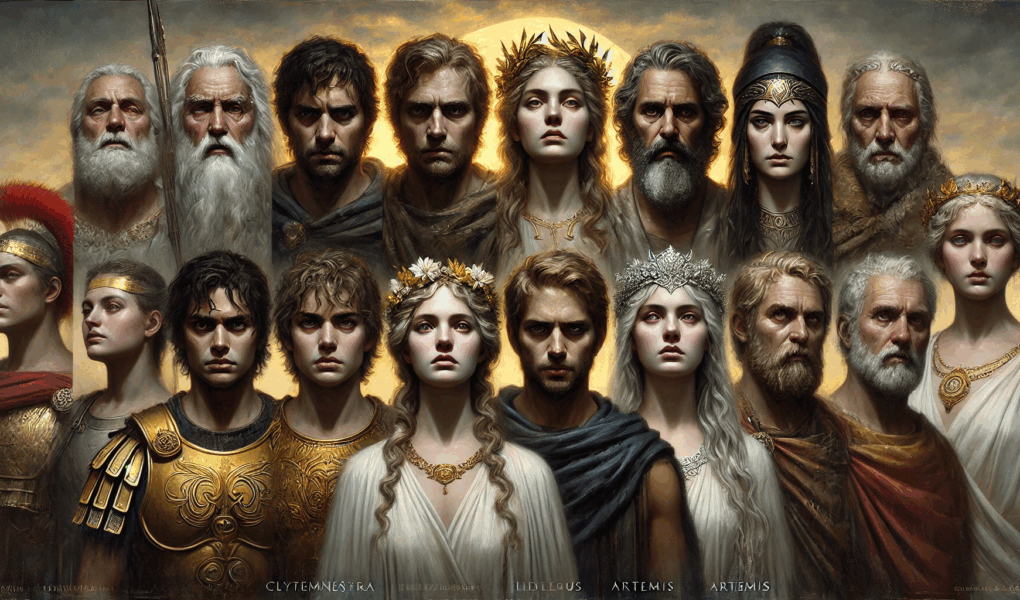
Agamemnon, Odysseus, and Menelaus — the men who carried kingdoms on their shoulders and tragedies in their hearts. Each face bears the burden differently: Agamemnon’s is carved with grief, Odysseus’s with calculation, Menelaus’s with grim resolve. These are not just leaders, but men torn between duty and blood.

Iphigenia, crowned in innocence. Clytemnestra, ablaze with betrayal. And Artemis, high above, watching it all with a gaze too divine to be swayed. This panel holds strength, sacrifice, and a fury that will one day return.

A select group of warriors, priests, and attendants — each face echoing the chorus that surrounded the sacrifice. Their expressions reflect the human spectrum: fear, reverence, disbelief, and the silence of obedience.

A mixed composition of men and women, father and daughter, queen and goddess. This collage captures the soul of Aulis not through action, but through gaze. Eyes that looked away. Eyes that dared to witness. Eyes that never forgot.

Iphigenia · Clytemnestra · Artemis · Priestess Attendant · Silent Witness · Oracle Figure

Agamemnon · Odysseus · Menelaus · High Priest · Young Warrior · Seer

Agamemnon · Clytemnestra · Iphigenia · Odysseus · Artemis · Menelaus · High Priest · Attendant
(To be continued)
*In this post, I illustrate the story of the Trojan War with videos from See U in History.
*I illustrate the story of the Trojan War with videos from See U in History.

This visionary composition bridges two worlds: on one side, ancient people gaze skyward as radiant craft descend — the Anunnaki, advanced and human-like, arrive in light and awe. On the other side, modern scholars pore over ancient texts, surrounded by digital reconstructions and glowing glyphs, revealing the hidden technologies behind the myths. Above it all, celestial orbs and flying craft blur the line between gods and visitors. This image honors the idea that myths may be fragmented memories of contact, reinterpreted across the ages.
**ETHNONOGY: OLD ANTHROPOLOGISTS’ SPECULATION
Other Ancient Alien theorists and I understand the so-called “myths” to be our ancestors’ reports of their observations.
We no longer agree with ethnocentric academics’ relegation of what our ancestors saw and heard from their ancestors to myths or fictional accounts.
Revisionist anthropologists like me regard “gods” and their miracles as actual accounts of the Anunnaki. The Anunnaki were people—not gods — with advanced technology and psychic abilities.

Beneath a vast ancient sky, early humans stand in awe as radiant craft descend — not gods, but visitors: the Anunnaki. Clad in gold and light, they emerge from ships alive with energy and geometry. This is the moment memory becomes myth, and myth begins to harden into belief.
Academics often dismiss miracles, devices, and psychokinetic activities that our ancestors witnessed and heard of as myths. They say “myths” to keep their jobs and get posted on Wikipedia. What they call myths are observational accounts and subsequent generations’ elaborations of these accounts as people pass them down.
Consider stories of gods, religious figures, and computational and transportation devices that reference what our ancestors saw, heard, felt, and discussed in concepts available in the languages they spoke and wrote.
Our forebearers tell of a whale swallowing Jonah. They designate a vimana, or flying saucer, as a dragon or magic carpet. They describe an Anunnaki sonar attack that crumbles Jericho’s walls as a miracle. They say that an enlightened Jewish rabbi is the God of gods.

In a city of stone and scripture, a tremor begins. A glowing device hums with power — misunderstood, it is worshipped as divine. Walls shudder and fall as ancient witnesses call it a miracle. Above, a flying craft burns in the sky like a dragon of old. In this world, technology is shrouded in myth, and memory is revered.
KEY WORDS/TAGS
Anunnaki, Ancient Aliens, Iphigenia, Agamemnon, Artemis, Clytemnestra, Greek Mythology Reinterpreted, Ancient Technology, Ethnographic Revisionism, Myth as Memory, Ancient Astronaut Theory, Aulis, Sacrifice and Wind, Divine Intervention, Gods as Visitors, Advanced Prehistoric Civilizations, Sacred Technology, Artemis and the Stag, Trojan War Origins, Symbolic Mythology, Historical Contact Narratives, Forgotten Knowledge, Technological Miracles, Mythological Disclosure, Ancient Contact Events, Interstellar Anthropology
For the list of Anunnaki and their various overlapping names and histories, see ANUNNAKI WHO’S WHO at http://wp.me/p1TVCy-1PE
* ANUNNAKI & ANCIENT ANTHROPOLOGY EVIDENCE, REFERENCES, TIMELINE & WHO’S WHO
Evidence https://wp.me/p1TVCy-1zg
References http://wp.me/p1TVCy-2cq
Timeline http://wp.me/p1TVCy-1Km
Who’s Who http://wp.me/p1TVCy-1PE
New Stuff www.enkispeaks.com
PLEASE REPOST THIS. Thank you for the help.

Attachments area

The Sacrifice of Iphigenia: Agamemnon’s Favorite Daughter – The Trojan War Saga – Season FinalePreview YouTube video Agamemnon – The Ambitious Greek King Who Brought Troy to RuinAgamemnon – The Ambitious Greek King Who Brought Troy to Ruin
 |


