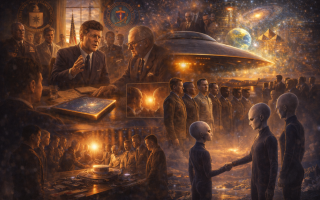
SAPIENS RISING: FROM SUMER TO COSMIC CITIZENSHIP
An Introduction to the Series
By Sasha Alex Lessin, Ph.D. (Anthropology, UCLA)
with contributing author Janet Kira Lessin
SAPIENS RISING: FROM SUMER TO COSMIC CITIZENSHIP
(9-Article Series)
- Why Sumer Still Terrifies the Establishment
- Neil Freer: Futant Philosopher of the 21st Century
- The Grail Bloodline: From Sumer to the Essenes
- The Anunnaki Hypothesis: Genetic Engineering and Human Origins
- Gods, Lords, and Controllers: How Religion Became a Slave Code
- Real evolution: From Bicameral Mind to Integrated Humanity
- Sapiens Rising: Neil Freer’s Manifesto for a Free Species
- Timothy Leary, Futants, and the Next Human
- From Slave Species to Cosmic Citizenship
For more than a century, scholars have known that the roots of human civilization lie deeper than Greece or Rome. Long before classical empires, the people of Sumer recorded histories, cosmologies, legal systems, and scientific observations in clay—using symbols that still challenge modern interpretation. These texts describe beings, technologies, and social orders that do not fit comfortably within conventional models of human development.
This nine-part series, Sapiens Rising: From Sumer to Cosmic Citizenship, explores why those earliest records continue to provoke resistance, ridicule, and suppression—and why they may matter now more than ever.
At its core, this series examines a simple but unsettling question: What if humanity’s origin story is incomplete?
Why Sumer Still Matters
Sumerian tablets do not read like naïve mythmaking. They read like attempts to describe events witnessed by people who lacked the vocabulary to name advanced technologies or non-human intelligences. Over time, these accounts were ritualized, moralized, and absorbed into religious frameworks that emphasized obedience, hierarchy, and fear. What began as memory became doctrine.
Modern institutions—academic, religious, political, and media—have inherited those frameworks. As a result, alternative interpretations of ancient history are often dismissed not on evidentiary grounds, but because they threaten foundational assumptions about human autonomy, authority, and power.
This series does not ask readers to “believe” a single interpretation. It asks readers to re-examine the evidence, the language used to interpret it, and the cultural mechanisms that determine which questions may be asked—and which may not.
Neil Freer and the Question of Human Maturity
A central figure in this exploration is Neil Freer (1943–2016), an independent philosopher and futurist whose work synthesized Sumerian studies, alternative anthropology, genetics, psychology, and futurism. Drawing in part on the controversial translations and interpretations of Zecharia Sitchin, Freer argued that humanity is a hybrid species—shaped not only by terrestrial evolution but by ancient intervention from a technologically advanced non-human civilization described in Sumerian texts as the Anunnaki.
Freer’s contribution was not simply historical. He was concerned with what such an origin story implies for the future. If humanity was shaped under conditions of domination, dependency, and enforced hierarchy, then psychological and cultural residues of those conditions would still shape human behavior today—particularly through religious systems, authoritarian governance, and perpetual conflict.
Freer called the next phase of human development “Sapiens Rising”: a transition from inherited obedience toward conscious, integrated, species-level responsibility.
Beyond Religion Versus Science
One of the persistent failures of modern discourse is the false dichotomy between religion and science. This series challenges that divide by treating both as cultural systems—each shaped by power, fear, curiosity, and incomplete information.
Rather than framing ancient gods as either literal deities or mere fiction, this series explores a third possibility long discussed in anthropology and comparative mythology: that ancient “gods” were real beings, later mythologized, whose technologies and social roles were gradually transformed into metaphysical abstractions.
Under this lens, religious traditions become archives of distorted memory—not evidence of divine revelation, but of historical encounters filtered through ritual and control.
Realevolution and the Integrated Human
This series also moves deliberately forward. It is not an exercise in nostalgia or grievance. Drawing on genetics, neuroscience, psychology, and futurist thought—including the work of Timothy Leary—it explores the possibility that humanity is entering a phase of realevolution: a shift from unconscious adaptation to conscious participation in its own development.
If early humanity was shaped by external forces, the question is no longer who shaped us—but whether we are ready to outgrow inherited systems of domination, integrate conflicting aspects of human nature, and assume ethical responsibility as a planetary species.
This includes:
- Reconciling scientific inquiry with spiritual meaning
- Releasing fear-based religious conditioning without abandoning the sacred
- Ending the use of myth and identity as tools of mass manipulation
- Preparing for a future that includes ecological stewardship and off-planet expansion
What This Series Is—and Is Not
This series is:
- A revisionist anthropological inquiry
- A synthesis of ancient texts, modern research, and futurist philosophy
- An exploration of power, memory, and human potential
This series is not:
- A call for blind belief
- A rejection of science
- An attack on individuals of faith
- A claim of final authority
Readers are invited to engage critically, thoughtfully, and independently.
The Path Ahead
Across nine articles, this series will examine:
- Why Sumerian history remains destabilizing
- Who Neil Freer was and why his work matters
- The Grail bloodline as genetic, not symbolic
- The Anunnaki hypothesis and human origins
- Religion as a legacy control system
- Realevolution and the integrated mind
- The futurist vision of Sapiens Rising
- The psychological framework of the “futant”
- And the possibility of Cosmic Citizenship—a mature, ethical human presence in a wider universe
The goal is not to replace one dogma with another, but to restore humanity’s right to question its own story.
If humanity is to survive itself, it must first remember who—and what—it is.