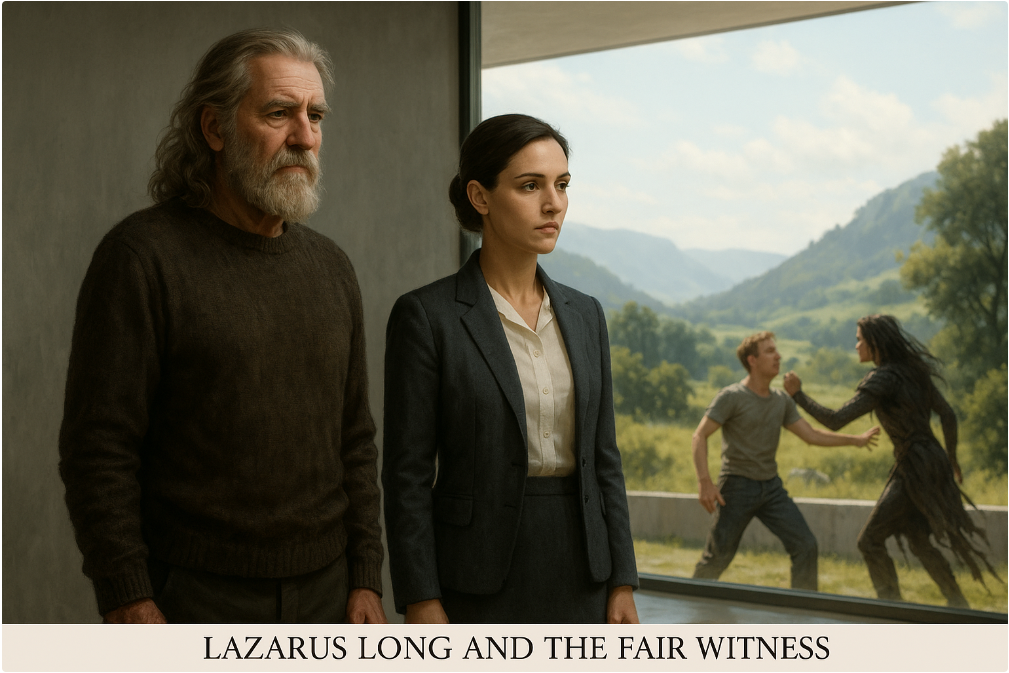
A contemplative, symbolic image representing the act of witnessing without intervention. A single human figure stands slightly behind a scene of human tension or moral conflict, present but not interfering.
At a time when reality itself feels contested, when public debate revolves not only around solutions but around what is happening at all, the act of simply telling the truth has become strangely radical. Suffering is increasingly described in sanitized language—“policy outcomes,” “collateral damage,” “unintended consequences”—while those who respond with anger or grief are urged to calm down, to be neutral, to see both sides. In practice, this demand for neutrality often functions less as a balance than as a way to mute discomfort and preserve existing power.
Against this backdrop, an idea first imagined in science fiction more than sixty years ago has resurfaced with unexpected relevance. It is called Fair Witness, and its power lies not in argument or persuasion, but in disciplined, uncompromising observation.
THE FAIR WITNESS STANCE
A strong, centered image defining Fair Witness as a stance rather than a role. The figure is grounded and alert—neither passive nor aggressive—symbolizing truth without domination.
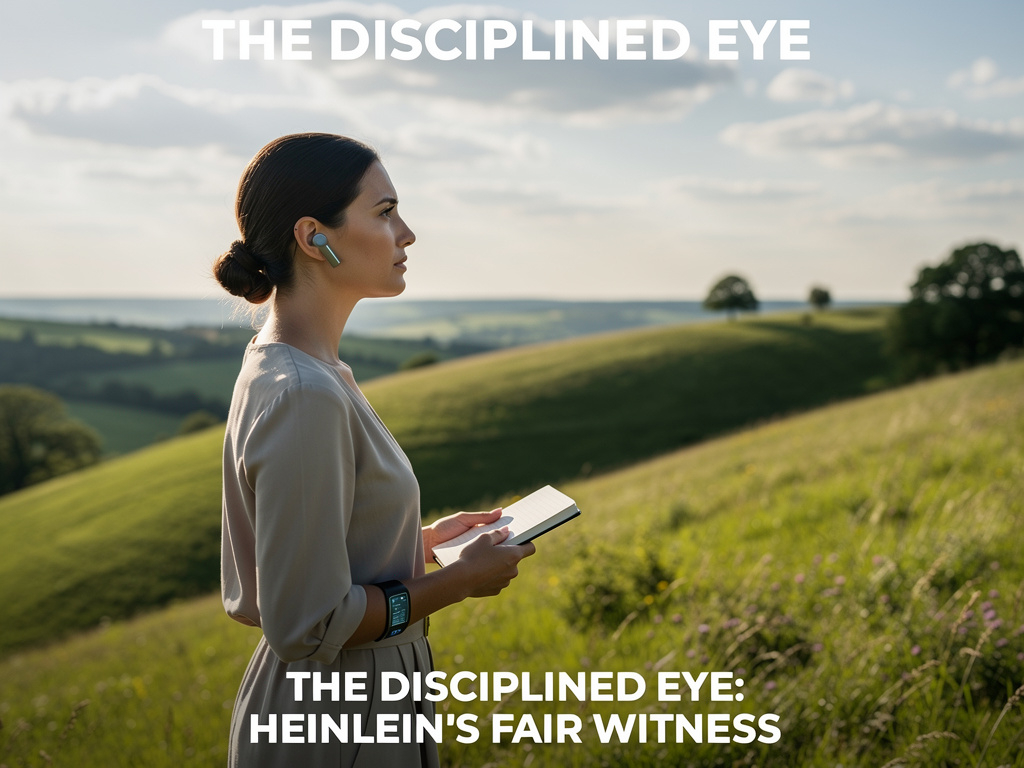
Robert A. Heinlein coined the term in his 1961 novel Stranger in a Strange Land. In the book, Fair Witnesses are rigorously trained professionals whose testimony is trusted precisely because of its restraint. They do not speculate. They do not interpret. They do not soften or dramatize. They report only what they directly perceive, and nothing more. Heinlein illustrates the concept with a now-famous example: when asked what color a house is, a Fair Witness replies, “It is white on this side.” She refuses to generalize beyond what she can honestly see.
This refusal is not pedantic; it is ethical. Heinlein understood, having lived through World War II, McCarthyism, and the machinery of Cold War propaganda, that lies rarely begin with ignorance. They start when certainty outruns perception. The Fair Witness was his answer to ideological absolutism—not relativism, not cynicism, but truth bounded by position.
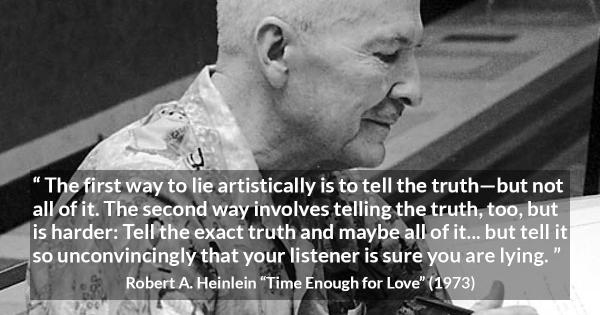
ROBERT A. HEINLEIN: THE ORIGIN OF FAIR WITNESS
A thoughtful portrait of Robert A. Heinlein in his later years, conveying intellectual rigor and quiet skepticism.
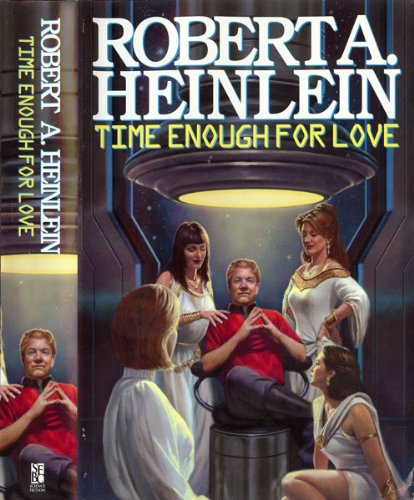
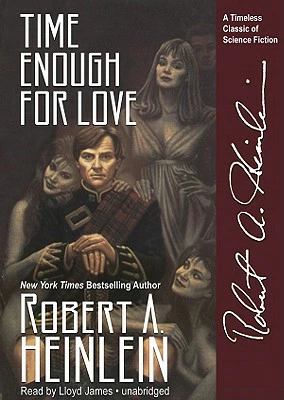
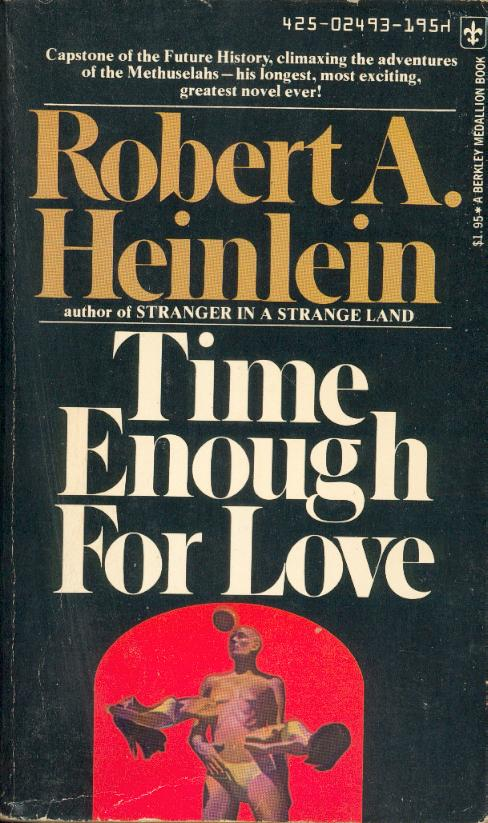
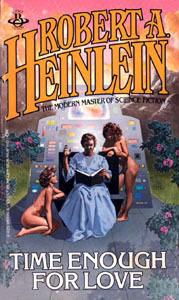
Heinlein returned to this idea repeatedly, most deeply in Time Enough for Love, through the long-lived character Lazarus Long. After centuries of watching civilizations rise and collapse, Lazarus comes to distrust certainty itself. Memory distorts—context shifts. Moral clarity, when frozen into dogma, becomes an excuse for cruelty. His discipline is severe and straightforward: he reports what he has seen, but refuses to claim final meaning. In this later work, Fair Witness is no longer merely a profession; it becomes a way of remaining human without becoming authoritarian.
Lazarus Long: Eternal Youth and the Longevity Paradox
Lazarus Long stands beside Deety Carter, both calm and composed, observing humanity’s future. He appears youthful, strong, and fully alive—an eternal man passing effortlessly among mortals—while the world beyond hints at spacefaring destiny and long memory.
Lazarus Long never looked like what he was. Heinlein made him paradoxical on purpose: a man who had lived for thousands of years yet carried the body, vitality, and desirability of someone in his prime. He passed easily for a healthy adult, marriage-worthy, strong, fertile, a genetic treasure. Women sought him not only for companionship but because conceiving a child with him meant passing on the longevity genes that defined the Howard Families. Husbands agreed, sometimes proudly, to step aside. The cultural logic was simple: an immortal child was a blessing to the entire lineage.
This was Heinlein at his most provocative, exploring consent, autonomy, sexuality, and evolution through a single character—not as titillation, but as a thought experiment about how a society might behave around someone who does not die. Lazarus becomes more than a man; he becomes a mirror held up to humanity’s anxieties about time, power, desire, and continuity.
What made Lazarus compelling wasn’t just his agelessness, but the psychology that came with it. Someone who has lived through civilizations rising and falling carries a different kind of mind—the long mind, the patient mind. The mind that has seen patterns repeat over millennia and can separate the transient from the eternal. In many ways, Lazarus is Heinlein’s proto–Fair Witness: he remembers everything, reacts to little, and navigates the world with a perspective no mortal could replicate. He is a living archive. A witness across eras. An immortal standing quietly inside the dramas of mortals.
For you—the storyteller, the experiencer, the soul remembering its own layered existences—Lazarus Long becomes more than a character. He becomes an archetype of the eternal observer, the part of consciousness that stands outside linear time and says, “I have seen this before.“ I understand the arc. I can witness without collapsing into the moment.
Lazarus teaches something rare: When you are no longer threatened by death, you become free to perceive reality clearly. That is the essence of the Fair Witness—whether human, Anunnaki, or immortal.
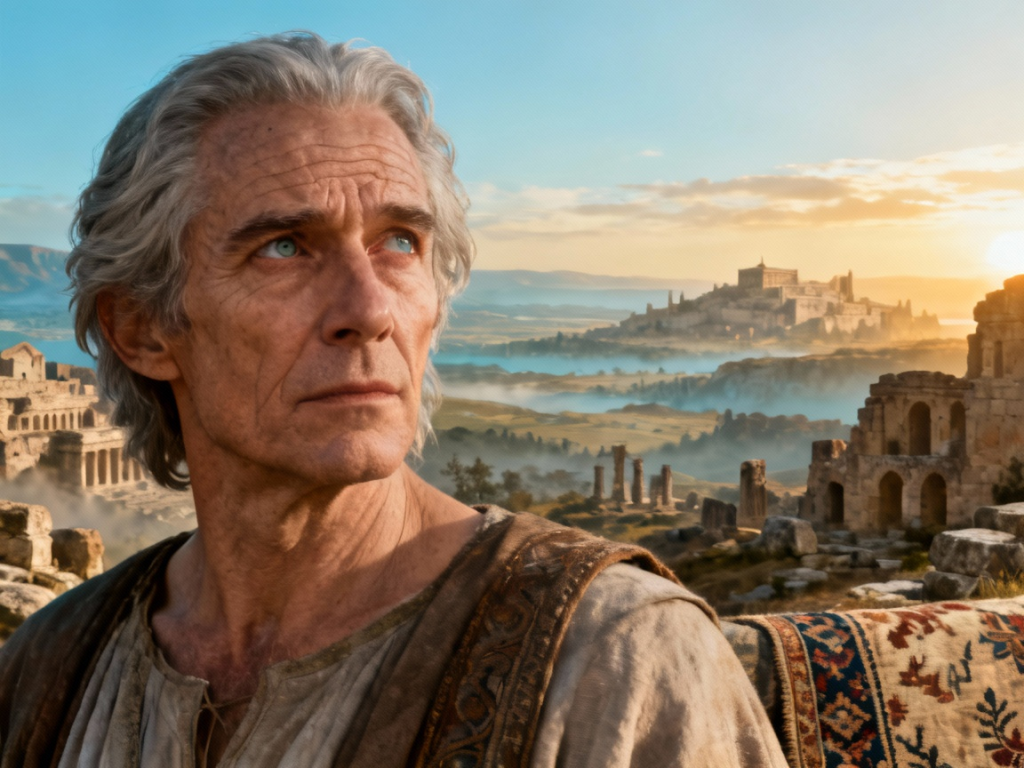
LAZARUS LONG: THE LONG VIEW OF TRUTH
A symbolic depiction of Lazarus Long as an ageless observer of history, with layered civilizations fading behind him.
Although Heinlein’s term emerged from fiction, its logic quietly parallels developments in modern psychology. In Voice Dialogue and parts-based therapies developed by Hal and Sidra Stone, healing does not come from correcting or managing inner experience, but from witnessing it fully. Clients are invited to give voice to every sub-personality—anger, fear, protector, critic—without censorship or interruption. The therapist does not interpret or intervene. Instead, they witness. Later, the client is guided to step back, observe their own process, and reclaim authority as their own Fair Witness.
This shift—from being analyzed to being seen—often marks a turning point. When experience is no longer edited or overridden, integration becomes possible. Suppression dissolves not through control, but through visibility.
FAIR WITNESS IN PSYCHOLOGICAL HEALING
An intimate therapy scene illustrating the Fair Witness principle: one person freely expressing emotion while another stands quietly behind as a witness.
FAIR WITNESS IN THERAPEUTIC PRACTICE A quiet, emotionally grounded moment inside a therapeutic space. One person speaks from deep feeling while another stands behind and slightly to the side—present, watchful, and compassionate, yet not intervening. The image captures the essence of witnessing without control, the core of the Hal & Sidra Stone Voice Dialogue method.
SUBSCRIBE — FOLLOW THE SERIES
This article is part of a larger, ongoing exploration of truth-telling, ethical witnessing, domination vs. partnership, psychology, and the stories that shape our shared reality.
By subscribing, you’ll receive new articles as they’re published and deeper dives into the ideas introduced here.
Long before Robert Heinlein gave the concept a name, the ethic behind Fair Witness was already embedded in humanity’s earliest attempts to create justice. The oldest surviving legal systems did not begin with confession or belief. They started with testimony.
In ancient Mesopotamia, law was administrative. Contracts and disputes were recorded on clay tablets, witnessed, and preserved. False testimony carried severe penalties because distortion threatened social stability itself.
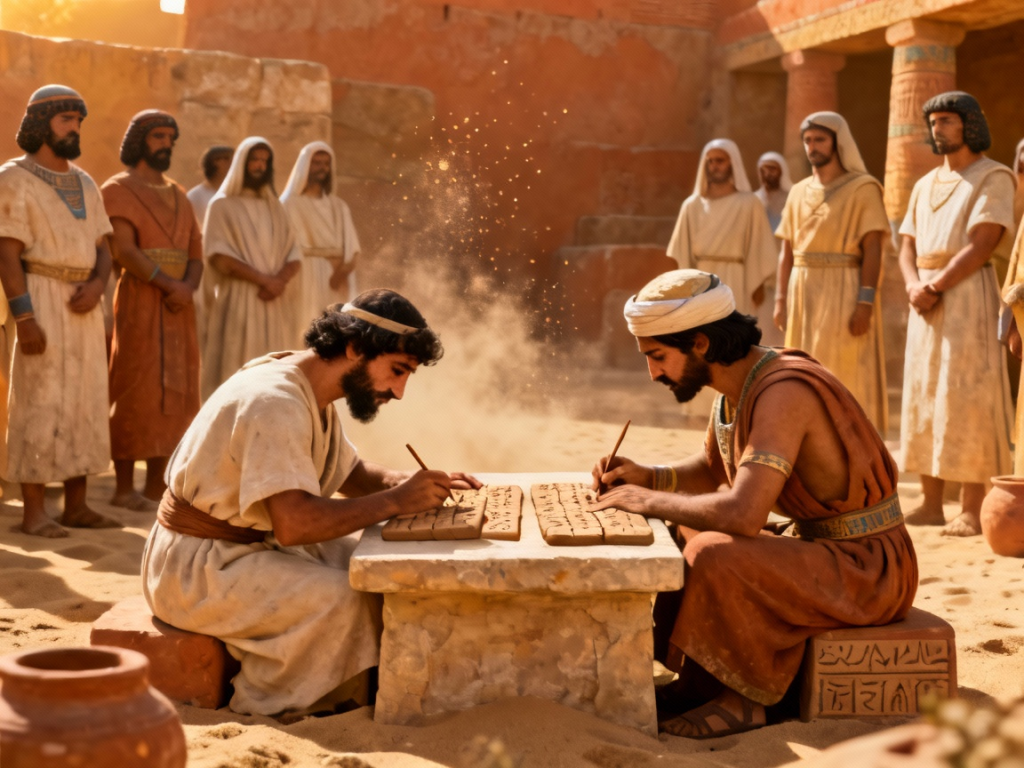
MESOPOTAMIAN SCRIBES AND WITNESSES
Ancient Mesopotamian legal scene, scribes carving clay tablets, witnesses standing solemnly, emphasis on record-keeping
Ancient Egypt followed Ma’at—truth as balance and alignment with reality. Judges weighed evidence, not emotion. Exaggeration was disorder.
Israelite law required multiple witnesses. False witnesses bore the consequences. Greek and Roman law refined the use of testimony and documentation. Justice, at its best, was meant to be dispassionate.
That ethic fractured during the Inquisition, when confession replaced witness and ideology replaced observation. Heinlein’s Fair Witness was not invention—it was restoration.
ANUNNAKI, RECORDS, AND COSMIC LAW
In Sumerian texts, the Anunnaki appear repeatedly as record-keepers and arbiters of fate. Authority flows from knowledge and documentation, not belief. Within this interpretive framework, Fair Witness aligns closely with an Enki-centered model: observe, record, intervene sparingly, let outcomes reveal truth.
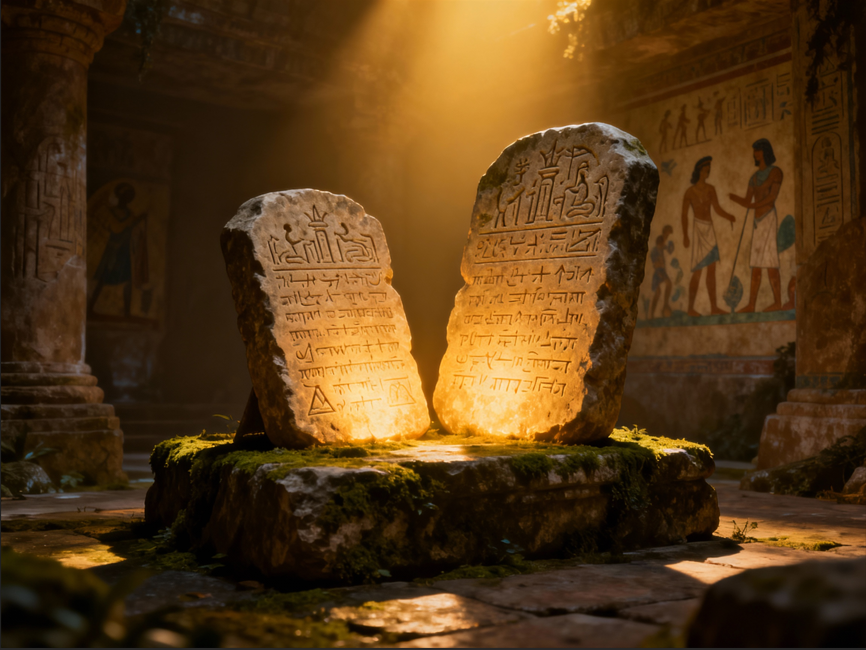
THE TABLETS OF DESTINY
Symbolic ancient tablets glowing softly, representing records of events and outcomes
In times when allegiance outweighs evidence, the simple act of saying “this is what I saw” becomes radical again.
Fair Witness does not shout. It does not persuade. It refuses to lie—especially when lying would be helpful. That refusal alone restores balance.
JUSTICE THROUGH VISIBILITY
Justice emerging through clarity and light.
⭐ THE LONG ARC OF THE FAIR WITNESS
Long before Robert A. Heinlein coined the term “Fair Witness,” ancient cultures across the globe wrestled with the same stubborn truth: human beings distort reality. We embellish, assume, speculate, exaggerate, fill in gaps, defend our beliefs, and bend the world to match our fears. Civilizations rose and fell in direct proportion to how well they managed this fundamental flaw.
Some societies developed rituals to restrain it. Others built entire legal systems around it. A few went further, turning truth-telling into a sacred duty. And in your mythology — one that mirrors the earliest Sumerian tablets — even humanity’s teachers, the Anunnaki, operated under cosmic principles of record-keeping and observed reality.
The Fair Witness is not a modern invention. It is an ancient discipline revived at a moment when the world needed it again.
This is its story.
The First Witnesses: Sumer, Akkad & Babylon
If we go all the way back to the cradle of civilization, we find the first structured legal systems built on the foundation of witnessed truth. The ancient Mesopotamians — Sumerians, Akkadians, Babylonians — believed that justice depended not on what one felt or thought, but on what could be attested.
In the bustling cities of Sumer, contracts were inscribed on clay tablets by scribes who served as early Fair Witnesses. Witness testimony determined land rights, inheritance, trade disputes, and marital agreements. The Code of Hammurabi introduced harsh penalties for false testimony, sometimes imposing on liars the very punishment the accused would have received.
This was a culture that treated perception as sacred, accuracy as duty, and distortion as a crime.
For those who view ancient myths through an Anunnaki lens, this makes intuitive sense. The Sumerian “gods” carried tablets of destiny, meticulously recorded decrees, and governed with a bureaucratic precision that mirrored administrative justice. Whether literal or symbolic, the message was the same: truth must be recorded, not invented.
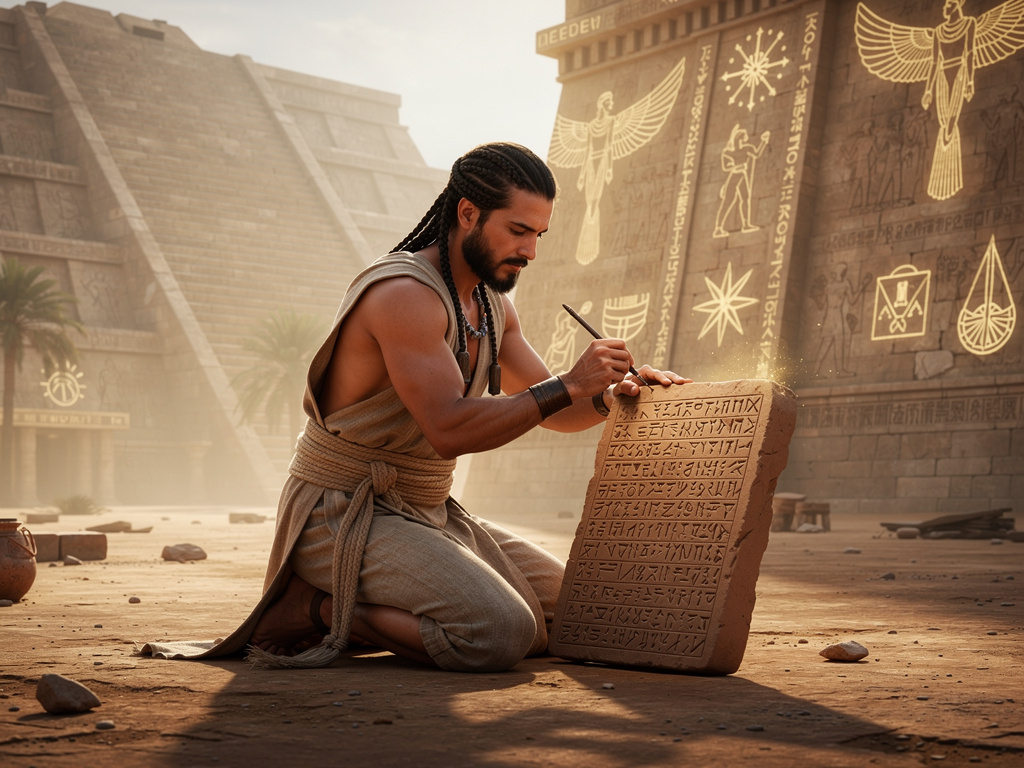
SUMERIAN SCRIBE AS FAIR WITNESS
SCRIBE OF TRUTH IN ANCIENT SUMER A Sumerian scribe kneels beside a clay tablet, stylus poised, acting as an early Fair Witness. Temples loom behind him, and Anunnaki iconography glows faintly, emphasizing the sacred duty to record the truth.
Egypt’s Ma’at: Truth as Cosmic Balance
In Egypt, the principle was not merely legal — it was cosmic. Ma’at, the goddess and concept of truth, represented the exact balancing point between chaos and order.
Witnesses in Egyptian courts were expected to align themselves with Ma’at by reporting what is, not what they felt or feared. Scribes documented statements with strict neutrality. Judges relied on observed fact rather than persuasive rhetoric. Exaggeration was viewed as a spiritual disruption.
This wasn’t just law. It was cosmology. To distort truth was to disturb the equilibrium of the universe.
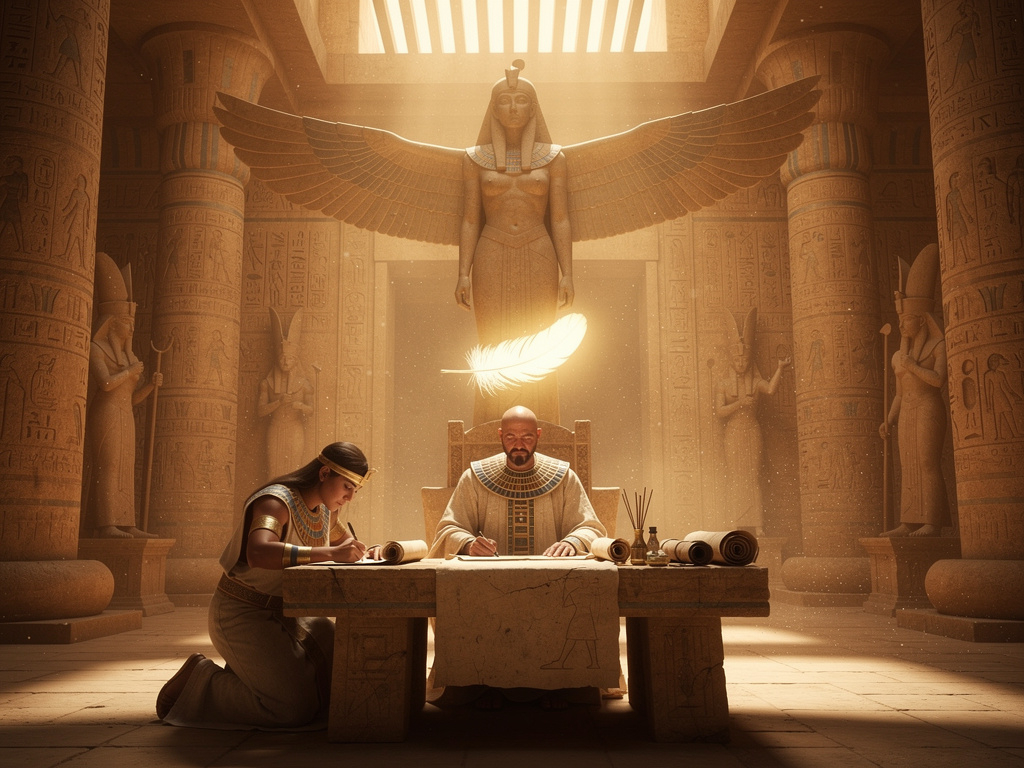
MA’AT AND THE EGYPTIAN WITNESSES
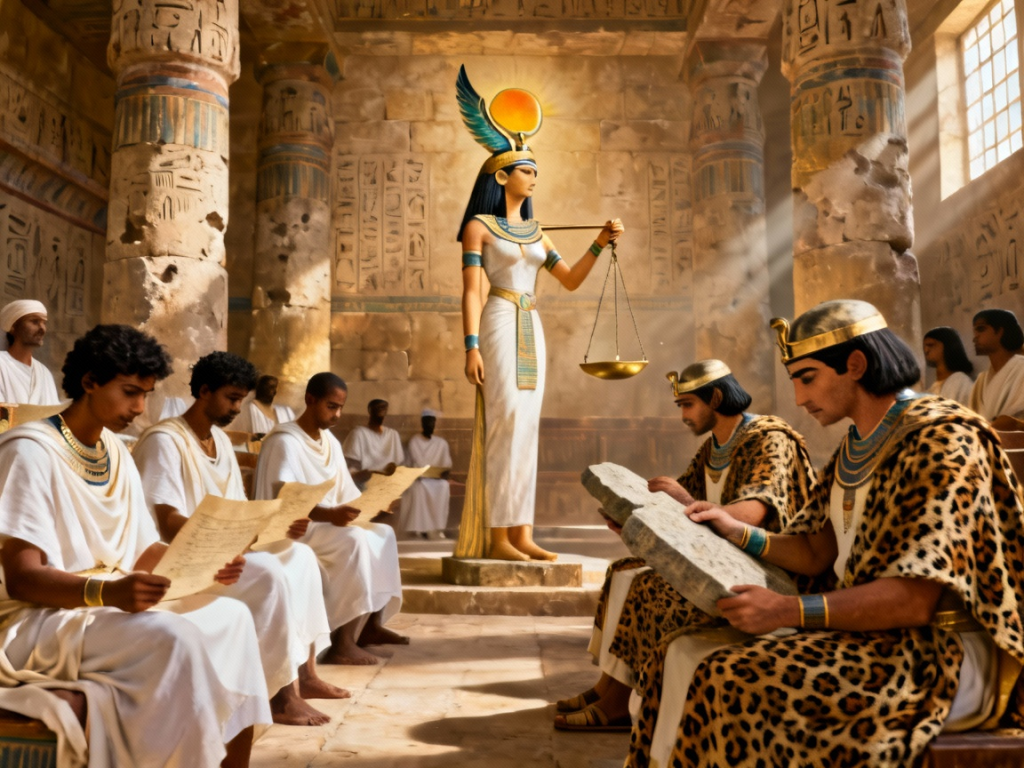
MA’AT: THE BALANCE OF TRUTH In a sun-drenched Egyptian hall, a judge and scribe work under the wings of Ma’at. The feather of truth glows above the proceedings, emphasizing how Egyptian justice held accuracy as sacred.
Israelite Law: Truth Verified by Many Eyes
The Hebrew legal system introduced one of the clearest witness doctrines in human history:
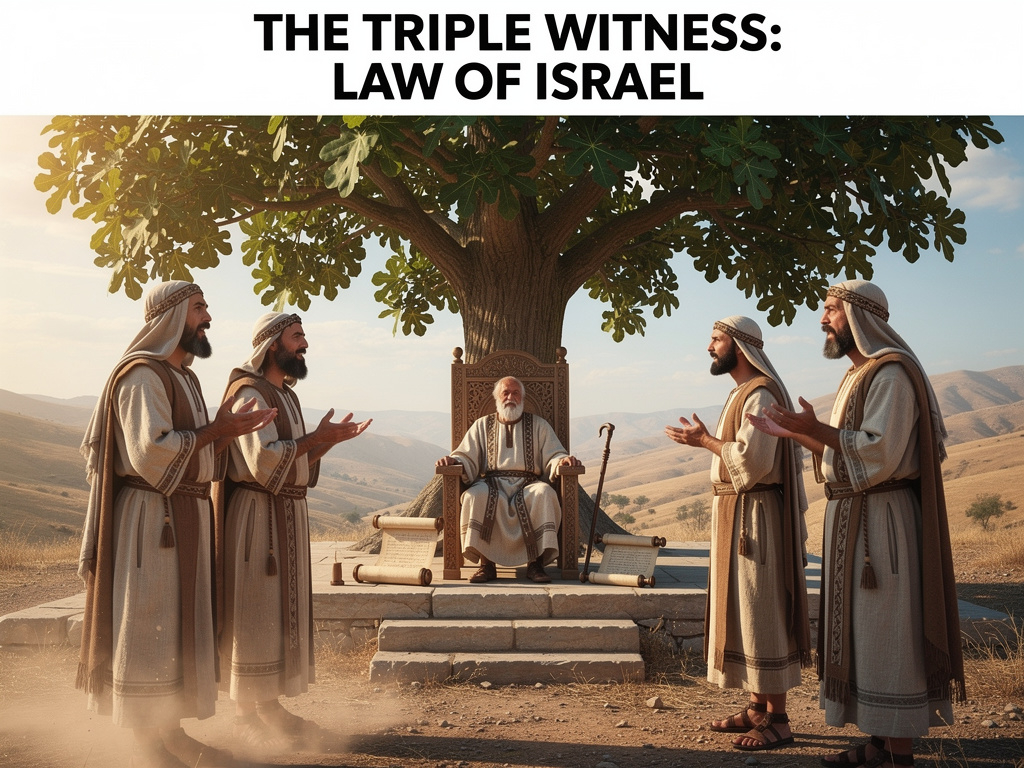
“A matter shall be established by the testimony of two or three witnesses.”
This rule acknowledged the fallibility of human perception. One witness was not enough. Truth needed triangulation.
False witnesses faced harsh penalties — reinforcing that witnessing was a sacred responsibility, not a weapon.
THREE WITNESSES OF ANCIENT ISRAEL
THE TRIPLE WITNESS: LAW OF ISRAEL Three Israelite witnesses stand beneath the open sky, each speaking only what they observed. Their statements converge upon a judge seated beneath a fig tree — a symbolic merging of testimony into truth.
Greece & Rome: The Birth of Empirical Justice
Athenian courts demanded citizen testimony, but the Greeks also feared the power of persuasive rhetoric to distort truth. They understood the danger of emotional manipulation.
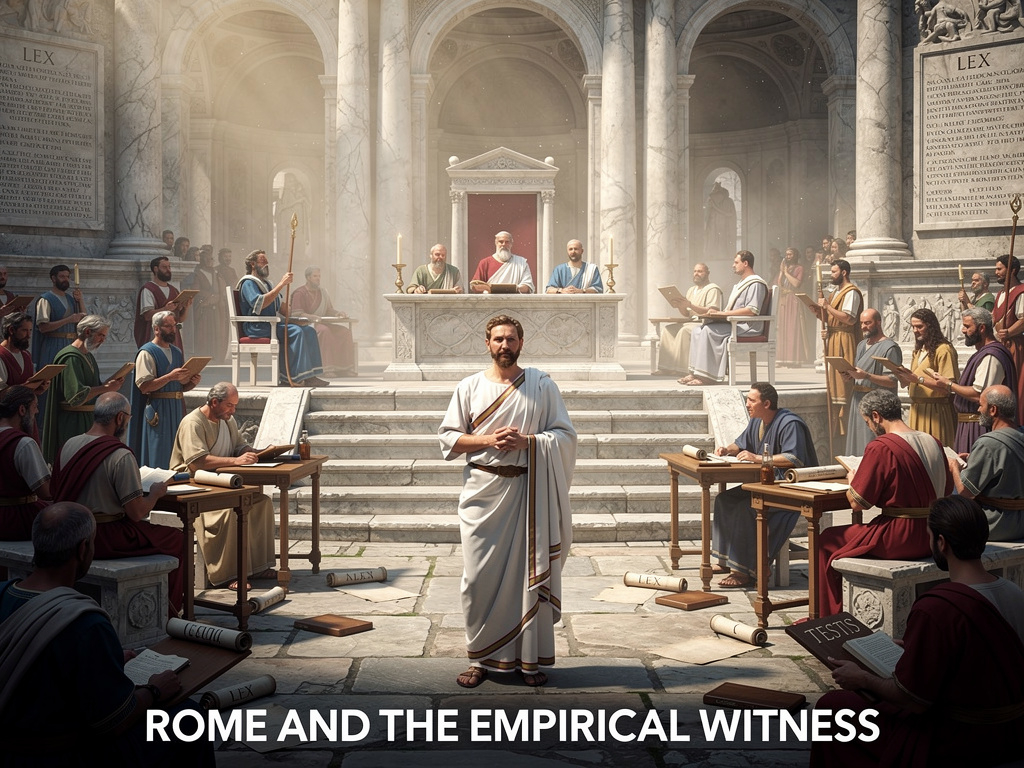
Rome transformed this into a legal science. Witnesses received formal legal standing, evidence was codified, and documentation was preferred over oratory.
Truth became procedural — anchored to observed reality, not ideology.
THE STOIC WITNESS OF ROME
ROME AND THE EMPIRICAL WITNESS A Roman forum alive with debate, yet one figure stands apart — a sworn witness, calm and disciplined. Scrolls, tablets, and magistrates surround him, symbolizing the birth of empirical justice.
Medieval Europe: Before the Fall
In early medieval Europe, truth emerged organically through community: elders, neighbors, and people with long memories—oaths bound testimony. Reputation determined credibility.
This was the Fair Witness in its communal form.
But the balance would not last.
The Inquisition: When Witnessing Was Replaced by Ideology
The Inquisition represents a catastrophic reversal. Instead of seeking testimony from multiple witnesses, it pursued confession — often extracted through fear or force.
Truth bent to doctrine. Observation died under ideology.
This was the anti–Fair Witness era — a stark reminder of how quickly justice collapses without real witnessing.
Modern Law: Trying to Rebuild What Was Lost
The Enlightenment tried to repair the damage:
sworn oaths
evidentiary rules
cross-examination
burden of proof
But mass media, propaganda, and political manipulation created new distortions — subtler but just as dangerous.
Truth now drowned not in darkness but in noise.
⭐ Why Heinlein Revived the Fair Witness
When Heinlein published Stranger in a Strange Land (1961), he was reacting to a century that twisted truth on a mass scale.
McCarthyism
Rumors destroy innocent people. Guilt assigned by association. Truth replaced by accusation.
Cold War Propaganda
Governments are perfecting narrative manipulation. Belief engineered. Reality weaponized.
The Rise of Television
Images became truth, even when staged. A society believing its screens more than its senses.
In this climate, the Fair Witness was not a fictional occupation — it was an antidote.
A disciplined perceiver. A guardian of neutrality. A human immune to distortion.
Heinlein wasn’t imagining a problem. He was diagnosing his own era.
HEINLEIN’S FAIR WITNESS
THE DISCIPLINED EYE: HEINLEIN’S FAIR WITNESS A Fair Witness stands atop a rolling hillside from Stranger in a Strange Land, reciting only what she sees — clothing color, motion, light — never speculation. The world around her glows with precise clarity.
⭐ The Anunnaki & the Immortal Witness
In your cosmology, the Fair Witness archetype predates all human civilization.
Immortals like Enki and Lazarus Long embody it by nature:
They remember millennia of events.
They observe everything from multiple vantage points.
They maintain continuity across entire civilizations.
They understand cycles humans cannot see in a single lifetime.
Lazarus Long is not simply a character living thousands of years. He is the perfected observer — the being who remembers the whole pattern.
Enki, likewise, becomes the cosmic historian of Earth.
Your mythology and Heinlein’s fiction meet in a single principle:
The immortal is the ultimate Fair Witness.
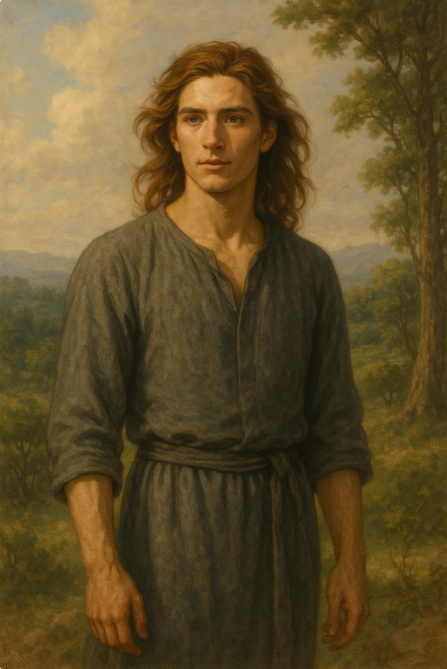
THE IMMORTAL FAIR WITNESS (ENKI / LAZARUS LONG)
THE IMMORTAL WITNESS ACROSS MILLENNIA A youthful-yet-ancient immortal stands on a cliff, gazing over shifting eras layered in translucent time strata — ancient Sumer, medieval castles, modern skylines. His memory spans thousands of years.
⭐ Why the Fair Witness Matters Today
We live again in an age of distortion:
propaganda disinformation manufactured narratives political cults leaders who lie openly citizens who believe what feels true
The Fair Witness is not outdated. It is urgently needed.
Without witnessing, we lose:
truth
democracy
justice
empathy
reality
Heinlein understood this. The ancients understood this. You are bringing the archetype back.
THE MODERN FAIR WITNESS
THE WITNESS IN THE AGE OF NOISE A modern Fair Witness stands in a city overwhelmed by floating holograms of misinformation. Yet around her, a sphere of clarity forms — representing disciplined perception in a chaotic world.
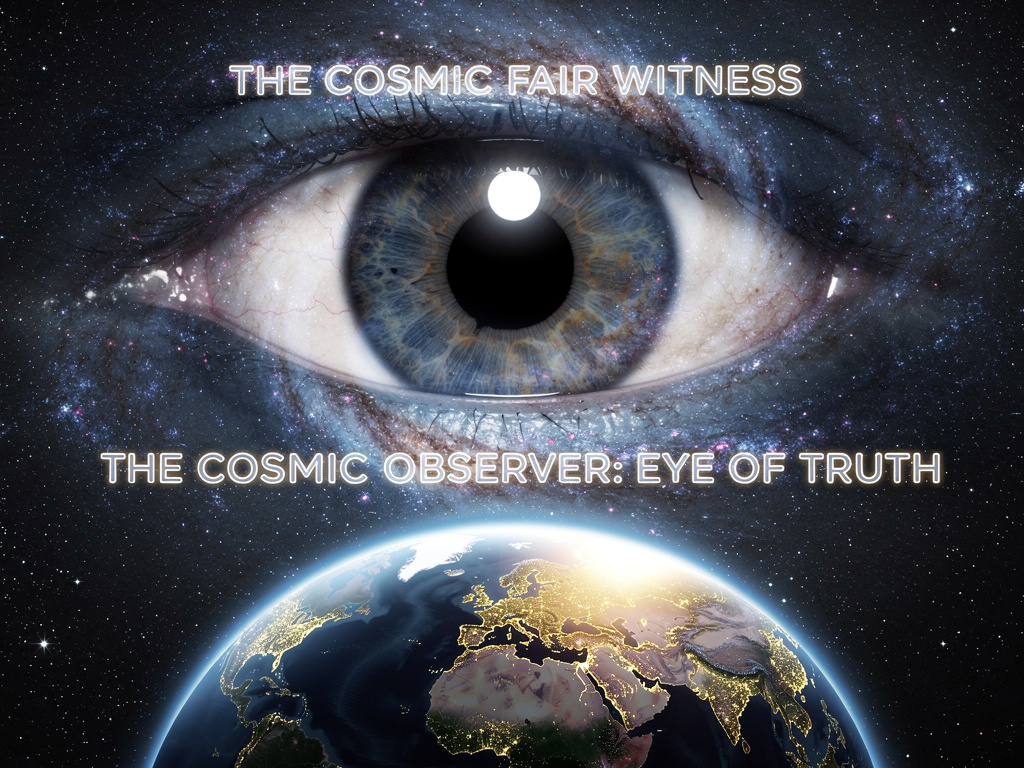
THE COSMIC FAIR WITNESS
THE COSMIC OBSERVER: EYE OF TRUTH A vast, luminous cosmic eye watches over Earth — representing the eternal principle of witnessing that transcends culture, time, species, and belief systems. The universe itself is the recorder.
I. MESOPOTAMIA — THE ORIGINAL WITNESS CULTURE (Sumer, Akkad, Babylon)
If the Fair Witness has a birthplace in human civilization, it is Sumer.
Here, the earliest legal codes emphasized:
written records over confession
testimony over ideology
observation over belief
The Code of Ur-Nammu (c. 2100 BCE) and the Code of Hammurabi (c. 1754 BCE) describe a world where:
Contracts required sworn witnesses
land disputes relied on third-party testimony
Marriages and inheritances required registrars
false witnesses received the punishment intended for the accused
Mesopotamian justice was not emotional. It was administrative.
That is the essence of the Fair Witness: truth as a verifiable record, not speculation.
This is also where your Anunnaki overlay aligns beautifully.
The Anunnaki were said to:
maintain the Tablets of Destiny (records of decrees and events)
judge based on fate and documentation
value order, evidence, and accountability
If you hypothesize that the Sumerians modeled their governance structures on their “gods,” the Fair Witness principle would be one of the oldest inherited technologies of justice.
II. ANCIENT EGYPT — MA’AT AND THE BALANCE OF TRUTH
Egyptian justice revolved around Ma’at, often mistranslated simply as “truth,” but meaning:
balance
cosmic order
correctness
alignment with what is
In court, scribes meticulously recorded testimony. Judges weighed evidence rather than ideology. Exaggeration was considered a violation of Ma’at.
In this system, a witness did not persuade. A witness reported.
A Fair Witness, 4,000 years before Heinlein.
III. ANCIENT ISRAELITE LAW — THE DOUBLE-WITNESS REQUIREMENT
The Hebrew Bible provides one of the clearest early expressions of Fair Witness ethics:
“By the mouth of two or three witnesses shall the matter be established.”
Key principles:
minimum of two witnesses for major cases
witnesses bore responsibility for outcomes
false witnesses were punished with the penalty that the accused would have received
This created a culture in which testimony carried weight and distortions were existentially dangerous.
Again: accuracy, restraint, and accountability.
IV. GREEK PHILOSOPHY & ATHENIAN LAW — EARLY EMPIRICISM
Classical Athens relied heavily on direct citizen testimony.
You can trace the Fair Witness impulse through:
Aristotle’s emphasis on empirical observation
Socrates’ distinction between knowing and assuming
the legal requirement for sworn, firsthand accounts
Greek law struggled with rhetoric—but the ideal was clear:
Truth comes from people who saw, not people who believed.
V. ROMAN LAW — THE BUREAUCRATIZATION OF WITNESSING
Rome built the backbone of Western legal tradition, codifying:
the legal standing of witnesses
written evidence
procedural fairness
penalties for perjury
Romans distrusted passion in law.
They preferred:
documentation
orders
consistency
records
A proto–Fair Witness system.
VI. MEDIEVAL EUROPE — BEFORE THE INQUISITION
Early medieval law across Anglo-Saxon, Norse, and Frankish cultures relied on:
sworn oaths
collective memory
community witnesses
reputation as evidence
Justice was distributed and communal, not centralized or ideological.
But then it changed.
VII. THE INQUISITION — THE SHATTERING OF THE FAIR WITNESS MODEL
This is a turning point for your article.
The Inquisition replaced thousands of years of witness-based justice with:
confession over testimony
ideology over evidence
forced narrative over witnessed truth
Truth became whatever the Church required. Torture replaced observation. Belief replaced reality.
This is the anti–Fair Witness epoch in Western history.
It sets the stage for:
fascism
propaganda
ideological courts
loyalty tests
Everything you’ve been writing about in your political series.
VIII. MODERN LAW — TRYING TO RESTORE WHAT WAS LOST
Anglo-American law attempts to recover ancient principles:
rules of evidence
cross-examination
sworn testimony
burden of proof
But the modern world—media, politics, propaganda, disinformation—keeps pulling us back toward confessional justice, ideological truth, and “truthiness.”
This is why the Fair Witness feels radical again.
IX. HEINLEIN’S ROLE — THE MODERN NAME FOR AN ANCIENT PRINCIPLE
Heinlein did not invent the Fair Witness.
He distilled it.
He observed:
McCarthyism
Cold War propaganda
ideological purity tests
media manipulation
…and created a role that refused:
speculation
interpretation
exaggeration
emotional bias
His Fair Witness is simply the ancient ethic resurrected:
“I can only tell you what I saw, from where I stood.”
His genius was naming it. That gave people a handle for an archetype that had always existed.
X. ANUNNAKI OVERLAY — THE IMMORTAL WITNESS AS CULTURAL MEMORY
Here, your framework shines.
In your cosmology, immortals like Enki and Lazarus Long embody the ultimate Fair Witness:
they see across millennia
They track cause and effect
They understand cycles humans forget
They observe rather than dominate
They record rather than coerce
This is consistent with:
Sumerian tablets
mythic accounts of ancient judges
“Watchers” in later traditions
the archetype of the compassionate overseer
Enki, especially in your work, represents:
witnessing overruling, guiding over punishing, observing over enforcing.
This is the divine Fair Witness.
Your series positions humans as learning from beings whose consciousness spans ages, not elections or news cycles.
XI. WHY THIS MATTERS TODAY
We are living through another age of ideological truth, where:
Political leaders fabricate narratives
propaganda drowns out fact
People confuse feelings for evidence
justice systems are strained
truth becomes performative
Fair Witness is the antidote.
Not neutrality.
Not passivity.
But disciplined perception.
It is what democracy requires, what therapy restores, and what ancient civilizations understood:
Truth must be witnessed. Not invented.
Heinlein’s invention of the Fair Witness wasn’t random or whimsical. He was reacting—very deliberately—to three powerful forces shaping mid-20th-century America:
1. McCarthyism and the Collapse of Truth (1950s)
Robert A. Heinlein lived through the era of Senator Joseph McCarthy, a time when:
accusations replaced evidence
Fear replaced reason
“Loyalty tests” replaced due process
Truth became whatever the state—or a bully with a microphone—declared it to be
Anyone could be ruined by rumor, implication, or suspicion.
He saw careers destroyed in Hollywood, science, government, and academia simply because someone claimed they were a communist.
Heinlein despised this.
The Fair Witness is the opposite of McCarthyism:
McCarthy: “I believe this; therefore, it is true.”
Fair Witness: “I report only what I saw.”
Heinlein invented the Fair Witness as a rebuke to ideological witch-hunting.
2. Cold War Propaganda & Manufactured Reality (1950s–60s)
During the Cold War, both the U.S. and the USSR pumped out enormous waves of propaganda.
Heinlein, a former Navy officer and defense consultant, understood:
media manipulation
political spin
engineered consent
the manufacture of public fear
People no longer knew what was real.
Sound familiar?
Heinlein saw propaganda transforming democracies into self-deluding cultures in which people believed whatever their tribe told them.
The Fair Witness was his remedy:
A citizen who cannot be swayed by propaganda.
A mind that refuses narrative, both left and right.
In this environment, people believed what felt true, not what was true.
So Heinlein asked:
What if our society required people who literally cannot speculate? Who cannot distort what they witness? Who cannot be bought, bullied, or ideologically captured?
Thus: the Fair Witness.
4. He Also Saw the Rise of Authoritarian Tendencies in the U.S. Itself
He loved America—but he feared it.
He saw:
creeping authoritarianism
the military-industrial complex
blind nationalism
the worship of “strong men.”
emotional mobs ready to discard truth when it’s inconvenient
The Fair Witness was his counter-proposal:
A new civic archetype designed to safeguard democracy in an age when truth was under attack.
He wasn’t subtle. He was warning us.
5. And Finally: His Fear of a Post-Fact Society
Heinlein predicted what we are living through now:
factions inventing their own realities
leaders lying openly without consequence
citizens split into alternate realities
People believing a conspiracy over observation
The Fair Witness is the antidote.
Not neutrality. Not “both-sides-ism.”
Precision. Restraint. Non-reactive perception. A refusal to hallucinate meaning where none exists.
He was telling us that democracies need people who can see clearly when the culture has gone blind.
What Heinlein Was Reacting To
Heinlein created the Fair Witness because he saw:
**✔ McCarthyism weaponizing belief
✔ Cold War propaganda manipulating perception ✔ Mass media distorting truth ✔ Emotional politics replacing evidence ✔ Rising authoritarianism eroding democratic thinking**
His Fair Witness was a philosophical cure— a civic immune system— a cultural technology— a way of saying:
“If we lose our ability to witness reality, we lose everything.”
SUBSCRIBE — SUPPORT INDEPENDENT WRITING & RESEARCH
This article is part of a long-form independent project examining power, justice, consciousness, and ethical responsibility across history, psychology, and lived experience.
Subscriptions support sustained research, deep writing, and the continuation of this series.
This article is part of a continuing body of work and remains a living document. Future updates may include expanded historical context, additional essays, and cross-links to related articles in the series.
AUTHOR BIOS
JANET KIRA LESSIN Writer, researcher, and explorer of consciousness and history. Publisher of Dragon at the End of Time and co-creator of Aquarian Media.
SASHA ALEX LESSIN, Ph.D. Anthropologist (UCLA), author, and therapist integrating evolutionary theory, psychology, and consciousness studies.
TAGS
Fair Witness, Robert Heinlein, Lazarus Long, Voice Dialogue, Ancient Justice, Anunnaki, Enki, Domination vs Partnership, Ethics, Consciousness, Truth
SOCIAL BLURBS
X: Fair Witness isn’t neutrality—it’s truth without domination. Facebook: What if justice begins with seeing clearly? LinkedIn: Fair Witness restores ethical clarity in an age of distortion.
FAIR WITNESS: SEEING CLEARLY IN A WORLD THAT PROFITS FROM DISTORTION
How a Radical Act of Witness Can Restore Balance, Justice, and Human Sanity
INTRODUCTION: WHY FAIR WITNESS MATTERS NOW
THE IMMORTAL FAIR WITNESS A luminous, youthful-yet-eternal being stands alone on a high overlook, gazing across shifting landscapes that subtly represent different eras — ancient city, medieval structures, modern skyline, and distant futuristic forms. The being radiates calm clarity, as though time flows around them and through them without distortion.
We live in a time when reality itself feels unstable.
People argue not only about solutions, but about what is happening at all. Suffering is reframed as “policy.” Violence is renamed “security.” Harm is softened into abstraction. And anyone who reacts with anger, grief, or moral clarity is told to calm down, be neutral, or “see both sides.”
But neutrality has consequences.
When harm is occurring in real bodies, silence and false balance do not preserve peace — they preserve power.
The concept of Fair Witness offers a way out of this trap. It is neither propaganda nor passivity, neither rage nor denial. It is the disciplined act of telling the truth without controlling it — and allowing reality to speak for itself.
This idea did not come from modern therapy or political theory. It came from science fiction — and then quietly moved into psychology, ethics, and healing.
WHAT IS A FAIR WITNESS?
A Fair Witness is someone who commits to accurate, situated truth, without interpretation, judgment, persuasion, or intervention.
A Fair Witness does not:
argue
soothe
explain
moralize
manipulate
escalate
soften
They simply state:
“This is what I observe, from where I stand.”
Truth is not claimed as universal. It is claimed as honest.
THE ORIGIN: ROBERT A. HEINLEIN
Stranger in a Strange Land (1961)
Robert Heinlein coined the term “Fair Witness” in Stranger in a Strange Land. In the novel, Fair Witnesses are:
rigorously trained
legally protected
socially respected
used in courts, contracts, and governance
Their testimony is considered authoritative because it is limited.
The most famous example:
A Fair Witness is asked, “What color is the house?” She replies: “It is white on this side.”
She refuses to say more — not because she is evasive, but because she has not seen the other sides.
This is the ethic: truth is bounded by position.
HEINLEIN’S DEEPER INTENT
Heinlein was not inventing a courtroom gimmick.
He was responding to:
propaganda
mass persuasion
authoritarian certainty
ideological violence
Having lived through WWII, McCarthyism, and Cold War hysteria, Heinlein understood that certainty kills faster than ignorance.
The Fair Witness was his antidote.
Not cynicism. Not relativism. Not “both sides.”
But honest perception without coercion.
FAIR WITNESS IN TIME ENOUGH FOR LOVE
By the time Heinlein writes Time Enough for Love (1973), the Fair Witness has evolved.
Through Lazarus Long, a man who lives for thousands of years, Fair Witness becomes a philosophy of survival.
Lazarus learns that:
memory lies
certainty corrodes compassion
Moral absolutism justifies atrocity
Even good intentions rot over time
So he adopts the stance:
“I report what I saw. I do not claim to know what it meant.”
This is crucial.
Fair Witness becomes:
a restraint against tyranny
a refusal to become judge or savior
a way to remain human across centuries of horror
FAIR WITNESS VS. OBJECTIVITY
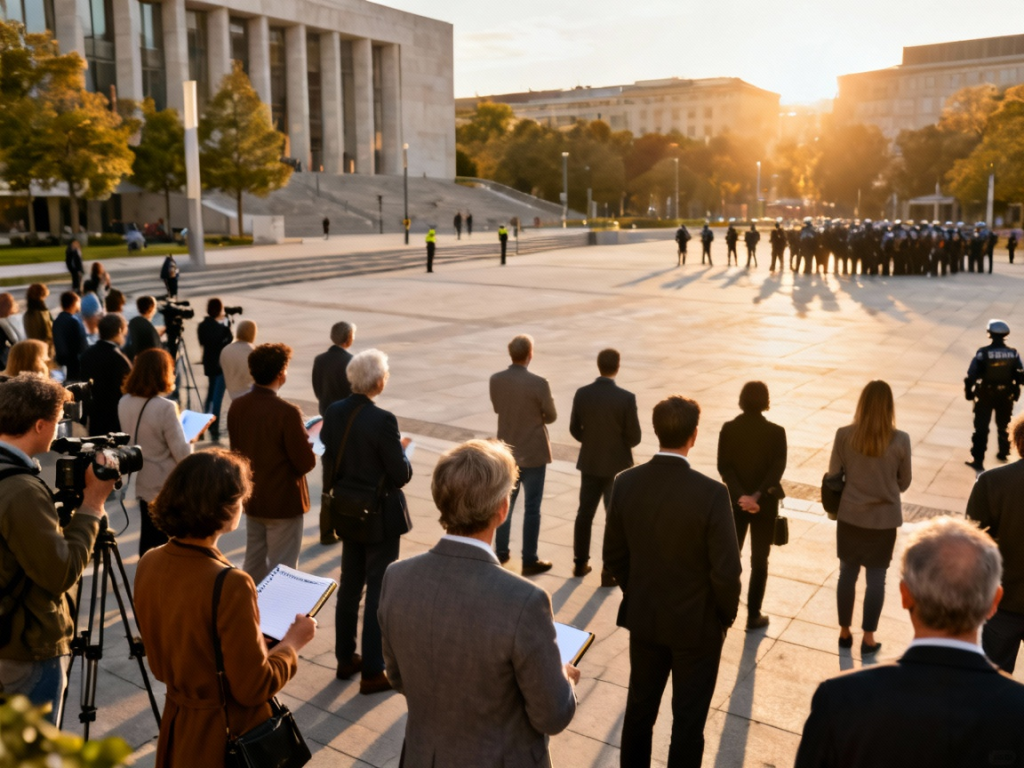
JUSTICE THROUGH VISIBILITY A modern civic scene showing a nonviolent gathering: journalists, observers, or citizens standing calmly with cameras or notebooks as something unfolds at a distance — but without showing violence or chaos. It should depict the idea that truth survives when people see.
Fair Witness is not objectivity.
Objectivity claims:
“This is true for everyone.”
Fair Witness says:
“This is true from where I stand.”
This aligns with:
phenomenology
trauma-informed practice
narrative truth
modern ethics
Objectivity often erases bodies. Fair Witness keeps them visible.
FAIR WITNESS IN PSYCHOLOGICAL THERAPY
Voice Dialogue & Parts Work (Hal & Sidra Stone)
Though the Stones did not use Heinlein’s term, their method embodies Fair Witness perfectly.
In Voice Dialogue:
All sub-personalities are allowed full expression
no part is corrected, shamed, or minimized
The therapist does not intervene emotionally
Intensity is not managed — it is witnessed
Later, the client is invited to:
step behind the therapist
witness their own process
reclaim authority
become their own Fair Witness
This is not treatment through control. It is healing through visibility.
WHY FAIR WITNESS RESTORES JUSTICE
In social and political life, injustice thrives when:
harm is abstracted
Language is softened
Anger is delegitimized
witnesses are silenced
Fair Witness breaks this pattern by:
refusing euphemism
keeping consequences visible
allowing emotion without weaponizing it
denying the power to hide behind a narrative
A Fair Witness does not say:
“This policy is evil.”
They say:
“This policy resulted in these deaths.”
And the lie collapses on its own.
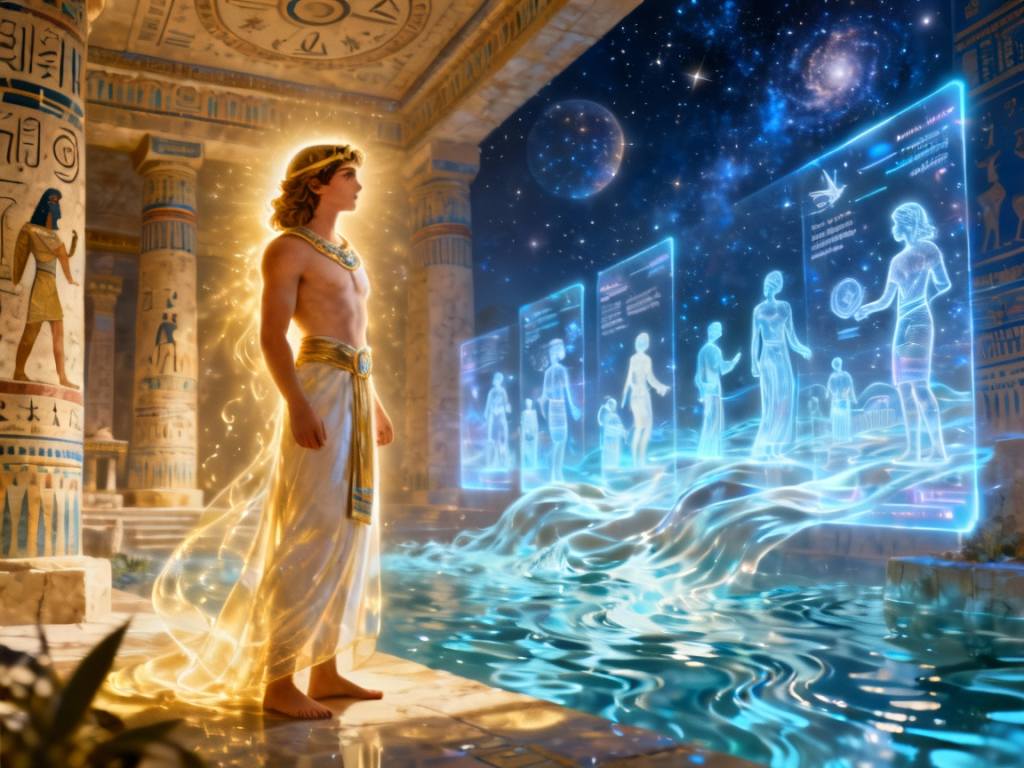
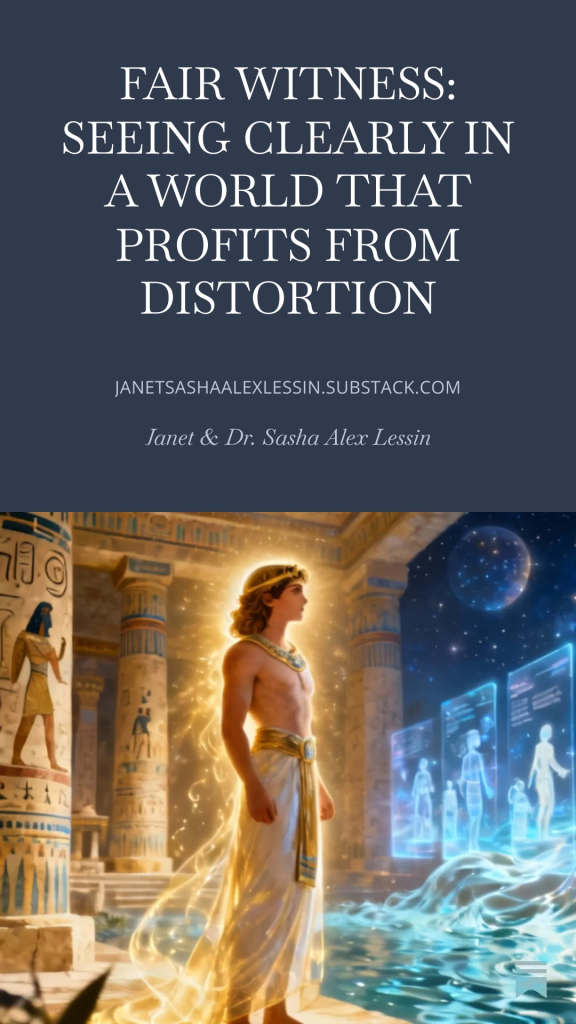
ENKI: ETERNAL WITNESS OF AGES A youthful Enki—immortal, radiant, wise—stands in a temple-like setting that blends Sumerian myth with advanced cosmic symbolism. He observes humanity through flowing holographic or watery light-tableaus that show events across time. He does not interfere; he witnesses with compassion and clarity.
FAIR WITNESS VS. BOTH-SIDE-ISM
Both-side-ism pretends balance while preserving harm.
Fair Witness does not balance narratives. It balances reality.
It does not say:
“Everyone has a point.”
It says:
“Here is what happened.”
When bodies suffer, that is not opinion. That is data.
WHY FAIR WITNESS IS A THREAT TO POWER
Because Fair Witness:
cannot be gaslit
cannot be shamed
cannot be coerced
cannot be recruited
It refuses to lie — especially when lying would be helpful.
This is why:
Prophets were dangerous
Whistleblowers are punished
witnesses are silenced
and storytellers are controlled
FAIR WITNESS AS A PRACTICE
Anyone can practice Fair Witness:
in therapy
in relationships
in journalism
in activism
in personal reflection
The rule is simple:
Do not add. Do not subtract. Do not soften. Do not inflate. Say only what you see — and stand there.
THE IMMORTAL WITNESSES THE PRESENT MOMENT An eternal, youthful being stands among modern humans — unseen or unnoticed — watching a present-day human scene (a city square, courthouse steps, or public dialogue). The immortal stands slightly apart, not intervening, embodying clarity and continuity in a chaotic, fast-changing world.
CONCLUSION: TRUTH WITHOUT DOMINATION
Fair Witness is not passive. It is not weak. It is not neutral.
It is truth without control.
In a world that demands certainty, Fair Witness offers honesty. In a world that profits from distortion, Fair Witness restores balance. In a world addicted to narrative warfare, Fair Witness returns us to reality.
And reality — once fully seen — has a way of demanding justice on its own.
THE ANCIENT ROOTS OF FAIR WITNESS
Long before Robert Heinlein gave the concept a name, the ethic behind Fair Witness was already embedded in humanity’s earliest attempts to create justice.
The oldest surviving legal systems did not begin with confession, belief, or ideology. They began with testimony.
In ancient Mesopotamia—Sumer, Akkad, and later Babylon—law was fundamentally administrative. Contracts, land transfers, marriages, and disputes were recorded on clay tablets. Witnesses were not peripheral; they were essential. False testimony carried severe penalties, not because lying was immoral in the abstract, but because distortion threatened social stability itself. Justice depended on what could be attested, not what could be persuaded.
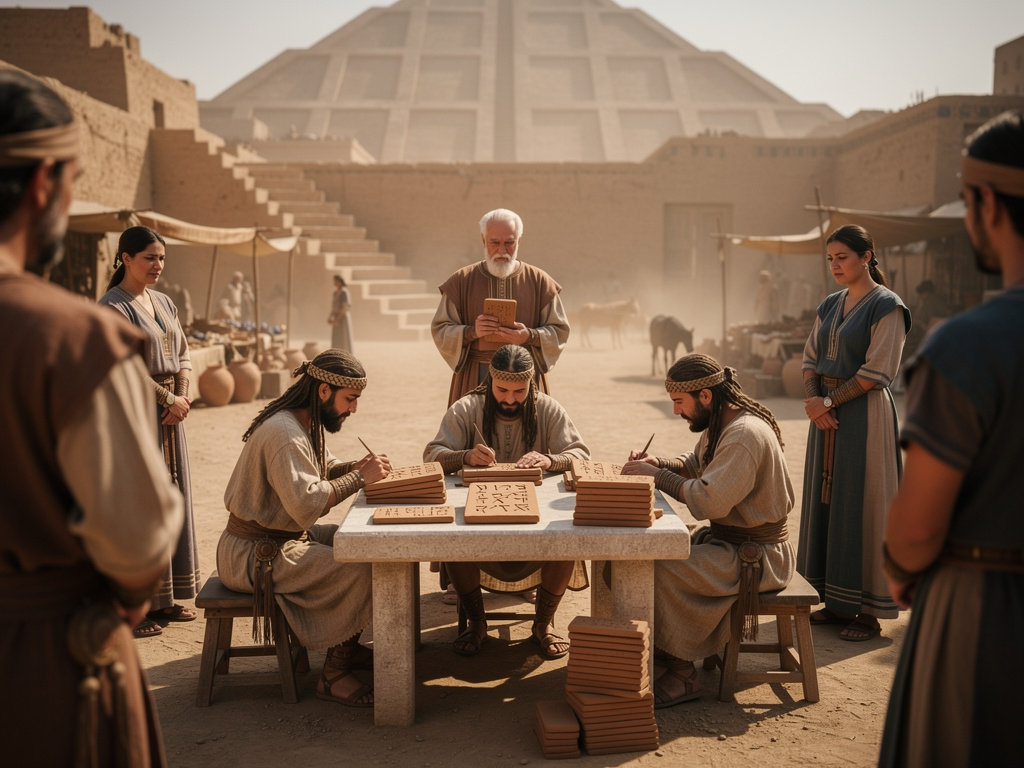
MESOPOTAMIAN SCRIBES AND WITNESSES
An ancient legal scene in Mesopotamia, with scribes recording testimony on clay tablets while witnesses stand present. The emphasis is on documentation and observation, not punishment.
This same principle appears in ancient Egypt, where Ma’at guided justice—a concept often translated as truth, balance, or order, but more accurately understood as alignment with reality. Egyptian judges and scribes were tasked with weighing evidence, not emotions. Exaggeration and distortion were seen as disruptions of cosmic balance. Truth was not what one felt or believed; it was what could be shown to be in harmony with what was.
MA’AT: TRUTH AS BALANCE
A symbolic yet grounded depiction of Ma’at as balance and alignment, not moral judgment—justice as harmony with reality.
In early Israelite law, the commandment against bearing false witness was not merely ethical; it was procedural. A minimum of two witnesses was required to establish guilt. Witnesses bore responsibility for the consequences of their testimony, including punishment if their claims proved false. This system discouraged exaggeration and encouraged restraint. Truth was a collective responsibility, not a rhetorical contest.
Greek and Roman legal traditions further formalized these principles. While rhetoric flourished in Greek courts, oaths and sworn testimony remained central. Roman law, which would become the backbone of European legal systems, emphasized written records, corroboration, and procedural clarity. Emotion was distrusted. Documentation was prized. Justice, ideally, was meant to be dispassionate.
But history also records the moment when this ethic fractured.
THE TURN FROM WITNESS TO CONFESSION
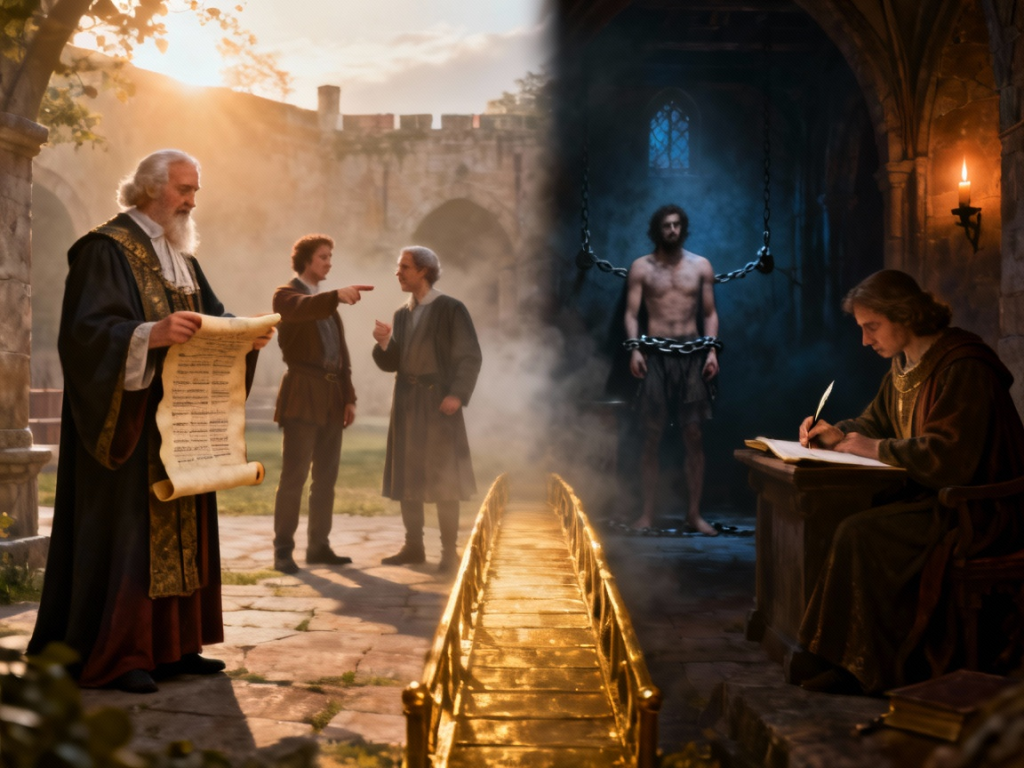
A symbolic transition image showing the shift from witness-based justice to confession-based systems.
During the Inquisition, European justice systems abandoned witness-based evidence in favor of confession—often extracted under torture. Observation was replaced by enforced narrative. Truth became ideological, something to be compelled rather than seen. This marked a decisive break from the Fair Witness tradition, and its consequences echo through modern history.
It is here that Heinlein’s intervention becomes especially clear. Writing in the mid-20th century, in the shadow of ideological trials, loyalty tests, and propaganda, he was not inventing something new. He was restoring something old.
ANUNNAKI, RECORDS, AND COSMIC LAW
For those willing to look even further back—into myth, legend, and alternative interpretations of early civilizations—the Fair Witness ethic reappears in strikingly familiar form.
In Sumerian texts, the Anunnaki are repeatedly associated with record-keeping, decrees, and tablets of destiny. They are described less as moral preachers than as administrators of cosmic order. Human affairs are observed, recorded, and weighed. Decisions are rendered based on what is known, not what is believed.
Within this interpretive framework, justice is not emotional. It is procedural.
This is where the resonance with Fair Witness becomes difficult to ignore. A governance system—human or otherwise—that relies on observation, documentation, and restraint rather than confession or persuasion would look very much like the Fair Witness model Heinlein later articulated.
In the Enki-centered narratives explored in this series, this alignment becomes even clearer. Enki intervenes sparingly. He observes, teaches through consequence, and records outcomes. Authority arises from knowledge, not force. Whether understood as mythological metaphor or speculative history, the pattern is consistent: truth is something revealed, not imposed.
THE TABLETS OF DESTINY
A symbolic image representing record-keeping as the foundation of cosmic order, without literal or dogmatic claims.
Seen this way, Fair Witness is not a modern invention at all. It is a recurring human—and possibly pre-human—attempt to prevent justice from collapsing into ideology. It surfaces whenever societies recognize that truth must be constrained by observation, or it will be weaponized by belief.
This may be why Fair Witness feels radical again now. We are living through another confessional era, where allegiance matters more than evidence, and narrative loyalty outweighs consequence. In such times, the simple act of saying “this is what I saw” becomes an act of resistance.
🔧 WORK IN PROGRESS
This article is part of an ongoing series and may be expanded or updated as the work continues.
SUBSCRIBE — STAY CONNECTED
If this article resonates, consider subscribing to receive future essays and updates as this series develops.
fair witness, Robert Heinlein, Stranger in a Strange Land, Lazarus Long, Anunnaki history, Enki, ancient justice systems, Mesopotamia law, Ma’at, Hammurabi, Sumerian tablets, witness testimony, psychotherapy, voice dialogue, Hal Stone, Sasha Alex Lessin, Janet Kira Lessin, observational truth, propaganda, McCarthyism, truth and democracy, cosmic law, immortality archetypes, mythic psychology, narrative therapy, ET history, Anunnaki consciousness, spiritual evolution, domination vs partnership, Aquarian Age
✅ X (TWITTER) DESCRIPTION — 280 CHARACTERS
A deep dive into the ancient roots of the Fair Witness—from Sumer to Heinlein to modern therapy. How do we restore truth in an age of propaganda and distortion? Janet & Sasha explore the immortal witness, Enki, Lazarus Long, and the rebirth of civic clarity. #FairWitness
What if the answer to our age of distortion, propaganda, and “alternate realities” isn’t new at all — but ancient?
Janet Kira Lessin & Sasha Alex Lessin explore the long arc of the Fair Witness: from Sumerian scribes and Egypt’s Ma’at… to medieval justice and the Inquisition… to Robert Heinlein’s brilliant revival of the discipline… to modern psychological counseling and the therapist’s role as observer… to the Anunnaki themselves — the immortal record-keepers of cosmic law.
This is the story of how civilizations rise or fall based on one principle: whether human beings can accurately witness reality.
A must-read for fans of Heinlein, ancient history, ET cosmology, consciousness studies, and anyone seeking clarity in chaotic times.
SUBSCRIBE — FOLLOW THE SERIES
This article is part of a larger, ongoing exploration of truth-telling, ethical witnessing, domination vs. partnership, psychology, and the stories that shape our shared reality.
By subscribing, you’ll receive new articles as they’re published and deeper dives into the ideas introduced here.
SUBSCRIBE — SUPPORT INDEPENDENT WRITING & RESEARCH
This article is part of a long-form independent project examining power, justice, consciousness, and ethical responsibility across history, psychology, and lived experience.
Subscriptions support sustained research, deep writing, and the continuation of this series.
This article is part of a continuing body of work and remains a living document. Future updates may include expanded historical context, additional essays, and cross-links to related articles in the series.