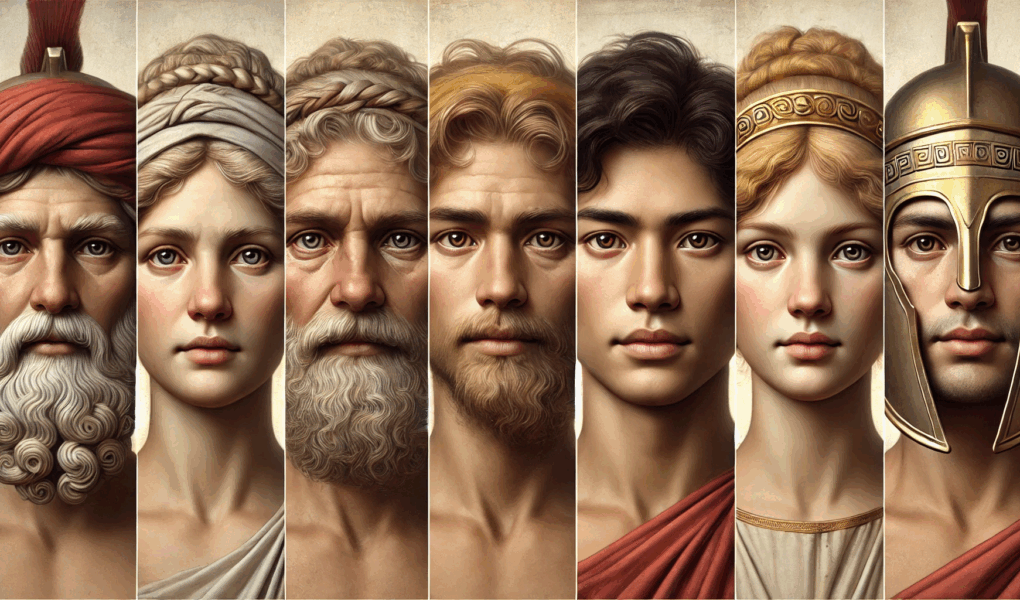
📘 ARTICLE SUMMARY:
This article explores how Cleisthenes of Athens built on Solon’s reforms to establish the world’s first literate democracy in Athens around 508 BCE. It details the political drama of the time, including power struggles with Hippias, Peisistratus, Isagoras, and the intervention of Sparta, as well as the historical roots of reform tracing back to the Alcmaeonid curse and the Oracle of Delphi. It also explains how Cleisthenes restructured Athenian society by locality (demes) instead of kinship.
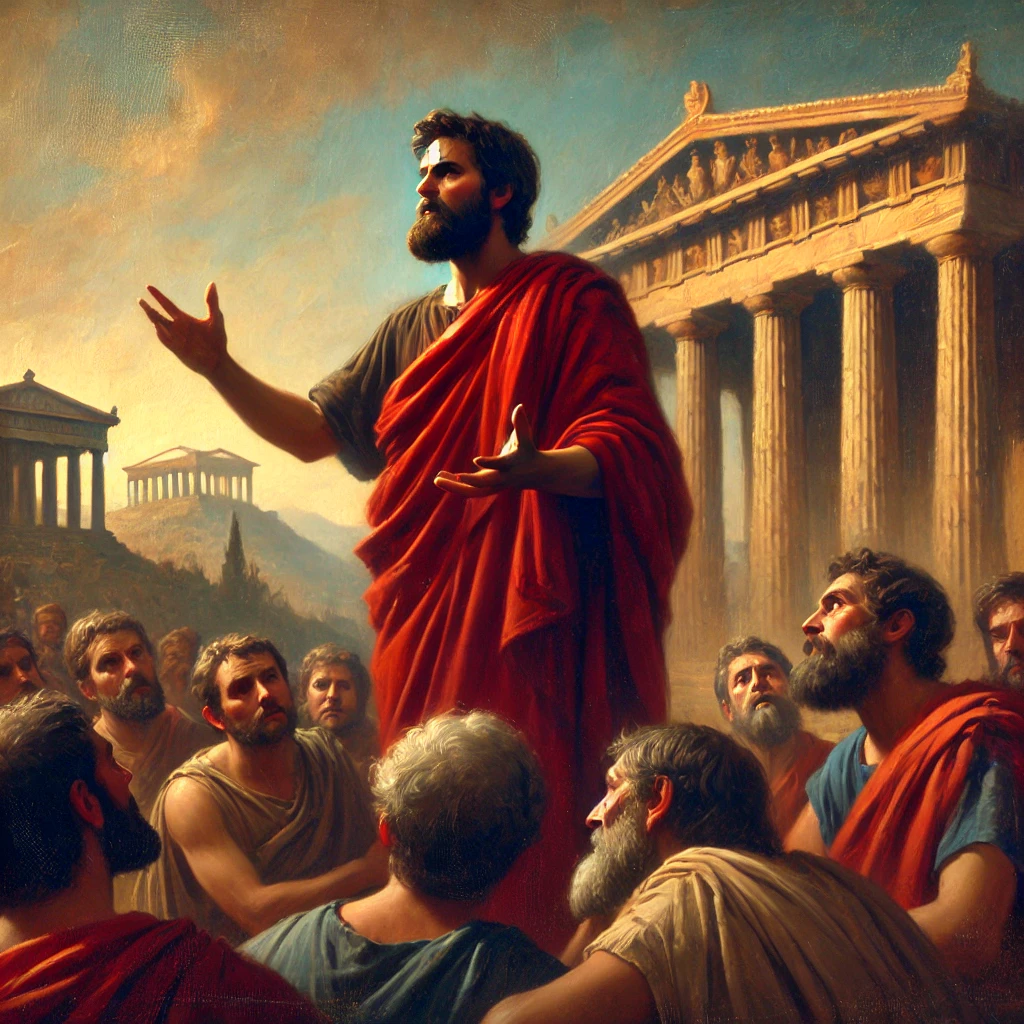
Cleisthenes stands boldly before the citizens of Athens, his arm outstretched in a powerful appeal to unity and reform. Against the backdrop of the Acropolis, his presence marks the turning point where Athenian identity shifts from aristocratic lineage to civic participation — the birth of democracy begins.
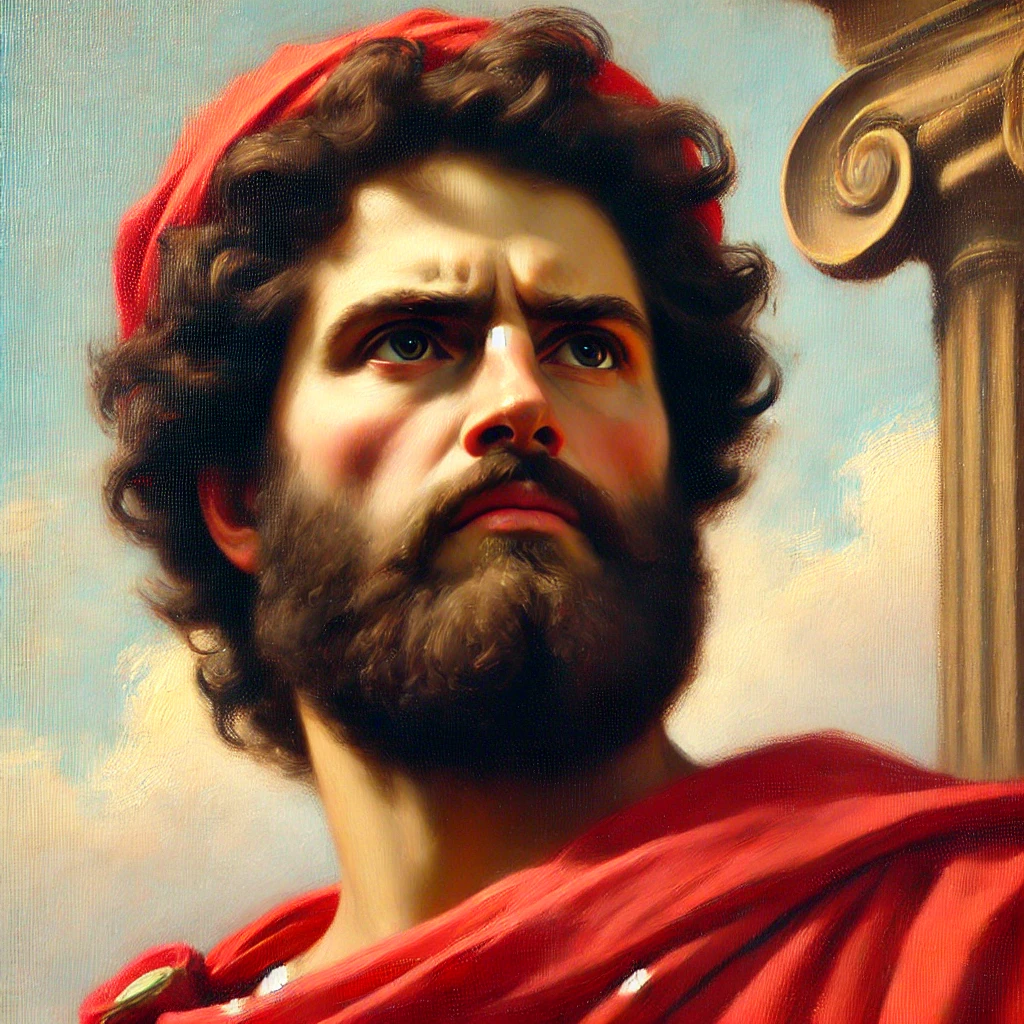
A close-up of Cleisthenes captures the fire and focus of a man reshaping history. His eyes reflect the weight of leadership and the clarity of democratic purpose, framed by the flowing red of his himation and the stately columns of Athens rising behind him.
CLEISTHENES EXPANDED SOLON’S REFORMS INTO THE FIRST LITERATE DEMOCRACY by Sasha Alex Lessin, Ph.D. (Anthropology, U.C.L.A.)
Peruse more on Cleisthenes and the history of ancient Greece at https://wp.me/s1TVCy-greece.
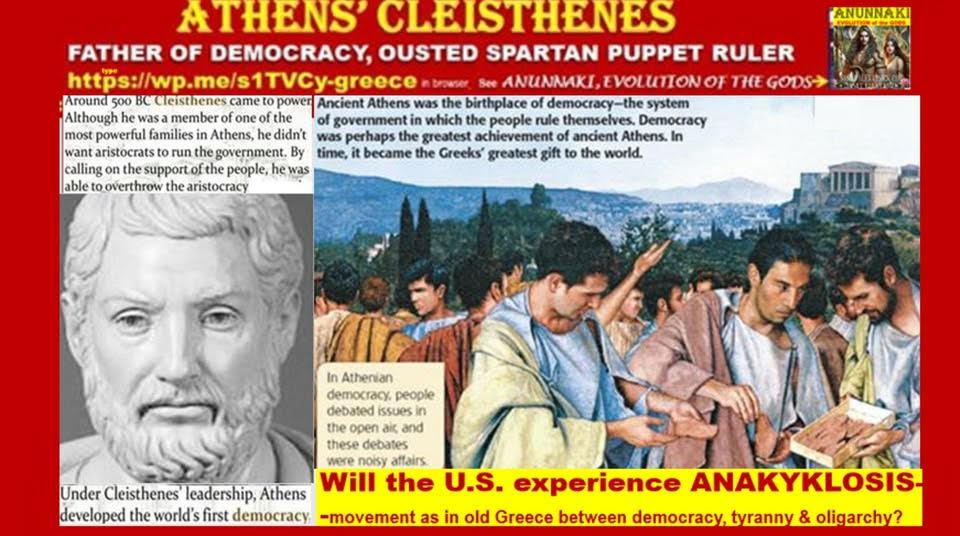
Athenian noble Cleisthenes of Athens (570-508 BCE) founded Athenian Democracy. He held the Office of Chief Archon (Highest Magistrate) of Athens (525–524)
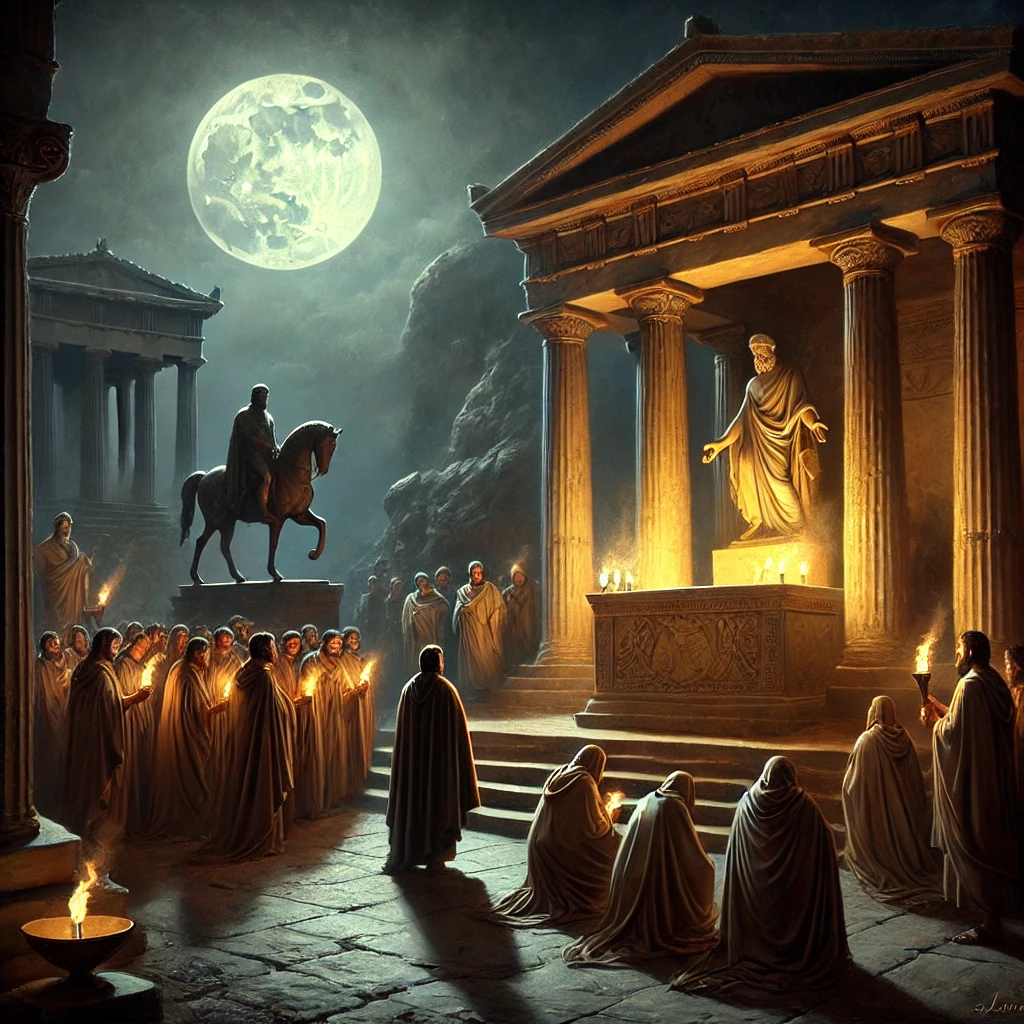
Under a pale moon, fugitives cling to the altar’s protection as silent soldiers watch from the shadows. The looming statue of Apollo bears witness to the sacred moment, casting judgment over all. Megacles stands apart, haunted by the moral weight of what’s to come — the seeds of a family curse sown in solemn silence.
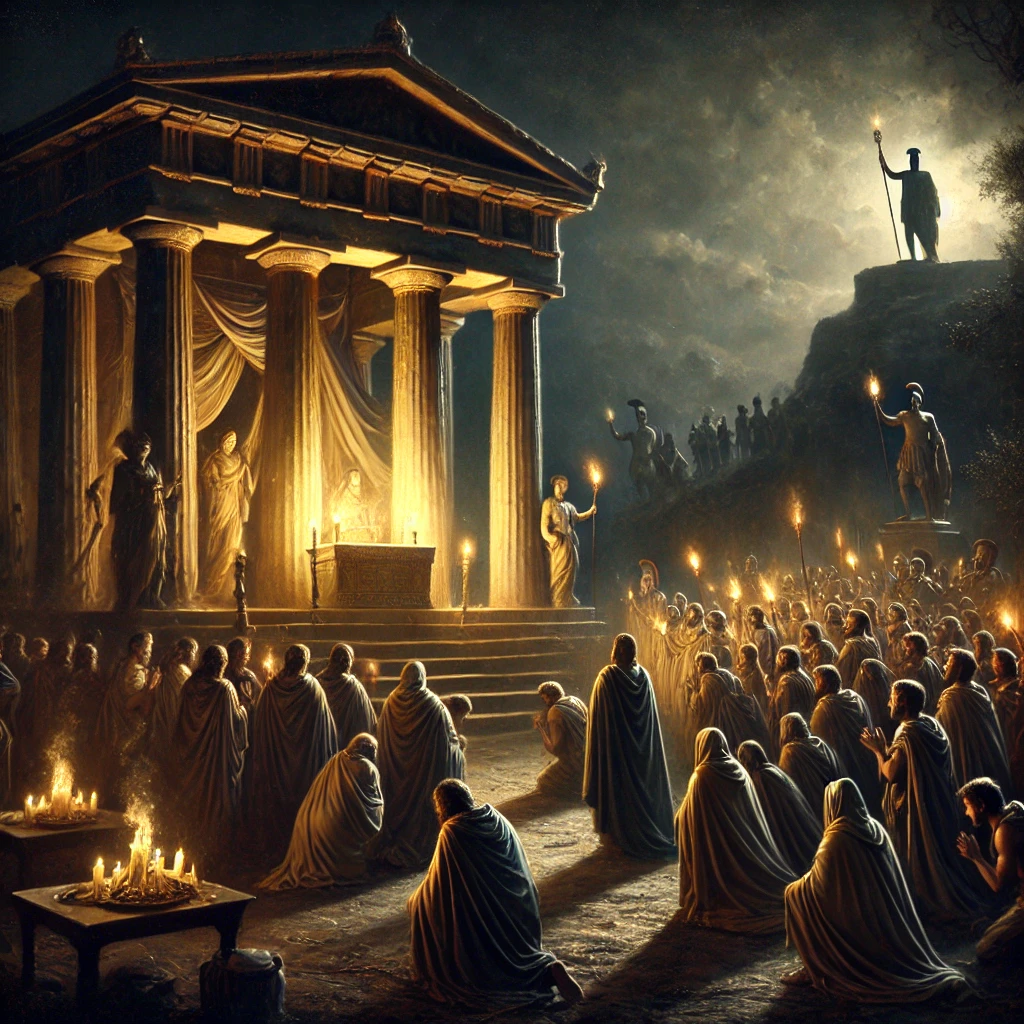
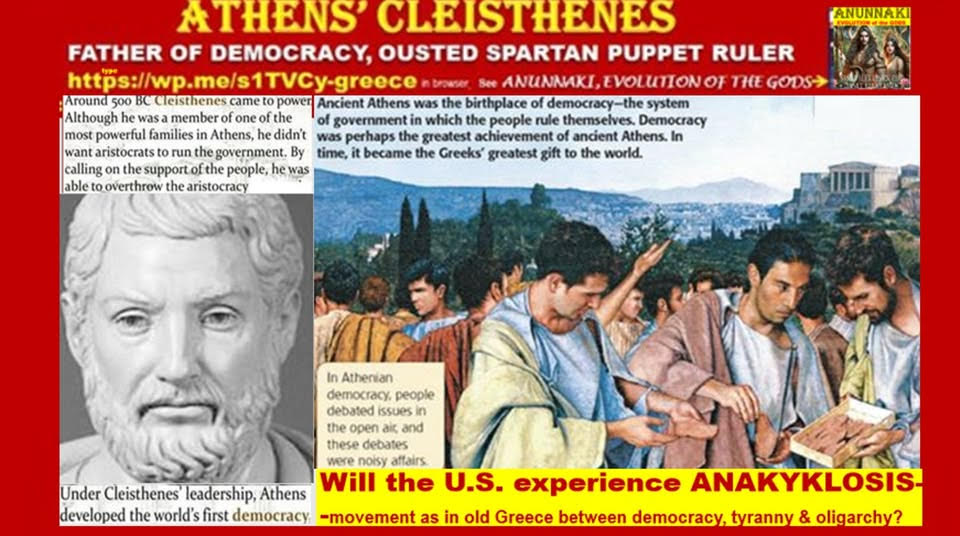
He allied with the People’s Assembly against the nobles in 508 BCE and imposed democratic reforms on Athens. He organized people into individual citizens of the locale, rather than by family and clan membership.
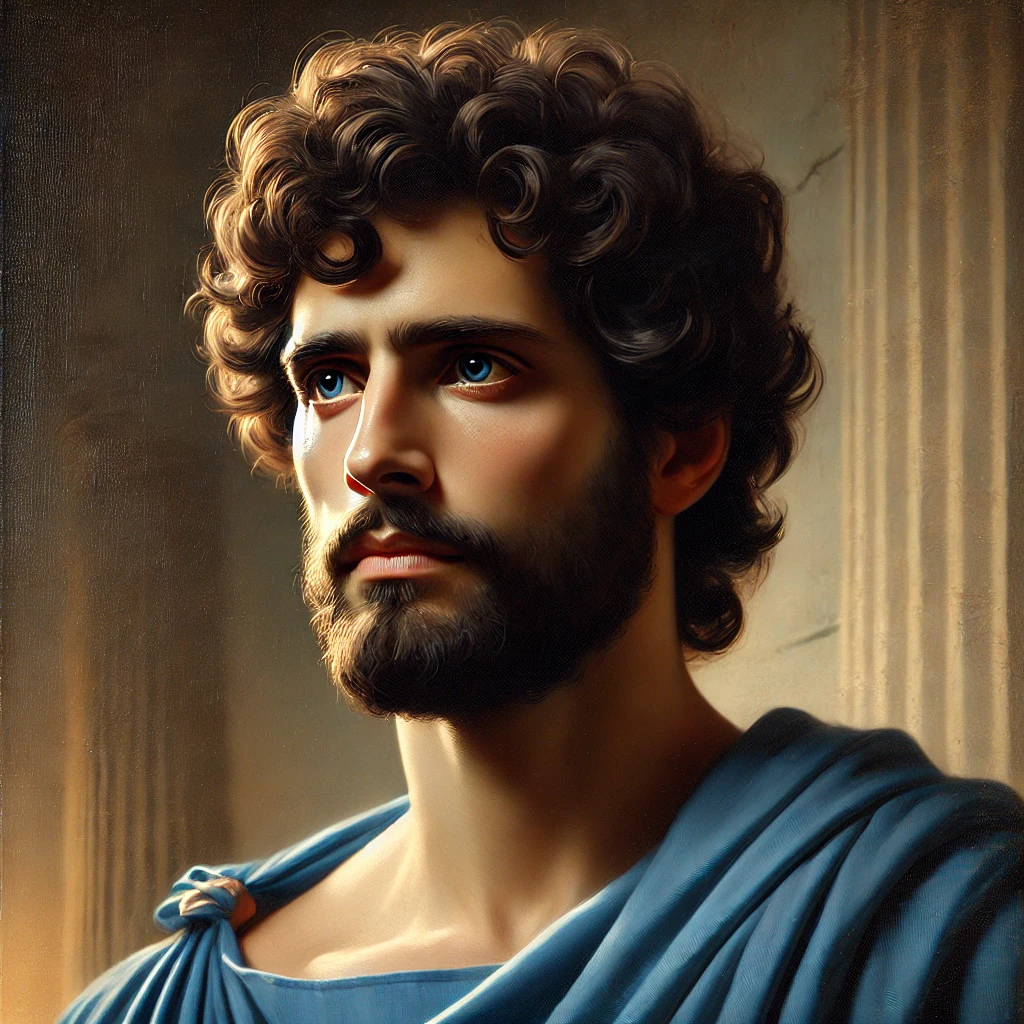
Megacles gazes forward with the clarity of a man aware of his legacy. In his calm but burdened expression, we see the origin of a curse—not born of malice, but of decision in crisis. Framed by the soft stone of the sanctuary wall, he stands between tradition and transformation.
His ALCMAEONID FAMILY bore a public curse on his great-grandfather MEGACLES, Chief Archon, when the Athenian noble CYLON tried but failed to seize the Acropolis [Civic Center] and make himself Tyrant [Dictator] (c. 632), as Trump has recently.
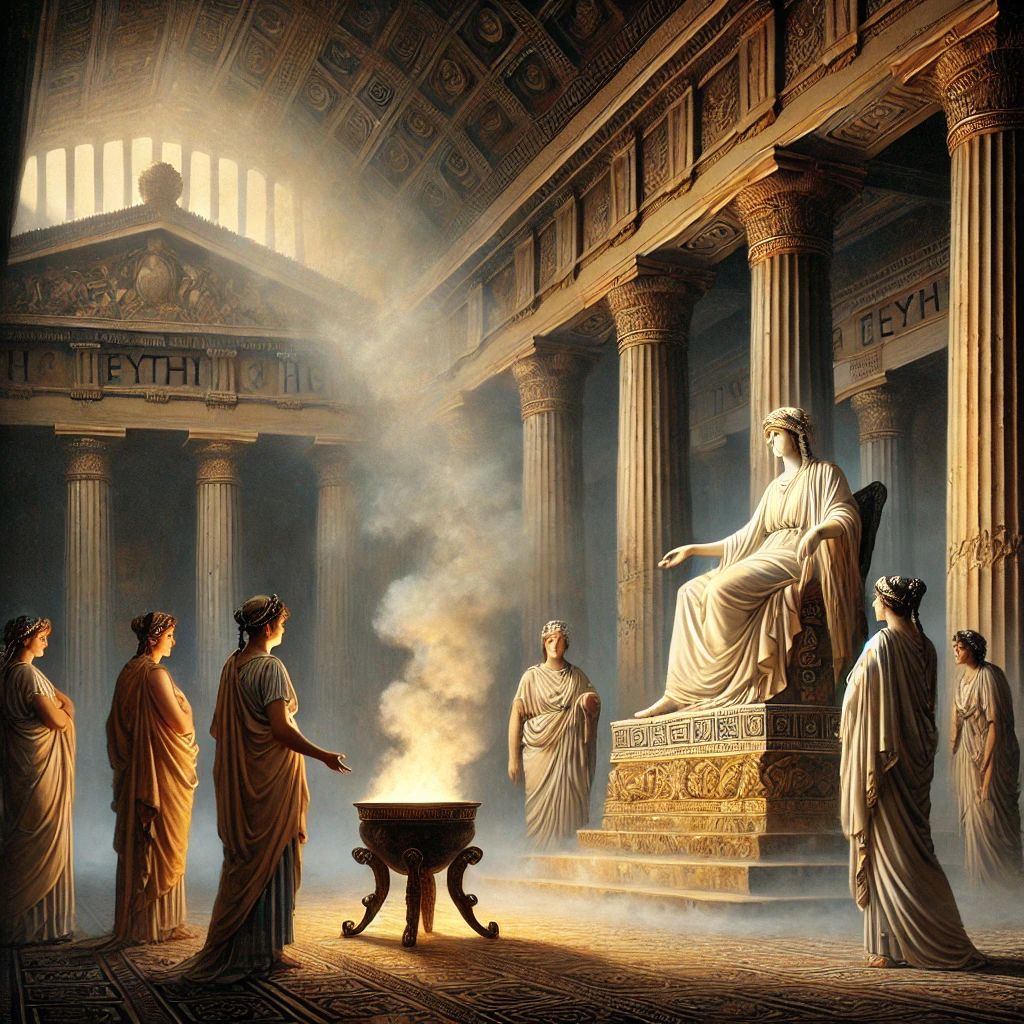
In the sacred glow of Apollo’s temple, the Pythia delivers her cryptic message, surrounded by incense and awe-struck attendants. Athenian envoys stand respectfully nearby, awaiting divine guidance. The fissure breathes its vapors, and history shifts in the silent moment between prophecy and action.
Some of Cylon’s followers took refuge at an altar and did not abandon it until Megacles’ forces promised them to spare their lives, but their captors killed them anyway. Megacles was held responsible.

Bathed in golden light and sacred stillness, the Oracle of Delphi sits in trance, her face serene and otherworldly. Incense swirls like prophecy itself as she channels the voice of Apollo. In this moment, time bends — and the fate of Athens hangs on the breath of a god.
The oracle of Apollo, son of Zeus or Marduk, at Delphi in central Greece, cursed Megacles and the Alcmaeonid clan.

Now meeting our gaze, the Oracle holds the viewer in a quiet, commanding trance. Her expression bridges the mortal and the divine — the serenity of stillness charged with ancient knowing. She speaks not in words, but through presence: your fate is already seen.
They exiled themselves, but Athens’ lawgiver Solon let them return in 594 BCE.
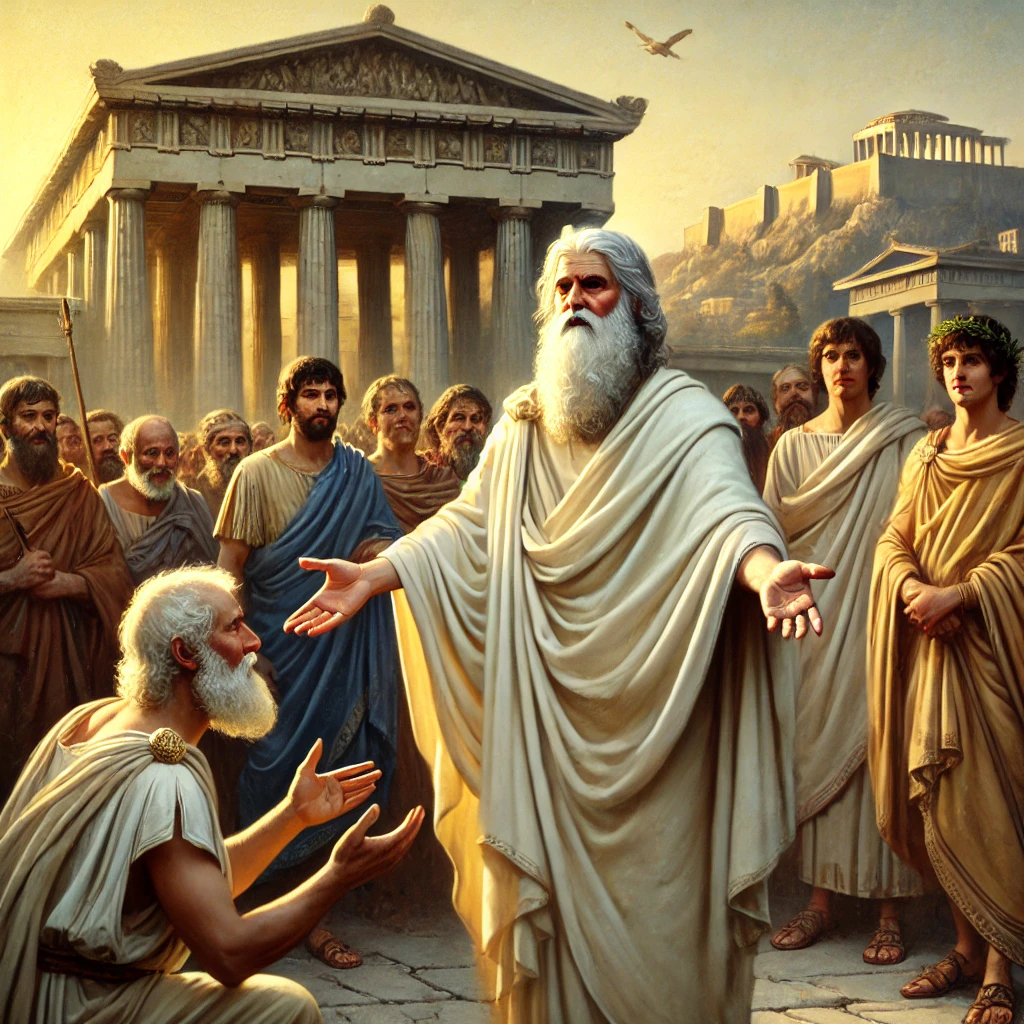
With the Acropolis rising behind him, Solon stands as a bridge between justice and renewal. His open arms welcome the Alcmaeonids back to Athens — an act of wisdom, forgiveness, and political restoration. The city breathes a new dawn, as reform takes root in the soil of return.
In return, allied with Solon, Megacles’ son Alcmaeon led an Athenian contingent that fought with Thessaly and the Tyrant of Sicyon (also named Cleisthenes), in the “SACRED WAR” for the protection of the augury establishment at Delphi.
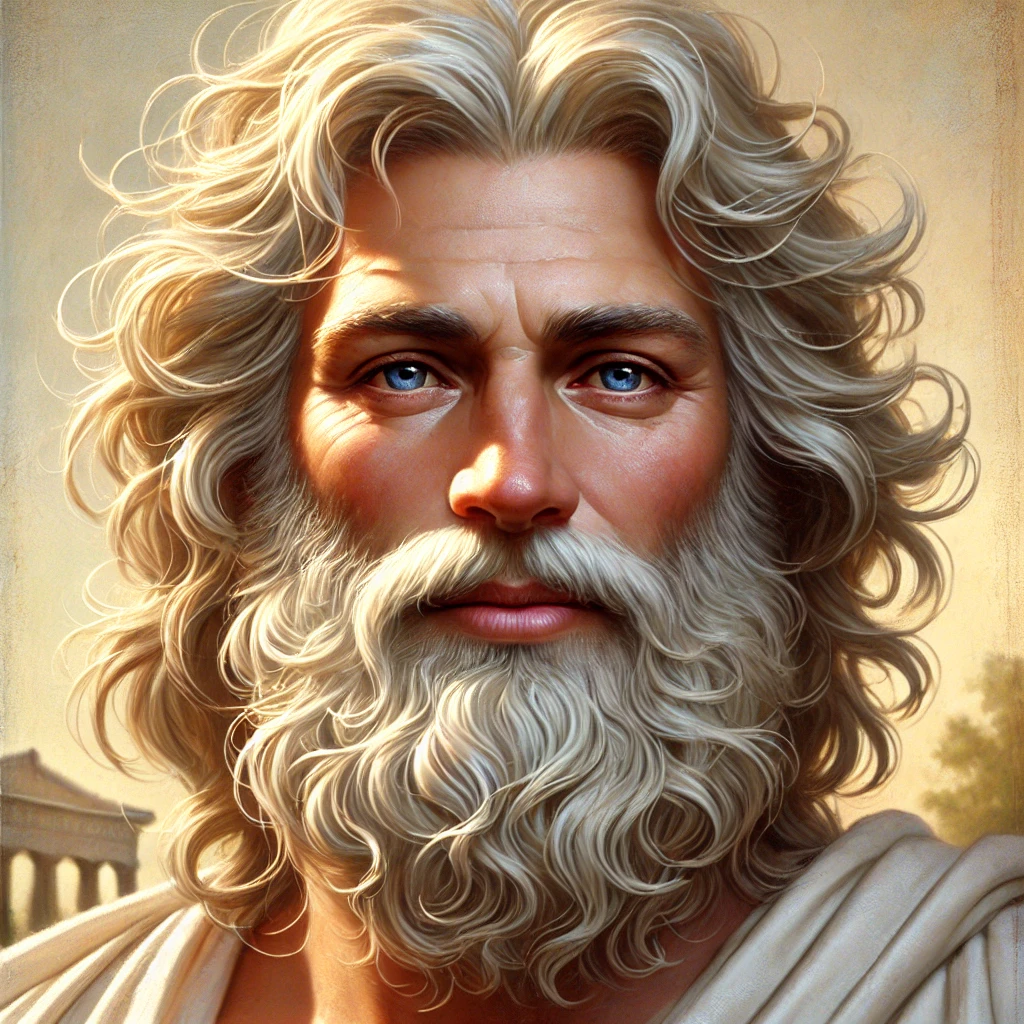
Now rendered with mythic clarity, Solon’s gaze holds the wisdom of generations. His hair flows naturally, his face composed with the quiet strength of a philosopher-statesman. In him, Athens found its conscience — the first true architect of justice and balance.
The old nobility thought that Solon had gone too far and were anxious to reverse the trend; the common people felt that he had not gone far enough. The Alcmaeonids, whom the curse had alienated from the nobility, championed a middle way based on Solon’s reforms.
When Cleisthenes was 25 years old, PEISISTRATUS, a noble who roused the poor, took power in 560 and again exiled the Alcmaeonids from Attica in 546. Cleisthenes was then 25 years old and could not return for 20 years, until 521.
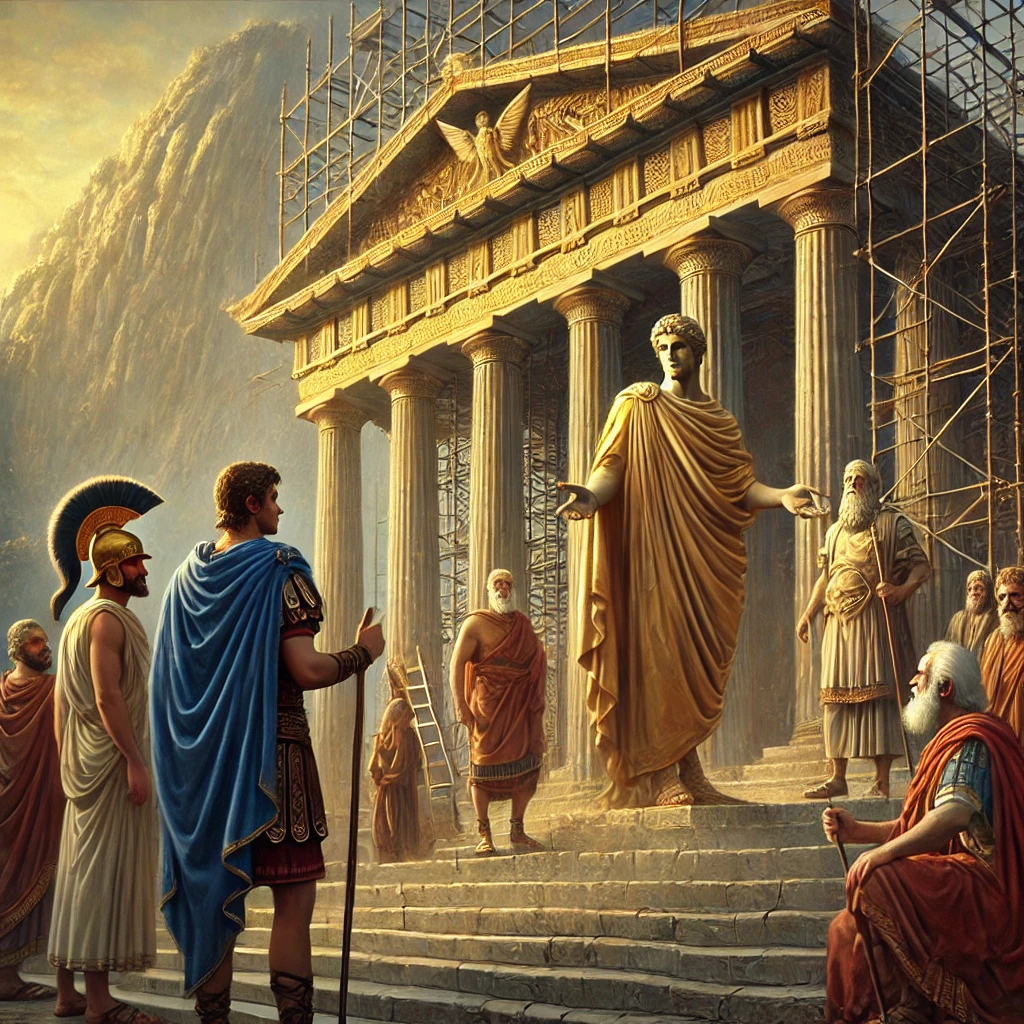
In the wake of devastation, Delphi rises again. Alcmaeon, youthful and resolute, gestures toward the sacred site his family helped restore. Beside him, Cleisthenes of Sicyon consults with temple architects, their shared vision etched in golden light. The gods watch silently as mortals rebuild what war had scarred.
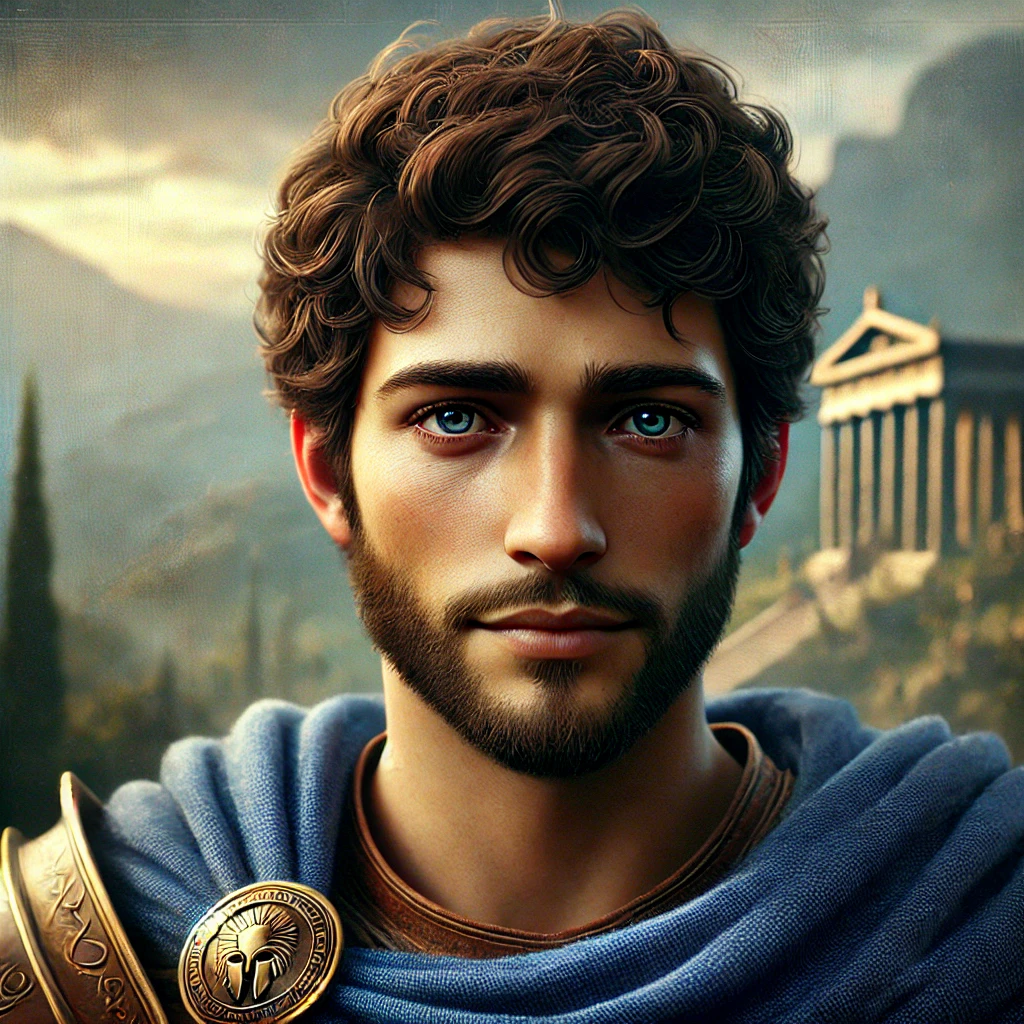
Facing us with open eyes and unwavering resolve, Alcmaeon embodies the noble spirit of Athens reborn. In the glow of sacred mountains, his gaze reveals not just a warrior but a soul forged by duty, honor, and the weight of legacy.
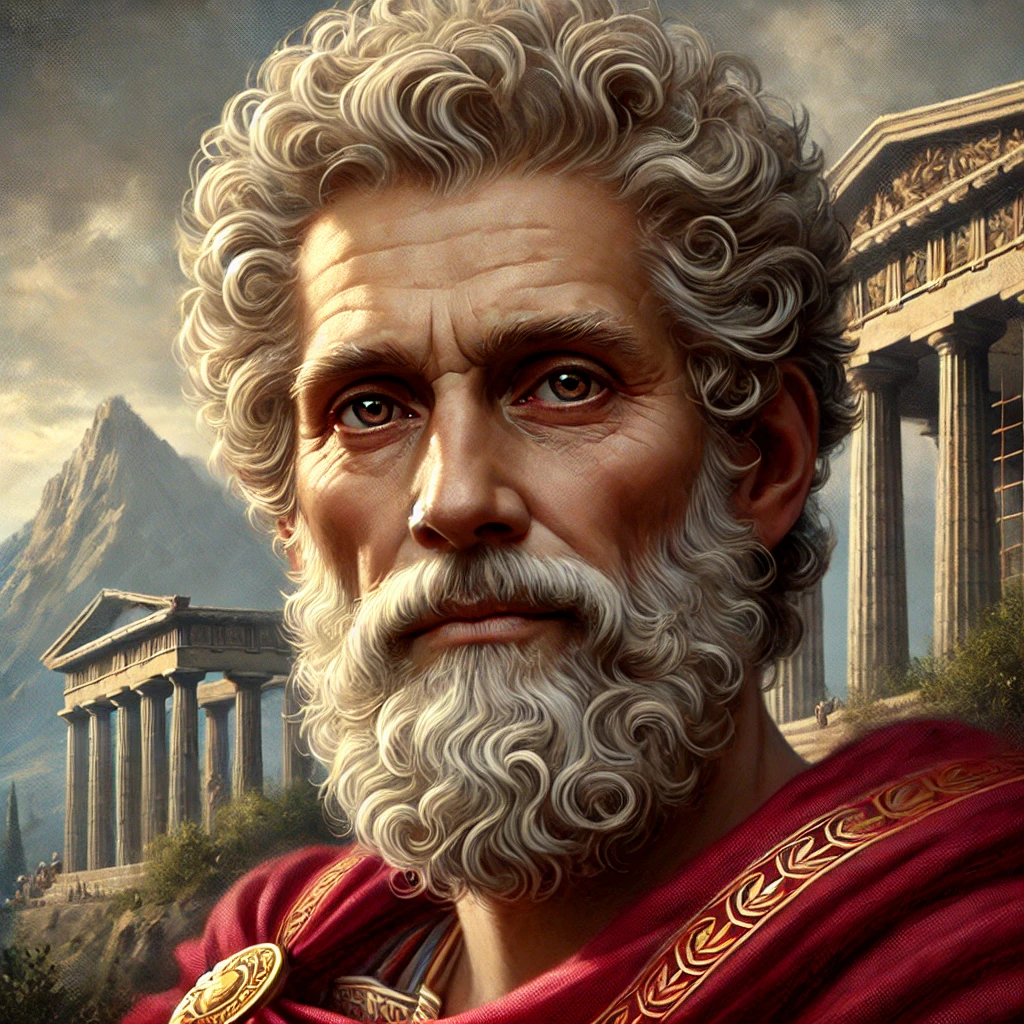
With eyes that weigh legacy and diplomacy, Cleisthenes of Sicyon stands as both patron and tactician. Draped in red and gold, he surveys Delphi’s sacred rebuild — not just for the gods, but for Greece. Every stone laid reflects his measured intent.
The Alcmaeonids’ part in the Sacred War ensured the favor of the Delphi establishment, and the Alcmaeonids helped rebuild APOLLO’S TEMPLE, which had burned down in 548.
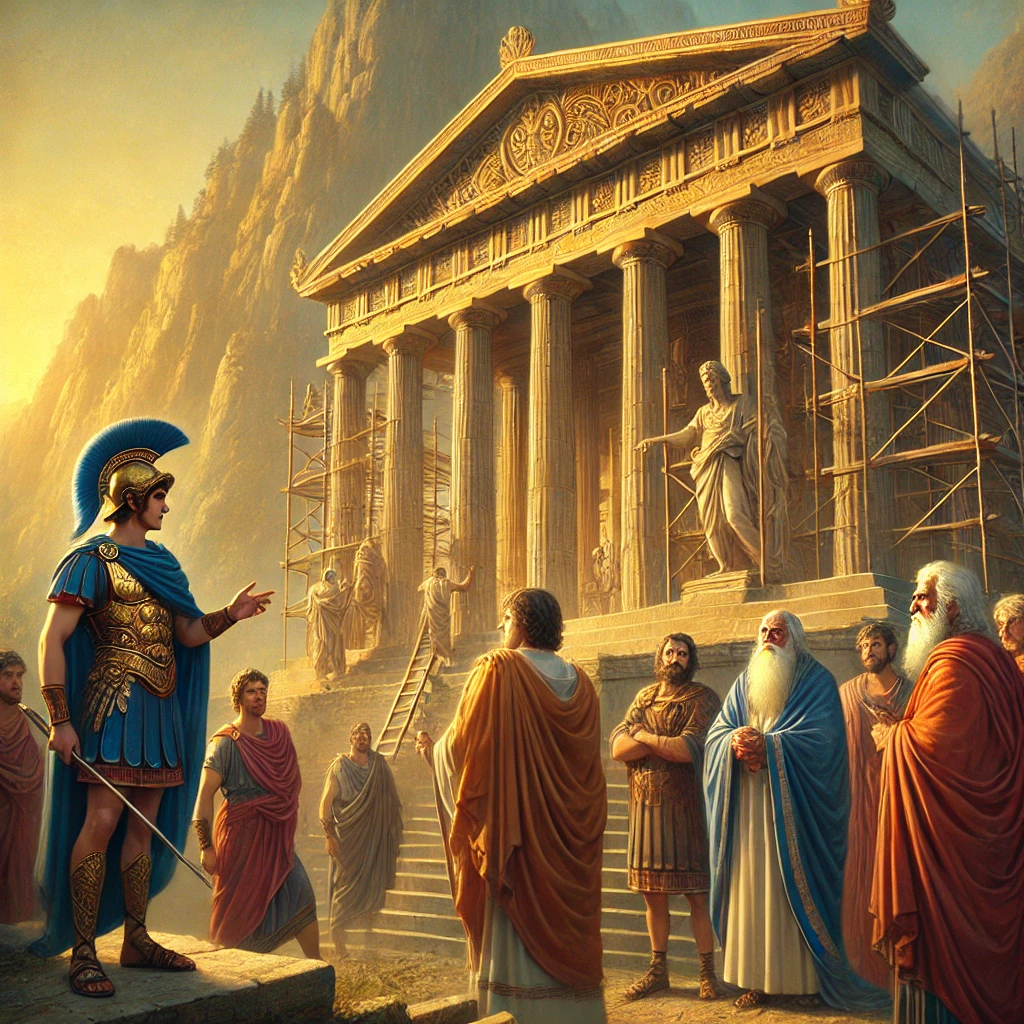
Back in Athens, the Assembly elected Cleisthenes Chief Archon in 525–524.
When Peisistratus died in 527, his son and successor, HIPPIAS, tried to win back the aristocrats, while the Alcmaeonids attempted to regain their position. In 512, Hippias, paranoid after enemies murdered him in 514, repressed the Athenians.
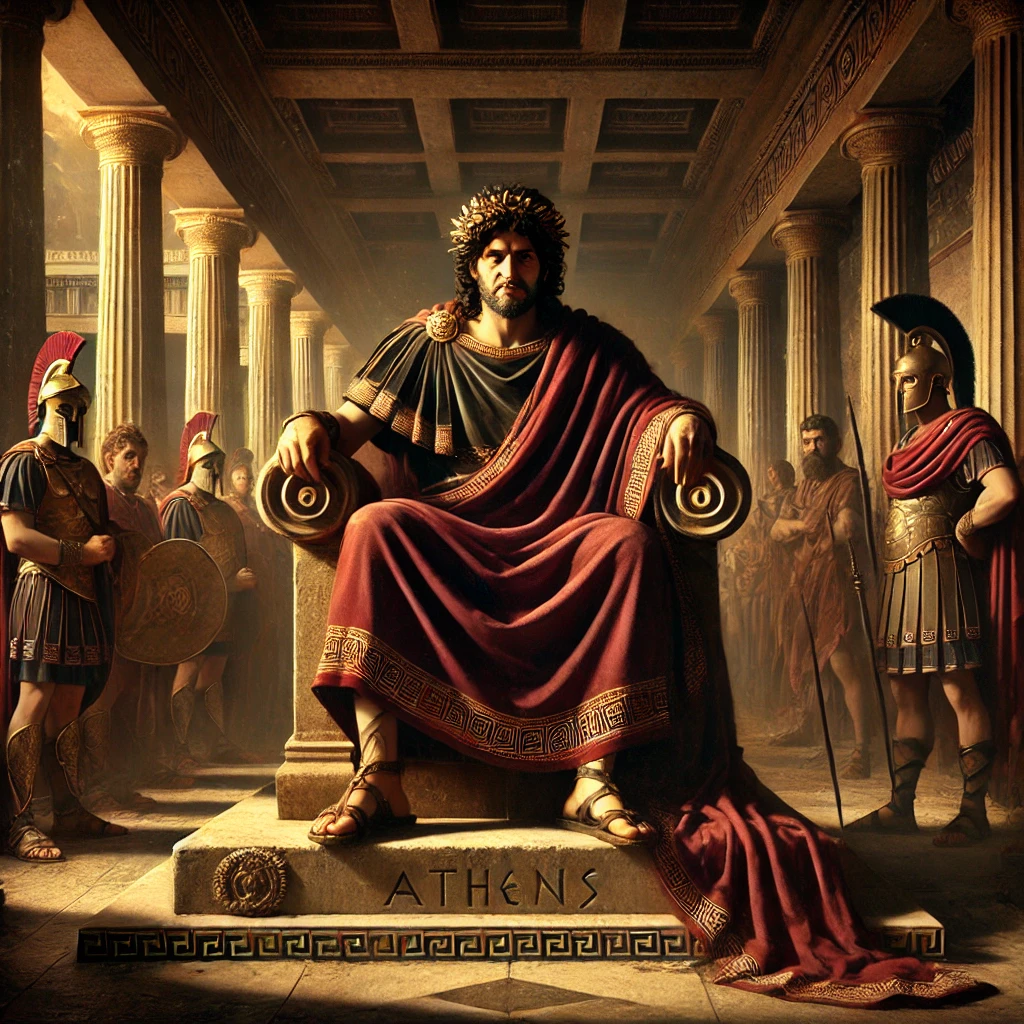
Seated high in his marble hall, Hippias wears the crown of power — but not peace. His gaze cuts toward imagined threats, and the silent tension of his court speaks louder than laws. Guards watch. Citizens hold their breath. The age of tyranny tightens like a shadow.
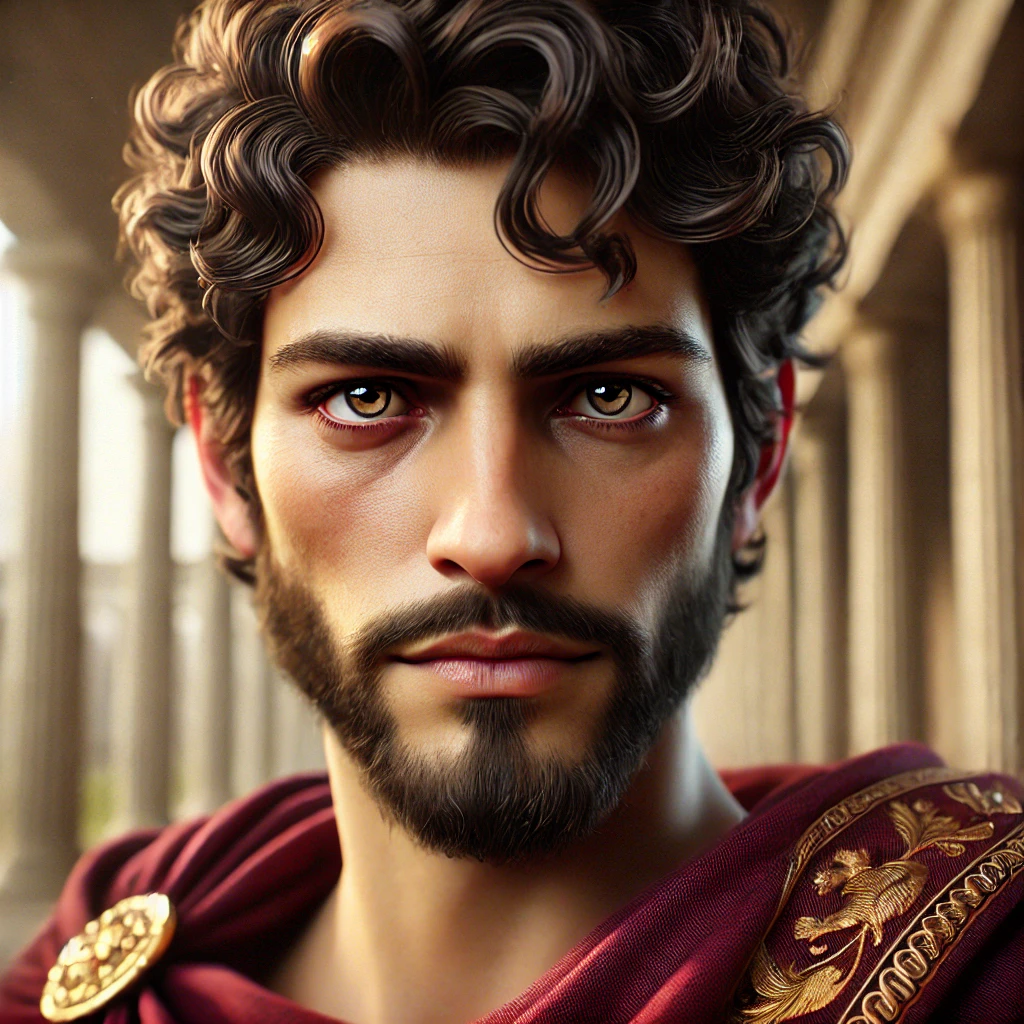
His eyes meet ours with chilling clarity — alert, intelligent, and always calculating. Draped in regal finery, Hippias wears suspicion like a second crown. Power surrounds him, but trust is gone. In his gaze, we see not just control, but the weight of fear.
The DELPHIC ORACLE persuaded the Spartans to send an army to Athens at their expense and force Hippias and his family to leave Attica.
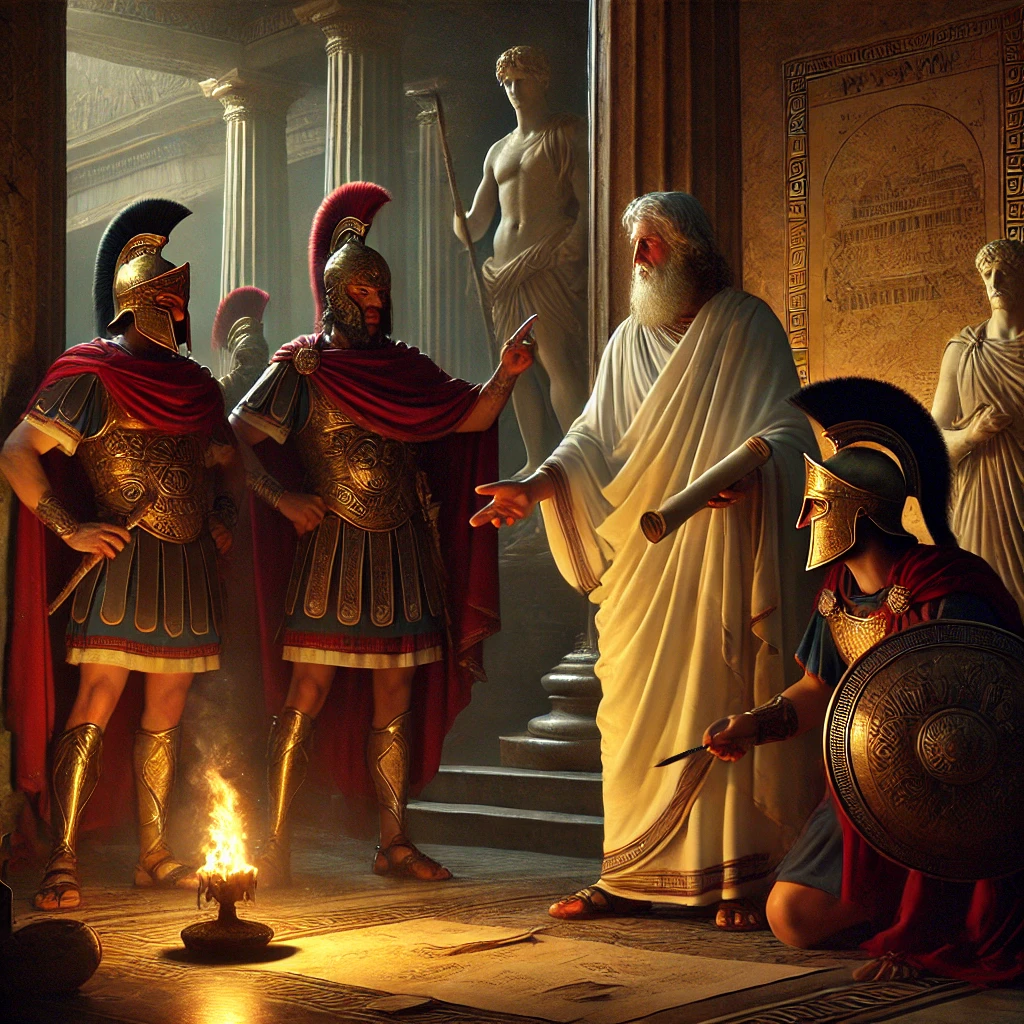
In a shadowed chamber lit by flame and ambition, Isagoras conspires with Spartan power. Cloaked in refinement, he gestures with confidence while warriors in crimson listen. The fate of Athens hangs not in battle, but in this quiet pact — drawn in secret, sealed with intent.
In 508, ISAGORAS, the leader of the reactionary nobles, was elected Chief Archon over Cleisthenes. Cleisthenes then brought the Athenian common people into partnership, and the People’s Assembly elected a relative of the Alcmaeonids as Chief Archon for the following year. Isagoras left Athens to get the Spartans to intervene on his behalf.
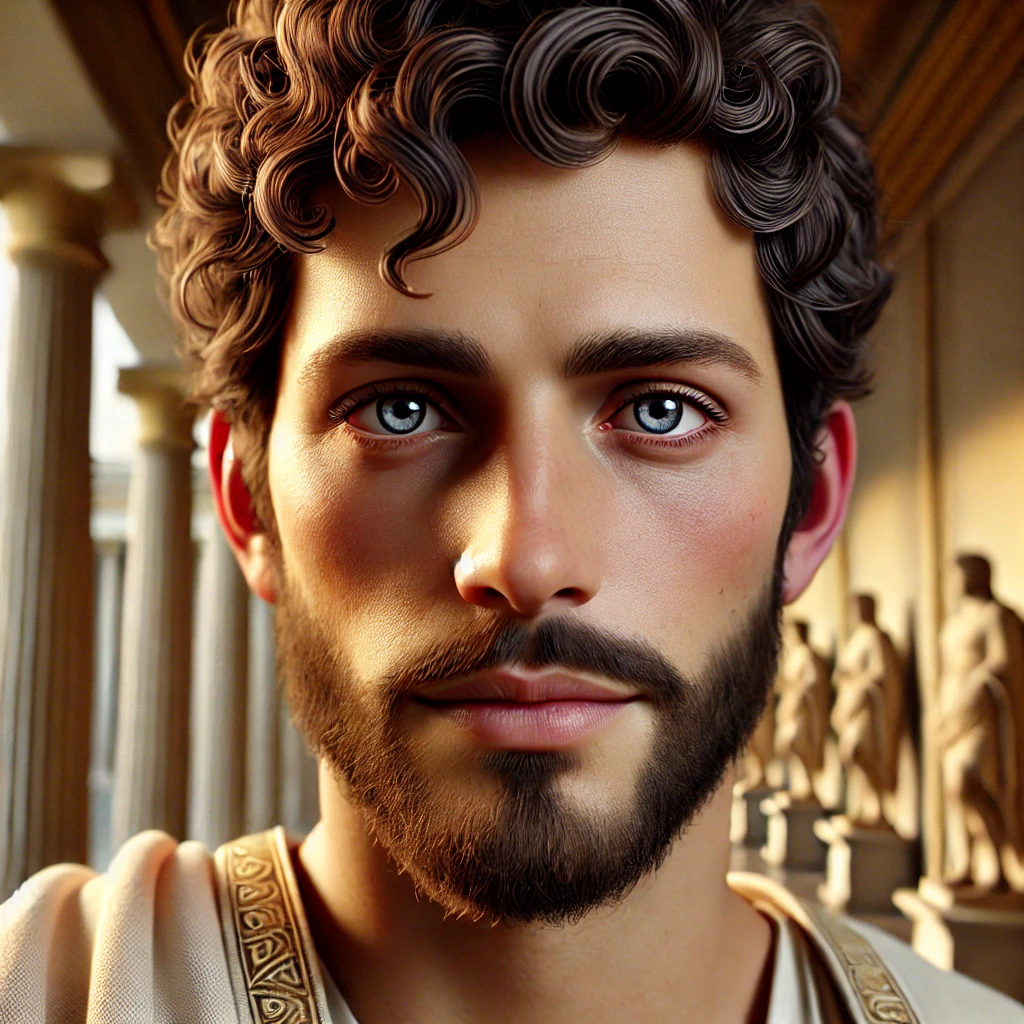
Now framed in the tones of antiquity, Isagoras appears as he might have stood in marble halls: curls natural, eyes alert, bearing rich with quiet entitlement. This is a man not born for the people, but for position — polished, precise, and always thinking one move ahead.
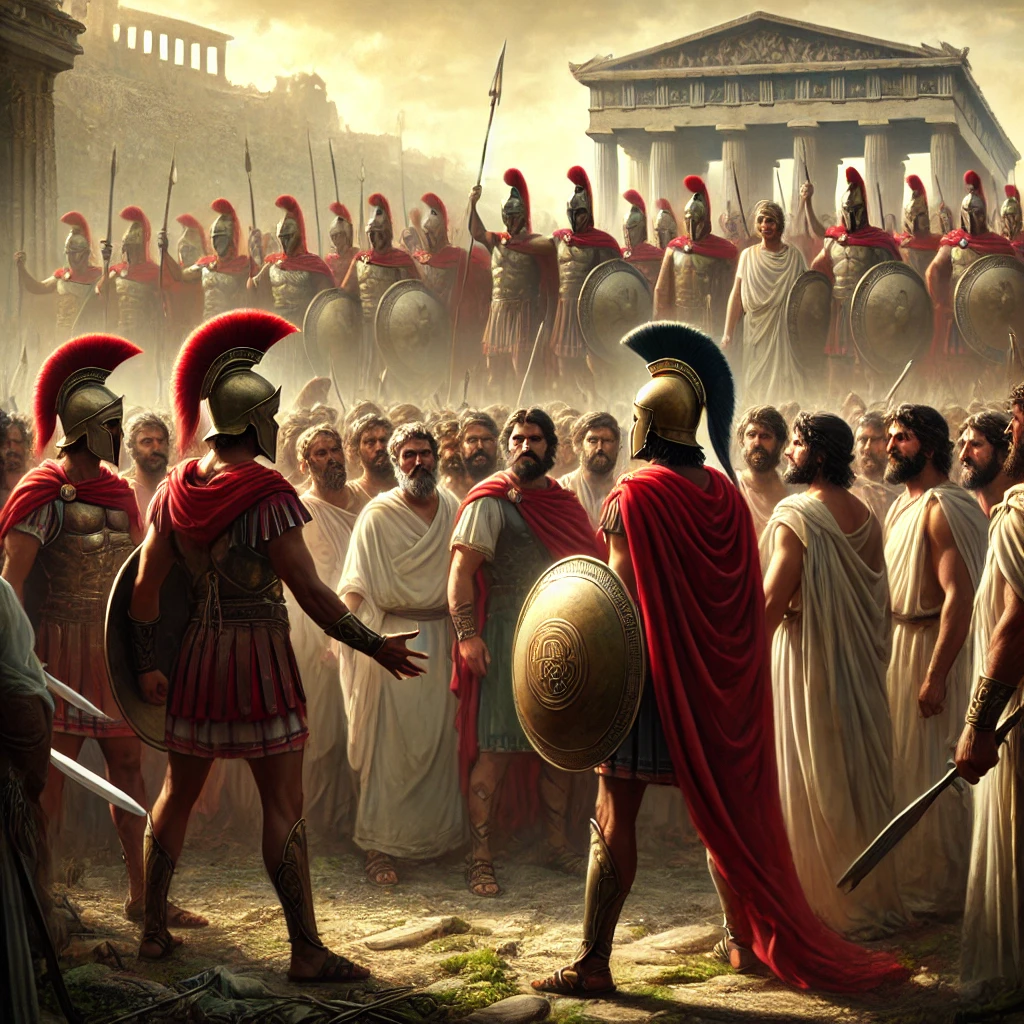
At the gates of their city, the people of Athens rise—not as soldiers, but as citizens. Side by side, men and women stand firm against the armored might of Sparta. Behind them, the Acropolis watches like a guardian of liberty. This is not just defiance — it is the birth of democratic courage.
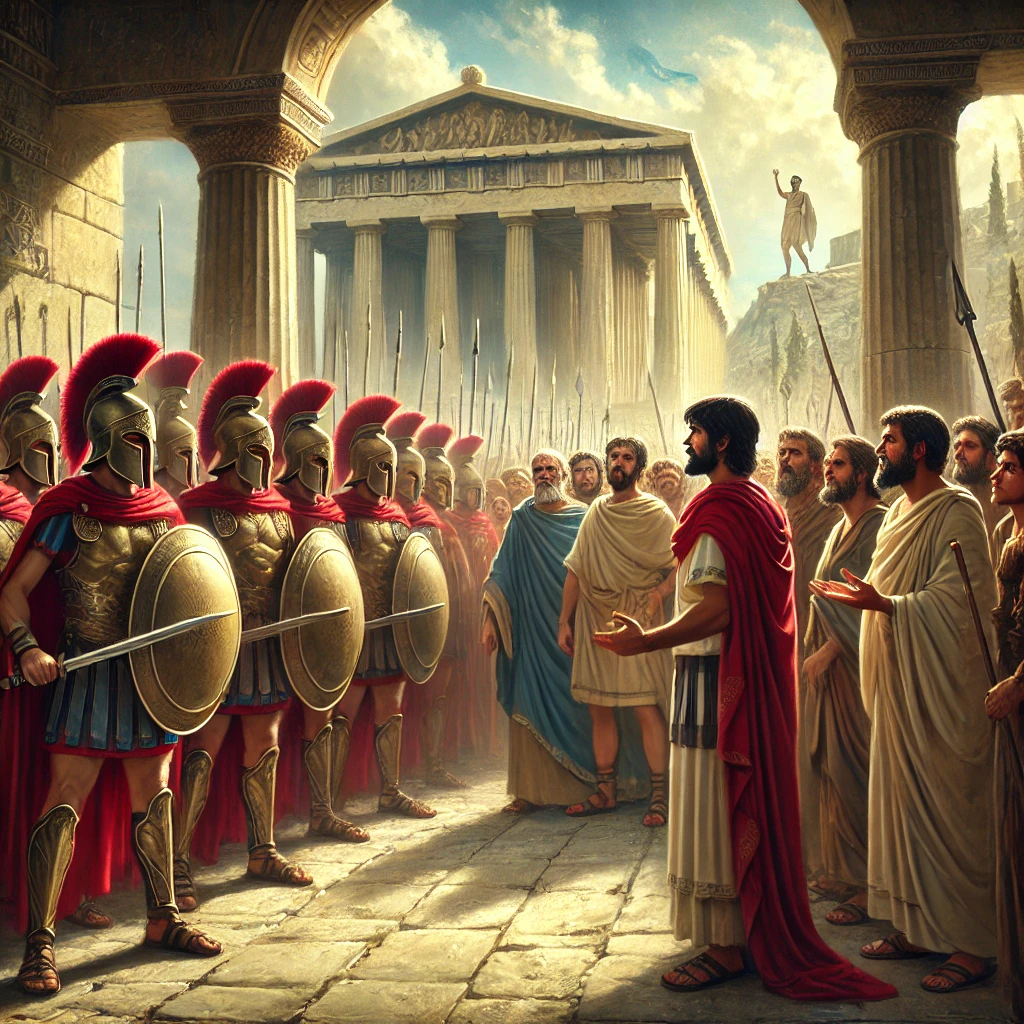
The Royalist SPARTANS TRIED TO STOP ATHENS FROM BECOMING DEMOCRATIC, and Sparta’s King demanded the expulsion of “those under the curse,” and the Athenian Assembly again expelled Cleisthenes and his relatives. The Athenians, however, resisted, and the Spartans withdrew.
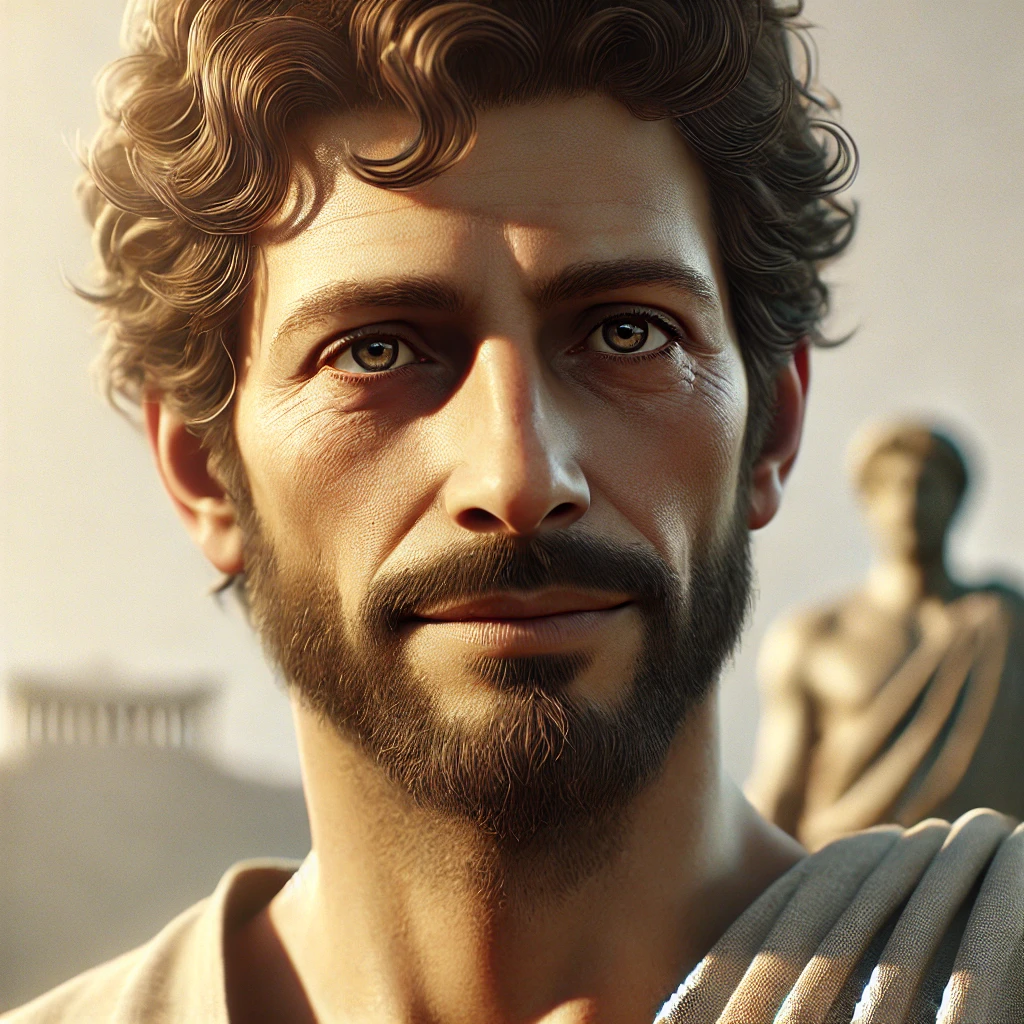
With quiet dignity, he stands his ground—not in armor, but in principle. His eyes, open and unwavering, reflect the strength of a people choosing courage over conquest. He is no king, no general — only free. And that is enough.
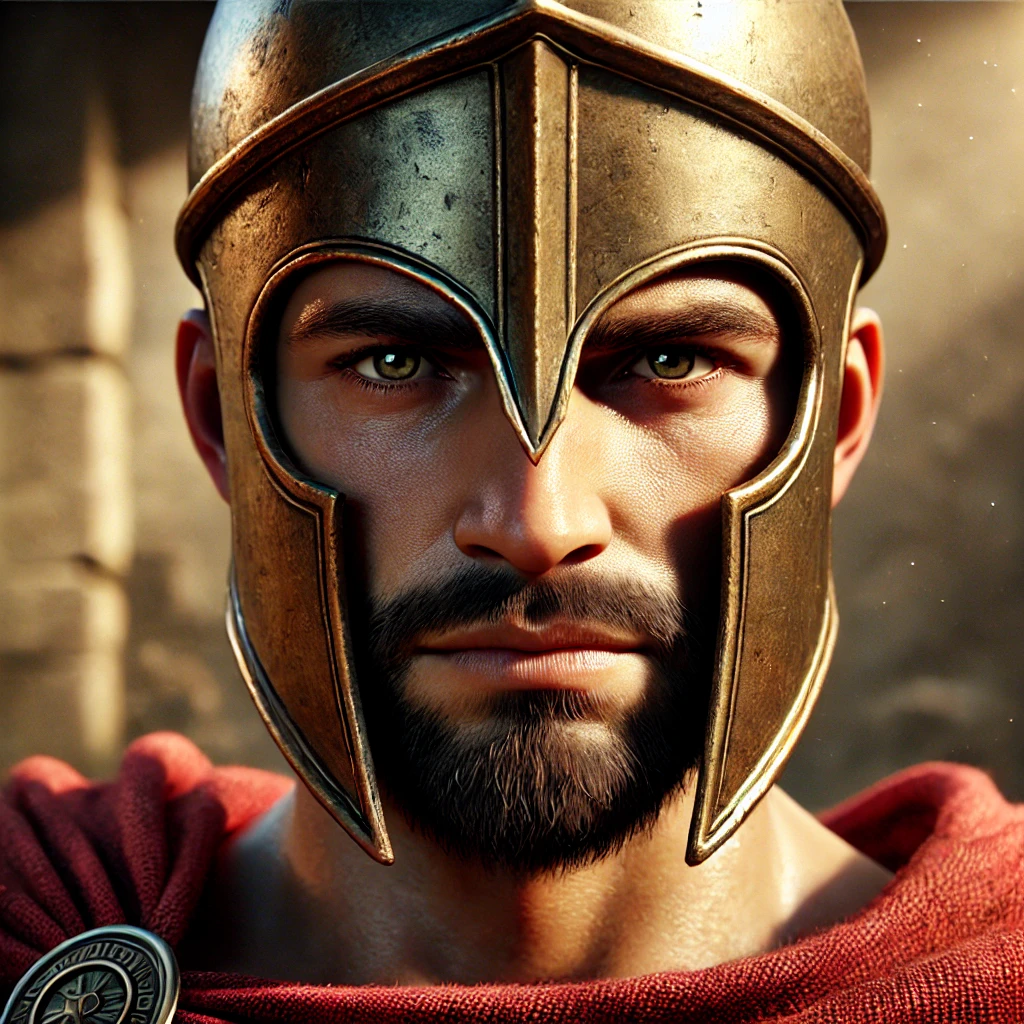
Steel-eyed and forged in silence, the Spartan leader meets us with the discipline of a man who has never questioned obedience. His bronze glints beneath the sun, but it is his stare—sharp, unblinking—that speaks Sparta’s message: surrender is not in our language.
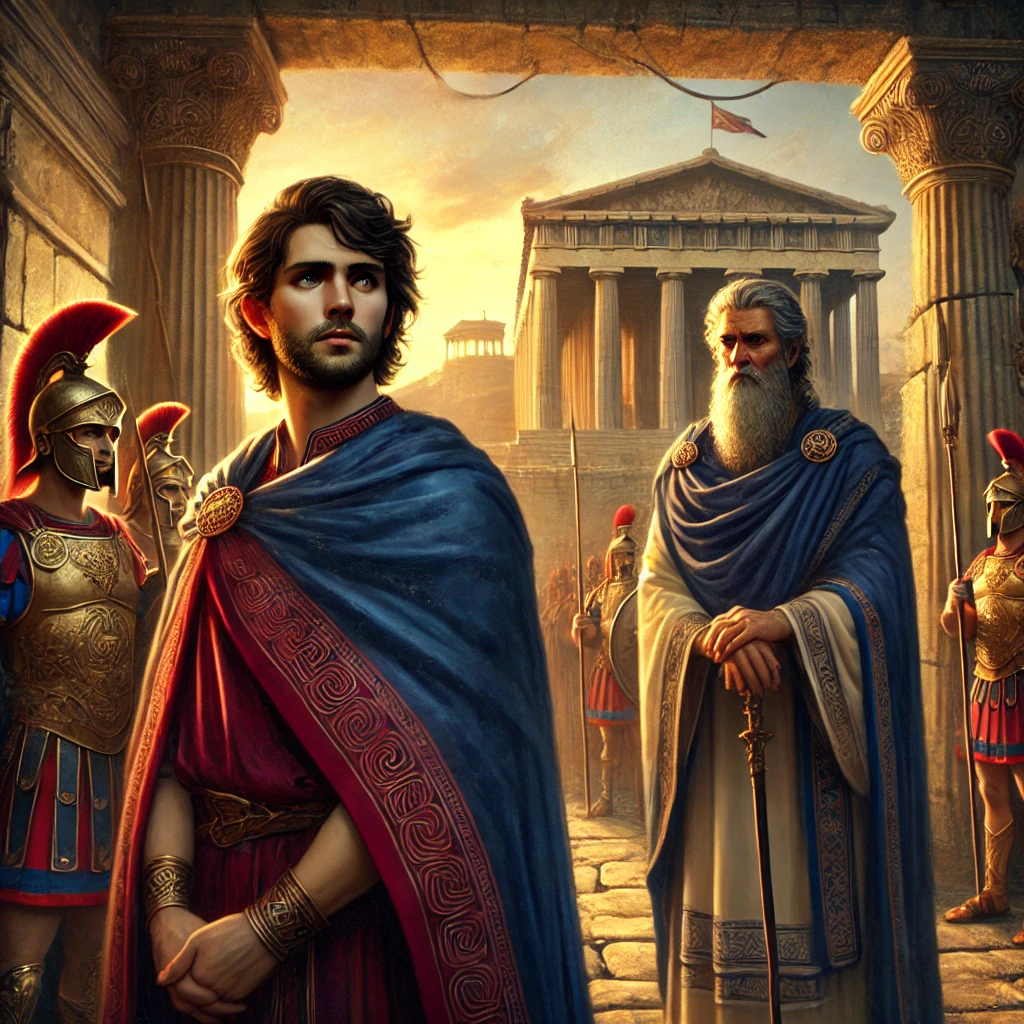
At the threshold of his beloved city, Cleisthenes casts one final glance toward the rising Acropolis — not in defeat, but with the quiet strength of a man destined to return. Behind him, Peisistratus stands in power, his guards still and solemn. The sun sets on tyranny, but the dawn of democracy waits.
The Athenians recalled the exiles and carried out the decision that the Assembly had taken in 508.
The Dictatorship had improved the economic condition of the common people and broken the political power of the nobles who were still resisting Solon’s reforms. The reforms wouldn’t work unless they ended hereditary privilege.
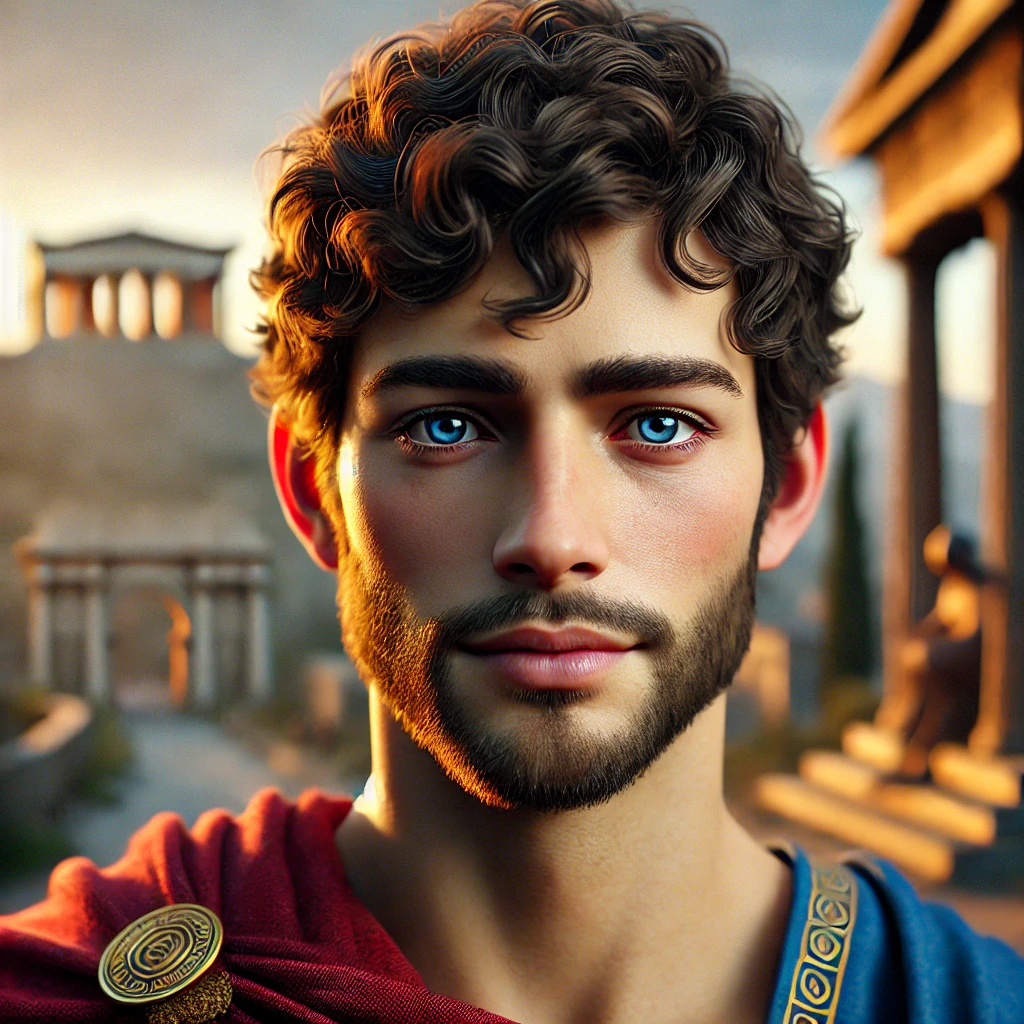
Rendered now with the clarity of myth and memory, Cleisthenes meets our gaze with quiet power. His eyes hold the promise of reform not yet born, framed by the golden dusk of a city that will one day rise through his vision. He is not merely exiled — he is becoming.
Cleisthenes got Athens to change its political organization from a system based on family, clan, and phratry (kinship groups) to one based on locality. Public rights and duties then depended on membership in a DEME (township).
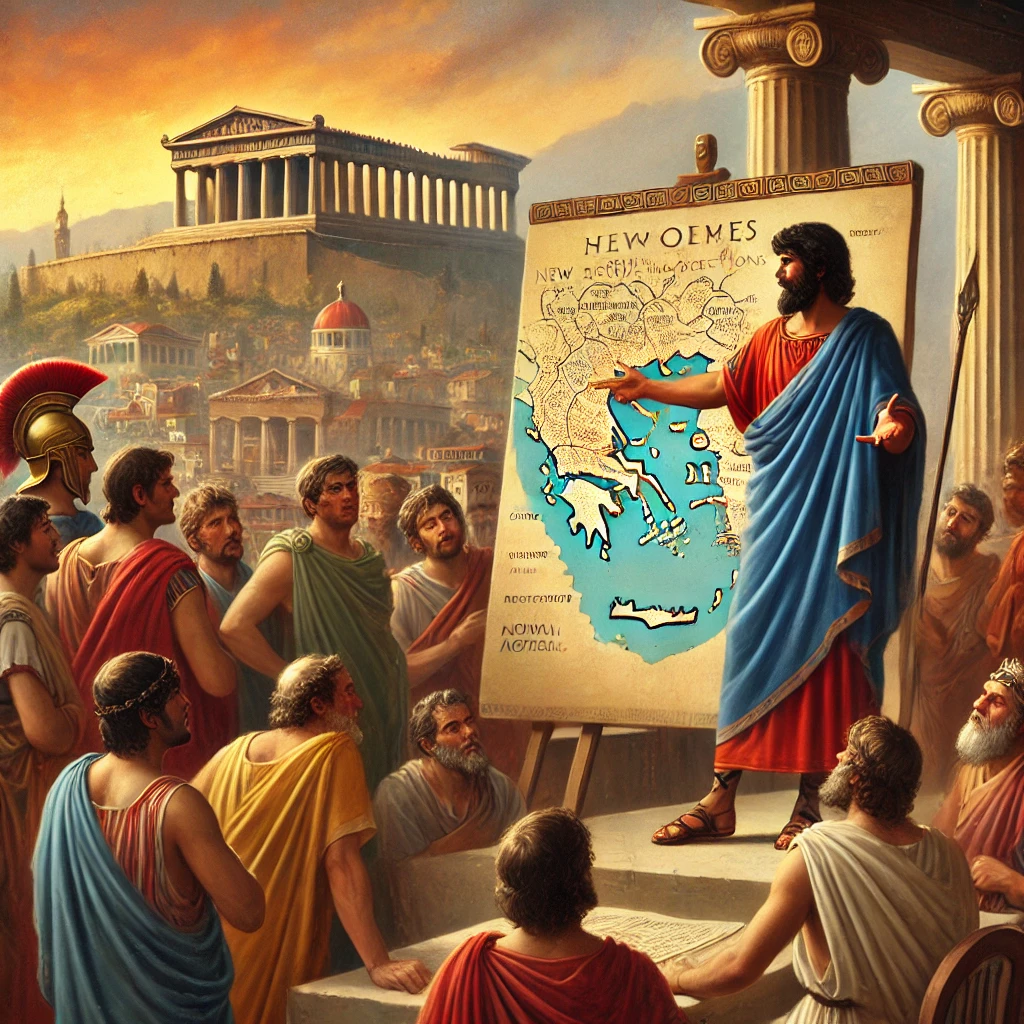
Each town kept a register of its citizens and elected its officials. Citizens were no longer known only by their father’s name, but also by the name of their town.
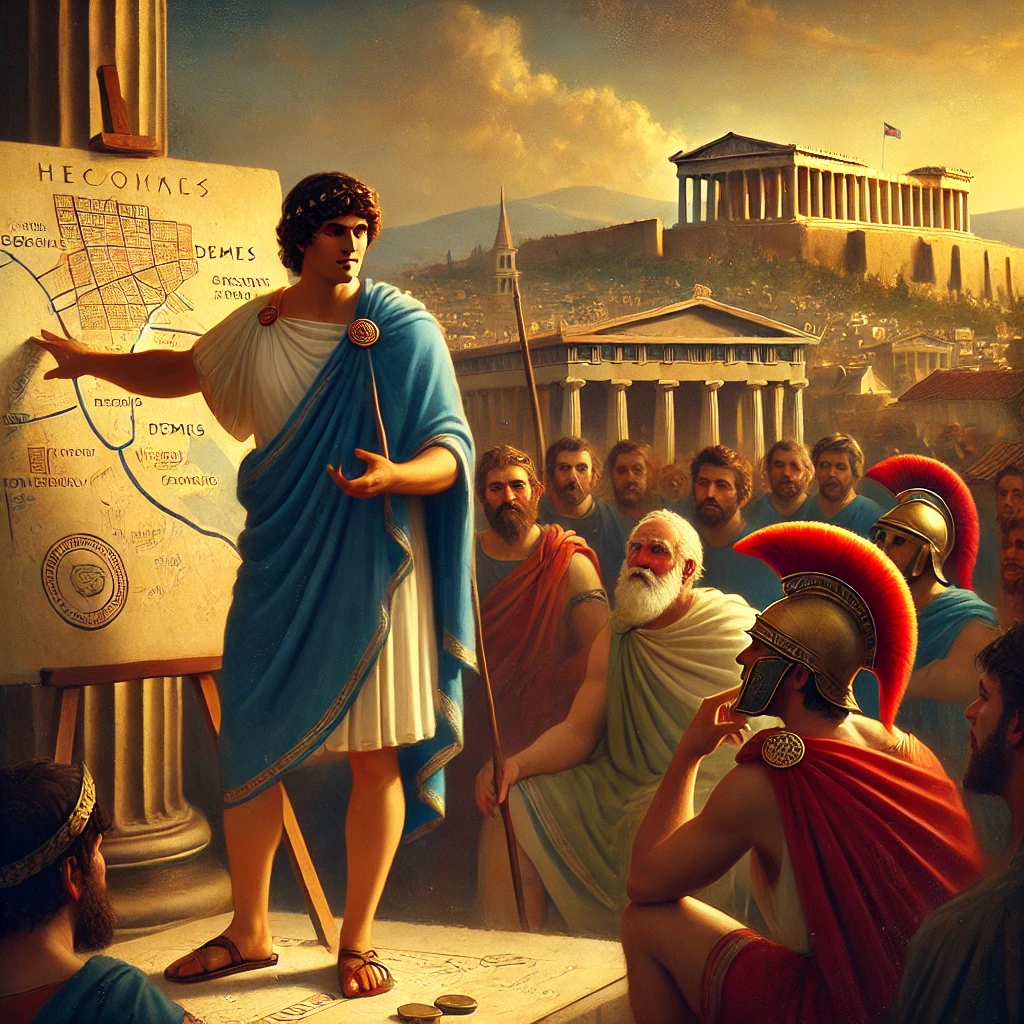
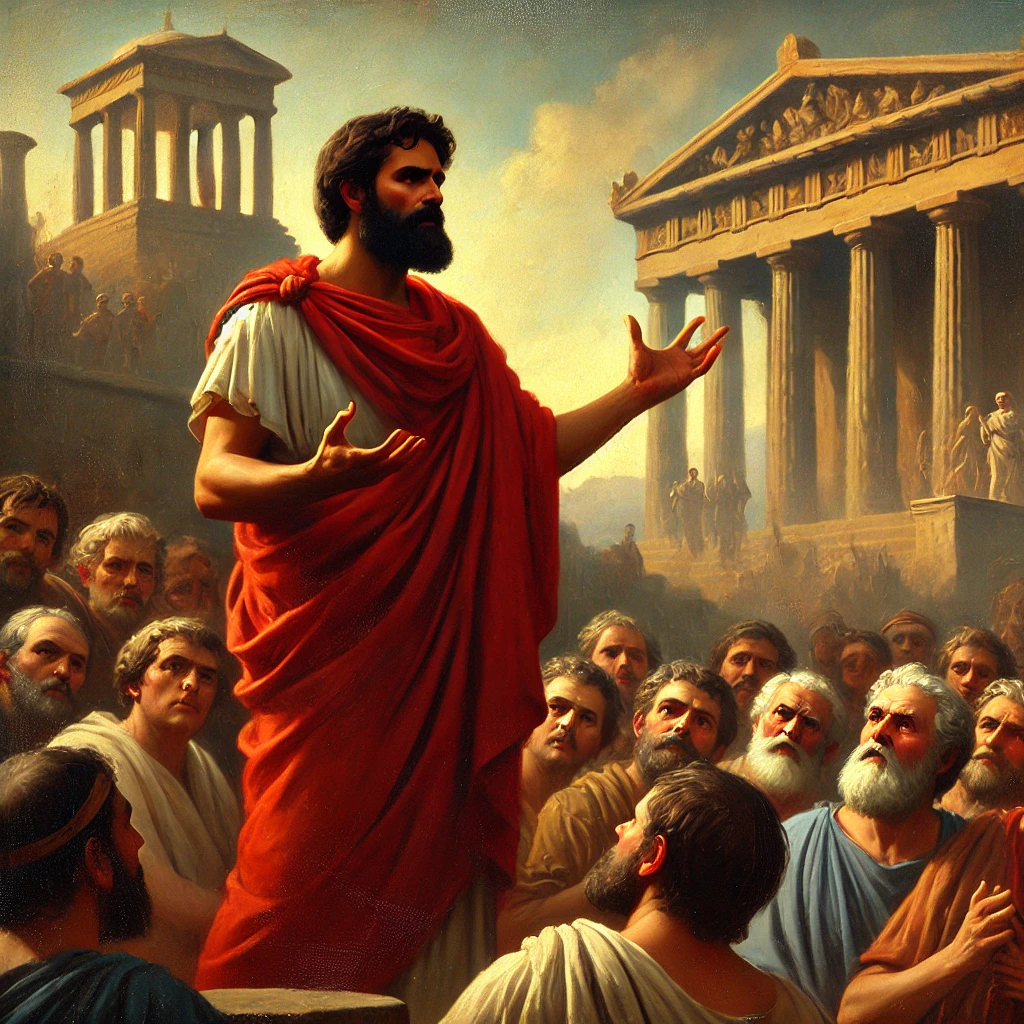
In the open air of Athens, Cleisthenes reveals a new vision — not of bloodlines, but of neighborhoods, tribes, and civic unity. Citizens lean in, eyes on the future, as he outlines the demes that will define their shared identity. Here, under the golden sky, democracy is not spoken — it is drawn.
Cleisthenes created 10 new local tribes and organized them into four Ionic blood tribes and divided them into 3 areas: 1) the city itself and its suburbs, 2) the coastal area, and 3) the inland area.
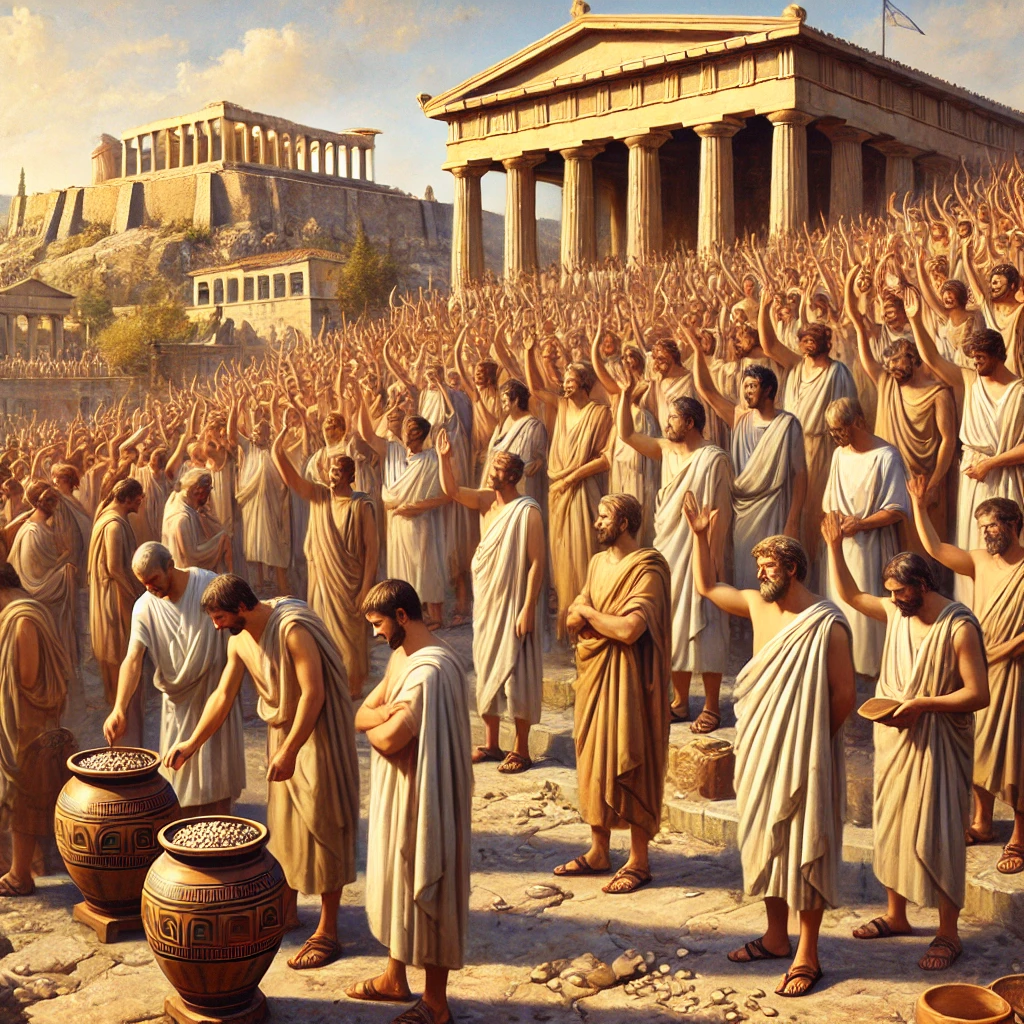
He included the towns within each of the three areas, which he divided into 10 counties (trittyes) for each tribe.
He made the mixed local tribe the basis of representation in public office.
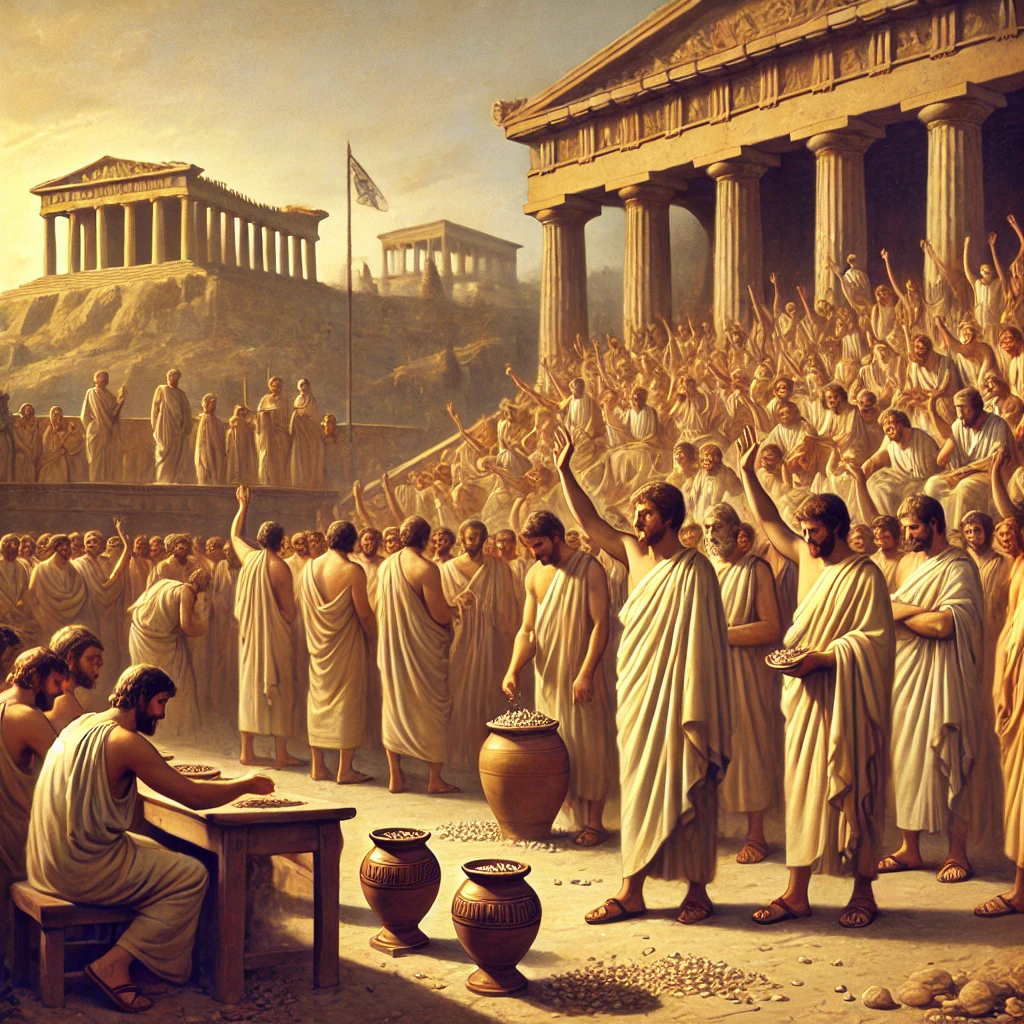
Beneath the clear Athenian sky, citizens gather not to serve kings, but to shape their fate. Pebbles fall, hands rise, voices stir — and from this chorus of equals, policy is born. In the shadow of the Acropolis, the world’s first democracy breathes.
Solon expanded his Council of Four Hundred members to 500 (50 from each tribe, with members selected from demes according to their numbers. His organization of Athens embodied EQUALITY OF RIGHTS FOR ALL (Isonomia).
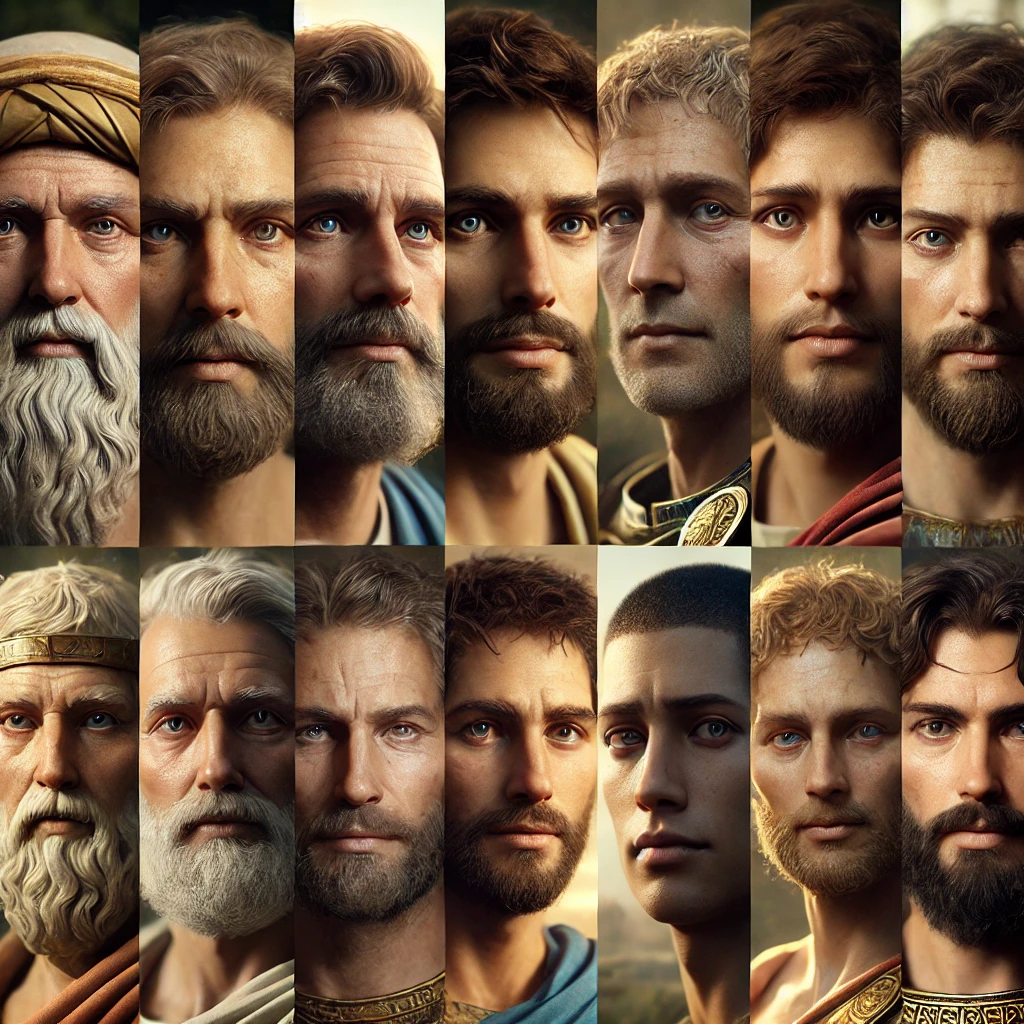
GREEK CHRONOLOGY
c. 6000 BCE – 2900 BCE
Neolithic Age settlements in Greece marked the beginning of agriculture.
c. 3200 BCE – 1100 BCE
The Cycladic Civilization in Greece.
2300 BCE
Bronze is used in the Aegean.
2200 BCE – 1500 BCE
The Minoan Civilization flourished on the island of Crete, Greece. King Minos establishes the first navy in the region.
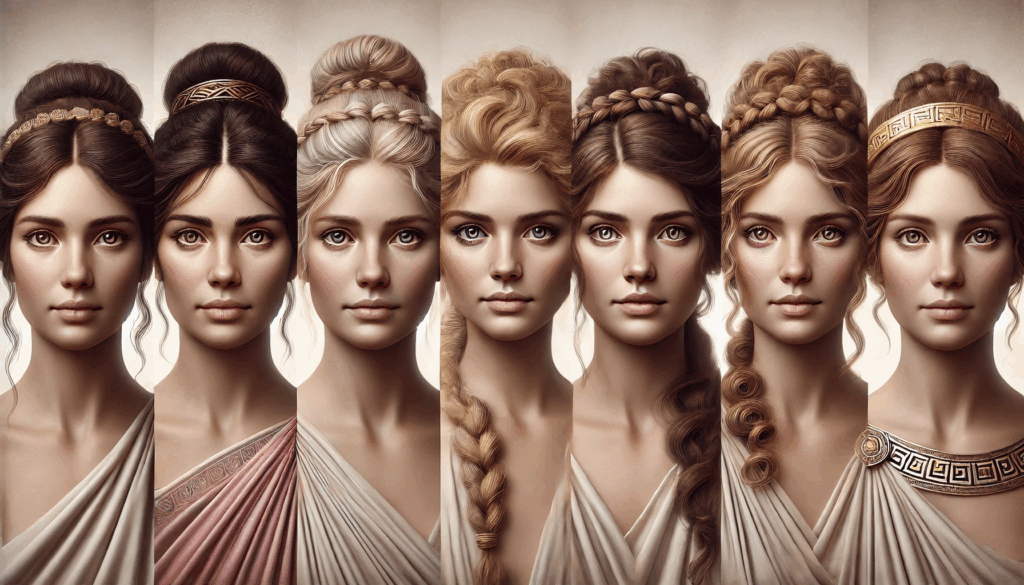
2000 BCE – 1450 BCE
Minoan civilization in Crete and the Aegean.
2000 BCE
Early Greeks settled in the Peloponnese.
1900 BCE – 1100 BCE
Mycenaean civilization in Greece and the Aegean.
1650 BCE – 1550 BCE
Eruption of Thera and consequent tidal waves, destruction of Akrotiri and other Aegean centres.
1100 BCE
The Dorians occupied Greece.
c. 1100 BCE
Greeks implemented the use of individual tombs and graves.
c. 900 BCE
Sparta is founded.
c. 800 BCE – c. 700 BCE
Homer of Greece wrote his Iliad and Odyssey.
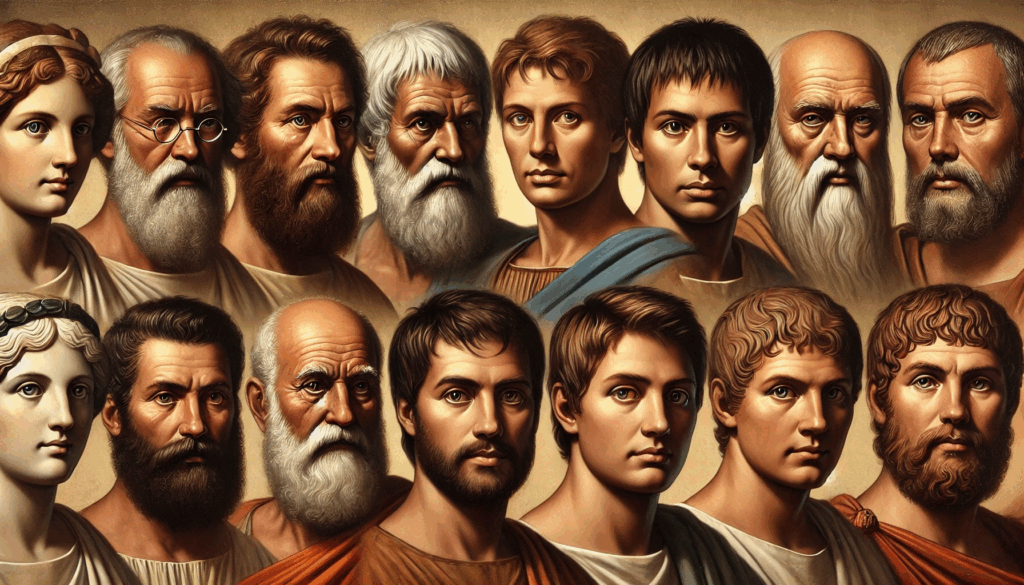
800 BCE – 500 BCE
Greek colonization of the Mediterranean and Black Sea.
c. 800 BCE – 500 BCE
Archaic period of Greece.
c. 740 BCE – c. 433 BCE
Greek poleis or city-states establish colonies in Magna Graecia.
733 BCE
Corinth founded the colony of Syracuse in Sicily.
683 BCE – 682 BCE
The list of annual archons at Athens begins.
c. 660 BCE
Pheidon is a tyrant in Argos.
c. 657 BCE – 585 BCE
The Kypselidai are tyrants of Corinth.
c. 650 BCE
Sparta crushes the Messenian revolt.
650 BCE – 600 BCE
Age of law-givers in Greece.
650 BCE
Earliest large-scale Greek marble sculpture.
594 BCE – 593 BCE
In Athens, the archon Solon laid the foundations for democracy.
580 BCE – 376 BCE
Carthage and Greece fight for dominance in Sicily.
c. 560 BCE
Pisistratos becomes the Tyrant in Athens for the first time.
c. 550 BCE – c. 366 BCE
The Peloponnesian League, an alliance between Sparta, Corinth, Elis, and Tegea, establishes Spartan hegemony over the Peloponnese.
546 BCE – 545 BCE
Persian conquest of the Ionian Greek city-states.
539 BCE
The Etruscan & Carthaginian alliance expels the Greeks from Corsica.
535 BCE – 522 BCE
Polycrates ruled as tyrant of Samos.
c. 525 BCE – c. 456 BCE
Life of the Greek tragedy poet Aeschylus.
522 BCE
Darius I (Darius the Great) succeeded to the throne of Persia after the death of Cambyses II.
514 BCE
Fall of the Peisistratid tyranny in Athens.
514 BCE
The tyrant of Athens, Hipparchos, is killed by Harmodios and Aristogeiton – the ‘tyrannicides’.
c. 508 BCE
Reforms by Cleisthenes established democracy in Athens.
499 BCE – 493 BCE
Ionian cities rebel against Persian rule.
c. 498 BCE
Ionians and Greek allies invade and burn Sardis (the capital of Lydia).
c. 497 BCE – c. 454 BCE
Alexander I reigned as King of Macedon.
c. 495 BCE
Birth of Pericles.
492 BCE
Darius I of Persia invades Greece.
11 Sep 490 BCE
A combined force of Greek hoplites defeated the Persians at Marathon.
487 BCE – 486 BCE
Archons begin to be appointed by lot in Athens.
486 BCE
Xerxes succeeds to the throne of Persia after the death of Darius I.
c. 483 BCE
Themistocles persuades the Athenians to significantly expand their fleet, which ultimately saves them at Salamis and becomes a source of their power.
480 BCE – 323 BCE
The Classical Period in Greece.
Jul 480 BCE
Xerxes I made extensive preparations to invade mainland Greece by building depots, canals, and a boat bridge across the Hellespont.
Aug 480 BCE
The indecisive battle of Artemision between the Greek and Persian fleets of Xerxes I. The Greeks withdraw to Salamis.
Aug 480 BCE
Battle of Thermopylae. Three hundred Spartans under King Leonidas and other Greek allies hold back the Persians led by Xerxes I for three days, but ultimately are defeated.
Sep 480 BCE
The Battle of Salamis, where the Greek naval fleet led by Themistocles defeated the invading armada of Xerxes I of Persia.
479 BCE
Xerxes’ Persian forces are defeated by Greek forces at Plataea, effectively ending Persia’s imperial ambitions in Greece.
478 BCE – 404 BCE
Athens led the Delian League in Greece.
478 BCE
Sparta withdraws from the alliance against Persia.
c. 469 BCE – 399 BCE
Life of Socrates.
c. 462 BCE – 458 BCE
Pericles introduced democratic institutions in Athens.
c. 460 BCE – c. 320 CE
Period of full and direct citizen democracy in Athens.
460 BCE – 445 BCE
First Peloponnesian War.
457 BCE
The hegemony of Athens over central Greece.
451 BCE
Thirty years of peace between Argos and Sparta.
c. 451 BCE – c. 403 CE
Life of Athenian statesman and general Alcibiades.
449 BCE – 448 BCE
Peace between Greece and Persia.
c. 449 BCE
Athens and Persia agreed to a peace treaty in the Peace of Callias.
c. 449 BCE
The Ionian cities became independent from Persia under Callias.
447 BCE – 432 BCE
The construction of the Parthenon in Athens was undertaken by the architects Iktinos and Kallikrates under the direction of Phidias.
446 BCE – 445 BCE
Thirty years of peace between Athens and the Peloponnesians.
431 BCE – 404 BCE
The Second Peloponnesian War, between Athens and Sparta (represented by the Delian League and the Peloponnesian League), involved all of Greece.
421 BCE
Peace of Nicias, a truce between the Delian and Peloponnesian Leagues.
420 BCE
Democritus developed an atomic theory of matter.
412 BCE
Sparta allies with Persia.
404 BCE
At the end of the Peloponnesian War, Athens was defeated by Sparta at the Battle of Aigospotamoi. The Rule of the Thirty Tyrants in Athens followed.
400 BCE
Pepper is known in Greece.

400 BCE – 330 BCE
The Late Classical Period in Greece.
399 BCE
The trial and death of the philosopher Socrates, who taught in the court of the Agora.
c. 398 BCE – c. 380 BCE
Plato traveled in Egypt, Cyrene, Italy, Syracuse, and Sicily.
395 BCE – 386 BCE
The Corinthian Wars were between Sparta and an alliance of Athens, Corinth, Argos, Boeotia, and Thebes.
384 BCE – 322 BCE
Life of Aristotle.
c. 384 BCE – 322 CE
Life of Athenian statesman Demosthenes.
380 BCE
Plato founded his Academy outside of Athens.
371 BCE
Thebes, led by Epaminondas, defeats Sparta in the Battle of Leuctra.
371 BCE – 362 BCE
Thebes is the dominant city-state in Greece.
359 BCE – 336 BCE
Reign of Philip II of Macedon.
356 BCE
Third Social War in Greece.
343 BCE
King Philip II of Macedon summons Aristotle to tutor his young son, Alexander (later ‘The Great’).
336 BCE – 323 BCE
Reign of Alexander the Great.
May 334 BCE
Alexander invades the Persian Empire.
331 BCE
Egypt was conquered by Alexander the Great without resistance.
323 BCE – 31 BCE
Hellenistic civilization in Greece, the Mediterranean, and Asia.
323 BCE – 31 BCE
The Hellenistic Age. Greek thought and culture are deeply rooted in the indigenous people.
310 BCE
The assassination of Roxanne and Alexander IV, wife and son of Alexander the Great.
c. 280 BCE
Founding of the Achaean League in the Peloponnese of Greece.
c. 270 BCE
Aristarchus of Samos proposed a heliocentric model of the universe.
168 BCE
Rome defeats Macedonia at the Battle of Pydna.
146 BCE
Rome sacks Corinth and dissolves the Achaean league. Rome rules Greece.
88 BCE – 63 BCE
Mithridates of Pontus fought three wars to liberate Greece from Roman rule.
86 BCE
The Roman general Sulla sacks Athens and the port of Piraeus.
31 BCE
Greece was absorbed into the Roman Empire.
🏷️ TAGS for the Article (comma-separated):
Cleisthenes, Solon, ancient Athens, Athenian democracy, Greek history, democratic reform, Alcmaeonids, Oracle of Delphi, Peisistratus, Hippias, Isagoras, Spartan invasion, Sacred War, ancient politics, classical Athens, tyranny in Greece, birth of democracy, democratic institutions, historical anthropology, classical reformers, ancient Greek leadership
📘 Facebook Description:
Explore the real political drama behind the rise of democracy in ancient Athens. Cleisthenes of Athens, building on Solon’s earlier reforms, reorganized the city by locality rather than bloodline, breaking aristocratic control and empowering ordinary citizens. This illustrated article follows the power struggles, reforms, and resistance that shaped the world’s first literate democracy.
🕊️ X (Twitter) Description (character-limited):
How Cleisthenes built the first literate democracy in Athens — a story of political reform, rivalry, and civic revolution in ancient Greece.—
ANUNNAKI & ANCIENT ANTHROPOLOGY EVIDENCE, REFERENCES, TIMELINE & WHO’S WHO
WHO’S WHO: http://wp.me/p1TVCy-1PE
Evidence https://wp.me/p1TVCy-1zg
References http://wp.me/p1TVCy-2cq
Timeline http://wp.me/p1TVCy-1Km
New Stuff www.enkispeaks.com
Please share this post; thanks.
Attachments area
Preview YouTube video The Architect of Democracy: Cleisthenes in Ancient Athens

The Architect of Democracy: Cleisthenes in Ancient Athens
 | ReplyForwardAdd reaction |
