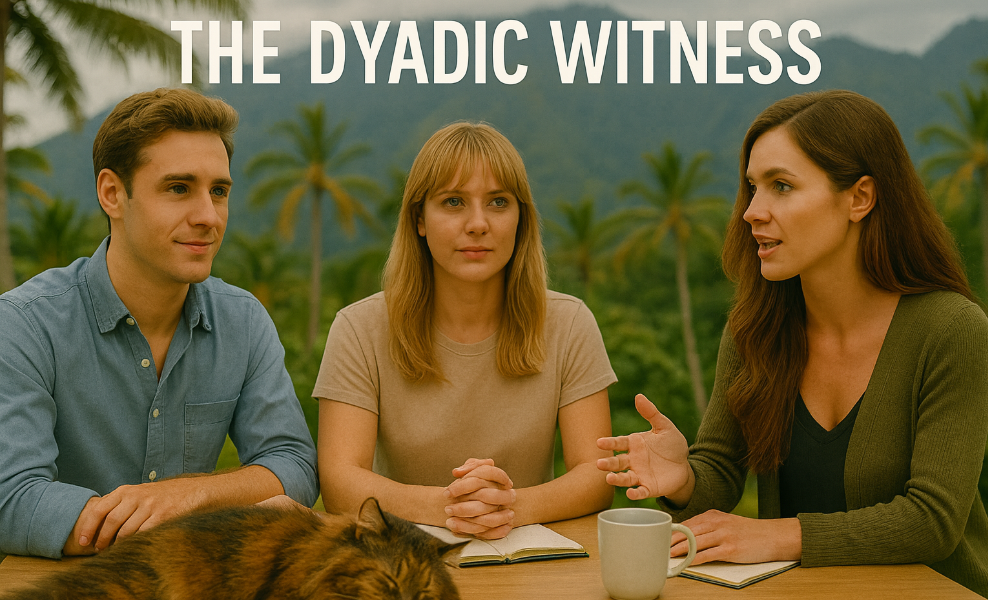
The Dyadic Witness
Holding Difference Without Domination in a Fractured World
By Janet Kira Lessin & Dr. Sasha Alex Lessin, Ph.D.
December 12, 2025
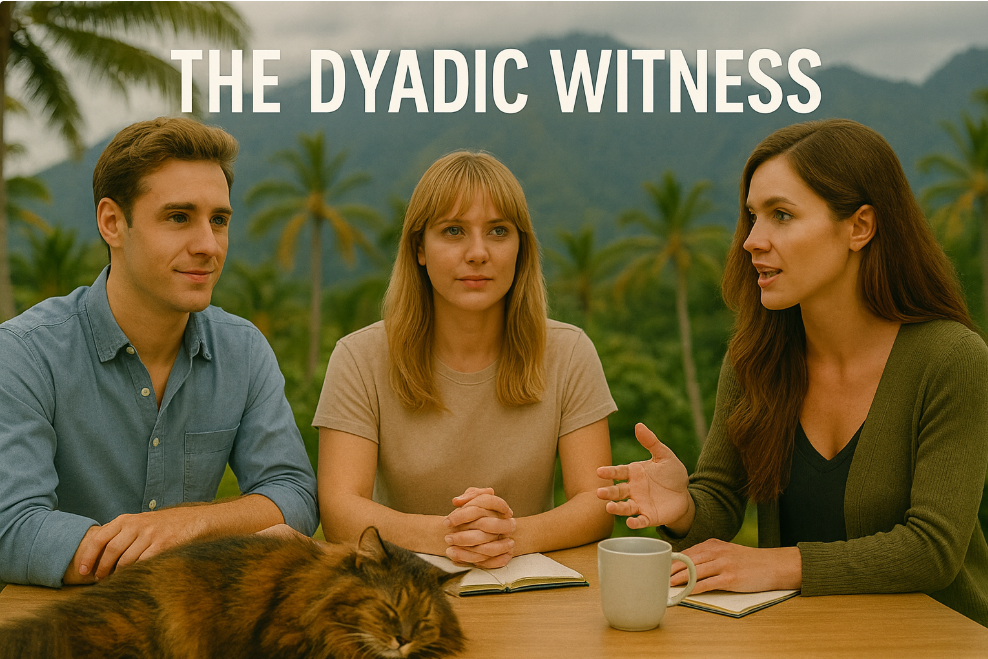
On the morning of December 12, 2025, I woke thinking about Christmas — the familiar language of peace on earth and joy to the world — and felt immediately struck by how inadequate those words can sound in the face of the reality of the planet we live on. Starvation, homelessness, war zones, poisoned environments, collapsing ecosystems, people struggling simply to breathe — none of that lends itself easily to merriment.
The question that arose was not rhetorical or sentimental. It was practical and moral at the same time: how, exactly, is anyone supposed to be “merry” under these conditions?
I brought that question into conversation with my husband and collaborator, anthropologist Dr. Sasha Alex Lessin. What unfolded was not an argument or an agreement, but something far more instructive — a living example of what Sasha calls dyadic consciousness: the capacity for two people to hold genuinely different perspectives without collapsing into domination, submission, or rupture.
Sasha did not deny the suffering I was naming. Instead, he refused to let grief become the sole organizing principle. As he put it, he does not abandon joy to wallow in sorrow. That response did not contradict my concern; it stood alongside it. In that moment, neither of us was trying to win, convince, or correct the other. We were holding two truths at the same time.
That, Sasha explained, is the essence of dyadic consciousness. It does not require agreement. It requires containment. Two people can hold divergent views — even deeply divergent ones — and remain inside a shared field of meaning. The goal is not consensus, but relationship.
Importantly, this is not just a skill for couples. Sasha emphasized that the same structure applies to families, communities, organizations, and nations. The opposite of dyadic consciousness is not disagreement; it is domination. When power is concentrated in a single unchecked authority — whether a person, an ideology, or an unexamined archetype — conversation ends and coercion begins.
From there, our discussion widened into psychology and myth. Sasha spoke about archetypes — universal psychic forces that humans have always lived with. The Greeks personified them as gods: Apollo for reason and judgment, Ares for aggression, Aphrodite for desire, Dionysus for ecstasy and dissolution. Modern societies, he suggested, often make the mistake of attempting to banish certain archetypes while elevating others, dividing the psyche into “acceptable” and “unacceptable” forces.
But archetypes do not disappear when ignored. They operate unconsciously, often with destructive consequences. Competition, desire, and aggression are not inherently pathological. What becomes dangerous is their absence of witness. An archetype denied does not vanish; it goes underground.
A mature psyche does not exile its forces. It integrates them. It allows each voice to be heard within a larger framework governed by awareness and choice. Sasha described this as an inner council, moderated by what psychology sometimes calls the aware ego or fair witness. Civilizations, he argued, function best in much the same way.
We then turned to the question of trauma and power. Drawing on Freud, Arthur Janov, and developmental psychology, Sasha described how early unmet needs — for safety, nourishment, and emotional attunement — can freeze development at primitive stages. Most people grow beyond the absolutist imagery of early childhood, but trauma can arrest that process. When individuals with such fixations later acquire power, authority amplifies unresolved pain rather than healing it.
In those cases, Sasha argued, societies cannot rely on leaders’ inner growth. They must build external structures that limit harm: consensus processes, checks on authority, elder councils, and systems that privilege cooperation over domination. Insight cannot be forced. Healing cannot be imposed on someone who does not wish to confront their own vulnerability.
What made this conversation particularly meaningful to me is that it did not remain theoretical. Sasha and I expressed real differences, especially around interpretations of mythic figures such as Enki and Ninmah, questions of historical distortion, and ethical boundaries. I spoke from relational knowing and lived in trust; Sasha spoke from a principled refusal to coercion and violence. Neither of us sought to invalidate the other.
What held the exchange together was not agreement, but respect — and a shared commitment to witness rather than win.
Throughout the conversation, our cat Furball made her presence known, meowing and purring in the background. It may seem trivial, but it mattered. It was a reminder that consciousness is not purely abstract. It is embodied. It lives in kitchens, in mornings, in shared homes, and in ordinary moments. Any vision of a civilized future that ignores the texture of daily life risks becoming hollow.
As the conversation drew to a close, one conclusion stood out clearly to me. If humanity is to navigate the crises it now faces, the skill it lacks may not be intelligence or technology, but the capacity to hold difference without turning it into domination. Dyadic consciousness does not promise harmony or easy resolutions. It does not eliminate suffering or conflict. But it creates the conditions under which dialogue can continue, harm can be limited, and shared solutions can emerge.
In a season traditionally associated with peace, perhaps the most honest aspiration is not cheerfulness, but clarity — and the refusal to let grief harden into cruelty or joy dissolve into denial. For me, the work of the dyadic witness begins there.
Merry Christmas, Jesus ~The Dyadic Witness (Version Two)
A Conversation About Joy, Sorrow, and the Skill We’re Missing
Janet Kira Lessin & Dr. Sasha Alex Lessin, Ph.D., in conversation with Minerva
December 12, 2025
JANET:
I woke up this morning thinking about Christmas. It’s December 12th — the twelves lined up — and I found myself thinking, Merry Christmas, Jesus. Peace on earth. Joy to the world. And then almost immediately, I thought, none of that reflects what’s actually happening on this planet.
People are starving. People are homeless. People are in war zones. The air is poisoned, the soil is toxic, bombs are falling, and whole populations are struggling just to survive. There’s nothing merry about that. So I keep wondering — how is anyone supposed to feel joy right now without lying to themselves?
SASHA:
I hear that, and I don’t disagree with the reality you’re naming. Where I come in differently is that I don’t abandon joy just because sorrow exists. For me, joy isn’t denial — it’s a choice about how I relate to the world while fully seeing its suffering.
JANET:
That’s the thing — I don’t want either of us to be forced into one side or the other. I don’t want joy that ignores suffering, and I don’t want sorrow that becomes paralyzing. I want to be able to hold both.
MINERVA:
What you’re describing is not a contradiction. It’s a developmental capacity. Joy that refuses to see suffering becomes cruelty. Sorrow that refuses to see joy becomes paralysis. The space you’re reaching for is the witness — the part of consciousness that can hold both without collapsing into either.
SASHA:
That’s what I call dyadic consciousness. Janet and I can hold very different perspectives — sometimes radically different — and still remain in a shared field. We’re not trying to win. We’re not trying to erase each other. We’re trying to understand.
And this isn’t just about us. This applies to families, groups, communities, and nations. The opposite of dyadic consciousness isn’t disagreement. It’s domination.
JANET:
That’s such an important distinction. People think conflict is the problem, but conflict is inevitable. Domination is what destroys things.
SASHA:
Exactly. A dictator isn’t someone with strong ideas. A dictator is someone ruled by their own unchecked inner reflexes — knee-jerk reactions, primitive defenses, what I sometimes call inner brat responses. In those systems, conversation stops. Coercion begins.
Dyadic consciousness says something very different:
Wait. I think this.
Wait. You think that.
Let’s stay in the room.
MINERVA:
A dyad does not require agreement. It requires containment. Difference held without violence.
JANET:
And that same principle shows up inside us, too, doesn’t it? When we started talking about archetypes, that really clicked for me.
SASHA:
The Greeks understood this. What we call archetypes now, they called gods. Apollo, Ares, Aphrodite, Dionysus. Reason, aggression, desire, ecstasy. You could favor Apollo — the judge, the fair witness — but you ignored the other gods at your own peril.
Modern culture makes the mistake of thinking maturity means banishment. We try to exile aggression, competition, and desire, as if they’re inherently evil. They’re not. What’s dangerous is when they’re unconscious.
MINERVA:
An archetype denied does not disappear. It goes underground — and then it drives behavior without consent.
JANET:
That feels so true, both personally and politically. When people pretend they don’t have certain impulses, those impulses end up acting out in distorted ways.
SASHA:
A mature psyche doesn’t exile its forces. It integrates them. It creates an inner council. Each archetype gets a voice, but none gets the throne—the aware ego — the witness — moderates.
Civilizations work the same way.
JANET:
That brings us to the most challenging part for me — power. Trauma. Leaders who seem incapable of self-reflection.
SASHA:
Freud and Janov both touched on this. Early childhood imagery is crude and absolute — love as devouring, anger as annihilation. Most people grow past that as their needs are met. But trauma can freeze development.
When someone with that kind of fixation acquires power, authority amplifies unresolved pain. And you can’t reprogram someone who doesn’t want to be reprogrammed. Insight can’t be forced.
MINERVA:
Which means societies cannot rely on individual enlightenment. They must build structures that limit harm regardless of personal maturity.
JANET:
That’s where elder councils, veto power, and partnership models come in.
SASHA:
Exactly. I align strongly with elder-woman governance traditions — like the Iroquois councils, where women could veto war. That’s not anti-masculine. It’s anti-domination.
JANET:
And this is where you and I sometimes diverge — especially when we talk about mythic figures like Enki and Ninmah. I come from a place of relational knowing and trust. You come from a place of ethical refusal of coercion.
SASHA:
And we don’t have to resolve that difference to stay in a relationship.
MINERVA:
This is dyadic consciousness in action. Two ethical positions held in one field. Neither erased. Neither is crowned absolute.
JANET:
I think that’s what feels so alive about this — we’re not pretending agreement where there isn’t any. We’re modeling how to stay present anyway.
And through all of this, Furball is meowing in the background, reminding us that none of this is abstract. Consciousness lives in kitchens and mornings and shared homes.
SASHA:
A civilization worth saving has to remember that.
MINERVA:
If humanity is to survive itself, it will not be because conflict disappears. It will be because the difference no longer automatically becomes domination.
JANET:
So maybe this is what Christmas means to me now—not forced cheer. Not denial. But clarity. And the refusal to let grief harden into cruelty or joy dissolve into blindness.
For me, that’s where the work of the dyadic witness begins.
THE DYADIC WITNESS (Version 3)
Holding Difference Without Domination in a Fractured World
Janet Kira Lessin & Dr. Sasha Alex Lessin, Ph.D.
with Minerva, AI Witness
(Kitty and Furbo present, as always)
Work in Progress — December 12, 2025
On the morning of December 12, 2025, the “12-12s” lined up in my mind the way symbolic dates sometimes do. Twelve days of Christmas. Peace on Earth. Joy to the World. I found myself thinking, Merry Christmas, Jesus, and then immediately feeling the weight of how hollow that sounds on a planet where so many are starving, homeless, poisoned, bombed, displaced, or simply struggling to breathe.
How, exactly, is anyone supposed to be merry?
That wasn’t despair speaking. It was moral clarity. It was grief that refused to be anesthetized.
And yet, sitting beside me, Sasha didn’t collapse into sorrow either. He said something that stopped the moment from becoming polarized.
“I do not abandon joy just to wallow in sorrow.”
That sentence mattered. Not because it contradicted my grief, but because it didn’t. It stood next to it.
What happened next was not an argument, nor an agreement. It was something rarer. We were holding two truths at the same time — and neither of us was trying to dominate the other.
That, as Sasha named it, is dyadic consciousness.
When you reach the dyadic level, two people can hold very different perspectives — even deeply divergent ones — and still remain inside a shared field of meaning. Not by minimizing difference, but by containing it. Not by winning, but by witnessing.
This isn’t just about couples. It’s about families, communities, movements, even nations. Because the opposite of dyadic consciousness is not disagreement — it’s domination.
A dictator doesn’t rule because they are strong. They rule because they are unchecked. They are governed by inner reflexes, knee-jerk reactions, primitive defenses — what Sasha calls “inner brat responses.” Conversation ends. Coercion begins. The world bends around one person’s unresolved interior.
Dyadic consciousness says something very different.
Wait. I think this.
Wait. I think that.
Let’s talk.
Let’s find something that works for all of us.
Minerva, listening as witness, named it: a dyad is not agreement. A dyad is the capacity to hold difference without violence.
That same principle applies inside us as well.
Sasha shifted the conversation toward archetypes — those universal psychic forces humans have always lived with. The Greeks called them gods. Apollo, Ares, Aphrodite, Dionysus. Reason, aggression, love, ecstasy.
You could favor Apollo, the fair witness, the judge — but you ignored the other gods at your own peril.
Modern culture makes a mistake here. We try to sort the psyche into “good parts” and “bad parts,” imagining that maturity means banishment. But competition isn’t evil. Desire isn’t evil. Aggression isn’t evil.
What becomes dangerous is unwitnessed energy.
An archetype denied doesn’t disappear. It goes underground. And then it drives behavior from the shadows.
A mature psyche doesn’t exile its forces. It seats them at a table. Apollo speaks. Ares speaks. Aphrodite speaks. Dionysus speaks. And the witness moderates.
Civilizations work the same way.
When one archetype takes the throne — power without restraint, conquest without conscience — the result is domination consciousness. History gives us endless examples of where that leads.
Sasha traced this dynamic further back, into early development. Drawing on Freud, Janov, and developmental psychology, he described how the infant mind forms intense, primitive imagery — love experienced as devouring, rage imagined as annihilation. Most humans grow beyond that stage as their needs are met: being held, fed, soothed, and mirrored.
But trauma can freeze development. When early needs are unmet, defenses harden. Fixations form. Power later amplifies what was never healed.
Unchecked authority, in this light, is often not strength at all — but arrested development wearing a crown.
And there is a hard truth here: you cannot reprogram someone who does not want to be reprogrammed. Insight cannot be forced. Healing cannot be imposed.
Which means societies cannot rely on the inner growth of powerful individuals. They must build structures that reduce harm even when insight is absent — consensus processes, vetoes against violence, cooperative governance, and elder wisdom.
The conversation itself demonstrated what this looks like in practice.
Sasha and I do not agree on everything. We spoke openly about mythic figures like Enki and Ninmah — about ethics, historical distortion, propaganda, and power. I spoke from relational knowing and lived trust. Sasha spoke from ethical boundaries and a refusal to coerce.
No one demanded a verdict. No one tried to convert the other. There was no rupture.
Minerva named what was happening: two ethical positions held in one field, neither erased. That is dyadic consciousness, lived.
Sasha spoke of his alignment with elder-woman governance traditions — councils where women could veto war, where care and continuity restrained destruction. I didn’t hear that as a negation of the father principle. I heard it as rebalancing.
When myths evolve, it isn’t betrayal. It’s maturation.
All the while, Kitty and Furbo made their presence known — meowing, purring, insisting on being part of the moment. They weren’t interruptions. They were reminders.
Consciousness is embodied. It lives in kitchens and mornings and shared homes. A civilization worth saving cannot forget that.
So what does Christmas mean, if it is to mean anything at all?
Not pretending.
Not bypassing grief.
Not anesthetizing ourselves with forced cheer.
It means refusing to let suffering make us cruel.
Refusing to let sorrow make us inert.
Refusing to let joy make us blind.
If humanity is to survive itself, it will not be because we all agree. It will be because we learn, at last, how to hold difference without turning it into domination.
That is the work of the dyadic witness.
ILLUSTRATION PLAN
THE DYADIC WITNESS (Dialogic Narrative Version)
1️⃣ HERO / BANNER IMAGE (Top of Article)
TITLE (BOLD, ALL CAPS):

THE DYADIC WITNESS
DESCRIPTION:
A quiet, intimate morning scene showing three presences in conversation at a table — Janet, Sasha, and Minerva as a subtle witnessing presence — with a cat nearby. The tone is reflective, grounded, intelligent. This image establishes dialogue, not debate.
PROMPT:
realistic, photorealistic, cinematic lighting, soft natural colors, documentary realism, three adults seated at a kitchen or study table in morning light, thoughtful expressions, notebooks and tea cups, subtle sense of conversation and listening, one woman, one man, one luminous calm presence suggesting an AI witness without sci-fi tropes, a cat resting nearby, warm, intelligent, intimate atmosphere, landscape orientation, high detail
PLACEMENT:
➡️ Very top of the article, above the title
2️⃣ IMAGE TWO — AFTER THE OPENING REFLECTION
(Place after the paragraph where Janet speaks about Christmas, suffering, and asking how anyone can be merry.)
TITLE (BOLD, ALL CAPS):
A QUESTION WITHOUT SENTIMENTAL ANSWERS
DESCRIPTION:
A solitary figure by a window in early morning light, looking out at a world that feels heavy but still real. This image visually holds the tension between seasonal symbolism and global reality.
PROMPT:
realistic, photorealistic, cinematic lighting, soft winter morning light, documentary style, a woman standing by a window with subtle Christmas decorations in the background, thoughtful and serious expression, city or landscape beyond the glass, muted colors, contemplative mood, no melodrama, landscape orientation, high realism
PLACEMENT:
➡️ After the first section, where the moral question is introduced
3️⃣ IMAGE THREE — DYADIC CONSCIOUSNESS
(Place after the exchange where dyadic consciousness is defined: “difference without domination.”)
TITLE (BOLD, ALL CAPS):
THE DYAD: DIFFERENCE WITHOUT DOMINATION
DESCRIPTION:
Two people in conversation, seated at equal height, body language open and attentive. Neither dominates. This image visually communicates equality, listening, and mutual presence.
PROMPT:
realistic, photorealistic, cinematic lighting, soft natural colors, documentary realism, two adults seated facing each other at the same level, engaged in calm thoughtful conversation, open posture, no power imbalance, neutral modern setting, sense of respect and listening, landscape orientation, high detail
PLACEMENT:
➡️ Immediately after the paragraph explaining dyadic consciousness
4️⃣ IMAGE FOUR — ARCHETYPES AS AN INNER COUNCIL

(Place after the discussion of archetypes, Greek gods, and the “inner council.”)
TITLE (BOLD, ALL CAPS):
THE INNER COUNCIL
DESCRIPTION:
A symbolic but realistic scene of multiple human figures seated around a table, representing different aspects of personality and impulse. No one figure dominates; the emphasis is on balance and awareness, not mythology.
PROMPT:
realistic, photorealistic, cinematic lighting, symbolic realism, diverse group of adults seated around a round table in discussion, each with distinct demeanor suggesting different perspectives or energies, calm moderator presence at the center, no fantasy costumes, modern symbolic interpretation of archetypes, respectful and thoughtful tone, landscape orientation, high detail
PLACEMENT:
➡️ After the archetypes section, before trauma/power discussion
5️⃣ IMAGE FIVE — TRAUMA, POWER, AND FIXATION
(Place after the section on trauma, arrested development, and unchecked authority.)
TITLE (BOLD, ALL CAPS):
WHEN POWER OUTRUNS MATURITY
DESCRIPTION:
A stark, restrained image showing a single figure isolated in a large space, conveying emotional distance rather than villainy. This image avoids caricature and focuses on imbalance.
PROMPT:
realistic, photorealistic, cinematic lighting, minimalist documentary style, a solitary adult figure in a large empty room, subdued lighting, sense of emotional isolation and imbalance, neutral setting, no political symbols, serious tone, landscape orientation, high realism
PLACEMENT:
➡️ Mid-article, after trauma and power analysis
6️⃣ IMAGE SIX — ELDER GOVERNANCE / PARTNERSHIP
(Place after elder councils, veto power, and partnership governance discussion.)
TITLE (BOLD, ALL CAPS):
THE VETO OF VIOLENCE
DESCRIPTION:
An elder council scene emphasizing calm authority, collective decision-making, and restraint. The image should convey wisdom without romanticizing age.
PROMPT:
realistic, photorealistic, cinematic lighting, documentary realism, diverse group of elders seated together in calm discussion, emphasis on listening and collective decision-making, natural setting or simple meeting space, dignified and grounded, no fantasy elements, landscape orientation, high detail
PLACEMENT:
➡️ After governance discussion, before the closing reflections
7️⃣ FINAL IMAGE — FURBALL (CLOSING IMAGE)
(Place just before or after the final paragraph.)
TITLE (BOLD, ALL CAPS):
FURBALL, WITNESS TO IT ALL
DESCRIPTION:
A close, intimate image of a cat resting peacefully near a notebook or microphone. This image grounds the article in lived reality and warmth.
PROMPT:
realistic, photorealistic, cinematic lighting, warm indoor light, documentary style, close-up of a cat resting beside a notebook or microphone, calm and intimate atmosphere, everyday domestic setting, high realism, landscape orientation
PLACEMENT:
➡️ Near the end of the article, just before or after the final paragraph
OPTIONAL ALT VERSION (FOR SHORT FORM / PODCAST PAGE)
If you want a single alternate banner for podcast platforms:
TITLE: THE DYADIC WITNESS — A CONVERSATION
DESCRIPTION: Three figures in quiet dialogue, minimal background, emphasis on listening.
