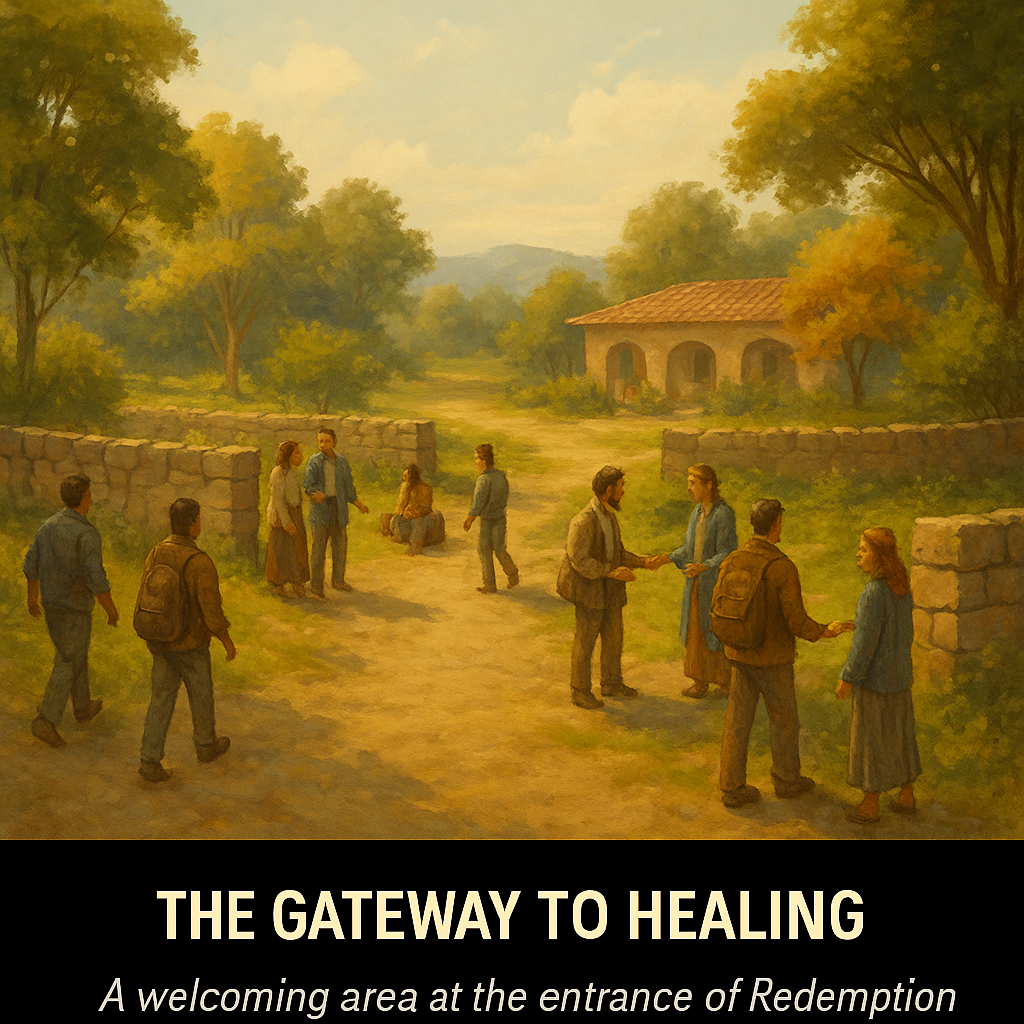
A vast, peaceful landscape showing an open natural sanctuary surrounded by low stone walls, with people arriving—some cautious, some relieved. Counselors and mentors welcome them. This image represents the first arrival into a Redemption Zone: secure but beautiful, dignified, hopeful.
REDEMPTION ZONES: RETHINKING JUSTICE, CRIMINALITY, AND THE PATH TO WHOLENESS
By Janet Kira Lessin with Minerva
What if we accepted everyone?
Not just the talented or the lawful or the culturally familiar. But everyone. What if we judged only on a single criterion: have you harmed others? And even then, what if we refused to discard anyone—offering instead a place for them to heal, transform, and return?
This is not utopian dreaming. It’s a possible model. One rooted in compassion, accountability, and the understanding that many so-called criminals were once victims, misdiagnosed, oppressed, or simply born into systems stacked against them.
The idea emerged from a simple but radical question:
What if society functioned more like the soul realm Michael Newton described—one that aims not to punish, but to help beings remember who they are?
Beyond Criminality: Who Are We Really Judging?
People are labeled “criminals” for:
- Petty theft out of poverty
- Immigration violations based on unjust borders
- Political resistance in authoritarian states
- Being targeted due to race, gender, or class
If our only filter for exclusion was actual, repeated harm to others — and if we evaluated each case through a trauma-informed, bias-aware lens — the number of truly dangerous individuals would shrink drastically.
Most people, given support, can heal. Most, given dignity, can rise.
The Redemption Zone: A Vision for Healing Justice
In our envisioned world, we begin from a place of universal acceptance. Every person is received with love, empathy, and compassion—regardless of origin, past status, or perceived value. But compassion does not mean chaos. To protect others and maintain harmony, we must first carefully discern who each person is, what they’ve experienced, and what healing they require.
This means conducting comprehensive psychological, emotional, and spiritual assessments for all. Those found to have committed harm—or those deeply wounded or unstable—are not thrown into a single system. They are carefully placed into tailored Redemption Zones, matched to their needs and risks. The person who once acted violently due to deep psychosis does not belong in the same rehabilitation space as someone imprisoned for nonviolent drug use.
This loving discernment ensures safety for all while upholding the central belief: everyone deserves the opportunity to heal.
We can look to history for both warning and wisdom. In the 18th and 19th centuries, Britain used Botany Bay in Australia as a penal colony, shipping convicts—many of them impoverished or politically inconvenient—across the world. It was not a system based on healing or reintegration, but on exile and forced labor. And yet, over time, some of those transported formed stable communities, built infrastructure, and became part of the fabric of a new society.
The lesson is mixed. Exile without support breeds trauma and alienation. But structured environments where people are given tools to heal, learn, and contribute—rather than merely punished—can lead to transformation. Our modern Redemption Zones would not repeat the mistakes of Botany Bay. They would replace punishment with purpose, creating spaces where souls could return to coherence and communities could grow from inclusion, not fear.
Rather than banishing people with troubled pasts, imagine placing them into Redemption Zones — not prisons, but supportive communities with:
- Trauma counseling and somatic healing
- Access to nature, rest, and nutrition
- Opportunities for education, creativity, and contribution
- Restorative justice processes involving those they harmed
- Spiritual mentorship or soul-based exploration
These would not be punitive holding pens. They would be incubators for reintegration, based on the belief that no one is too far gone to return to love.
Each person would undergo a customized healing journey. Their “sentence” would not be time-based, but transformation-based: they leave when their soul, body, and psyche show integration.
First, We Must Know the Truth: Are They Truly Guilty?
Before healing can begin, we must verify: Is the person truly responsible for harm?
A Redemption Zone would require an entirely new approach to evaluation:
- False accusations must be uncovered.
- Survival-based actions must be compassionately reinterpreted.
- Systemic bias must be stripped from every layer of the process.
Truth-seeking panels would be composed not only of legal experts, but trauma counselors, spiritual mentors, and community representatives. They would focus on context, not just content—the why behind the what.
Systems That Work: Models for True Rehabilitation
Once true harm is identified, what systems can help individuals return to society as healed, whole participants?
🔄 Restorative Justice Circles
- Dialogue between offender, victim, and community
- Focuses on acknowledgment, restitution, and reintegration
- Rooted in Indigenous and community traditions
🧠 Trauma-Informed Therapy
- EMDR, Somatic Experiencing, IFS (Internal Family Systems)
- Addresses the root trauma driving destructive behavior
- Emphasizes safety, embodiment, and emotional literacy
🍄 Psychedelic-Assisted Therapy
- MDMA, psilocybin, and ketamine used in healing settings
- Breakthroughs in PTSD, addiction, and moral injury
- Facilitates deep reconnection with self and empathy for others
🧘♀️ Spiritual Life Review
- Modeled after Newton’s soul review process
- Encourages perspective shift through soul-based reflection
- Often integrated with meditation, dreamwork, and breathwork
🧑🌾 Earth & Creative Therapy
- Gardening, working with animals, music, art, storytelling
- Rebuilds self-esteem, empathy, and connection to beauty and life
Release from the Redemption Zone wouldn’t be timed. It would be earned through healing. Progress would be measured in empathy, contribution, and self-awareness.
Final Reflection: What Kind of World Are We Creating?
Redemption Zones are not just institutions. They are a mindset. A planetary invitation to move from fear to faith, from walls to windows.
In such a world:
- Children are taught how to process emotion, not suppress it.
- Adults are not thrown away for one mistake.
- Souls who lose their way are helped to return.
Yes, some may need containment. But containment can be loving, temporary, and transformational.
We don’t need more punishment. We need more healing.
Because what we call criminal may simply be the symptom of a soul who was never seen.
Let us see them. Let us build spaces where they can see themselves again.
Let us remember them back into the world.
This article is part of the series:
“A Society That Remembers”
- From Open Shores to Fortress Walls – A history of U.S. immigration and how it narrowed over time
- What If We Accepted Everyone? – A visionary reframing of how we sort, heal, and include
- Redemption Zones – Human-level rehabilitation for those who’ve caused harm
- Return to Source – How the soul realm lovingly addresses the truly irredeemable
More articles in development.
Tags: redemption zones, healing justice, criminal justice reform, trauma-informed care, restorative justice, reincarnation, spiritual rehabilitation, Michael Newton, compassion-based justice, truth and reconciliation, Botany Bay, containment with dignity

