The Secret Life of Melusine: Mysterious Mermaid & Serpent Mother of European Nobility
I found Melusine in my family tree. I’m not exactly sure how we’re related. But here’s what I found:
Melusine (Lusina), Princess Maelasanu, Melusine de Lusina (Milouziena des Scythe) Vere the First, Scythian Princess of the Picts of Albha, the Dragon Princess and Fairy Daughter of Satan, Witch, Druidhe, Druid Fey de la Fontaine de Soif de Lusignan
740–
BIRTH ABT 740
DEATH Unknown mother-in-law of 33rd great-grandaunt

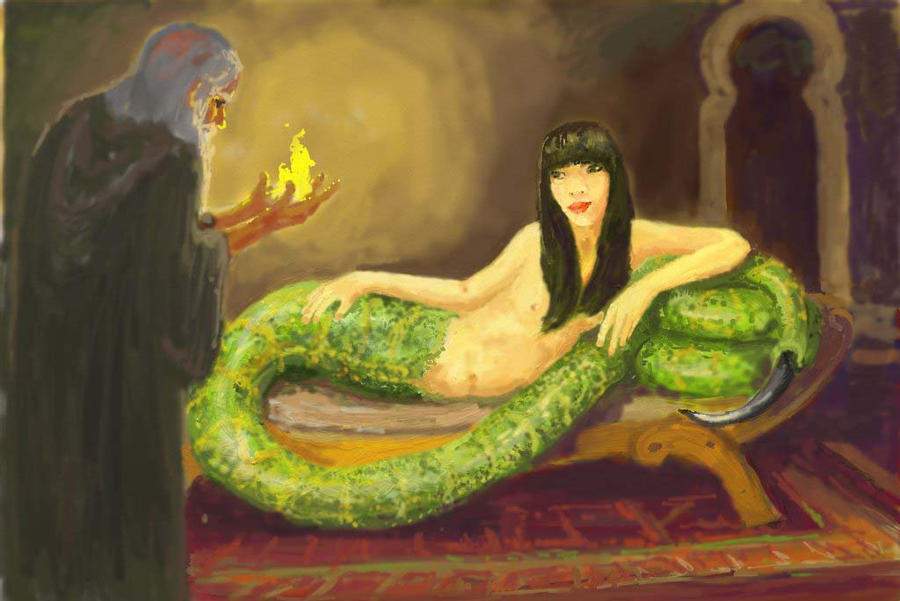
Melusine is the spirit of freshwater, usually depicted as a woman who is a serpent or fish from the waist down, much like the mythical mermaid. She is also frequently illustrated with two tails. The image of Melusine is so famous and enduring that, perhaps without knowing her by name, we still recognize her image today as the logo for Starbucks Coffee.

The Starbucks Logo: Melusine and her two tails; Deriv (CC BY-SA 4.0)
Sixteenth-century Theologian Martin Luther referred to Melusine unfavorably several times as a succubus, and nineteenth-century composer Felix Mendelssohn wrote a concert overture titled “The Fair Melusina”.
Melusine or Melusina is a figure of European folklore and mythology, a female spirit of fresh water in a sacred spring or river, usually depicted as a woman who is a serpent or fish from the waist down, much like a two-tailed mermaid. She is sometimes referred to as the Serpent Mother of European Royalty.
https://atlanteangardens.blogspot.com… According to the book, “The Serpent And The Swan: The Animal Bride In Folklore And Literature,” the name “Melusine” was used as an abbreviation of the words ‘Mere des Lusignan’ or ‘Mother of the Lusignans.’ The House of Lusignan was a royal house of French origin, which at various times ruled several principalities in Europe and the Levant, including the kingdoms of Jerusalem, Cyprus, and Armenia, from the 12th through the 15th centuries during the Middle Ages. Presentation by Dr. Sharonah Fredrick Visuals by Kendra Bruning
These days, images of Melusine are still seen in the Vendée region of Poitou, western France, where one can drink Melusine-brand beer and eat Melusine-style baguettes. In Vouvant, paintings of her and her sons decorate the “Tour Melusine,” the ruins of a Lusignan castle guarding the banks of the River Mère, where visitors of the tower can lunch at the Cafe Melusine nearby.

Tour Mélusine ( Public Domain )
The legends of Melusine are especially connected with the northern and western areas of France, Luxembourg, and the Low Countries. Her name derives from Mère Lusine (“Mother of the Lusignans”), connecting her with Cyprus, where the French Lusignan royal house that ruled from 1192 to 1489 claimed to be her descendants. The legend of Melusine, therefore, is related to the territorial and dynastic expansion of her descendants beyond Lusignan across the Mediterranean to distant Armenia during the crusades (1095 – 1291).
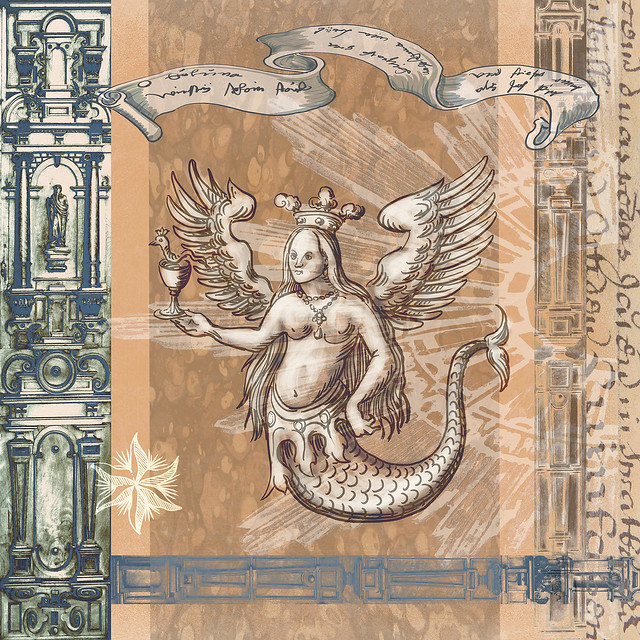
The Fairy and the King: The Legend of Pressyne, the Mother of Melusine
One day, at the time of the Crusades, Elynas, the King of Albany, went hunting and saw a beautiful lady in the forest. The lady’s name was Pressyne. Elynas persuaded her to marry him and she agreed. However, Pressyne demanded a promise from him that he must never enter her chamber when she birthed or bathed her children.
The couple lived happily for some time until Pressyne gave birth to triplets. When, as one would expect to happen in these stories, her husband broke his promise, Pressyne left the kingdom, together with her three daughters, and traveled to the lost Isle of Avalon where her daughters — Melusine, Melior and Palatyne — would grow up.

The woman took her children to the lost Isle of Avalon ( CC BY 2.0 )
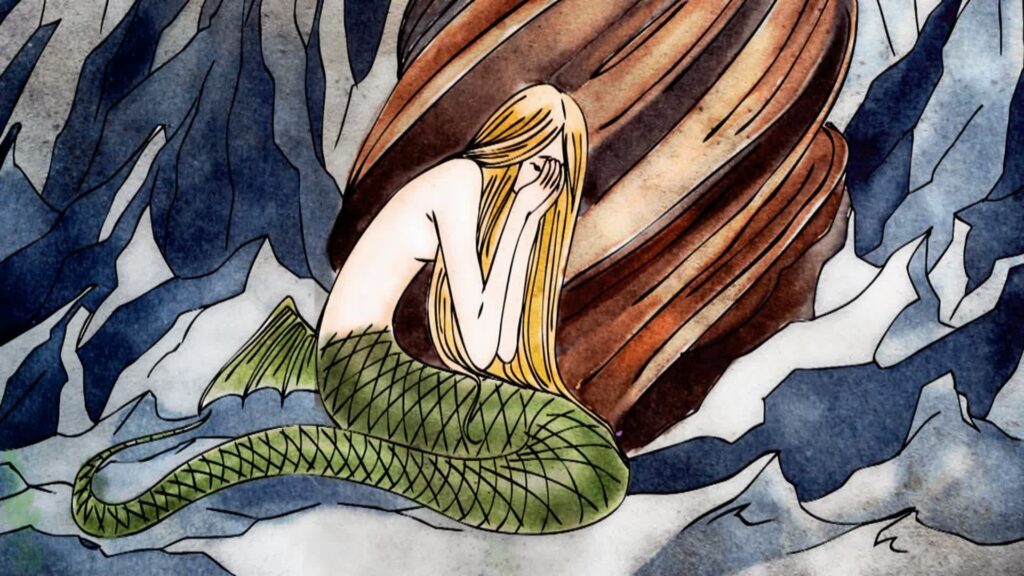
On their fifteenth birthday, the eldest daughter, Melusine, asked her mother why she separated them from their father and took them to Avalon. After hearing of their father’s broken promise, Melusine sought revenge. She rallied her sisters and the three sisters captured Elynas and trapped him in a mountain. When she heard what her daughters have done, Pressyne punished them for their disrespect to their father. She condemned Melusine to take the form of a fish from the waist down every Saturday. In other versions of the legend, Melusine was condemned to take on the form of a serpent on Saturdays.

Middle Ages
People Involved
Melusine, Count of Anjou (Melusine’s husband)
Outcome
Count of Anjou loses Melusine forever
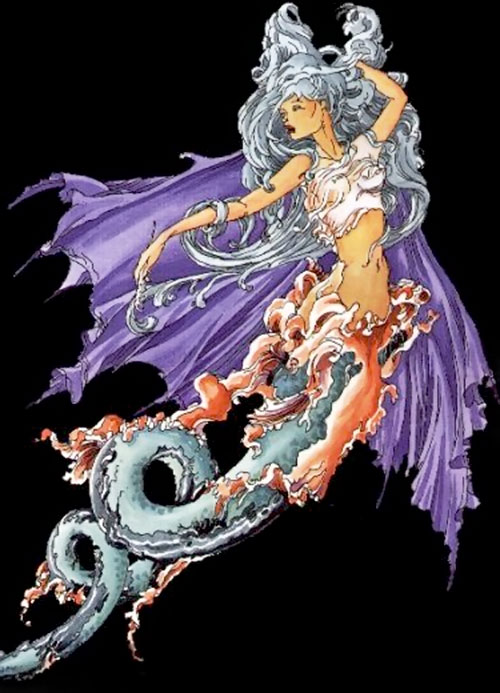
Melusine is a figure of European folklore, a female spirit of fresh water in a sacred spring or river. She is usually depicted as a woman who is a serpent or fish from the waist down (much like a mermaid). She is also sometimes illustrated with wings, two tails, or both. Her legends are especially connected with the northern and western areas of France, Luxembourg, and the Low Countries. She is also connected with Cyprus, where the French Lusignan royal house that ruled the island from 1192 to 1489 claimed to be descended from Melusine.

Versions in Literature
The most famous literary version of Melusine tales, that of Jean d’Arras, compiled about 1382–1394, was worked into a collection of “spinning yarns” as told by ladies at their spinning. Coudrette (Couldrette) wrote The Romans of Partenay or of Lusignen: Otherwise known as the Tale of Melusine, giving source and historical notes, dates and background of the story. He goes into detail and depth about the relationship of Melusine and Raymondin, their initial meeting and the complete story.
The tale was translated into German in 1456 by Thüring von Ringoltingen, the version of which became popular as a chapbook. It was later translated into English c. 1500, and often printed in both the 15th century and the 16th century. A prose version is entitled the Chronique de la princesse (Chronicle of the Princess).
It tells how in the time of the Crusades, Elynas, the King of Albany (an old name for Scotland or Alba), went hunting one day and came across a beautiful lady in the forest. She was Pressyne, mother of Melusine. He persuaded her to marry him but she agreed, only on the promise — for there is often a hard and fatal condition attached to any pairing of fay and mortal — that he must not enter her chamber when she birthed or bathed her children. She gave birth to triplets. When he violated this taboo, Pressyne left the kingdom, together with her three daughters, and traveled to the lost Isle of Avalon.
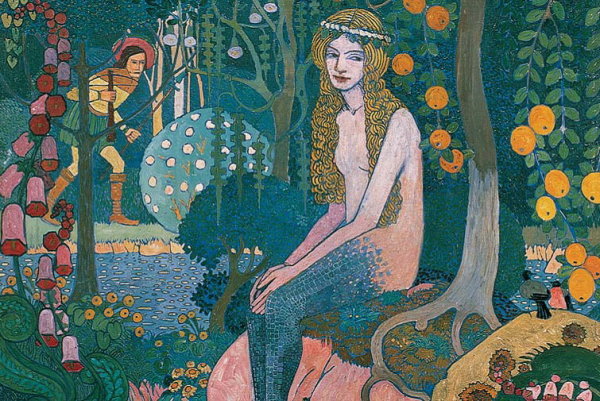
The three girls — Melusine, Melior, and Palatyne — grew up in Avalon. On their fifteenth birthday, Melusine, the eldest, asked why they had been taken to Avalon. Upon hearing of their father’s broken promise, Melusine sought revenge. She and her sisters captured Elynas and locked him, with his riches, in a mountain. Pressyne became enraged when she learned what the girls had done, and punished them for their disrespect to their father. Melusine was condemned to take the form of a serpent from the waist down every Saturday. In other stories, she takes on the form of a mermaid.
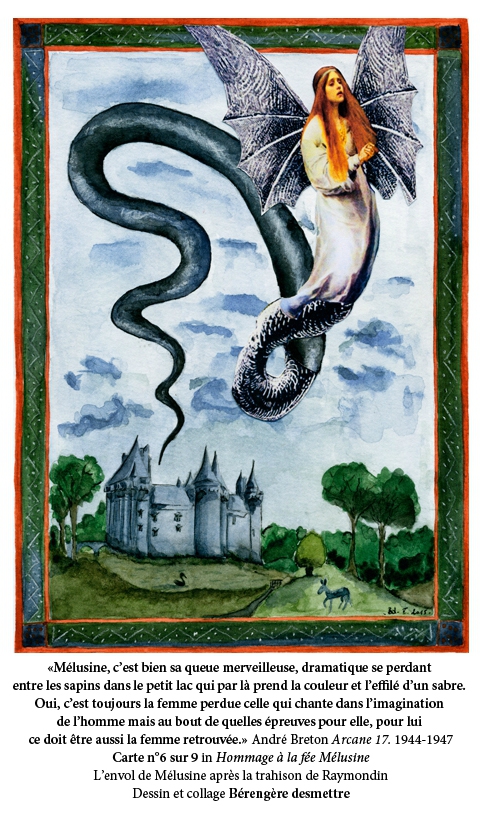
Raymond of Poitou came across Melusine in a forest of Coulombiers in Poitou in France, and proposed marriage. Just as her mother had done, she laid a condition: that he must never enter her chamber on a Saturday. He broke the promise and saw her in the form of a part-woman, part-serpent, but she forgave him. When, during a disagreement, he called her a “serpent” in front of his court, she assumed the form of a dragon, provided him with two magic rings, and flew off, never to return.
In The Wandering Unicorn by Manuel Mujica Láinez, Melusine tells her tale of several centuries of existence, from her original curse to the time of the Crusades.

Legends
Melusine legends are especially connected with the northern areas of France, Poitou and the Low Countries, as well as Cyprus, where the French Lusignan royal house that ruled the island from 1192 to 1489 claimed to be descended from Melusine. Oblique reference to this was made by Sir Walter Scott who told a Melusine tale in The Minstrelsy of the Scottish Border (1802–1803) stating that
| “the reader will find the fairy of Normandy, or Bretagne, adorned with all the splendour of Eastern description. The fairy Melusina, also, who married Guy de Lusignan, Count of Poitou, under condition that he should never attempt to intrude upon her privacy, was of this latter class. She bore the count many children, and erected for him a magnificent castle by her magical art. Their harmony was uninterrupted until the prying husband broke the conditions of their union, by concealing himself to behold his wife make use of her enchanted bath. Hardly had Melusina discovered the indiscreet intruder, than, transforming herself into a dragon, she departed with a loud yell of lamentation, and was never again visible to mortal eyes; although, even in the days of Brantome, she was supposed to be the protectress of her descendants, and was heard wailing as she sailed upon the blast round the turrets of the castle of Lusignan the night before it was demolished.” | ” |
The Luxembourg family also claimed descent from Melusine through their ancestor Siegfried. When in 963 A.D. Count Siegfried of the Ardennes (Sigefroi in French; Sigfrid in Luxembourgish) bought the feudal rights to the territory on which he founded his capital city of Luxembourg, his name became connected with the local version of Melusine. This Melusina had essentially the same magic gifts as the ancestress of the Lusignans, magically making the Castle of Luxembourg on the Bock rock (the historical center point of Luxembourg City) appear the morning after their wedding.
On her terms of marriage, she too required one day of absolute privacy each week. Alas, Sigfrid, as the Luxem-bourgish call him, “could not resist temptation, and on one of the forbidden days he spied on her in her bath and discovered her to be a mermaid. When he let out a surprised cry, Melusina caught sight of him, and her bath immediately sank into the solid rock, carrying her with it. Melusina surfaces briefly every seven years as a beautiful woman or as a serpent, holding a small golden key in her mouth. Whoever takes the key from her will set her free and may claim her as his bride.” In 1997 Luxembourg issued a postage stamp commemorating her.
Martin Luther knew and believed in the story of another version of Melusine, die Melusina zu Lucelberg (Lucelberg in Silesia), whom he referred to several times as a succubus (Works, Erlangen edition, volume 60, pp 37–42). Johann Wolfgang von Goethe wrote the tale of Die Neue Melusine in 1807 and published it as part of Wilhelm Meisters Wanderjahre. The playwright Franz Grillparzer brought Goethe’s tale to the stage and Felix Mendelssohn provided a concert overture “The Fair Melusina,” his Opus 32.
Melusine is one of the pre-Christian water-faeries who were sometimes responsible for changelings. The “Lady of the Lake”, who spirited away the infant Lancelot and raised the child, was such a water nymph. Other European water sprites include Loreleiand the nixie.
“Melusina” would seem to be an uneasy name for a girl-child in these areas of Europe, but Ehrengard Melusine von der Schulenburg, Duchess of Kendal and Munster, mistress of George I of Great Britain, was christened Melusine in 1667.
The chronicler Gerald of Wales reported that Richard I of England was fond of telling a tale according to which he was a descendant of a countess of Anjou who was in fact the fairy Melusine, concluding that his whole family “came from the devil and would return to the devil”. The Angevin legend told of an early Count of Anjou who met a beautiful woman when in a far land, where he married her. He had not troubled to find out about her origins. However, after bearing him four sons, the behaviour of his wife began to trouble the count. She attended church infrequently, and always left before the the Mass proper.
One day he had four of his men forcibly restrain his wife as she rose to leave the church. Melusine, evaded the men and clasped the two youngest of her sons and in full view of the congregation carried them up into the air and out of the church through its highest window. Melusine and her two sons were never seen again. One of the remaining sons was the ancestor, it was claimed, of the later Counts of Anjou and the Kings of England.
Related Legends
The Travels of Sir John Mandeville recounts a legend about Hippocrates’ daughter. She was transformed into a hundred-foot long dragon by the goddess Diane, and is the “lady of the manor” of an old castle. She emerges three times a year, and will be turned back into a woman if a knight kisses her, making the knight into her consort and ruler of the islands. Various knights try, but flee when they see the hideous dragon; they die soon thereafter. This appears to be an early version of the legend of Melusine.
The Mermaid and the Gentleman: The Legend of Melusine, the Mother of Kings
Sometime later, history repeated itself when, while out hunting in the forests of the Ardennes, Raymondin, Lord of Forez in Poitou, a poor but noble gentleman, met the beautiful Melusine who was sitting beside a fountain in a glimmering white dress…
Melusine
From Wikipedia, the free encyclopedia
Melusine-WikipediaFor other uses, see Melusine (disambiguation).Melusine’s secret discovered, from Le Roman de Mélusine by Jean d’Arras, ca 1450–1500. Bibliothèque nationale de France.
Melusine (French: [melyzin]) or Melusina is a figure of European folklore and mythology, a female spirit of fresh water in a sacred spring or river. She is usually depicted as a woman who is a serpent or fish from the waist down (much like a mermaid). She is also sometimes illustrated with wings, two tails, or both. Her legends are especially connected with the northern and western areas of France, Luxembourg, and the Low Countries.
The House of Luxembourg (which ruled the Holy Roman Empire from AD 1308 to AD 1437 as well as Bohemia and Hungary), the House of Anjou and their descendants the House of Plantagenet (kings of England) and the French House of Lusignan (kings of Cyprus from AD 1205–1472, and for shorter periods over Armenia and Jerusalem) are said in folk tales and medieval literature to be descended from Melusine.
One tale says Melusine herself was the daughter of the fairy Pressyne and king Elinas of Albany (now known as Scotland). Melusine’s mother leaves her husband, taking her daughters to the isle of Avalon after he breaks an oath never to look in at her and her daughter in their bath. The same pattern appears in stories where Melusine marries a nobleman only after he makes an oath to give her privacy in her bath; each time, she leaves the nobleman after he breaks that oath. Shapeshifting and flight on wings away from oath-breaking husbands also figure in stories about Melusine. According to Sabine Baring-Gould in Curious Tales of the Middle Ages, the pattern of the tale is similar to the Knight of the Swan legend which inspired the character “Lohengrin” in Wolfram von Eschenbach‘s Parzival. [1]
Contents
- 1Literary versions
- 2Legends
- 3Related legends
- 4Structural interpretation
- 5References in the arts
- 6See also
- 7References
- 8External links
Literary versions
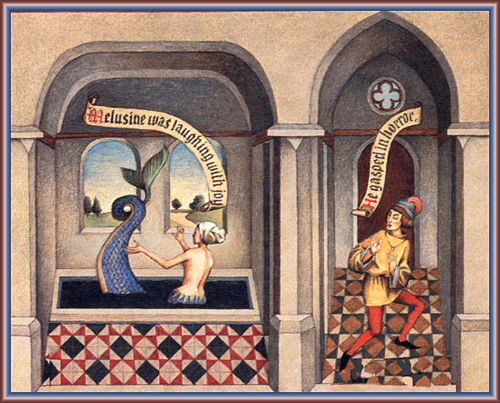
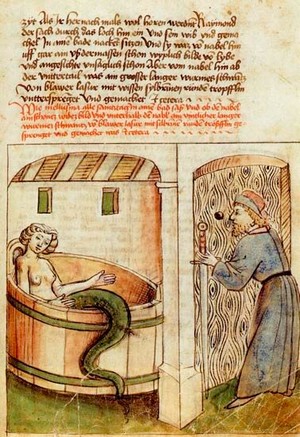
Raymond walks in on his wife, Melusine, in her bath and discovers she has the lower body of a serpent. Illustration from the Jean d’Arras work, Le livre de Mélusine (The Book of Melusine), 1478.
The most famous literary version of Melusine tales, that of Jean d’Arras, compiled about 1382–1394, was worked into a collection of “spinning yarns” as told by ladies at their spinning coudrette (coulrette (in French)). He wrote The Romans of Partenay or of Lusignen: Otherwise known as the Tale of Melusine, giving source and historical notes, dates and background of the story. He goes into detail and depth about the relationship of Melusine and Raymondin, their initial meeting and the complete story.
The tale was translated into German in 1456 by Thüring von Ringoltingen, which version became popular as a chapbook. It was later translated into English, twice, around 1500, and often printed in both the 15th century and the 16th century. There is also a Castilian and a Dutch translation, both of which were printed at the end of the 15th century. [2] A prose version is entitled the Chronique de la princesse (Chronicle of the Princess).
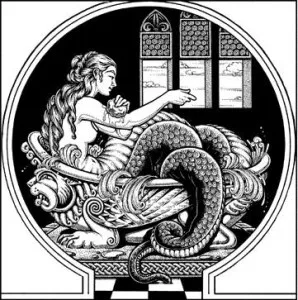
It tells how in the time of the Crusades, Elynas, the King of Albany (an old name for Scotland or Alba), went hunting one day and came across a beautiful lady in the forest. She was Pressyne, mother of Melusine. He persuaded her to marry him but she agreed, only on the promise—for there is often a hard and fatal condition attached to any pairing of fay and mortal—that he must not enter her chamber when she birthed or bathed her children. She gave birth to triplets. When he violated this taboo, Pressyne left the kingdom, together with her three daughters, and traveled to the lost Isle of Avalon.
The three girls—Melusine, Melior, and Palatyne—grew up in Avalon. On their fifteenth birthday, Melusine, the eldest, asked why they had been taken to Avalon. Upon hearing of their father’s broken promise, Melusine sought revenge. She and her sisters captured Elynas and locked him, with his riches, in a mountain. Pressyne became enraged when she learned what the girls had done, and punished them for their disrespect to their father. Melusine was condemned to take the form of a serpent from the waist down every Saturday. In other stories, she takes on the form of a mermaid.
Raymond of Poitou came across Melusine in a forest of Coulombiers in Poitou in France, and proposed marriage. Just as her mother had done, she laid a condition: that he must never enter her chamber on a Saturday. He broke the promise and saw her in the form of a part-woman, part-serpent, but she forgave him. When, during a disagreement, he called her a “serpent” in front of his court, she assumed the form of a dragon, provided him with two magic rings, and flew off, never to return.[3]
In The Wandering Unicorn by Manuel Mujica Láinez, Melusine tells her tale of several centuries of existence, from her original curse to the time of the Crusades. [4]
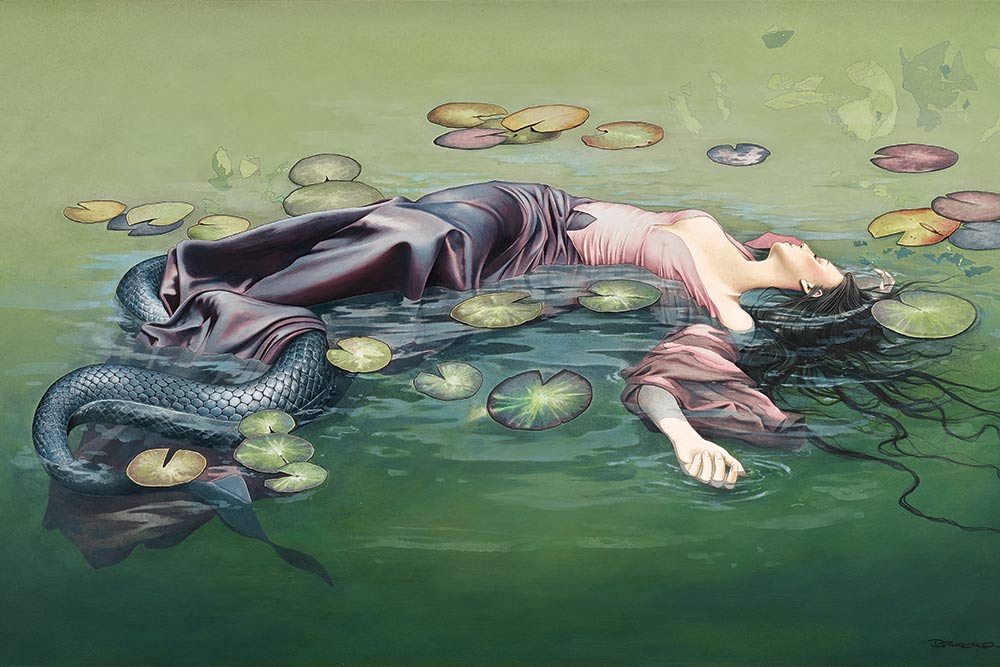
Legends
Melusine legends are especially connected with the northern areas of France, Poitou and the Low Countries, as well as Cyprus, where the French Lusignan royal house that ruled the island from 1192 to 1489 claimed to be descended from Melusine. Oblique reference to this was made by Sir Walter Scott who told a Melusine tale in Minstrelsy of the Scottish Border (1802–1803) stating that
the reader will find the fairy of Normandy, or Bretagne, adorned with all the splendour of Eastern description. The fairy Melusina, also, who married Guy de Lusignan, Count of Poitou, under condition that he should never attempt to intrude upon her privacy, was of this latter class. She bore the count many children, and erected for him a magnificent castle by her magical art. Their harmony was uninterrupted until the prying husband broke the conditions of their union, by concealing himself to behold his wife make use of her enchanted bath. Hardly had Melusina discovered the indiscreet intruder, than, transforming herself into a dragon, she departed with a loud yell of lamentation, and was never again visible to mortal eyes; although, even in the days of Brantome, she was supposed to be the protectress of her descendants, and was heard wailing as she sailed upon the blast round the turrets of the castle of Lusignan the night before it was demolished.
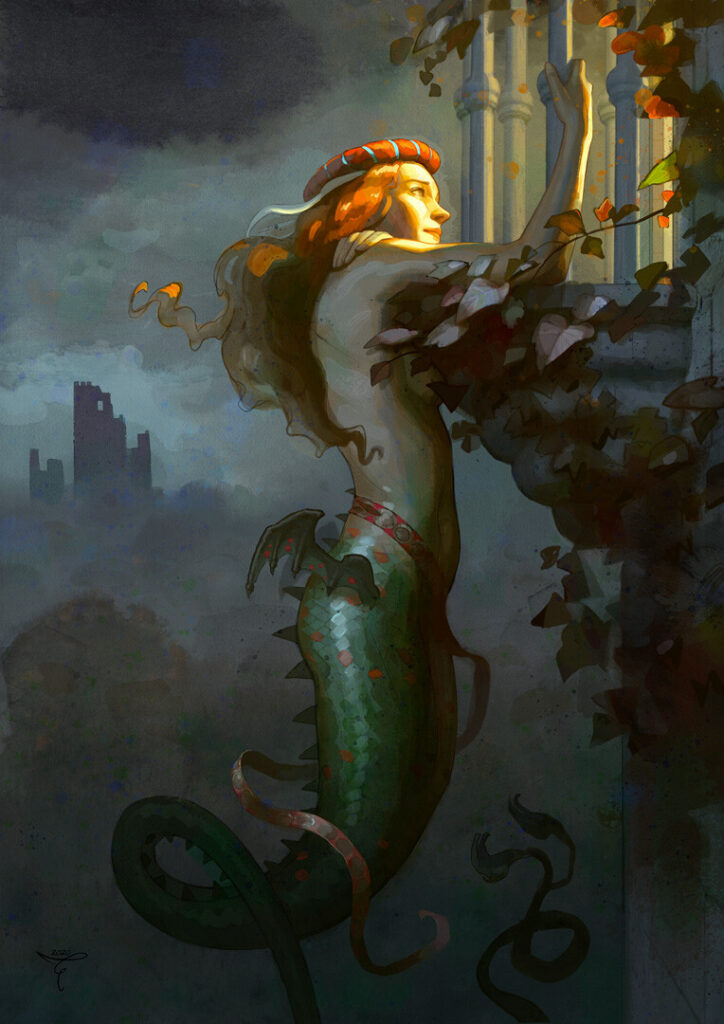
Melusine by Ludwig Michael von Schwanthaler (1845)
The Luxembourg family also claimed descent from Melusine through their ancestor Siegfried.[5] When in 963 A.D. Count Siegfried of the Ardennes (Sigefroi in French; Sigfrid in Luxembourgish) bought the feudal rights to the territory on which he founded his capital city of Luxembourg, his name became connected with the local version of Melusine. This Melusina had essentially the same magic gifts as the ancestress of the Lusignans, magically making the Castle of Luxembourg on the Bock rock (the historical center point of Luxembourg City) appear the morning after their wedding. On her terms of marriage, she too required one day of absolute privacy each week.
Alas, Sigfrid, as the Luxem-bourgish call him, “could not resist temptation, and on one of the forbidden days he spied on her in her bath and discovered her to be a mermaid. When he let out a surprised cry, Melusina caught sight of him, and her bath immediately sank into the solid rock, carrying her with it. Melusina surfaces briefly every seven years as a beautiful woman or as a serpent, holding a small golden key in her mouth. Whoever takes the key from her will set her free and may claim her as his bride.” In 1997 Luxembourg issued a postage stamp commemorating her.[6]
Martin Luther knew and believed in the story of another version of Melusine, die Melusina zu Lucelberg (Lucelberg in Silesia), whom he referred to several times as a succubus (Works, Erlangen edition, volume 60, pp 37–42). Johann Wolfgang von Goethe wrote the tale of Die Neue Melusine in 1807 and published it as part of Wilhelm Meisters Wanderjahre. The playwright Franz Grillparzer brought Goethe’s tale to the stage and Felix Mendelssohn provided a concert overture “The Fair Melusina,” his Opus 32.
Melusine is one of the pre-Christian water-faeries[citation needed] who were sometimes responsible for changelings. The “Lady of the Lake“, who spirited away the infant Lancelot and raised the child, was such a water nymph. Other European water sprites include Lorelei and the nixie.
“Melusina” would seem to be an uneasy name for a girl-child in these areas of Europe, but Ehrengard Melusine von der Schulenburg, Duchess of Kendal and Munster, mistress of George I of Great Britain, was christened Melusine in 1667.
The chronicler Gerald of Wales reported that Richard I of England was fond of telling a tale according to which he was a descendant of a countess of Anjou who was in fact the fairy Melusine. [7] The Angevin legend told of an early Count of Anjou who met a beautiful woman when in a far land, where he married her. He had not troubled to find out about her origins. However, after bearing him four sons, the behavior of his wife began to trouble the count. She attended church infrequently, and always left before the Mass proper. One day he had four of his men forcibly restrain his wife as she rose to leave the church. Melusine evaded the men and clasped the two youngest of her sons and in full view of the congregation carried them up into the air and out of the church through its highest window. Melusine and her two sons were never seen again. One of the remaining sons was the ancestor, it was claimed, of the later Counts of Anjou and the Kings of England. [8]
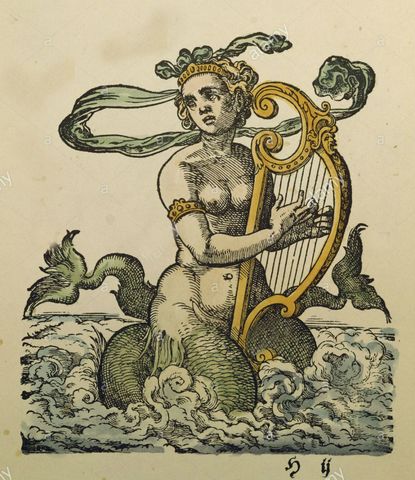
Related legends
The Travels of Sir John Mandeville recounts a legend about Hippocrates‘ daughter. She was transformed into a hundred-foot-long dragon by the goddess Diane, and is the “lady of the manor” of an old castle. She emerges three times a year and will be turned back into a woman if a knight kisses her, making the knight into her consort and ruler of the islands. Various knights try, but flee when they see the hideous dragon; they die soon thereafter. This appears to be an early version of the legend of Melusine. [9]
Structural interpretation
Jacques Le Goff considered that Melusina represented a fertility figure: “she brings prosperity in a rural area…Melusina is the fairy of medieval economic growth”.[10]
References in the arts
 | hideThis section has multiple issues. Please help improve it or discuss these issues on the talk page. (Learn how and when to remove these template messages)This section appears to contain trivial, minor, or unrelated references to popular culture. (May 2017)This section needs additional citations for verification. (May 2017) |
“Melusine” by Julius Hübner.
- Melusine is the subject of Friedrich de la Motte Fouqué‘s novella Undine (1811), Halévy‘s grand opera La magicienne (1858) and Jean Giraudoux‘s play Ondine (1939).
- Antonín Dvořák‘s Rusalka, Opera in three acts, Libretto by Jaroslav Kvapil, is also based on the fairy tale Undine by Friedrich de la Motte Fouqué.
- Felix Mendelssohn depicted the character in his concert overture The Fair Melusine (Zum Märchen von der Schönen Melusine), opus 32.
- Marcel Proust‘s main character compares Gilberte to Melusine in Within a Budding Grove. She is also compared on several occasions to the Duchesse de Guermantes who was (according to the Duc de Guermantes) directly descended from the Lusignan dynasty. In the Guermantes Way, for example, the narrator observes that the Lusignan family “was fated to become extinct on the day when the fairy Melusine should disappear” (Volume II, Page 5, Vintage Edition.).
- The story of Melusine (also called Melusina) was retold by Letitia Landon in the poem “The Fairy of the Fountains” in Fisher’s Drawing Room Scrap Book, 1834,[11] and reprinted in her collection The Zenana. Here she is representative of the female poet. An analysis can be found in Anne DeLong, pages 124–131. [12]
- Mélusine appears as a minor character in James Branch Cabell‘s Domnei: A Comedy of Woman-Worship (1913 as The Soul of Melicent, rev. 1920) and The High Place (1923).
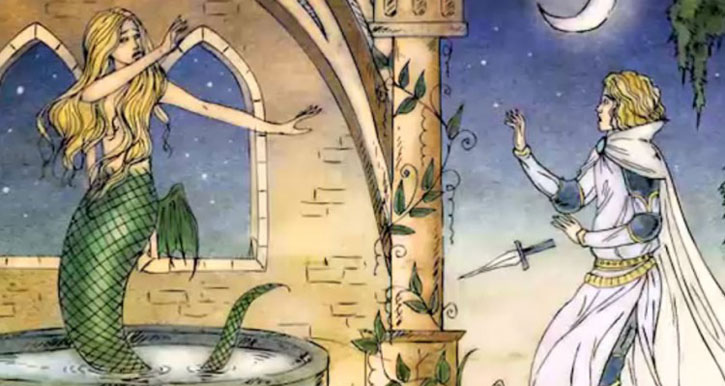
- In Our Lady of the Flowers, Jean Genet twice says that Divine, the main character, is descended from “the siren Melusina” (pp. 198, 298 of the Grove Press English edition (1994)). (The conceit may have been inspired by Genet’s reading of Proust.)
- Melusine appears to have inspired aspects of the character Mélisande, who is associated with springs and waters, in Maurice Maeterlinck‘s play Pelléas and Mélisande, first produced in 1893. Claude Debussy adapted it as an opera by the same name, produced in 1902.
- In Wilhelm Meister’s Journeyman Years, Goethe re-tells the Melusine tale in a short story titled “The New Melusine”.
- Georg Trakl wrote a poem titled “Melusine”.
- Margaret Irwin’s fantasy novel These Mortals (1925) revolves around Melusine leaving her father’s palace, and having adventures in the world of humans. [13]
- Charlotte Haldane wrote a study of Melusine in 1936 (which her then husband J.B.S. Haldane referred to in his children’s book “My Friend Mr Leakey”).
- Aribert Reimann composed an opera Melusine, which premiered in 1971.
- The Melusine legend is featured in A. S. Byatt‘s late 20th century novel Possession. One of the main characters, Christabel LaMotte, writes an epic poem about Melusina.
- Philip the Good‘s 1454 Feast of the Pheasant featured as one of the lavish ‘entremets’ (or table decorations) a mechanical depiction of Melusine as a dragon flying around the castle of Lusignan. [14]
- Rosemary Hawley Jarman used a reference from Sabine Baring-Gould‘s Curious Myths of the Middle Ages[15] that the House of Luxembourg claimed descent from Melusine in her 1972 novel The King’s Grey Mare, making Elizabeth Woodville‘s family claim descent from the water-spirit. [16] This element is repeated in Philippa Gregory‘s novels The White Queen (2009) and The Lady of the Rivers (2011), but with Jacquetta of Luxembourg telling Elizabeth that their descent from Melusine comes through the Dukes of Burgundy. [17][5]
- In his 2016 novel In Search of Sixpence the writer Michael Paraskos retells the story of Melusine by imagining her as a Turkish Cypriot girl forceably abducted from the island by a visiting Frenchman.
- Kurt Heasley of the US band Lilys wrote a song titled “Melusina” for the 2003 album Precollection.
- French singer Nolwenn Leroy recorded a song titled “Mélusine” on her album Histoires Naturelles in 2005.
- The gothic metal band Leaves’ Eyes released a song and EP titled “Melusine” in April 2011.
- In Final Fantasy V, a video game RPG originally released by Squaresoft for the Super Famicom in 1992, Melusine appears as a boss. Her name was mistranslated as “Mellusion” in the PS1 port included as part of Final Fantasy Anthology but was correctly translated in subsequent localizations.
- The fairy is said to be “a recurring metaphor” in Breton’s Arcanum 17.
- In Czech and Slovak, the word meluzína refers to wailing wind, usually in the chimney. This is a reference to the wailing Melusine looking for her children. [18]
- In the video game The Witcher 3: Wild Hunt, a particularly powerful siren is named Melusine.
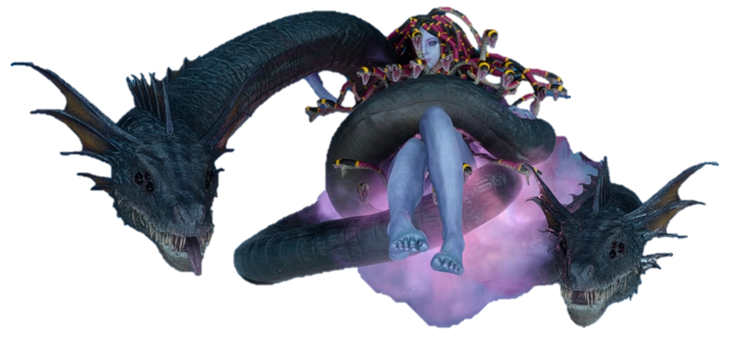
- In the video game Final Fantasy XV, the sidequest “O Partner, My Partner” has the player pitted against a level 99 daemon named Melusine, she is depicted as a beautiful woman, wrapped in snakes. In this version she is weak to fire despite usually depicted as a being of water.
- In the movie Fantastic Beasts: The Crimes of Grindelwald actress Olwen Fouéré plays a character named “Melusine”.
- In the book “Light and Shadow”, part 5 of The Longsword Chronicles by GJ Kelly, ‘The Melusine’ is the name of a coastal brigantine of the Royal Callodon Navy.
- The video game Sigi – A Fart for Melusina is a parody of the legend. The player character is Siegfried, who tries to rescue his beloved Melusine.
- In June 2019, it was announced that Luxembourg’s first petascale supercomputer, a part of the European High-Performance Computing Joint Undertaking (EuroHPC JU) programme, is to be named “Meluxina”. [19]
- The Starbucks logo is Melusine. [20]
- In the webcomic Eerie Cuties, one of the main characters is a melusine named Brook. She takes a human form with a snake around her neck most of the time, though changes into her snake form on occasion.

See also
- Echidna (mythology) Greek Mythological serpent woman, mother of monsters
- Legend of the White Snake
- Morgen (mythological creature)
- Neck (water spirit)
- Naiad
- Potamides (mythology)
- Partonopeus de Blois
- Yuki-onna
- Knight of the Swan
References
- Donald Maddox and Sara Sturm-Maddox, Melusine of Lusignan: foundling fiction in late medieval France. Essays on the Roman de Mélusine (1393) of Jean d’Arras.
- Lydia Zeldenrust, The Mélusine Romance in Medieval Europe: Translation, Circulation, and Material Contexts. (Cambridge: D.S. Brewer, 2020) (on the many translations of the romance, covering French, German, Dutch, Castilian, and English versions) ISBN 9781843845218
- Jean d’Arras, Mélusine, roman du XIVe siècle, ed. Louis Stouff. Dijon: Bernigaud & Privat, 1932. (Scholarly edition of the important medieval French version of the legend by Jean d’Arras.)
- Otto j. Eckert, “Luther and the Reformation,” lecture, 1955. e-text
- Proust, Marcel. (C. K. Scott Moncrieff, trans.) Within A Budding Grove. (Page 190)
- ^ Baring-Gould, Sabine (1882). Curious Myths of the Middle Ages. Boston: Roberts Brothers. pp. 343–393.
- ^ Lydia Zeldenrust, The Mélusine Romance in Medieval Europe: Translation, Circulation, and Material Contexts (Cambridge: D. S. Brewer, 2020)
- ^ Boria Sax, The Serpent and the Swan: Animal Brides in Literature and Folklore. Knoxville, TN: University of Tennessee Press/ McDonald & Woodward, 1998.
- ^ Láinez, Manuel Mujica (1983) The Wandering Unicorn Chatto & Windus, London ISBN 0-7011-2686-8;
- ^ Jump up to:a b Philippa Gregory; David Baldwin; Michael Jones (2011). The Women of the Cousins’ War. London: Simon & Schuster.
- ^ Luxembourg Stamps: 1997
- ^ Flori, Jean (1999), Richard Coeur de Lion: le roi-chevalier, Paris: Biographie Payot, ISBN 978-2-228-89272-8 (in French)
- ^ Huscroft, R. (2016) Tales From the Long Twelfth Century: The Rise and Fall of the Angevin Empire, Yale University Press, pp. xix–xx
- ^ Christiane Deluz, Le livre de Jehan de Mandeville, Leuven 1998, p. 215, as reported by Anthony Bale, trans., The Book of Marvels and Travels, Oxford 2012, ISBN 0199600600, p. 15and footnote
- ^ J. Le Goff, Time, Work and Culture in the Middle Ages (London 1982) p. 218-9
- ^ Letitia Landon
- ^ DeLong
- ^ Brian Stableford, ” Re-Enchantment in the Aftermath of War”, in Stableford, Gothic Grotesques: Essays on Fantastic Literature. Wildside Press, 2009, ISBN 978-1-4344-0339-1 (p.110-121)
- ^ Jeffrey Chipps Smith, The Artistic Patronage of Philip the Good, Duke of Burgundy (1419–1467), PhD thesis (Columbia University, 1979), p. 146
- ^ “Stephan, a Dominican, of the house of Lusignan, developed the work of Jean d’Arras, and made the story so famous, that the families of Luxembourg, Rohan, and Sassenage altered their pedigrees so as to be able to claim descent from the illustrious Melusina”, citing Jean-Baptiste Bullet‘s Dissertation sur la mythologie française (1771).
- ^ Jarman, Rosemary Hawley (1972). “Foreword”. The King’s Grey Mare.
- ^ Gregory, Philippa (2009). “Chapter One” (PDF). The White Queen.
- ^ Smith, G.S.; C. M. MacRobert; G. C. Stone (1996). Oxford Slavonic Papers, New Series. XXVIII (28, illustrated ed.). Oxford University Press, USA. p. 150. ISBN 978-0-19-815916-2.
- ^ “Le superordinateur luxembourgeois “Meluxina” fera partie du réseau européen EuroHPC” [Luxembourgish supercomputer “Meluxina” will be part of the EuroHPC European network]. gouvernement.lu (in French). 14 June 2019. Retrieved 30 June2019.
- ^ “So, Who is the Siren? | Starbucks Coffee Company”. web.archive.org. 2011-01-08. Retrieved 2021-03-10.
- Letitia Elizabeth Landon. Fisher’s Drawing Room Scrap Book, 1834.
- Anne DeLong. Mesmerism, Medusa and the Muse, The Romantic Discourse of Spontaneous Creativity, 2012.
External links
 | Wikimedia Commons has media related to Melusine. |
 | Wikisource has original text related to this article:Curious Myths of the Middle Ages: Melusina |
- “Melusina”, translated legends about mermaids and water sprites that marry mortal men, with sources noted, edited by D. L. Ashliman, at University of Pittsburgh
- Terri Windling, “Married to Magic: Animal Brides and Bridegrooms in Folklore and Fantasy”
- Sir Walter Scott, Minstrelsy of the Scottish Border (e-text)
- Jean D’Arras, Melusine, Archive.org
- “Mélusine” . Encyclopædia Britannica (11th ed.). 1911.
| Authority control | BNF: cb11949589t (data)GND: 118580590NKC: jo20201089147SUDOC: 02745973XVIAF: 205817288WorldCat Identities: viaf-205817288 |
|---|
- European legendary creatures
- Fictional Scottish people
- Medieval legends
- French legendary creatures
- European dragons
- Mythological human hybrids
- Water spirits
- Mermaids
‘Melusine came to Lusignan and circled it three times, shrieking woefully in a plaintive female voice. Up in the fortress and in the town below, people were utterly amazed; they knew not what to think, for they could see the form of a serpent, yet they heard the lady’s voice issuing forth from it’.
Jean d’Arras, Roman de Mélusine (1393), M 260-261.[1]
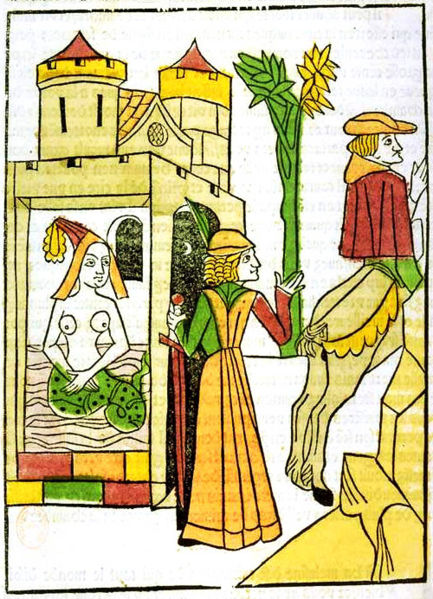
Image of Melusine as a mermaid/serpent from Le Livre de Mélusine (Geneva, 1478).
The story of the fairy Melusine dates from the late fourteenth-century, but has its origins in many human-hybrid folktales of the oral tradition.[2] Melusine, a daughter of a human father and a fairy mother, could be said to have started life as a hybrid and in the course of her mythical career exhibited a number of different hybrid forms. Having transgressed against her father, she was cursed by her mother, the fairy Presine, to turn into a serpent every Saturday. Her only hope of salvation was to find a man who would love her enough to a) respect her privacy every Saturday; and b) if he ever did find out that she was part serpent, to ignore this fact and keep her secret.
The story (or perhaps in Melusine’s case we should say the tale), tells us that Melusine met Count Raymondin, and the two fell in love. Together they had ten sons, eight of whom bore some mark of their fairy ancestry and many of whom proved to be fearsome warriors. Melusine and Raymondin remained very much in love until one day Raymondin’s cousin, the Count of Forez, counselled Raymondin to find out what his wife actually did on a Saturday. Could she be having an affair? Why was there such mystery? The doubts gnawed at Raymondin until eventually he decided to spy on her and, when he did, he realised that Melusine’s secret was that she was only part human. From the waist upwards she was a beautiful woman, but from the waist down, she was a serpent – as we see in this woodcut from one of the first printed versions of the story.
But what type of hybrid creature was she? As the images above and below demonstrate, categorizing Melusine proved difficult. In the 1478 woodcut of the French editio princeps she is very much like a mermaid, although her tail is that of a serpent, rather than a fish. Her chronicler Jean d’Arras tells us that when Raymondin saw Melusine in her bathtub ‘from her head to her navel she had the form of a woman and was combing her hair; and from her navel down she had the form of a serpent’s tail, as thick as a herring barrel, and very long, and she was splashing her tail in the water so much that she made it shoot up to the ceiling’.[3] In the image below, from a contemporary manuscript, we see that she is depicted with wings (an allusion to her final transformation into a dragon), for Melusine’s story did not end with the initial betrayal by Raymondin.[4]

Image of Melusine as a serpent with wings from Le Roman de Mélusine by Jean d’Arras, fifteenth-century manuscript, Bibliothèque Nationale de France.
As Jean d’Arras’ Mélusine ou La Noble Histoire de Lusignan, written c. 1393 relates, Melusine decided to forgive Raymondin’s initial transgression. However, following the murder of one of their sons by another, Raymondin publicly denounced his wife, blaming her for her son’s murderous/monstrous nature. It was at this point that the curse came into effect because Raymondin had publicly repudiated her. As her mother Presine had foretold, Melusine was now condemned to become wholly serpent and had lost all hope of becoming human:
If you had not been false I would have been spared pain and torment, and I would have lived like a natural [human] woman, and I would have died a natural death, with all my sacraments, and I would have been buried in the church of Notre Dame de Lusignan, and my day would have been celebrated. But you have inflicted upon me an obscure penance that stems from my past misfortunes. And for this reason, I must suffer until the Day of Judgment because of your falseness. I pray God may forgive you. [5]

©Photo. R.M.N. / R.-G. Ojda
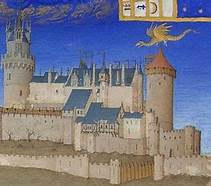
Image of Melusine as a dragon, flying over the Château de Lusignan, from Les Très Riches Heures de duc de Berry, fifteenth-century manuscript in Musée Condé, Chantilly, France.
As this image of Melusine, now depicted as a dragon, demonstrates, her fate was to fly away from Lusignan, only to return to foretell, with dire screams, the death of each count. So in one version of the story, a hybrid human-fairy creature became a hybrid human-serpent, who eventually becomes wholly serpent/dragon-like. Or did she? If we look at some of the printed woodcuts of the late fifteenth century, Melusine does indeed fly out of the top-most tower of Lusignan but does so in another hybrid body not unlike the second image here (i.e. she retains some evidence of her human form). [6]
The image of Melusine as a dragon flying over the castle of Lusignan is a vignette in the calendar page for March in the beautiful manuscript known as the Les Très Riches Heures de duc de Berry. This manuscript was commissioned by and was one of the treasured possessions of Jean (1340-1416), Duc de Berry, third son of Jean II of France and Bonne of Luxembourg. Jean d’Arras’ 1393 tale of the fairy Melusine was not just written to entertain his audience: he had been specifically commissioned by Jean, Duc de Berry to write the story as part of a propaganda campaign for his patron, the new Lord of Lusignan.
The end of the story relates that Melusine came back one last time to Lusignan, just before Jean, Duc de Berry’s forces raised the siege of the castle in 1374. In this way, Melusine, the legendary builder of the castle, could be viewed as noting the passage of the fortress into new hands. Her presence was to mark the ending of English power there and the beginning of Jean, Duc de Berry’s reign as Lord of Lusignan. In effect, by using the story in this fashion, the new Lord of Lusignan was seeking to bolster his credentials as the true Lord of Lusignan, whose coming had been foretold by its foundress.[7]
Given Jean Duc de Berry’s interest in the appropriation of the Melusine myth for his own political ends, the unusually favourable treatment of Melusine in Jean d’Arras narrative begins to make sense, for though her sons have monstrous attributes, she herself, though she transforms into a serpent, is still considered to be a good and true lady. Melusine’s essentially good nature is emphasised throughout Jean d’Arras’s tale: when she first meets Raymondin at the fountain, she makes it clear that her powers might seem like the work of the devil but that she herself was ‘on God’s side and …
I believe everything a true Christian must believe’.[8] Even more strikingly, when she finally transforms into a dragon, we are told that the people of the city, ‘cried out with one voice: Today we are losing the most valiant lady, who ever governed a land, and the wisest, the humblest, the most charitable, the best loved and most attentive to the needs of her people, who has ever been seen’.[9] Melusine’s orthodoxy is further emphasised in the advice she gives her two youngest sons before she departs forever: ‘Listen to what I say and keep it always in mind, because it is important.
First, love and serve God, your Creator, always. Obey all the commandments of our holy Church and all the teachings and commandments of our Catholic faith’.[10] If Jean, Duc de Berry, was claiming a link with a dragon foundress, at least the dragon was a true Christian! The villain of the piece (or perhaps misguided idiot would be closer), is not Melusine in her final, dragon-like, incarnation but rather her husband who, although he will suffer their separation, will not have to endure being a serpent for all eternity.

Image of Melusine on the binding of a book owned by Louis-Henri de Lomenie, Comte de Brienne: Worth’s copy of Ulisse Aldrovandi, Serpentum, et draconum historiæ libri duo (Bologna, 1640), front cover details.
Jean, Duc de Berry, wasn’t the only one who sought to appropriate the allure of Melusine in an attempt to raise his own political fortunes. None of the manuscripts above are in the Worth Library but there is a connection between the legend of Melusine and Edward Worth for the latter’s library includes a number of bindings on books belonging to Louis-Henri Lomenie (1635-1698), Comte de Brienne. As this image demonstrates, Melusine was, quite literally, the crowning glory in Louis-Henri’s coat of arms. Here we see her in yet another guise – in a washtub, holding up a mirror and combing her hair (an allusion to Melusine in mermaid form).
Why did Louis-Henri Lomenie, Comte de Brienne, a noble man in seventeenth-century France, decide to include this reference to the fairy Melusine in his family coat of arms? The answer lies in a desire for power. The famous and powerful Lusignan family were said to have been from the Limoisin, the same area from which the new comtes de Brienne claimed descent. In addition, Louis-Henri probably had in mind the claim that the comtes de Luxembourg were likewise descendants of Melusine since his mother was of the House of Luxembourg: Louise de Béon-Luxembourg (d. 1665), was one of the descendants of Charles, the twenty-fifth comte de Brienne, and was, in addition, an heiress of the House of Luxembourg.]
The two cows, seen here in the 1st and 4th quarter of the coat of arms, represent the House of Béon, while the rampant crowned lions represent the House of Luxembourg. By including the Luxembourg elements on his coat of arms, and, in addition, adding the mysterious fairy Melusine, Lomenie de Brienne sought to move up the slippery ladder of power at the French court. For Louis-Henri it was simply too good a story to ignore and the fair Melusine graces many of the bindings on his books in the Worth Library.
As Ridley Elmes reminds us, Jean, Duc de Berry, and Louis-Henri Lomenie, Comte de Brienne, may have appropriated the legend of Melusine for political ends but her story might also be interpreted in other ways.[12] The sixteenth-century doctor, Paracelsus (1493-1641), wrote about Melusine as type, rather than Melusine as ancestral progenitrix. His treatise On Nymphs, Sylphs, Pygmies and Salamanders, includes a section on water nymphs of which Melusine is one of the most famous examples. Like Jean d’Arras, he emphasised Melusine’s quest to become human. At the same time, Melusine, for Paracelsus, was less an ancestral figure and more an alchemical principle, one which played a vital role in the union of Iliaster and Aquaster into the Primordial Man.[13]
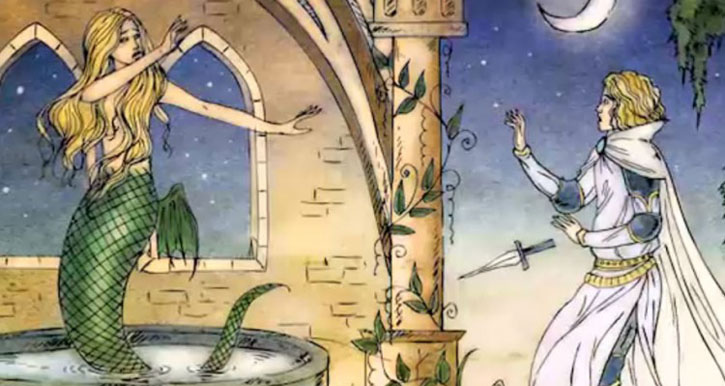
One might conclude that Melusine’s multiple forms reflect the multitude of meanings ascribed to her. That her legend lives on may be seen in the decision of the city of Luxembourg to erect a statue in her honour to mark the 1050th anniversary of the city’s foundation in 2015. Here too, we see another variation on the tale: for Melusina of Luxembourg is shown as a mermaid.
Sources
Brownlee, Kevin, ‘Melusine’s Hybrid Body and the Poetics of Metamorphosis’, in Donald Maddox and Sara Sturm-Maddox (eds), Melusine of Lusignan. Founding Fiction in Late Medieval France (Athens, Georgia, 1996), pp 76-99.
Brownlee, Marina S., ‘Interference in Mélusine,’ in Donald Maddox and Sara Sturm-Maddox (eds), Melusine of Lusignan: Founding Fiction in Late Medieval France (Athens, Georgia, 1996), pp 226-240.
Chambers, Jane, ‘“For Love’s Sake”: Lamia and Burton’s Love Melancholy’, Studies in English Literature, 1500-1900, 22, no. 4 (1982), 583-600.
Delogu, Daisy, ‘Jean d’Arras Makes History: Political Legitimacy and the Roman de Mélusine’, Dalhousie French Studies, 80 (Fall 2007), 15-28.
Maddox, Donald, and Sara Sturm-Maddox (eds), Melusine of Lusignan: Founding Fiction in Late Medieval France (Athens, Georgia, 1996).
Guigard, Joannis, Nouvel Armorial du Bibliophile : Guide de l’Amateur des livres armoriés (Paris: Rondeau, 1890), 2 vols.
Péporté, Pit, ‘Melusine and Luxembourg: A Double Memory’, in Misty Urban, Deva F. Kemmis and Melissa Ridley Elmes (eds), Melusine’s Footprint: Tracing the Legacy of a Medieval Myth (Leiden, 2017), pp 162-182.
Ridley Elmes, Melissa, ‘The Alchemical Transformation of Melusine’, in Misty Urban, Deva F. Kemmis and Melissa Ridley Elmes (eds), Melusine’s Footprint: Tracing the Legacy of a Medieval Myth (Leiden, 2017), pp 94-108.
Nichols, Stephen G., ‘Melusine between Myth and History: Profile of a Female Demon’, in Donald Maddox and Sara Sturm-Maddox (eds), Melusine of Lusignan: Founding Fiction in Late Medieval France (Athens, Georgia, 1996), pp 137-164.
Sturm Maddox, Sara, ‘Crossed Destinies: Narrative Programs’, in Donald Maddox and Sara Sturm-Maddox (eds), Melusine of Lusignan: Founding Fiction in Late Medieval France (Athens, Georgia, 1996), pp 12-31.
Urban, Misty, Deva F. Kemmis and Melissa Ridley Elmes (eds), Melusine’s Footprint: Tracing the Legacy of a Medieval Myth (Leiden, 2017).
Zeldenrust, Lydia, ‘Serpent or Half-Serpent? Bernhard Richel’s Melusine and the Making of a Western European Icon’, Neophilologus, 100 (2016), 19-41.
Text: Dr. Elizabethanne Boran, Librarian of the Edward Worth Library.
[1] Donald Maddox and Sara Sturm-Maddox, ‘Introduction: Melusine at 600’, in Donald Maddox and Sara Sturm-Maddox (eds), Melusine of Lusignan. Founding Fiction in Late Medieval France (Athens, Georgia, 1996), p. 1.
[2] Chambers notes an ancient Greek story with similarities to the story of Melusine: Jane Chambers, ‘“For Love’s Sake”: Lamia and Burton’s Love Melancholy’, Studies in English Literature, 1500-1900, 22: 4 (1982), 583-600.
[3] Kevin Brownlee, ‘Melusine’s Hybrid Body and the Poetics of Metamorphosis’, in Donald Maddox and Sara Sturm-Maddox (eds), Melusine of Lusignan. Founding Fiction in Late Medieval France (Athens, Georgia, 1996), p. 80.
[4] Nichols notes that this latter visual image of Melusine links her iconographically with the theme of the ‘winged siren’: Stephen G. Nichols, ‘Melusine between Myth and History: Profile of a Female Demon’, in Donald Maddox and Sara Sturm-Maddox (eds), Melusine of Lusignan. Founding Fiction in Late Medieval France (Athens, Georgia, 1996), p. 139.
[5] Marina S. Brownlee, ‘Interference in Mélusine’, in Donald Maddox and Sara Sturm-Maddox (eds), Melusine of Lusignan. Founding Fiction in Late Medieval France (Athens, Georgia, 1996), p. 234.
[6] On this see Lydia Zeldenrust, ‘Serpent or Half-Serpent? Bernhard Richel’s Melusine and the Making of a Western European Icon’, Neophilologus, 100 (2016), 19-41.
[7] On this point see Pit Péporté, ‘Melusine and Luxembourg: A Double Memory’, in Misty Urban, Deva F. Kemmis and Melissa Ridley Elmes (eds), Melusine’s Footprint. Tracing the Legacy of a Medieval Myth (Leiden, 2017), pp 162-182 and Daisy Delogu, ‘Jean d’Arras Makes History: Political Legitimacy and the Roman de Mélusine’, Dalhousie French Studies, 80 (Fall 2007), 15-28.
[8] Sara Sturm Maddox, ‘Crossed Destinies’, p. 23.
[9] Sara Sturm Maddox, ‘Crossed Destinies: Narrative Programs’, in Donald Maddox and Sara Sturm-Maddox (eds), Melusine of Lusignan. Founding Fiction in Late Medieval France (Athens, Georgia, 1996), p. 24.
[10] Brownlee, ‘Interference in Mélusine, p. 234.
[11] According to Guigard, her father was Bernard de Béon du Masseu and her mother was Louise de Luxembourg-Brienne: Joannis Guigard, Nouvel Armorial du Bibliophile. Guide de l’Amateur des livres armoriés (Paris: Rondeau, 1890), 2 vols, vol. II, p. 327.
[12] Melissa Ridley Elmes, ‘The Alchemical Transformation of Melusine’, in Misty Urban, Deva F. Kemmis and Melissa Ridley Elmes (eds), Melusine’s Footprint. Tracing the Legacy of a Medieval Myth (Leiden, 2017), pp 94-105.
[13] Ibid., p. 99, fn 20.
Melusine’s Possible Lusignan, Luxembourg, and Plantagenet Descendants
From: https://childrenofarthur.wordpress.com/tag/melusine-of-lusignan/
I have long been interested in the Fairy Melusine, as evidenced by my writing the book Melusine’s Gift. While researching that novel, I learned that Melusine was referenced in Philippa Gregory’s The Cousins War series, beginning with The Lady of the Rivers, so I had to read those novels. I found them fascinating since I’ve also long been interested in the Wars of the Roses. Indeed, it’s possible that I am descended from Elizabeth Woodville, and her mother, Jacquetta of Luxembourg, who figure prominently in the novels.
Melusine
But one thing confused me about Gregory’s depiction of Melusine. Her insistence that Jacquetta, and the House of Luxembourg, was descended from the famous mermaid-like fairy. I assumed there must be some source to this idea, but Gregory never explains the connection in the novel. Melusine is better known as the ancestor to the House of Lusignan, so I could only guess that some member of the House of Lusignan had married into the House of Luxembourg, but who?
I also was surprised by Gregory making the English characters in the novel suspicious of Jacquetta and Elizabeth because of their connection to Melusine. Both women are even accused of witchcraft, so clearly descent from a famous mythical creature—sorceress, mermaid, flying serpent woman, however you want to describe Melusine—was a partial explanation for this fear and their belief that the women might share their ancestor’s supernatural powers. But Gregory completely ignored that the English royal family, the Plantagenets, including Edward IV, whom Elizabeth Woodville married, themselves claimed descent from Melusine. Not until the final novel in the series, The King’s Curse, does she even make a passing reference to this connection.
Where did Gregory get the idea that the House of Luxembourg could be descended from Melusine? According to Wikipedia, Gregory may have gotten this idea from another novelist. “Rosemary Hawley Jarman used a reference from Sabine Baring-Gould’s Curious Myths of the Middle Ages that the House of Luxembourg claimed descent from Melusine in her 1972 novel The King’s Grey Mare, making Elizabeth Woodville’s family claim descent from the water-spirit. This element is repeated in Philippa Gregory’s novels The White Queen (2009) and The Lady of the Rivers (2011), but with Jacquetta of Luxembourg telling Elizabeth that their descent from Melusine comes through the Dukes of Burgundy.”
First, let me say that the claim of the Dukes of Burgundy to being descended from Melusine seems unlikely. In fact, I believe Gregory made up the connection that the House of Luxembourg is connected to the House of Burgundy. If they were at the time of the mid-fifteenth century, it was a very tenuous connection and I could not find a connection. Furthermore, the Dukes of Burgundy during Jacquetta’s time in the early fifteenth century were directly descended from the French royal family.
Baring-Gould’s claim that the House of Luxembourg claimed descent from Melusine is true, but it is not a credible claim. In fact, in The Book of Melusine of Lusignan by Gareth Knight, who is perhaps the greatest expert on Melusine, it is stated that the Luxembourg legend says that Sigefroy, first Count of Lusignan, married a woman named Melusine (p. 117). Since we know Melusine married Count Raimond of Lusignan in other versions of the legend, it is likely various nobles just decided to make up their own connections to Melusine. Somehow, I just don’t see Melusine as a bigamist who deserted Raimond and then went and remarried. Furthermore, Sigefroy is considered the first count of Luxembourg and he lived in the tenth century, while Melusine seems to have lived in the eighth century when she is married to Raimond of Lusignan. Plus, we know that Sigefroy was married to Hedwig of Nordgau, by whom he had several children, including those through whom the House of Luxembourg descended.
So the link between Melusine and Luxembourg seems to be completely fanciful, but still, I decided to dig into Jacquetta’s family tree to see whether I could find any Lusignan link, and believe it or not, I did find a connection. The link is actually through Jacquetta’s paternal grandmother’s line, as shown below. The tree begins with the first documented member of the House of Lusignan, Hugh I, who lived in the ninth century and whom we can presume would be the alleged descendant of Melusine. Each person on the chart is the parent of the person below him or her.
Lusignan Genealogy, linking to Luxembourg
Hugh I
Hugh II (d. 967) According to the Chronicle of Saint-Maixent, he built the castle at Lusignan.
Hugh III
Hugh IV (d.1026)
Hugh V (d.1060)
Hugh VI (1039/43-1103/10)
Hugh VII of Lusignan (1065-1171)
Hugh VIII of Lusignan (d. 1165/71)
Aimery of Lusignan (1145-1205) – brother to Guy, King of Jerusalem
Hugh I of Cyprus (1194/5-1218)
Marie de Lusignan (1215-1251/3)
Hugh, Count of Brienne (1240-1296)
Walter V of Brienne (1278-1311)
Isabella of Brienne (1306-1360), claimant to the Kingdom of Jerusalem
Louis of Enghien (d. 1394)
Marguerite of Enghien (b. 1365) m. John of Luxembourg, Lord of Beauvoir
Peter of Luxembourg, Count of Saint-Pol (1390-1433)
Jacquetta of Luxembourg married Earl Rivers
Elizabeth, Queen of England m. Edward IV
Elizabeth of York m. Henry VII
Henry VIII of England
The genealogy above is a very roundabout way to connect Luxembourg to Lusignan, but the connection is there. That said, Jacquetta was as closely connected to the Plantagenets already as she was to Lusignan, being a descendant of Plantagenet king Henry III as shown below.
Henry III of England (1208-1272)
Beatrice of England (1242-1275) m. John II, Duke of Brittany
Marie of Brittany (1268-1339)
John of Chatillon, Count of Saint-Pol (d. 1344)
Mahaut of Chatillon, Countess of Saint-Pol
John of Luxembourgh, Lord of Beauvoir
Peter of Luxembourg
Jacquetta of Luxembourg
This chart would mean that Jacquetta would also be potentially descended from Melusine if it were true that the Plantagenets were descended from Melusine. But what was the Plantagenet connection? We know that Richard the Lionhearted, who was brother to King John and, therefore, uncle to Henry III, used to like to joke about being descended from Melusine. Therefore, the link has to date to before the thirteenth century. The connection of the Plantagenets to the Lusignan’s actually exists in the line of Anjou from which the Plantagenet line descended.
about:
Fulk Anjou, King of Jerusalem
Geoffrey V of Anjou m. Maud, daughter of Henry I of England
Henry II of England
John of England
Henry III
Here’s where things get confusing. In the first chart above showing Jacquetta’s ancestors, we have Aimery of Lusignan, brother to King Guy of Jerusalem. The genealogy of the Kings of Jerusalem is full of marriages where husbands inherited the crown from their wives. Let’s try to unravel the genealogy of the Kings of Jerusalem.
Fulk of Anjou, King of Jerusalem m. Ermengarde of Maine. They were the parents of Geoffrey of Anjou, progenitor of the Plantagenets. Fulk later married Melisende, Queen of Jerusalem. They had two sons Baldwin III and Amalric, both Kings of Jerusalem. Melisende was herself the daughter of King Baldwin II of Jerusalem, so Fulk achieved the throne through marriage. Also, notably, Melisende is often confused with Melusine because of the similar name, though that may or may not be the cause of the Plantagenet claim to descent from Melusine.
Melisende got her own name from her father, King Baldwin II’s mother, Melisende, who was the daughter of Guy I of Montlhery. Who Guy’s father was is questionable. According to Wikipedia, he was probably the third son of Thibault of Montlhery, though some sources say his father’s name was Milo. I find this latter assertion interesting since the Fairy Melusine may have had a son named Milo or Milon according to some less than creditable sources. But that does not explain the link between Lusignan and the Plantagenets.
As it turns out, Fulk’s son, Amalric, had a daughter, Sybilla, who ended up inheriting the crown of Jerusalem and passing it to her husband, Guy of Lusignan. The result is that the link between Plantagenets and Lusignan is only through marriage, making them sort of half-cousins, but the Plantagenets themselves are not direct descendants of Lusignan. At least not through the House of Anjou.
But a later Plantagenet link does exist. Henry III’s mother was Isabella of Angouleme. Isabella was engaged to marry Hugh IX of Lusignan (brother of Aimery and Guy) when King John instead married her and made her Queen of England. As a result, the Lusignans rebelled against the English king. After John’s death in 1216, Isabella returned to France and married in 1220 Hugh X, the son of her former fiancée. (Not so strange since he was within a few years of her age while King John was twenty-four years older than Isabella.) Hugh X and Isabella had many children who would have been the half-siblings to King Henry III. Among those children was Aymer, who became Bishop of Winchester, and Alice, who married the Earl of Surrey, while the other children seem to have remained in France. So again, another Lusignan connection for the Plantagenets, but again, only by marriage.
“The Wandering Unicorn” by Manuel Mujica Lainez is a fanciful novel about Melusine watching over her Lusignan descendants during the Crusades.
In any case, what is clear from these genealogical explorations is that if Melusine was the progenitor of the House of Lusignan, she had many, many descendants. But the question remains whether she even lived. The line of Lusignan can only be traced back for certain to Hugh I who lived in the early tenth century, and his son is likely the true builder of the Castle of Lusignan, which is reputed to have been built by Melusine. Searches for Hugh’s ancestry would be difficult and would require going back a century or two to find the ancestress Melusine if she existed at all. However, no records seem to exist of Hugh’s ancestry.
The question also arises whether we even know Melusine’s real name? According to The Serpent and the Swan: The Animal Bride in Folklore and Literature, the name Melusine was used by the first chroniclers of her tale, D’Arras and Couldrette, as an abbreviation of the French words “Mere des Lusignan” which would be “Mother of the Lusignans” in English (Source http://jungiangenealogy.weebly.com/melusine-de-alba.html). In other words, the real Melusine, like so many medieval and ancient women, remains nameless to us.
https://c0.pubmine.com/sf/0.0.3/html/safeframe.htmlREPORT THIS AD
______________________________________________________________________
Tyler Tichelaar, Ph.D., is the author of The Children of Arthur series, including the novels Arthur’s Legacy and Melusine’s Gift. You can learn more about him at www.ChildrenofArthur.com.
Melusine; the legend of the Lusignan Feudal Dynasty
“How the noble and powerful fortress of Lusignan of Poitou was founded by a fairy.”—Jean d’Arras, c.1500’s
Melusine by Jules Hubner
The legend of Melusine is the tale recorded by the poet Jean d’Arras, written about 1382 – 1394. It is considered one of the most complex and significant works of the late medieval ages. It was translated into English about the year 1500 and printed throughout the fifteenth and sixteenth centuries. It tells the tale, part historical, part myth, part legend, of the Lusignans, a Feudal Dynasty hailing from southwestern France and the region of Poitou. I learned of Melusine from my Parisian friend Robert Couturier while sharing the list of French castles that I hope to one day visit. The castle, La Rochefoucauld, lovely and unpretentious, sits at the top of my list. A sixteenth century staircase attributed to Leonardo da Vinci rests within. I’d like to climb those one hundred and eight steps. François de la Rochefoucauld was an author noted for his seventeenth century maxims and memoirs. He was considered the exemplar of the seventeenth century nobleman. He is known for writing aphorisms. An aphorism delivers a punch in three seconds. Think of it this way: aphorism= “We/one” + “subject that converts” + “makes us sting or laugh.”
“True love is like ghosts, which everybody talks about and few have seen.”
“We forgive so long as we love.”
“To say one never flirts is in itself a form of flirtation.”
“We all have strength enough to bear the misfortunes of others.”
—François de la Rochefoucauld, Reflections or Sentences and Moral Maxims.
Robert knows the La Rochefoucauld family and shared the tale of one of the ten greatest historical families of France. The first was Foucauld de la Roche, son of Comte de Lusignan. The Lusignans ruled as kings of Jerusalem in the 12th century. Legend says that Melusine is their ancestress, and so the legend begins.
I have just placed in my basket at Amazon a copy of the 2012 release of Jean d’Arras’s, MELUSINE or, THE NOBLE HISTORY OF LUSIGNAN. When it arrives I will review his work and embellish this post.
Melusine by Ludwig Michael von Schwanthaler, 1845
Her legend is shared with French school children early on by story or song. The tale is purported to be of Breton origin and equally hails from Poitou. There it is said she reigned as the fairy Queen of the forest of Colombiers. Her father was Elainas (Elynas) the King of Albany (Scotland), her mother the fairy Pressine.
One day while King Elainas was out hunting he stopped to quench his thirst at a spring, whereby he heard the voice of a woman singing. Here he met the fairy Pressine, though he questioned her he could not learn from where she came. They were married with the one condition that Elainas promise to never interrupt her while she was lying-in. Pressine gave birth to triplets, three daughters; Melusine, Meliot, and Palatine. Upon hearing the news that Pressine had given birth, Elainas could not contain his joy and burst in upon her while she was bathing her daughters. Pressine flew into a wrath of anger and promised that from then on her descendants would avenge her. She left with her daughters for the home of her sister the Queen of the Lost Island. (There is some reference made that this is Avalon…).
Illustration from Le Livre de Mélusine by Jean d’Arras, 1478.
The Island of The Lost exists in the same way as all elusive mythical lands do, one finds it only by good fortune, luck or happenstance, stepping in only if the conditions are just right. Even those who seek for it will seek to no avail. That’s the important thing to remember. Pressine raised her daughters here high on a mountain-top from whereby they could see the land of Albany that of their father. As her daughters grew Pressine told them the story of why they were estranged from him. Melusine took it upon herself to devise the plot which unfolded with the aid of her two sisters. They traveled to Albany and using their feminine wiles tricked their father, along with his wealth, into seclusion and entrapment deep within the forest of Brandebois.
Pressine upon hearing the news flew into another of her—shall I say noteworthy— rages, and cast punishment in the direction of her three lovely daughters. Meliot was banished to an Armenian castle where she was locked away. Palatine was abandoned in the depths of the forest Brandebois with her father. Melusine was dealt the harshest punishment as she had plotted the mischief. Every Saturday Melusine turned into a ‘sea serpent’ from the waist down, does this mean she is the original mermaid? Her fate was to remain this way until the day she met a man willing to marry her on the condition that he never visited her on Saturday. (No, to the Saturday Night Date…)
Melusine set off to travel the world, passing through the Black Forest, followed by the Ardennes, she arrived finally in the forest of Colombiers, in Poitou. Here the inhabitants greeted her and said, “We have been waiting for you to rule the land.” One day Melsuine was guarding the Fountain of Thirst, or the Fountain of the Fays, at Colombiers with two friends, when Raimond de Lusignan stopped by. It was a fountain called thus because of the marvelous things that happened at the fountain which rose at the foot of a high rock. The two talked the night away and by morning agreed to be married on the one condition—as there are always conditions attached to relationships between mortals and fays—that they respect the Saturday night oath. Raimond was wandering in the forest after accidentally killing his uncle the Count of Poitou, (Guy de Lusignan, I believe but have to research and confirm), his arrow had deflected and struck the count while on a boar hunt. (This reminds me of a scene from the medieval comic film by Jean-Marie Poiré Just Visiting).
If Raimond were to forget his pledge and brake the vow, he’d lose her love forever more. The “happy wife, happy life” dictum is a forever refrain. They married and with the great wealth inherited from her father King Elainas, she built the castle Lusignan at the foot of the fountain where they’d first met. Melusine gave birth to ten boys, all of which had strange defects. One son had one blue eye and one red eye, one had a giant tooth… Despite their flaws, the children of Melusine and Raimond were loved throughout the land. Raimond’s love continued unabated, until the one, better forgotten day, when his curiosity could not be contained. Raimond had noticed that Melusine’s absences coincided with the building of a castle, church, monastery, town or tower—all of which happened over the course of one night as if by magic.One day Raimond’s brother was visiting and rallied by the enigmatic curiosity inherent in the marriage of his brother to Melusine, he persuaded—as we all know families have persuasive powers over us that we would often like to ignore, be it the thirteenth century or present moment—Raimond to sleuth out what she did each Saturday night.
Raimond spied her at her bath and was shocked. He discovered that from the waist down she was a serpent. He said nothing until the day that their son Geoffrey of the Giant Tooth went berserk and attacked a monastery killing one hundred monks, included in that count was one of his own brothers. Mon dieu. Raimond accused Melusine of ruining his lineage. Melusine took the form of a fifteen-foot serpent and flew from the castle circling it three times. Wailing her sorrows, returning to visit her children at night. Legend has it Raimond was never happy again, and that Melusine cries beside each Lusignan before their death and at their birth.
Alternate legend says that Melusine sank into a rock after Raimond spied her, where she is locked until every seventh year when she is freed and surfaces holding a golden key in her mouth. Whoever takes the key may claim her as his bride. (Sword in the stone sexism!) And did you notice the number seven?
Illustration from Le Roman de Mélusine by Jean d’Arras, ca. 1450-1500.
The children of Melusine went on to become the King of Cyprus, the King of Armenia, the King of Bohemia, the Duke of Luxembourg, the last King of Jerusalem, and The Lord of Lusignan. It is said that her noble line will reign till the end of the world. Power to myth and legend.
“Myth equals an old, old story.”—Puccini
https://www.sunypress.edu/pdf/60616.pdf
In 719 Charles Martel defeated Rainfroi de VER, Duke of Anjou and Mayor of the Palace of Neustrie. This victory brought back together key houses of the Franks under one rule and is considered an important date in European history. Rainfroi de VER (also known as Raymond) was married to another legendary character, Melusine. Melusine de VER has also been known as Melusina, Melouziana de Scythes, Maelasanu, and The Dragon Princess. She entered literary history in the book Roman de Melusine written in 1393 by Jean d’Arras. The story is a mix of fiction and fact, commissioned by the Duke de Berry, a French noble who was brother to King Charles V, and uncle of King Charles VI. It was meant to be a family history and to uphold the proprietary claims to Lusignan and Anjou.
In this story, Melusine’s mother was a Presine fairy who charmed Elinas, the king of Scotland. The result was their daughter Melusine. Half fairy and half princess, Melusine wandered over to the Continent and eventually met up with Rainfroi/Raymond in the forests Anjou. They met while he was out boar hunting. Overcome with her beauty, he took her hand in marriage, and many adventures ensued. As a result of this book, Melusine was subsequently featured in medieval tales across Europe, variously depicted as a mermaid, a water sprite, a fairy queen, a fairy princess, a dragon princess, and a forest nymph.
She came to represent any magical creature who marries a mortal man. Most royal houses in Europe have claimed lineage to the real Melusine, so she has been the subject of great speculation. Legends about Melusine and Rainfroi (or Raymond) also often have a connection to boars and boar hunting. Charles Martel went on to become Duke of all the Franks and founder of the Carolinian line of Kings. Thirteen years later in 732 he defeated the Saracen Army at Poitiers in France and saved Western Europe from complete invasion by the Moslems.
As a result of this, his son Pepin III became 1st King of the Franks. Pepin in turn was the father of Charlemagne and Berta. Charlemagne, the 2nd King of the Franks, is the ancestor of every existing and former ruling house or dynasty in Europe. His sister Berta was joined in marriage to the son of Rainfroi de VER, Milo de VER in 800 AD, the same year her brother was crowned Holy Roman Emperor.
Milo de Ver was the Duke of Anjou, Count of Angleria, and Duke Leader of Charlemagne’s house. Milo and Berta had two sons, one being Roland (legendary Paladin for whom “Song of Roland” was written) and Milo de VER II. The de Ver line passed from Milo II through a succession of Earls of Genney: Milo II’s son Nicasius de VER was father to Otho de VER, father to Amelius de VER, father to Gallus de VER, father to Mansses de VER, father to Alphonso de VERE (Alphonsus). Alphonsus de VERE, Earl of Genney, was “Councilor to Edward the Confessor” King Edward III of England, who had both Norman and Flemish advisors. Alphonsus de VERE had a son Alberic de VERE, also known as Aubrey I.
NOTE: Aubrey comes from the Teutonic name Alberic, or “elf-ruler.”
992 Comments2 SharesLikeCommentShare
Melusine
‘Melusine came to Lusignan and circled it three times, shrieking woefully in a plaintive female voice. Up in the fortress and in the town below, people were utterly amazed; they knew not what to think, for they could see the form of a serpent, yet they heard the lady’s voice issuing forth from it’.
Jean d’Arras, Roman de Mélusine (1393), M 260-261.[1]
Image of Melusine as a mermaid/serpent from Le Livre de Mélusine (Geneva, 1478).
The story of the fairy Melusine dates from the late fourteenth-century, but has its origins in many human-hybrid folktales of the oral tradition.[2] Melusine, a daughter of a human father and a fairy mother, could be said to have started life as a hybrid and in the course of her mythical career exhibited a number of different hybrid forms. Having transgressed against her father, she was cursed by her mother, the fairy Presine, to turn into a serpent every Saturday. Her only hope of salvation was to find a man who would love her enough to a) respect her privacy every Saturday; and b) if he ever did find out that she was part serpent, to ignore this fact and keep her secret.
The story (or perhaps in Melusine’s case we should say the tale), tells us that Melusine met Count Raymondin, and the two fell in love. Together they had ten sons, eight of whom bore some mark of their fairy ancestry and many of whom proved to be fearsome warriors. Melusine and Raymondin remained very much in love until one day Raymondin’s cousin, the Count of Forez, counselled Raymondin to find out what his wife actually did on a Saturday. Could she be having an affair? Why was there such mystery? The doubts gnawed at Raymondin until eventually he decided to spy on her and, when he did, he realised that Melusine’s secret was that she was only part human. From the waist upwards she was a beautiful woman, but from the waist down, she was a serpent – as we see in this woodcut from one of the first printed versions of the story.
But what type of hybrid creature was she? As the images above and below demonstrate, categorizing Melusine proved difficult. In the 1478 woodcut of the French editio princeps she is very much like a mermaid, although her tail is that of a serpent, rather than a fish. Her chronicler Jean d’Arras tells us that when Raymondin saw Melusine in her bathtub ‘from her head to her navel she had the form of a woman and was combing her hair; and from her navel down she had the form of a serpent’s tail, as thick as a herring barrel, and very long, and she was splashing her tail in the water so much that she made it shoot up to the ceiling’.[3] In the image below, from a contemporary manuscript, we see that she is depicted with wings (an allusion to her final transformation into a dragon), for Melusine’s story did not end with the initial betrayal by Raymondin.[4]
Image of Melusine as a serpent with wings from Le Roman de Mélusine by Jean d’Arras, fifteenth-century manuscript, Bibliothèque Nationale de France.
As Jean d’Arras’ Mélusine ou La Noble Histoire de Lusignan, written c. 1393 relates, Melusine decided to forgive Raymondin’s initial transgression. However, following the murder of one of their sons by another, Raymondin publicly denounced his wife, blaming her for her son’s murderous/monstrous nature. It was at this point that the curse came into effect because Raymondin had publicly repudiated her. As her mother Presine had foretold, Melusine was now condemned to become wholly serpent and had lost all hope of becoming human:
If you had not been false I would have been spared pain and torment, and I would have lived like a natural [human] woman, and I would have died a natural death, with all my sacraments, and I would have been buried in the church of Notre Dame de Lusignan, and my day would have been celebrated. But you have inflicted upon me an obscure penance that stems from my past misfortunes. And for this reason I must suffer until the Day of Judgment because of your falseness. I pray God may forgive you.
©Photo. R.M.N. / R.-G. Ojda
Image of Melusine as a dragon, flying over the Château de Lusignan, from Les Très Riches Heures de duc de Berry, fifteenth-century manuscript in Musée Condé, Chantilly, France.
As this image of Melusine, now depicted as a dragon, demonstrates, her fate was to fly away from Lusignan, only to return to foretell, with dire screams, the death of each count. So in one version of the story a hybrid human-fairy creature became a hybrid human-serpent, who eventually becomes wholly serpent/dragon-like. Or did she? If we look at some of the printed woodcuts of the late fifteenth century, Melusine does indeed fly out of the top-most tower of Lusignan but does so in another hybrid body not unlike the second image here (i.e. she retains some evidence of her human form).[6]
The image of Melusine as a dragon flying over the castle of Lusignan is a vignette in the calendar page for March in the beautiful manuscript known as the Les Très Riches Heures de duc de Berry. This manuscript was commissioned by and was one of the treasured possessions of Jean (1340-1416), Duc de Berry, third son of Jean II of France and Bonne of Luxembourg. Jean d’Arras’ 1393 tale of the fairy Melusine was not just written to entertain his audience: he had been specifically commissioned by Jean, Duc de Berry to write the story as part of a propaganda campaign for his patron, the new Lord of Lusignan.
The end of the story relates that Melusine came back one last time to Lusignan, just before Jean, Duc de Berry’s forces raised the siege of the castle in 1374. In this way, Melusine, the legendary builder of the castle, could be viewed as noting the passage of the fortress into new hands. Her presence was to mark the ending of English power there and the beginning of Jean, Duc de Berry’s reign as Lord of Lusignan. In effect, by using the story in this fashion, the new Lord of Lusignan was seeking to bolster his credentials as the true Lord of Lusignan, whose coming had been foretold by its foundress.
Given Jean Duc de Berry’s interest in the appropriation of the Melusine myth for his own political ends, the unusually favourable treatment of Melusine in Jean d’Arras narrative begins to make sense, for though her sons have monstrous attributes, she herself, though she transforms into a serpent, is still considered to be a good and true lady. Melusine’s essentially good nature is emphasised throughout Jean d’Arras’s tale: when she first meets Raymondin at the fountain, she makes it clear that her powers might seem like the work of the devil but that she herself was ‘on God’s side and … I believe everything a true Christian must believe’.
Even more strikingly, when she finally transforms into a dragon, we are told that the people of the city, ‘cried out with one voice: Today we are losing the most valiant lady, who ever governed a land, and the wisest, the humblest, the most charitable, the best loved and most attentive to the needs of her people, who has ever been seen’.[9]
Melusine’s orthodoxy is further emphasised in the advice she gives her two youngest sons before she departs forever: ‘Listen to what I say and keep it always in mind, because it is important. First, love and serve God, your Creator, always. Obey all the commandments of our holy Church and all the teachings and commandments of our Catholic faith’.
If Jean, Duc de Berry, was claiming a link with a dragon foundress, at least the dragon was a true Christian! The villain of the piece (or perhaps misguided idiot would be closer), is not Melusine in her final, dragon-like, incarnation but rather her husband who, although he will suffer their separation, will not have to endure being a serpent for all eternity.
Image of Melusine on the binding of a book owned by Louis-Henri de Lomenie, Comte de Brienne: Worth’s copy of Ulisse Aldrovandi, Serpentum, et draconum historiæ libri duo (Bologna, 1640), front cover details.
Jean, Duc de Berry, wasn’t the only one who sought to appropriate the allure of Melusine in an attempt to raise his own political fortunes. None of the manuscripts above are in the Worth Library but there is a connection between the legend of Melusine and Edward Worth for the latter’s library includes a number of bindings on books belonging to Louis-Henri Lomenie (1635-1698), Comte de Brienne. As this image demonstrates, Melusine was, quite literally, the crowning glory in Louis-Henri’s coat of arms. Here we see her in yet another guise – in a washtub, holding up a mirror and combing her hair (an allusion to Melusine in mermaid form).
Why did Louis-Henri Lomenie, Comte de Brienne, a noble man in seventeenth-century France, decide to include this reference to the fairy Melusine in his family coat of arms? The answer lies in a desire for power. The famous and powerful Lusignan family were said to have been from the Limoisin, the same area from which the new comtes de Brienne claimed descent. In addition, Louis-Henri probably had in mind the claim that the comtes de Luxembourg were likewise descendants of Melusine since his mother was of the House of Luxembourg: Louise de Béon-Luxembourg (d. 1665), was one of the descendants of Charles, the twenty-fifth comte de Brienne, and was, in addition, an heiress of the House of Luxembourg.[11]
The two cows, seen here in the 1st and 4th quarter of the coat of arms, represent the House of Béon, while the rampant crowned lions represent the House of Luxembourg. By including the Luxembourg elements on his coat of arms, and, in addition, adding the mysterious fairy Melusine, Lomenie de Brienne sought to move up the slippery ladder of power at the French court. For Louis-Henri it was simply too good a story to ignore and the fair Melusine graces many of the bindings on his books in the Worth Library.
As Ridley Elmes reminds us, Jean, Duc de Berry, and Louis-Henri Lomenie, Comte de Brienne, may have appropriated the legend of Melusine for political ends but her story might also be interpreted in other ways.[12] The sixteenth-century doctor, Paracelsus (1493-1641), wrote about Melusine as type, rather than Melusine as ancestral progenitrix. His treatise On Nymphs, Sylphs, Pygmies and Salamanders, includes a section on water nymphs of which Melusine is one of the most famous examples. Like Jean d’Arras, he emphasised Melusine’s quest to become human. At the same time, Melusine, for Paracelsus, was less an ancestral figure and more an alchemical principle, one which played a vital role in the union of Iliaster and Aquaster into the Primordial Man.[13]
One might conclude that Melusine’s multiple forms reflect the multitude of meanings ascribed to her. That her legend lives on may be seen in the decision of the city of Luxembourg to erect a statue in her honour to mark the 1050th anniversary of the city’s foundation in 2015. Here too, we see another variation on the tale: for Melusina of Luxembourg is shown as a mermaid.
Sources
Brownlee, Kevin, ‘Melusine’s Hybrid Body and the Poetics of Metamorphosis’, in Donald Maddox and Sara Sturm-Maddox (eds), Melusine of Lusignan. Founding Fiction in Late Medieval France (Athens, Georgia, 1996), pp 76-99.
Brownlee, Marina S., ‘Interference in Mélusine,’ in Donald Maddox and Sara Sturm-Maddox (eds), Melusine of Lusignan: Founding Fiction in Late Medieval France (Athens, Georgia, 1996), pp 226-240.
Chambers, Jane, ‘“For Love’s Sake”: Lamia and Burton’s Love Melancholy’, Studies in English Literature, 1500-1900, 22, no. 4 (1982), 583-600.
Delogu, Daisy, ‘Jean d’Arras Makes History: Political Legitimacy and the Roman de Mélusine’, Dalhousie French Studies, 80 (Fall 2007), 15-28.
Maddox, Donald, and Sara Sturm-Maddox (eds), Melusine of Lusignan: Founding Fiction in Late Medieval France (Athens, Georgia, 1996).
Guigard, Joannis, Nouvel Armorial du Bibliophile : Guide de l’Amateur des livres armoriés (Paris: Rondeau, 1890), 2 vols.
Péporté, Pit, ‘Melusine and Luxembourg: A Double Memory’, in Misty Urban, Deva F. Kemmis and Melissa Ridley Elmes (eds), Melusine’s Footprint: Tracing the Legacy of a Medieval Myth (Leiden, 2017), pp 162-182.
Ridley Elmes, Melissa, ‘The Alchemical Transformation of Melusine’, in Misty Urban, Deva F. Kemmis and Melissa Ridley Elmes (eds), Melusine’s Footprint: Tracing the Legacy of a Medieval Myth (Leiden, 2017), pp 94-108.
Nichols, Stephen G., ‘Melusine between Myth and History: Profile of a Female Demon’, in Donald Maddox and Sara Sturm-Maddox (eds), Melusine of Lusignan: Founding Fiction in Late Medieval France (Athens, Georgia, 1996), pp 137-164.
Sturm Maddox, Sara, ‘Crossed Destinies: Narrative Programs’, in Donald Maddox and Sara Sturm-Maddox (eds), Melusine of Lusignan: Founding Fiction in Late Medieval France (Athens, Georgia, 1996), pp 12-31.
Urban, Misty, Deva F. Kemmis and Melissa Ridley Elmes (eds), Melusine’s Footprint: Tracing the Legacy of a Medieval Myth (Leiden, 2017).
Zeldenrust, Lydia, ‘Serpent or Half-Serpent? Bernhard Richel’s Melusine and the Making of a Western European Icon’, Neophilologus, 100 (2016), 19-41.
Text: Dr. Elizabethanne Boran, Librarian of the Edward Worth Library.
[1] Donald Maddox and Sara Sturm-Maddox, ‘Introduction: Melusine at 600’, in Donald Maddox and Sara Sturm-Maddox (eds), Melusine of Lusignan. Founding Fiction in Late Medieval France (Athens, Georgia, 1996), p. 1.
[2] Chambers notes an ancient Greek story with similarities to the story of Melusine: Jane Chambers, ‘“For Love’s Sake”: Lamia and Burton’s Love Melancholy’, Studies in English Literature, 1500-1900, 22: 4 (1982), 583-600.
[3] Kevin Brownlee, ‘Melusine’s Hybrid Body and the Poetics of Metamorphosis’, in Donald Maddox and Sara Sturm-Maddox (eds), Melusine of Lusignan. Founding Fiction in Late Medieval France (Athens, Georgia, 1996), p. 80.
[4] Nichols notes that this latter visual image of Melusine links her iconographically with the theme of the ‘winged siren’: Stephen G. Nichols, ‘Melusine between Myth and History: Profile of a Female Demon’, in Donald Maddox and Sara Sturm-Maddox (eds), Melusine of Lusignan. Founding Fiction in Late Medieval France (Athens, Georgia, 1996), p. 139.
[5] Marina S. Brownlee, ‘Interference in Mélusine’, in Donald Maddox and Sara Sturm-Maddox (eds), Melusine of Lusignan. Founding Fiction in Late Medieval France (Athens, Georgia, 1996), p. 234.
[6] On this see Lydia Zeldenrust, ‘Serpent or Half-Serpent? Bernhard Richel’s Melusine and the Making of a Western European Icon’, Neophilologus, 100 (2016), 19-41.
[7] On this point see Pit Péporté, ‘Melusine and Luxembourg: A Double Memory’, in Misty Urban, Deva F. Kemmis and Melissa Ridley Elmes (eds), Melusine’s Footprint. Tracing the Legacy of a Medieval Myth (Leiden, 2017), pp 162-182 and Daisy Delogu, ‘Jean d’Arras Makes History: Political Legitimacy and the Roman de Mélusine’, Dalhousie French Studies, 80 (Fall 2007), 15-28.
[8] Sara Sturm Maddox, ‘Crossed Destinies’, p. 23.
[9] Sara Sturm Maddox, ‘Crossed Destinies: Narrative Programs’, in Donald Maddox and Sara Sturm-Maddox (eds), Melusine of Lusignan. Founding Fiction in Late Medieval France (Athens, Georgia, 1996), p. 24.
[10] Brownlee, ‘Interference in Mélusine, p. 234.
[11] According to Guigard, her father was Bernard de Béon du Masseu and her mother was Louise de Luxembourg-Brienne: Joannis Guigard, Nouvel Armorial du Bibliophile. Guide de l’Amateur des livres armoriés (Paris: Rondeau, 1890), 2 vols, vol. II, p. 327.
[12] Melissa Ridley Elmes, ‘The Alchemical Transformation of Melusine’, in Misty Urban, Deva F. Kemmis and Melissa Ridley Elmes (eds), Melusine’s Footprint. Tracing the Legacy of a Medieval Myth (Leiden, 2017), pp 94-105.
[13] Ibid., p. 99, fn 20.
The Legend of Melusine
Written on May 18, 2016 by ER at 5:26 PM | 0 Comments
ER, Luxembourg, Northern EuropeMedieval, Mythology
http://www.historynaked.com/the-legend-of-melusine/
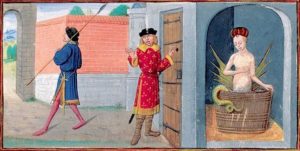
If you have read The White Queen or watched the miniseries of the same name, you have heard of Melusine. In those stories, Jacquetta Woodville was descended from the mythical goddess and had otherworldly powers from her, which she passed onto her daughter, Elizabeth. (And they were terrible at it as everything rebounded on them because they totally forgot the Rule of Three, but I digress). However, Melusine was a popular myth in medieval times. There are several versions of the story, but the meat of the story is the same.
A young nobleman gets lost in the woods while hunting and comes upon an extremely beautiful woman in the woods near a sacred spring. In some stories, she is one among three and some she is alone, but she is always very beautiful and singing in an unearthly way. The nobleman falls madly in love and begs the young woman to be his wife on one condition. The young man must never disturb or look upon her on a Saturday when she bathes. He agrees and they marry and have many children. In some stories, the children are perfect and in others they always have something monstrous about them.
As time passes, the nobleman gets curious about what exactly his wife is doing on her Saturdays away and goes to spy on her. What he sees is that she because a serpent from the waist down. He is horrified and cries out, and she sees that he has broken his promise. Melusine leaves never to return to her husband. Her parting words were, “But one thing will I say unto thee before I part, that thou, and those who for more than a hundred years shall succeed thee, shall know that whenever I am seen to hover over the fair castle of Lusignan, then will it be certain that in that very year the castle will get a new lord; and though people may not perceive me in the air, yet they will see me by the Fountain of Thirst; and thus shall it be so long as the castle stands in honour and flourishing–especially on the Friday before the lord of the castle shall die.”
In some stories, the nobleman in question is Elianas, the King of Albany or Scotland, in others it is Raymond, Count of Pointers. One legend combines the two and says that Elianas married a girl fey girl named Pressine, who laid the don’t spy on me bathing condition on the marriage. Elianas broke it, and Pressine took Melusine with their other children to Avalon. She grew up and traveled to the Black Forest, and that of Ardennes, and at last she arrived in the forest of Colombiers, in Poitou. There she met Raymond and the little drama played out again.
The castles she is associated with are many- Lusignan and Luxembourg on the Bock rock. The story was first written down in 1393 by Jean d’Arras, secretary to the Duke of Berry, received orders from his master to collect all information attainable with reference to Melusina, probably for the entertainment of the sister of the duke, the Countess de Bar. He called his work Le Roman de Mélusine, was translated into English about 1500, and often printed in the 15th and 16th century. Stephen, a Dominican monk related to the Lusignans, reworked d’Arras’ work and popularized it.
The legend became so popular that the ruling families of Luxembourg, Rohan and Sassenaye altered their official family trees to claim descent from Melusine. The Plantagenets were said to be descended from Melusine as well, and she was said to be the source of their legendary temper. Emperor Henry VII also bragged he was descended from Melusine. Later, Melusine became a potent symbol of Luxembourgish unity and culture against the German aggressors in World War I and World War II.
So where did the legend originate? The story is said to be a metaphor for the medieval view of female sexuality- the duality of the virgin and the whore. But there are older connections. There are legends of “Dames Blanches” or White Ladies, in the woods of Normandy and Lorraine. Nature spirits that lived near caves and natural springs. It is believed Melusine may be derived from them. There are similar legends in both Germany and the Netherlands. There are also ties to the Irish Banshee as well.
No matter the source, the story of Melusine has intrigued people for generations.
Melusine
Definition

by Joshua J. Mark
published on 14 October 2021 Listen to this article Available in other languages: Indonesian, French
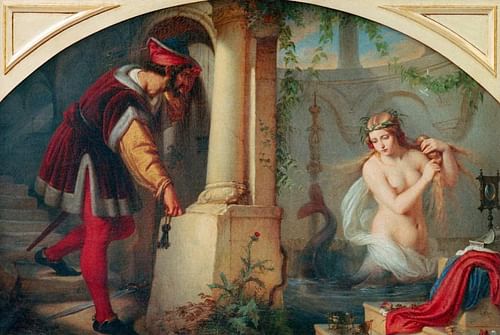
Melusine (pronounced Mel-ew-seen, also given as Melusina) is a legendary figure from European folklore depicted as a mermaid, sometimes with two tails, as a serpent from the waist down, or as a dragon. She is associated with the ruling houses of Anjou, Lusignan, and Plantagenet and supposedly warned nobles of these houses of impending death or change.
Also known as Melisande, her tale is best known from the work of the 14th-century French writer Jean d’Arras who wrote his Roman de Melusine at the request of Jean, duc de Berry (Duke of Berry, l. 1340-1416), and presents her in a sympathetic light. According to the legend, and d’Arras’ work, Melusine was cursed by her mother to become half-serpent every Saturday until she married a man who would respect her privacy on Saturdays and not look upon her or accept her as she was. She marries the nobleman Raymondin, promising to make him wealthy and famous, on the condition that he leave her alone every Saturday. Raymondin keeps his promise, and Melusine does the same, until he is persuaded by family to spy on her one Saturday in her bath. When he breaks his vow to her, she leaves him, returning only to visit her children or fulfill the obligations of the curse to warn of death or announce a change in fortunes.
The tale of Melusine is similar to those of the Swan Maiden and Valkyrie from Germanic and Norse mythology in which a mortal man marries a supernatural woman who either simply expects him to respect her privacy and personal rights or makes that a condition of their union, who is then betrayed by her husband, leaves him, and forces him to embark on a quest to win her back. In the Melusine legend, however, the male characters who betray their promise do nothing to win their wives back because they understand there is nothing to be done.
The Melusine story took many forms besides the traditional tale by d’Arras and was known in France, Britain, Germany, and Luxembourg as well as other regions. She is the subject of children’s tales, musical pieces, poetry, paintings, sculptures, and video games and appears as the logo of the world-famous Starbucks Corporation. She is also said to have inspired the story of The Little Mermaid by Hans Christian Anderson, and in Czech folklore, her name is attached to howling winds which are believed to be Melusine wailing for her lost children after she is betrayed by her husband.
Melusine’s Story
The legend begins with the story of Melusine’s parents – the nobleman Elinas (either from England or Scotland) and the mysterious woodland beauty Pressine. Elinas has recently lost his wife and goes hunting to distract him from his grief. In the forest, he comes to drink at the Well of Thirst and hears Pressine singing nearby. They return to his hunting lodge and talk through the night, and Elinas falls in love with her and asks her to marry him. Pressine agrees, noting how the devotion he showed to his first wife promises the same for his second. She makes him swear an oath to one condition, however, that he never try to see her at the birth of any of their children. Elinas agrees, and the two become happily married.RAYMONDIN’S BETRAYAL MEANS THERE IS NO HOPE OF MELUSINE EVER LIVING A NORMAL LIFE AGAIN.
In time, Pressine gives birth to triplets, three girls – Melusine, Melior, and Palatine – and when Elinas hears the news, he is overcome with joy and rushes to the bedchamber to see them, forgetting his oath. Pressine is outraged, calling him a traitor to his word, and then takes the girls and spirits them away to the Isle of Avalon, leaving Elinas to mourn his loss for the rest of his life. Pressine is also in mourning over the loss of her true love, however, and she brings the girls to a high mountain each morning where they can look out upon Elinas’ realm and tells them they would be living there if their father had only kept his word.
When the girls reach the age of fifteen, Pressine tells them the whole story, and both Melior and Palatine agree it was unfortunate but also understandable that, in a moment of happiness, their father forgot his promise. Melusine remains silent, however, and begins plotting her revenge on the man who hurt her mother and forced their exile to Avalon. She convinces her sisters to help her, and together they use their magical powers to seal Elinas inside a mountain along with all of his treasure. Scholar Bettina L. Knapp describes what happens next:
Subsequently, the daughters returned to their mother and, expecting to be praised for their action, met with her wrath. Aghast at her daughters’ cruelty, Pressine told them that, by incarcerating their father, they had destroyed the only happiness she had ever experienced – his love for her. The punishments she meted out to her daughters were severe: Melusine, who had initiated the horrendous act, would, like Cain who killed his brother, go through life with the knowledge of her transgression and pain of its consequences: every Saturday the lower half of her body, from the umbilicus down, would assume the form of a serpent. If she found a man willing to marry her, he would have to promise not to look at her on Saturdays, nor ever reveal the taboo to anyone. As long as he adhered to the pact, Melusine would be capable of extraordinary achievements: the building of great fortresses, multiple towns, the amassing of inordinate wealth. She would bear many children, thus creating the great Lusignan lineage. If, on the other hand, her husband violated the oath, she would not only return to and retain her serpent form until Judgment Day, but each time the Lusignan fortresses changed hands or a descendent died, she would appear in the environs in her serpentine form for three days of painful lamentation. (35)
Melusine is then banished from Avalon, while Melior is sealed inside a castle for life, and Palatine is imprisoned in the same mountain as her father. Melusine settles by a stream in the woods of France near Poitiers where, one day, she meets the nobleman Raymondin who is distraught because he has just killed his uncle in a hunting accident. She consoles him and offers him advice on how to explain the death to his family, and he falls in love with her. When he asks her to marry him, she agrees, telling of all the wonderful things she will be able to do for him, but stipulates that he must promise to leave her alone every Saturday, a condition he swears he will abide by.
The couple is married for over ten years during which Melusine provides Raymondin with all of the land, wealth, and power her mother said she would as well as ten children. Depending on the version of the legend, all or most of the children are deformed in some way but are still accepted and loved by their parents. One day, however, Raymondin’s family begins questioning why Melusine must have Saturdays to herself and why she never attends Mass with the rest of the family. Raymondin begins wondering if his wife is unfaithful to him, gives into his insecurities, spies on Melusine one Saturday while she is bathing and learns her secret, and then denounces her as a “false serpent” publicly. His betrayal means there is no hope of Melusine ever living a normal life again.
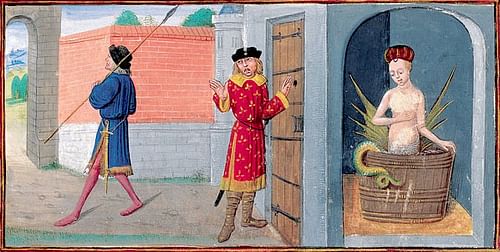
She flies out the window in the form of a dragon (or, in another version, leaps into a river and swims away) only returning to visit her children or, in accordance with her mother’s curse, to mark the passing of the family fortresses and lands to other hands or the death of a family member. In some versions of the legend, she eventually finds herself among creatures similar to herself and starts a new life there, leaving only to fulfill the obligations of her curse. In others (or variations on the same one), the curse becomes unbearable finally and she begs her mother to give her a new body. Pressine, still unable to forgive her, obliges by giving her a man’s body, which conflicts with her feminine soul, and she leaves her in this condition for the rest of her life. The only time she shapeshifts is when she becomes a dragon who returns to her former home to continue fulfilling the obligation of the original curse.
Origin & Motif
The Melusine legend is a variation on two types of folktale, the first having to do with the lying-in taboo and the second with the Swan Maiden or Valkyrie. Women in the Middle Ages were considered unclean after childbirth and also too physically weak to resume their usual responsibilities for 10 to 20 days after giving birth. During this time, the husband was supposed to leave her alone to be attended by female servants or female members of the family. If the husband failed in this, some form of bad luck would follow. Tales concerning the lying-in taboo illustrated this cultural belief while also providing an entertaining story.THE LYING-IN TABOO AT THE HEART OF THE PRESSINE SECTION OF THE LEGEND IS MIRRORED IN THE MELUSINE-RAYMONDIN PART OF THE TALE.
The Swan Maiden/Valkyrie motif comes from Germanic and Norse mythology and involves a supernatural woman in the form of a swan who comes to bathe in a lake or stream, shedding her swan skin. An unmarried man steals the skin (in the case of the Swan Maiden) or clothes (with the Valkyrie) and hides it, trapping the Swan Maiden (or Valkyrie) on earth and enticing her to marry him. In time, the husband either betrays his wife by destroying the skin or clothes – at which point she leaves him – or their children find the skin/clothes and return them to their mother – allowing her to fly away. This usually results in the husband being forced to embark on a quest to prove his worth to his wife and bring her back home.
In Slavic folklore, this motif figures in two tales concerning the witch Baba Yaga – The Frog Princess and Maria Morevna – both focusing on the efforts the husband characters must go to in order to prove themselves to the women they have betrayed. In both, the husband has either explicitly or implicitly agreed to a condition set by his wife, which he then purposefully ignores, and according to the supernatural rules governing the union, the wife is spirited away. After a number of ordeals, the husband is redeemed and wins his wife back.
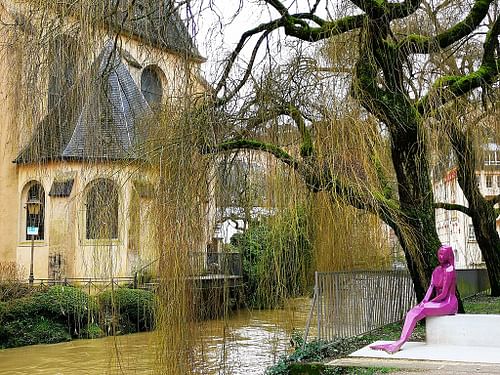
In these tales, and others like them, the husband character is much more active than Elinas and Raymondin of the Melusine legend, but all touch on what seems to have been an ancient motif encouraging marital fidelity and trust. The common theme in all the tales is how misfortune follows a man who breaks faith with a wife who has made him a success. The lying-in taboo at the heart of the Pressine section of the legend is mirrored in the Melusine-Raymondin part of the tale in that watching one’s wife bathe, without her knowledge, was considered just as taboo as seeing her during her period of lying-in; both were an invasion of a woman’s privacy during a time when she was supposed to be left alone. This same motif appears in myths and legends from many ancient cultures, probably best-known from the tale of Artemis and Acteon; when Acteon spies on Artemis bathing without her knowledge or consent, she turns him into a stag, and he is torn apart by his own hunting dogs.
Link with Noble Houses
In all these tales, the man is at fault for breaking a taboo or a trust, and the same is true in the Melusine legend. The difference in this tale is that the men seem to understand the futility of trying to win their wives back, even though they clearly loved them, adding a tragic dimension to the story and elevating Melusine as a heroine undeserving of her fate. The legend was purposefully revised by Jean d’Arras between c. 1387-1393 for political purposes to make Melusine more sympathetic as the foundress of the Lusignan Dynasty. The basic elements of the story itself are not that different from many others of its type, however, as noted by scholars Maria Leach and Jerome Fried:
The breaking of the taboo, reduplicated in this story by the incident of Pressine, is itself simply another version of the offended supernatural wife motif told by others and worked into this tale so that it would not be lost. Parallels of the Melusine story are found in several parts of the world. (705)
D’Arras altered the offended supernatural wife motif to make sure an audience would understand Melusine as a good Christian beloved by her subjects who was unjustly cursed by a hard-hearted mother and betrayed by a faithless husband. The work was commissioned by Jean, duc de Berry of the House of Lusignan best known as a patron of the arts and collector of illuminated manuscripts. An image of Melusine as a dragon, flying over the fortress of Lusignan, appears in the famous illuminated manuscript Les Très Riches Heures du Duc de Berry (begun c. 1412-1416) commissioned by the duke.
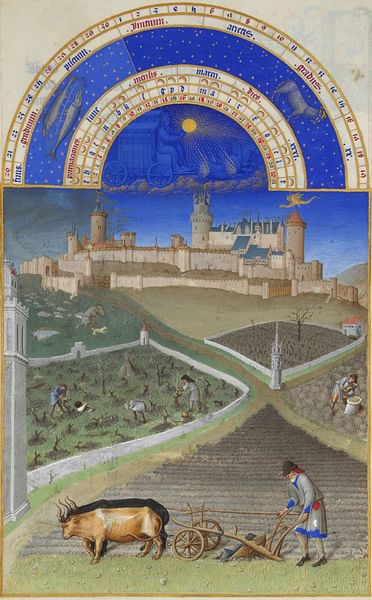
The duke requested the Melusine tale from d’Arras as part of a propaganda campaign. The story ends in d’Arras’ version with Melusine returning to the castle of Lusignan in 1374 just before the duke’s forces liberated it from the English. Her cries signaled the duke’s victory and the castle changing hands, establishing the duke as the rightful heir of Melusine who was thought to have magically built the fortress when she was first with Raymondin. In d’Arras’ version of the story, then, the duke is linked directly to the founder of the Lusignan house, establishing his legitimacy.
The Duke of Berry is only one noble to claim descent from Melusine, however, as she was also claimed as an ancestor by the nobility of Britain, Germany, and Luxembourg. Richard I of England (r. 1189-1199) claimed Melusine as a direct ancestor, supposedly boasting of his relationship with a supernatural entity he felt brought him luck. Other noble houses similarly linked themselves with the legend at least 200 years before Jean d’Arras wrote his version of Melusine, and she still appears on the family heraldry of a number of European noble families.
Conclusion
Why the nobility of medieval, Catholic Europe chose to link themselves to a supernatural entity who, in all the versions of the story, does not attend Mass, is a question scholars still debate and discuss. The 14th-century French writer Couldrette links Melusine to the Arthurian legends in his Roman de Melusine through the figure of the Good Knight of England, a member of King Arthur’s court, who goes in search of the treasure of Melusine’s father. He fails in his quest, however, as it has been decreed that Melusine’s son Geoffrey of the Great Tooth will defeat the treasure’s guardian and no other.
As the Arthurian Legend was embraced by a number of Europe’s nobility, Melusine came to be regarded as belonging to each by their respective writers. Although a supernatural entity, she is given Christian values and virtues by most if not all writers of medieval literature, and her children were regarded as heroic foundational figures by the various houses of Europe accordingly.https://www.youtube.com/embed/Z5mlGka3vYc?autoplay=0
Knapp offers a Jungian interpretation of the legend which, she claims, people would have responded to on a subconscious level as they do with all archetypal figures from scripture, myth, and legend:
That Melusine, like her mother, is associated with a fountain located in the heart of a forest, suggests a capacity in both of them to alter, cleanse, heal, and regenerate an ailing psyche. The ever-renewing waters from a fountain, emerging from the depths of the earth (the unconscious), rising into the air (consciousness), may indicate a timeless as well as a restless and continuously mobile quality in mother and daughter. (41)
Knapp points out that both Elinas and Raymondin are despondent when they first meet Pressine and Melusine and, in both cases, are healed of their psychic wounds, allowing for them to experience wholeness and material success. According to this interpretation, the nobles of the various kingdoms were responding to the symbolism of the tale which resonated with the Christian message of redemption and completeness.
However she came to be regarded as the great ancestor of European nobility, her popularity has endured for hundreds of years. In the present day, Melusine is featured in video games, poetry, novels, and is the often-controversial figure of the Starbucks logo. Objections to her Starbucks image frequently associate her with a siren, mermaid, or with Lilith, Adam’s first wife before Eve was created, but Melusine is quite different from any of these. She does not lure anyone to certain doom nor is she associated with any kind of rebellion against the Christian God. She is always presented, in Shakespeare’s phrase, as one “more sinned against than sinning” and, besides the mermaid’s tale, only shares in the qualities of the others mentioned in her seemingly endless capacity to entrance, fascinate, and inspire.
Melusine de Alba
Gateway Ancestor
de Vere > de Lacy > de Clare > Stewart > Lindsay
Melusine the Mermaid is said to have given birth to the House of Anjou.
https://jungiangenealogy.weebly.com/melusine-de-alba.html
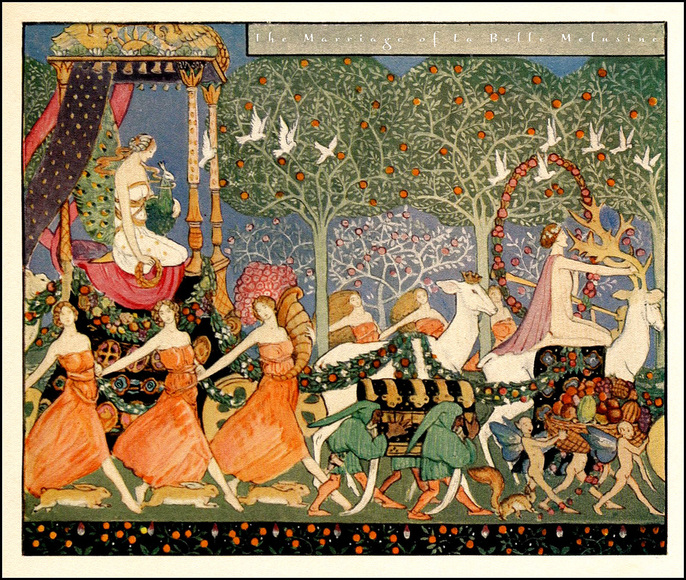
Royal House of Lusignan
http://books.google.com/books?id=Yx0YAAAAMAAJ&printsec=frontcover&dq=The+Royal+House+of+Lusignan+Its+Founder+and+Present+Representative&hl=en&sa=X&ei=F0A5U-HeCKXIsATP1oLABA#v=onepage&q=The%20Royal%20House%20of%20Lusignan%20Its%20Founder%20and%20Present%20Representative&f=false
Melusine’s ‘Magickal’ DNA & The Royal Houses of Europe: Regarding the legendary line of Frankish kings known as the Merovingians, it will be recalled that the mother of their founder Merovee (or Meroveus) was believed to have been raped by the Quinotaur: a mythical sea-bull. The Merovingian Mythos, is related to the narrative of Melusine, and specifically, in her non-fictional incarnation as Melisande, the mother of Fulk V, Count of Anjou and daughter of Baldwin II. In this context, Melusine’s Bloodline is attributed with uniting the Merovingian house with the line of Anjou; and thus to the Plantagenets who would produce several English monarchs. Both stories share an identical theme: of legendary sea-creatures giving rise to powerful bloodlines.
An even earlier rendition of the Quinotaur/Melusine legend is the ancient Phoenician tale of Europa and the bull. Here again, a sea-bull ravages a maiden of high birth. Europa is the daughter of Canaan, the son of Poseidon. We should also note that the goddess (or princess) Europa is the source of the name of continental Europe; and that the image of Europa and the bull — which corresponds esoterically to the Quinotaur and his quarry — is widely used on EU documents, and Euro coinage. The same symbol can be applied to the Merovingians, and — through Melusine — to the Angevin line and the House of Lorraine (Hapsburgs).
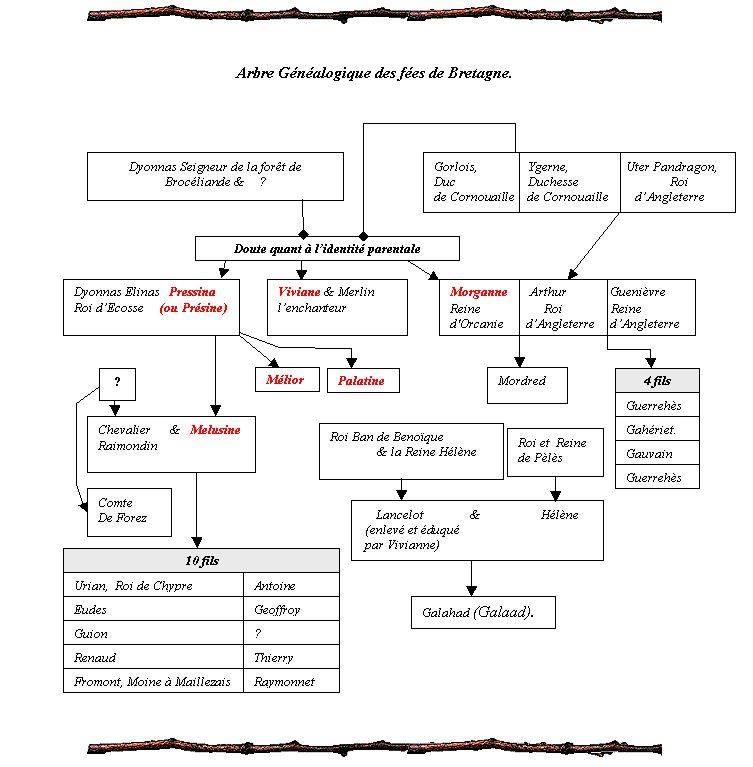
…Elven-Faerie Genelogical Chart Featuring Morgane Le Fey & Melusine….
The Dragon-Faery Queen…Melusine Is Thy Name:
Author, Jean D’Arras wrote his major work “Chronique de Melusine” in 1393 after being commissioned to do so by the Duke of Berry. According to history the Duke of Berry was so fascinated with the story of Melusine, that his sister Marie (Duchess of Bar/Berry) told D’Arras to record all the information that he could find on Melusine to please her brother the Duke.
D’Arras spent numerous years researching and collecting information which followed William de Portenach’s previous stories of Melusine. In 1478, D’Arras’ last work Le Liure de Melusine en Fracoys was published posthumously.
According to the book, “The Serpent And The Swan: The Animal Bride In Folklore And Literature,” the name “Melusine” was used by D’Arras and Couldrette as an abbreviation of the words ‘Mere des Lusignan’ or ‘Mother of the Lusignans.’ Many other derivations of the name Melusine were suggested pairing the fairy story with Greco-Roman deities and even Celtic origins.
Melusine – Thüring von Ringoltingen
Another thought argued by Markale was the latinization of the greek words, “Melas-Leuke” meaning “Black and White.” So, pretty much the story of Melusine is one that defines double-nature meaning she was human and animal, good and evil, both male and female. The male and female part is weird, I know, but according to the stories the fact that she was fish-like or serpent-like gave the idea of her upper half being more feminine while her lower half was more phallus-like.
(credit J’aime Rubio)
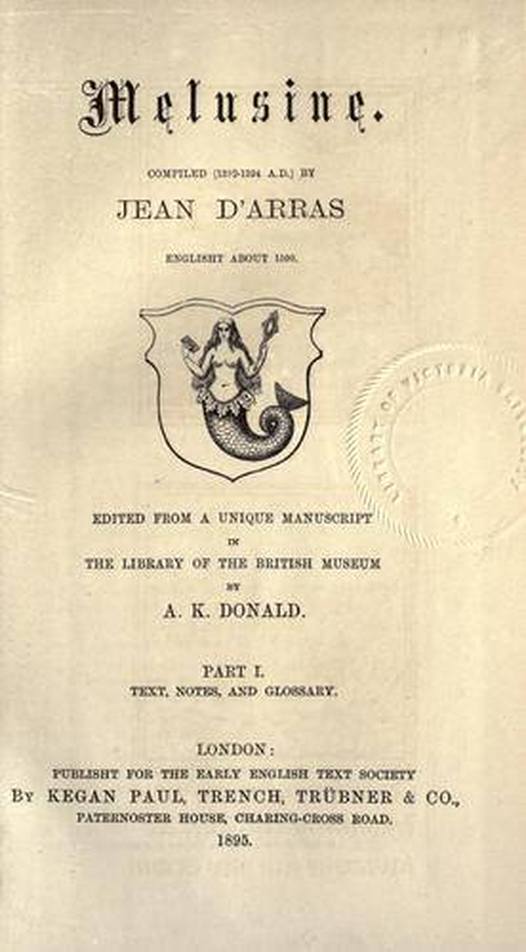
Melisende (Melusine)of Lusignan…Dragon Princess of Antioch:
Melisende de Lusignan, Princess of Antioch (1200 Holy Land- after 1249), was the youngest daughter of Queen Isabella I of Jerusalem by her fourth and last marriage to King Amalric II of Jerusalem. She had a sister Sibylla of Lusignan, a younger brother, Amalric who died as a young child. By her mother’s previous marriages, Melisande had three half-sisters, Maria of Montferrat, who succeeded their mother as queen of Jerusalem on 5 April 1205; Alice of Champagne, and Philippa of Champagne.
In January 1218, Melisande married as his second wife, Bohemond IV, Prince of Antioch, son of Bohemond III, Prince of Antioch and Orgueilleuse de Harenc. The marriage produced three daughters:
Isabelle of Antioch (died young)
Marie of Antioch (died after 10 December 1307), she was childless.
Helvis of Antioch (died young)
Melisende protested the succession of her nephew King Henry I of Cyprus as Regent of Jerusalem on the death of her half-sister, Alice in 1246. Alice had been Queen-consort of Cyprus and regent of Jerusalem for Conrad IV of Germany.
She died sometime after 1249. Upon the childless death of her only surviving daughter, Marie sometime after December 1307, the direct line of Melisende became extinct. Her half-sister Maria’s line died out in 1268.
However her full sister Sibylla, who married King Leo I of Armenia, had many descendants, and the direct lines of Alice and Philippa continue in the 21st century; their many descendants include the British Royal Family. (credit Wikipedia)
The RED LION (ie. RED DRAGON) OF ANTIOCH:
The Principality of Antioch
Antioch was captured in 1098 by Bohemund of Hauteville originating from Apulia and son of Robert Guiscard. Bohemund founded a principalty independent from Byzantium against the wishes of the Emperor Alexius who had wanted to reunite the territory to the Byzantine Empire. Instead the principalty became a de jure vassal of the Patriarch of Jerusalem and later of Baldwin of Bouillon who had been crowned king by the Patriarch.
After the fall of Edessa in 1144, Antioch was attacked by Nur ad-Din during the Second Crusade. Much of the eastern part of the Principality was lost, and Raymond was killed at the battle of Inab in 1149. His successor, Raynald, immediately found himself in conflict with the Byzantines, this time in Cyprus; he made peace with Manuel I Comnenus, however, in 1158, and the next year Manuel arrived to take personal control of the Principality. Henceforth, the Principality of Antioch was to be a vassal of Byzantium until Manuel’s death in 1180. Although this arrangement meant that the Principality had to provide a contingent for the Byzantine Army (troops from Antioch participated in an attack on the Seljuk Turks in 1176), it also safeguarded the city against Nur ad-Din at a time when it was in serious danger of being overrun.
At his death Raymond III bequeathed the County of Tripoli to Bohemund III.
Bohemond III’s death resulted in a struggle for control between Antioch, represented by Bohemond of Tripoli, and Armenia, represented by Bohemond III’s grandson Raymond-Rupen. Bohemond of Tripoli, as Bohemond IV, took control by 1207, but Raymond briefly ruled as a rival from 1216 to 1219.
PRINCES OF ANTIOCH
House of Hauteville
Bohemond I
1099-1111
Tancred
1111-1112
Roger van Salerno
1112-1119
Baldwin II of Jerusalem
1119-1126
Bohemond II
1126-1130
Constance
1130-1163
Baldwin II of Jerusalem
1131
Folco of Jerusalem
1131-1136
Raymond of Poitiers
1136-1149
Baldwin III of Jerusalem
1149-1153
Reginald of Châtillon
1153-1160
Aimery de Limoges patr. Antioch
1160-1163
House of Poitiers
Bohemond III
1163-1187
Princes of Antioch, Counts of Tripoli
Bohemond III
1187-1201
Bohemond IV
1201-1216
Raymond Rupen
1216-1219
Bohemond IV
1219-1233
Bohemond V
1233-1252
Bohemond VI the One-eyed
1252-1268
Mameluk Capture of Antioch 1268
Titulary Princes of Antioch, Counts of Tripoli
Bohemond VI the One-eyed
1268-1275
Bohemond VII
1275-1287
Lucy
1288-1289
Mameluk Capture of Tripoli 1289
Titulary Princes of Antioch
Philip of Toucy
1299-1300
Marguerite of Lusignan
†1308
John I of Lusignan
1345-1375
Janus
1392-1398
John II
1418-1432
John III of Coimbra
1433-1457
To Venice
Bohemond died in 1233, and Antioch, ruled by his son Bohemond V, played no important role in the Fifth Crusade, Holy Roman Emperor Frederick II’s struggles to take back Jerusalem in the Sixth Crusade, or Louis IX of France’s Seventh Crusade.
In 1268 the city was captured by the Mameluks and Bohemund VI retired to Tripoli which fell in 1289.
From that time there only have been titulary Princes of Antioch.
The RED LION of Antioch
In 13th century sources the arms of Antiochia are described and given as Argent, a lion Gules. Their origin may be in Byzantium of which the Prince of Antioch was a (nominal) vassal.
This Lion may be traced back to Bohemond I who in 1097 blandly requested of Emperor Alexius the office of grand domestic of the east, which would have made him imperial viceroy for all the lands that the crusaders might conquer..”
This is reported by Anna Komnena in the Alexiade (Book X, H.XI [1])):
“Therefore when Bohemund demanded the office of Grand Domestic of the East, he (Alexius I) did not gain his request, for he was trying to ‘out-Cretan a Cretan’. For the Emperor feared that if he gained power he would make the other Counts his captives and bring them round afterwards to doing whatever he wished. Further he did not want Bohemund to have the slightest suspicion that he was already detected, so he flattered him with fair hopes by saying, “The time for that has not come yet; but by your energy and reputation and above all by your fidelity it will come ere long.””
Protovestiarios of Michael VII Parapinaces.
There is no record that Alexius granted such a request but maybe Bohemund was appeased by the function of a protovestiarios, a high-ranking title bestowed to important aristocrats which, in the 9th -11th centuries were appointed as generals and ambassadors (and that he was). The emblem of rank of a Byzantine count was a lion and of such a protovestiarios a red lion on a white background. This can be seen on a picture of Michael VII Parapinaces where a proedros protovestiarios is depicted dressed in a tunica charged with big medallions enclosing red lions passant. [2]
Such a red lion was probably also adopted by Raymond of Poitiers and the House of Poitiers in general, as a red lion was the arms of the Count of Poitou until the mid-13t century. In Antioch the red lion can be traced back with some certainty to Bohemond IV whose son Henry married Melisende de Lusignan. Their son Hugues III of Cyprus combined the arms of Lusignan with a red lion.
The red lion on a white field can also be found on a stone, today in the Museum of Cairo.
(credit www.hubert-herald.nl)
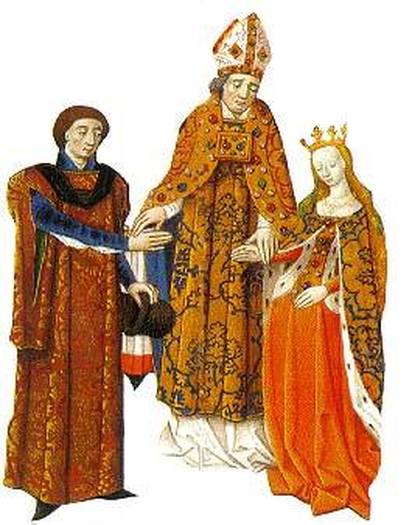
The Regal Legacy of the Faery-Dragon Queen
(Pictured above: Fulk V marries Queen Melisende)
In French history, many royals all the way back to the days of Charlemagne have claimed to have descended from Melusine’s family lineage….furthermore, there have been more than one royal damsel with the name Melisende (ie Melusine)…. In fact, the Plantagenet families, Angevin lineage and the House of Anjou and Vere still claim lineage that date back to the story of Melusine.
WAS THERE A REAL MELUSINE?
One of the ‘Royal Melusine’s’ in history, was married to Fulk V (Foulques V), the Count of Anjou. According to legend, King Richard I (Lion Heart) had once made comments of his ancestor Fulk III (Fulk’s grandfather) saying “We come from the Devil, and to the Devil we shall go.”- meaning that because the story of Melusine had been attached to evil, cursed or even perhaps the spawn of the devil that the family bloodlines were tainted.
It was said that the Plantegenet line, Angevin, Vere and Anjou lineage all went back to the Melusine story. Even prior to the marriage of Fulk V and Melisende there had been rumored legends of ancestry to a mythical fairy that resembled Melusine’s story.
WHAT DOES HISTORY SAY?
According to historical evidence, Melisende was born the daughter of King Baldwin II of Jerusalem (whose ancestry came from Rethel, France) and her mother was Morphia (daughter to Prince Constantine I of Armenia). Baldwin deferred to King Louis VI of France to recommend a Frankish vassel for his daughter’s hand. He then in turn recommended a rich crusader and military commander, and possibly a threat to Louis VI himself, the Count of Anjou, Fulk V.
Melisende married Fulk Anjou V (Count of Anjou) and bore a son Baldwin III whom the King wanted to to make heir to the throne. In 1131 upon the untimely death of her father, Melisende became Queen of Jerusalem and co-ruler with her husband. Contemporaries of Melisende who did rule during the same time included Urraca of Castille, Empress Matilda (wife of Geoffrey, son of Fulk V-Count of Anjou) and Eleanor of Aquitaine.
She proved to be a mighty ruler and a very strong minded and intellectual woman. She watched over her son and helped him rule over the land, although not without complications. Her strong will and “matriarchal” tendencies truly left a legacy of her motherly care and determination to take care of her son and her people no matter what, even at the cost of upsetting her son’s feelings.
Quite possibly the story and fables of this water fairy, nymph, mermaid, whatever you want to call “Melusine” may have very well originated with Queen Melisende. Over the hundreds of years and all the fables, legends and lore of this mythical fairy or “Dames Blanches” that were told for so long, that the real story of Queen Melisende was forgotten and a fictional one was created…or, as is the case with so many ancient ‘myths’, there is (at least), an element of factual truth, crafted into the various legends and mythologies….
SO WAS MELUSINE A SERPENT OR A MERMAID?
According to symboldictionary.com :
“A MELUSINE is a typical illustration of a twin-tailed siren or mermaid.
This creature is associated with numerous stories and legends, and is imbued with symbolic meaning in alchemy. The most common iteration of the siren is as Melusine, a creature from medieval legend. Melusine (sometimes, Melusina) was, according to legend, beautiful woman with a disturbing tendency to transform into a serpent from the waist down while bathing; it is the discovery of this nature that triggers calamity.
Melusine the Alchemal Siren
As the story is most often told, the cursed maiden is discovered in the forest by Raymond, the Duke of Aquitaine, who begs her to marry him. She agrees, on condition that he never disturb her on a Saturday, when she bathes. Raymond eventually grows suspicious of his young wife, and spies on her- and his shocked reaction to her true appearance reveals his betrayal to Melusine, who transforms herself into a dragon and departs in a shrieking fury. This story can be viewed as a metaphor for sexuality, and the contradictory duality of the female nature as viewed through medieval lore and esoteric doctrines.
In fact, it is the same dual-nature (ie esoteric Dualism) symbolism, that is found in the ancient esoteric school of alchemy…the use of the siren / mermaid as a more benevolent emblem of enlightenment- the siren of the philosophers. Alchemically, the siren’s two tails represent unity -of earth and water, body and soul- and the vision of Universal Mercury, the all-pervading anima mundi that calls out and makes the philosopher yearn to her.”
(credit J’aime Rubio)
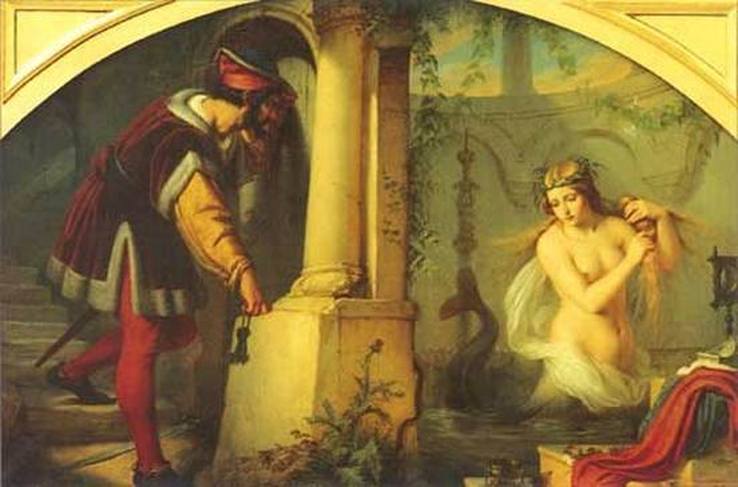
Melusine…’King Arthur’… & the Dragon Princess:
Melusine de VER has also been known as Melusina, Melouziana de Scythes, Maelasanu, and The Dragon Princess. She entered literary history in the book Roman de Melusine written in 1393 by Jean d’Arras. The story is a mix of fiction and fact, commissioned by the Duke de Berry, a French noble who was brother to King Charles V, and uncle of King Charles VI. It was meant to be a family history and to uphold the proprietary claims to Lusignan and Anjou.
In this story Melusine’s mother was a Presine fairy who charmed Elinas, the king of Scotland. The result was their daughter Melusine. Half fairy and half princess, Melusine wandered over to the Continent and eventually met up with Rainfroi/Raymond in the forests Anjou. They met while he was out boar hunting. Overcome with her beauty, he took her hand in marriage, and many adventures ensued. As a result of this book, Melusine was subsequently featured in medieval tales across Europe, variously depicted as a mermaid, a water sprite, a fairy queen, a fairy princess, a dragon princess, and a forest nymph. She came to represent any magical creature who marries a mortal man. Most royal houses in Europe have claimed lineage to the real Melusine, so she has been the subject of great speculation. Legends about Melusine and Rainfroi (or Raymond) also often have a connection to boars and boar hunting.
Melusine is known best in Magickal mythology as a Nixie, or Mermaid, with a Serpent tail or fish tail; however the Name Melusine is mentioned in “Charge of the Goddess” along with the names of Athene, Bride, Astarte and other goddesses as Names of Diana, Queen of All Witcheries.
Many intriguing legends surround Melusine, who sometimes appears with wings, and is believed to be a beautiful, enchanting but potentially dangerous Spirit, living in and around fresh water springs and streams.
In Britain, the Lady of the Lake was a Siren just like Melusine, who spirited away Lancelot to raise him in the ways of the Neighbours….
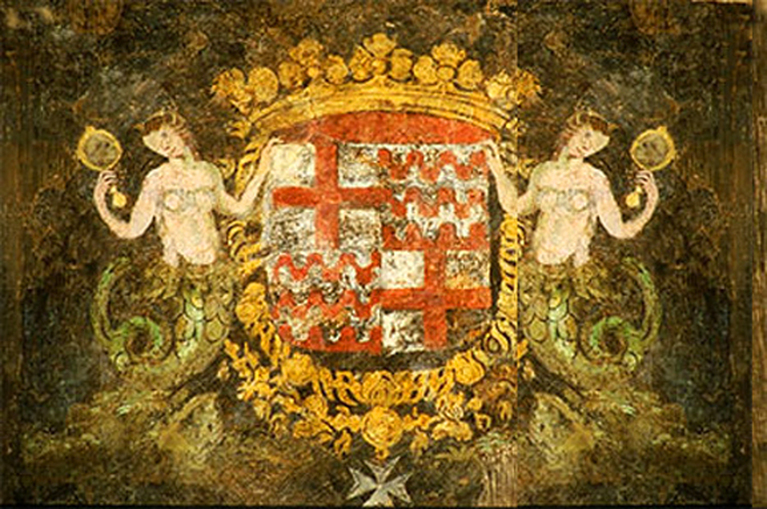
http://venerablevixens.wordpress.com/2013/06/10/the-line-of-melusina-jacquetta-of-luxembourg/Melusine the Celtic Mermaid:
Melusine (or Melusina) is a figure of European legends and folklore, a feminine spirit of fresh waters in sacred springs and rivers.
She is usually depicted as a woman who is a serpent or fish (much like a mermaid) from the waist down. She is also sometimes illustrated with wings, two tails or both.
Melusine is sometimes used as a heraldic figure, typically in German and Scandinavian Coats of arms, where she supports one scaly tail in each arm. She may appear crowned. The Coat of Arms of Warsaw features a siren (identified in Polish as a syrenka) very much like a depiction of Melusine, brandishing a sword and shield. She is the water-spirit from the Vistula who identified the proper site for the city to Boreslaus of Masovia in the late 13th century. Ferenc Frangepin, Archbishop of Kalocsa in Hungary, included in his will of 1543 a series of seven tapestries representing the story of “The Beautiful Melusina.”
The Archbishop’s tapestries will have shown the most famous literary version of Melusine tales, that of Jean d’Arras, compiled about 1382 – 1394 and worked into a collection of “spinning yarns” told by ladies at their spinning. The tale was translated into the English language c. 1500, and often printed in both the 15th century and the 16th century. (There is also a prose version called the Chronique de la princesse.)
It tells how Elynas, the King of Albany (a poetical euphemism for Scotland) went hunting one day and came across a beautiful lady in the forest. She was Pressyne, mother of Melusine. He persuaded her to marry him but she agreed, only on the promise — for there is often a hard and fatal condition attached to any pairing of fay and mortal — that he must not enter her chamber when she birthed or bathed her children. She gave birth to triplets. When he violated this taboo, Pressyne left the kingdom, together with her three daughters, and traveled to the lost Isle of Avalon.
The three girls — Melusine, Melior, and Palatyne — grew up in Avalon. On their fifteenth birthday, Melusine, the eldest, asked why they had been taken to Avalon. Upon hearing of their father’s broken promise, Melusine sought revenge. She and her sisters captured Elynas and locked him, with his riches, in a mountain. Pressyne became enraged when she learned what the girls had done, and punished them for their disrespect to their father. Melusine was condemned to take the form of a serpent from the waist down every Saturday.
Raymond of Poitou came across Melusine in a forest in France, and proposed marriage. Just as her mother had done, she laid a condition, that he must never enter her chamber on a Saturday. He broke the promise and saw her in the form of a part-woman part-serpent. She forgave him. Only when, during a disagreement with her, he called her a “serpent” in front of his court, did she assume the form of a dragon, provide him with two magic rings and fly off, never to return.
Melusine myths are especially connected with the northern, most Celtic areas of Gaul and the Low Countries. Sir Walter Scott told a Melusine tale in Minstrelsy of the Scottish Border (1802 -1803) confident that “the reader will find the fairy of Normandy, or Bretagne, adorned with all the splendour of Eastern description.
The fairy Melusina married Guy de Lusignan, Count of Poictou, under condition that he should never attempt to intrude upon her privacy. She bore the count many children, and erected for him a magnificent castle by her magical art. Their harmony was uninterrupted until the prying husband broke the conditions of their union, by concealing himself to behold his wife make use of her enchanted bath. Hardly had Melusina discovered the indiscreet intruder, than, transforming herself into a dragon, she departed with a loud yell of lamentation, and was never again visible to mortal eyes ; although, even in the days of Brantome, she was supposed to be the protectress of her descendants, and was heard wailing as she sailed upon the blast round the turrets of the castle of Lusignan the night before it was demolished.”
When Count Siegfried of the Ardennes bought the feudal rights to Luxembourg in 963, his name became connected with the local version of Melusine. In 1997 Luxembourg issued a postage stamp commemorating this Melusina, with essentially the same magic gifts as the ancestress of the Lusignans. This Melusina magically made the castle of Bock appear the morning after their wedding. On her terms of marriage, she too required one day of absolute privacy each week.
Alas, Sigefroid, as the Luxembourgeois call him, “could not resist temptation, and on one of the forbidden days he spied on her in her bath and discovered her to be a mermaid. When he let out a surprised cry, Melusina caught sight of him, and her bath immediately sank into the solid rock, carrying her with it. Melusina surfaces briefly every seven years as a beautiful woman or as a serpent, holding a small golden key in her mouth. Whoever takes the key from her will set her free and may claim her as his bride.”
Melusine is one of the pre-Christian era water-faeries who were sometimes responsible for changelings. The “Lady of the Lake”, who spirited away the infant Lancelot and raised the child, was such a water nymph. For other European water sprites dangerous to humans, especially men, see Lorelei, Nixie.
(credit Celtopedia)
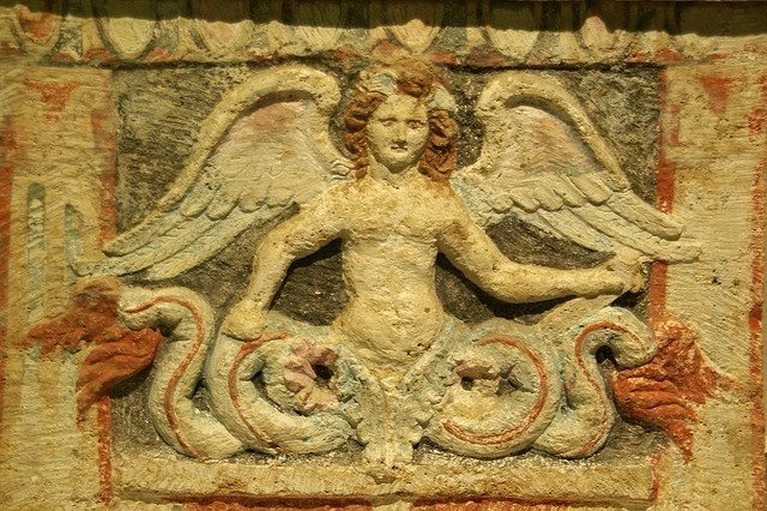
Melusine (Etruscan):
Escil·la, relleu d’una urna etrusca, Boston Skylla, Etruscan urn, Late 3rd century B.C., Museum of Fine Arts, Boston. This object is one of five ash urns found in a tomb of the Velsi family of ancient Chiusi. On the urn’s front is a Skylla, a winged marine monster with the torso of a young woman and coiled fishtails instead of legs. Many Etruscans believed that the journey to the Underworld involved a dangerous sea voyage.
(credit Andrea Kiss)
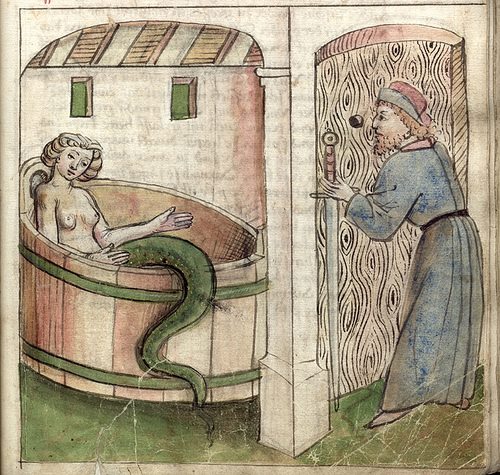
The ‘Legend’ of Melusine and the Count of Anjou:
In the ancient stories the tale of Melusine (sometimes Melusina) is spoken in reference to a water fairy who was stricken with a condition of being half-woman and half-fish (or serpentine) every Saturday. The tales were fabled to have started around spinning wheels, meaning that women were gossiping and telling stories while working. As the story went, for long as Melusine’s husband didn’t see her on that one particular day of the week, all would fair well for everyone. As most fairy tales or legends usually go, nothing ever goes according to plan.
Melusine, the daughter of Pressina a full-fledged water fairy and the daughter of a mortal man, King Elinas (or King Helmas) wasn’t always a mermaid/serpentine creature. According to the myth and legend stories, she was stricken with this ailment or condition after her mother found out what Melusine did to her father, King Elinas.
King Elinas had met Pressina at the “fontaine de la soif” (Fountain of Thirst) and fell madly in love with her instantly. He then asked for her hand in marriage. Pressina agreed to marry the king under the condition that he never enter into her chambers during or just after childbirth. Shortly after the marriage she became pregnant with triplets and soon thereafter gave birth to three daughters Melusine, Melior, and Plantina. King Elinas’ curiosity got the best of him after his elder son (from a previous marriage) insisted that he go in and see his wife and new babies. Pressina was so overcome with sadness because her king had broken his promise, that she takes the babies and runs away off to a hidden island, Cephalonia.
When the daughters are teenagers, Pressina takes the girls to look upon their father’s realm. She tells the girls about the promise their father broke and Melusine decides to seek revenge against her father. She convinces her two other sisters to help her kidnap their father and imprison him inside of a mountain. Once Pressina finds out about this, she becomes very upset and punishes Melusine by telling her that she will become a half-fish/serpent creature every Saturday for the rest of her life.
Melusine goes on living in the forest until one day she stumbles across Raymondin,-Count of Anjou (some stories say Duke of Aquitaine), who had been very distressed due to accidentally killing his uncle during a boar hunt. He was unsure what to do, and since having come across Melusine, she promised him that she help him obtain riches, wealth and power to which he could never imagine and offered advice how to go about explaining the accidental death he caused of his uncle to his family. The new found companion he found in her, helped ease his grief. He was so pleased with Melusine’s help that he asked her to be his bride. She agreed under one condition, that he could not see her in her chambers on Saturdays, no matter what.
He agreed to the silly request and they were married at once. Melusine helped him gain power to the kingdom and build up the city of Poitou and newly built Lusignan, where Melusine became the mother of the Lusignan line. She even had the castle built in Lusignan and ruled over the land graciously and lovingly to her people.
Over time the happy couple had in upwards of at least 10 children (most of which were born with a deformity of some sort). It was obvious due to the time span of so many children being born that they had been married for at least 10 years or more when Raymondin became pressured by family members about Melusine’s odd Saturday activities. It became more curious when they mentioned that she didn’t like to attend Mass at their Cathedral and Raymondin started wondering what she may be doing in her chambers by herself.
In a fit of jealousy (thinking she may also be cheating ) he peeked through the keyhole in the door to her chambers and sees her bathing in a tub. She appeared as beautiful as ever from the waist up, but from the waist down her fish or serpent-like body splashed around with a fierce tail. Raymondin couldn’t believe his eyes but never did he mention this to anyone until their son Geoffrey burned down the Church. He felt that Geoffrey was a bad soul and had perhaps inherited it from his wife, Melusine. He then accused her of being a “Faulse Serpente.” Melusine then is so distraught over the fact that Raymondin not only knew of her secret, thus he broke his promise, but also that he announced it to everyone of what she really was. Some books say Melusine then turned into a serpentine creature or dragon and flew away, while I read another state she jumped out the window in her fish-like state and swam away into the river. She was said to visit her children in the night in human form but other stories claim that she was a bad omen, for if you saw her flying around crying out that meant an impending death in the land.
In French history, many royals all the way back to the days of Charlemagne have claimed to have descended from Melusine’s family lineage. In fact, the Plantagenet families, Angevin lineage and the House of Anjou and Vere still claim lineage that date back to the story of Melusine.
(credit J’aime Rubio)
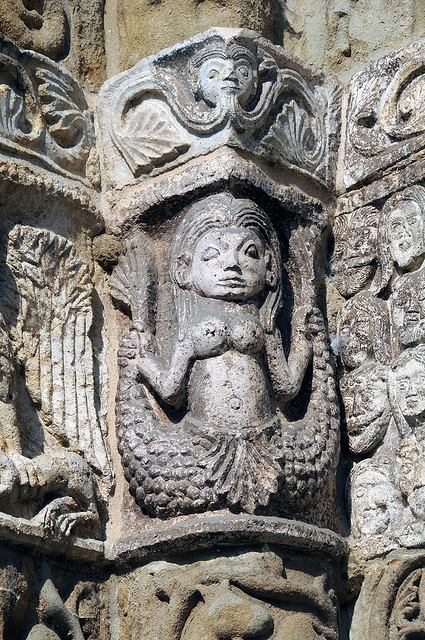
Melusine (italy):
A melusine or mermaid in the facade of San Michele, Pavia, Italy.
(credit Andrea KissIn 719 Charles Martel defeated Rainfroi de VER, Duke of Anjou and Mayor of the Palace of Neustrie.
This victory brought back together key houses of the Franks under one rule and is considered an important date in European history. Rainfroi de VER (also known as Raymond) was married to another legendary character, Melusine.
Melusine de VER has also been known as Melusina, Melouziana de Scythes, Maelasanu, and The Dragon Princess. She entered literary history in the book Roman de Melusine written in 1393 by Jean d’Arras. The story is a mix of fiction and fact, commissioned by the Duke de Berry, a French noble who was brother to King Charles V, and uncle of King Charles VI. It was meant to be a family history and to uphold the proprietary claims to Lusignan and Anjou.
In this story Melusine’s mother was a Presine fairy who charmed Elinas, the king of Scotland. The result was their daughter Melusine. Half fairy and half princess, Melusine wandered over to the Continent and eventually met up with Rainfroi/Raymond in the forests Anjou. They met while he was out boar hunting. Overcome with her beauty, he took her hand in marriage, and many adventures ensued. As a result of this book, Melusine was subsequently featured in medieval tales across Europe, variously depicted as a mermaid, a water sprite, a fairy queen, a fairy princess, a dragon princess, and a forest nymph. She came to represent any magial creature who marries a mortal man. Most royal houses in Europe have claimed lineage to the real Melusine, so she has been the subject of great speculation. Legends about Melusine and Rainfroi (or Raymond) also often have a connection to boars and boar hunting.
Charles Martel went on to become Duke of all the Franks and founder of Carolinian line of Kings. Thirteen years later in 732 he defeated the Saracen Army at Poitiers in France, and saved Western Europe from complete invasion by the Moslems. As a result of this, his son Pepin III, became 1st King of the Franks. Pepin in turn was the father of Charlemagne and Berta. Charlemagne, 2nd King of the Franks, is the ancestor of every existing and former ruling house or dynasty in Europe. His sister Berta was joined in marriage to the son of Rainfroi de VER, Milo de VER in 800 AD, the same year her brother was crowned Holy Roman Emperor.
Milo de Ver was the Duke of Anjou, Count of Angleria, and Duke Leader of Charlemagne’s house. Milo and Berta had two sons, one being Roland (legendary Paladin for whom “Song of Roland” was written) and Milo de VER II. The de Ver line passed from Milo II through a succesion of Earls of Genney: Milo II ‘s son Nicasius de VER was father to Otho de VER, father to Amelius de VER, father to Gallus de VER, father to Mansses de VER, father to Alphonso de VERE (Alphonsus) . Alphonsus de VERE, Earl of Genney, was “Councilor to Edward the Confessor” King Edward III of England, who had both Norman and Flemish advisors. Alphonsus de VERE had a son Alberic de VERE, also known as Aubrey I. NOTE: Aubrey comes from the Teutonic name Alberic, or “elf-ruler.”
Born sometime before 1040, Alberic de VERE (Aubrey I) came to England with William the Conqueror from Normandy in 1066, was one of King William’s most favoured knights, and after the battle of Hastings, Alberic held land and lordships in many counties, including Middlesex where he owned Kensington and Earls Court. His wife was Beatrix, daughter of Henry Castellan, of Baurbough (some accounts say she was William the Conqueror’s sister) by whom he had a daughter and five sons, Alberci (Aubrey de VERE II), Geffery, Roger, Robert an William. He used the motto,”Albri Comes” which which has been interpreted “Albery of truth cometh.” He was alternately known as Alberic (Latin), Aubrey, Aberica Senior, Albri, Albertic, Albery, Aubri, Albury, and Alphonsus (in Greek). This Aubrey I, took the habit of a monk; and was buried in the church of Colne priory, which he had founded.
Alberic de VERE the Second (Aubrey II), born in 1062 and also known as “Ablecricus, Junior,” was successor to his father and became so much in favor with King Henry I. that he was not only made great “Chamberlain of England” but also “Justiciar of England” or Justice of All England. Aubrey II built a huge castle at Hedingham c.1140 using the Archbishop of Canterbury as his architect. On May 15 in 1141, he was killed in London in a riot and buried in Colne Priory.
Alberic de VERE the Third (Aubrey III), born circa 1110, succeeded his father. During this time there was much turmoil in England, including a conflict between the Empress Maud, daughter of Henry I and King Stephen. It was really a fight between Normans and Flemings for the English throne. Since Stephen’s wife was the Flemish Matilda, Countess of Boulogne, those Flemings already in England naturally flocked to her side. Aubrey III with ties to both the Flemings and the Normans, seemed to have played both sides. Empress Matilda (Maude) frequently came to Hedingham Castle as a visitor and guest of de Vere, and it was here that she was cornered by King Stephen, escaping out of the castle by a rope. The other Matilda, Queen and wife of King Stephen, and Flemish, was another regular visitor to Hedingham, and she died there on the 3rd May 1152, and was later buriedat Faversham Abbey, Kent.
Eventually Aubrey III sided with the Norman Matilda/Maude and her son Henry II. Once Maude took control of the throne and became Empress, “in order to engage him to her interest” confirmed to Aubrey the office of great Chamberlain, all of his father’s estates, along with other inheritances such as the earldom of Cambridge, Oxford, Berkshire, Wiltshire, and Doreseshire, which Maud’s son, Henry II, confirmed this, constituting him Aubrey 1st Earl of Oxford.
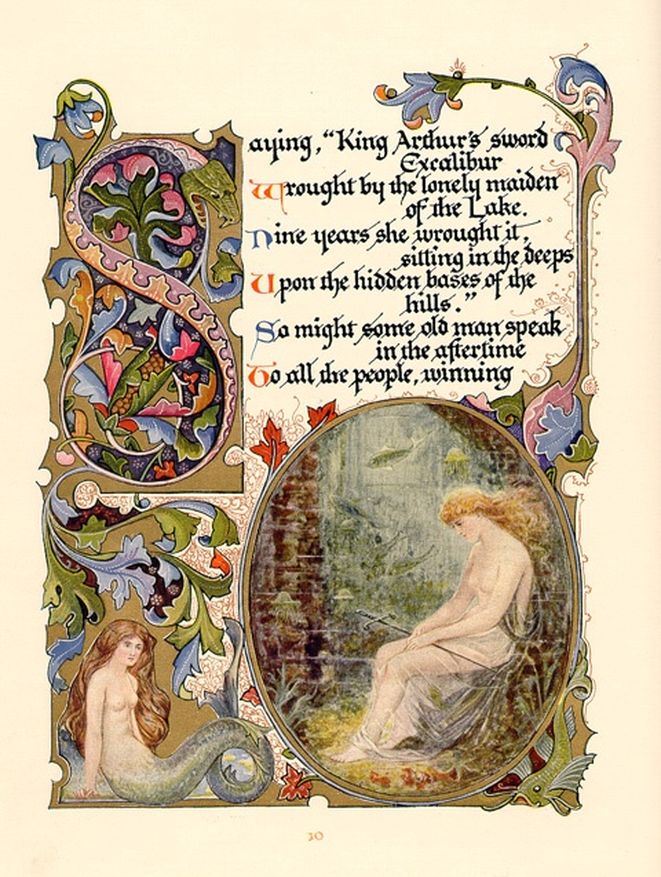
Melusine…King Arthur & Lady of the Lake:
Illuminated letters, Tale of King Arthur & Mermaid.
(credit Suzie Bee)Melusine as ‘mother goddess’:
We know the name of the European hydrologic goddess; Melusine. She inhabits the locals of sweet water wells and springs. Alternatively, she is called a mermaid or the Dragon Princess and legends say she is half human and half dragon/fish/snake. The lineage of Merovingian kings claim her as progenitress and gave them their right to rule. The etymology of her name is disputed but may be related to melit which means sweet and is also related to the Greek word for honey. The Merovingian line is choc full of legends that pass for history and so nothing more can be learned about the Serpent/Dragon Goddess that can be trusted. Also, the etymology of the word dragon is not at all helpful. It is supposedly from a Greek word that means good eyesight and has no known cognates which is extremely unusual.
(credit falashaleott.blogspot)
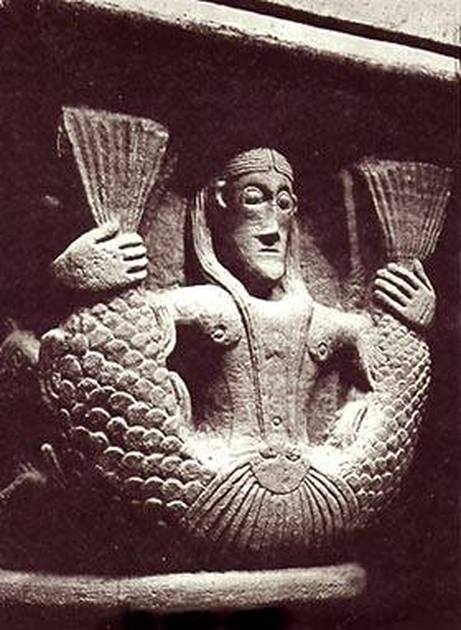
Both Pressina and her daughter Melusine in their turns served as “fountains” or Grail Maidens, until they were in their marriageable prime, as Dragon Queens, capable of bearing children without too many complications. Gille Sidhean, Pressina’s husband, and Raymond, Melusine’s husband, and both the women themselves, all had comparable Vere descent. Clearly, the men were related to their spouses, by blood, race or name. Raymond de Verrieres, or Ver-en-Forez, Lord of Pictavia and Anjou, had the Druidic Blue Boar as his family badge.
Pictavia was founded by Melusine’s maternal forefathers, the Ver Kings of the Danaan remnant, and so the assertion as fact that the House of Vere, The First Royal House of Anjou, was of the pure elven, Royal Dragon Blood appears inescapable. Much to the annoyance of the church and its chroniclers, who appear to have attempted to eclipse the pure origins and thus the genuine sovereign status of the Royal House of Vere by various means, as they did with many other Royal Dragon families of the Sang Real and the San Graal. For the Dragon and the Grail, for the Vere it is of some considerable importance that we maintainour royal status and assert our Elven, Dragon origins.
Raymond de Vere, Count of Anjou, alias Rainfroi de Vere, married, in 733, Melusine de Lusina. She was the daughter of Elinas, King of the Picts, and Bruithina MacBrude, and, thus, was a princess of the southern Picts of Alba. Her totem tribal badge was the Dragon, hence the fairytale connotations. The Dragon Motif was depicted in 1200 AD. on the seal of Hugh de Vere, whilst the Blue Boar, a Druidic caste badge, was [n.b.] derived from the family of Raymond de Vere.
Their son was Count Maelo de Vere, commander of Emperor Charlemagne’s army. From Maelo’s own marriage to Charlemagne’s sister, Bertha Martel, sprang a succession of Earls of Genney. Maelo’s brother was Roland, for whom “Song of Roland” was written.
In the Arthurian and Magdalene traditions of the Ladies of the Lake, Melusine was a fountain fey – an enchantress of the Underwood. Her fountain at Verrières en Forez was called Lusina – meaning Light-bringer – from which derived the name of the Royal House of Lusignan – the Crusader Kings of Jerusalem. The Fount of Melusine was said to be located deep within a thicket wood in Anjou. She was also known as Melusina, Melouziana de Scythes, Maelasanu, and The Dragon Princess.
The Melusine story is a powerful initiatory legend emerging from the deeply transformative Faery Tradition of ancient Europe. There had always been a Melusine back and back beyond the reaches of time. Such legends manifest as history: the innate sacromagical power of Melusine affected key places and events in the development of the medieval world and from there reached far into the shaping of the modern world through the conflicts for Jerusalem and the Middle East. Melusine de VERE appeared in the book Roman de Melusine written in 1393 by Jean d’Arras. The story is a mix of fiction and fact, commissioned by the Duke de Berry, a French noble who was brother to King Charles V, and uncle of King Charles VI. It was meant to be a family history and to uphold the proprietary claims to Lusignan and Anjou.
In this story Melusine’s mother was a Presine fairy who charmed Elinas, the king of Scotland. The result was their daughter Melusine. Half fairy and half princess, Melusine wandered over to the Continent and eventually met up with Rainfroi/Raymond in the forests of Anjou. They met while he was out boar hunting. Overcome with her beauty, he took her hand in marriage, and many adventures ensued. As a result of this book, Melusine was subsequently featured in medieval tales across Europe, variously depicted as a mermaid, a water sprite, a fairy queen, a fairy princess, a dragon princess, and a forest nymph. She came to represent any magial creature who marries a mortal man. This fay by enchantment built the castle of Lusignan for her husband. Most royal houses in Europe have claimed lineage to the real Melusine, so she has been the subject of great speculation.
Charles Martel went on to become Duke of all the Franks and founder of Carolinian line of Kings. Thirteen years later in 732 he defeated the Saracen Army at Poitiers in France, and saved Western Europe from complete invasion by the Moslems. As a result of this, his son Pepin III, became 1st King of the Franks. Pepin in turn was the father of Charlemagne and Berta. Charlemagne, 2nd King of the Franks, is the ancestor of every existing and former ruling house or dynasty in Europe. His sister Berta was joined in marriage to the son of Rainfroi de VER, Milo de VER in 800 AD, the same year her brother was crowned Holy Roman Emperor. Then, the entire Merovingian line is transmitted to Plantagenets only through Eleanor of Aquitaine.
The end of the Grail quest is the return to the source of life and rebirth into it as divinely self-conscious entities purified by involvement in earthly experiences and having also contributed to the ongoing process of cosmic evolution by refining our substance. The great lesson for Parzival — for all of us because he is our prototype — is the interconnected relationship of all earth entities. The bonds of a universal brotherhood make us all kin. The suffering of one hurts all, and compassion in our heart obliges us to ask forever: What ails our brother?
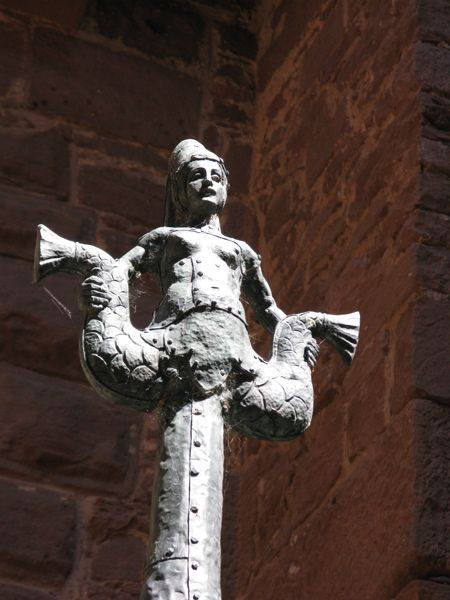
Melusine(Alsace):
Germanic Melusine located at Alsace on border between France and Germany.
(credit Jennifer Litchfield)http://www.magickriver.net/ringlords.htm
One of history’s best known Grail fairies was Princess Melusine, daughter of the Pictish King, Elinas of Alba – a descendant of the 2nd-century King Vere of Caledonia, Lord of the Dragon. In the year 733, Melusine (maintaining the family heritage) married Rainfroi de Vere, Prince of Anjou, and among their offspring was Count Maelo, the commander of Emperor Charlemagne’s army. From Maelo’s own marriage to Charlemagne’s sister, sprang the Vere Counts of Guisnes who, as previously mentioned, were the reputed Elf-kings and became England’s Great Chamberlains and Earls of Oxford.
In the Arthurian and Magdalene traditions of the Ladies of the Lake (as discussed in Bloodline of the Holy Grail), Melusine was a ‘fountain fey’ – an enchantress of the Underwood. Her fountain at Verrières en Forez was called Lusina (meaning ‘light bringer’), from which derived the name of the Royal House of Lusignan – the Crusader Kings of Jerusalem. The Fount of Melusine was said to be located deep within a thicket wood in Anjou, and she was often depicted as a mermaid, as she is still beguilingly portrayed in an old painting at Count Dracula’s Bran Castle in Romania.
In the 12th century, Melusine’s descendant, Robert de Vere, 3rd Earl of Oxford and legal pretender to the Earldom of Huntingdon, was appointed as King Richard I’s Steward of the forest lands of Fitzooth. As Lord of the Greenwood and titular Herne of the Wild Hunt, he was a popular people’s champion of the Sidhé heritage – as a result of which he was outlawed for
taking up arms against King John. It was he who, subsequently styled Robin Fitzooth, became a prototype for the popular tales of Robin Hood.
Of all the monarchs who ever sat upon the Throne of England, the Tudor Queen, Elizabeth I, was by far the most in tune with ancient cultures and wood lore. She was even called the ‘Fairie Queen’ and, before being formally crowned, she was installed by the people as their Queen of the Greenwood. This was an ancient ritual of the Shining Ones – the elven race of the Albi gens. The ceremony was conducted in the mist of early dawn in the depths of Windsor Forest and, to facilitate the installation, the customary Robin Hood legacy of the House of Vere was brought into play.
At that time the Queen’s Lord Chamberlain was Edward de Vere of Loxley, 17th Earl of Oxford, and it was his office to invest Elizabeth by first deposing the Caille Daouine. This was the traditional King of the Forest (whose name had given rise to Scotland’s Pictish realm of Caledonia) – the mighty Stag of the Seven Tines, upon whose back Lord Vere rode into the ceremonial clearing.
Edward de Vere of Oxford was a friend and student of the Rosicrucian alchemist and Secret Service operative, John Dee, and he worked closely with the statesman and philosopher, Francis Bacon (later Viscount St Albans). Between them (along with others) they comprised the Royal Court Syndicate, which was responsible for providing much of the material for
the works of their playwright colleague, William Shakespeare.
As mentioned in connection with Melusine, fountains, springs and water in general were always associated with the Ring Lord female line. This stems from the very earliest times of the Anunnaki, whose founding mother (as explained in ancient Mesopotamian literature) was Tiâmat the sea-dragon. In later times these queens were commonly represented as mermaids (mere maids), and were often called Ladies of the Lake. This was a style granted to Mary Magdalene when she had settled in Provence from AD 44.
While the male descendants of her and Jesus became the noted Fisher Kings in Gaul, the female line retained its Dragon Queen status, in a quite separate dynasty, as the matriarchal Queens of Avallon in Burgundy. They were known as the House del Acqs (the House of the Waters) and among their number was the great 6th-century Queen Viviane, revered as the Lady of the Lake in Arthurian romance. This heritage was so important to the Celtic Church that, when King Kenneth MacAlpin united the Scots and Picts in 844, his extant installation
document made special mention of his descent from the Queens of Avallon.
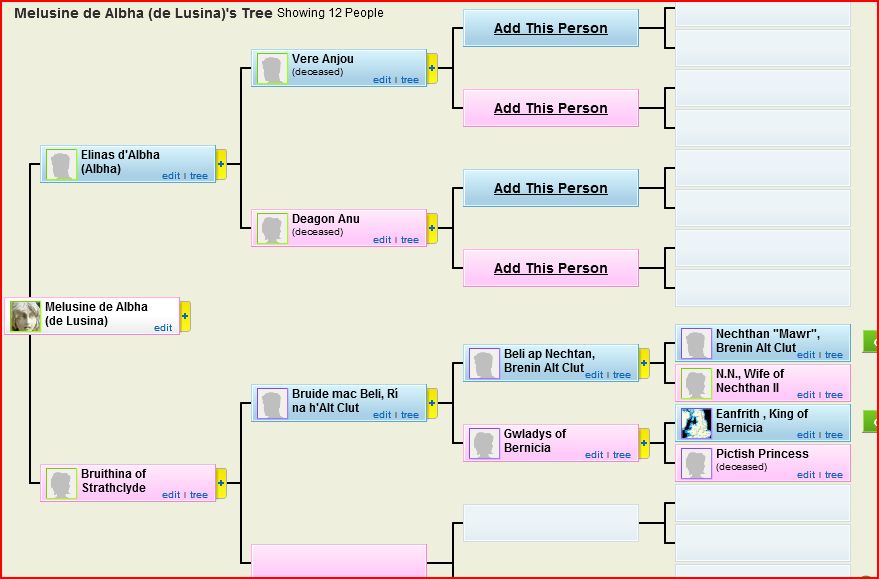
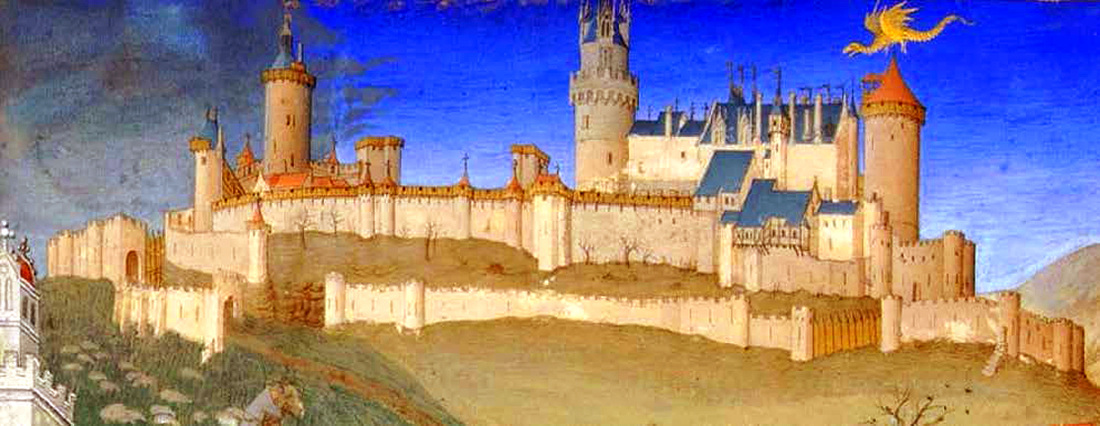
Culture and the king: the social implications of the Arthurian legend … By Martin B. Shichtman, James P. Carley,
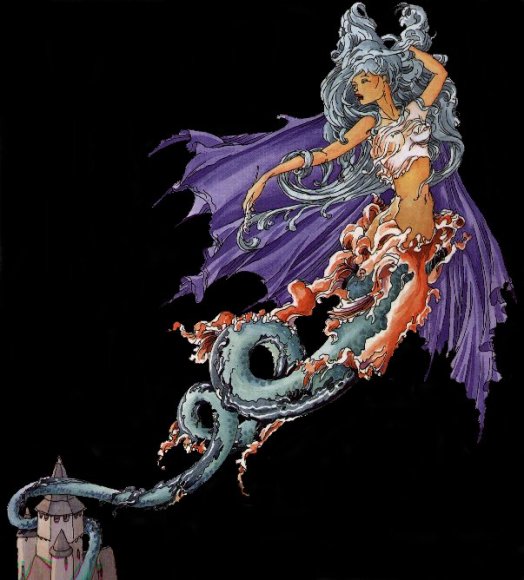
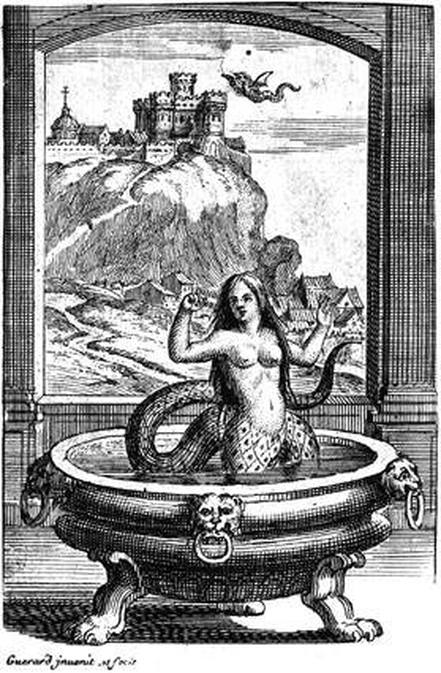
Melusine & Pressine… Serpentine-Fairies of the Matriarchal Age & Builders & Mothers of Megaliths :
(the following text was translated from the original French)
Fairies matriarchs
The mother of Melusine is called Pressine. This prohibits the father to see his children breastfeed. This means that the father does not live in the family of the mother and does not share his family privacy. If he violates this prohibition, it is enclosed in a lost island. It therefore has no right or duty to his children. Worse, they are his children who do not recognize any right because they are his daughters that trap: they do not want just as a father. He has no power over them, but they have on him. The power to reject absolutely.
However the power is ultimately the mother Pressine therefore takes over. She did not want to shut her lover (obviously too far in the matriarchal family), thus condemning her daughter Melusine, the eldest, which must reign until his death in:
1. Being winds. But it already was! This is the power of the Mother Goddess of the origins flying through the skies in serpentine form (energy) is the Goddess of the Sacred Sources and megaliths.
2. “You will take a normal life as a woman and wife.” Curious normality when we know that the normality of the matriarchal family live without father and husband, where brothers and sisters live together all their lives and practice stealth union with an external lover, who does not live in house, and that does not matter. This “normal” is actually a real curse for the woman who is “wife” living with a “husband.”
***Sabbatical snake worship***
However, women are putting conditions on these new contracts, these families of a new kind, where the husband and father appear. Firstly, women keep their religions. And Saturday is a holy day devoted to the Goddess Snake ablutions, secret rites reserved for women, high priestesses. The men are not allowed, which is symbolized by the ban on the husband to see his wife on Saturday because it is the day of worship of the serpent. Melusine is a high priestess, and the fact that she married a man is not only harmful to the privacy of the matriarchal family, but this excursion takes an even more dangerous turn as man tries to include not only matriarchal family home, but also in the priesthood and the cult of the snake, originally reserved only for women in elected and initiated.
The theft of the ancient religion
He had to be something serious for the female to be so challenged. But for now, the woman has not lost everything and keeps control of his powers by putting his conditions. Because if there is betrayal, transgression, interference of the new male power in the secret rites, since the pact is broken and the woman returns to reign alone in its absolute and indivisible power of winged snakes. And marriage keeps he still his stealth and insignificant side, it is definitely not sealed, and it is the woman who breaks immediately when it considers that the contract is broken. The man has not yet totally pulled it off. He will have to patient even a few hundred years for stealing his name to the woman, steal her children, rob his worship.
The weapon hunting weapon of war
However, the man has already committed the irreparable and became very dangerous. For indeed, it was from the hunting weapon to kill humans. And indeed, a young hunter, Raymondin, and his maternal uncle who taught (the Count of Poitiers), go hunting in the woods and swamps. In matriarchal families, it is indeed the brother of the sister who educates his children because there is no father and the latter, even if sometimes knows his children, has no right or duty to them.
The initiation of fosterage
The uncle is benevolent towards his nephew. He lives with him in the house of the sister and mother and sends all his knowledge. He even gives his time to the education of nieces and nephews, it is his role as the sister is busy in its economic functions, trading, weaving, spinning, pottery, plantings, harvests, feeding, but also in its religious functions, the practice of divination and worship the Mother Goddess and the Serpent. And the lesson of the day for the uncle and nephew, is the wild boar hunt, occupation in which great men, but they are also educated and aware of astronomy and astrology (Civilizations of the Mother Goddess are keen on these two sciences). And during a camp in the evening, uncle studied the signs in the sky and tells his nephew in a deep voice as if, at that moment, a subject killed his sovereign, he would become the greatest lords. And of course, this idea never entered the young man as he loved this uncle so thoughtful …
The founder of the maternal uncle murder
The nephew is it benevolent towards uncle, being his heir in title? For in fact, men have already taken the land of women to defend and manage on their behalf. The Celtic invasions took place and the men rush to grab land increasingly large, base their powers wrens. The symbolic animal of the Gauls (or Celtic) is the wild boar, wild boar hunting, which lasts several days, could be a hunting Gallic invaders. And the hunt ends badly for Uncle course. Why? Because under the guise of an unfortunate hunting accident, wanting to kill the big boar Raymondin kills his uncle and thus inherits all its lands. Indeed, at that time, the maternal nephew who inherits land uncle, not the children’s uncle (who also does not live with him but with their mother in another matriarchal family) . Because the land in the past belonged to the women who managed collectively, and their transmission always goes through them. The man is king, but his mother or his sister. Man inherits, but the woman. Children’s rights are not held in an account at a succession. The children of the sister of the king are the legitimate heirs and even if the kings begin to live with their wives and their children also, these unions are still considered very stable.
Totem lines
Raymondin seems a little hero, paid for his crime with a powerful character, the new Count of Poitiers. It receives only a vassal stronghold, which the prophetess Melusine tells her he will be determined by the perimeter obtained by a deerskin cut into thin strips assembled. As in many stories around the world, the fairy agrees to marry Raymondin, conditionally. And during her marriage, she not only gives him 10 children, but 8 are monstrous, as is often the children born of the Gods (one has three eyes, the other one, the other a lion’s paw on cheek, etc.. totem animals?).
The builder mother
More importantly, between pregnancies, Tinker carries huge stones by air to build towers, castles, chapels, churches, abbeys cyclopean size and all the megaliths in the region. His madness construction extends from the Aquitaine Poitou Charentes passing by. A stronghold and a rather worthy of a kingdom, not a huge tower that claims to have been built by the Fairy much larger territory. The inclusion of megaliths clearly announces that references the tale, passed down orally before undergoing the pen of Jean d’Arras or Couldrette the fourteenth and fifteenth centuries, dating back to the beginning of time directed by the Civilization of the Great Goddess, the one where huge stones were erected without being able to explain how even today.
Sources of Youth & snake life
More serpentine fairy, tapping his heel creates amount of springs, wells and rivers. In ancient times, the sources were of a sacred character, and they found a cave filled with statues of devotions to the Sequana Nymph at the source of the Seine (the votive shrines sources of the Seine are now exposed Archaeological Museum of Dijon). Sources were considered miraculous healing or. Melusine and never misses the ritual bath on Saturday in which it is serpentine woman. The woman doctor of antiquity had control of the snake she held well in hand. It symbolized the energies of Mother Earth. The Snake is a powerful symbol of healing! In ancient Greece, the god of medicine, Asclepius (Aesculapius) was the Serpent attribute. In temples dedicated to him, including at Epidaurus, the oracle was delivered through snakes, snakes found elsewhere wrapped around the caduceus.
The prophetess
Melusine and keeps prophesy! She predicted Raymondin his immediate future: how it will assign a fief by the Count of Poitiers with a deerskin, how her wedding will take place, how it should go on Britain to claim his land. It employs a future certainty, its ads are prophetic. It is characteristic of the Fairies (Latin fata: the destinies, fatum: divine utterance).
(credit matricien.org)
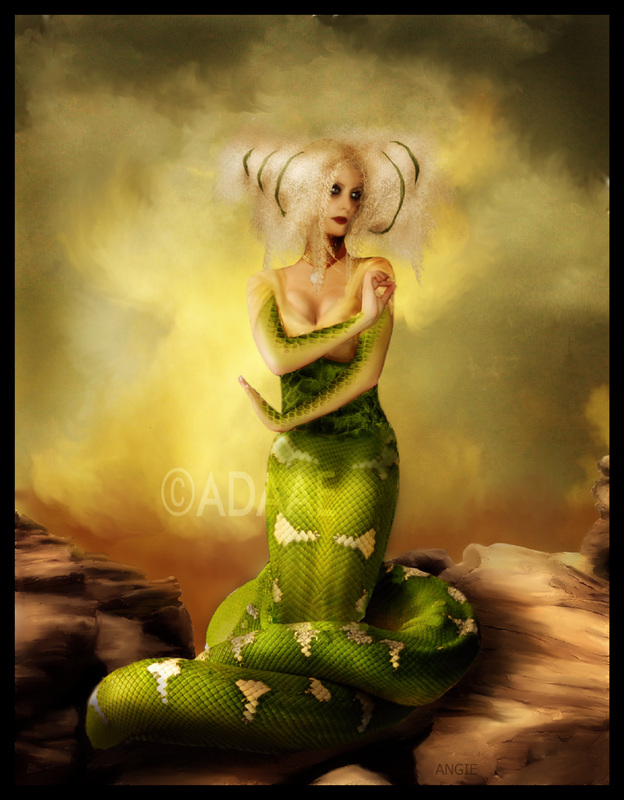
The Lusignan Dynasty: Footprints of the Dragon:
(Description of the Heraldic Arms: this picture shows the coat of arms of Lusignan, kings of Cyprus,Jerusalem and Cilicia. Its description comes from Héraldique Européenne)
The Lusignan family originated in Poitou near Lusignan in western France in the early 10th century. By the end of the 11th century, they had risen to become the most prominent petty lords in the region from their castle at Lusignan. In the late 12th century, through marriage and inheritance, a cadet branch of the family came to control the Kingdoms of Jerusalem and of Cyprus, while in the early 13th century, the main branch succeeded in the Counties of La Marche and Angoulême. As Crusader princes in the Latin East, they soon had connections with the Hethumid rulers of the Kingdom of Cilicia, which they inherited through marriage in the mid-14th century. The Armenian and Cypriot branches of the family eventually merged and the dynasty died out after the Ottoman conquest of their Asian kingdoms.
Origins
The Château de Lusignan, near Poitiers, was the principal seat of the Lusignans; it was destroyed during the Wars of Religion, and only its foundations remain in Lusignan. According to legend the earliest castle was built by the folklore water-spirit Melusine. The lords of the castle at Lusignan were counts of La Marche, over which they frequently fought with the counts of Angoulême. Count Hugh le Brun (“Hugh the Swarthy”), like most of the lords of Poitou, backed Arthur of Brittany as the better heir to Richard Lionheart when John Lackland acceded to the throne of England in 1199. Eleanor of Aquitaine traded English claims for their support of John. To secure his position in La Marche, the widowed Hugh arranged a betrothal with the daughter of his next rival of Angoulême, no more than a child; John however married her himself, in August 1200, and deprived Hugh of La Marche and his brother of Eu in Normandy. The aggrieved Lusignans turned to their liege lord, Philip Augustus, King of France. Philip demanded John’s presence— a tactical impossibility— and declared John a contumacious vassal. As the Lusignan allies managed to detain both Arthur and Eleanor, John surprised their unprepared forces at the castle of Mirebeau, in July 1202, and took Hugh prisoner with 200 more of Poitou’s fighting men. King John’s savage treatment of the captives turned the tide against himself, and his French barons began to desert him in droves. Thus the Lusignans’ diplomatic rebellion led directly to the loss of half of England’s French territory, which was soon incorporated into France by Philip Augustus (The other “half”, Aquitaine, was the possession of Eleanor, who was still alive).
Lusignan Crusader kings
The Lusignans were among the French nobles who made great careers in the Crusades. An ancestor of the later Lusignan dynasty in the Holy Land, Hugh VI of Lusignan, was killed in the east during the Crusade of 1101. Another Hugh arrived in the 1160s and was captured in a battle with Nur ad-Din Zangi. In the 1170s, Amalric arrived in Jerusalem, having been expelled by Richard Lionheart (at that point, acting Duke of Aquitaine) from his realm, which included the family lands of Lusignan near Poitiers. Amalric married Eschiva, the daughter of Baldwin of Ibelin, and entered court circles. He had also obtained the patronage of Agnes of Courtenay, the divorced mother of King Baldwin IV, who held the county of Jaffa and Ascalon and was married to Reginald of Sidon. He was appointed Agnes’s constable in Jaffa, and later constable of the kingdom. Hostile rumours alleged he was Agnes’s lover, but this is questionable. It is likely that his promotions were aimed at weaning him away from the political orbit of the Ibelin family, who were associated with Raymond III of Tripoli, Amalric I’s cousin and the former bailli or regent. Amalric’s younger brother, Guy, arrived at some date before Easter 1180. When he arrived is quite unknown, unless we accept the statement of Ernoul that he arrived at this precise juncture on Amalric’s advice. Many modern historians believe that Guy was already well established in Jerusalem by 1180, but there is no contemporary evidence to support this belief. What is certain is that Amalric of Lusignan’s success facilitated Guy’s social and political advancement.
Older accounts (derived from William of Tyre and Ernoul) claim that Agnes was concerned that her political rivals, headed by Raymond of Tripoli, were determined to exercise more control by forcing Agnes’ daughter, the princess Sibylla, to marry someone of their choosing, and that Agnes foiled these plans by advising her son to have Sibylla married to Guy. However, it seems that the King, who was less malleable than earlier historians have portrayed, was considering the international implications: it was vital for Sibylla to marry someone who could rally external help to the kingdom, not someone from the local nobility. With the new King of France, Philip II, a minor, the chief hope of external aid was Baldwin’s first cousin Henry II, who owed the Pope a penitential pilgrimage on account of the Thomas Becket affair. Guy was a vassal of Richard of Poitou and Henry II, and as a formerly rebellious vassal, it was in their interests to keep him overseas.
Guy and Sibylla were hastily married at Eastertide 1180, apparently preventing a coup by Raymond’s faction to marry her toAmalric of Lusignan’s father-in-law, Baldwin of Ibelin. By his marriage Guy also became count of Jaffa and Ascalon and bailli of Jerusalem. He and Sibylla had two daughters, Alice and Maria. Sibylla already had one child, a son from her first marriage to William of Montferrat.
An ambitious man, Guy convinced Baldwin IV to name him regent in early 1182. However, he and Raynald of Châtillon made provocations against Saladin during a two-year period of truce. But it was his military hesitance at the siege of Kerak which disillusioned the king with him. Throughout late 1183 and 1184 Baldwin IV tried to have his sister’s marriage to Guy annulled, showing that Baldwin still held his sister with some favour. Baldwin IV had wanted a loyal brother-in-law, and was frustrated in Guy’s hard-headedness and disobedience. Sibylla was held up in Ascalon, though perhaps not against her will. Unsuccessful in prying his sister and close heir away from Guy, the king and the Haute Cour altered the succession, placing Baldwin V, Sibylla’s son from her first marriage, in precedence over Sibylla, and decreeing a process to choose the monarch afterwards between Sibylla and Isabella (whom Baldwin and the Haute Cour thus recognized as at least equally entitled to succession as Sibylla), though she was not herself excluded from the succession. Guy kept a low profile from 1183 until his wife became queen in 1186.
Guy’s term as king is generally seen as a disaster; he was defeated by Saladin at the Battle of Hattin in 1187, and was imprisoned in Damascus as Saladin reconquered almost the entire kingdom. Upon his release, his claim to the kingship was ignored, and when Sibylla died at the Siege of Acre in 1191, he no longer had any legal right to it. Richard, now king of England and a leader of the Third Crusade, supported Guy’s claim, but in the aftermath of the crusade Conrad of Montferrat had the support of the majority of nobles. Instead, Richard sold Guy the island of Cyprus, which he had conquered on his way to Acre. Guy thereby became the first Latin lord of Cyprus. Amalric succeeded Guy in Cyprus, and also became King of Jerusalem in 1198. Amalric was responsible for establishing the Roman Catholic Church on Cyprus.
The male line of the Lusignans in the Levant died out in 1267 with Hugh II of Cyprus, Amalric’s great-grandson (the male line continued in France until 1308).
(credit Wikipedia)
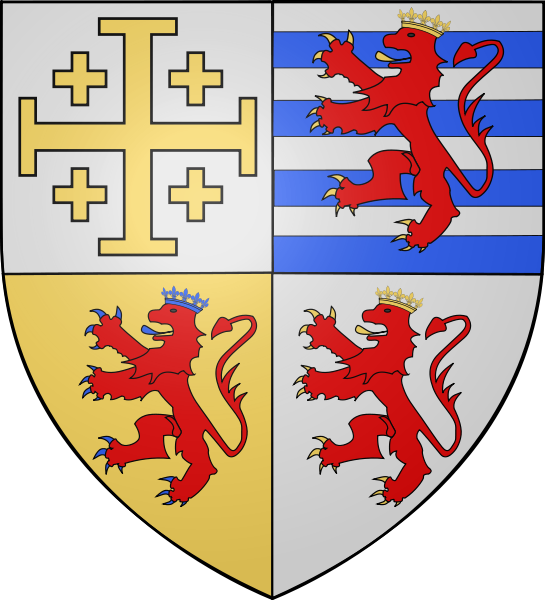
http://books.google.com/books?id=h6qLi66yFHkC&printsec=frontcover#v=onepage&q&f=false‘Melusine of Lusignan & The Cult of the Faery Woman’:
…indeed a most intriguing, (not to mention exceedingly relevant) title for a book, particularly inview of the recent focus of this fb page:
Melusine Bloodlines
In 719 Charles Martel defeated Rainfroi de VER, Duke of Anjou and Mayor of the Palace of Neustrie.
This victory brought back together key houses of the Franks under one rule and is considered an important date in European history. Rainfroi de VER (also known as Raymond) was married to another legendary character, Melusine.
Melusine de VER has also been known as Melusina, Melouziana de Scythes, Maelasanu, and The Dragon Princess. She entered literary history in the book Roman de Melusine written in 1393 by Jean d’Arras. The story is a mix of fiction and fact, commissioned by the Duke de Berry, a French noble who was brother to King Charles V, and uncle of King Charles VI. It was meant to be a family history and to uphold the proprietary claims to Lusignan and Anjou.
In this story Melusine’s mother was a Presine fairy who charmed Elinas, the king of Scotland. The result was their daughter Melusine. Half fairy and half princess, Melusine wandered over to the Continent and eventually met up with Rainfroi/Raymond in the forests Anjou. They met while he was out boar hunting. Overcome with her beauty, he took her hand in marriage, and many adventures ensued. As a result of this book, Melusine was subsequently featured in medieval tales across Europe, variously depicted as a mermaid, a water sprite, a fairy queen, a fairy princess, a dragon princess, and a forest nymph. She came to represent any magial creature who marries a mortal man. Most royal houses in Europe have claimed lineage to the real Melusine, so she has been the subject of great speculation. Legends about Melusine and Rainfroi (or Raymond) also often have a connection to boars and boar hunting.
Charles Martel went on to become Duke of all the Franks and founder of Carolinian line of Kings. Thirteen years later in 732 he defeated the Saracen Army at Poitiers in France, and saved Western Europe from complete invasion by the Moslems. As a result of this, his son Pepin III, became 1st King of the Franks. Pepin in turn was the father of Charlemagne and Berta. Charlemagne, 2nd King of the Franks, is the ancestor of every existing and former ruling house or dynasty in Europe. His sister Berta was joined in marriage to the son of Rainfroi de VER, Milo de VER in 800 AD, the same year her brother was crowned Holy Roman Emperor.
Milo de Ver was the Duke of Anjou, Count of Angleria, and Duke Leader of Charlemagne’s house. Milo and Berta had two sons, one being Roland (legendary Paladin for whom “Song of Roland” was written) and Milo de VER II. The de Ver line passed from Milo II through a succesion of Earls of Genney: Milo II ‘s son Nicasius de VER was father to Otho de VER, father to Amelius de VER, father to Gallus de VER, father to Mansses de VER, father to Alphonso de VERE (Alphonsus) . Alphonsus de VERE, Earl of Genney, was “Councilor to Edward the Confessor” King Edward III of England, who had both Norman and Flemish advisors. Alphonsus de VERE had a son Alberic de VERE, also known as Aubrey I. NOTE: Aubrey comes from the Teutonic name Alberic, or “elf-ruler.” (credit weebly.com)
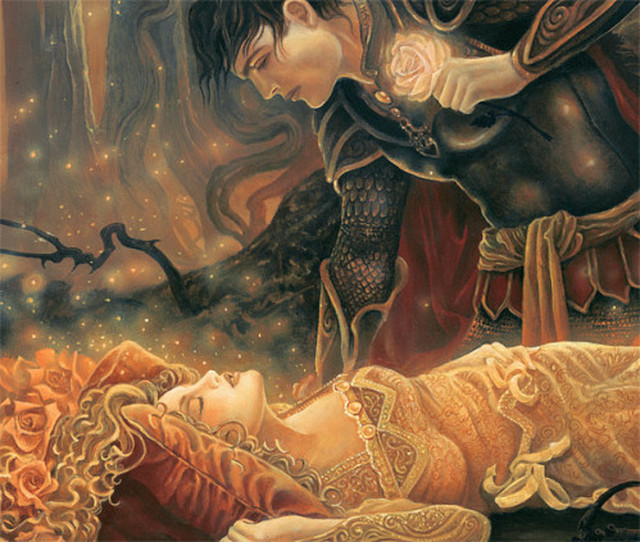
My family connection to Melusine. This is just one connection to her. I know that she’s also related to me through Edward IV and Elizabeth Woodville through her mother:
Jacquetta of Luxembourg, Duchess of Bedford, mother of Elizabeth Woodville (15th GGM)
1415–1472
BIRTH 1415 • Luxembourg
DEATH 30 MAY 1472 • (age 55 – 57)
MELUSINE CONNECTION TO JANET KIRA LESSIN
- Melusine (Lusina), Princess Maelasanu, Melusine de Lusina (Milouziena des Scythe) Vere the First, Scythian Princess of the Picts of Albha, the Dragon Princess and Fairy Daughter of Satan, Witch, Druidhe, Druid Fey de la Fontaine de Soif de Lusignan 740-
mother-in-law of 33rd great-grandaunt - Milo II (Maleo I) Maelus) de Ver (Verrieres), Duke of Aungiers Angiers, Duke Leader of Great King Charles’ house and army, Compte d’ Anjou), Commander-in- 755-820
Son of Melusine (Lusina), Princess Maelasanu, Melusine de Lusina (Milouziena des Scythe) Vere the First, Scythian Princess of the Picts of Albha, the Dragon Princess and Fairy Daughter of Satan, Witch, Druidhe, Druid Fey de la Fontaine de Soif de Lusignan - Bertbelle Bertha Bertheld de Francie; Bertha (MARTEL) of the FRANKS, m. “Prince Maelo (Milo) de Ver, Comte d’Anjou (b. c. 760) = , half sister of King Charles I Charlemagne (35th GG Aunt) 748-
Wife of Milo II (Maleo I) Maelus) de Ver (Verrieres), Duke of Aungiers Angiers, Duke Leader of Great King Charles’ house and army, Compte d’ Anjou), Commander-in- - Pepin III Brevis, “The Short” (King of Franks 751-768), Duc de Brabant, Mayor of Neustria, Austrasia (36th GGF) NaN-NaN
Father of Bertbelle Bertha Bertheld de Francie; Bertha (MARTEL) of the FRANKS, m. “Prince Maelo (Milo) de Ver, Comte d’Anjou (b. c. 760) = , half sister of King Charles I Charlemagne (35th GG Aunt) - Charles I Charlemagne the Great, Emperor of The Holy Roman Empire, King of the Franks (France) (771-814), King of the Lombards, Emperor of the Romans (33rd & 35th GGF) 748-814
Son of Pepin III Brevis, “The Short” (King of Franks 751-768), Duc de Brabant, Mayor of Neustria, Austrasia (36th GGF) - Louis “the Pious”, (Charlemagne) FRANCE, King of the Franks, King of the Aquitaine, “The Fair”, “The Debonaire” (34th GGF) 778-840
Son of Charles I Charlemagne the Great, Emperor of The Holy Roman Empire, King of the Franks (France) (771-814), King of the Lombards, Emperor of the Romans (33rd & 35th GGF) - Charles II, King of France (Charlemagne) (33rd GGF) NaN-NaN
Son of Louis “the Pious”, (Charlemagne) FRANCE, King of the Franks, King of the Aquitaine, “The Fair”, “The Debonaire” (34th GGF) - Judith of France (32nd GGM) NaN-
Daughter of Charles II, King of France (Charlemagne) (33rd GGF) - Baudouin II of Flanders (31st GGF) -NaN
Son of Judith of France (32nd GGM) - Arnulf of Flanders (30th GGF) NaN-NaN
Son of Baudouin II of Flanders (31st GGF) - Baudoin III, Count of Flanders (29th GGF)
Son of Arnulf of Flanders (30th GGF) - Count Arnulf II of Flanders (28th GGF) 961-987
Son of Baudoin III, Count of Flanders (29th GGF) - Baudoin IV Count of Flanders 27th GGF)
Son of Count Arnulf II of Flanders (28th GGF) - Baldwin V, Baudoin Count of Flanders (26th GGF) 1012-1067
Son of Baudoin IV Count of Flanders 27th GGF) - Matilda (Mathilde) of Flanders, Queen of England, Duchess of Normandy, m. William the Conqueror (25th GGM) 1031-1083
Daughter of Baldwin V, Baudoin Count of Flanders (26th GGF) - Henry I, King of England, House of Normandy (24th GGF) 1068-1135
Son of Matilda (Mathilde) of Flanders, Queen of England, Duchess of Normandy, m. William the Conqueror (25th GGM) - Empress Matilda, Empress Maude, Holy Roman Empress; Queen of the Romans, Queen of England (disputed) (23rd GGM) 1102-1167
Daughter of Henry I, King of England, House of Normandy (24th GGF) - Henry II King of England (House of Plantagenet) (20th GGF & 22nd GGF) 1133-1189
Son of Empress Matilda, Empress Maude, Holy Roman Empress; Queen of the Romans, Queen of England (disputed) (23rd GGM) - King John I Lackland, Plantagenet, of Ireland,KING OF ENGLAND (23rd GGF) 1166-1216
Son of Henry II King of England (House of Plantagenet) (20th GGF & 22nd GGF) - King Henry III King of England, “Curtmantle” de Beaufort, Plantagenet,Henry of Winchester, Lord of Ireland, Duke of Aquitaine (1216 -1272), Hou (18th & 22nd GGF) 1207-1272
Son of King John I Lackland, Plantagenet, of Ireland,KING OF ENGLAND (23rd GGF) - Edward I King of England (21st GGF) 1239-1307
Son of King Henry III King of England, “Curtmantle” de Beaufort, Plantagenet,Henry of Winchester, Lord of Ireland, Duke of Aquitaine (1216 -1272), Hou (18th & 22nd GGF) - Edward II, King of England, Edward of Caernarfon, House of Plantagenet (20th GGF) 1284-1327
Son of Edward I King of England (21st GGF) - Edward III PLANTAGENET (19th MGGF) (15th & 19th GGF) King of England, Lord of Ireland 1312-1377
Son of Edward II, King of England, Edward of Caernarfon, House of Plantagenet (20th GGF) - John of Gaunt, 1st Duke of Lancaster (m. 1396), House of Plantagenet (by birth), Founded House of Lancaster (14th GGF) Duke of Lancaster 1340-1399
Son of Edward III PLANTAGENET (19th MGGF) (15th & 19th GGF) King of England, Lord of Ireland - John Beaufort, 1st Earl of Somerset (great-grandson was Henry VII) (15th GGF) 1371-1410
Son of John of Gaunt, 1st Duke of Lancaster (m. 1396), House of Plantagenet (by birth), Founded House of Lancaster (14th GGF) Duke of Lancaster - Joan Beaufort, Queen of Scotland (married James I, King of Scots (18th GGF), mother of James II (17th GGF) ) (12th, 14th & 18th GGM) 1404-1445
Daughter of John Beaufort, 1st Earl of Somerset (great-grandson was Henry VII) (15th GGF) - Sir John Stewart, 1st Earl of Atholl, Sir Lord John I “The Hearty”, Knight of Balveny & Earlshill, Lord of Lorn, Lord of Auchterhouse, (11th GGF) 1437-1512
Son of Joan Beaufort, Queen of Scotland (married James I, King of Scots (18th GGF), mother of James II (17th GGF) ) (12th, 14th & 18th GGM) - John Stewart, 2nd Earl of Atholl III (10th GGF) 1475-1521
Son of Sir John Stewart, 1st Earl of Atholl, Sir Lord John I “The Hearty”, Knight of Balveny & Earlshill, Lord of Lorn, Lord of Auchterhouse, (11th GGF) - Lady Margaret or Barbara Stuart Stewart (9th GGM) 1535-1574
Daughter of John Stewart, 2nd Earl of Atholl III (10th GGF) - Alexander Hanna Hannay (8th GGF) 1530-1640
Son of Lady Margaret or Barbara Stuart Stewart (9th GGM) - Jane Guthrie Spears (7th GGM) NaN-1710
Daughter of Alexander Hanna Hannay (8th GGF) - Col. James Robert Patten Patton (County Monaghan, Ireland) (6th GGF) 1660-1697
Son of Jane Guthrie Spears (7th GGM) - Dr. William Patten (York, Maine) (5th GGF) 1698-1752
Son of Col. James Robert Patten Patton (County Monaghan, Ireland) (6th GGF) - Elizabeth Ann Patten Sprague (4th GGM) 1740-1783
Daughter of Dr. William Patten (York, Maine) (5th GGF) - George Nelson Sprague (3rd GGF) 1790-1857
Son of Elizabeth Ann Patten Sprague (4th GGM) - George Nelson Sprague (2nd GGF) 1811-1897
Son of George Nelson Sprague (3rd GGF) - George William Sprague (GGF) 1850-1890
Son of George Nelson Sprague (2nd GGF) - Bessie Electa Sprague Grandmother 1890-1953
Daughter of George William Sprague (GGF) - June Alice Shook Thompson Mother 1922-1997
Daughter of Bessie Electa Sprague Grandmother - Janet Lynn Thompson Garofalo Smith Lessin
You are the daughter of June Alice Shook Thompson Mother